oil type MITSUBISHI ECLIPSE 1990 User Guide
[x] Cancel search | Manufacturer: MITSUBISHI, Model Year: 1990, Model line: ECLIPSE, Model: MITSUBISHI ECLIPSE 1990Pages: 391, PDF Size: 15.27 MB
Page 87 of 391
=--Y
jl
1 /
i "
_. ---“._ _ _ ._ ..-..+_LI_y_--- -
9-2ENGINE- General Information
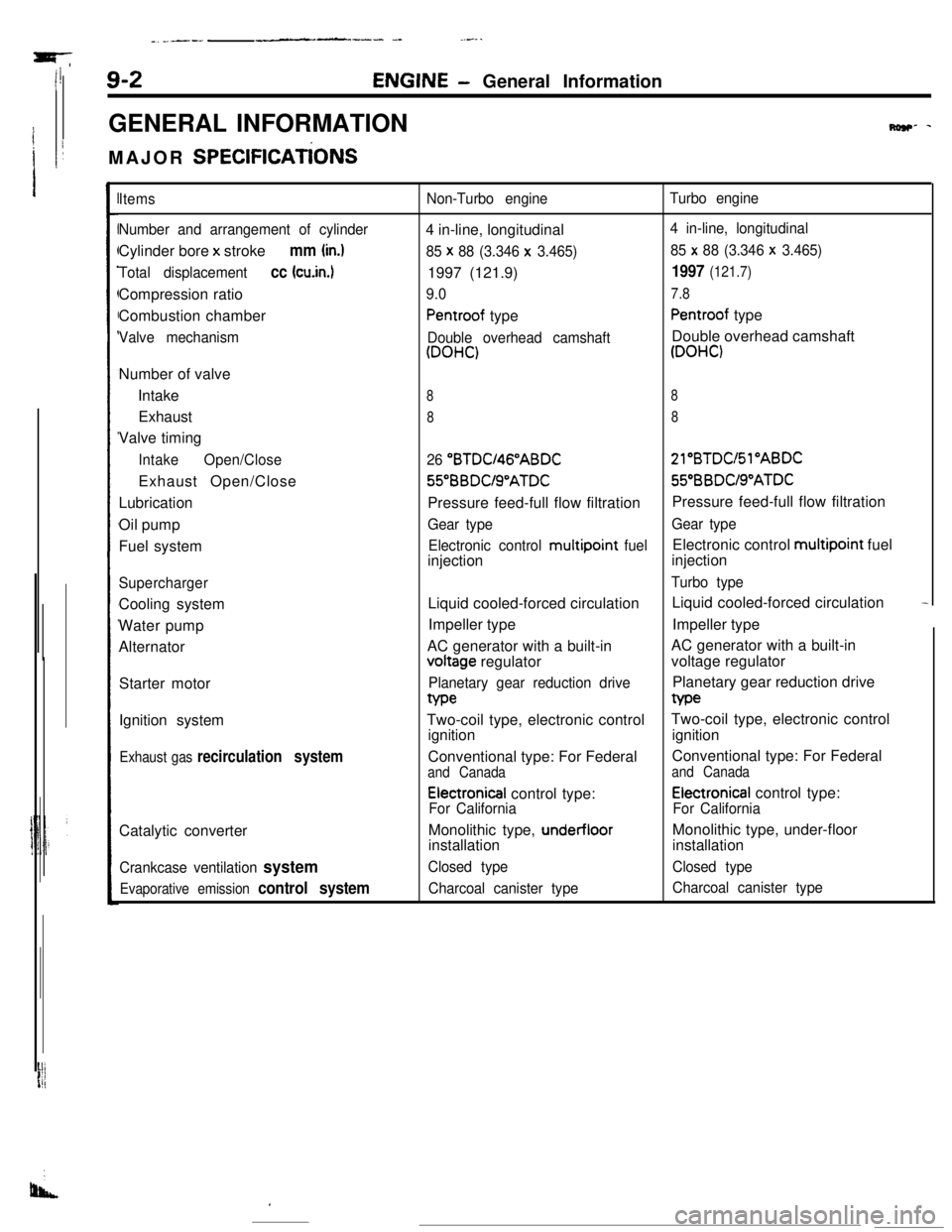
GENERAL INFORMATION
MAJOR
SPEClFlCATiONS
Row- -
Items
Number and arrangement of cylinderCylinder bore x stroke
mm (in.)
Total displacementcc (cu.in.1Compression ratio
Combustion chamber
Valve mechanismNumber of valve
Intake
Exhaust
Valve timing
IntakeOpen/CloseExhaust Open/Close
Lubrication
Oil pump
Fuel system
SuperchargerCooling system
Water pump
Alternator
Starter motor
Ignition system
Exhaust gas recirculation systemCatalytic converter
Crankcase ventilation system
Evaporative emission control system
Non-Turbo engineTurbo engine4 in-line, longitudinal
4 in-line, longitudinal
85 x
88 (3.346 x 3.465)85 x 88 (3.346 x 3.465)1997 (121.9)
1997 (121.7)
9.07.8
Pentroof typePentroof type
Double overhead camshaftDouble overhead camshaft
(DOHC)(DOHC)
88
88
26 “BTDU46”ABDC21”BTDC/Sl”ABDC56BBDUS”ATDC55”BBDUS”ATDC
Pressure feed-full flow filtrationPressure feed-full flow filtration
Gear typeGear type
Electronic control multipoint
fuelElectronic control multipoint fuel
injectioninjection
Turbo typeLiquid cooled-forced circulationLiquid cooled-forced circulation
-Impeller typeImpeller type
AC generator with a built-involtage regulatorAC generator with a built-in
voltage regulator
Planetary gear reduction drivePlanetary gear reduction drivetype
Two-coil type, electronic controlTwo-coil type, electronic control
ignitionignition
Conventional type: For FederalConventional type: For Federal
and Canadaand Canada
Electronical control type:Electronical control type:
For CaliforniaFor CaliforniaMonolithic type,
under-floorMonolithic type, under-floor
installationinstallation
Closed typeClosed type
Charcoal canister typeCharcoal canister type
I
Page 88 of 391

q7 --_-.-ENGINE
- General Information9-3TECHNICAL FEATURES
HIGH PERFORMANCE AND . . .._..............1. The DOHC 16-valve engine ensures excellent intake and exhaust
FUEL ECONOMYefficiency.
2. The rocker arm is of the roller-type-cam-follower design which Iminimizes friction loss.
3. The combustion chamber is of the pentroof type with a squish
area that offers outstanding combustion efficiency.
4. The multipoint fuel injection system is electronically
controlled.5. The intake manifold is the inertia supercharging type which
improves intake efficiency and the dual-type exhaust manifold
offers good exhaust efficiency.
6. The two-coil type electronic control ignition system ensures
good ignition performance.
LOW VIBRATION AND. . . . . . ..I.................1. The hydraulic lash adjuster, together with the roller rocker arm,
LOW NOISEcontributes to reduced operating noise of the valve mechanism.
2. A cogged type belt is used to drive the camshaft.
3. The auto tensioner maintains the optimum timing belt tension.
4. The torsional damper reduces twisting vibration in the crankshaft’
to a minimum.
5. The silent shaft system reduces engine vibration and rolling
’moment to a minimum
SERVICEABILITY . . . . . . . . . . . . . . . . . . . . . . . . . . . . . . . . . . . . .1. The self-diagnosis system makes troubleshooting easier.
2. The lash adjuster eliminates the need for valve clearance
adjustment.3. The auto tensioner eliminates the need for timing belt
tension adjustment.
-.--..-. --.-
Page 92 of 391
s’ y _._----,_ - k - ..-_ _ _
ENGINE- Base Engine9-7I
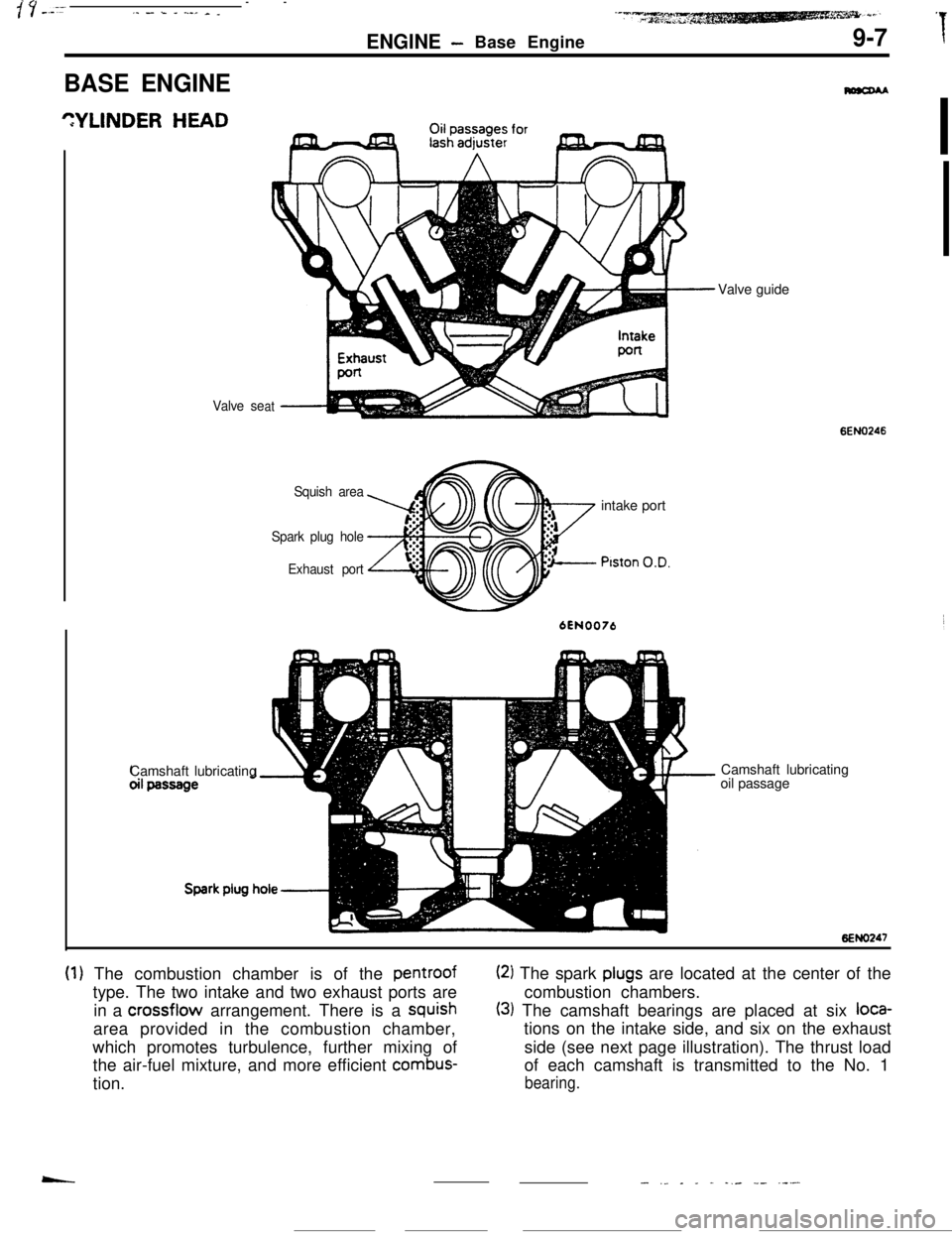
BASE ENGINE
Valve seat
Squish area
Spark plug hole
Exhaust portintake port
Piston O.D.
6EN0076Camshaft lubricatingValve guide
6ENO246Camshaft lubricating
oil passage
6ENO247
(1) The combustion chamber is of the pentroof(2) The spark plugs are located at the center of the
type. The two intake and two exhaust ports arecombustion chambers.
in a crossflow arrangement. There is a
squish(3) The camshaft bearings are placed at six loca-area provided in the combustion chamber,tions on the intake side, and six on the exhaust
which promotes turbulence, further mixing ofside (see next page illustration). The thrust load
the air-fuel mixture, and more efficient
combus-of each camshaft is transmitted to the No. 1
tion.
bearing.
- ._ _ _ - -,- -- .---
Page 94 of 391
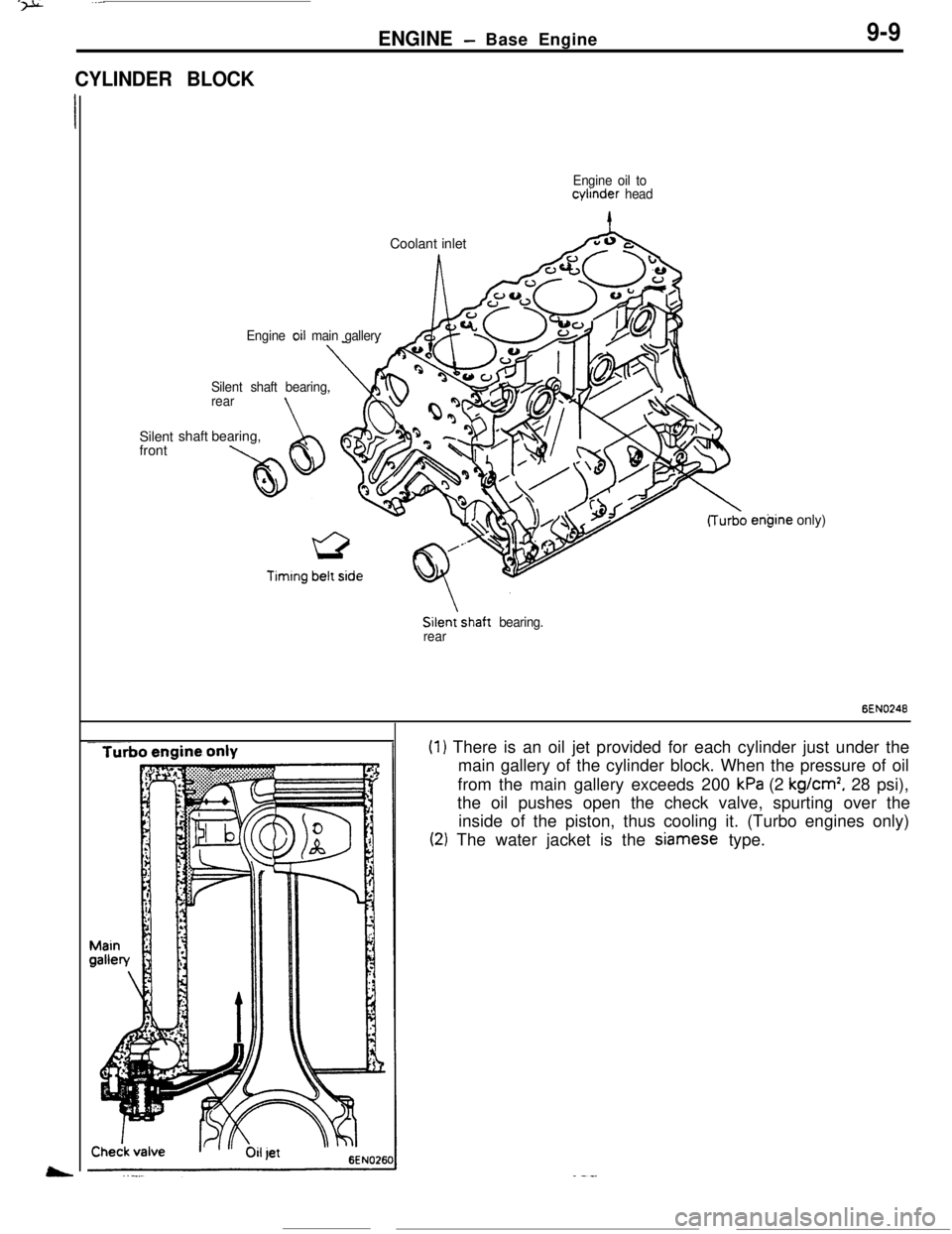
CYLINDER BLOCKENGINE
- Base Engine9-9
Engine oil tocylinder
headCoolant inlet
ASilent
front
Engine oil main gallery
Silent shaft bearing,
rear
\shaft bearing,
A taw
Silenishaft bearing.
rearengine only)
6EN0246
(1) There is an oil jet provided for each cylinder just under the
main gallery of the cylinder block. When the pressure of oil
from the main gallery exceeds 200
kPa (2 kg/cm’, 28 psi),
the oil pushes open the check valve, spurting over the
inside of the piston, thus cooling it. (Turbo engines only)
(2) The water jacket is the Siamese type.
Page 95 of 391
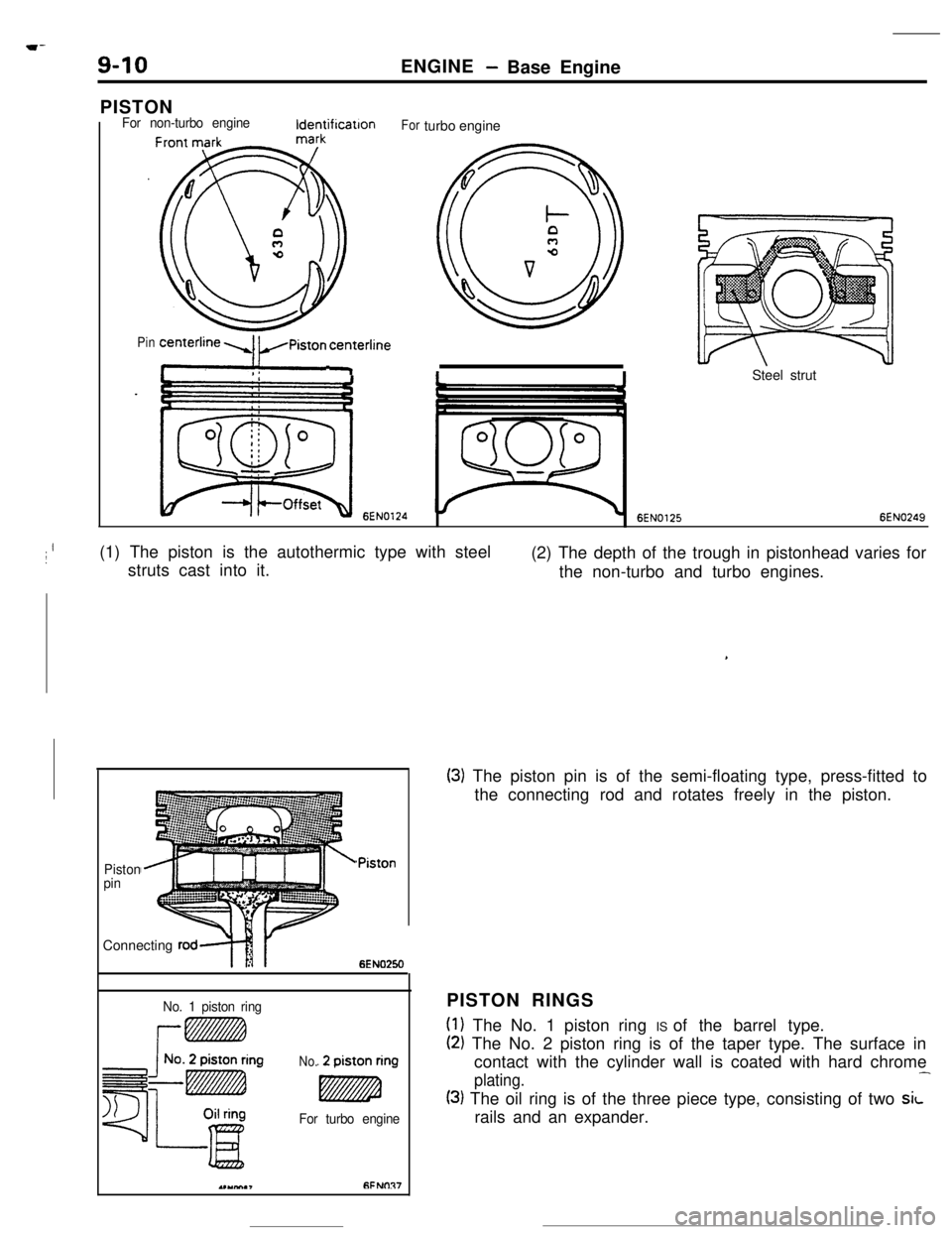
9-10PISTONENGINE- Base Engine
For non-turbo engineldentificatlonForturbo engine
Pin;nterline y FPiston ceyerline
6EN01246EN0125Steel strut6EN0249
Ij(1) The piston is the autothermic type with steel
struts cast into it..(2) The depth of the trough in pistonhead varies for
the non-turbo and turbo engines.
Piston
pinConnecting
rod?\i
~Piston
6EN0250
No. 1 piston ringPISTON RINGS
No.3
For turbo engine
(1) The No. 1 piston ring IS of the barrel type.
(2) The No. 2 piston ring is of the taper type. The surface in
contact with the cylinder wall is coated with hard chrome
plating.-
(3) The oil ring is of the three piece type, consisting of two sLrails and an expander.
.,YM,,fiFNflR7
,
(3) The piston pin is of the semi-floating type, press-fitted to
the connecting rod and rotates freely in the piston.
Page 99 of 391
ENGINE - Base Engine
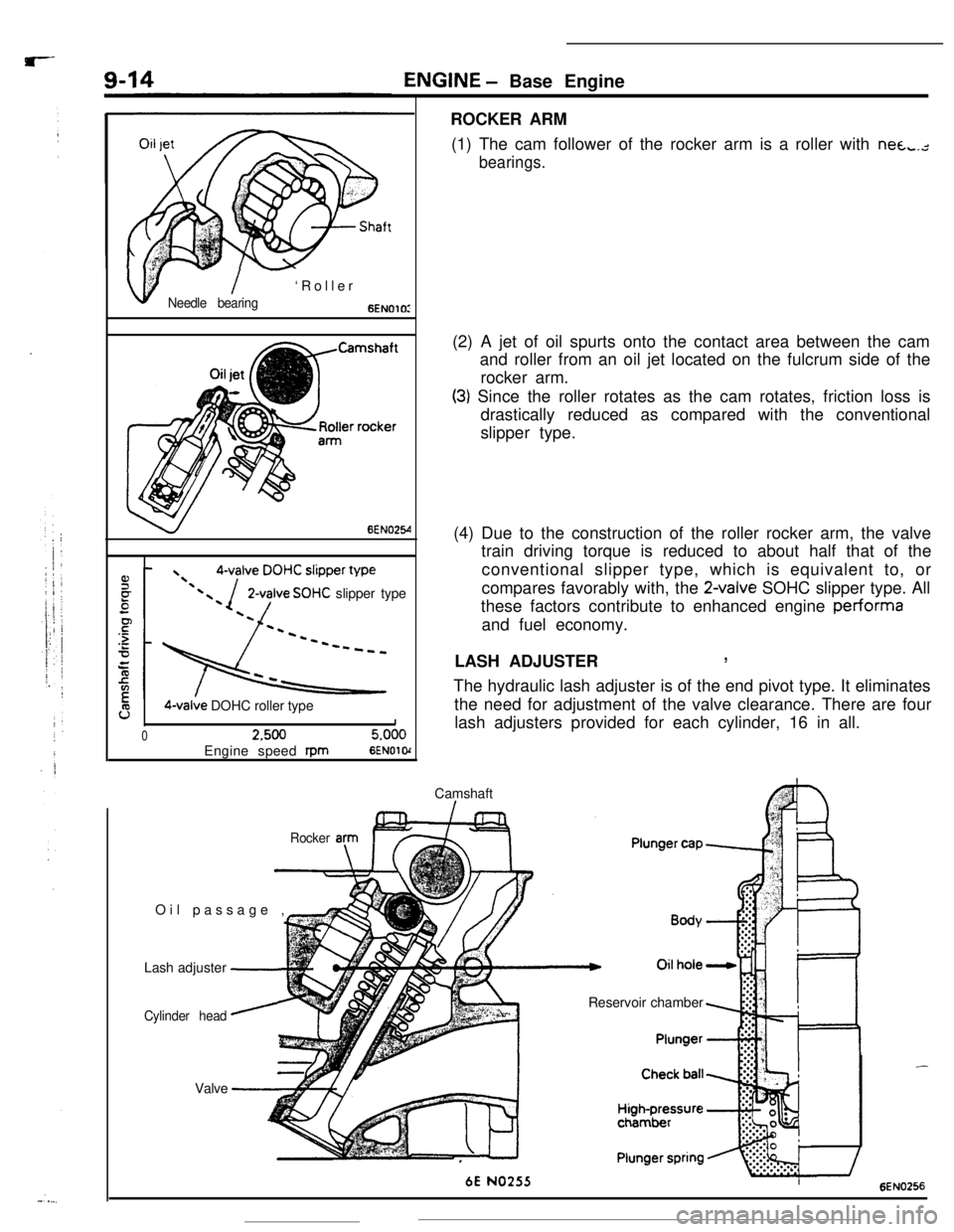
ROCKER ARM
(1) The cam follower of the rocker arm is a roller with nea,.,-
bearings.
v
,I$- I- ‘Roller
Needle bearing6ENOlOI
6EN025-4
2-valve SOHC slipper type
9O-valve DOHC roller type1
02.5005.000Engine speed
rpm6ENOl o(Camshaft
I-Oil passage ,
EIr(2) A jet of oil spurts onto the contact area between the cam
and roller from an oil jet located on the fulcrum side of the
rocker arm.
(3) Since the roller rotates as the cam rotates, friction loss is
drastically reduced as compared with the conventional
slipper type.
(4) Due to the construction of the roller rocker arm, the valve
train driving torque is reduced to about half that of the
conventional slipper type, which is equivalent to, or
compares favorably with, the
2-valve SOHC slipper type. All
these factors contribute to enhanced engine performa
and fuel economy.
LASH ADJUSTER
,The hydraulic lash adjuster is of the end pivot type. It eliminates
the need for adjustment of the valve clearance. There are four
lash adjusters provided for each cylinder, 16 in all.
Rocker anIF=Lash adjuster
-
Cylinder head
--Valve
‘-Reservoir chamber
6E NO255
-6EN0256
Page 103 of 391
9-18ENGINE- Base Engine
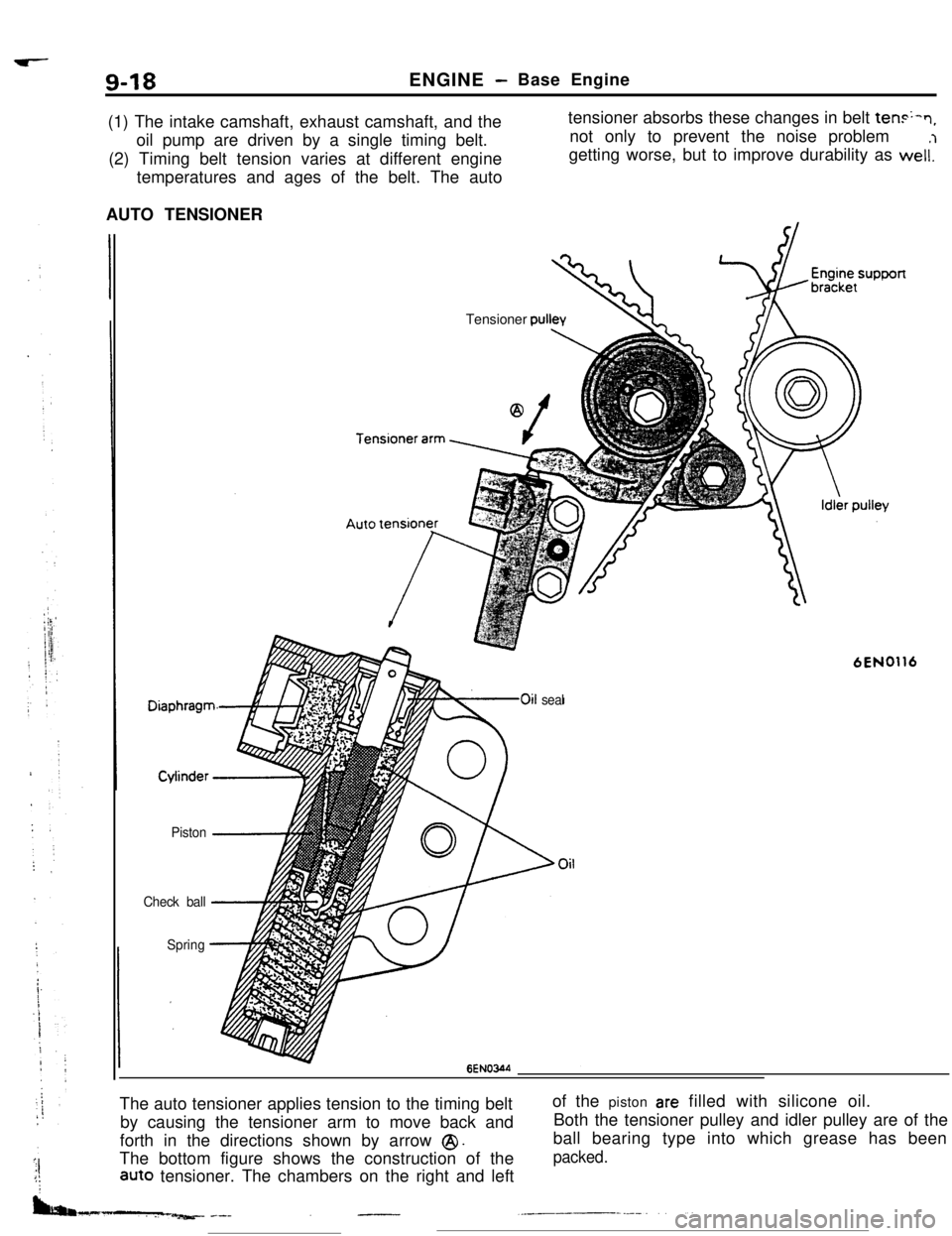
(1) The intake camshaft, exhaust camshaft, and the
oil pump are driven by a single timing belt.
(2) Timing belt tension varies at different engine
temperatures and ages of the belt. The autotensioner absorbs these changes in belt
ten+n,not only to prevent the noise problem
getting worse, but to improve durability as weli’l
AUTO TENSIONER
Piston -1
Check ball-4,
SpringTensioner
cwllev
6EN0116
LOoil seal
6ENOWThe auto tensioner applies tension to the timing belt
by causing the tensioner arm to move back and
forth in the directions shown by arrow
@I.The bottom figure shows the construction of the
aUt0 tensioner. The chambers on the right and leftof the piston
are filled with silicone oil.
Both the tensioner pulley and idler pulley are of the
ball bearing type into which grease has been
packed.
Page 105 of 391
9-20ENGINE- Lubricathn System
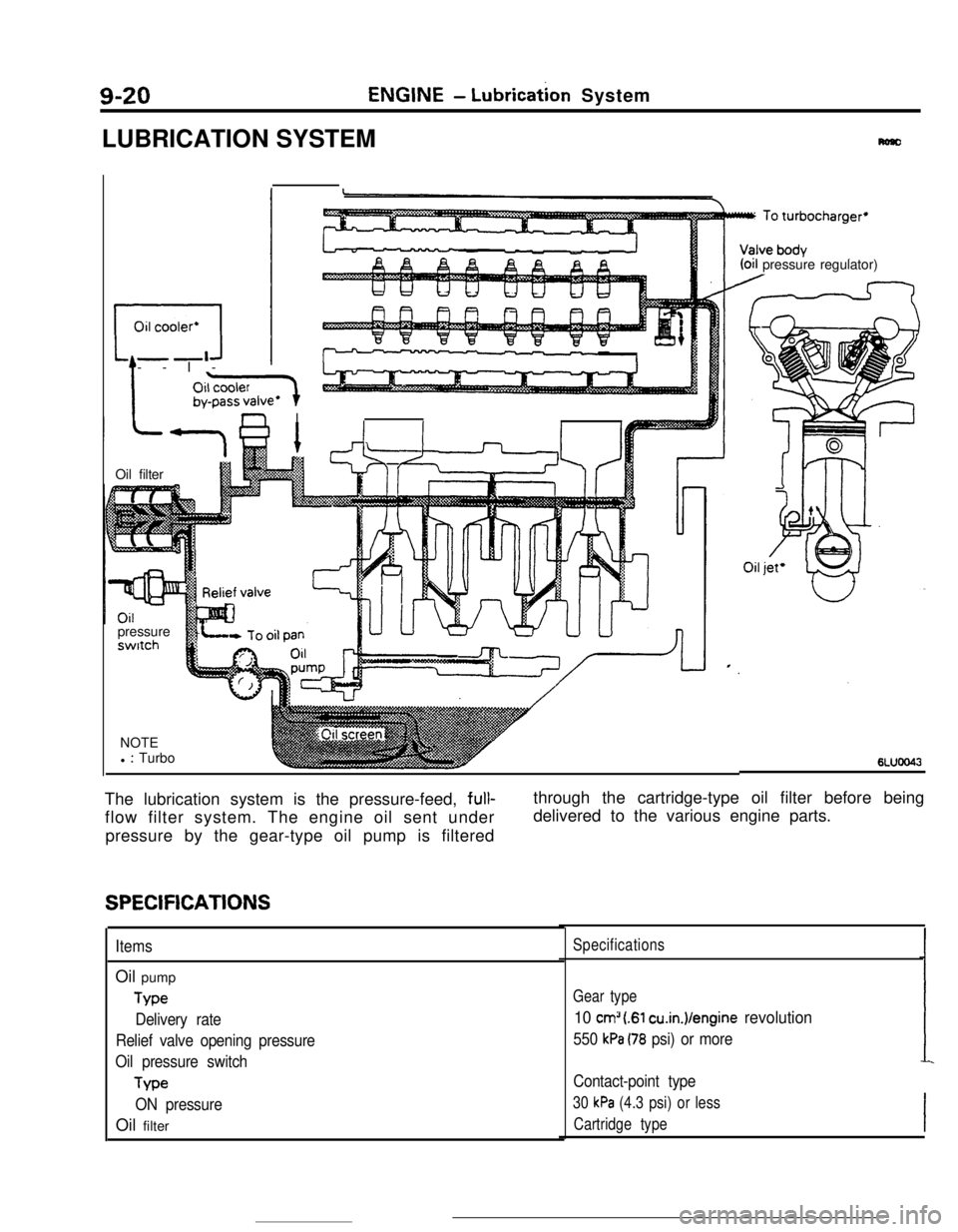
LUBRICATION SYSTEM
nasllOil cooler*
r-4--I-
(oil pressure regulator)
I
n I-1Oil filter
pressureswttch
NOTE
l
: Turbo6LUOO43The lubrication system is the pressure-feed, full-
flow filter system. The engine oil sent under
pressure by the gear-type oil pump is filteredthrough the cartridge-type oil filter before being
delivered to the various engine parts.
SPECIFICATIONS
ItemsOil pump
Type
Delivery rate
Relief valve opening pressure
Oil pressure switch
Type
ON pressureOil filter
Specifications
Gear type
10 cm” (.Sl cu.in.)/engine revolution
550 kPa (78 psi) or more
Contact-point type
30 kPa (4.3 psi) or less
Cartridge type
Page 115 of 391
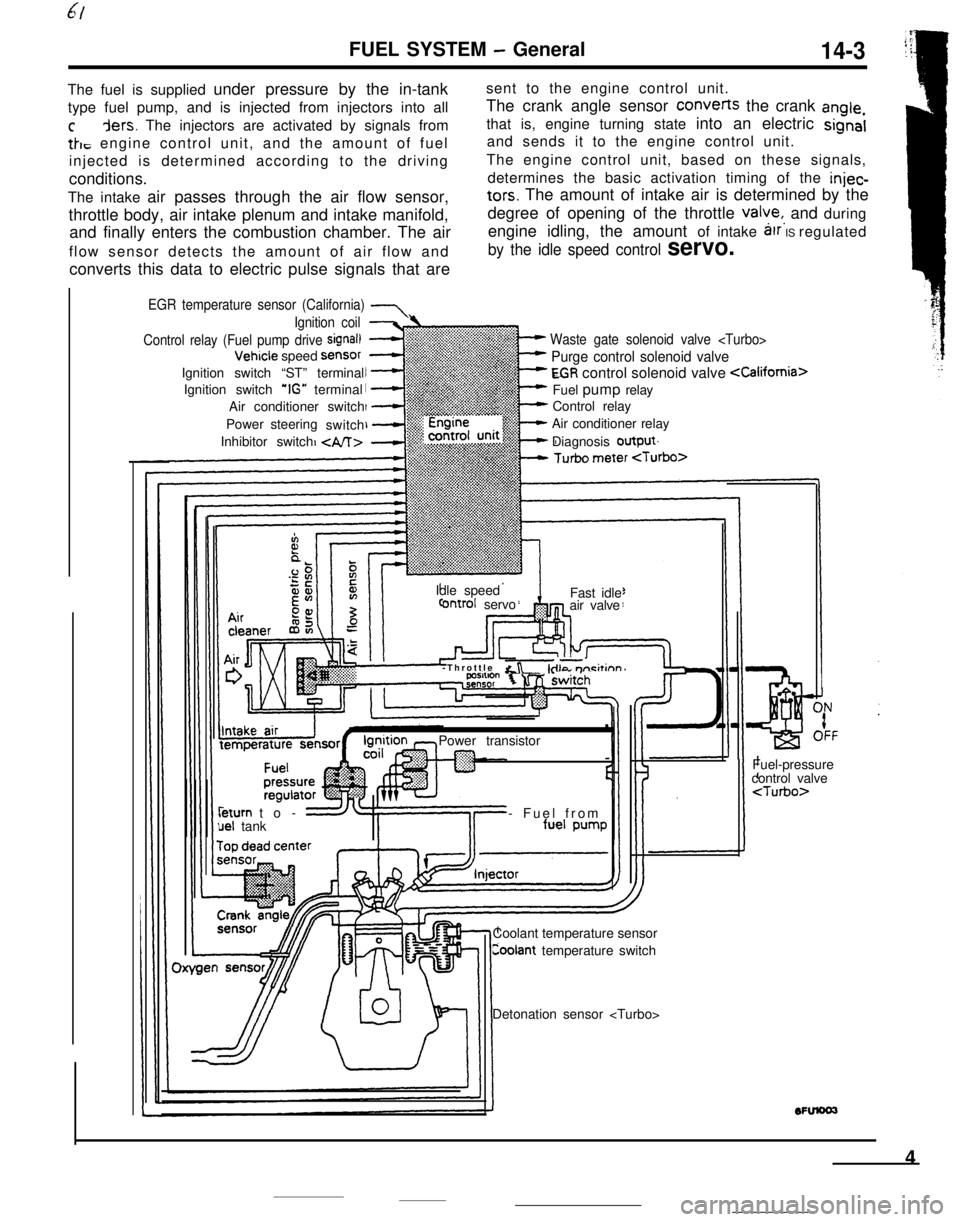
FUEL SYSTEM - General14-3The fuel is supplied under pressure by the in-tanksent to the engine control unit.
type fuel pump, and is injected from injectors into allThe crank angle sensor converts the crank
angle,
cders. The injectors are activated by signals fromthat is, engine turning state into an electric signal
tk, engine control unit, and the amount of fueland sends it to the engine control unit.
injected is determined according to the drivingThe engine control unit, based on these signals,
conditions.determines the basic activation timing of the
injec-The intake air passes through the air flow sensor,
tars. The amount of intake air is determined by the
throttle body, air intake plenum and intake manifold,degree of opening of the throttle
valye,, and during
and finally enters the combustion chamber. The airengine idling, the amount of intake
arr IS regulated
flow sensor detects the amount of air flow and
by the idle speed control servo.converts this data to electric pulse signals that are
EGR temperature sensor (California) 7
Waste gate solenoid valve
Purge control solenoid valve
EGR control solenoid valve
Control relay
Air conditioner relay
Diagnosis output
Ignition coil
Control relay (Fuel pump drive
signal)Vehicle speed
SensorIgnition switch “ST” terminal
Ignition switch
‘IG” terminal
Air conditioner switch
Power steering
switch
Inhibitor switch
Idle speed
ontrol servoFast idle
air valve
-Throttle
&r -kilo m-i&inn’Power transistorleturn to-
uel tank- Fuel from
Coolant temperature sensor
Coolant temperature switchFuel-pressure
control valve
4
Page 118 of 391

14-6FUEL SYSTEM -Fuel Supply and Fuel Pressure Control
intake manifold/I\
Engine
Fuel
03AOOlOThe fuel supply system comprises electromagnetic
type injectors, a delivery pipe, a fuel pressure
regulator, a motor-driven fuel pump, and the engine
control unit, which activates and controls the injec-
tors and fuel pump based on data supplied by the
various sensors.
After being filtered by an in-tank filter, the fuel is
pumped from the tank and is filtered again by an
external filter before it is distributed to the injectors
through the delivery pipe. The pressure of fuel
delivered to the injectors is regulated by the fuel
pressure
reoulator; excess fuel after pressure reg-ulation has been performed is returned to the fuel
tankThe injectors are activated on command from the
engine control unit and inject the fuel to each intake
port of cylinder head sequentially according to the
predetermined ignition order.
In addition, a fuel-pressure control valve has been
equipped in order to maintain idling stability of turbo
models immediately after restarting under high- -
temperature conditions.
The fuel tank is located under the floor of the rear
seat, thus giving it protection in the event of a
rear-end collision. A fuel pump drive terminal is
provided in the engine compartment for greater
serviceability.
-
SPECIFICATIONSItems
Fuel pump
Type
Delivery rate
liters (gals.VHr
Delivery pressurekPa (psi)
Fuel pressure regulator
Tvw
Regulated fuel pressurekPa (psi)
Fuel filter
Rated flow rate
liters (qts.)/min.
Filter areacm’ (in.‘)
Injectors
TypeCoil resistance
n
--
.- -_-_
SpecificationsMotor-driven, in-tank type
Minimum 90 (23.8)
450 - 600 (64 - 85)
Diaphragm type
335 (47.6)
255 (36.3)
2
(2.1)
1,500 (233)Solenoid type
,.13-16
2-3
I