check oil MITSUBISHI ECLIPSE 1991 User Guide
[x] Cancel search | Manufacturer: MITSUBISHI, Model Year: 1991, Model line: ECLIPSE, Model: MITSUBISHI ECLIPSE 1991Pages: 1216, PDF Size: 67.42 MB
Page 71 of 1216
FRONT SUSPENSION - Drive Shaft2-23
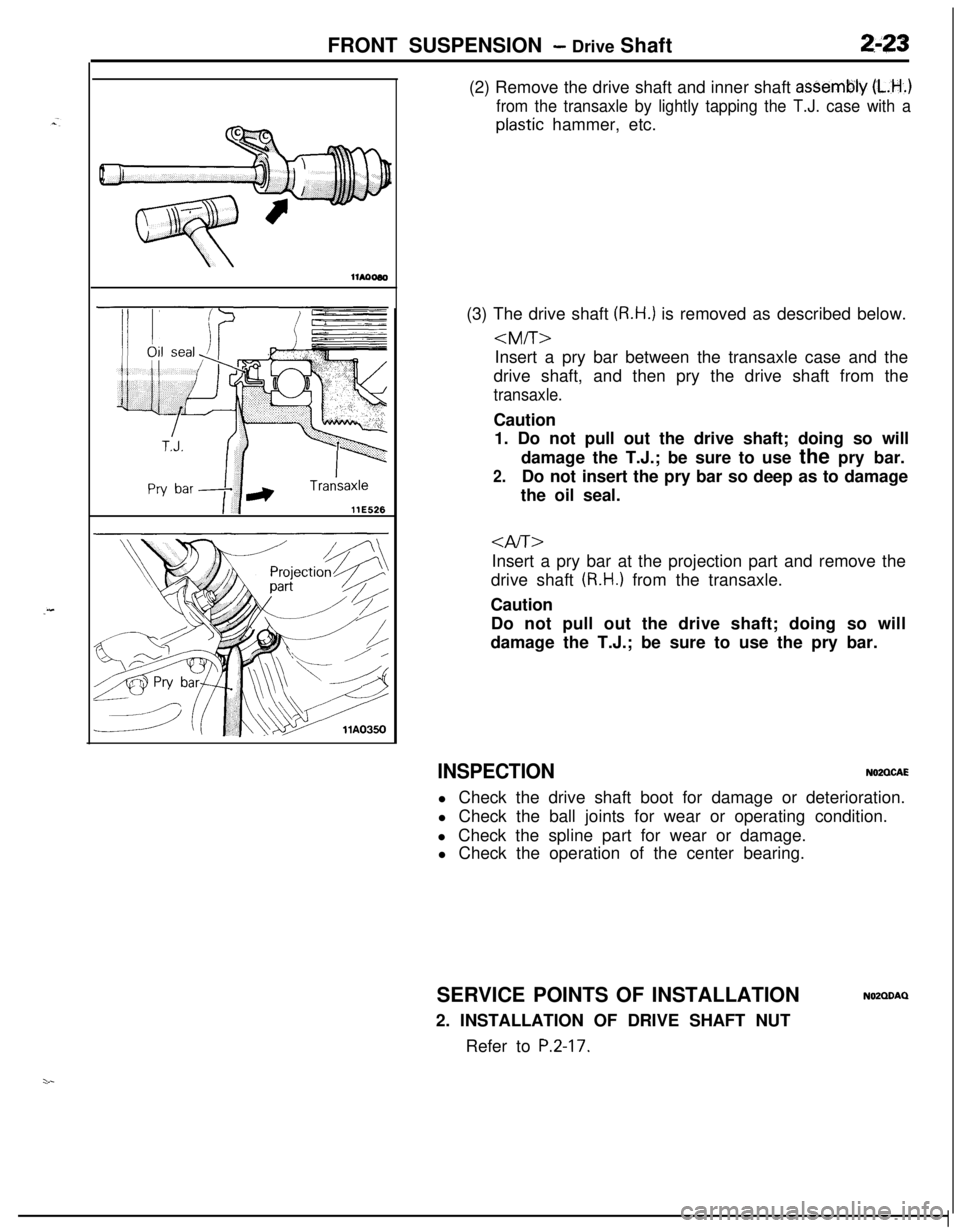
llE526(2) Remove the drive shaft and inner shaft
asSembly (L.H..)
from the transaxle by lightly tapping the T.J. case with a
plastic hammer, etc.
(3) The drive shaft
(R.H.) is removed as described below.
drive shaft, and then pry the drive shaft from the
transaxle.Caution
1. Do not pull out the drive shaft; doing so will
damage the T.J.; be sure to use the pry bar.
2.Do not insert the pry bar so deep as to damage
the oil seal.
Insert a pry bar at the projection part and remove the
drive shaft
(R.H.) from the transaxle.
Caution
Do not pull out the drive shaft; doing so will
damage the T.J.; be sure to use the pry bar.
INSPECTIONN02QCAEl Check the drive shaft boot for damage or deterioration.
l Check the ball joints for wear or operating condition.
l Check the spline part for wear or damage.
l Check the operation of the center bearing.
SERVICE POINTS OF INSTALLATION
2. INSTALLATION OF DRIVE SHAFT NUT
Refer to
P.2-17.
NOZQDAQ
Page 77 of 1216
FRONT SUSPENSION - Strut Assembly
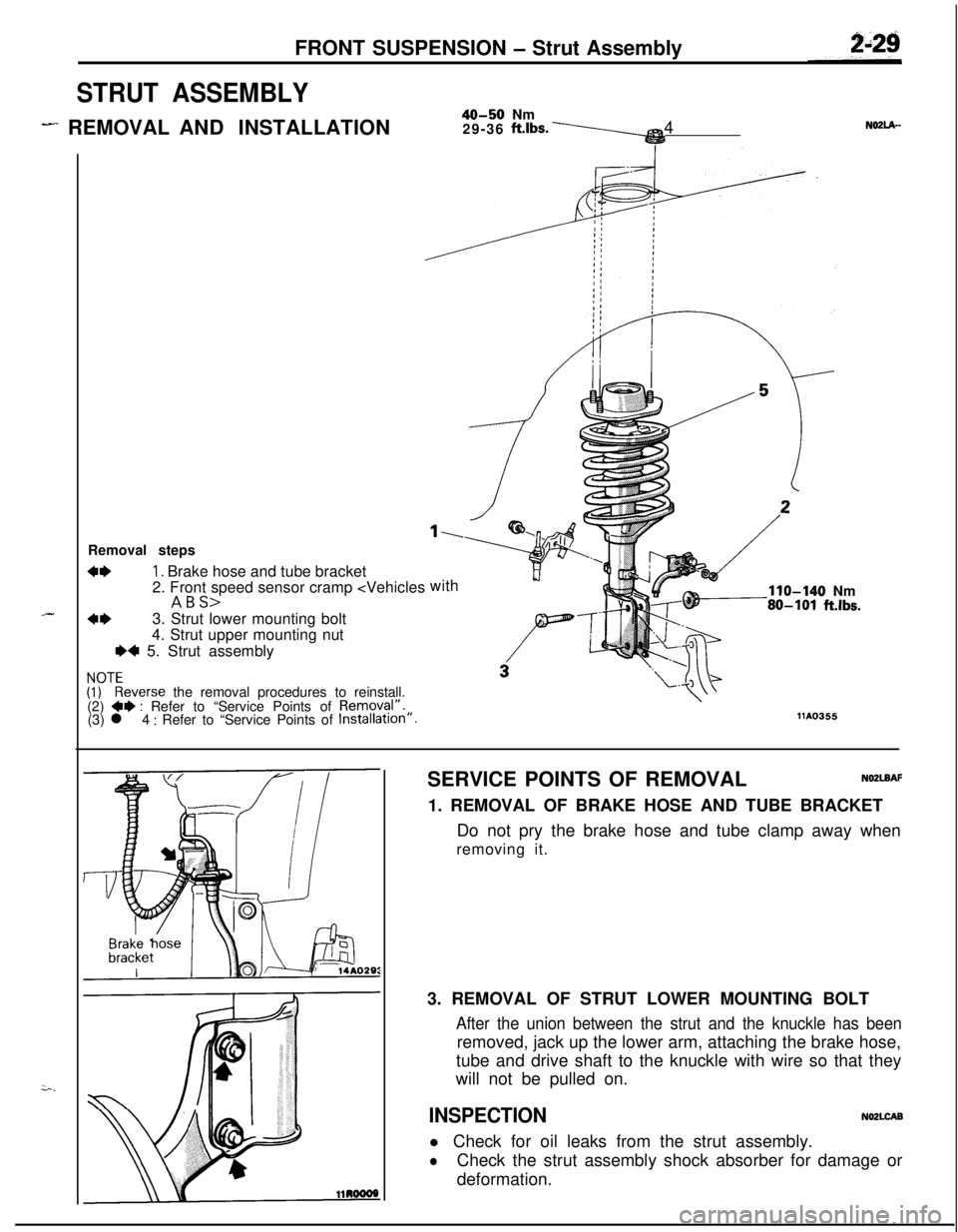
STRUT ASSEMBLY
- REMOVAL AND INSTALLATION40-50 Nm
29-36 ft.lbs.\4N02lA-
.-Removal steps
4*1. Brake hose and tube bracket
2. Front speed sensor cramp
4*3. Strut lower mounting bolt
4. Strut upper mounting nut
e+ 5. Strut assembly
!rEeverse the removal procedures to reinstall.
(2) **: Refer to “Service Points of Removal”.
(3) l 4 : Refer to “Service Points of Installation”.
1.with
110-140 Nm80-101 ft.lbs.
1110355SERVICE POINTS OF REMOVAL
NO2LBAF1. REMOVAL OF BRAKE HOSE AND TUBE BRACKET
Do not pry the brake hose and tube clamp away when
removing it.
3. REMOVAL OF STRUT LOWER MOUNTING BOLT
After the union between the strut and the knuckle has beenremoved, jack up the lower arm, attaching the brake hose,
tube and drive shaft to the knuckle with wire so that they
will not be pulled on.
INSPECTIONNO2LCABl Check for oil leaks from the strut assembly.
lCheck the strut assembly shock absorber for damage or
deformation.
Page 79 of 1216
FRONT SUSPENSION - Strut Assembly
MB991237 -12l.0254
Strut insulator bearing12A0523
Bu’mp rubber
Dust Gover12LOO32-SERVICE POINTS OF DISASSEMBLY
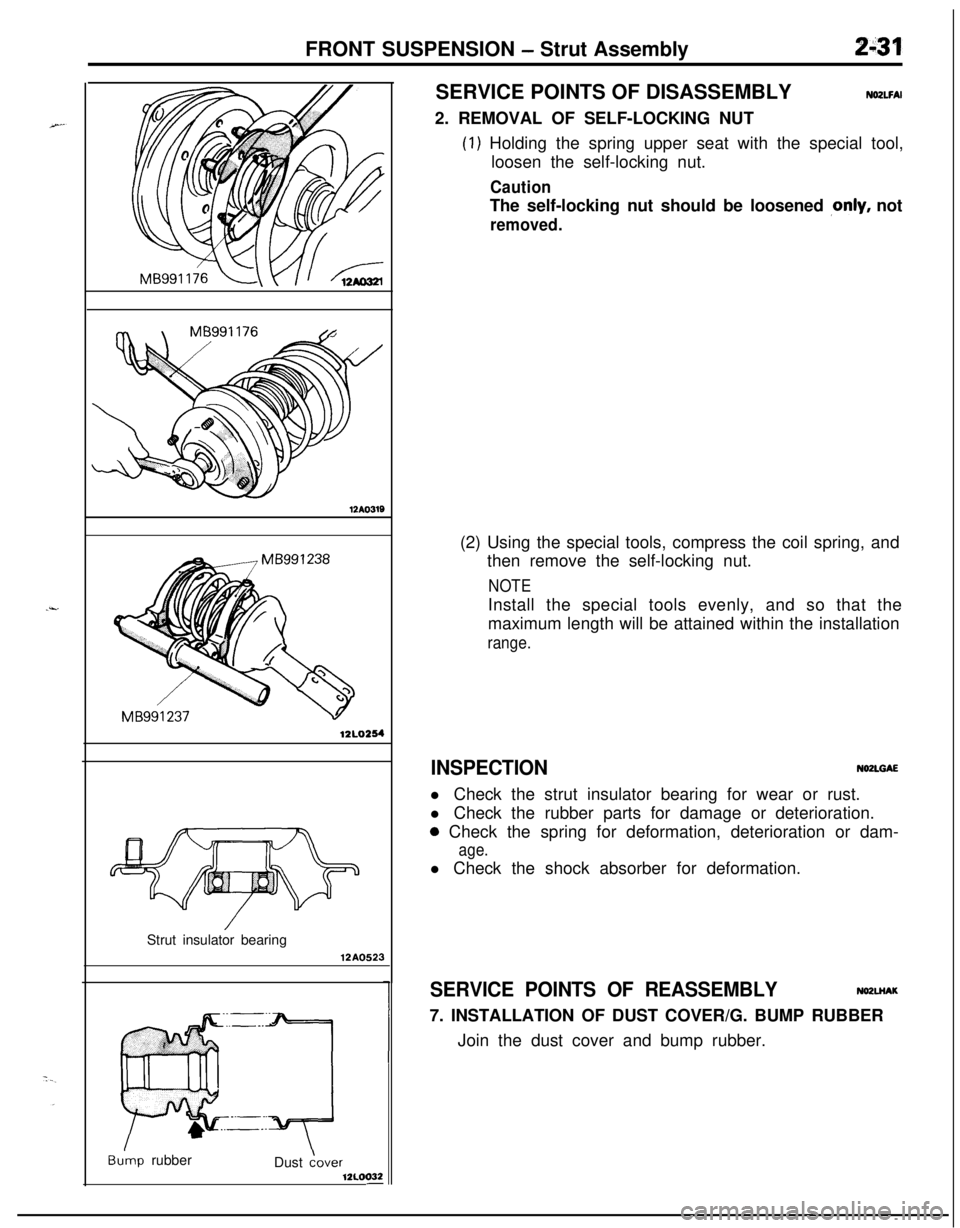
NO2LFAI2. REMOVAL OF SELF-LOCKING NUT
(1) Holding the spring upper seat with the special tool,
loosen the self-locking nut.
CautionThe self-locking nut should be loosened
,only, not
removed.(2) Using the special tools, compress the coil spring, and
then remove the self-locking nut.
NOTEInstall the special tools evenly, and so that the
maximum length will be attained within the installation
range.
INSPECTIONNOZLGAEl Check the strut insulator bearing for wear or rust.
l Check the rubber parts for damage or deterioration.
0 Check the spring for deformation, deterioration or dam-
age.l Check the shock absorber for deformation.
SERVICE POINTS OF REASSEMBLYNO2LHAK7. INSTALLATION OF DUST COVER/G. BUMP RUBBER
Join the dust cover and bump rubber.
Page 103 of 1216
3-1
REAR AXLE
CONTENTSAXLE SHAFT
...................................................10
DIFFERENTIAL CARRIER................................19DRIVE SHAFT
..................................................13SERVICE ADJUSTMENT PROCEDURES..
.....8
GearOilLevelCheck...................................8
LimitedSlipDifferentialCheck....................9
..Rear Axle Total Backlash Check.................8Rear Wheel Bearing End Play Check
.........
8Rear Wheel Bearing Rotation Sliding
ResistanceCheck.........................................9
SPECIALTOOLS.............................................4
SPECIFICATIONS.............................................
2
GeneralSpecifications..................................2
Lubricants......................................................3Sealants and Adhesives...............................
3Service
Specifications...................................2TorqueSpecifications...................................
3
TROUBLESHOOTING......................................6Axle Shaft
Grease leakageNoise while wheels are rotatingDifferential (Conventional Differential)
Bearing noise while driving or coasting
Constant noise
Gear noise while coasting
Gear noise while driving
HeatNoise while turning
Oil leakage
Differential (Limited Slip Differential)
Abnormal noise during driving or
gear changing
Abnormal noise when cornering
Break down
Gear noise
Gear oil leakage
SeizureThe limited slip differential does
not function
Drive Shaft
Noise
Page 108 of 1216
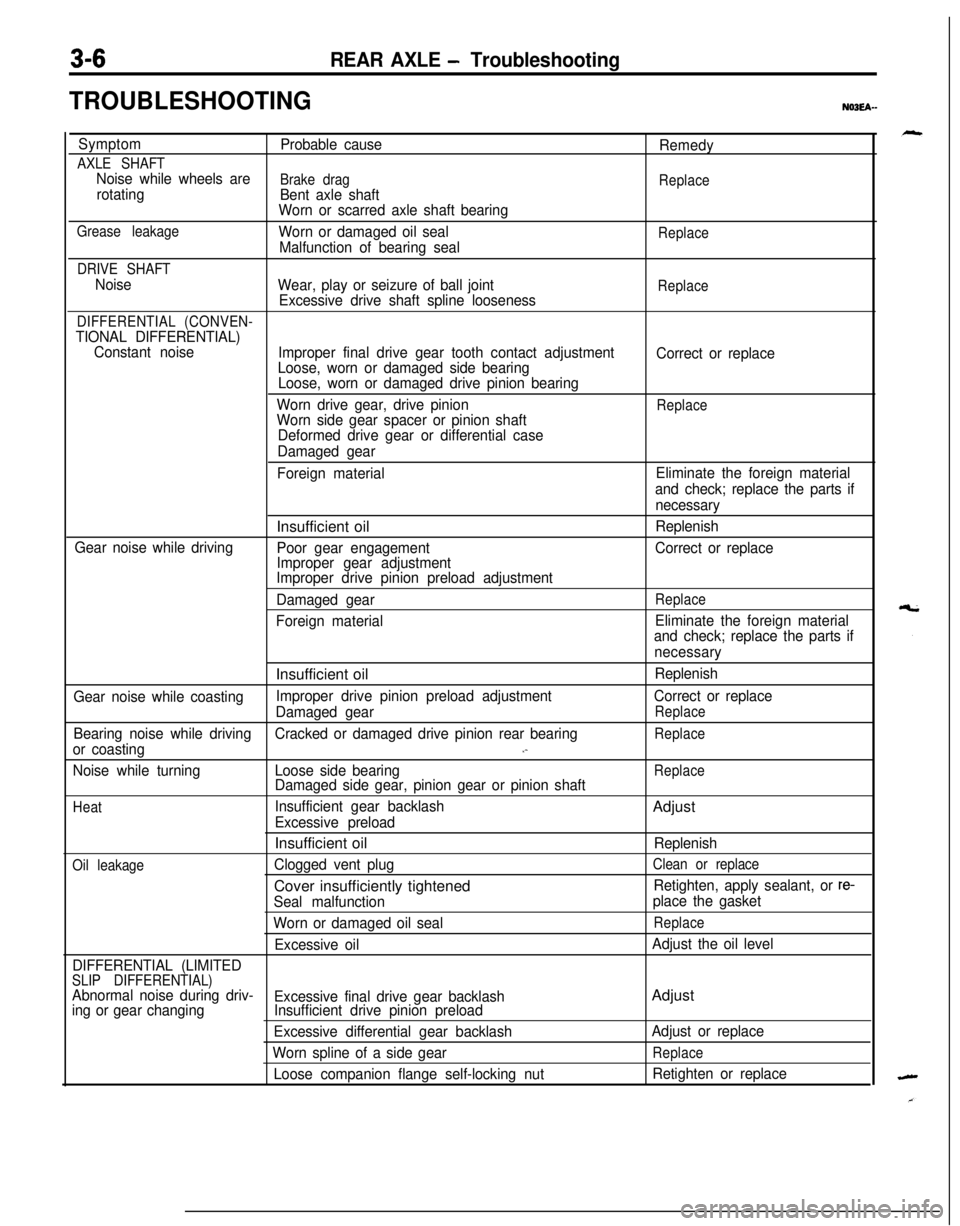
3-6REAR AXLE - Troubleshooting
TROUBLESHOOTINGNO3EA-
Symptom
Probable cause
Remedy
AXLE SHAFTNoise while wheels areBrake drag
Replacerotating
Bent axle shaft
Worn or scarred axle shaft bearing
Grease leakageWorn or damaged oil sealReplaceMalfunction of bearing seal
DRIVE SHAFT
Noise
Wear, play or seizure of ball jointReplaceExcessive drive shaft spline looseness
DIFFERENTIAL (CONVEN-TIONAL DIFFERENTIAL)
Constant noise
Improper final drive gear tooth contact adjustment
Correct or replace
Loose, worn or damaged side bearing
Loose, worn or damaged drive pinion bearing
Worn drive gear, drive pinion
ReplaceWorn side gear spacer or pinion shaft
Deformed drive gear or differential case
Damaged gear
Foreign materialEliminate the foreign material
and check; replace the parts if
necessaryInsufficient oil
Replenish
Gear noise while driving
Poor gear engagementCorrect or replace
Improper gear adjustment
Improper drive pinion preload adjustment
Damaged gear
Replace
Foreign materialEliminate the foreign material
and check; replace the parts if
necessaryInsufficient oil
Replenish
Gear noise while coastingImproper drive pinion preload adjustmentCorrect or replace
Damaged gear
Replace
Bearing noise while drivingCracked or damaged drive pinion rear bearingReplace
or coasting.-
Noise while turningLoose side bearingReplaceDamaged side gear, pinion gear or pinion shaft
HeatInsufficient gear backlashAdjust
Excessive preloadInsufficient oil
Replenish
Oil leakageClogged vent plugClean or replaceCover insufficiently tightened
Retighten, apply sealant, or re-
Seal malfunctionplace the gasket
Worn or damaged oil seal
Replace
Excessive oilAdjust the oil level
DIFFERENTIAL (LIMITED
SLIP DIFFERENTIAL)Abnormal noise during driv-
Excessive final drive gear backlashAdjusting or gear changingInsufficient drive pinion preload
Excessive differential gear backlashAdjust or replace
Worn spline of a side gear
Replace
Loose companion flange self-locking nutRetighten or replace
Page 109 of 1216
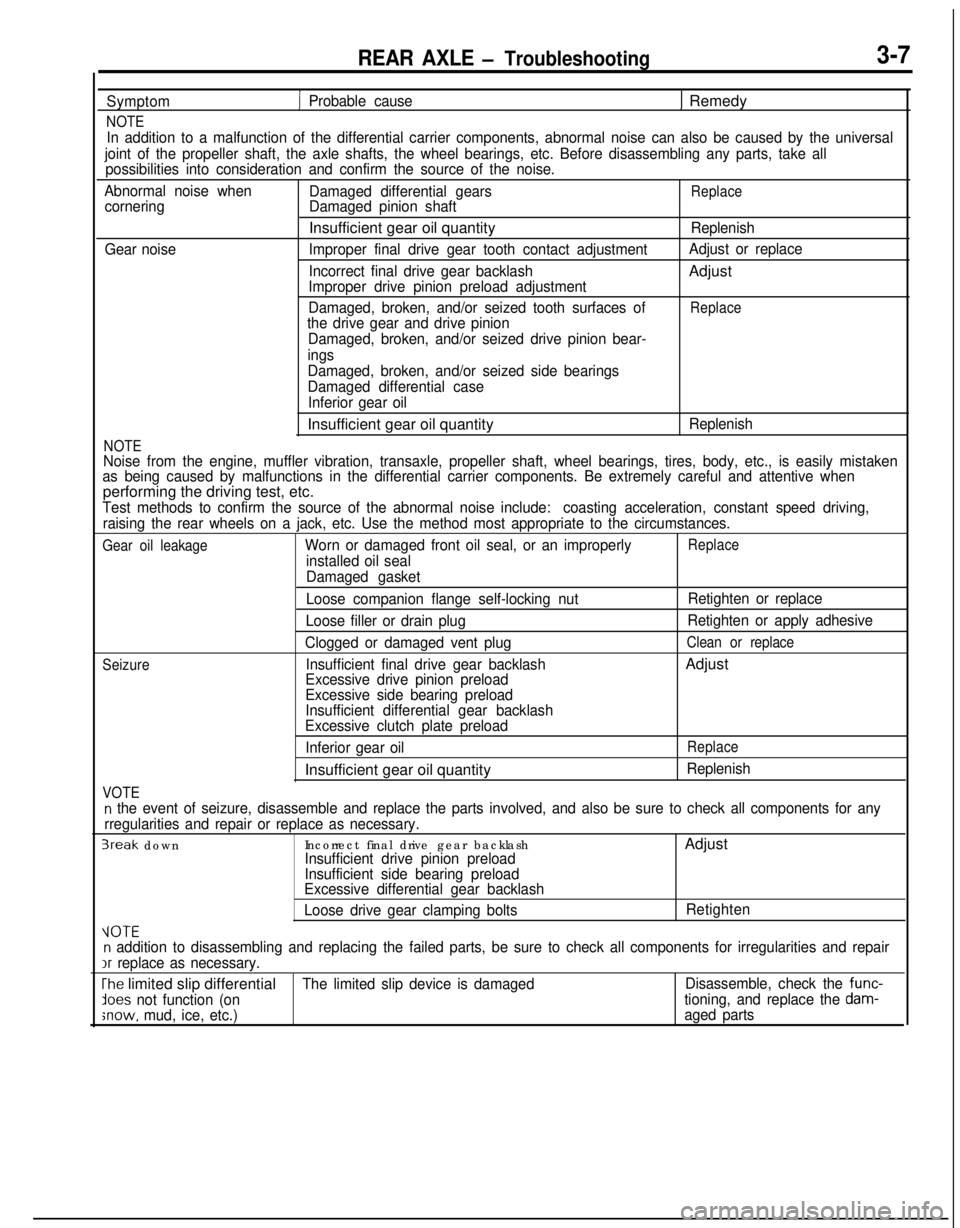
REAR AXLE - Troubleshooting3-7
Symptom
NOTE
1 Probable cause1 Remedy
In addition to a malfunction of the differential carrier components, abnormal noise can also be caused by the universal
joint of the propeller shaft, the axle shafts, the wheel bearings, etc. Before disassembling any parts, take all
possibilities into consideration and confirm the source of the noise.
Abnormal noise when
Damaged differential gears
ReplacecorneringDamaged pinion shaftInsufficient gear oil quantity
Replenish
Gear noiseImproper final drive gear tooth contact adjustmentAdjust or replace
Incorrect final drive gear backlashAdjust
Improper drive pinion preload adjustment
Damaged, broken, and/or seized tooth surfaces of
Replacethe drive gear and drive pinion
Damaged, broken, and/or seized drive pinion bear-
ings
NOTE
Damaged, broken, and/or seized side bearings
Damaged differential case
Inferior gear oilInsufficient gear oil quantity
Replenish
Noise from the engine, muffler vibration, transaxle, propeller shaft, wheel bearings, tires, body, etc., is easily mistaken
as being caused by malfunctions in the differential carrier components. Be extremely careful and attentive whenperforming the driving test, etc.
Test methods to confirm the source of the abnormal noise include:coasting acceleration, constant speed driving,
raising the rear wheels on a jack, etc. Use the method most appropriate to the circumstances.
Gear oil leakageWorn or damaged front oil seal, or an improperlyReplace
installed oil seal
Damaged gasket
Seizure
VOTE
Loose companion flange self-locking nut
Loose filler or drain plug
Clogged or damaged vent plug
Insufficient final drive gear backlash
Excessive drive pinion preload
Excessive side bearing preload
Insufficient differential gear backlash
Excessive clutch plate preload
Inferior gear oilInsufficient gear oil quantityRetighten or replace
Retighten or apply adhesive
Clean or replaceAdjust
Replace
Replenish
n the event of seizure, disassemble and replace the parts involved, and also be sure to check all components for any
rregularities and repair or replace as necessary.
3reak downIncorrect final drive gear backlashAdjustInsufficient drive pinion preload
Insufficient side bearing preload
Excessive differential gear backlash
Loose drive gear clamping boltsRetighten
VOTEn addition to disassembling and replacing the failed parts, be sure to check all components for irregularities and repairIr
replace as necessary.
The limited slip differentialThe limited slip device is damagedDisassemble, check the func-
lees not function (ontioning, and replace the dam-
;now, mud, ice, etc.)aged parts
Page 110 of 1216
3-8REAR AXLE - Service Adjustment Procedures
09D031
llA0065SERVICE ADJUSTMENT PROCEDURES
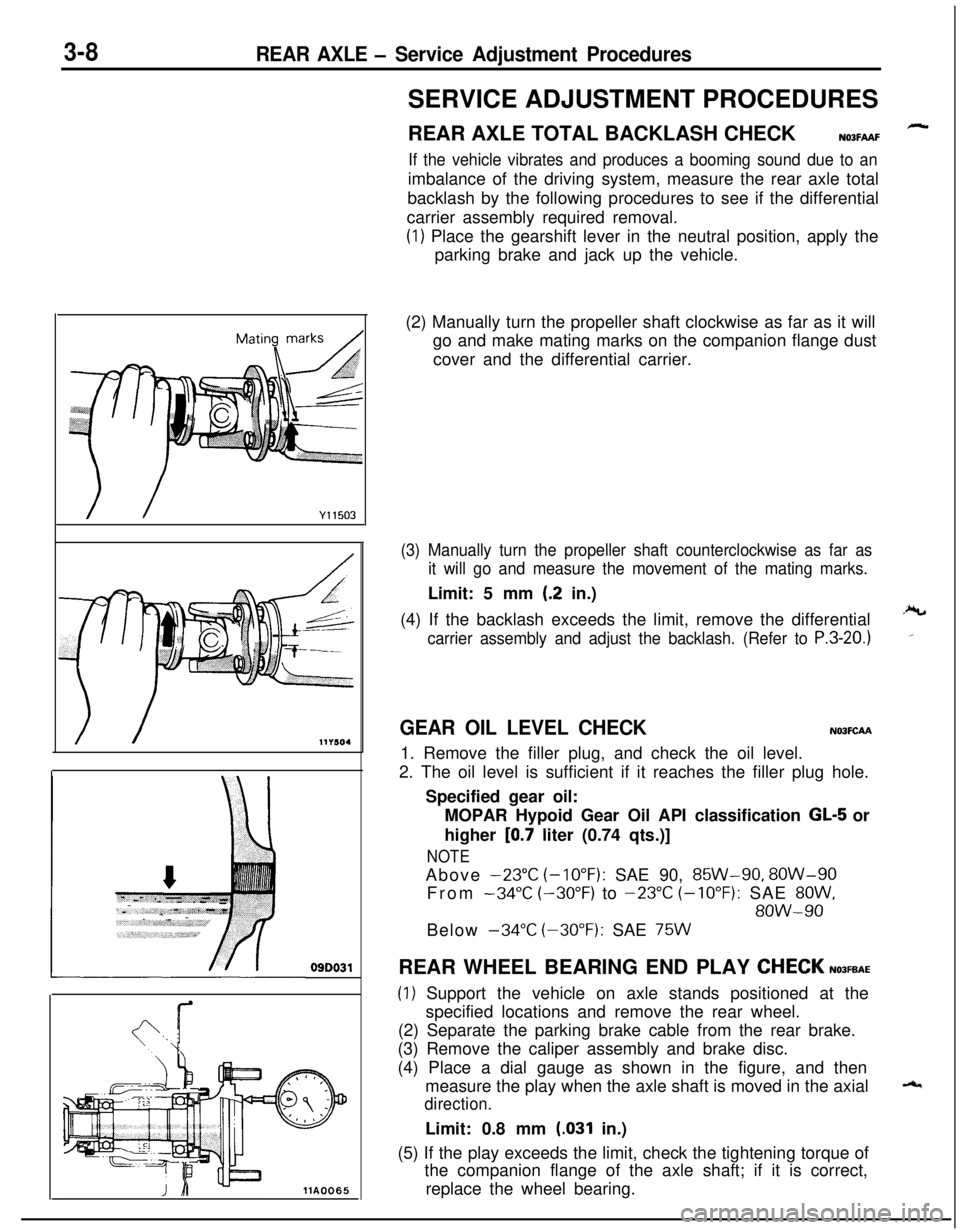
REAR AXLE TOTAL BACKLASH CHECK
N03FAAF
If the vehicle vibrates and produces a booming sound due to animbalance of the driving system, measure the rear axle total
backlash by the following procedures to see if the differential
carrier assembly required removal.
(1) Place the gearshift lever in the neutral position, apply the
parking brake and jack up the vehicle.
(2) Manually turn the propeller shaft clockwise as far as it will
go and make mating marks on the companion flange dust
cover and the differential carrier.
(3) Manually turn the propeller shaft counterclockwise as far as
it will go and measure the movement of the mating marks.Limit: 5 mm
(.2 in.)
(4) If the backlash exceeds the limit, remove the differential
carrier assembly and adjust the backlash. (Refer to P.3-20.)
GEAR OIL LEVEL CHECKN03FCAA1. Remove the filler plug, and check the oil level.
2. The oil level is sufficient if it reaches the filler plug hole.
Specified gear oil:
MOPAR Hypoid Gear Oil API classification
GL-5 or
higher
[0.7 liter (0.74 qts.)]
NOTEAbove
-23°C (-10°F): SAE 90, 85W-90, 8OW-90
From
-34°C (-30°F) to -23°C (-10°F): SAE 8OW,
8OW-90Below
-34°C (-30°F): SAE 75WREAR WHEEL BEARING END PLAY
CHECKN03FEAE
(1) Support the vehicle on axle stands positioned at the
specified locations and remove the rear wheel.
(2) Separate the parking brake cable from the rear brake.
(3) Remove the caliper assembly and brake disc.
(4) Place a dial gauge as shown in the figure, and then
measure the play when the axle shaft is moved in the axial
direction.Limit: 0.8 mm
(.031 in.)
(5) If the play exceeds the limit, check the tightening torque of
the companion flange of the axle shaft; if it is correct,
replace the wheel bearing.
Page 113 of 1216
12A0611
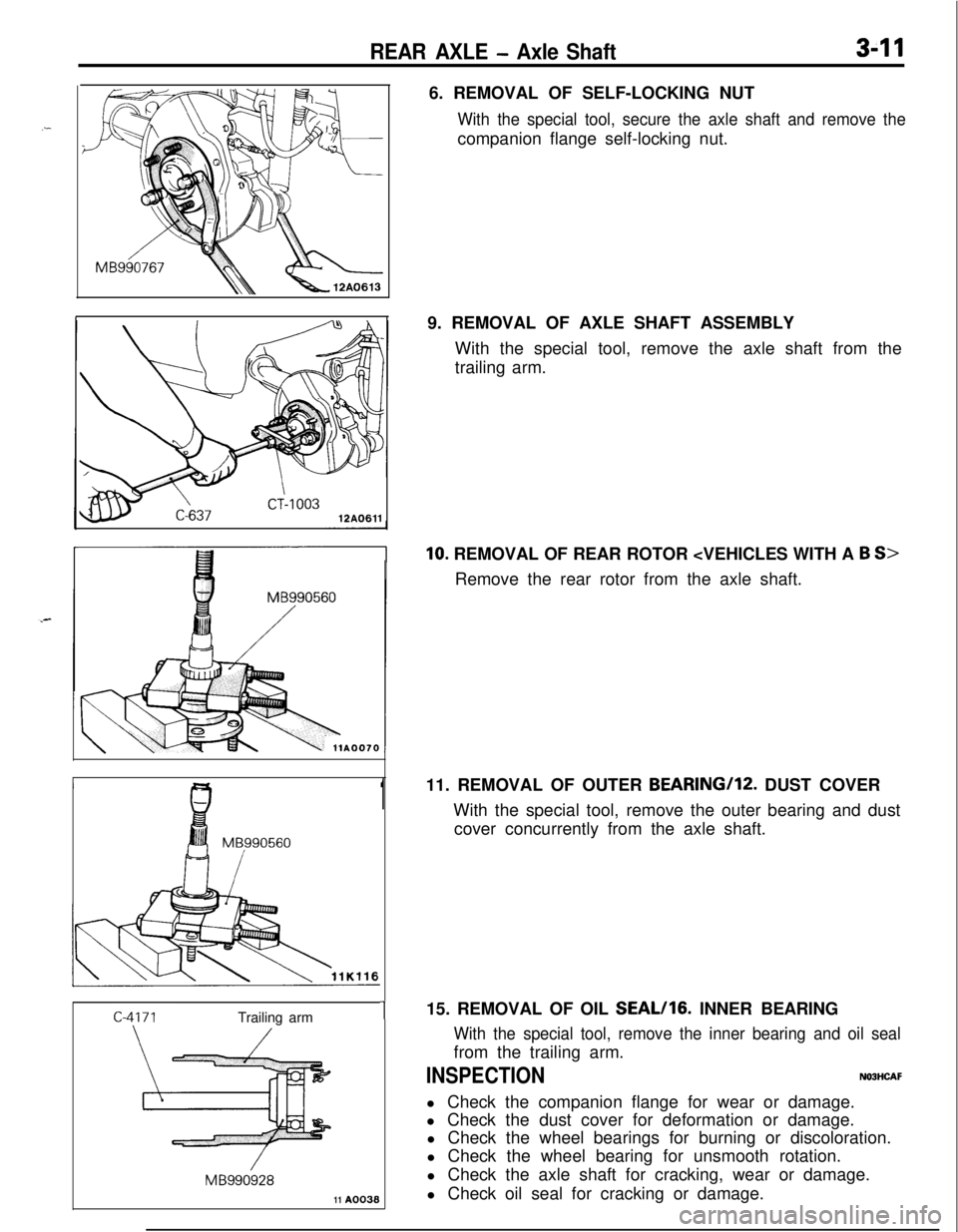
REAR AXLE - Axle Shaft3-116. REMOVAL OF SELF-LOCKING NUT
With the special tool, secure the axle shaft and remove thecompanion flange self-locking nut.
9. REMOVAL OF AXLE SHAFT ASSEMBLY
With the special tool, remove the axle shaft from the
trailing arm.
10. REMOVAL OF REAR ROTOR
111. REMOVAL OF OUTER BEARING/lZ. DUST COVER
With the special tool, remove the outer bearing and dust
cover concurrently from the axle shaft.
115. REMOVAL OF OIL SEAL/lG. INNER BEARING
MB990560
/Trailing arm
/
/MB99092811
A0038
With the special tool, remove the inner bearing and oil sealfrom the trailing arm.
INSPECTIONNOBHCAFl Check the companion flange for wear or damage.
l Check the dust cover for deformation or damage.
l Check the wheel bearings for burning or discoloration.
l Check the wheel bearing for unsmooth rotation.
l Check the axle shaft for cracking, wear or damage.
l Check oil seal for cracking or damage.
Page 116 of 1216
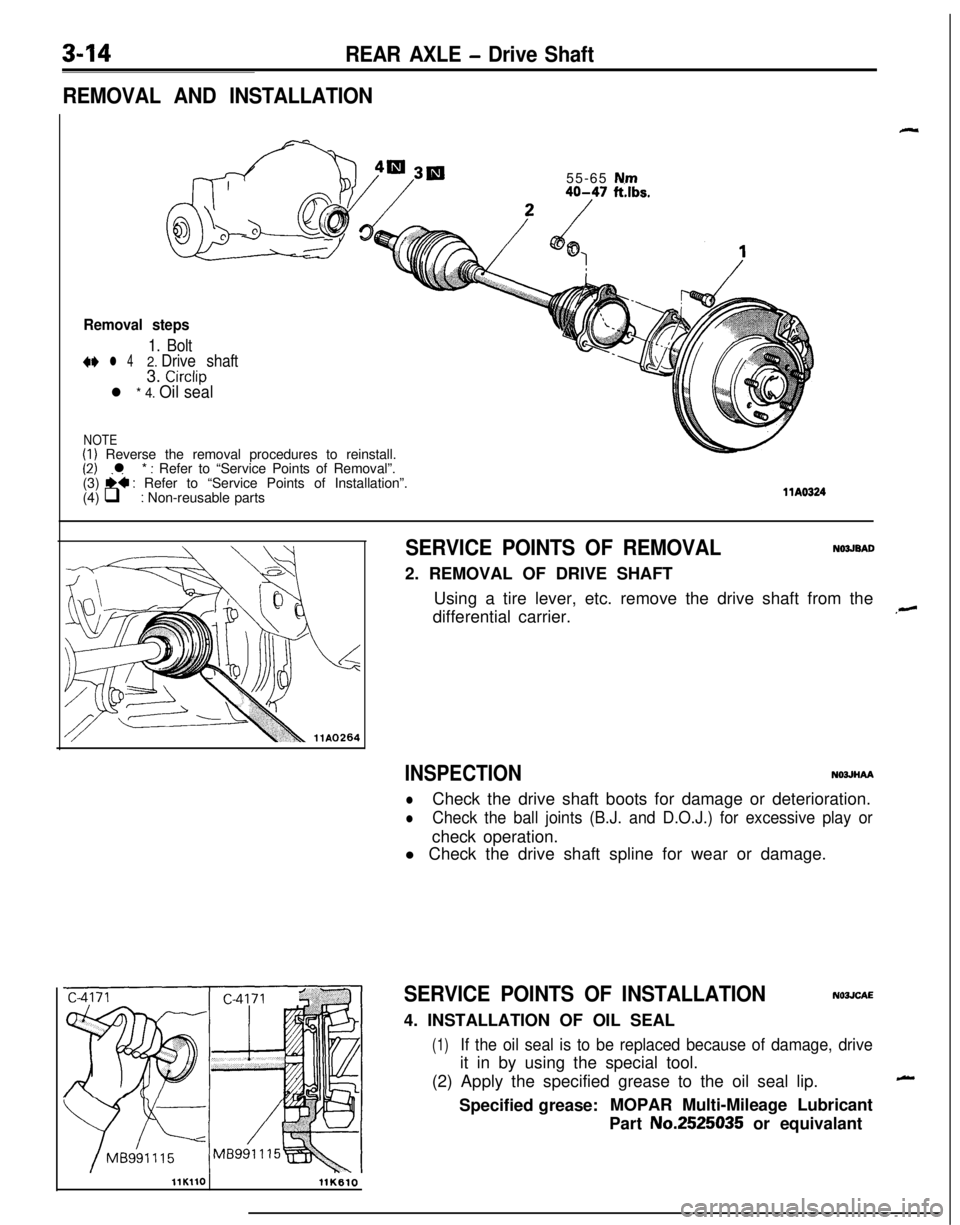
3-‘14REAR AXLE - Drive Shaft
REMOVAL AND INSTALLATION55-65
N.m40-47 ft.lbs.
Removal steps
1. Bolt+e l 42. Drive shaft3. Circlip
l * 4. Oil seal
NOTE(1) Reverse the removal procedures to reinstall.(2) l * : Refer to “Service Points of Removal”.<-,(3) ii : Refer to “Service Points of Installation”.
(4) q : Non-reusable partsllA0324
SERVICE POINTS OF REMOVALNO3JEAD2. REMOVAL OF DRIVE SHAFT
Using a tire lever, etc. remove the drive shaft from the
differential carrier.
INSPECTIONNOJJHAA
lCheck the drive shaft boots for damage or deterioration.
lCheck the ball joints (B.J. and D.O.J.) for excessive play orcheck operation.
l Check the drive shaft spline for wear or damage.
SERVICE POINTS OF INSTALLATIONN03JCAE4. INSTALLATION OF OIL SEAL
(1)If the oil seal is to be replaced because of damage, driveit in by using the special tool.
(2) Apply the specified grease to the oil seal lip.
Specified grease:MOPAR Multi-Mileage Lubricant
Part No.2525035 or equivalant
,-
-
llK110llK610
Page 127 of 1216
REAR AXLE -Differential Carrier3-25
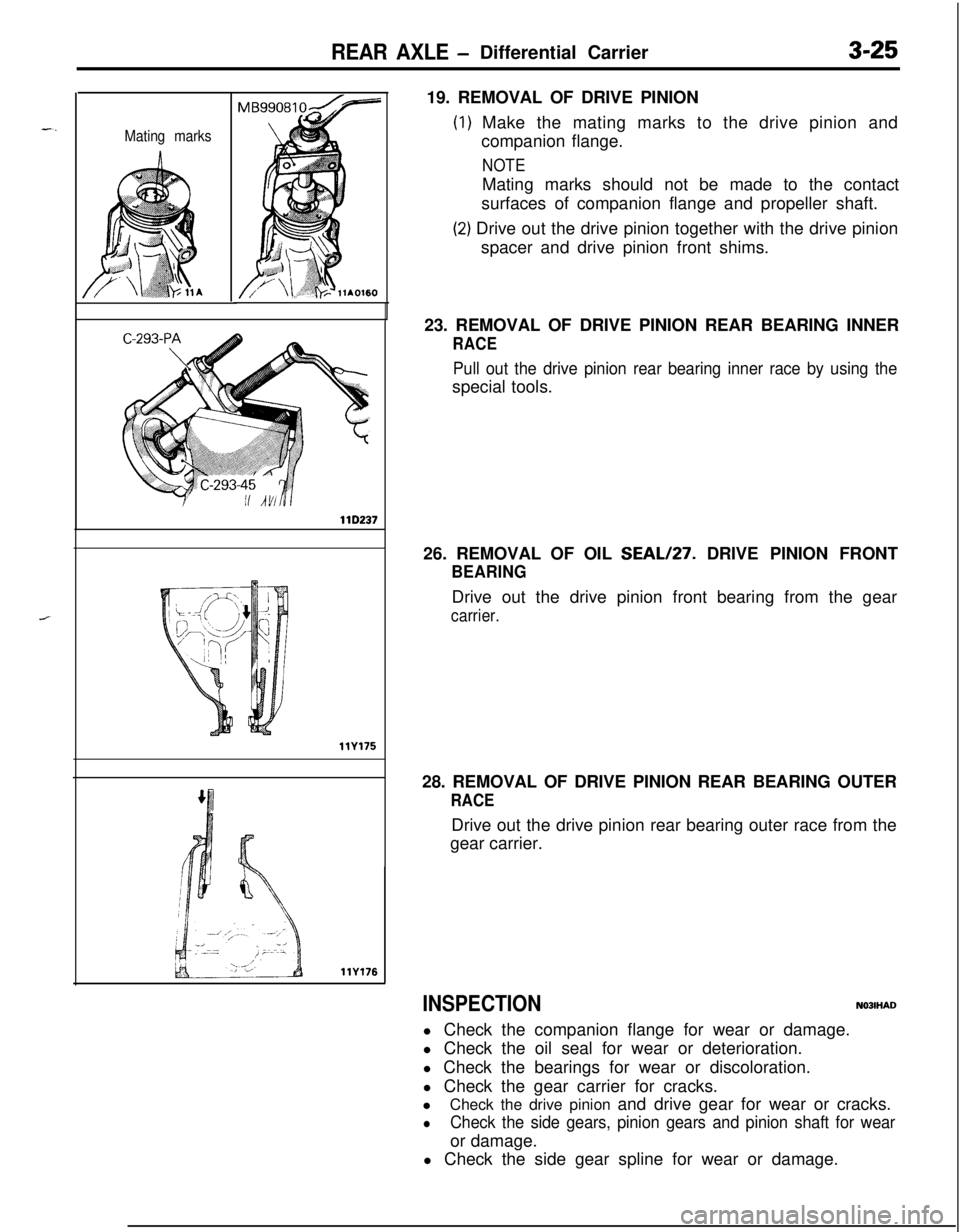
Mating marks
llD237
llY175
llY17619. REMOVAL OF DRIVE PINION
) Make the mating marks to the drive pinion and
companion flange.
NOTEMating marks should not be made to the contact
surfaces of companion flange and propeller shaft.
!) Drive out the drive pinion together with the drive pinion
spacer and drive pinion front shims.
23. REMOVAL OF DRIVE PINION REAR BEARING INNER
RACE
Pull out the drive pinion rear bearing inner race by using thespecial tools.
26. REMOVAL OF OIL SEAL/27. DRIVE PINION FRONT
BEARINGDrive out the drive pinion front bearing from the gear
carrier.28. REMOVAL OF DRIVE PINION REAR BEARING OUTER
RACEDrive out the drive pinion rear bearing outer race from the
gear carrier.
INSPECTIONN03lHADl Check the companion flange for wear or damage.
l Check the oil seal for wear or deterioration.
l Check the bearings for wear or discoloration.
l Check the gear carrier for cracks.
lCheck the drive pinion and drive gear for wear or cracks.
lCheck the side gears, pinion gears and pinion shaft for wearor damage.
l Check the side gear spline for wear or damage.