electric MITSUBISHI ECLIPSE 1991 Service Manual
[x] Cancel search | Manufacturer: MITSUBISHI, Model Year: 1991, Model line: ECLIPSE, Model: MITSUBISHI ECLIPSE 1991Pages: 1216, PDF Size: 67.42 MB
Page 1 of 1216
BACKUPGROUP INDEX &ma
;r Service Manual
LASER
TALON
1991
Volume-l
Engine, Chassis
& Body
FOREWORDThis Service Manual has been prepared with the
latest service information available at the time of
‘* publication.It is subdivided into various group
categories and each section contains diagnosis,
disassembly, repair, and installation procedures
along with complete specifications and tightening
references. Use of this manual will aid in properly
performing any servicing necessary to maintain or
restore the high levels of performance and reliabilitydesigned into these outstanding vehicles.
This BACKUP DSM manual IS to be used ONLY as a BACKUP. Please DO NOT REDISTRIBUTEWHOLE SECTIONS. This BACKUP was sold to you under the fact that you do indeed OWNa GENUINE DSM MANUAL. It CANNOT BE considered a REPLACEMENT (Unless your originalmanual was lost or destroyed.)Please See
README.N or README.HTML for additional information
Thank you. G~mm~emymanual@hotma~l.com
1,
wA
CHRYSLER
CORPORATION
Chrysler Corporation reserves the right to make changes in design 0’: tomake additions to or improvements in its products without lmqoslngd ., . any obligations upon itself to install them on its products previouslymanufactured.
0 1990 Mitsubishi Motors CorporationPrinted in U.S.A.Introduction and
Master
Troubleshooting. . . . . .,. . . . . . . . . r...m,
Lubrication and Maintenance . . . . . . . . ‘-0‘8
; “. i,
.Front Suspension. . . . . . . . . . . . . . ..*............d...Rear Axle
. . . . . . . . . . . . . . . . . . . . . . . . . . . . ..‘.....................
/
ServiceBrakes-Parking. . . . . . . . . . . . . . . . . . . . . . . . . . . . . . . . . . . . . .
Clutch. . . . . . . . . . . . . . . . . . . . . . . . . . . . . . . . . ..~......................‘t.
Cooling. . . . . . . . . . . . . . . . . ..i....................................
,., .‘,-,
Engine..i....~....r...............~....~.*,.~.~.~,‘~~...;..~~..Intake and Exhaust
. . . . . . ..L....................Fuel System
. . . . . . . . . . . ..ti.......r................~...Propeller Shaft
.......................................IRear
Suspensiori.............................y.f...
ManualSteering- Power.....................................Manual
I
transaxle-Automatic .............:;i...,;.....;Wheels
and Tires.................................
Body.............................................................Heater & Air Conditioning
..............Emission
Contr6l Systems..............
INOTE: For Electrical, refer toVolume-2 “Electrical”.
Page 14 of 1216
I4INTRODUCTION AND MASTER TROUBLESHOOTING - Precautions before Service
mm (In.1smo59
PARTSWhen replacing parts, use MOPAR genuine parts.
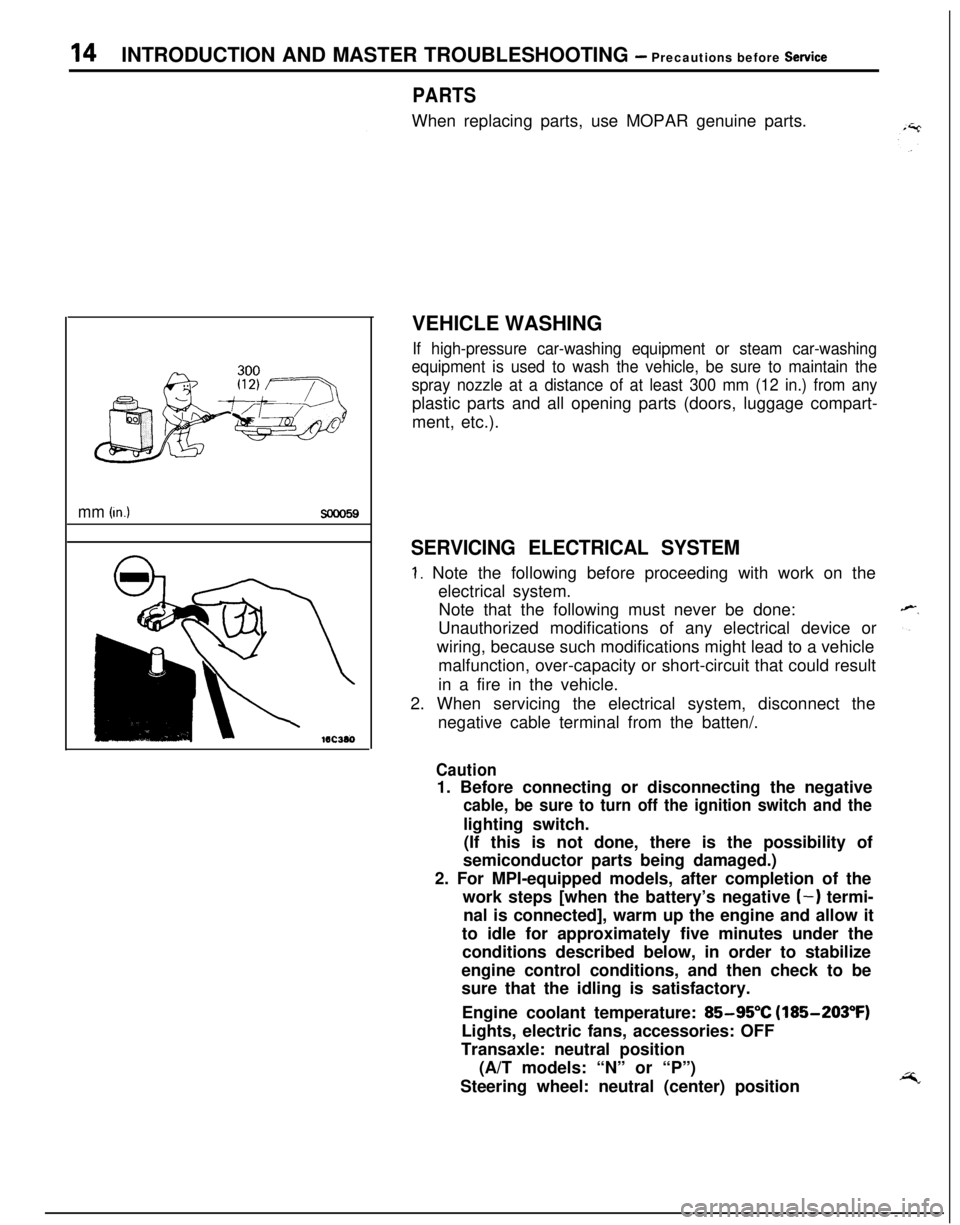
VEHICLE WASHING
If high-pressure car-washing equipment or steam car-washing
equipment is used to wash the vehicle, be sure to maintain the
spray nozzle at a distance of at least 300 mm (12 in.) from anyplastic parts and all opening parts (doors, luggage compart-
ment, etc.).
SERVICING ELECTRICAL SYSTEM
1. Note the following before proceeding with work on the
electrical system.
Note that the following must never be done:
Unauthorized modifications of any electrical device or
wiring, because such modifications might lead to a vehicle
malfunction, over-capacity or short-circuit that could result
in a fire in the vehicle.
2. When servicing the electrical system, disconnect the
negative cable terminal from the batten/.
Caution1. Before connecting or disconnecting the negative
cable, be sure to turn off the ignition switch and thelighting switch.
(If this is not done, there is the possibility of
semiconductor parts being damaged.)
2. For MPI-equipped models, after completion of the
work steps [when the battery’s negative
(-) termi-
nal is connected], warm up the engine and allow it
to idle for approximately five minutes under the
conditions described below, in order to stabilize
engine control conditions, and then check to be
sure that the idling is satisfactory.
Engine coolant temperature:
85-95°C (185-203°F)
Lights, electric fans, accessories: OFF
Transaxle: neutral position
(A/T models: “N” or “P”)
Steering wheel: neutral (center) position
Page 16 of 1216
16INTRODUCTION AND MASTER TROUBLESHOOTING - Precautions before Service
Cl6362
OOYSssOOV833
10A15A
COY5695. Connect connectors which have catches by inserting the
connectors until they snap.
9%
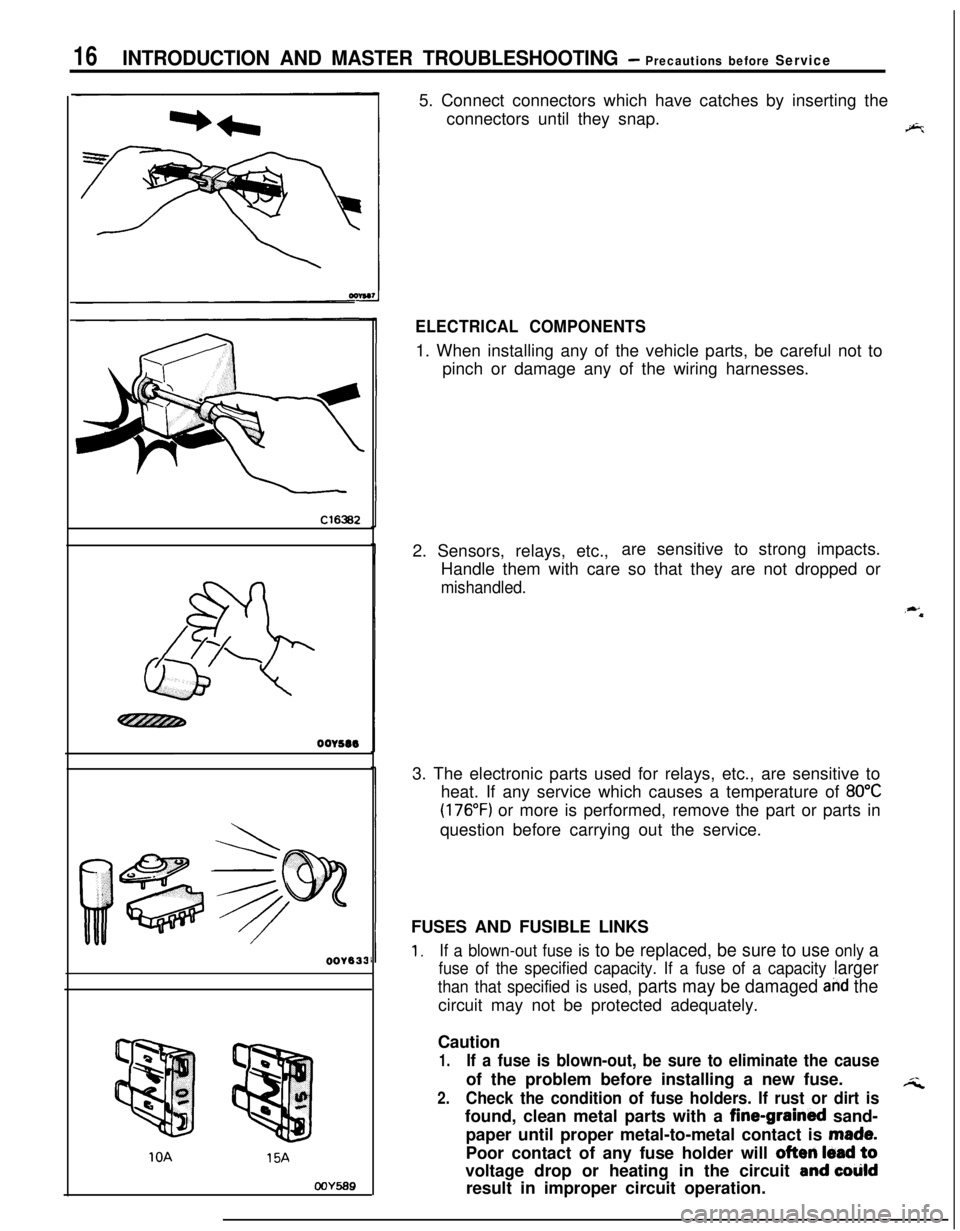
ELECTRICAL COMPONENTS1. When installing any of the vehicle parts, be careful not to
pinch or damage any of the wiring harnesses.
2. Sensors, relays, etc.,are sensitive to strong impacts.
Handle them with care so that they are not dropped or
mishandled.
,**3. The electronic parts used for relays, etc., are sensitive to
heat. If any service which causes a temperature of
80°C
(176°F) or more is performed, remove the part or parts in
question before carrying out the service.
FUSES AND FUSIBLE LINKS
1.If a blown-out fuse is to be replaced, be sure to use only a
fuse of the specified capacity. If a fuse of a capacity larger
than that specified is used, parts may be damaged and thecircuit may not be protected adequately.
Caution
1.If a fuse is blown-out, be sure to eliminate the causeof the problem before installing a new fuse.
;i2.Check the condition of fuse holders. If rust or dirt isfound, clean metal parts with a fine-grained sand-
paper until proper metal-to-metal contact is
made.Poor contact of any fuse holder will
often lead tovoltage drop or heating in the circuit
and colildresult in improper circuit operation.
Page 17 of 1216
INTRODUCTION AND MASTER TROUBLESHOOTING - Precautions before Sew&e‘37
Nominal
sizeSAE
gi:ePermissible current
In engine
Othercompart-areasment
0.3mm2AWG22-5A
0.5
mm2AWG207A13A
0.85
mm’AWG189A17A
1.25
mm2AWG1612A22A
2.0mm2AWG1416A30A
3.0mm’AWG1221A40A
5.0mm2AWG1031A54A
r ‘.
oorsas
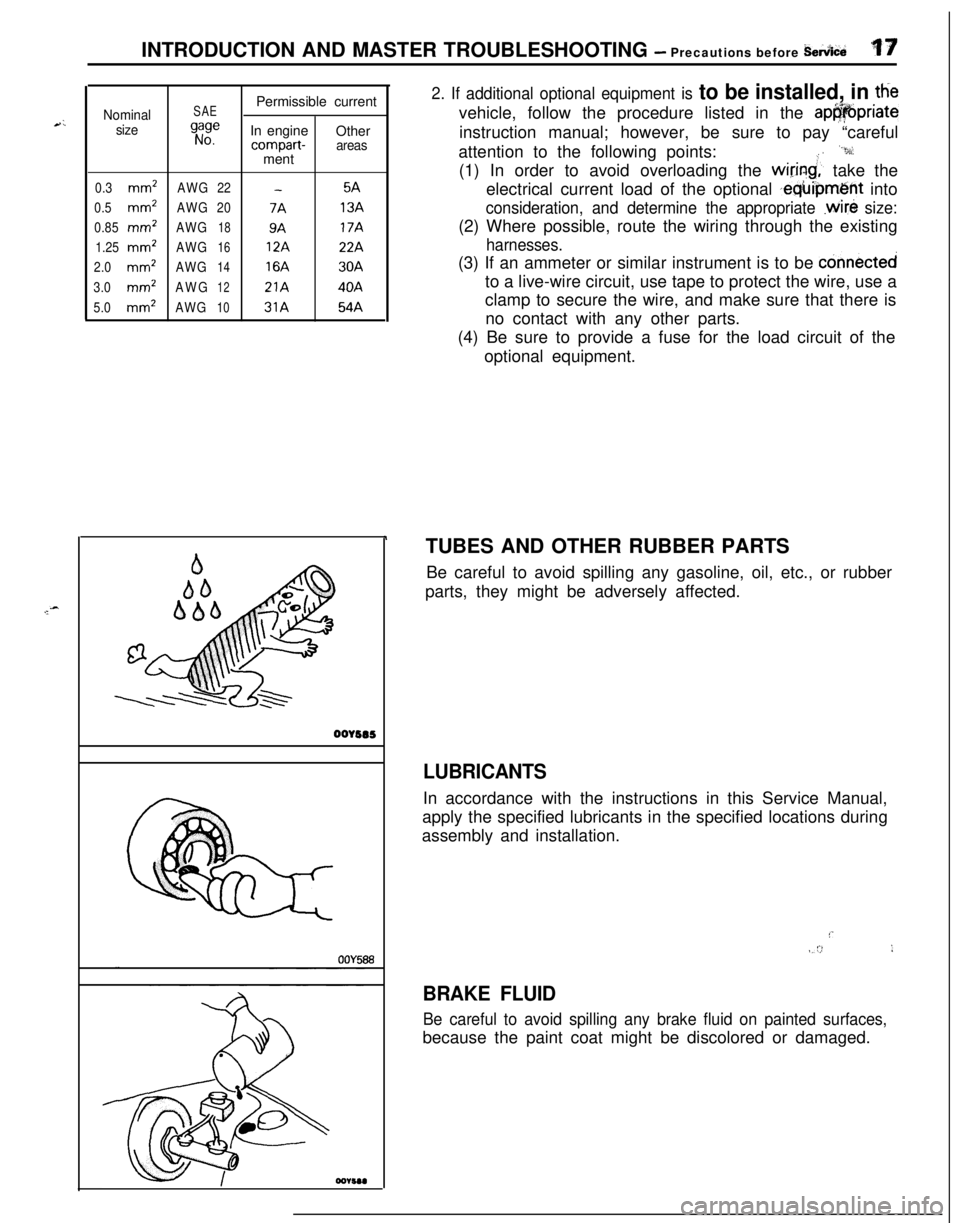
2. If additional optional equipment is to be installed, in ttievehicle, follow the procedure listed in the
ap@@priateinstruction manual; however, be sure to pay “careful
attention to the following points:
“9:(1) In order to avoid overloading the
wiring;’ take the
electrical current load of the optional
,equipment into
consideration, and determine the appropriate .wire size:(2) Where possible, route the wiring through the existing
harnesses.(3) If an ammeter or similar instrument is to be
connectedto a live-wire circuit, use tape to protect the wire, use a
clamp to secure the wire, and make sure that there is
no contact with any other parts.
(4) Be sure to provide a fuse for the load circuit of the
optional equipment.
TUBES AND OTHER RUBBER PARTS
Be careful to avoid spilling any gasoline, oil, etc., or rubber
parts, they might be adversely affected.
LUBRICANTSIn accordance with the instructions in this Service Manual,
apply the specified lubricants in the specified locations during
assembly and installation.
!’IV/ :>,I
BRAKE FLUID
Be careful to avoid spilling any brake fluid on painted surfaces,because the paint coat might be discolored or damaged.
Page 149 of 1216

BRAKES - Anti-lock Braking System Troubleshooting5-9
ANTI-LOCK BRAKING SYSTEM
-- TROUBLESHOOTINGNO!JEBAE
PARTICULAR CHARACTERISTICS OF
THE ANTI-LOCK BRAKING SYSTEMModels equipped with the anti-lock braking system
(A.B.S.) may exhibit one or more of the following
characteristics from time to time, but none of these
is abnormal.
(1) A pulsing feeling in the brake pedal, or vibration
of the body or the steering wheel, when the
anti-lock braking system is activated by sudden
braking or by braking on a slippery road surface.Actually, this phenomenon is an indication that
the anti-lock braking system is functioning nor-
mally.(2) When the vehicle speed reaches approximately
6 km/h (4 mph) after the engine is started and
the vehicle starts off (for the first time), a
whining motor noise may be heard from the
engine compartment if the vehicle is traveling in
a quiet place, but this noise is simply the result
of a self-check being made of the anti-lock
braking system operation.
TROUBLESHOOTING METHODSProblems related to the anti-lock braking system
(A.B.S.) can be classified into two general categor-
ies: problems in the electrical system and those in
the hydraulic system.For problems in the electrical system, the
self-diagnosis function is built into the electronic control
unit (E.C.U.) causing the A.B.S. warning light to
illuminate as a warning to the driver.
Problems in the hydraulic system (poor braking,
etc.) can be located in the same way as for ordinary
brakes. There is, however, the necessity to check todetermine whether the problem is related to ordin-
ary brake components or to the components relatedto the A.B.S.
HOW TO USE THE TROUBLESHOOTING
FLOW CHART(1) Using the flow chart, check the ABS warning
light light-up sequence and check the condition
of braking operation.
(2) Following the check chart listed in the remedy
column, perform the checks. There are [Explana-tion] and [Hint] in each check chart. Refer to
them when troubleshooting.
NOTEECU: Electronic control unit
HU: Hydraulic unit
MUT: Multi-use tester
Page 150 of 1216
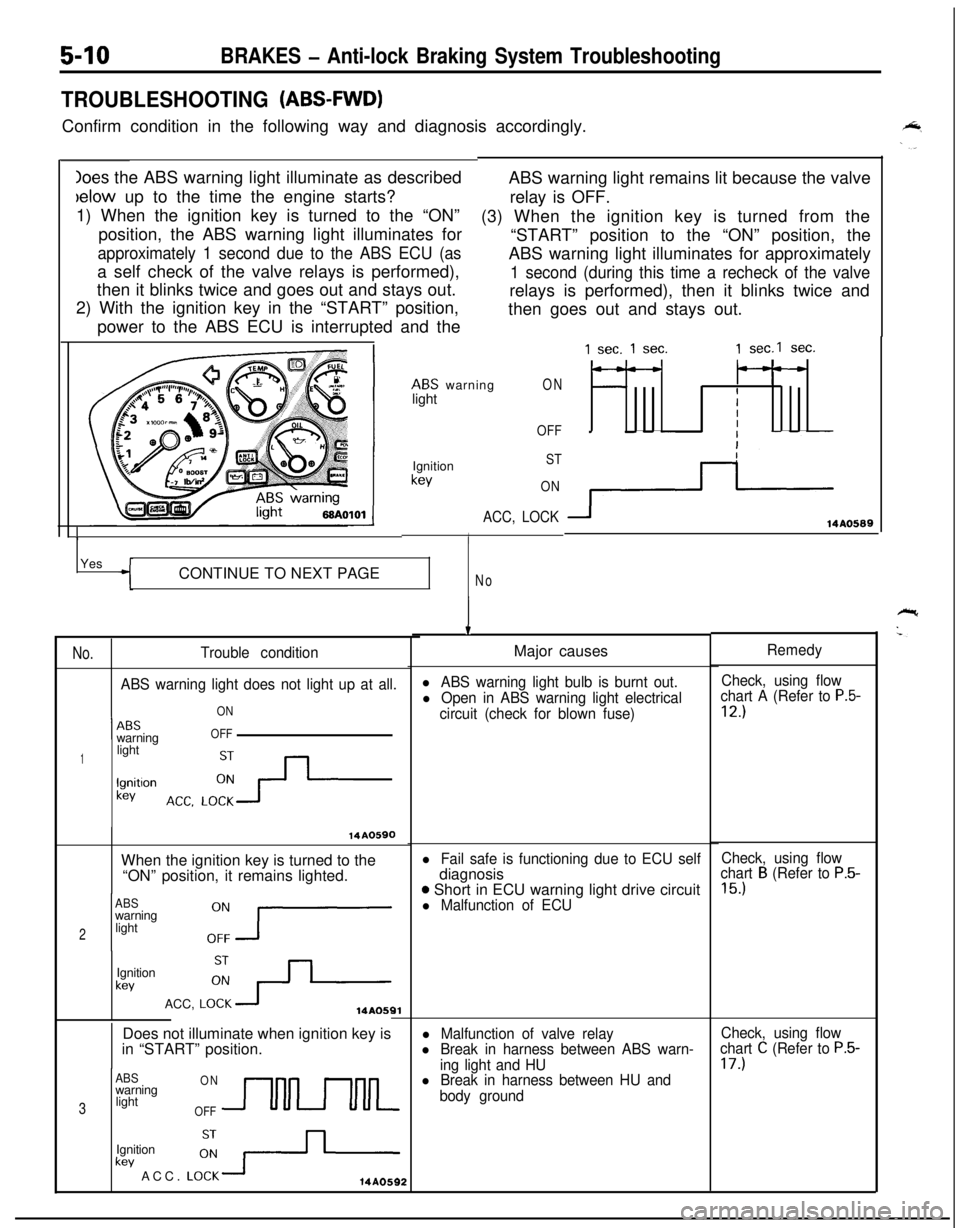
Ioes the ABS warning light illuminate as describedbelow up to the time the engine starts?
1) When the ignition key is turned to the “ON”
position, the ABS warning light illuminates for
approximately 1 second due to the ABS ECU (asa self check of the valve relays is performed),
then it blinks twice and goes out and stays out.
2) With the ignition key in the “START” position,
power to the ABS ECU is interrupted and the
5-10BRAKES - Anti-lock Braking System Troubleshooting
TROUBLESHOOTING (ABS-FWD)Confirm condition in the following way and diagnosis accordingly.
ABS warning light remains lit because the valve
relay is OFF.
(3) When the ignition key is turned from the
“START” position to the “ON” position, the
ABS warning light illuminates for approximately
1 second (during this time a recheck of the valverelays is performed), then it blinks twice and
then goes out and stays out.
ABS warning
lightON
OFF
1Ignition
kev
ST
ON
ACC, LOCK
IYes
CONTINUE TO NEXT PAGE
No
No.Trouble condition
ABS warning light does not light up at all.
ON
1 --ABSwarningOFF
1lightlgnitlon
kev
14A0590When the ignition key is turned to the
“ON” position, it remains lighted.
ABSwarning
2light
Ignition
kevACC,
LO:+14AOSQlDoes not illuminate when ignition key is
in “START” position.
ABSONwarning
3lightOFFUULkev ACC.
LO:-+-Ignition14A0592
1 sec. 1 sec.1 sec.1 sec.
---
IIII
3114AO589
IMajor causes
l ABS warning light bulb is burnt out.Check, using flow
l Open in ABS warning light electricalchart A (Refer to P.5-
circuit (check for blown fuse)12.)
l Fail safe is functioning due to ECU selfdiagnosis
o Short in ECU warning light drive circuitl Malfunction of ECU
l Malfunction of valve relayl Break in harness between ABS warn-
ing light and HU
l Break in harness between HU and
body groundRemedy
Check, using flow
chart
B (Refer to P.5-
15.)
Check, using flow
chart C (Refer to P.5-17.)
Page 151 of 1216
BRAKES - Anti-lock Braking System Troubleshooting5-14
./
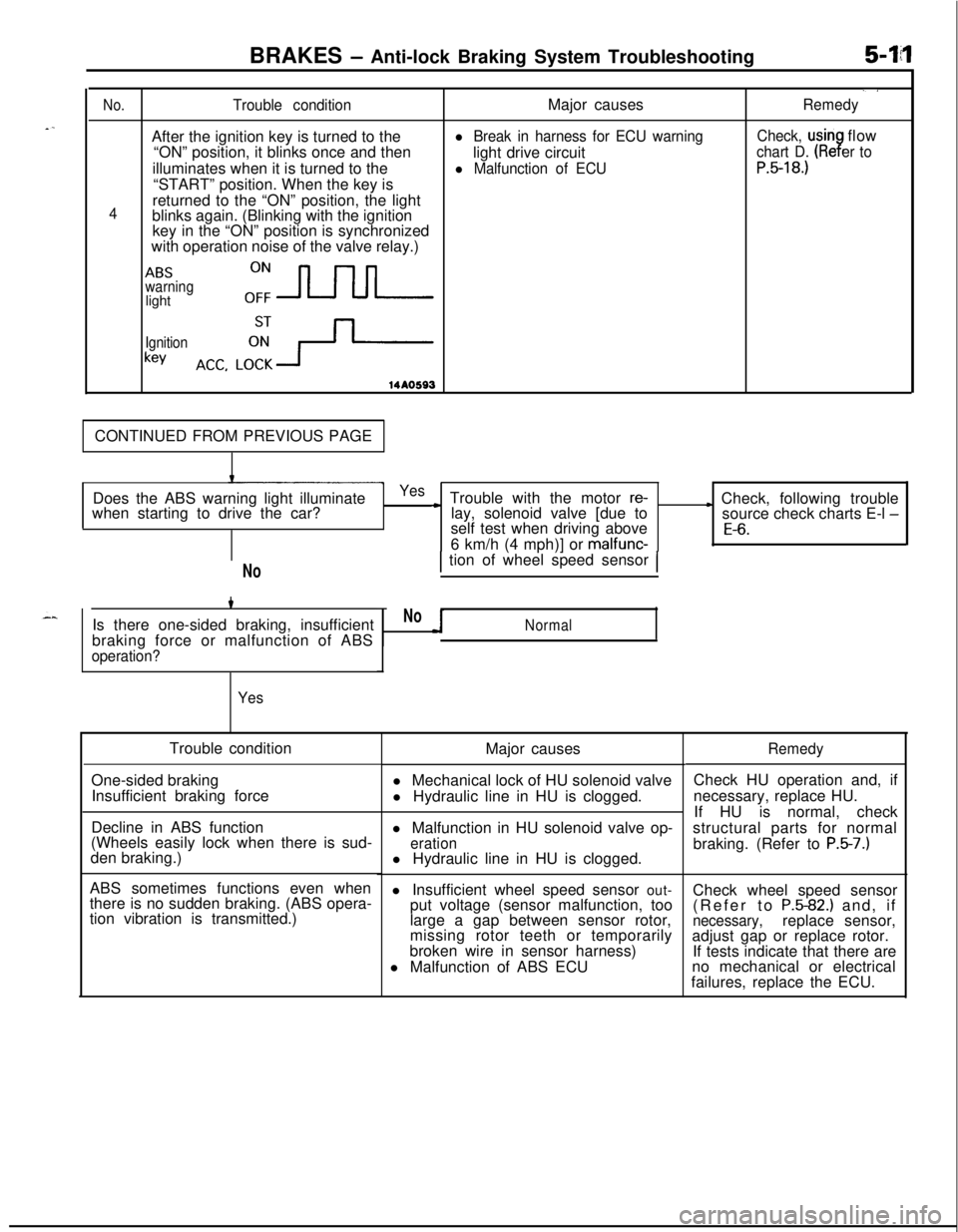
No.Trouble conditionMajor causesRemedyAfter the ignition key is turned to the
l Break in harness for ECU warningCheck, usinflow
“ON” position, it blinks once and then
light drive circuit
chart D. (Re er to9illuminates when it is turned to the
l Malfunction of ECUP.5-18.)“START” position. When the key is
4returned to the “ON” position, the light
blinks again. (Blinking with the ignition
key in the “ON” position is synchronized
with operation noise of the valve relay.)
ABSwarninglighto:-
Ignition
keyACC. LCi+-
14*0593CONTINUED FROM PREVIOUS PAGE
Does the ABS warning light illuminate
when starting to drive the car?
Yes~ Trouble with the motor re-lay, solenoid valve [due toL Check, following trouble
source check charts E-l -self test when driving above
E-6.6 km/h (4 mph)] or malfunc-
NoIs there one-sided braking, insufficient
braking force or malfunction of ABS
operation?
YesTrouble condition
Major causes
One-sided braking
Insufficient braking forcel Mechanical lock of HU solenoid valve
l Hydraulic line in HU is clogged.
Decline in ABS function
(Wheels easily lock when there is sud-
den braking.)
ABS sometimes functions even when
there is no sudden braking. (ABS opera-
tion vibration is transmitted.)
1 tion of wheel speed sensor 1
NoNormall Malfunction in HU solenoid valve op-
erationl Hydraulic line in HU is clogged.
l Insufficient wheel speed sensor out-
put voltage (sensor malfunction, too
large a gap between sensor rotor,
missing rotor teeth or temporarily
broken wire in sensor harness)
l Malfunction of ABS ECU
RemedyCheck HU operation and, if
necessary, replace HU.
If HU is normal, check
structural parts for normal
braking. (Refer to
P.5-7.)Check wheel speed sensor
(Refer to
P.5-82.) and, ifnecessary,replace sensor,
adjust gap or replace rotor.
If tests indicate that there are
no mechanical or electrical
failures, replace the ECU.
Page 165 of 1216
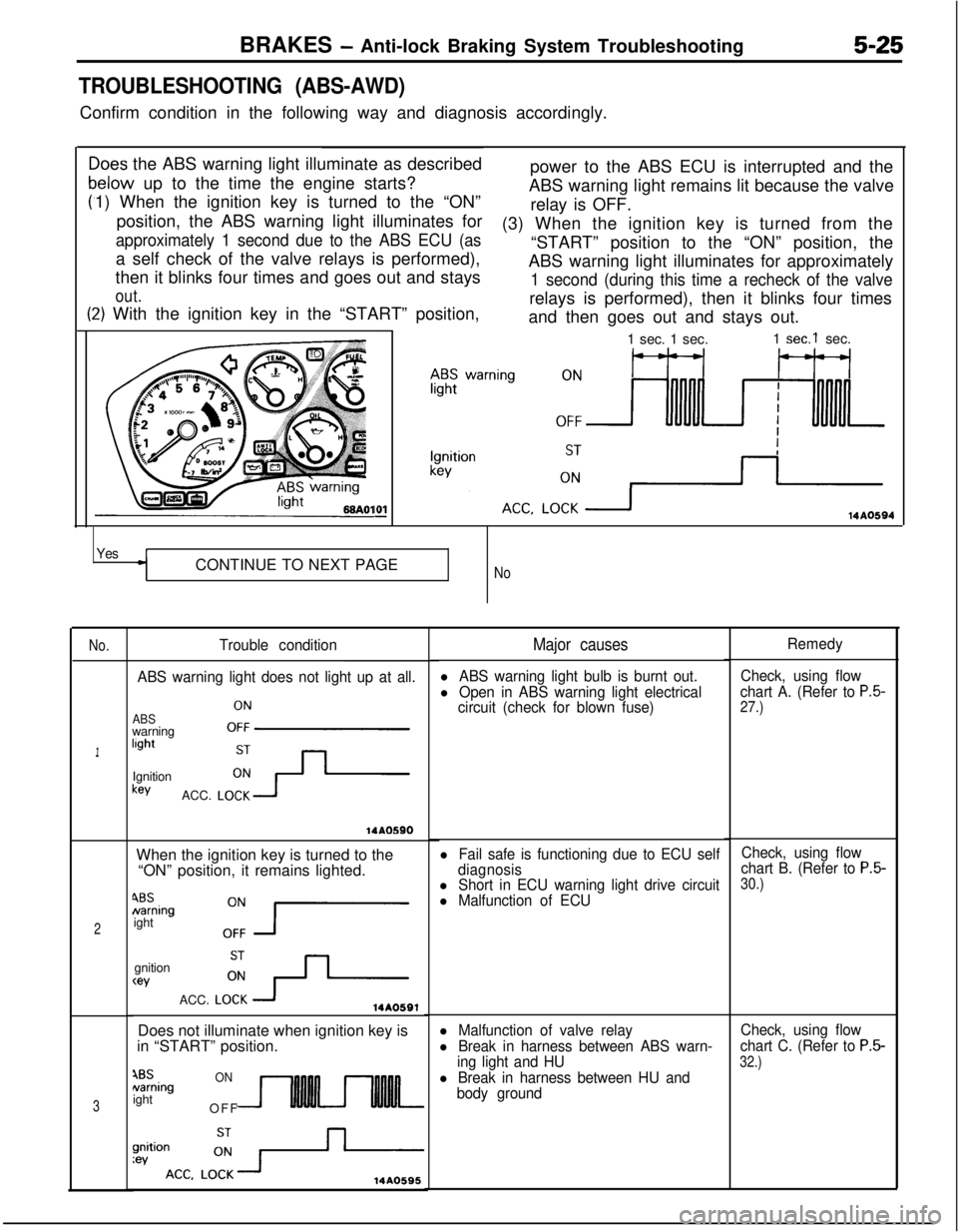
BRAKES - Anti-lock Braking System Troubleshooting5-25
TROUBLESHOOTING (ABS-AWD)Confirm condition in the following way and diagnosis accordingly.
C
F
>oes the ABS warning light illuminate as described
relow up to the time the engine starts?
1) When the ignition key is turned to the “ON”
position, the ABS warning light illuminates for
approximately 1 second due to the ABS ECU (asa self check of the valve relays is performed),
then it blinks four times and goes out and stays
out.power to the ABS ECU is interrupted and the
ABS warning light remains lit because the valve
relay is OFF.
t:2) With the ignition key in the “START” position,(3) When the ignition key is turned from the
“START” position to the “ON” position, the
ABS warning light illuminates for approximately
1 second (during this time a recheck of the valverelays is performed), then it blinks four times
and then goes out and stays out.IO1
-1 sec. 1 sec.1
sec.1 sec.
14AO594
YesCONTINUE TO NEXT PAGE
No
No.
1
2
3
Trouble condition
ABS warning light does not light up at all.
ABSwarninglightOFFIgnitionkey
ACC.
LO;-+
14AOSSOWhen the ignition key is turned to the
“ON” position, it remains lighted.
4BSNamingight
0:7gnition
wACC.
LO:+14A0591Does not illuminate when ignition key is
in “START” position.
4BSNamingightONOFF
14A0595
Major causes
l ABS warning light bulb is burnt out.
l Open in ABS warning light electrical
circuit (check for blown fuse)
l Fail safe is functioning due to ECU self
diagnosis
l Short in ECU warning light drive circuitl Malfunction of ECU
l Malfunction of valve relay
l Break in harness between ABS warn-
ing light and HU
l Break in harness between HU and
body groundRemedy
Check, using flow
chart A. (Refer to
P.5-27.)
Check, using flow
chart B. (Refer to P.5-30.)
Check, using flow
chart C. (Refer to
P.5-
32.)
Page 166 of 1216
5-26BRAKES - Anti-lock Braking System Troubleshooting
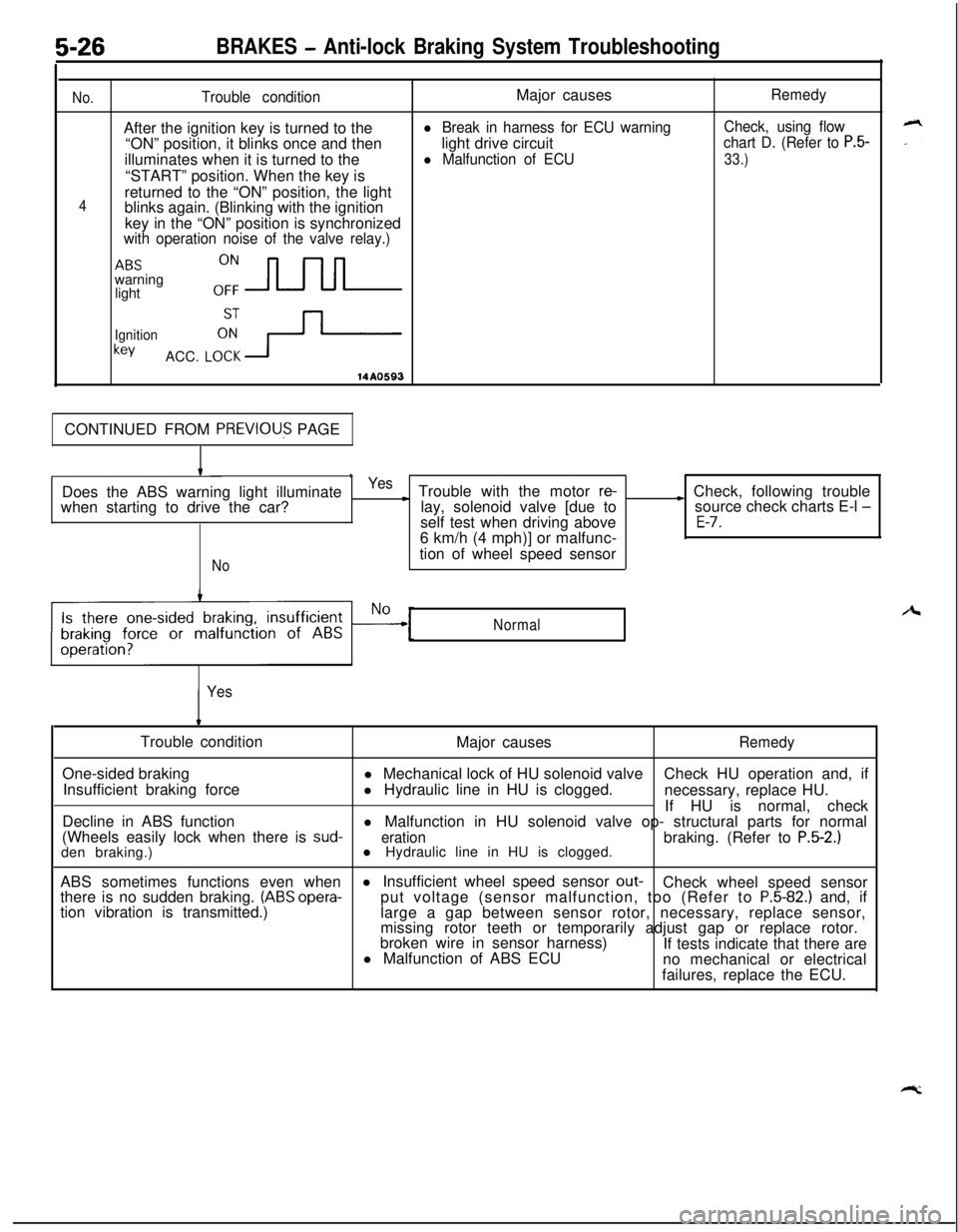
No.Trouble conditionMajor causesRemedyAfter the ignition key is turned to the
l Break in harness for ECU warningCheck, using flow“ON” position, it blinks once and thenlight drive circuitchart D. (Refer to P.5-illuminates when it is turned to the
l Malfunction of ECU33.)“START” position. When the key is
returned to the “ON” position, the light
4blinks again. (Blinking with the ignition
key in the “ON” position is synchronized
with operation noise of the valve relay.)
ABSwarning
light
0:~
Ignition
keyACC. iv-
14A0593CONTINUED FROM
PREVIOU? PAGE
I ,
Does the ABS warning light illuminateYes* Check, following trouble
when starting to drive the car?L Trouble with the motor re-lay, solenoid valve [due to
self test when driving above
6 km/h (4 mph)] or malfunc-source check charts E-l -E-7.
Notion of wheel speed sensor
Normal
YesTrouble condition
Major causes
RemedyOne-sided brakingl Mechanical lock of HU solenoid valveCheck HU operation and, if
Insufficient braking forcel Hydraulic line in HU is clogged.
necessary, replace HU.
If HU is normal, check
Decline in ABS functionl Malfunction in HU solenoid valve op- structural parts for normal
(Wheels easily lock when there is
sud-
erationbraking. (Refer to P.5-2.)den braking.)l Hydraulic line in HU is clogged.
ABS sometimes functions even whenl Insufficient wheel speed sensor
out-Check wheel speed sensor
there is no sudden braking. (ABS opera-put voltage (sensor malfunction, too (Refer to P.5-82.) and, if
tion vibration is transmitted.)
large a gap between sensor rotor, necessary, replace sensor,
missing rotor teeth or temporarily adjust gap or replace rotor.
broken wire in sensor harness)
If tests indicate that there are
l Malfunction of ABS ECU
no mechanical or electrical
failures, replace the ECU.
Page 250 of 1216
7-2COOLING - Specifications
SPECIFICATIONS
GENERAL SPECIFICATIONSIcNQ7cA- I
ItemsCooling method
Radiator
TypeRadiator fan motor
TypeWater pump
Type
Thermostat
TypeIdentification mark
Drive belt
TypeEngine coolant temperature gauge unit
WeEngine coolant temperature sensor (Engine control)
TypeEngine coolant temperature switch (Air conditioner)
WeSpecifications
Water-cooled, pressurized, forced circulation
with electrical fan
Pressurized corrugated fin type
Direct current ferrite type
Impeller of centrifugal type
Wax pellet type with jiggle valve
88 (Stamped on flange)
V-ribbed belt
Thermistor type
Thermistor type
Thermistor type
SERVICE SPECIFICATIONSN07CB.-
Items
Standard valueRange of coolant antifreeze concentration
%
ThermostatValve opening temperature of thermostat
“C (“F)Full-opening temperature of thermostat
“C (“F)Opening pressure of cap high pressure valve
kPa (psi)
Therm0 sensor (on radiator)
Operating temperature
OFF
+ ON“C (“F)ON
--P OFF“C (“F)Engine coolant temperature gauge unit
ResistanceAt
70°C (158°F) QEngine coolant temperature sensor (Engine control)
ResistanceAt
20°C (68°F) kQAt
80°C (176°F) QEngine coolant temperature
switch (Air conditioner)
ON -+ OFF operating temperature
“C (“F)Limit
Opening pressure cap high pressure valve
kPa (psi)
Specifications
30-6088 (190)
100 (212) or more
75-105 (11-15)
82-88 (180-190)
78 (172) or less
104f 13.5
2.45
I!I 0.24
296
+ 32
112-l 18 (234-244)
65 (9.2)