check engine MITSUBISHI GALANT 1989 Service Repair Manual
[x] Cancel search | Manufacturer: MITSUBISHI, Model Year: 1989, Model line: GALANT, Model: MITSUBISHI GALANT 1989Pages: 1273, PDF Size: 37.62 MB
Page 247 of 1273
FUEL SYSTEM
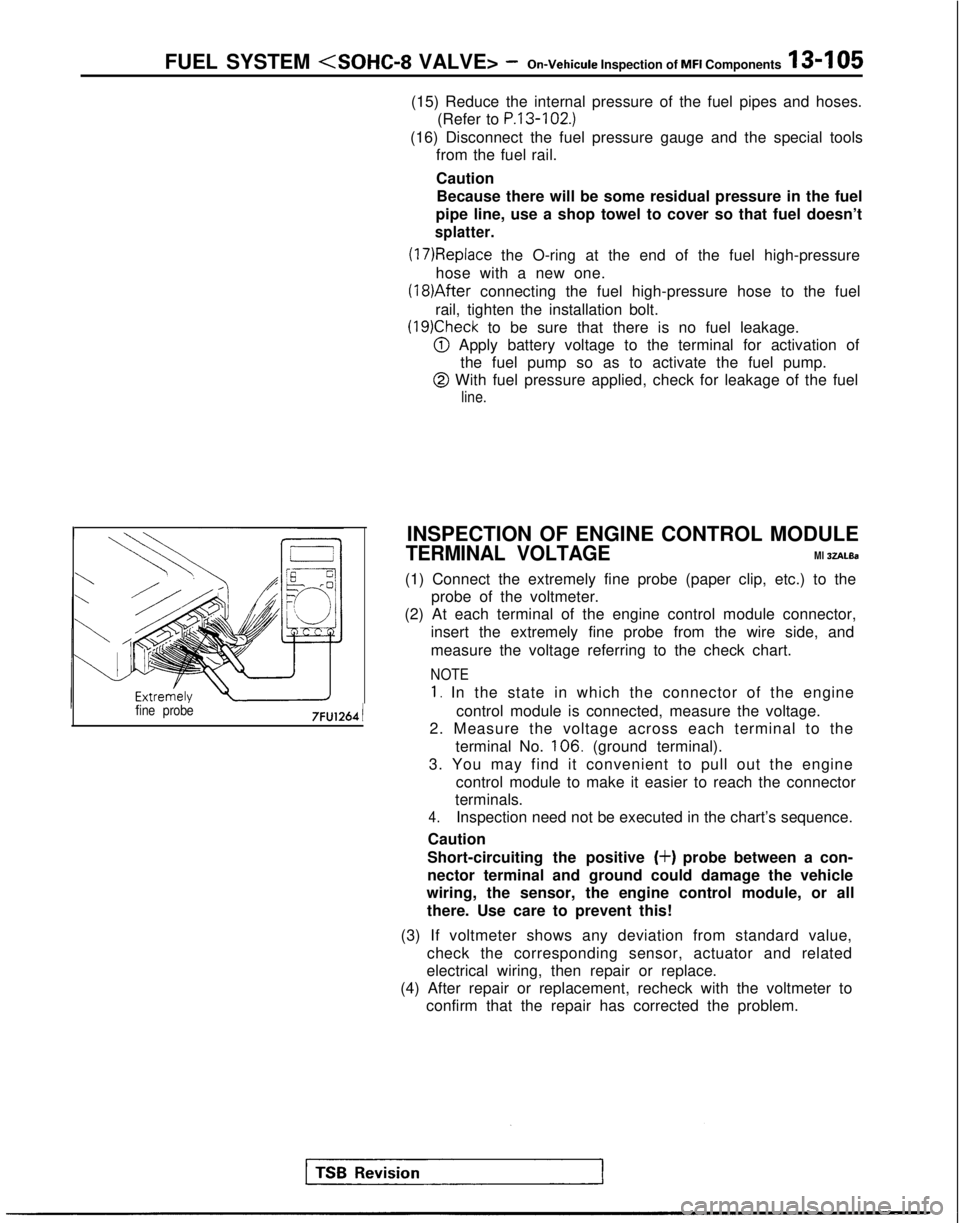
fine probe7FU1264 1
(15) Reduce the internal pressure of the fuel pipes and hoses.
(Refer to
P.13-102.)
(16) Disconnect the fuel pressure gauge and the special toolsfrom the fuel rail.
Caution
Because there will be some residual pressure in the fuel
pipe line, use a shop towel to cover so that fuel doesn’t
splatter.
(17)Replace the O-ring at the end of the fuel high-pressure
hose with a new one. (18)After
connecting the fuel high-pressure hose to the fuel
rail, tighten the installation bolt.
(19)Check to be sure that there is no fuel leakage.
@ Apply battery voltage to the terminal for activation of the fuel pump so as to activate the fuel pump.
@ With fuel pressure applied, check for leakage of the fuel
line.
INSPECTION OF ENGINE CONTROL MODULE
TERMINAL VOLTAGEMl 3ZALBa
(1) Connect the extremely fine probe (paper clip, etc.) to the probe of the voltmeter.
(2) At each terminal of the engine control module connector,
insert the extremely fine probe from the wire side, and
measure the voltage referring to the check chart.
NOTE
1. In the state in which the connector of the engine
control module is connected, measure the voltage.
2. Measure the voltage across each terminal to the
terminal No. 106.
(ground terminal).
3. You may find it convenient to pull out the engine control module to make it easier to reach the connector
terminals.
4.Inspection need not be executed in the chart’s sequence.
Caution
Short-circuiting the positive
(+) probe between a con-
nector terminal and ground could damage the vehicle
wiring, the sensor, the engine control module, or all
there. Use care to prevent this!
(3) If voltmeter shows any deviation from standard value, check the corresponding sensor, actuator and related
electrical wiring, then repair or replace.
(4) After repair or replacement, recheck with the voltmeter to confirm that the repair has corrected the problem.
Page 248 of 1273
13-106
FUEL SYSTEM
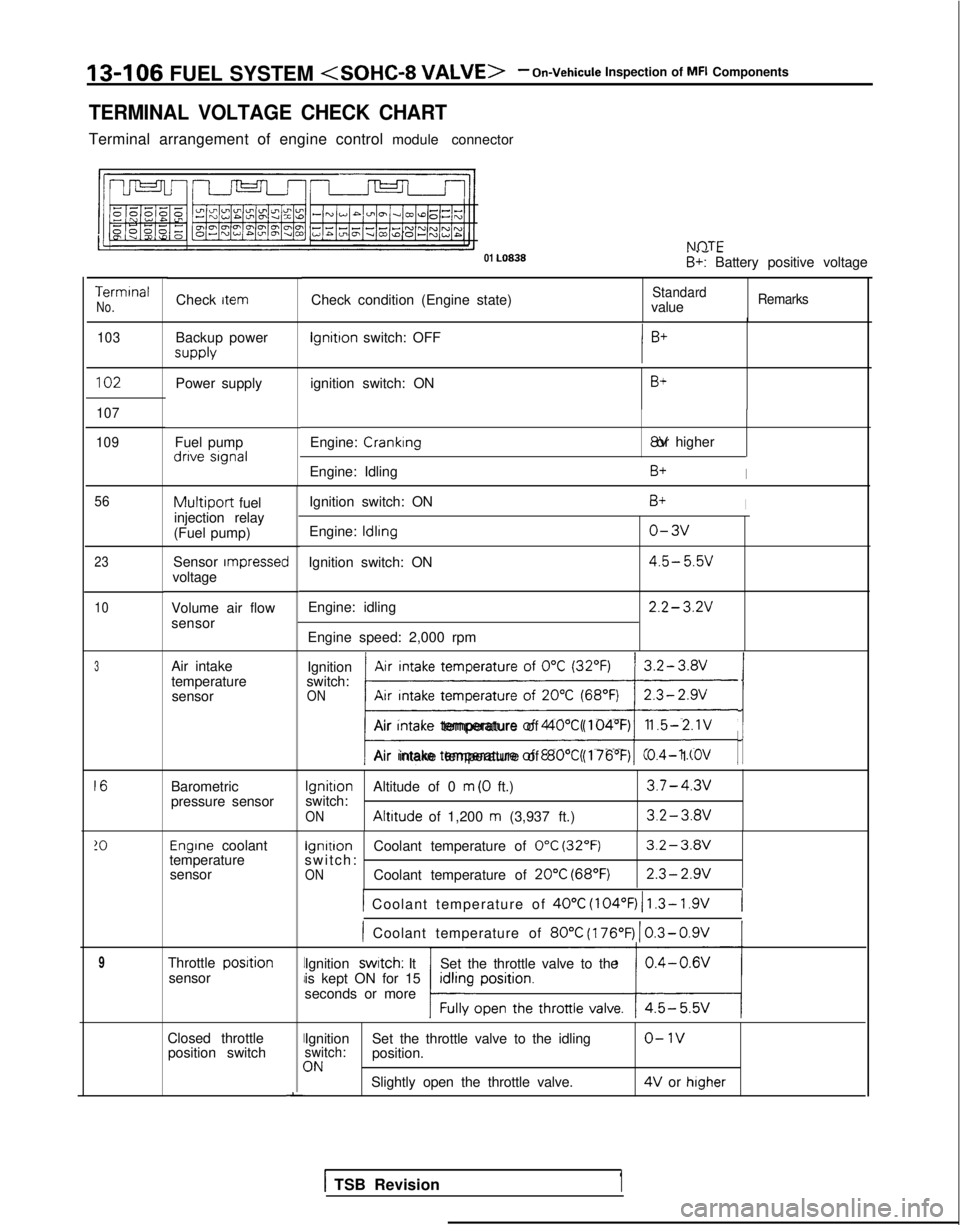
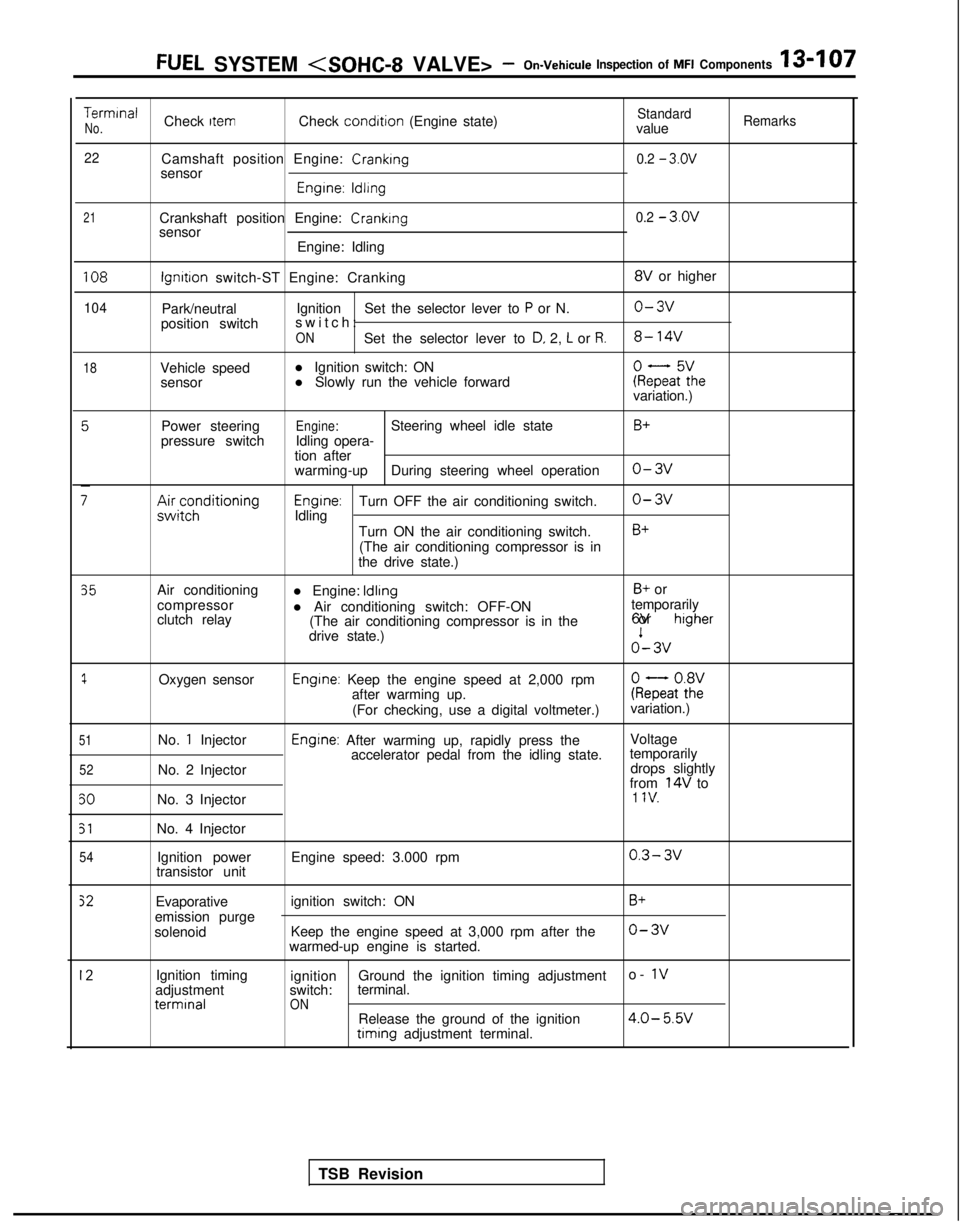
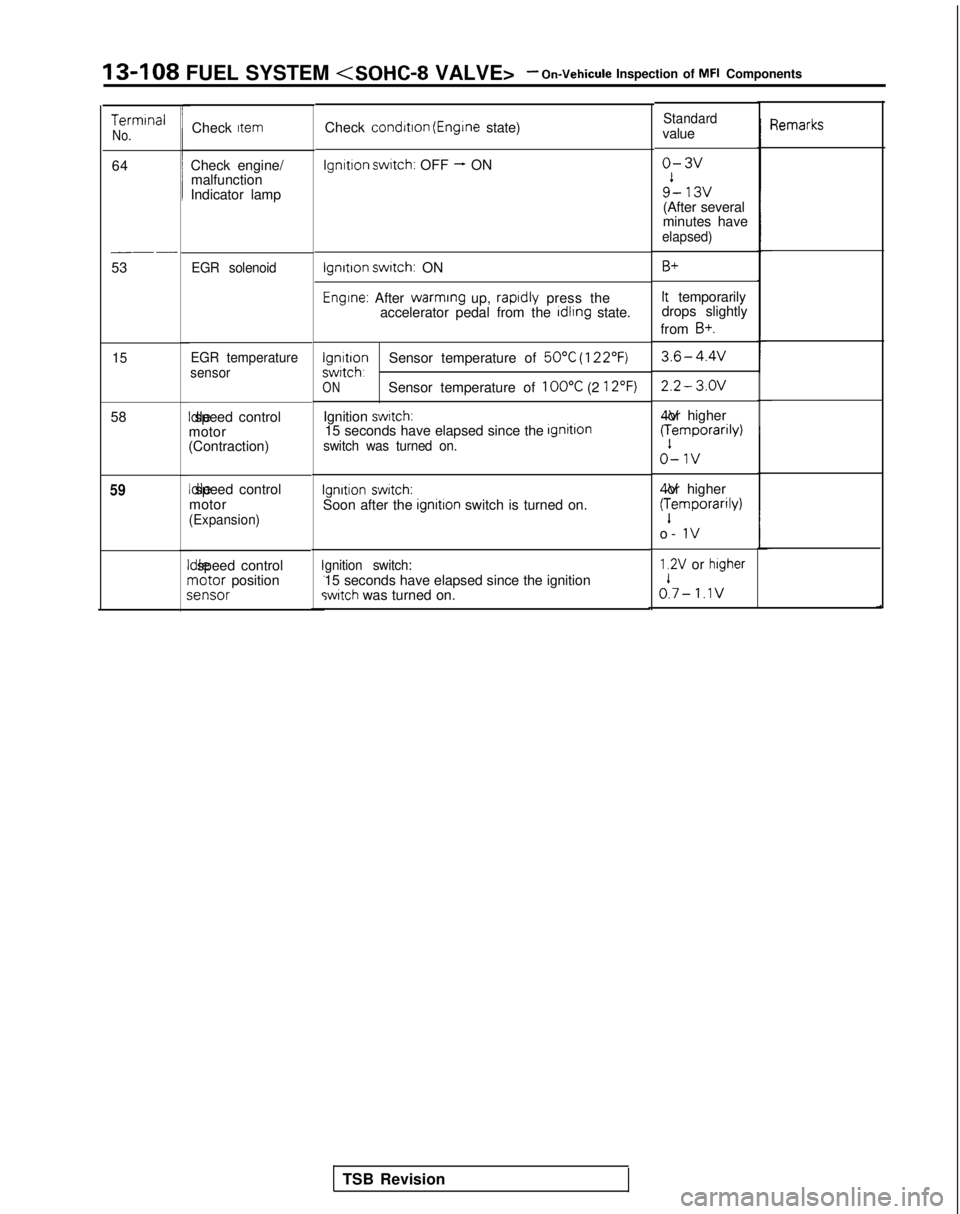
TERMINAL VOLTAGE CHECK CHART
Terminal arrangement of engine control module connector NflTF
01 LO838
. .- -B+: Battery positive voltage
Terminal
No.Check condition (Engine state)StandardvalueRemarksCheck item
103
Backup power supply lgnitron
switch: OFF
102Power supply ignition switch: ONB+
107
109
Fuel pump dnve signal
Engine: Cranking 8V or higher
Engine: Idling
B+I
Ignition switch: ON
Engine:
ldlrng
Ignition switch: ON
Engine: idling
Engine speed: 2,000 rpm
B+I
o-3v
4.5- 5.5v
2.2- 3.2V
56
23
10
Multiport fuel
injection relay
(Fuel pump)
Sensor
rmpressecvoltage
Volume air flow
sensor
Air intake
temperature sensor Ignition
Air intake temperature of
0°C (32°F)switch:ONAir Intake temperature of 20°C (68°F); ji/
Air Intake temperature of 40°C (104°F)1.5-2.1V
Air intake temperature of 80°C (176’F)0.4- 1 .OV
Barometric
pressure sensor
Ignition
Altitude of 0 m (0 ft.)3.7-4.3vswitch:ON Altitude
of 1,200 m (3,937 ft.)3.2-3.av
Engrne coolant lgnitron
Coolant temperature of 0°C (32°F)3.2-3.Wtemperature switch: -sensorONCoolant temperature of 20°C (68°F)2.3-2.9v
1 Coolant temperature of 40°C
(104°F) 1 1.3- 1.9V(
) Coolant temperature of 80°C
(176’F)
1 0.3-0.9V
Throttle posrtionsensor Ignition swatch: It
Set the throttle valve to the
is kept ON for 15
seconds or more
Closed throttle position switchII
I
I
-
Ignition Set the throttle valve to the idlingo-1vswitch:position.3NSlightly open the throttle valve. 4V
or higher
3
16
!O
9
1 TSB Revision1
Page 249 of 1273
FUEL SYSTEM
TerminalCheck ItemCheck condition
(Engine state)StandardNo.valueRemarks
22
Camshaft position Engine: Cranking0.2 - 3.ov
sensor
Engrne: ldllng
21Crankshaft position Engine: Crankingsensor
Engine: Idling0.2 - 3.ov
108
104
18
lgnrtron switch-ST Engine: Cranking 8V
or higher
Park/neutral Ignition
Set the selector lever to
P or N.o-3v
position switch switch
:
ONSet the selector lever to D, 2, L or R.8- 14V
Vehicle speed
l Ignition switch: ON
sensor l Slowly run the vehicle forwardkeFaF:hevariation.)
Power steering
pressure switch
;;ir;z;ditioning
Engine:Steering wheel idle state
Idling opera-
tion after
warming-up During steering wheel operation
Engrne:Turn OFF the air conditioning switch.
Idling
Turn ON the air conditioning switch.(The air conditioning compressor is in
the drive state.)
B+
o-3v
o-3v
B+
35
1
51
52
50
51
54
Air conditioning
compressor
clutch relay
Oxygen sensor
No.
1 Injector
No. 2 Injector
No. 3 Injector
No. 4 Injector Ignition power
transistor unit l Engine: Idling
B+ or
l Air conditioning switch: OFF-ON temporarily
(The air conditioning compressor is in the 6V or
higher
drive state.)o’- 3v
Engine: Keep the engine speed at 2,000 rpm
after warming up. kQatot8h2:
(For checking, use a digital voltmeter.) variation.)
Engine: After warming up, rapidly press the
Voltage
accelerator pedal from the idling state. temporarily
drops slightly
from
14V to1 IV.
Engine speed: 3.000 rpm0.3- 3v
Evaporative
emission purge
solenoid ignition switch: ON
Keep the engine speed at 3,000 rpm after the
warmed-up engine is started.B+
o-3v
12Ignition timing
adjustment terminal
ignition
Ground the ignition timing adjustment o- 1vswitch:
terminal.ONRelease the ground of the ignition4.0- 5.W timing
adjustment terminal.
TSB Revision
Page 250 of 1273
13-108 FUEL SYSTEM
TermrnalNo.
64
__-
53
15
58
59
Check Item
Check engine/
malfunction
Indicator lamp
EGR solenoid
EGR temperature
sensor Idle speed control
motor
(Contraction) Idle speed control
motor
(Expansion)
II
dle speed controlrnotor positions
;ensor
Check
condrtron (Engrne state)
lgnrtron swatch: OFF - ON
lgnrtron swatch: ON
Engine: After warming
up, raprdly press the
accelerator pedal from the rdlrng state.
lgnrtronSensor temperature of 50°C (122°F)swrtch,ONSensor temperature of 100°C (2 12°F)
Ignition swatch:15 seconds have elapsed since the IgnitlOnswitch was turned on.
Ignition switch:Soon after the ignitron switch is turned on.
gnition switch:15 seconds have elapsed since the ignitionswitch was turned on.
Standardvalue
o-3v
9’- 13v(After several
minutes have
elapsed)
B+
It temporarily
drops slightly
from
B+.
3.6-4.4v
2.2- 3.OV 4V or higher
(:emporarily)
o-1v
4V or higher
(:emporarily)
o-
IV
1.2V or higher
A- 1.1v
qemarks
TSB Revision
Page 261 of 1273
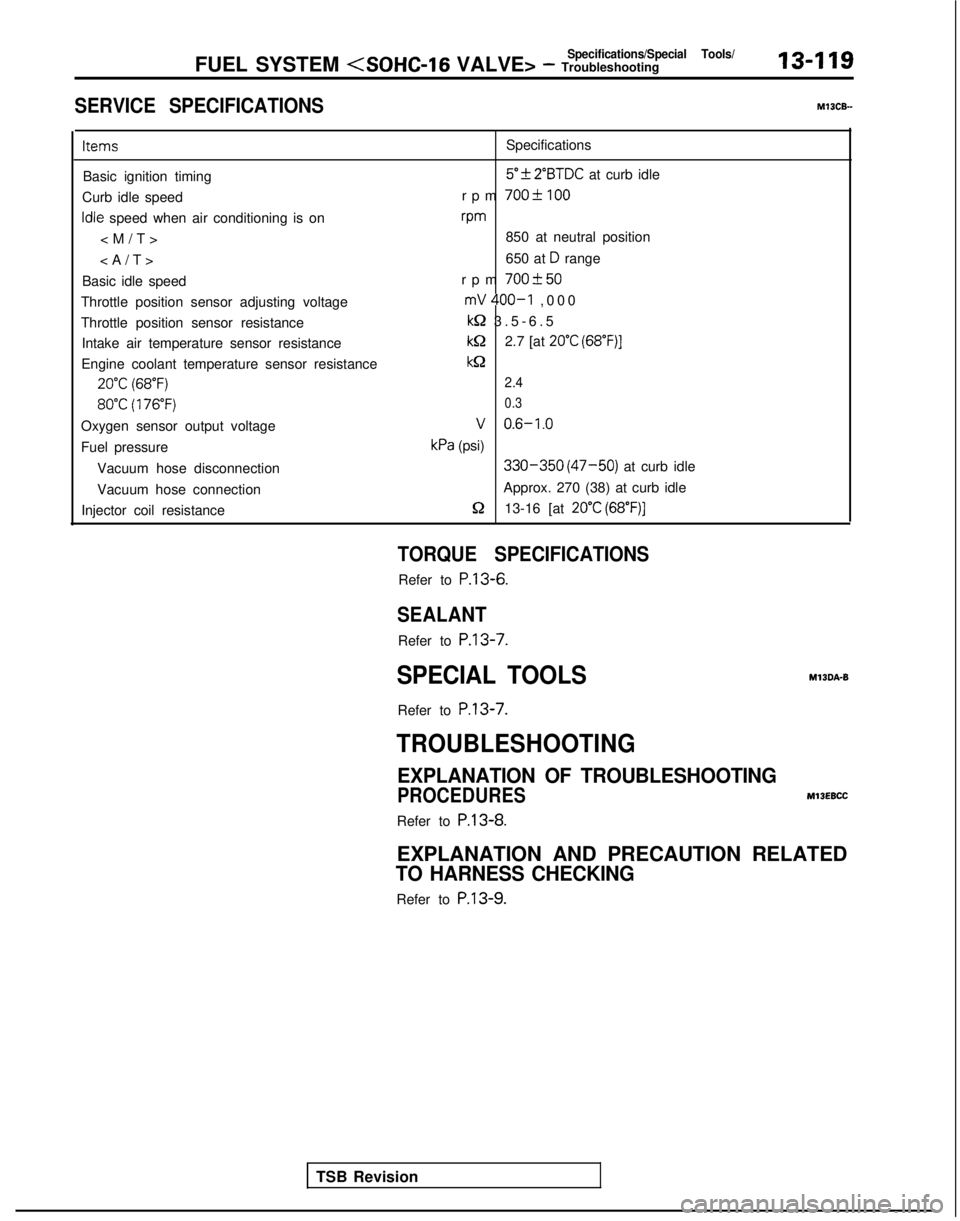
Specifications/Special Tools/FUEL SYSTEM
SERVICE SPECIFICATIONS
13-119 MlOCB-
Items
Specifications
Basic ignition timing
5”f 2”BTDC at curb idle
Curb idle speed rpm
700-C 100
Idle speed when air conditioning is onvm
850 at neutral position
650 at
D range
Basic idle speed rpm
700+50
Throttle position sensor adjusting voltagemV 400-I ,00
0
Throttle position sensor resistance
kQ 3.5-6.
5
Intake air temperature sensor resistance
kQ2.7 [at 20°C (68”F)]
Engine coolant temperature sensor resistancekQ
20°C (68°F)2.4
80°C (176°F) 0.3
Oxygen sensor output voltageV 0.6-1.0
Fuel pressurekPa (psi)
Vacuum hose disconnection
330-350 (47-50) at curb idle
Vacuum hose connection Approx. 270 (38) at curb idle
Injector coil resistance
5213-16 [at 20°C (68”F)]
TSB Revision
TORQUE SPECIFICATIONS
Refer to P.13-6.
SEALANT
Refer to
P.13-7.
SPECIAL TOOLS
Refer to
P.13-7.
MlBDA-B
TROUBLESHOOTING
EXPLANATION OF TROUBLESHOOTING
PROCEDURES
MllEBCC
Refer to P.13-8.
EXPLANATION AND PRECAUTION RELATED
TO HARNESS CHECKING
Refer to P.13-9.
Page 262 of 1273
13-120FUEL SYSTEM
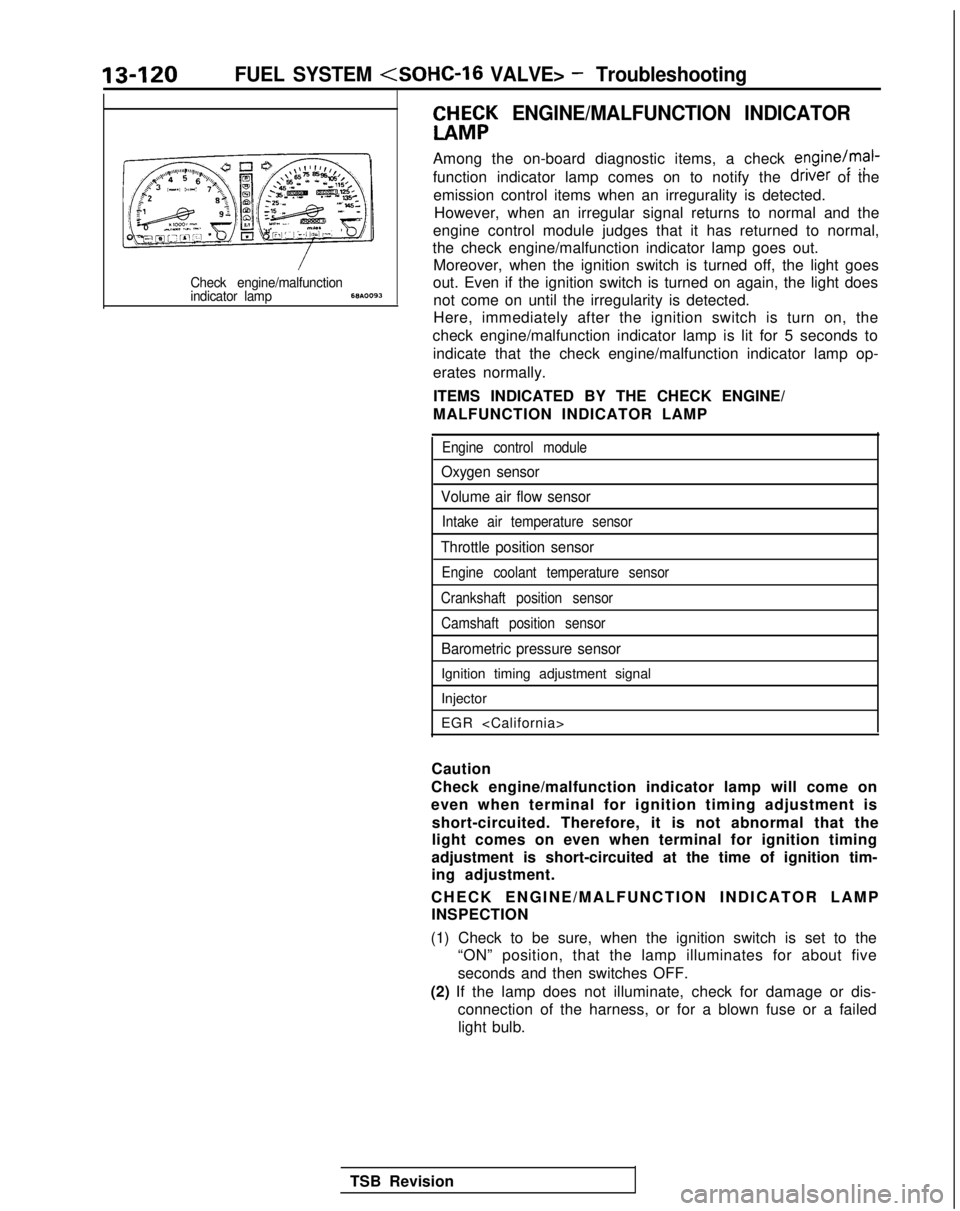
CHH;K
ENGINE/MALFUNCTION INDICATOR
Among the on-board diagnostic items, a check engine/mal-
function indicator lamp comes on to notify the driver
of the
emission control items when an irregurality is detected. However, when an irregular signal returns to normal and the
engine control module judges that it has returned to normal,
the check engine/malfunction indicator lamp goes out. Moreover, when the ignition switch is turned off, the light goes
Check engine/malfunctionout. Even if the ignition switch is turned on again, the light doesindicator lamp68A.0093not come on until the irregularity is detected.
Here, immediately after the ignition switch is turn on, the
check engine/malfunction indicator lamp is lit for 5 seconds to indicate that the check engine/malfunction indicator lamp op-
erates normally.
ITEMS INDICATED BY THE CHECK ENGINE/
MALFUNCTION INDICATOR LAMP
Engine control module
Oxygen sensor
Volume air flow sensor
Intake air temperature sensor
Throttle position sensor
Engine coolant temperature sensor
Crankshaft position sensor Camshaft position sensor
Barometric pressure sensor
Ignition timing adjustment signal
Injector
EGR
Caution
Check engine/malfunction indicator lamp will come on
even when terminal for ignition timing adjustment is short-circuited. Therefore, it is not abnormal that the
light comes on even when terminal for ignition timing
adjustment is short-circuited at the time of ignition tim-
ing adjustment.
CHECK ENGINE/MALFUNCTION INDICATOR LAM
P
INSPECTION
(1) Check to be sure, when the ignition switch is set to the “ON” position, that the lamp illuminates for about five
seconds and then switches OFF.
(2) If the lamp does not illuminate, check for damage or dis- connection of the harness, or for a blown fuse or a failedlight bulb.
TSB Revision
Page 263 of 1273
FUEL SYSTEM
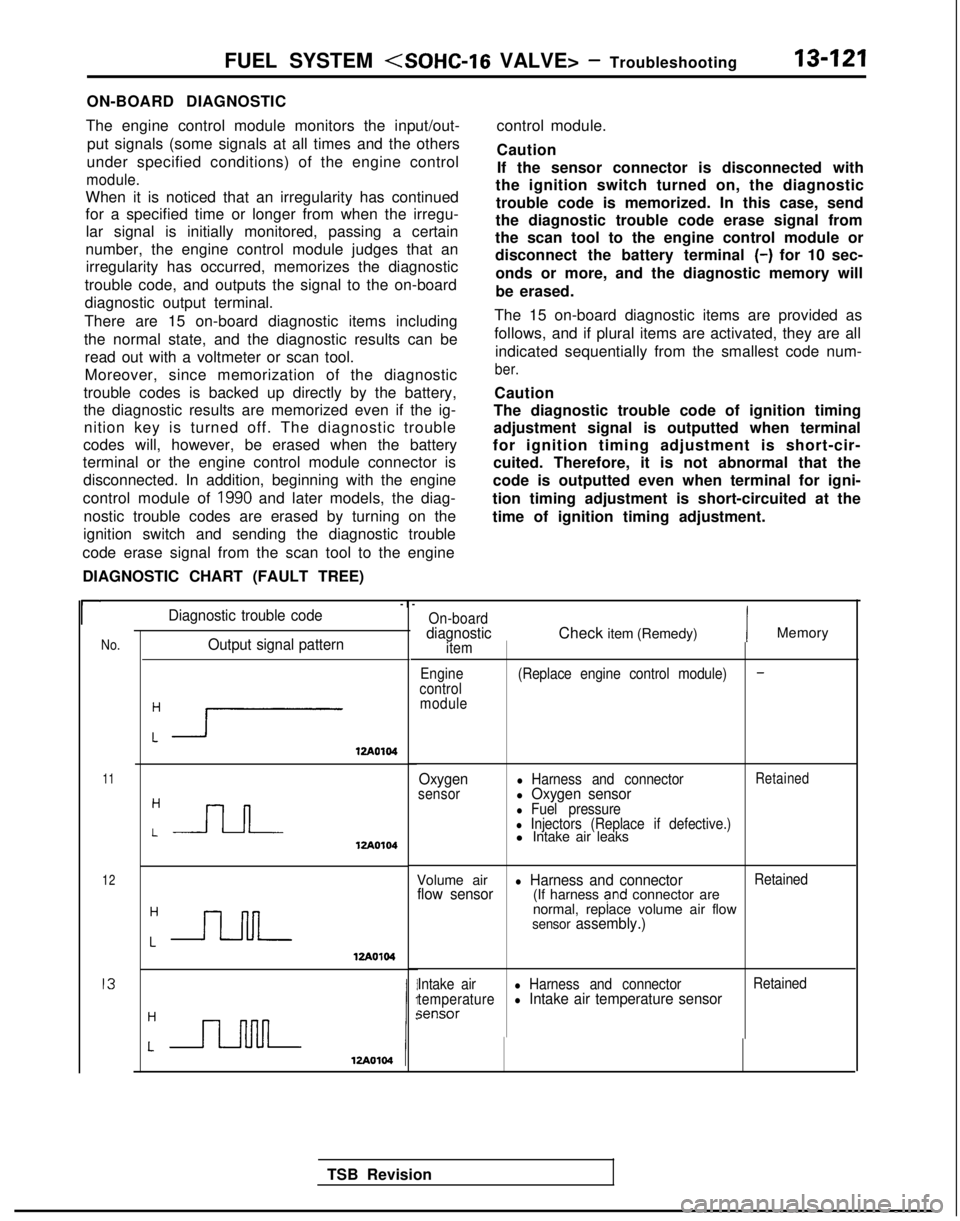
ON-BOARD DIAGNOSTIC
The engine control module monitors the input/out- put signals (some signals at all times and the others
under specified conditions) of the engine control
module.
When it is noticed that an irregularity has continued
for a specified time or longer from when the irregu- lar signal is initially monitored, passing a certain
number, the engine control module judges that an irregularity has occurred, memorizes the diagnostic
trouble code, and outputs the signal to the on-board
diagnostic output terminal.
There are 15 on-board diagnostic items including
the normal state, and the diagnostic results can be read out with a voltmeter or scan tool.
Moreover, since memorization of the diagnostic
trouble codes is backed up directly by the battery,
the diagnostic results are memorized even if the ig- nition key is turned off. The diagnostic trouble
codes will, however, be erased when the battery
terminal or the engine control module connector is
disconnected. In addition, beginning with the engine
control module of
1990 and later models, the diag-
nostic trouble codes are erased by turning on the
ignition switch and sending the diagnostic trouble
code erase signal from the scan tool to the engine
DIAGNOSTIC CHART (FAULT TREE) control module.
Caution
If the sensor connector is disconnected with
the ignition switch turned on, the diagnostic
trouble code is memorized. In this case, send
the diagnostic trouble code erase signal from
the scan tool to the engine control module or
disconnect the battery terminal
(-) for 10 sec-
onds or more, and the diagnostic memory will
be erased.
The 15 on-board diagnostic items are provided as
follows, and if plural items are activated, they are all indicated sequentially from the smallest code num-
ber.
Caution
The diagnostic trouble code of ignition timing
adjustment signal is outputted when terminal
for ignition timing adjustment is short-cir- cuited. Therefore, it is not abnormal that the
code is outputted even when terminal for igni-
tion timing adjustment is short-circuited at the
time of ignition timing adjustment.
r
No.Output signal pattern
:i1zA0104
11
12
I3
:-J-l-J-12Ao104
Diagnostic trouble code-I
-
On-boarddiagnosticitem
Engine
control moduleCheck item (Remedy)IMemory
(Replace engine control module)-
Oxygensensorl Harness and connectorRetainedl Oxygen sensorl Fuel pressurel Injectors (Replace if defective.)l Intake air leaks
Volume air
l Harness and connectorRetainedflow sensor(If harness and connector are
normal, replace volume air flow
sensor assembly.)
Intake airl Harness and connector Retained
temperaturel Intake air temperature sensorsensor
TSB Revision
Page 264 of 1273
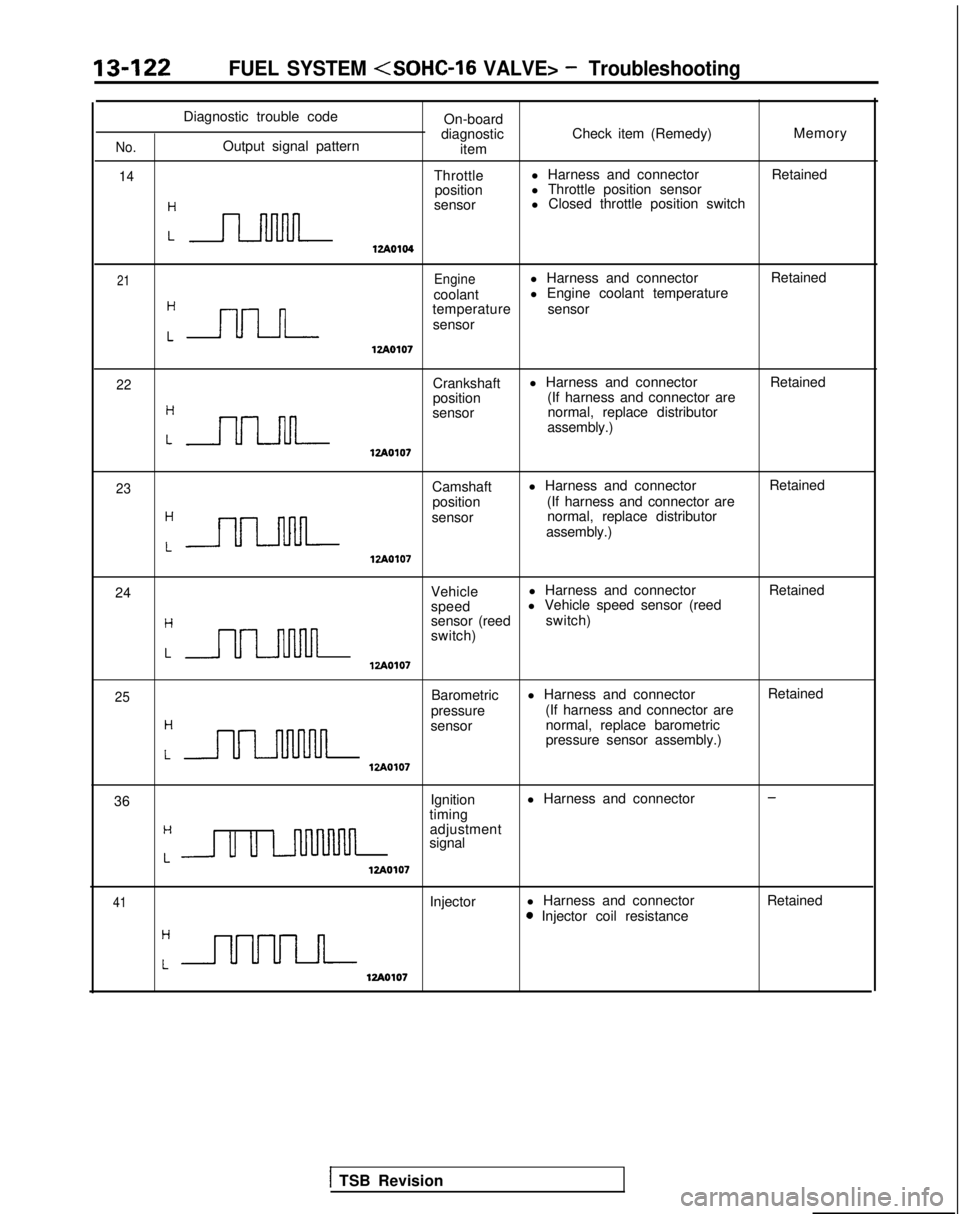
13-122FUEL SYSTEM
Diagnostic trouble codeOn-board
diagnostic Check item (Remedy) Memory
No.Output signal pattern
item
14Throttlel Harness and connector
Retained
position l Throttle position sensor
:n
sensor l Closed throttle position switch
12Ao104
21Enginel Harness and connector
Retained
coolant l Engine coolant temperature
Cnn
temperature
sensor
sensor
lzAO107
22Crankshaft l Harness and connector
Retained
position (If harness and connector are
:nn
sensor normal, replace distributor
assembly.)
lzAOlO7
23Camshaft l Harness and connector
Retained
position (If harness and connector are
:-
sensor normal, replace distributor
assembly.)
12Ao107
24 Vehiclel Harness and connector
Retained
speed l Vehicle speed sensor (reed
Hsensor (reed
switch)
switch)
LULl-uulnlzAO107
25
H
Barometric
pressure l Harness and connector
(If harness and connector are
LULMlvul
sensor normal, replace barometric
pressure sensor assembly.)
VA0107
Retained
36 Ignition
l Harness and connector
-
timingH
Lu u LnllMnn
adjustment
signal
12Ao107
41Injector l Harness and connector0 Injector coil resistance Retained
12Ao107
1 TSB Revision
Page 265 of 1273

l EGR valve control vacuumFUEL SYSTEM <SOHC-l6 VALVE> - Troubleshooting13423
NOTE1.Replace the engine control module if a diagnostic trouble code is output\
although the inspectio")
Check item (Remedy)
l EGR valve control vacuumFUEL SYSTEM
NOTE1.Replace the engine control module if a diagnostic trouble code is output\
although the inspection reveals that there
is no problem with the check items.
2.The code numbers will be displayed in order, starting from the lowest.
TROUBLESHOOTING TABLE
NOTE *:
The failsafe/back-up function is in operation.
DE;;;zic On-board
diagnostic
code No. item Diagnostic content
Major causeRemarks (trouble
phenomenon, etc.)
EngineThe engine control module--l Engine stop
control itself is abnormal. l Impossible start
module
11Oxygen
sensor Though the air/fuel mixture
(1) The oxygen sensor is troubled.
l Deterioration of
ratio closed loop control is (2) Open-circuit, short-circuit or exhaust gas
operated, the signal voltage of improper connector contact purifying
the oxygen sensor does not occurs in the oxygen sensor performance*
vary (to be lean/rich). circuit.
(3) The fuel pressure is improper. l Deterioration of
(4) The injector is troubled. exhaust gas
(5) Air is sucked through the purifying
gasket clearance, etc. performance*
(6) The engine control module is l Abnormal start
troubled. l Unstable idling
l Abnormal
acceleration
12Volume
air flow
sensor Though the engine is running,
(1) Volume air flow sensor is l Abnormal
the signal frequency of the air troubled. acceleration*
flow sensor is 1
OHz or less. (2) Open-circuit, short-circuit or l Unstable idling*
improper connector contact
occurs in the volume air flow
sensor circuit.
(3) The engine control module is l Inappropriate idle
troubled. speed*
TSB Revision
Page 269 of 1273
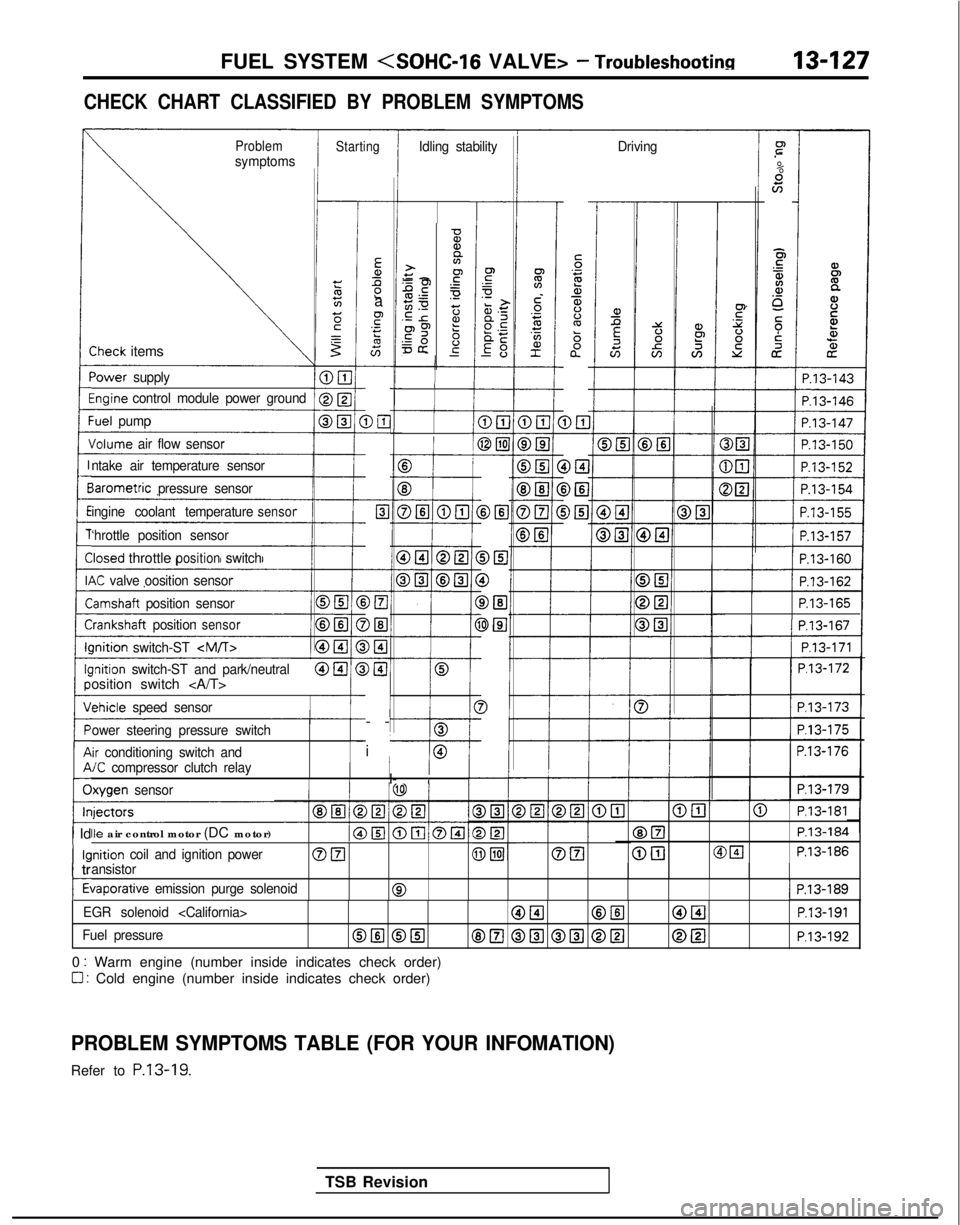
FUEL SYSTEM
CHECK CHART CLASSIFIED BY PROBLEM SYMPTOMS
ProblemsymptomsStartingIdling stability Drivingr”
.-
%scn
E5
$4.a,o_
5;i
cz
iP.13-143
-
Ea,Ll2a
F.- s
G-
DE-
c-
Elc
-
-
>El
)El-
)I3-
)@I
I-
-
i
-
5‘32a,$%ba”
D&l DEI
i>El
-0%,a>+y -2.gPE.-50 z.E r2?p9 6=& g-
-
-Sheck items
‘ower
supply
%ginecontrol module power groundI
1 P.13-146
:uel pump
Jolume air flow sensor
B
f
E3
DELI @El
cP.13-162
P.13-165III P.13-167I
1/ P.l3-171 1
P.l3-172
P.l3-173
P.l3-175
P.13-176
P.l3-179
ntake air temperature sensor
BIB
DEI
0
DEl
3El
3
-I
iarometric
pressure sensor
ingine coolant temperature
sensor
‘hrottle position sensor
Iosed throttlepositionswitch
K valve oosition sensor
lamshaft position sensor
i-:rankshaft positionsensorIIlnition
switch-ST
-I---0lnition switch-ST and park/neutralosition switch
chicle
speed sensor
ower steering pressure switch
ir conditioning switch and/C compressor clutch relayI/I- IIlxygen sensor
@El@ P.l3-181
@ElP.13-184
@[email protected]
Ile air control motor (DC motor)
inition coil and ignition powerOFI@piJOEIansistor
tiaporative emission purge solenoid01 P.13-189
1 Id
kl
c
tr
t
EGR solenoid
Fuel pressureOIlI @El8E.l @El @El @[email protected]
0 : Warm engine (number inside indicates check order)
0 : Cold engine (number inside indicates check order)
PROBLEM SYMPTOMS TABLE (FOR YOUR INFOMATION)
Refer to P.13-19.
TSB Revision