check engine MITSUBISHI GALANT 1989 Service Repair Manual
[x] Cancel search | Manufacturer: MITSUBISHI, Model Year: 1989, Model line: GALANT, Model: MITSUBISHI GALANT 1989Pages: 1273, PDF Size: 37.62 MB
Page 502 of 1273

Auto-crursecontrol unit
I 2EB16 I
lntr’")
13-360AUTO-CRUISE CONTROL SYSTEM - Troubleshooting
11. CHECKING THE THROTTLE POSITION SENSOR AND CLOSED THROTTLE POSITION S\
WITCH
CIRCUIT
Auto-crursecontrol unit
I 2EB16 I
lntr’
(18)
MFI controlmodule1380424
>
control
unrt
I f
Throttleposrtronsensor
Closed throttle-position swrtch
(18)MFI controlmodule
<1993models
>
13A0425(12)Auto-cruise
control unit
Throttleposition
sensorClosed throttle ‘position
switch
(18)MFI controlmodule13A0428
Description of operation
The throttle position sensor and closed throttle position switchare mounted in the idle speed control motor position sensor Orthrottle body and are sensors in the MFI system. The closed
throttle position switch is turned OFF when the accelerator
pedal is pressed and ON when it is released. In addition, throttle
position sensor output voltage varies according to the degree of
opening of the throttle valve.
Troubleshooting hint
Diagnostic-No.17
Diagnostic-No.1 7
ECU terminal voltage
TerminalNo.
4
5 Signal
Conditions
Terminal
voltage
Closed throttle When accelerator Battery
position switch
-pedal is pressedpositive voltage
When accelerator
pedal is releasedov
ThrottleWhen accelerator 4.0v-5%’position sensorpedal is pressedall the way down
When accelerator 0.48~0.72v
pedal is released
1 TSB Revision
Page 540 of 1273
13-398
AUTO-CRUISE CONTROL SYSTEM - Setice Adjustment procedures
03*02.5*
1
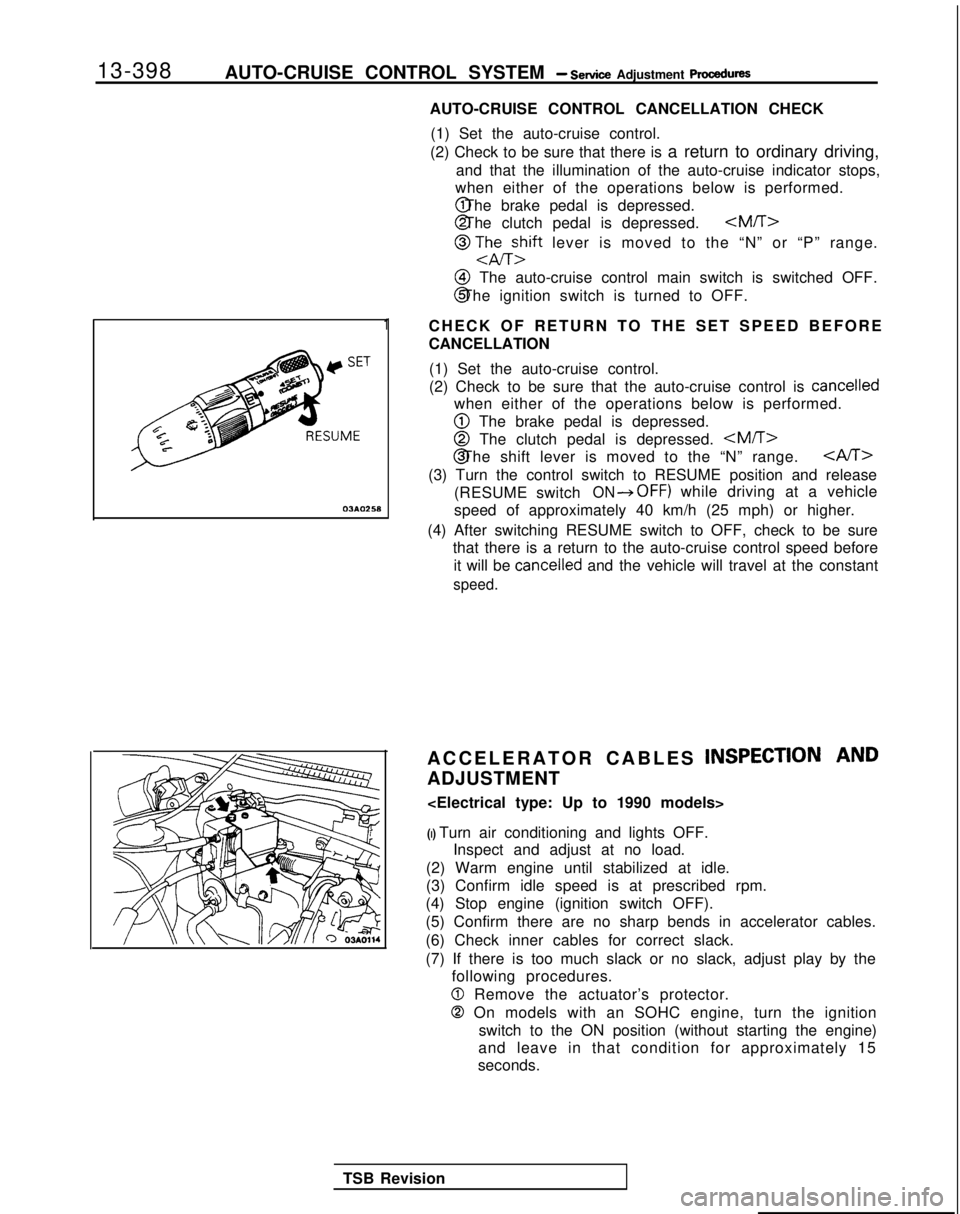
AUTO-CRUISE CONTROL CANCELLATION CHECK
(1) Set the auto-cruise control.
(2) Check to be sure that there is a return to ordinary driving,
and that the illumination of the auto-cruise indicator stops,
when either of the operations below is performed. @ The brake pedal is depressed.
@ The clutch pedal is depressed.
@ TJhEzift lever is moved to the “N” or “P” range.
@I The auto-cruise control main switch is switched OFF.
@ The ignition switch is turned to OFF.
CHECK OF RETURN TO THE SET SPEED BEFORE
CANCELLATION (1) Set the auto-cruise control.
(2) Check to be sure that the auto-cruise control is
cancelled
when either of the operations below is performed.
@ The brake pedal is depressed.
@ The clutch pedal is depressed.
CAST>
(3) Turn the control switch to RESUME position and release
(RESUME switch
ON*OFF) while driving at a vehicle
speed of approximately 40 km/h (25 mph) or higher.
(4) After switching RESUME switch to OFF, check to be sure that there is a return to the auto-cruise control speed before
it will be
cancelled and the vehicle will travel at the constant
speed.
ACCELERATOR CABLES INSPECTION AND
ADJUSTMENT
(I) Turn air conditioning and lights OFF. Inspect and adjust at no load.
(2) Warm engine until stabilized at idle.
(3) Confirm idle speed is at prescribed rpm.
(4) Stop engine (ignition switch OFF).
(5) Confirm there are no sharp bends in accelerator cables.
(6) Check inner cables for correct slack.
(7) If there is too much slack or no slack, adjust play by the following procedures.
0 Remove the actuator’s protector.
0 On models with an SOHC engine, turn the ignition
switch to the ON position (without starting the engine)
and leave in that condition for approximately 15
seconds.
TSB Revision
Page 541 of 1273
AUTO-CRUISE CONTROL SYSTEM - Setice Adjustment ~rccedures13-399
Accelerator cable B
Intake manifold
plenum
VAdjusting bolts07A0021
Throttle -.--
StopperCloskd throttleposition swrtch 03~0278
Acceleratorcable A
I
03A0271
-Ai+1-2 mm (.04-.08
in.)
TSB Revision
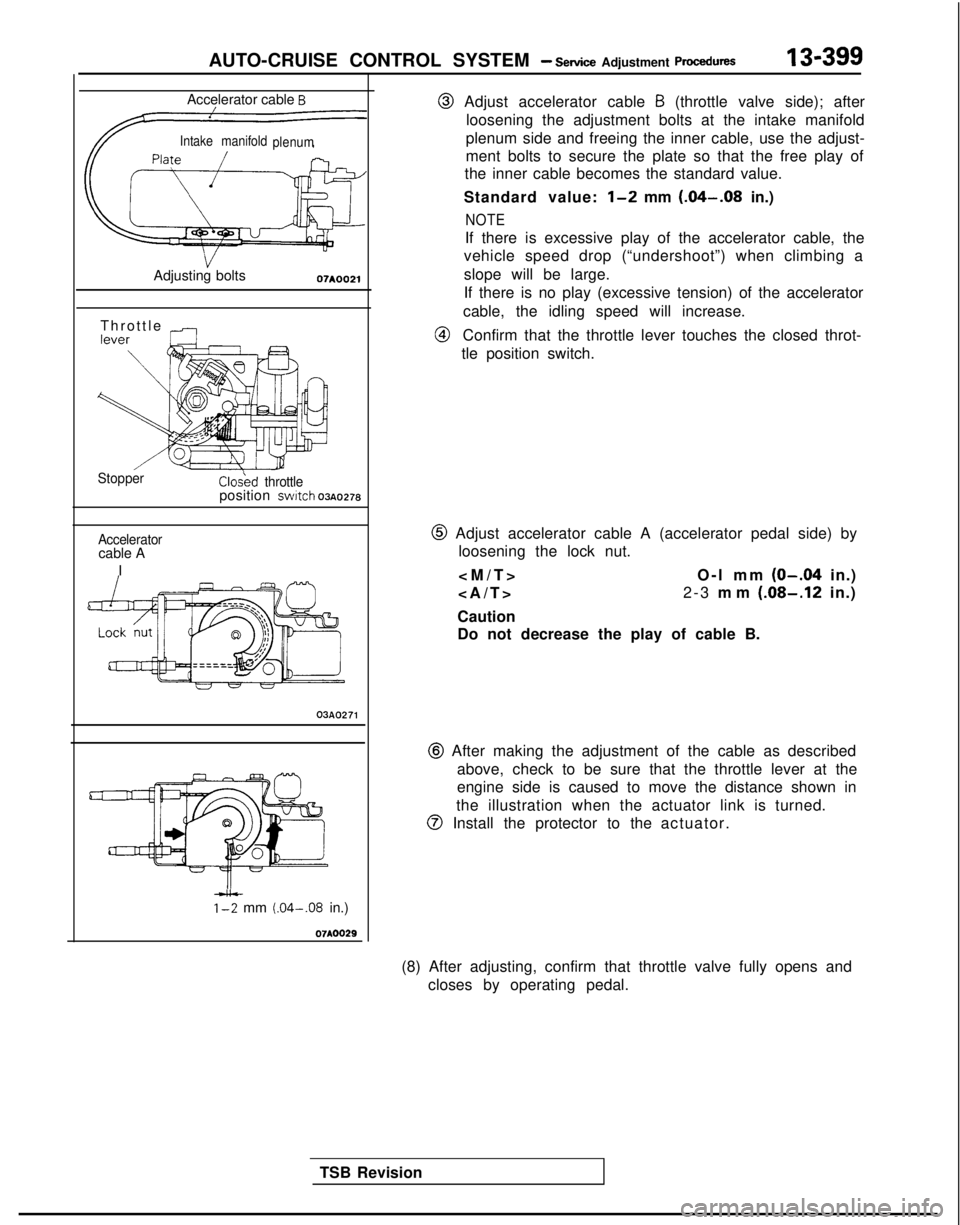
@ Adjust accelerator cable B (throttle valve side); after
loosening the adjustment bolts at the intake manifold
plenum side and freeing the inner cable, use the adjust-
ment bolts to secure the plate so that the free play of
the inner cable becomes the standard value.
Standard value:
l-2 mm (.04-.08 in.)
NOTE
If there is excessive play of the accelerator cable, the
vehicle speed drop (“undershoot”) when climbing a
slope will be large.
If there is no play (excessive tension) of the accelerator
cable, the idling speed will increase.
@Confirm that the throttle lever touches the closed throt-
tle position switch.
@ Adjust accelerator cable A (accelerator pedal side) by loosening the lock nut.
O-l mm
(O-.04 in.)
>
2-3
mm
(.08-.12 in.)
Caution
Do not decrease the play of cable B.
@ After making the adjustment of the cable as described above, check to be sure that the throttle lever at the
engine side is caused to move the distance shown in
the illustration when the actuator link is turned.
@ Install the protector to the actuator.
(8) After adjusting, confirm that throttle valve fully opens and closes by operating pedal.
Page 542 of 1273
13-400AUTO-CRUISE CONTROL SYSTEM - Service Adjustment procedures
rThrottle cableAdjusting nut B
\uto-cruise dontrolcable
ThrottlecableAdjusting nut D
A
03A0281
Stopper
ThrottleLock nut/ Adjusting nut B
Stopper07AOO54
07AOO55
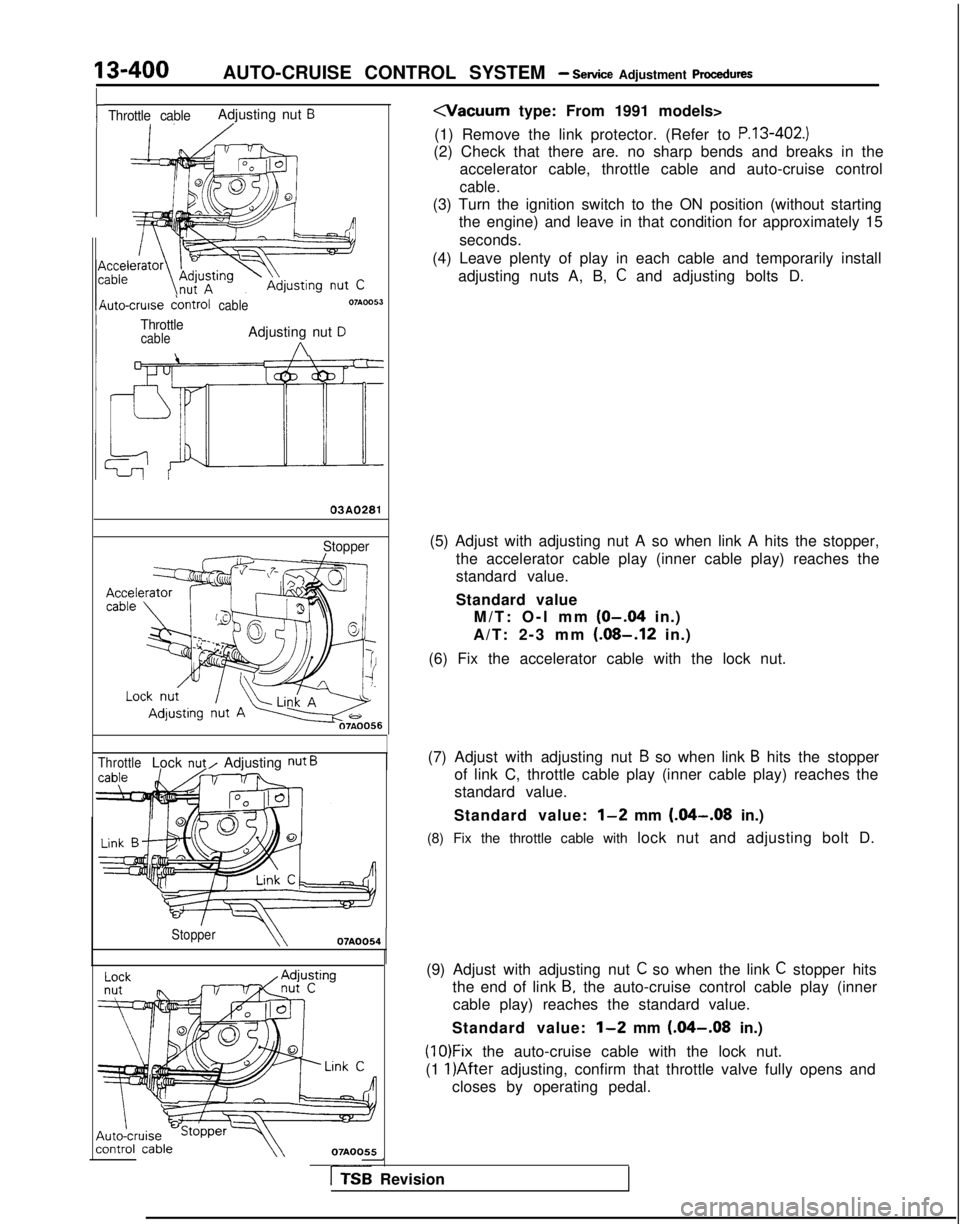
(1) Remove the link protector. (Refer to
P.13-402.)
(2) Check that there are. no sharp bends and breaks in the accelerator cable, throttle cable and auto-cruise control
cable.
(3) Turn the ignition switch to the ON position (without startingthe engine) and leave in that condition for approximately 15
seconds.
(4) Leave plenty of play in each cable and temporarily install adjusting nuts A, B,
C and adjusting bolts D.
(5) Adjust with adjusting nut A so when link A hits the stopper, the accelerator cable play (inner cable play) reaches the
standard value.
Standard valueM/T: O-l mm
(O-.04 in.)
A/T: 2-3 mm
(.08-.12 in.)
(6) Fix the accelerator cable with the lock nut.
(7) Adjust with adjusting nut
B so when link B hits the stopper
of link C, throttle cable play (inner cable play) reaches the
standard value.
Standard value:
l-2 mm (&I-.08 in.)
(8) Fix the throttle cable with lock nut and adjusting bolt D.
(9) Adjust with adjusting nut
C so when the link C stopper hits
the end of link
B, the auto-cruise control cable play (inner
cable play) reaches the standard value.
Standard value:
l-2 mm (.04-.08 in.)
(1O)Fix the auto-cruise cable with the lock nut.
(1
l)After adjusting, confirm that throttle valve fully opens and
closes by operating pedal.
-
rTSB Revision
Page 553 of 1273
14-1
COOLING
ENGINE COOLANT TEMPERATURE GAUGE
UNIT, ENGINE COOLANT
TEMPERATURE SENSOR AND ENGINE
COOLANT TEMPERATURE
SWITCH.............
31
RADIATOR ....................................................... 9
RADIATOR FAN MOTOR ASSEMBLY ..........
12
SERVICE ADJUSTMENT PROCEDURES..
.....
8
Engine Coolant Concentration Test .............
8
Engine Coolant LeakCheck
........................8
Engine Coolant
Replacement .......................
8
Radiator Cap Pressure Test .........................
8
SPECIAL TOOL................................................5
SPECIFICATIONS .............................................
2
General Specifications ..................................
2
Lubricant
....................................................... 4
CONTENTS
IM14AA-
Sealant. . . . . . . . . . . . . ..__...........’ . . . . . . . . . . . . . \
. . . . . .._.........4
ServiceSpecifications . . . . .. . . . . . . . . . . . . . . . . . . . . . . . . . . . .2
Torque
Specifications. . . . . . . . . . . . . . . . . . . . . . . . . . . . . . . . . . .3
THERMOSTAT. . . . . . . . . . . . . . . . . . . . . . . . . . . . . . . . . . . . \
. . . . . . . . . . . . .13
TROUBLESHOOTING. . . . . . . . . . . . . . . . . . . . . . . . . . . . . . . . . . . . \
. .5
No rise in temperature
Overheat
WATER HOSE AND WATER PIPE
. . . . . . . . . . . . . . . . . . . . . . . . . . . . . . . . . . .26
WATER HOSE AND WATER PIPE
WATER HOSE AND WATER PIPE
. . . . . . . . . . . . . . . . . . . . .
. . . . . . . . . . . . . . . . . . . . . . . . . . . . . ..a.....23
WATER PUMP
WATER PUMP
. . . . . . . . . . . . . . . . . . . . . . . . . . . . . . .15
Page 560 of 1273
14-8
COOLING -Service Adjustment Procedures T210863
SERVICE ADJUSTMENT PROCEDUl$t&
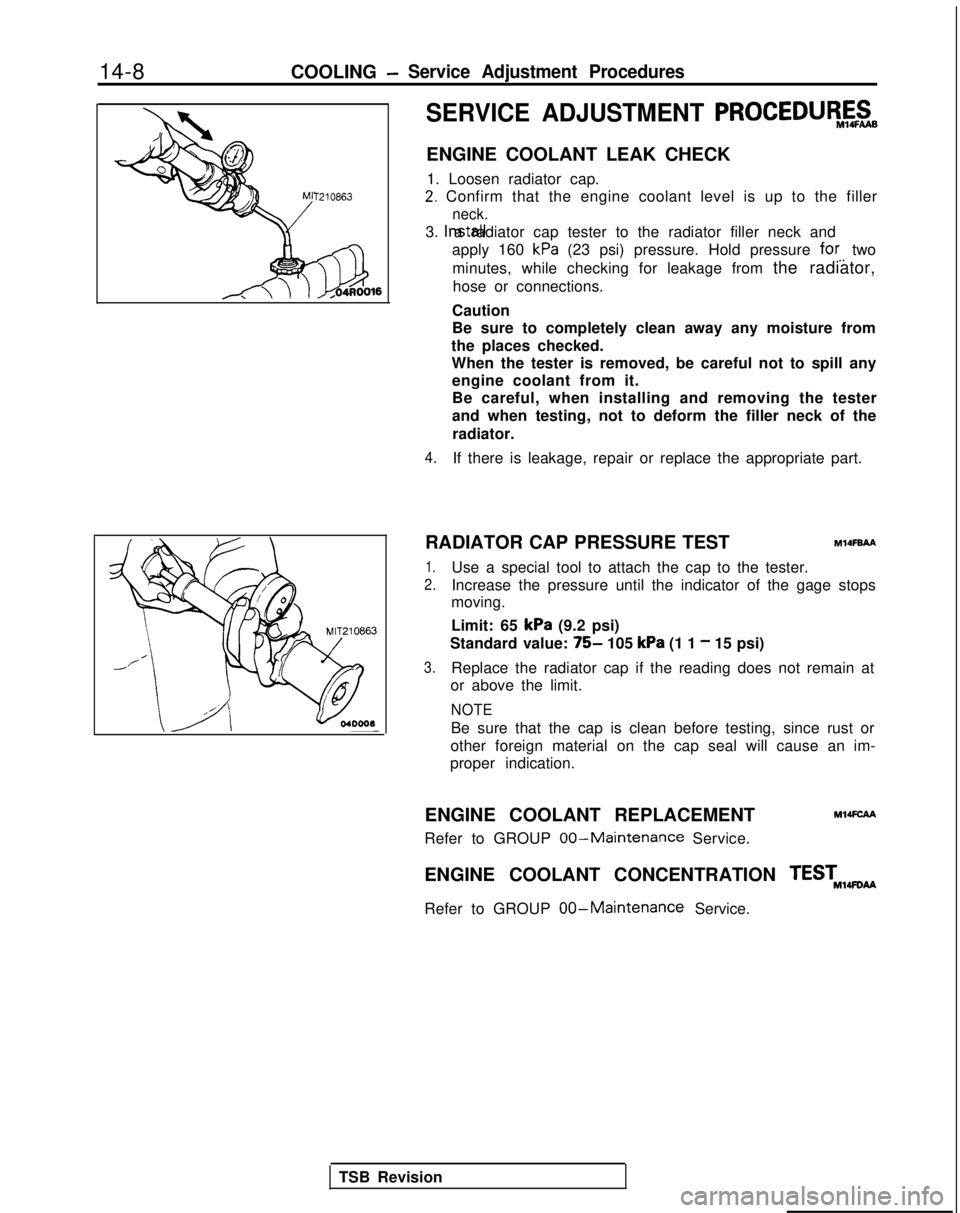
ENGINE COOLANT LEAK CHECK
1. Loosen radiator cap.
2. Confirm that the engine coolant level is up to the filler
neck.
3. Install a radiator cap tester to the radiator filler neck and
apply 160
kPa (23 psi) pressure. Hold pressure for. two
minutes, while checking for leakage from the radiator, hose or connections.
Caution
Be sure to completely clean away any moisture from
the places checked. When the tester is removed, be careful not to spill anyengine coolant from it.
Be careful, when installing and removing the tester
and when testing, not to deform the filler neck of the
radiator.
4.If there is leakage, repair or replace the appropriate part.
RADIATOR CAP PRESSURE TEST
MlOFBAA
1.Use a special tool to attach the cap to the tester.
2.Increase the pressure until the indicator of the gage stops
moving.
Limit: 65
kPa (9.2 psi)
Standard value:
75- 105 kPa (1 1 - 15 psi)
3.Replace the radiator cap if the reading does not remain at
or above the limit.
NOTE
Be sure that the cap is clean before testing, since rust or
other foreign material on the cap seal will cause an im-
proper indication.
ENGINE COOLANT REPLACEMENT
MMFCAA
Refer to GROUP 00-Maintenance Service.
ENGINE COOLANT CONCENTRATION TEST,,wti
Refer to GROUP
00-Maintenance Service.
TSB Revision
Page 563 of 1273
COOLING - Radiator14-11
04A0020
A
B’ -WaterI
423°C (725°F)temperature
TSB Revision RESISTOR INSPECTION
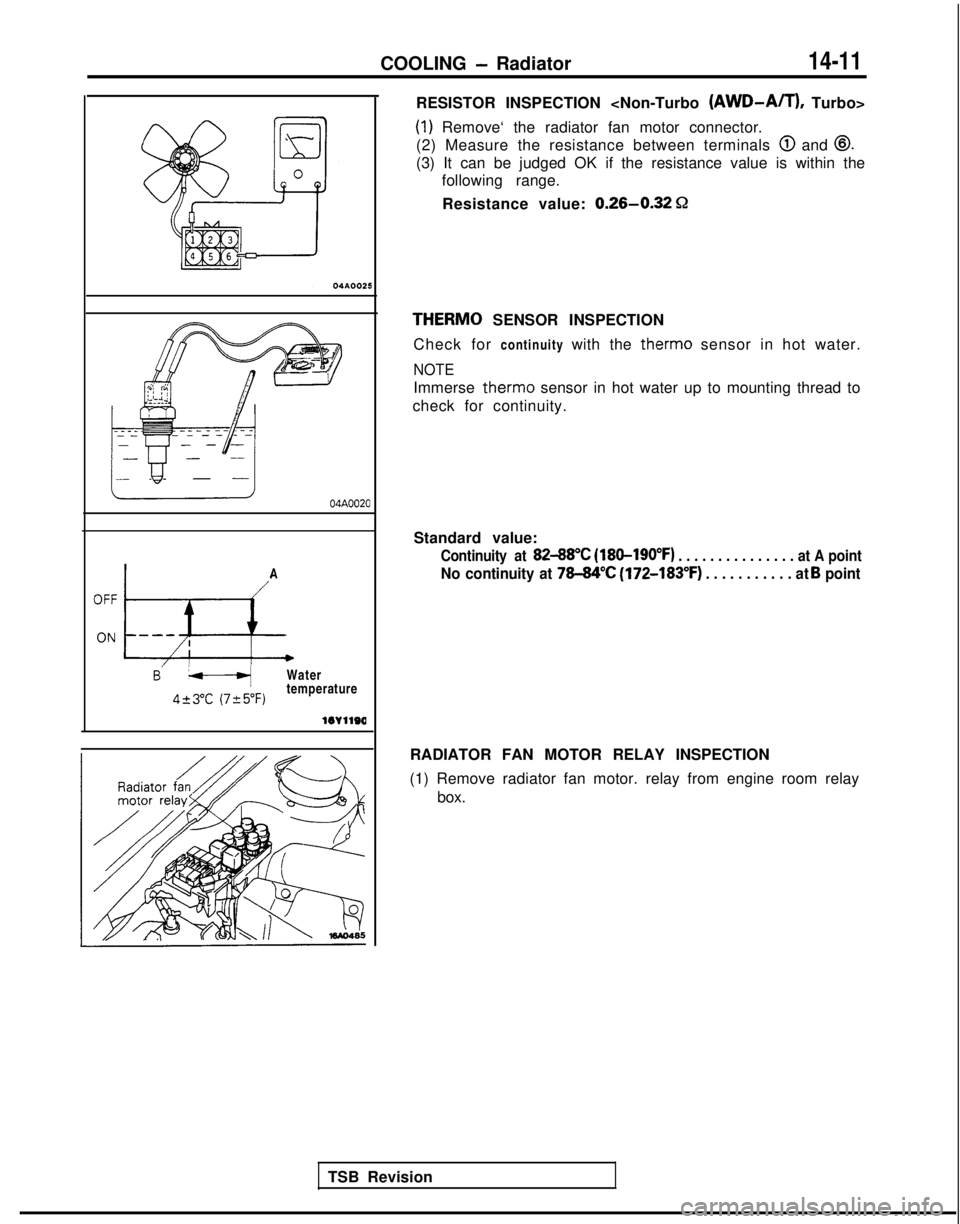
(1) Remove‘ the radiator fan motor connector.
(2) Measure the resistance between terminals
0 and @.
(3) It can be judged OK if the resistance value is within the following range.
Resistance value:
0.26-0.32 Q
THERM0 SENSOR INSPECTION
Check for continuity with the therm0
sensor in hot water.
NOTE
Immerse therm0
sensor in hot water up to mounting thread to
check for continuity.
Standard value:
Continuity at 82-88”C (180-190°F) . . . . . . . . . . . . . . . at A point
No continuity at 7844°C (172-183°F) . . . . . . . . . . . at B point
RADIATOR FAN MOTOR RELAY INSPECTION
(1) Remove radiator fan motor. relay from engine room relay box.
Page 570 of 1273
14-18COOLING - Water Pump
Quality canvas Core wire
\\Adhesive rubber
\Rib rubberlCOO29
W
ater pump
J--iLi+
O-ring
W
ater pipe
I I
SERVICE POINTS OF REMOVALMl4MCAK
2. REMOVAL OF ENGINE MOUNT BRACKET
(1) Place a wooden block at the oil pan part of the engine, and
then jack up the vehicle.
Caution
Jack up carefully,
so as not to apply a load to each part.
(2) Remove the engine mount bracket.
5. REMOVAL OF DRIVE BELT Before removing the V-ribbed belt, loosen the water pump
pulley installation bolt.
INSPECTION
V-RIBBED BELT
M14MDAG
Check following items and replace if faulty.
l Check belt surface for damage, peeling or cracks.
l Check belt surface for oil or grease.
l Check belt rubber for wear or brittleness.
l Check the pulleys for cracks or damage.
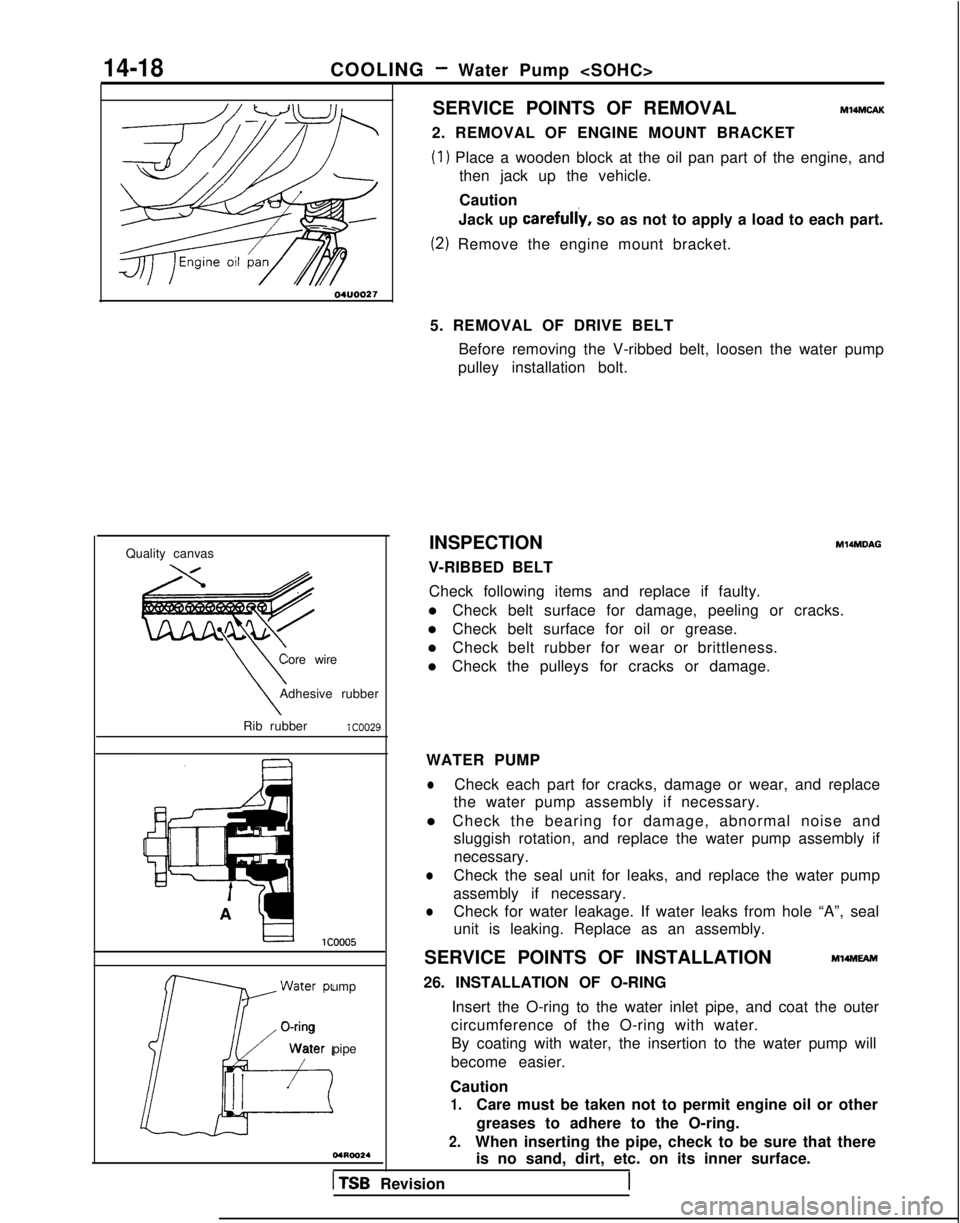
WATER PUMP
lCheck each part for cracks, damage or wear, and replace
the water pump assembly if necessary.
l Check the bearing for damage, abnormal noise and sluggish rotation, and replace the water pump assembly if
necessary.
lCheck the seal unit for leaks, and replace the water pump
assembly if necessary.
lCheck for water leakage. If water leaks from hole “A”, seal
unit is leaking. Replace as an assembly.
SERVICE POINTS OF INSTALLATION
Ml4MEAm
26. INSTALLATION OF O-RING Insert the O-ring to the water inlet pipe, and coat the outer
circumference of the O-ring with water. By coating with water, the insertion to the water pump will
become easier.
Caution
1.Care must be taken not to permit engine oil or other
greases to adhere to the O-ring.
2.When inserting the pipe, check to be sure that there is no sand, dirt, etc. on its inner surface.
1 TSB Revision
Page 575 of 1273
COOLING - Water Hose and Water Pipe
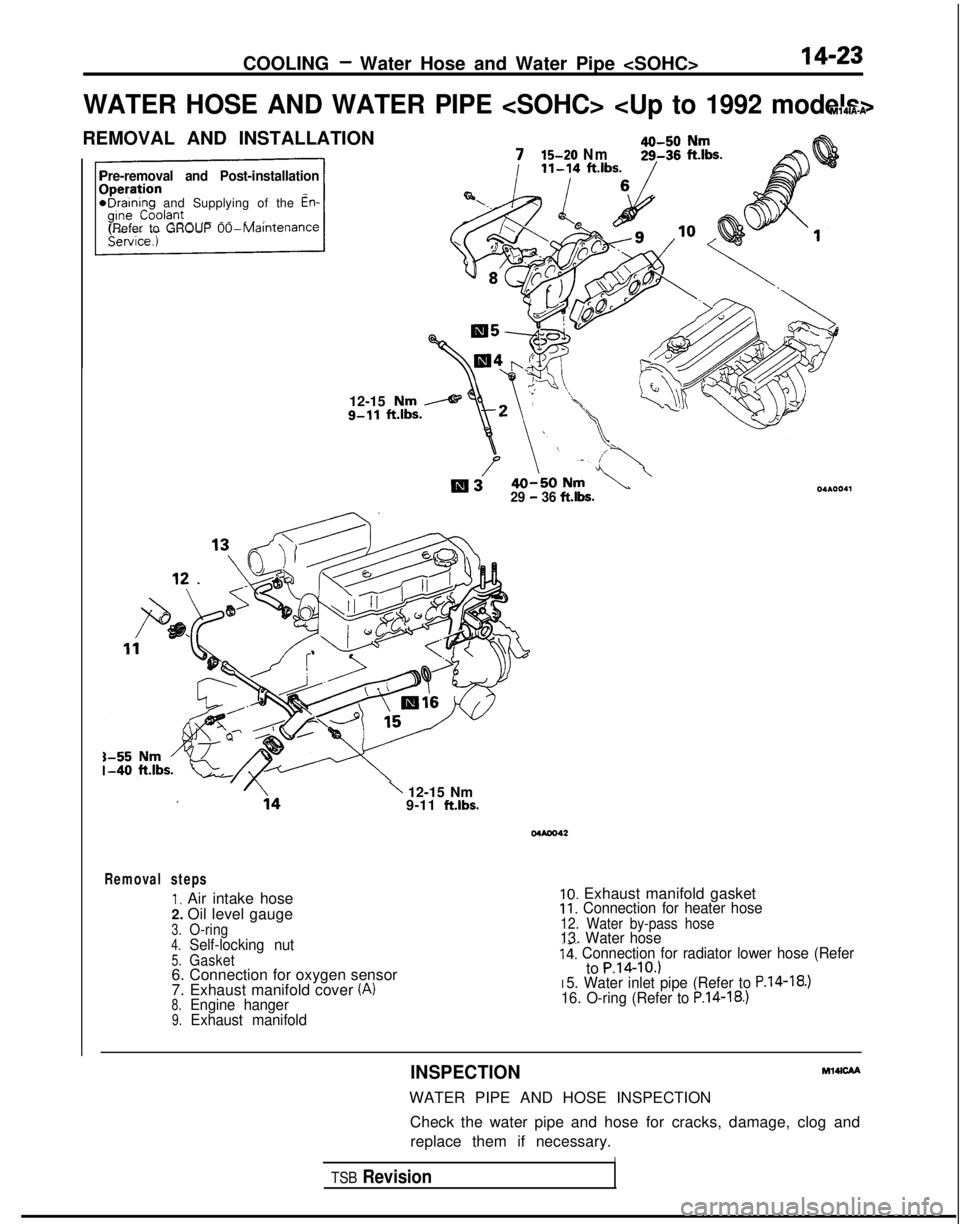
WATER HOSE AND WATER PIPE
REMOVAL AND INSTALLATION
Pre-removal and Post-installation
*Draining and Supplying of the En-
(Refer to GROUP 00-Maintenance
12-15 Nm
g-11
ft.lbs.
715-20 Nm
Ill329 - 36 fths.
\ 12-15 Nm
9-11 ft.lbs.
Mbm42
Removal steps
1. Air intake hose
2. Oil level gauge
3.O-ring4.Self-locking nut5.Gasket6. Connection for oxygen sensor
7. Exhaust manifold cover (A)
8.Engine hanger9.Exhaust manifold
10. Exhaust manifold gasket11. Connection for heater hose12. Water by-pass hose13. Water hosei41 Connection for radiator lower hose (Referto P.14-IO.)I 5. Water inlet pipe (Refer to P.14-18.)16. O-ring (Refer to P.14-18.)
INSPECTIONMl4lcAA
WATER PIPE AND HOSE INSPECTION
Check the water pipe and hose for cracks, damage, clog andreplace them if necessary.
ITSB Revision
Page 584 of 1273
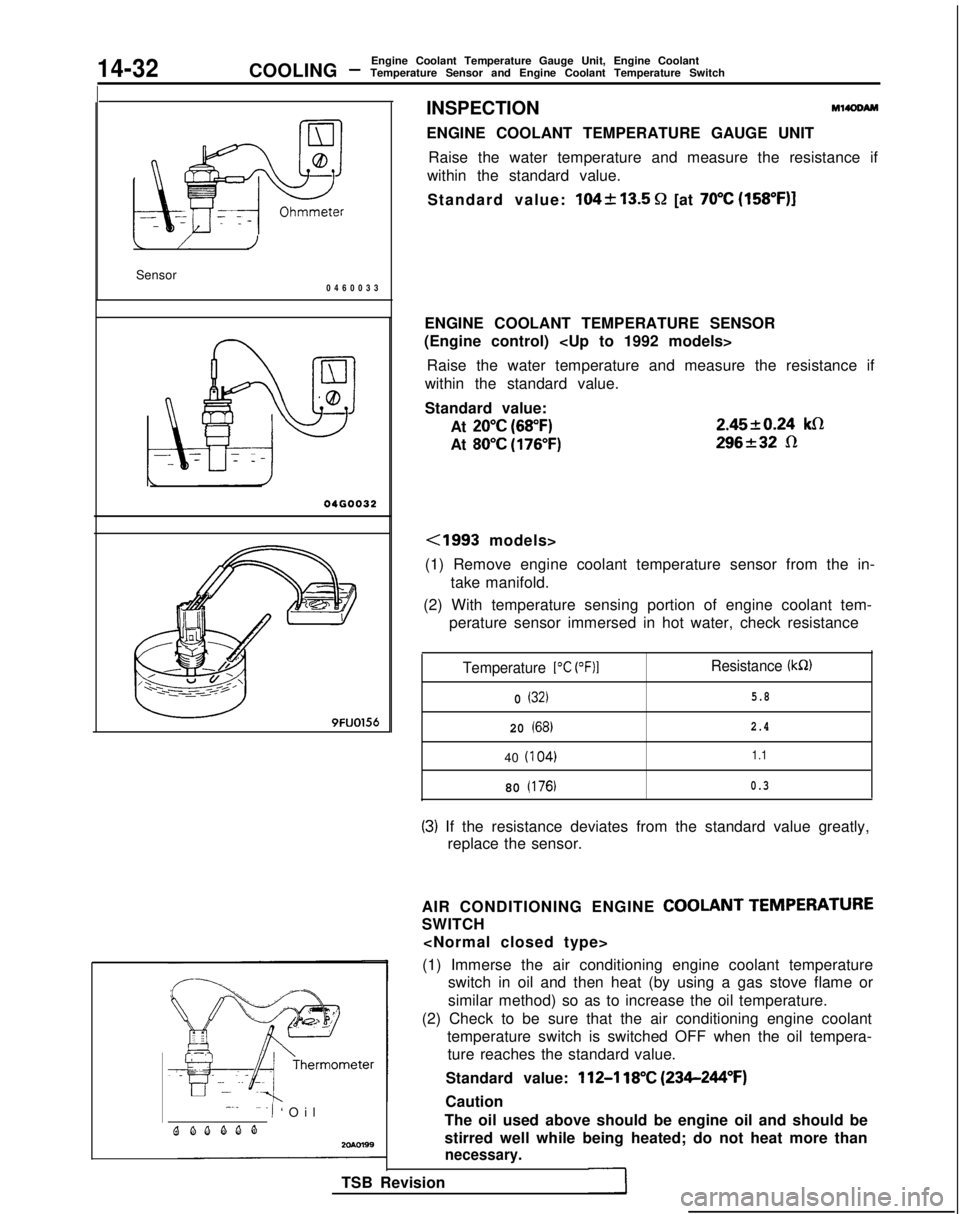
14-32COOLING -Engine Coolant Temperature Gauge Unit, Engine Coolant
Temperature Sensor and Engine Coolant Temperature Switch
/
Sensor
J
046003
3
04GOO32
9FUO156
---
--I ‘Oi
l
QQQQQQ2cmn99
INSPECTIONM14OOAM
ENGINE COOLANT TEMPERATURE GAUGE UNIT
Raise the water temperature and measure the resistance if
within the standard value.
Standard value:
104k13.5 Q [at 70°C (158”F)]
ENGINE COOLANT TEMPERATURE SENSOR
(Engine control)
Raise the water temperature and measure the resistance if
within the standard value.
Standard value:
At
20°C (68°F)
At 80°C (176°F) 2.4520.24
klR
296232 R
<1993 models>
(1) Remove engine coolant temperature sensor from the in- take manifold.
(2) With temperature sensing portion of engine coolant tem- perature sensor immersed in hot water, check resistance
Temperature 1°C (OF)1Resistance (kR)
0 (32)5.8
20 (68)2.4
40
(I
04)1.1
80 (176)0.3
(3) If the resistance deviates from the standard value greatly,
replace the sensor.
AIR CONDITIONING ENGINE
COOLANT TEMPERATURE
SWITCH
(1) Immerse the air conditioning engine coolant temperature switch in oil and then heat (by using a gas stove flame or
similar method) so as to increase the oil temperature.
(2) Check to be sure that the air conditioning engine coolant temperature switch is switched OFF when the oil tempera-ture reaches the standard value.
Standard value:
112-l 18°C (234-244°F)
Caution
The oil used above should be engine oil and should be
stirred well while being heated; do not heat more than
necessary.
TSB Revision