check engine MITSUBISHI GALANT 1989 Service Repair Manual
[x] Cancel search | Manufacturer: MITSUBISHI, Model Year: 1989, Model line: GALANT, Model: MITSUBISHI GALANT 1989Pages: 1273, PDF Size: 37.62 MB
Page 968 of 1273
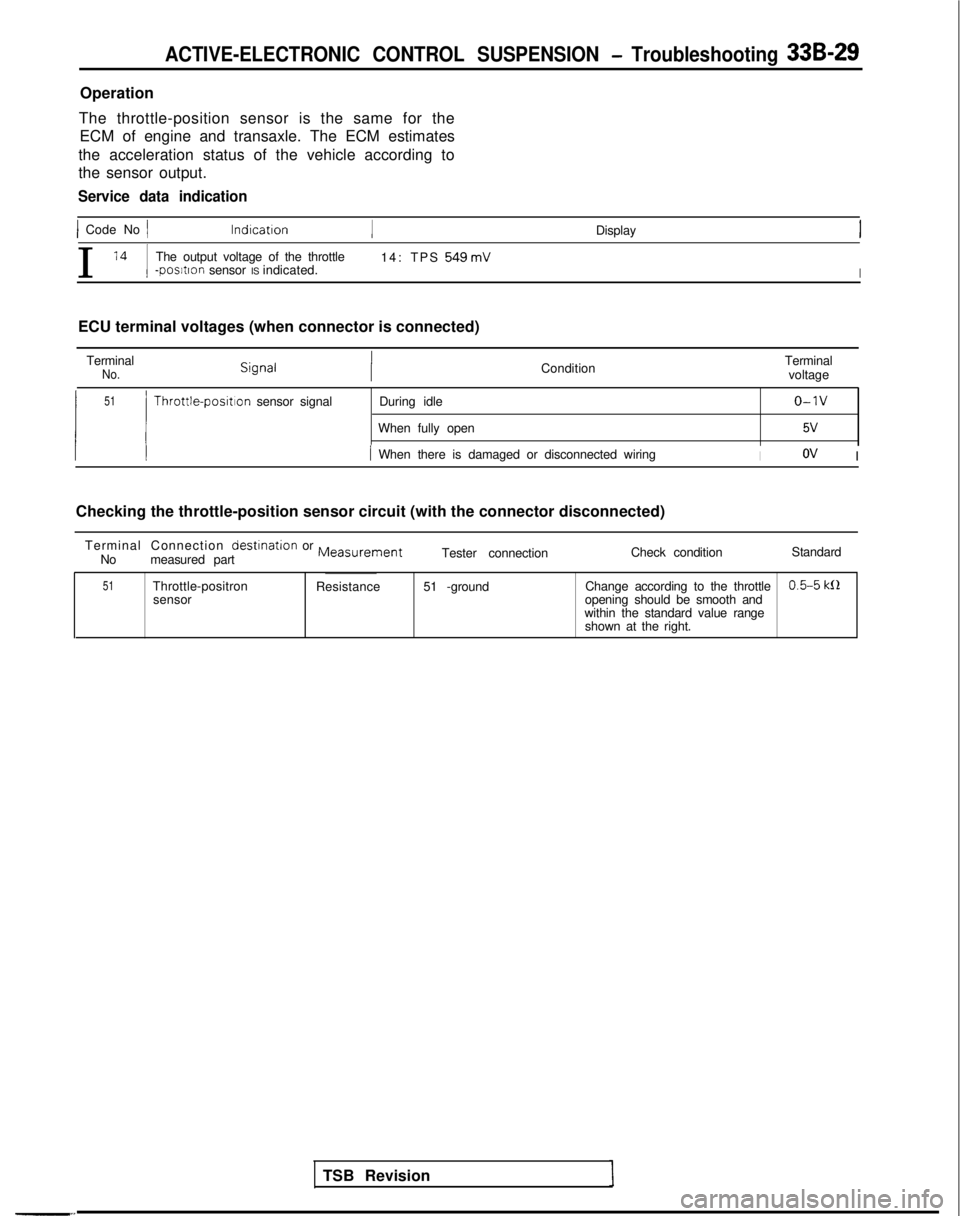
ACTIVE-ELECTRONIC CONTROL SUSPENSION - Troubleshooting 33B-29
Operation
The throttle-position sensor is the same for the ECM of engine and transaxle. The ECM estimates
the acceleration status of the vehicle according to
the sensor output.
Service data indication
) Code No 1 lndrcatron
Display
I
l4 1
The output voltage of the throttle 14: TPS 549mV-postron sensor IS indicated.I
ECU terminal voltages (when connector is connected)
Terminal
No.Condition Terminal
voltage
51
1 !
Throttle-posrtlon sensor signal During idleo-1v
When fully open5v
/ When there is damaged or disconnected wiringIov I
Checking the throttle-position sensor circuit (with the connector disco\
nnected) Terminal Connection
destrnation or MeasurementNo measured part Tester connection
Check condition
Standard
51Throttle-positron
sensor Resistance
51 -ground Change according to the throttle0.5-5 k0opening should be smooth and
within the standard value range shown at the right.
TSB Revision
Page 982 of 1273
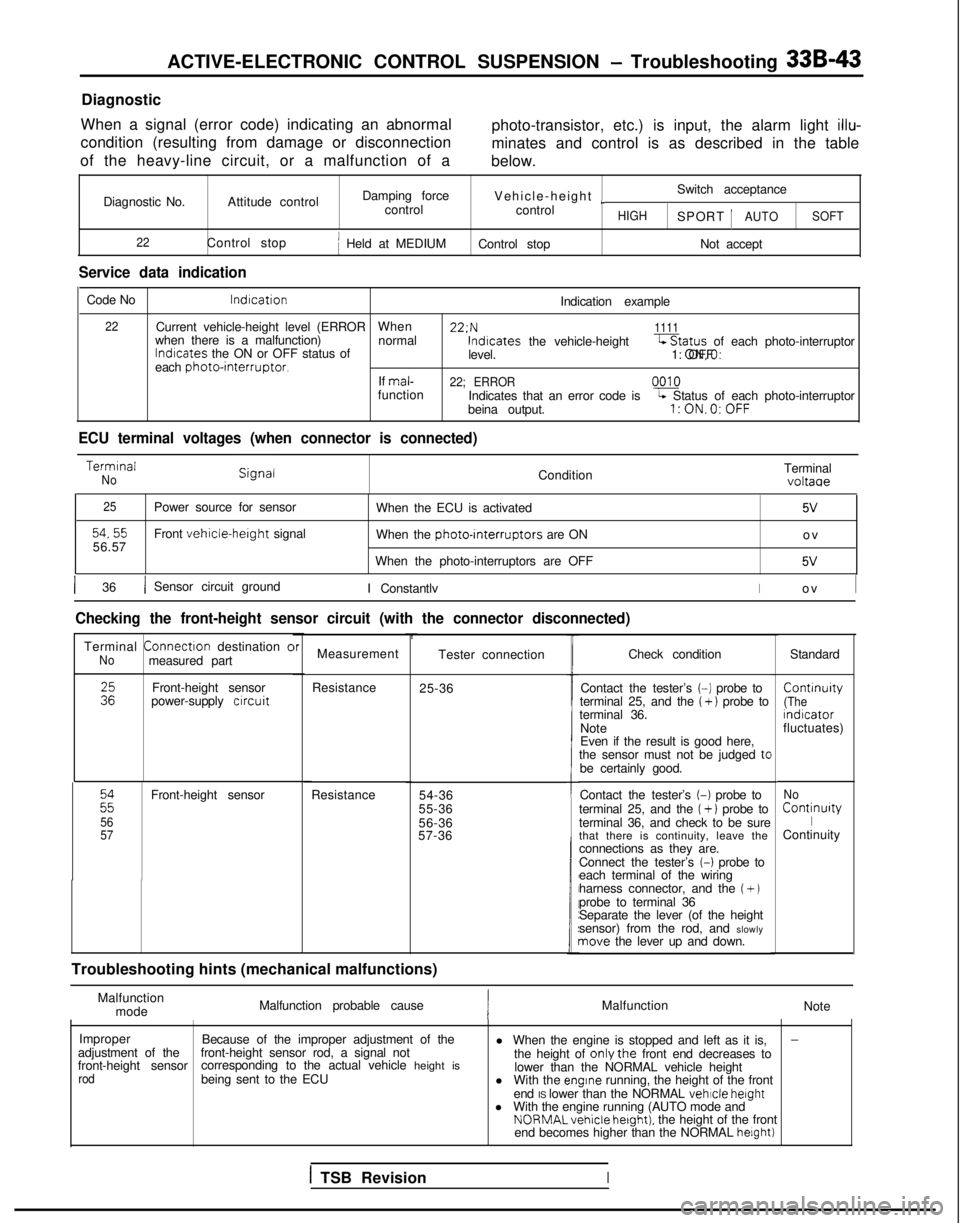
ACTIVE-ELECTRONIC CONTROL SUSPENSION - Troubleshooting 33B-43
Diagnostic
When a signal (error code) indicating an abnormal
condition (resulting from damage or disconnection
of the heavy-line circuit, or a malfunction of a photo-transistor, etc.) is input, the alarm light
illu-
minates and control is as described in the table
below.
Diagnostic No. Attitude control Damping force
Vehicle-height
~Switch acceptance
control control
HIGHSPORT 1AUTOSOFT
22
Control stopj Held at MEDIUM Control stop Not accept
Service data indication
Code No lndrcation
Indication example
22Current vehicle-height level (ERRORWhen 22:N1111when there is a malfunction)
normallndrcates
the ON or OFF status of lndtcates
the vehicle-height-Status of each photo-interruptor
level. 1: ON,O: OFF
each
photointerruptor.If mal-22; ERRORfunction
0010
Indicates that an error code isL Status of each photo-interruptor
beina output.l:ON.O:OFF
ECU terminal voltages (when connector is connected) Termrnal
NoCondition
Terminalvoltaae
25
54,5556.57Power source for sensor
Front vehicle-herght signal
When the ECU is activated
5V
When the photo-rnterruptors are ON
o
v
When the photo-interruptors are OFF
5V
1 36/ Sensor circuit ground I ConstantlvIo
v
I
Checking the front-height sensor circuit (with the connector disconnect\
ed)
Terminal
Connectron
destination cNomeasured part
:zFront-height sensor
power-supply crrcuit
22
56
57
Front-height sensor
Resistance
brMeasurement
Resistance 25-36Tester connection
54-36
55-36
56-36
57-36
t
Troubleshooting hints (mechanical malfunctions) Check condition
Standard
Contact the tester’s
(-1 probe to Contrnuity
terminal 25, and the ( + ) probe to(Theterminal 36.
rndrcator
Note fluctuates)
Even if the result is good here,
the sensor must not be judged
tcbe certainly good.
Contact the tester’s
(-1 probe to
terminal 25, and the (+ 1 probe to
terminal 36, and check to be sure
that there is continuity, leave the
connections as they are.
Connect the tester’s
(-1 probe to
each terminal of the wiring
harness connector, and the
(+ Jprobe to terminal 36
Separate the lever (of the height
sensor) from the rod, and slowly
nave the lever up and down.
No Continurty
IContinuity
Malfunction mode Malfunction probable cause
Malfunction
Note
Improper Because of the improper adjustment of the
-adjustment of the
front-height sensorfront-height sensor rod, a signal not
l When the engine is stopped and left as it is,
corresponding to the actual vehicle height is the height of onlythe front end decreases to
rodbeing sent to the ECU lower than the NORMAL vehicle height
l With the engrne running, the height of the front
end IS lower than the NORMAL vehicle
height
l With the engine running (AUTO mode and NORMALvehicle
hetght). the height of the front
end becomes higher than the NORMAL helght)
1 TSB RevisionI
Page 984 of 1273
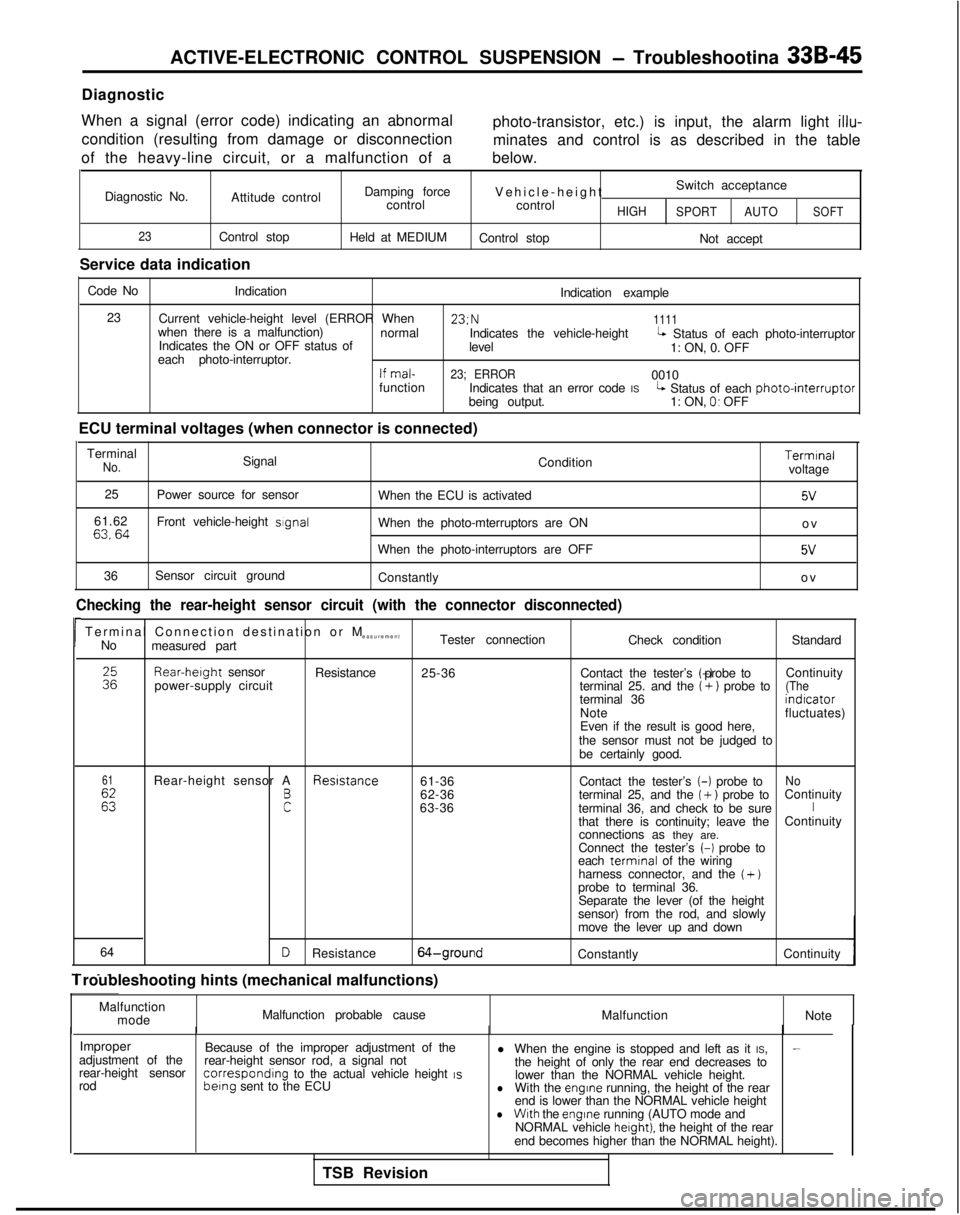
ACTIVE-ELECTRONIC CONTROL SUSPENSION - Troubleshootina 33B-45
Diagnostic
When a signal (error code) indicating an abnormal condition (resulting from damage or disconnection
of the heavy-line circuit, or a malfunction of a photo-transistor, etc.) is input, the alarm light
illu-
minates and control is as described in the table
below.
Diagnostic No. Attitude control
23Control stop
Service data indication Damping force
control
Held at MEDIUM Vehicle-heigh
t
Switch acceptance
control
HIGH SPORT AUTOSOFT
Control stop
Not accept
Code No Indication
Indication example
23 Current vehicle-height level (ERROR When 23;N
1111when there is a malfunction)
normal
Indicates the ON or OFF status of Indicates the vehicle-height
levelL Status of each photo-interruptor
each photo-interruptor. 1: ON, 0. OFF
If mal-23; ERROR0010
function Indicates that an error code IS
being output.L Status of each photointerruptor1: ON, 0. OFF
ECU terminal voltages (when connector is connected) Terminal
No.Signal Condition
25 Power source for sensor
When the ECU is activated
61.62
63,64Front vehicle-height sIgnalWhen the photo-mterruptors are ON
When the photo-interruptors are OFF
36 Sensor circuit ground
Constantly Terminal
voltage
5v
o
v
5V
o
v
Checking the rear-height sensor circuit (with the connector disconnecte\
d)
rTerminal Connection destination or
M
easurement
No measured part Tester connection
Check conditionStandardRear-herght
sensor
power-supply circuit Resistance
25-36 Contact the tester’s (-) probe to
Continuity
terminal 25. and the
(+) probe to(Theterminal 36 indrcator
Note fluctuates)
Even if the result is good here,
the sensor must not be judged to be certainly good.
61
Es
Rear-height sensor A Resrstance
61-36No
F
Contact the tester’s (-)
probe to
62-36 terminal 25, and the ( +) probe toContinuity
63-36 terminal 36, and check to be sureIthat there is continuity; leave the Continuity
connections as they are.
Connect the tester’s
(-1 probe to
each termrnal
of the wiring
harness connector, and the
( +)probe to terminal 36. Separate the lever (of the height
sensor) from the rod, and slowly
move the lever up and down
64
- _. .
DResistance64-groundConstantly Continuity
1 roubleshooting hints (mechanical malfunctions)
Malfunctionmode Malfunction probable cause
MalfunctionNote
Improper Because of the improper adjustment of the l When the engine is stopped and left as it IS,
-adjustment of the
rear-height sensorrear-height sensor rod, a signal not
the height of only the rear end decreases to
rod correspondrng
to the actual vehicle height IS berng
sent to the ECU lower than the NORMAL vehicle height.lWith the engrne running, the height of the rear
end is lower than the NORMAL vehicle height
lWith the engine
running (AUTO mode and
NORMAL vehicle herght). the height of the rear
end becomes higher than the NORMAL height).
TSB Revision
Page 986 of 1273

ACTIVE-ELECTRONIC CONTROL SUSPENSION - Troubleshooting 33B-47
Operation
The vehicle-speed sensor is a reed switch type with pulse signals being \
sent four times for each rotation of
the transaxle output gear.
Diagnostic
If there is damage or disconnection of the heavy-line
the alarm light illuminates and control is as
de-
circuit, or a malfunction of the vehicle-speed sensor, scribed in the table below.
Diagnostic No. 24
Attitude control Damping force
Vehicle-height Switch acceptance
control controlHIGHSPORTAUTO SOFT
Control stop
Held at MEDIUMHeld at NORMAL
Not accept
Service data indication Code No lndrcation
Display
24 Indicates the vehicle speed Input
to
24: SPEED SNSR. 0 km/h
the ECU (including the simulated
vehicle speed)
ECU terminal voltages (when connector is connected)
ITerNmo_na’ConditionTerminal
voltage
I I
58 /
I
Vehicle-speed signal1 When the vehicle-speed sensor reed switch is ONo
v
IIII
*When the vehicle-speed sensor reed switch is OFF8V
TSB Revision
*In order to supply the EPS pull-up power
(8V)
Checking the vehicle-speed sensor circuit (with the connector disconnec\
ted)
Termrnal
Connectron
destination or M
easurement
No measured part
Tester connection
Check conditionStandard
58 Vehrcle-speed
sensor
Resistance
58-groundWith the battery’s (-1 termrnal
Continuity
disconnected, move the vehicleIback and forth.Nocontinuity
Troubleshooting hints In actual urban driving, it is not so likely that the
sensor fails.., ^_^.tnrottle IS kept 3U% or more open for more than 30
seconds. Therefore, the conditions have been This takes into account that the vehicle speed sen-
somewhat stricter to prevent unnecessary applica-
sor is shared by many systems such as EPS,
Auto-
tion of the fall safe function due to the racing of the cruise control, etc. and that the failure of the sensor
engine when stopped. However, the vehicle may can also be detected from the state of these sys-
terns.run uncontrolled for some distance when the speed
Page 1026 of 1273
ACTIVE-ELECTRONIC CONTROL SUSPENSIONService Adjustment- Procedures33B-87
Alarm light
With scan tool
Diagnostic check terminal
Serial/
on-board
diagnostic’
outwt
TSB RevisionI
Serial/diagnostic
-switching input
Simulated vehicle-
-speed input
-Ground
16LOO91
!
TOE-IN
Standard value:
Ok3 mm (Of.12 in.)
1. Adjust the toe-in by undoing the clips and turning the left and right tie rod turnbuckles by the same amount (in
opposite directions).
2. The toe will move out as the left turnbuckle
is turned
toward the front of the vehicle and the right turnbuckle is
turned toward the rear of the vehicle.
3.For each half turn of the left and right tie rods, the toe-in will
be adjusted by 6 mm
(.24 in.).
4.After making the adjustments, use a turning radius gage to confirm that the steering wheel turning angle is within the
standard value range. (Refer to GROUP 37A
POWER
STEERING-Service Adjustment Procedures.)
WHEEL BEARING ADJUSTMENT
M33FcAA
Bearing preload is pre-set to the specified value by design and
therefore can not be adjusted.
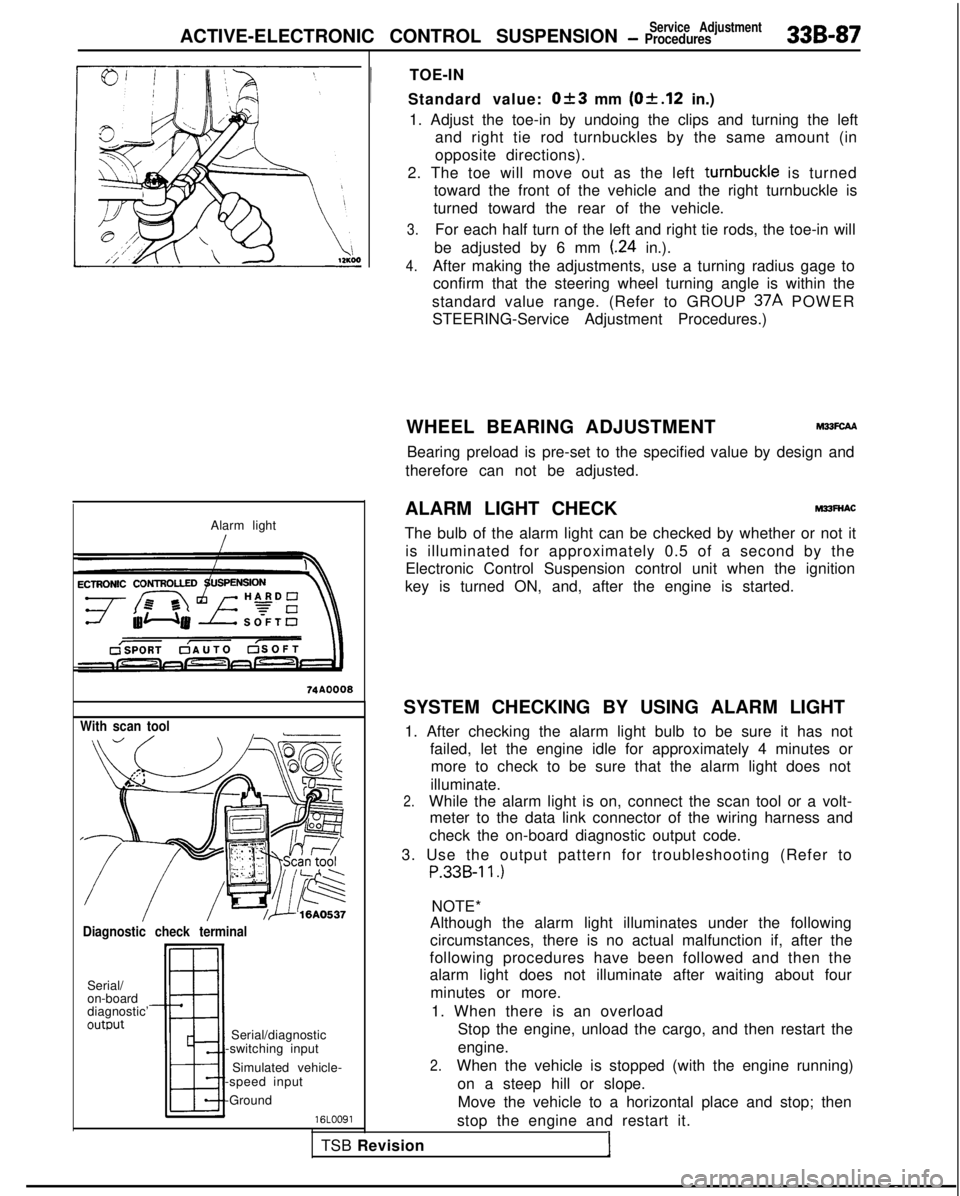
ALARM LIGHT CHECK
MPFNAC
The bulb of the alarm light can be checked by whether or not it is illuminated for approximately 0.5 of a second by the
Electronic Control Suspension control unit when the ignition
key is turned ON, and, after the engine is started.
SYSTEM CHECKING BY USING ALARM LIGHT 1. After checking the alarm light bulb to be sure it has not failed, let the engine idle for approximately 4 minutes ormore to check to be sure that the alarm light does not
illuminate.
2.While the alarm light is on, connect the scan tool or a volt- meter to the data link connector of the wiring harness and
check the on-board diagnostic output code.
3. Use the output pattern for troubleshooting (Refer to
P.33B-11.)
NOTE*
Although the alarm light illuminates under the following
circumstances, there is no actual malfunction if, after the
following procedures have been followed and then the
alarm light does not illuminate after waiting about four
minutes or more.
1. When there is an overload Stop the engine, unload the cargo, and then restart the
engine.
2.When the vehicle is stopped (with the engine running)
on a steep hill or slope.Move the vehicle to a horizontal place and stop; then
stop the engine and restart it.
Page 1027 of 1273
338-88 ACTIVE-ELECTRONIC CONTROL SUSPENSION - ~~~%.,~Rment
With voltmeter
!//ii’12A0476
L
edge surface17AOOW(Right
Front) (Left
Rear)
12A0224 J3. When vehicle-height adjustments are made frequently
After stopping the engine, open the hood and allowthe compressor to cool; then restart the engine.
4. When the vehicle is driven on winding roads in the
mountains continuously for 18 minutes or longer.
To protect the return pump from damage, stop the
engine and then restart it.
*: Applicable to 1989 models only.
CHECKING BY ON-BOARD DIAGNOSTIC
1.Regardless of whether or not the alarm light is illuminated,
check the diagnostic output codes at the diagnostic termi-
nal.
2. If a malfunction code is output to the diagnostic terminal, perform the troubleshooting procedures according to the
output code.
NOTE
Diagnostic trouble codes are entered into the memory, even if
the ignition is at the OFF position, so that it is possible to check
for the existence of malfunctions that occurred previously.
NORMAL VEHICLE HEIGHT CHECK AND ADJUST-
MENT
1. Park the vehicle on a flat surface.
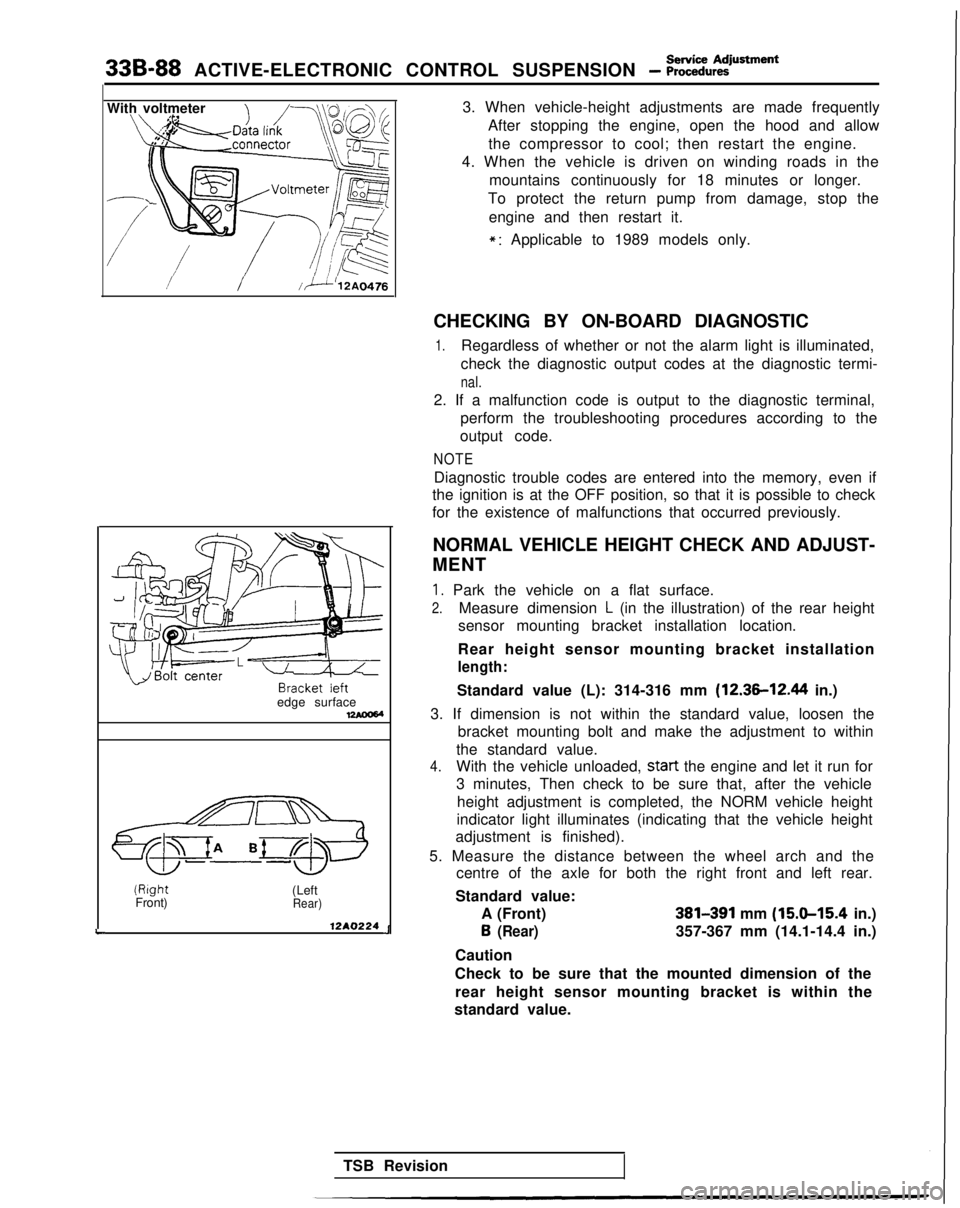
2.Measure dimension L (in the illustration) of the rear height
sensor mounting bracket installation location.
Rear height sensor mounting bracket installation
length:
Standard value (L): 314-316 mm (12.36-12.44 in.)
3. If dimension is not within the standard value, loosen the bracket mounting bolt and make the adjustment to within
the standard value.
4.With the vehicle unloaded, start
the engine and let it run for
3 minutes, Then check to be sure that, after the vehicle
height adjustment is completed, the NORM vehicle height
indicator light illuminates (indicating that the vehicle height
adjustment is finished).
5. Measure the distance between the wheel arch and the centre of the axle for both the right front and left rear.
Standard value: A (Front)
381391 mm (15.9-15.4 in.) 6
(Rear)357-367 mm (14.1-14.4 in.)
Caution
Check to be sure that the mounted dimension of the rear height sensor mounting bracket is within the
standard value.
TSB Revision
Page 1028 of 1273
ACTIVE-ELECTRONIC CONTROL SUSPENSION - ~~:i%,~:iustment 33B-89
Without
disconnecting
:he air tubing
Remaining
pressure
P =
120 kPa
(17 psi)
By disconnecting the
fir tubing
normal
condition
P ‘=.0
Front
tear (From 1990
model!
rmzIIconditlui
12AO281
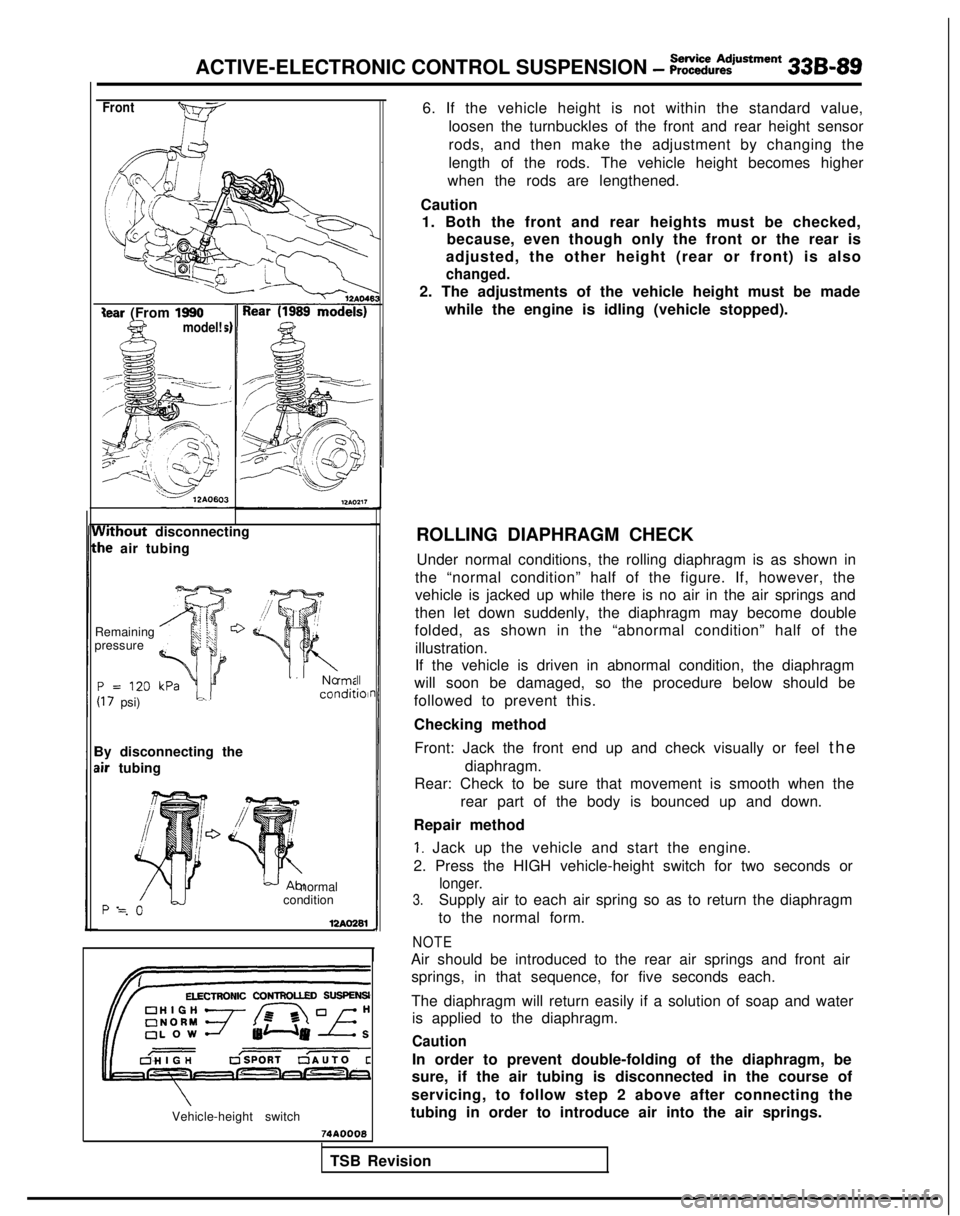
Vehicle-height switch 6. If the vehicle height is not within the standard value,
loosen the turnbuckles of the front and rear height sensor
rods, and then make the adjustment by changing the
length of the rods. The vehicle height becomes higher
when the rods are lengthened.
Caution 1. Both the front and rear heights must be checked, because, even though only the front or the rear is
adjusted, the other height (rear or front) is also
changed.
2. The adjustments of the vehicle height must be made
while the engine is idling (vehicle stopped).
ROLLING DIAPHRAGM CHECK Under normal conditions, the rolling diaphragm is as shown in
the “normal condition” half of the figure. If, however, the
vehicle is jacked up while there is no air in the air springs and
then let down suddenly, the diaphragm may become double
folded, as shown in the “abnormal condition” half of the
illustration.
If the vehicle is driven in abnormal condition, the diaphragm
will soon be damaged, so the procedure below should be
followed to prevent this.
Checking method
Front: Jack the front end up and check visually or feel th
e
diaphragm.
Rear: Check to be sure that movement is smooth when the
rear part of the body is bounced up and down.
Repair method
1. Jack up the vehicle and start the engine.
2. Press the HIGH vehicle-height switch for two seconds or
longer.
3.Supply air to each air spring so as to return the diaphragm
to the normal form.
NOTE
Air should be introduced to the rear air springs and front air springs, in that sequence, for five seconds each.
The diaphragm will return easily if a solution of soap and water is applied to the diaphragm.
Caution
In order to prevent double-folding of the diaphragm, be
sure, if the air tubing is disconnected in the course of
servicing, to follow step 2 above after connecting the
tubing in order to introduce air into the air springs.
74AOOQ8
TSB Revision
Page 1030 of 1273
ACTIVE-ELECTRONIC CONTROL SUSPENSION - %ii%:justment 33B-91
Indicator lights that illuminate for 0.5
second after ECU power ON
Control mode AUTO mode indi-
cator
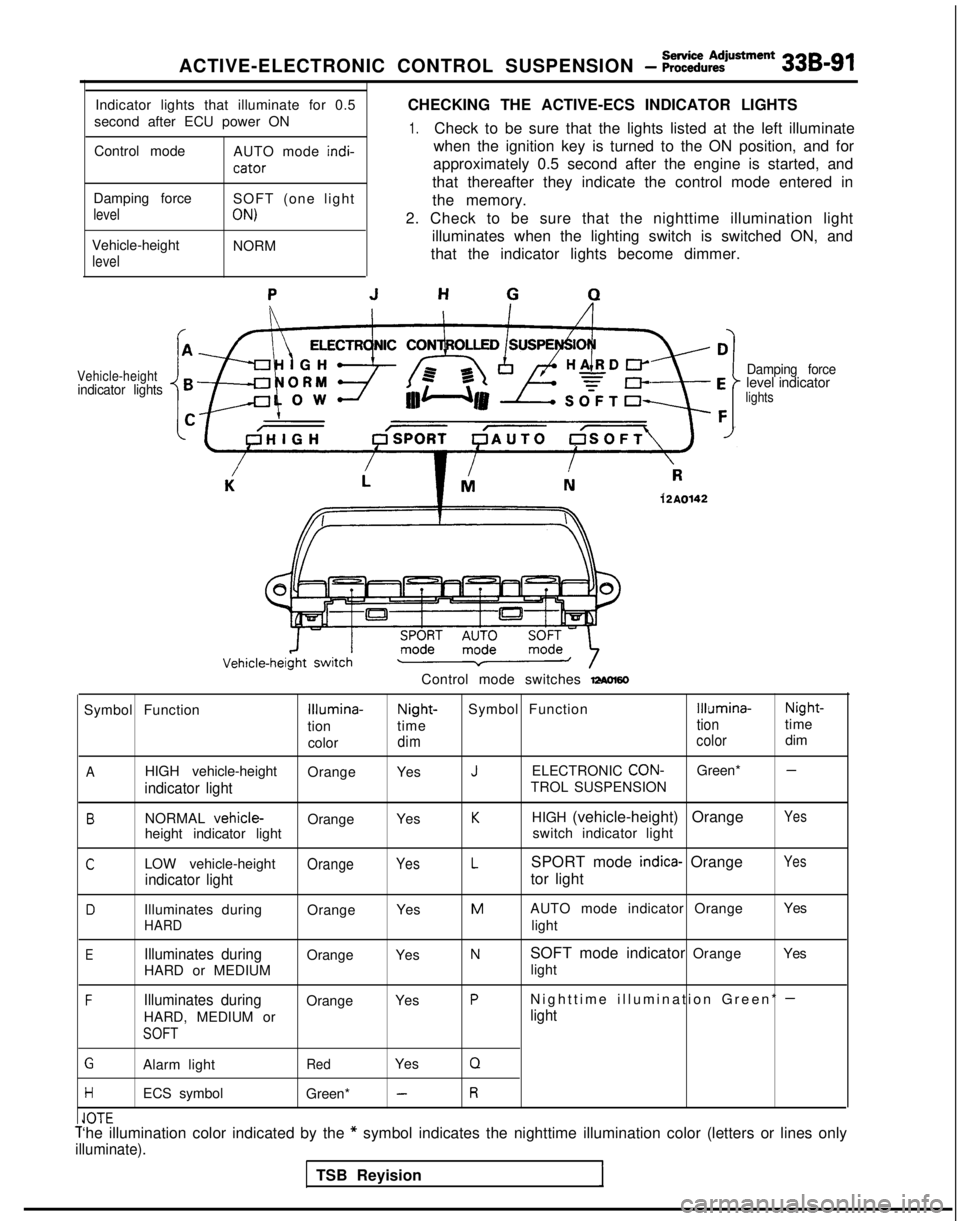
CHECKING THE ACTIVE-ECS INDICATOR LIGHTS
1.Check to be sure that the lights listed at the left illuminate
when the ignition key is turned to the ON position, and for
approximately 0.5 second after the engine is started, and
that thereafter they indicate the control mode entered in
Damping force
level
Vehicle-height
level
SOFT (one light
ON)
NORM the memory.
2. Check to be sure that the nighttime illumination light illuminates when the lighting switch is switched ON, and
that the indicator lights become dimmer.
Vehicle-heightindicator lights Damping forcelevel indicatorlights
12A0142
Control mode switches -60
Symbol FunctionIllumina-Night-
Symbol FunctionIllumina- Night-
tion time
tiontime
color
dim colordim
AHIGH vehicle-height
OrangeYesJELECTRONIC CON-Green* -
indicator lightTROL SUSPENSION
BNORMAL vehicle-OrangeYesKHIGH (vehicle-height) OrangeYes
height indicator light switch indicator light
CLOW vehicle-heightOrangeYesLSPORT mode indica- OrangeYes
indicator lighttor light
DIlluminates during
OrangeYesMAUTO mode indicator Orange Yes
HARDlight
EIlluminates duringOrange
YesNSOFT mode indicator Orange Yes
HARD or MEDIUM light
FIlluminates duringOrange
YesPNighttime illumination Green* -
HARD, MEDIUM orlight
SOFT
GAlarm lightRedYesQ
HECS symbol
Green* -R
IA-r-Cl”lCT‘he illumination color indicated by the * symbol indicates the nighttime illumination color (letters or lines on\
ly
illuminate).
TSB Reyision
Page 1031 of 1273
33B-92 ACTIVE-ELECTRONIC CONTROL SUSPENSION - ~~:%:?stment
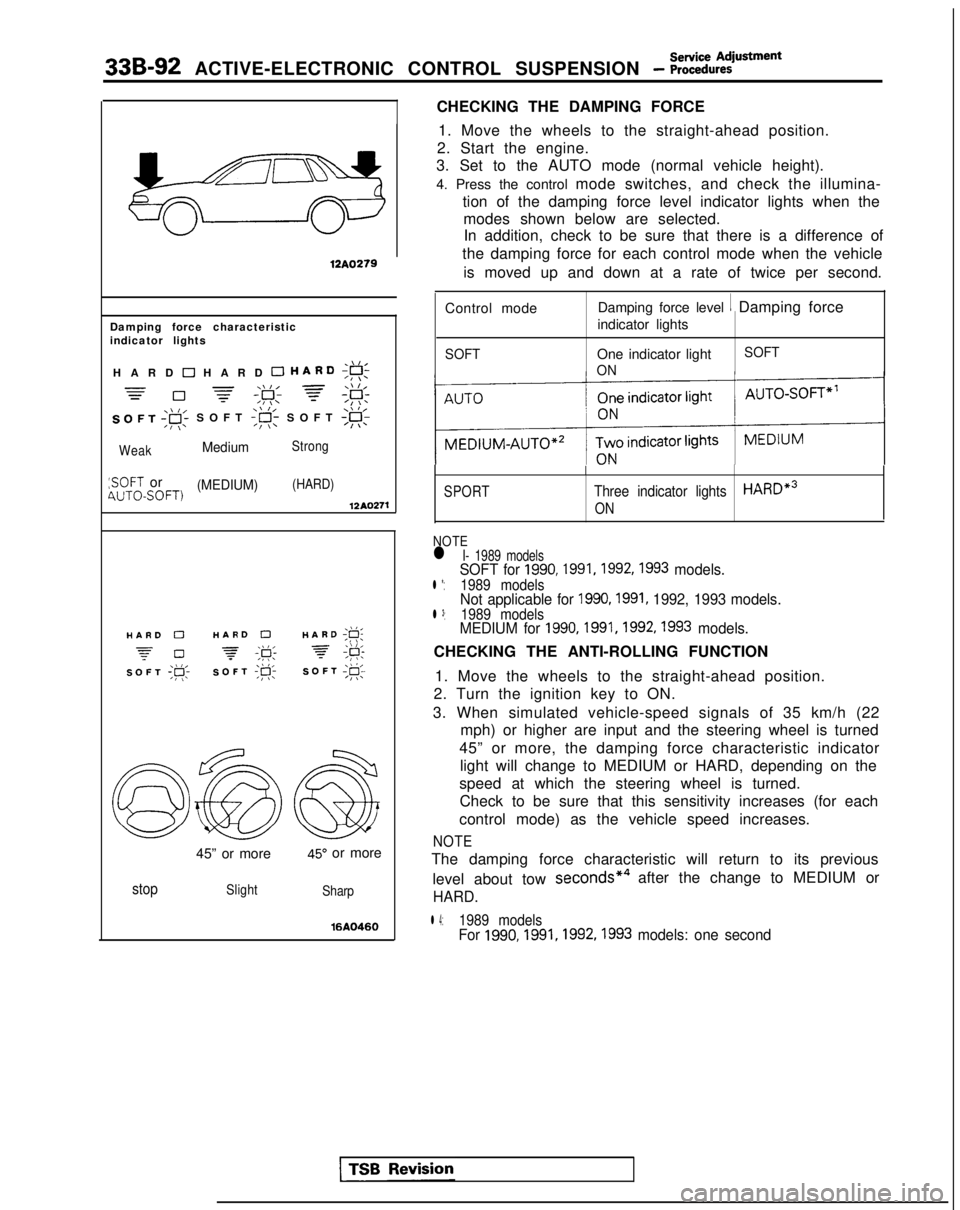
CHECKING THE DAMPING FORCE
12A0279
Damping force characteristic
indicator lights
,\,IHARD 0 HARD 0 HARD;g!;
=-\\I, =\\ l,=0 -=-,F; f;F:
SOFT ,gi SOFT
:SOFT or(MEDIUM)(HARD)4UTOSOFT)12AQ271
./I,HARD 0HARD 0HARD ;g;
z-0 -\k 3,\I I,SOFT ;p;SOFT ;R-SOFT I@;
45” or more45” or more
stopSlight
Sharp
16AQ460
1. Move the wheels to the straight-ahead position.
2. Start the engine.
3. Set to the AUTO mode (normal vehicle height).
4. Press the control mode switches, and check the illumina-
tion of the damping force level indicator lights when themodes shown below are selected.In addition, check to be sure that there is a difference of
the damping force for each control mode when the vehicle
is moved up and down at a rate of twice per second.
Control mode Damping force level
1 Damping force
indicator lights
SOFTOne indicator light
ON SOFT
SPORT
I
Three indicator lightsHARDe3
ON
NOTEl I- 1989 modelsSOFT for 1990,1991,1992,1993 models.l *:1989 modelsNot applicable for 1990,1991, 1992, 1993 models.l 3:1989 modelsMEDIUM for 1990,1991,1992,1993 models.
CHECKING THE ANTI-ROLLING FUNCTION
1. Move the wheels to the straight-ahead position.
2. Turn the ignition key to ON.
3. When simulated vehicle-speed signals of 35 km/h (22 mph) or higher are input and the steering wheel is turned
45” or more, the damping force characteristic indicator light will change to MEDIUM or HARD, depending on the
speed at which the steering wheel is turned. Check to be sure that this sensitivity increases (for each
control mode) as the vehicle speed increases.
NOTE
The damping force characteristic will return to its previous
level about tow seconds*4
after the change to MEDIUM or
HARD.
l 4:1989 modelsFor 1990,1991,1992,1993
models: one second
Page 1032 of 1273
Service AdjustmentACTIVE-ELECTRONIC CONTROL SUSPENSION - Procedures33B-93
\\ I/HARD ;g;
7 #
SOFT;#c
\\ I/HARD ;F;
7 ;&
SOFT;@;
I12AO399
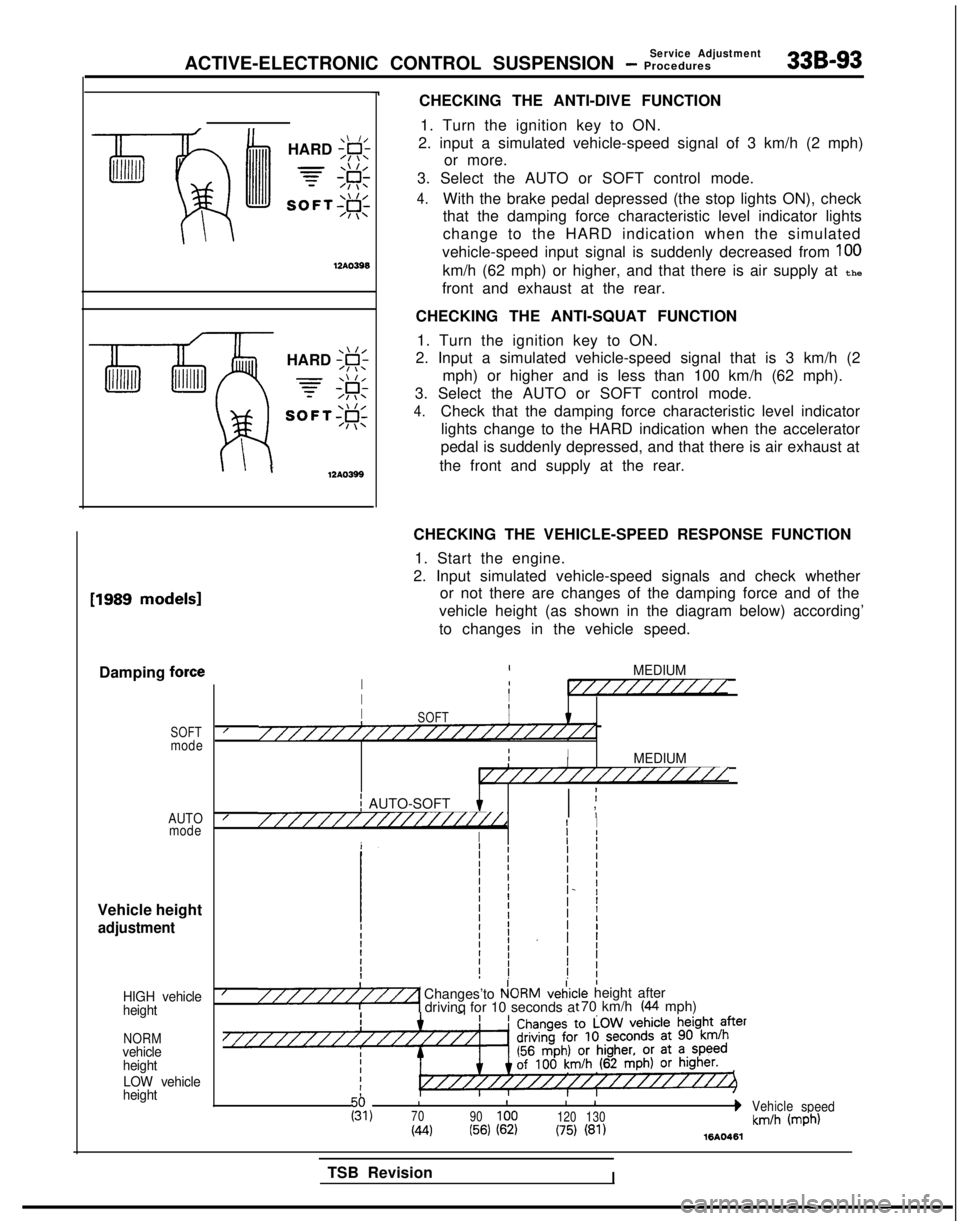
CHECKING THE ANTI-DIVE FUNCTION1. Turn the ignition key to ON.
2. input a simulated vehicle-speed signal of 3 km/h (2 mph) or more.
3. Select the AUTO or SOFT control mode.
4.With the brake pedal depressed (the stop lights ON), check
that the damping force characteristic level indicator lights
change to the HARD indication when the simulated
vehicle-speed input signal is suddenly decreased from
100
km/h (62 mph) or higher, and that there is air supply at the
front and exhaust at the rear.
CHECKING THE ANTI-SQUAT FUNCTION 1. Turn the ignition key to ON.
2. Input a simulated vehicle-speed signal that is 3 km/h (2
mph) or higher and is less than 100 km/h (62 mph).
3. Select the AUTO or SOFT control mode.
4.Check that the damping force characteristic level indicator lights change to the HARD indication when the accelerator
pedal is suddenly depressed, and that there is air exhaust at
the front and supply at the rear. [1989
models1
Damping force
SOFTmode
AUTO mode
Vehicle height
adjustment
HIGH vehicle
height
NORMvehicle
height
LOW vehicle
height
CHECKING THE VEHICLE-SPEED RESPONSE FUNCTION
1. Start the engine.
2. Input simulated vehicle-speed signals and check whether or not there are changes of the damping force and of the
vehicle height (as shown in the diagram below) according’
to changes in the vehicle speed.
IMEDIUMI1I//////////IIIII8SOFTI////////////////////////IIIIMEDIUMI////////////////
j AUTO-SOFT I ;I ,////////////////i//dI I
I
Ij I
I/Changes’to P!ORMveiic“““““1 drivinq for 10 seconds a:le height after t 70 km/h (44 mph)
III
I 1g,70
90100 120130bVehicle
speed
(44(56) (62)(75) (81)km/h (mph)1610461
TSB RevisionI