check engine MITSUBISHI GALANT 1989 Service Repair Manual
[x] Cancel search | Manufacturer: MITSUBISHI, Model Year: 1989, Model line: GALANT, Model: MITSUBISHI GALANT 1989Pages: 1273, PDF Size: 37.62 MB
Page 585 of 1273
COOLING -Engine Coolant Temperature Gauge Unit, Engine Coolant
Temperature Sensor and Engine Coolant Temperature Switch14-33
20R0586
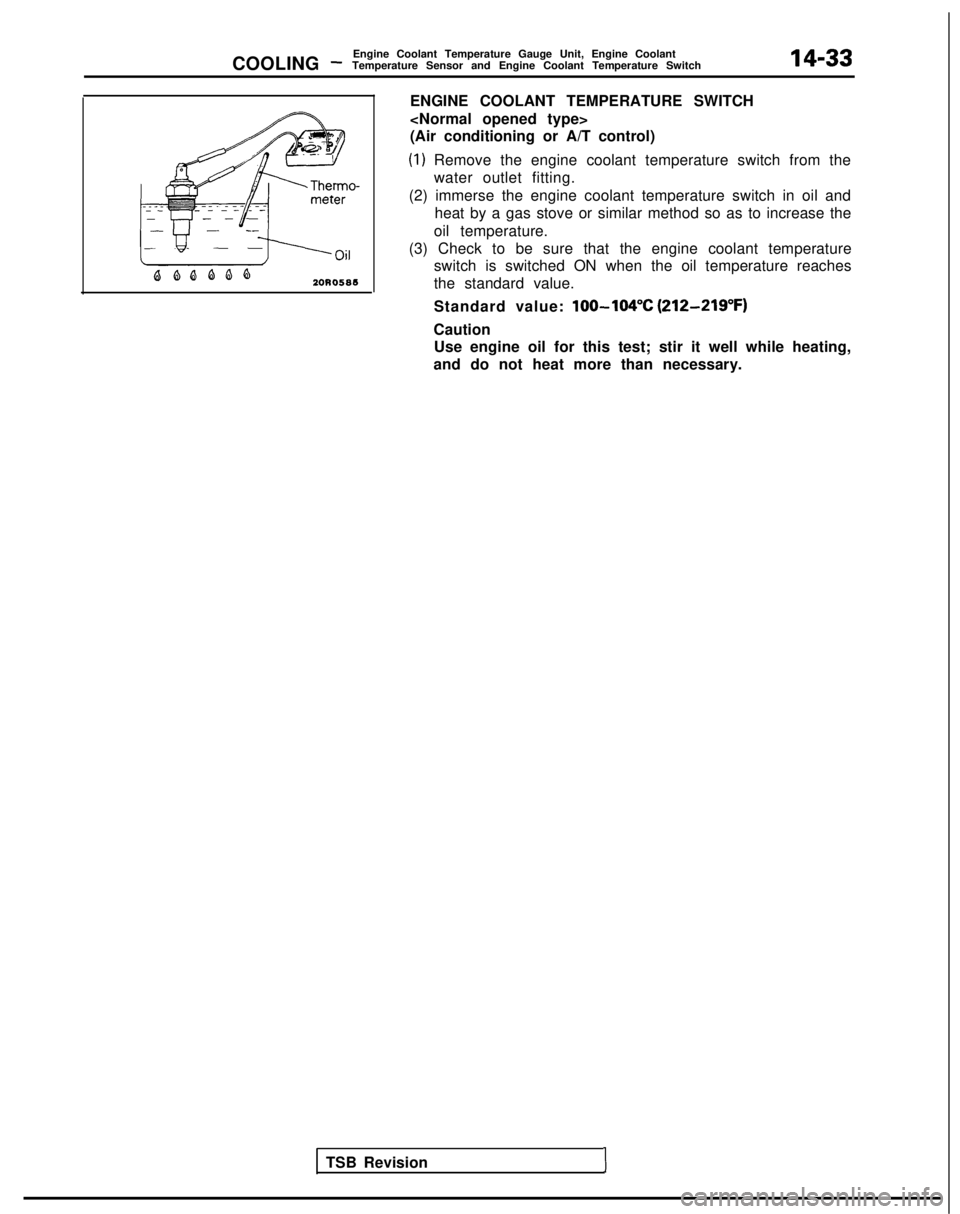
ENGINE COOLANT TEMPERATURE SWITCH
(Air conditioning or A/T control)
(1) Remove the engine coolant temperature switch from the
water outlet fitting.
(2) immerse the engine coolant temperature switch in oil and heat by a gas stove or similar method so as to increase the
oil temperature.
(3) Check to be sure that the engine coolant temperature switch is switched ON when the oil temperature reaches
the standard value.
Standard value:
lOO-104% (212-219°F)
CautionUse engine oil for this test; stir it well while heating,
and do not heat more than necessary.
TSB Revision
1
Page 593 of 1273
INTAKE AND EXHAUST - Service Adjustment Procedures15-7
Turbocharger waste
gate actuator
05A0150
OSAOlSl
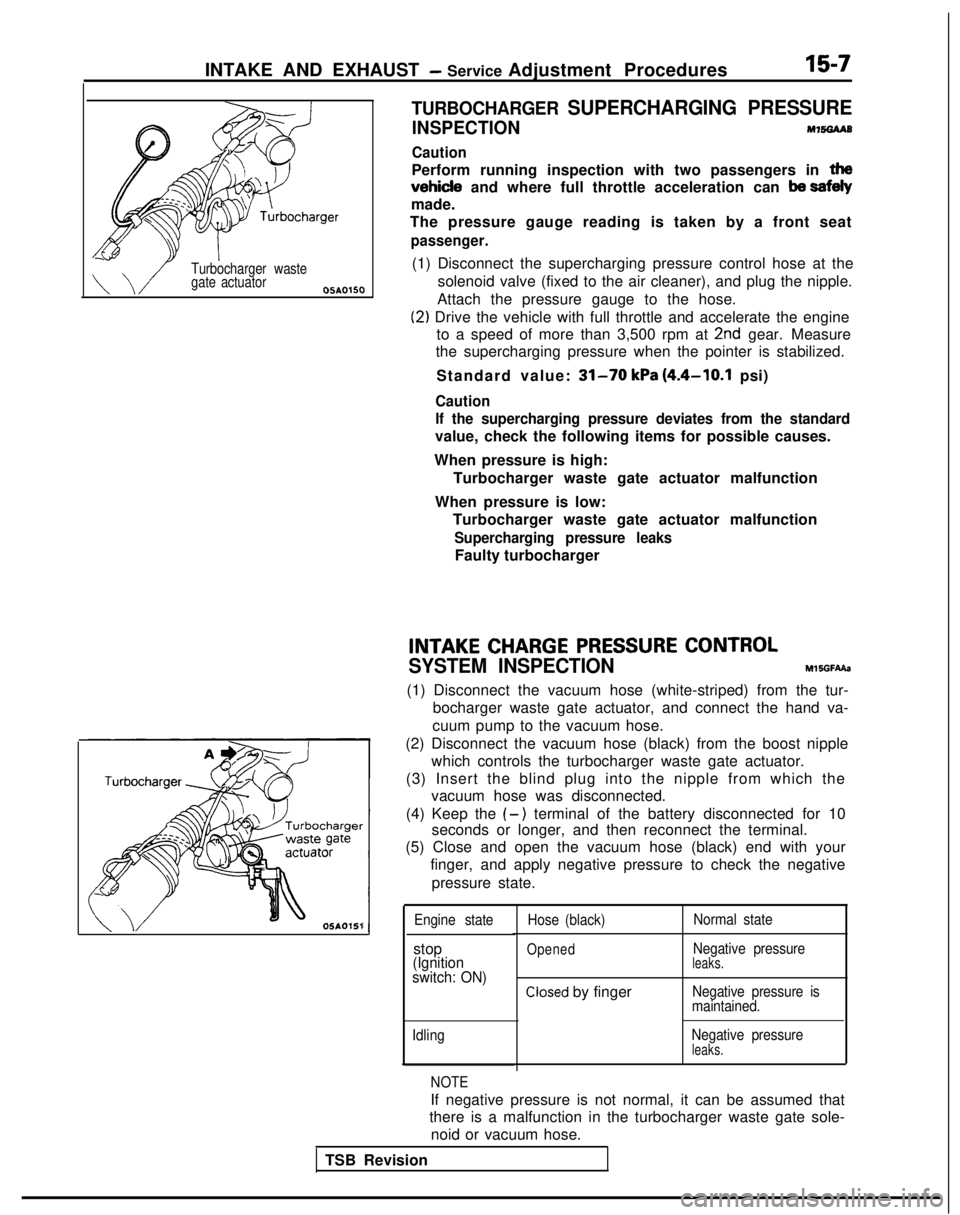
TURBOCHARGER SUPERCHARGING PRESSURE
INSPECTIONM7!%3AAB
Caution
Perform running inspection with two passengers in tha
vehicle and where full throttle acceleration can ba sefely
made.
The pressure gauge reading is taken by a front seat
passenger.
(1) Disconnect the supercharging pressure control hose at the
solenoid valve (fixed to the air cleaner), and plug the nipple.
Attach the pressure gauge to the hose.
(2) Drive the vehicle with full throttle and accelerate the engine to a speed of more than 3,500 rpm at
2nd gear. Measure
the supercharging pressure when the pointer is stabilized.
Standard value:
31-70 kPa (4.4-10.1 psi)
Caution
If the supercharging pressure deviates from the standard
value, check the following items for possible causes.
When pressure is high: Turbocharger waste gate actuator malfunction
When pressure is low: Turbocharger waste gate actuator malfunction
Supercharging pressure leaks
Faulty turbocharger
INTAKECHARGEPRESSURECONTROL
SYSTEM INSPECTION
MlSGFAAa
(1) Disconnect the vacuum hose (white-striped) from the tur- bocharger waste gate actuator, and connect the hand va-
cuum pump to the vacuum hose.
(2) Disconnect the vacuum hose (black) from the boost nipple which controls the turbocharger waste gate actuator.
(3) Insert the blind plug into the nipple from which the vacuum hose was disconnected.
(4) Keep the
(-) terminal of the battery disconnected for 10
seconds or longer, and then reconnect the terminal.
(5) Close and open the vacuum hose (black) end with your
finger, and apply negative pressure to check the negative
pressure state.
Engine state
stop(Ignition
switch: ON)
Idling Hose (black)
Opened
Normal state
Negative pressure
leaks.
Closed by fingerNegative pressure is
maintained.
Negative pressure
leaks.
NOTE
If negative pressure is not normal, it can be assumed that
there is a malfunction in the turbocharger waste gate sole-
noid or vacuum hose.
TSB Revision
Page 594 of 1273
15-8INTAKE AND EXHAUST - Service Adjustment Procedures
u--05A0155
61 N006C
6 I NO056
(6) Put a blind plug on the vacuum hose (black) end.
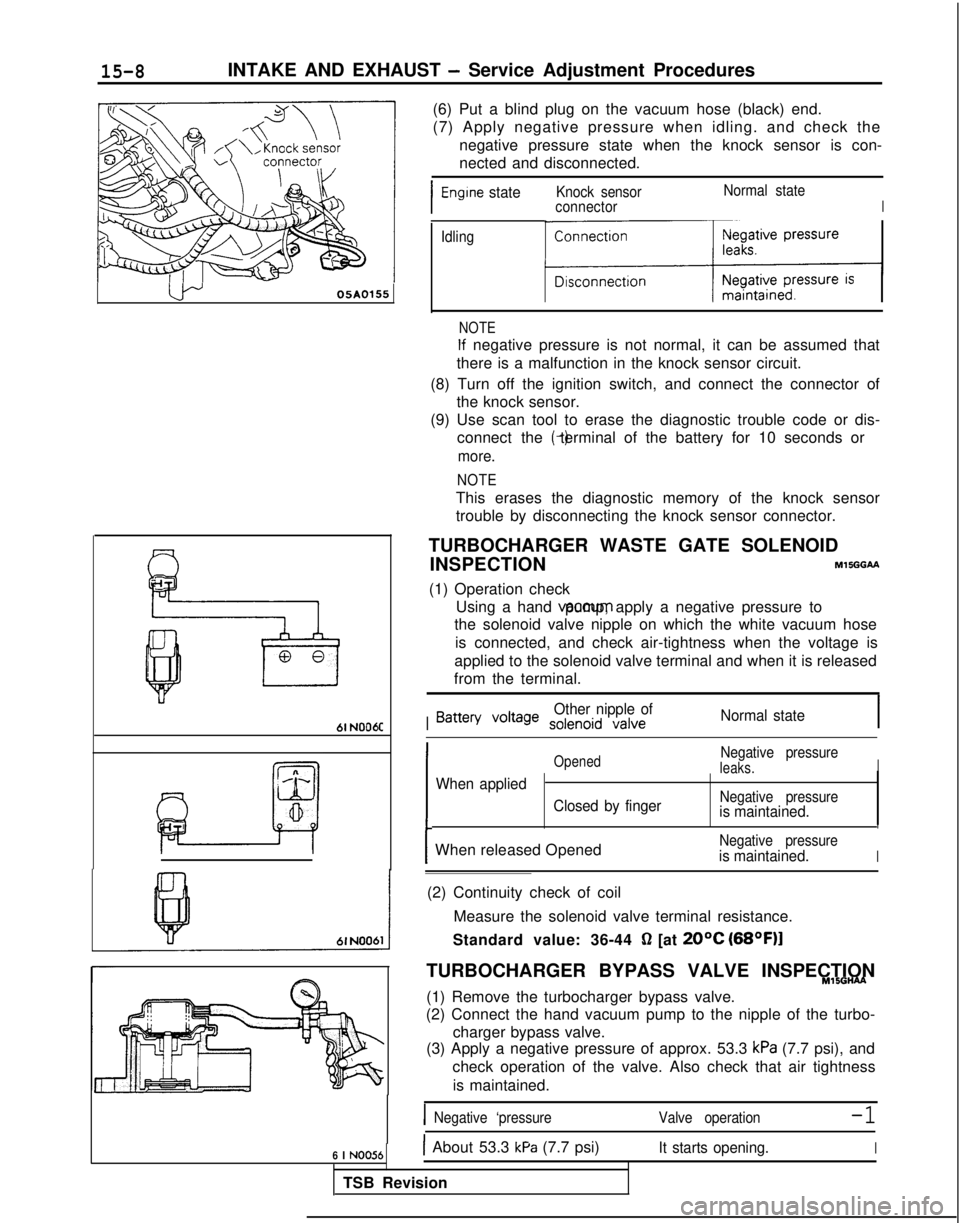
(7) Apply negative pressure when idling. and check thenegative pressure state when the knock sensor is con-
nected and disconnected.
I
Engine stateKnock sensor Normal state
connectorI
Idling
ml
NOTE
If negative pressure is not normal, it can be assumed that
there is a malfunction in the knock sensor circuit.
(8) Turn off the ignition switch, and connect the connector of the knock sensor.
(9) Use scan tool to erase the diagnostic trouble code or dis- connect the (-) terminal of the battery for 10 seconds or
more.
NOTE
This erases the diagnostic memory of the knock sensor
trouble by disconnecting the knock sensor connector.
TURBOCHARGER WASTE GATE SOLENOID INSPECTION
MlSGGM
(1) Operation check Using a hand vaccum pump, apply a negative pressure to
the solenoid valve nipple on which the white vacuum hose
is connected, and check air-tightness when the voltage is
applied to the solenoid valve terminal and when it is released
from the terminal.
I
Other nipple ofBattery Voltage solenoid valveNormal state
OpenedNegative pressureleaks.I
When applied
Closed by fingerNegative pressureis maintained.LIII
Negative pressureis maintained.IIWhen released Opened
(2) Continuity check of coil Measure the solenoid valve terminal resistance.
Standard value: 36-44
0 [at 20°C (68OF)l
TURBOCHARGER BYPASS VALVE INSPECTIONMlSGHAA
(1) Remove the turbocharger bypass valve.
(2) Connect the hand vacuum pump to the nipple of the turbo-
charger bypass valve.
(3) Apply a negative pressure of approx. 53.3
kPa (7.7 psi), and
check operation of the valve. Also check that air tightness
is maintained.
INegative ‘pressure Valve operation-1
IAbout 53.3 kPa (7.7 psi)It starts opening.I
TSB Revision
Page 613 of 1273
INTAKE AND EXHAUST -Exhaust Manifold (SOHC-8 VALVE>15-27
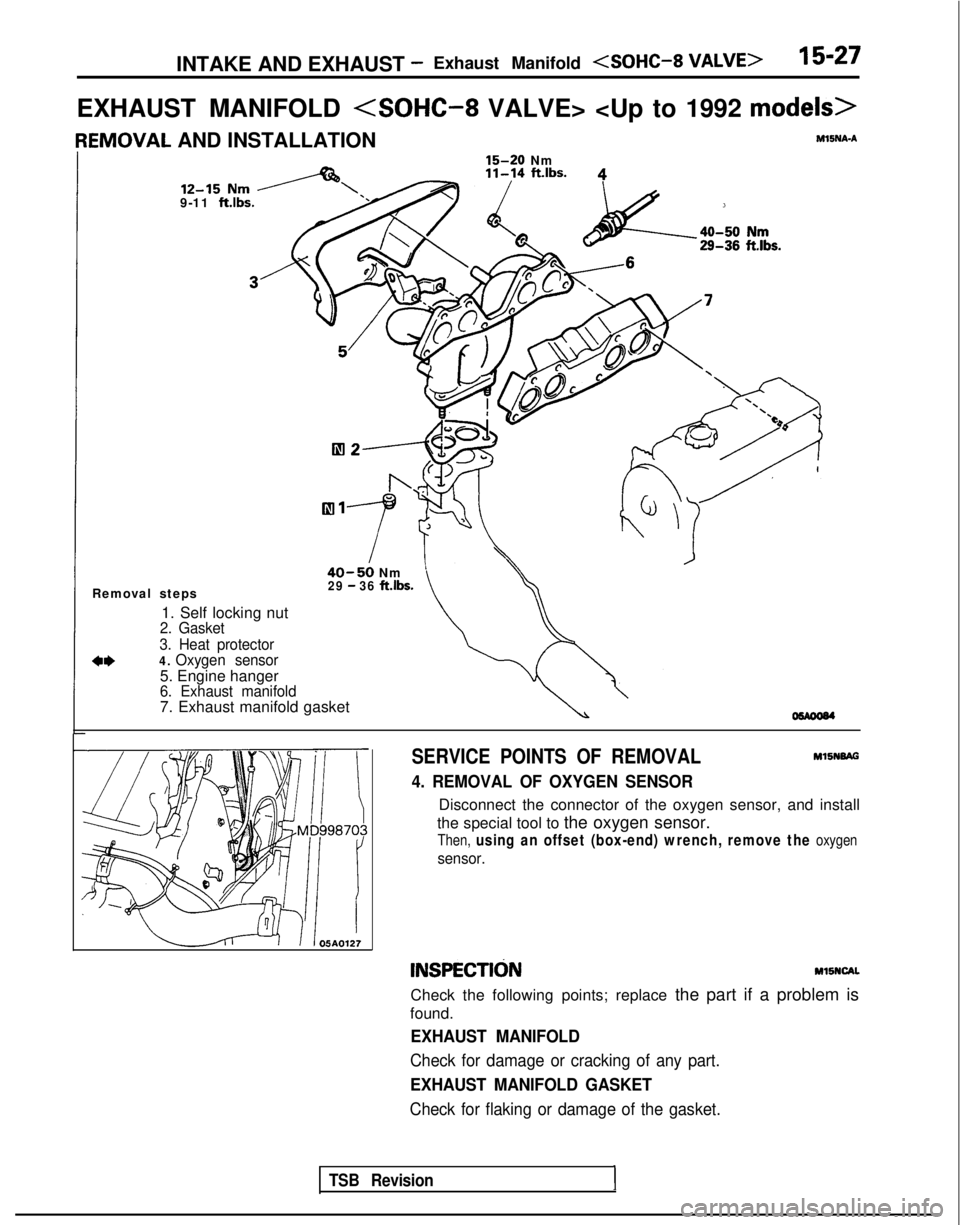
EXHAUST MANIFOLD
IEMOVAL AND INSTALLATIONYSNA-A
15-20
Nm
9-11 ftlbs.
40-50 Nm
Removal steps29 - 36 ft.lbs.
1. Self locking nut2. Gasket
3. Heat protector
a*4. Oxygen sensor
5. Engine hanger6. Exhaust manifold7. Exhaust manifold gasket
SERVICE POINTS OF REMOVAL MlSNBAG
4. REMOVAL OF OXYGEN SENSOR
Disconnect the connector of the oxygen sensor, and install
the special tool to the oxygen sensor.
Then, using an offset (box-end) wrench, remove the oxygen
sensor.
INSPECTldNMllNCAL
Check the following points; replace the part if a problem is
found.
EXHAUST MANIFOLD
Check for damage or cracking of any part.
EXHAUST MANIFOLD GASKET
Check for flaking or damage of the gasket.
TSB Revision1
Page 623 of 1273

EMISSION CONTROL SYSTEMS - Troubleshooting17-3
TROUBLESHOOTINGMVEA-
SymptomProbable causeRemedy
Engine will not start or hardVacuum hose disconnected or Repair or replaceto startdamaged
The EGR valve is not closed. Repair or replace
Malfunction of the evaporativeRepair or replace
emission purge solenoid
Rough idle or engine stalls The EGR valve is not closed.Repair or replace
Vacuum hose disconnected or damaged Repair or replace
Malfunction of the positive crankcaseReplaceventilation valve
Malfunction of the purge control system Check the system; if there is a
problem, check its component parts.
Engine hesitates or poorIcceleration
Zxcessive oil consumption
)oor fuel mileage
Malfunction of the exhaust gasrecirculation system
Positive crankcase ventilation line
clogged
Malfunction of the exhaust gas
recirculation system Check the system; if there is a
problem, check its component parts.
Check positive crankcase ventilation
system
Check the system; if there is a problem,
check its component parts.
TSB Revision
Page 637 of 1273
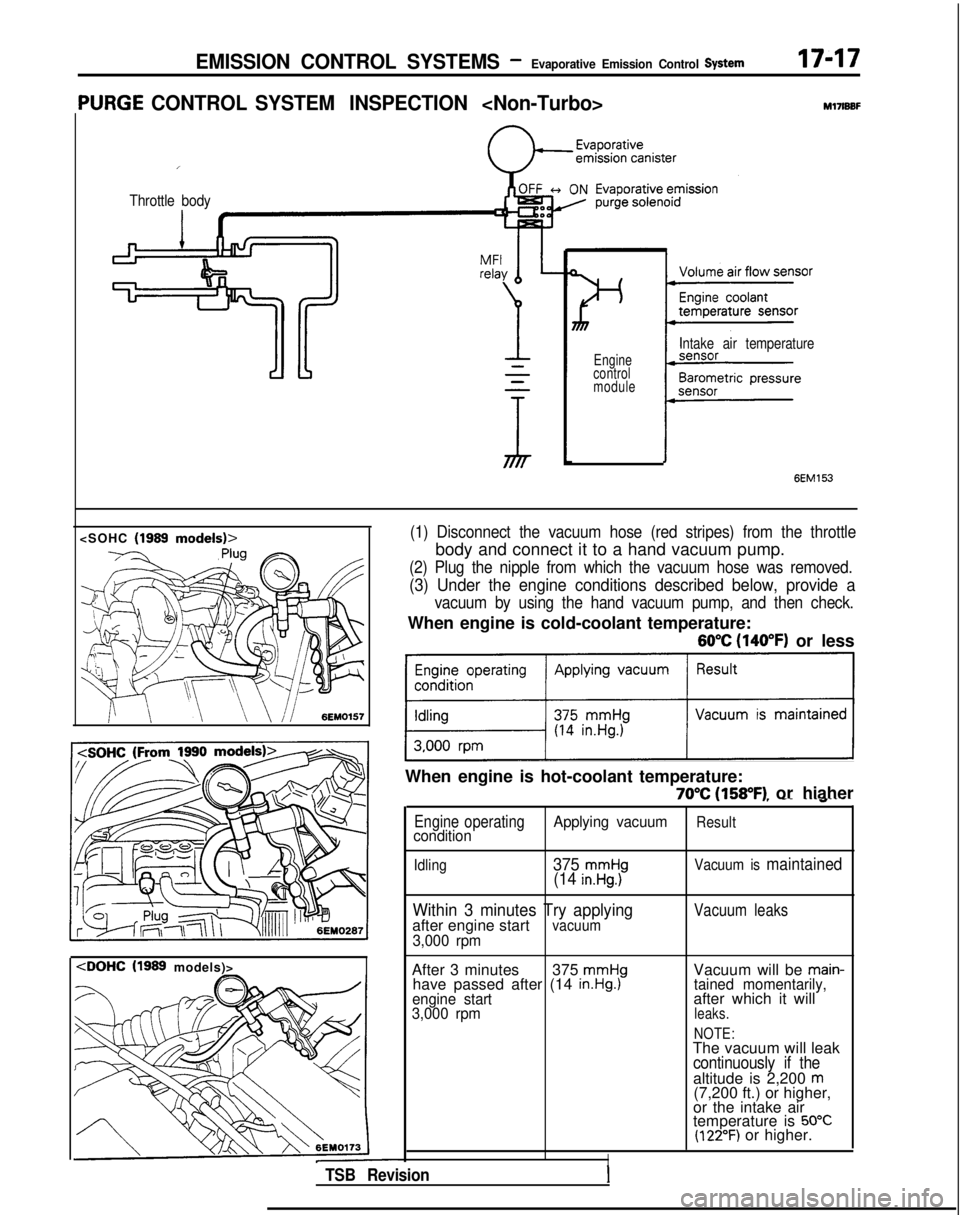
EMISSION CONTROL SYSTEMS -Evaporative Emission Control System17-17
‘URGE CONTROL SYSTEM INSPECTION
I
Throttle body
M17lBBF
Engine
control
module
Intake air temperature
models)>
6EM153
(1) Disconnect the vacuum hose (red stripes) from the throttle
body and connect it to a hand vacuum pump.
(2) Plug the nipple from which the vacuum hose was removed.
(3) Under the engine conditions described below, provide a
vacuum by using the hand vacuum pump, and then check.
When engine is cold-coolant temperature:
60°C (140°F) or less
~1
When engine is hot-coolant temperature:
70°C (158°F) or hiaher, -- ---~“----
Engine operatingApplying vacuumResultcondition
Idling375 mmHg(14 in.Hg.)Vacuum is maintained
Within 3 minutes Try applyingafter engine startvacuum3,000 rpm
Vacuum leaks
After 3 minutes 375 mmHghave passed after (14 in.Hg.)engine start
3,000 rpm
Vacuum will be main-tained momentarily,after which it willleaks.
NOTE:
The vacuum will leakcontinuously if thealtitude is 2,200 m(7,200 ft.) or higher,
or the intake air
temperature is
50°C(122°F) or higher.
ITSB RevisionI
Page 638 of 1273
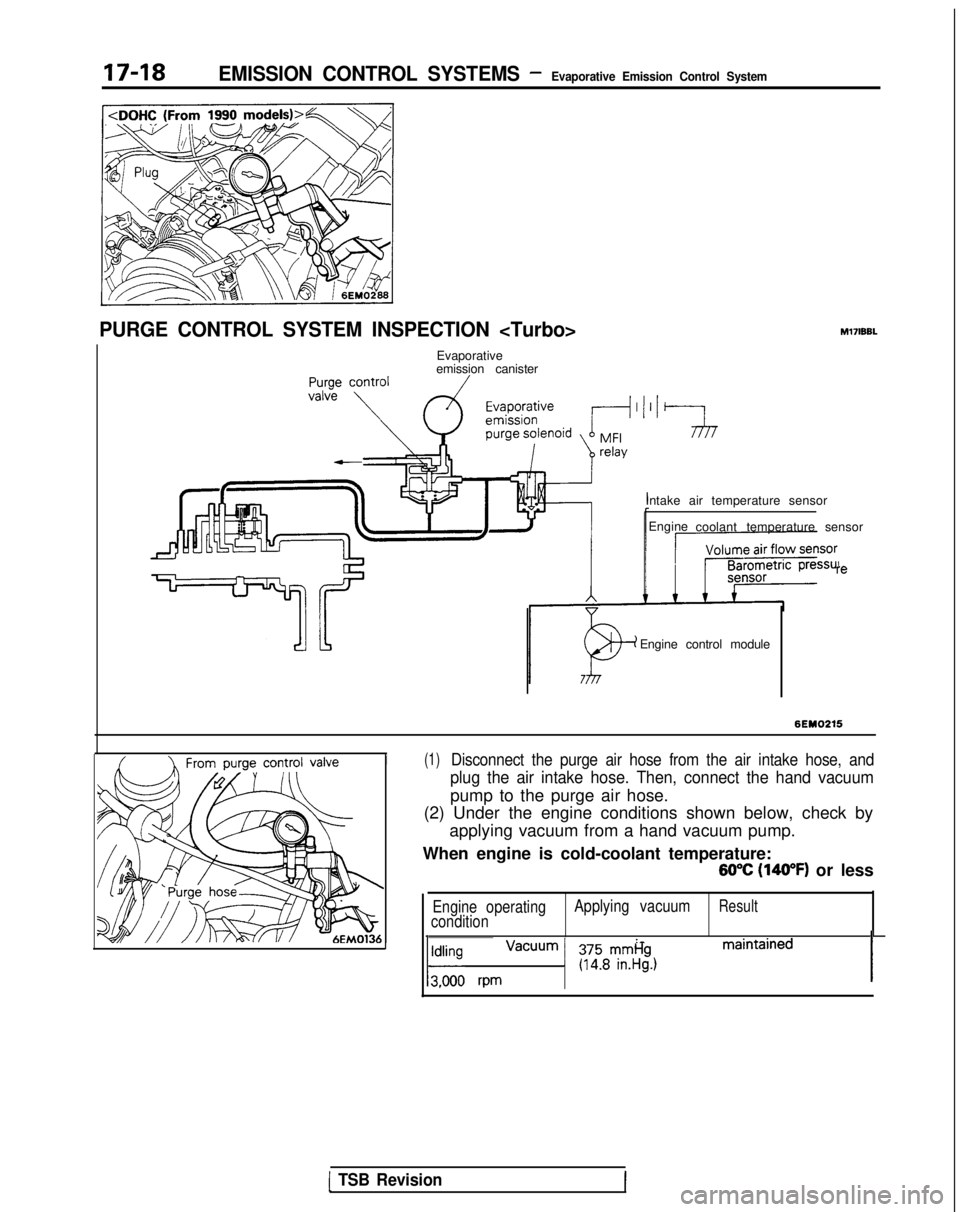
EMISSION CONTROL SYSTEMS -Evaporative Emission Control System
PURGE CONTROL SYSTEM INSPECTION
Evaporative
emission canister
Intake air temperature sensorEngine coolant temperature sensor re
Engine control module
I(1)Disconnect the purge air hose from the air intake hose, and
plug the air intake hose. Then, connect the hand vacuum
pump to the purge air hose.
(2) Under the engine conditions shown below, check by
applying vacuum from a hand vacuum pump.
When engine is cold-coolant temperature:
60°C (140°F) or less
Engine operating Applying vacuumResultcondition
1 vacuum is maintained 1ldldl rpm1 gy?r$y)
[ TSB Revision
Page 640 of 1273
17-20EMISSION CONTROL SYSTEMS -Evaporative Emission Control System
Engine speed (rpm)>
3FU262
E2id>
‘_/- )Engine
speed
(rpm)1 FU446
1 TSB Revision
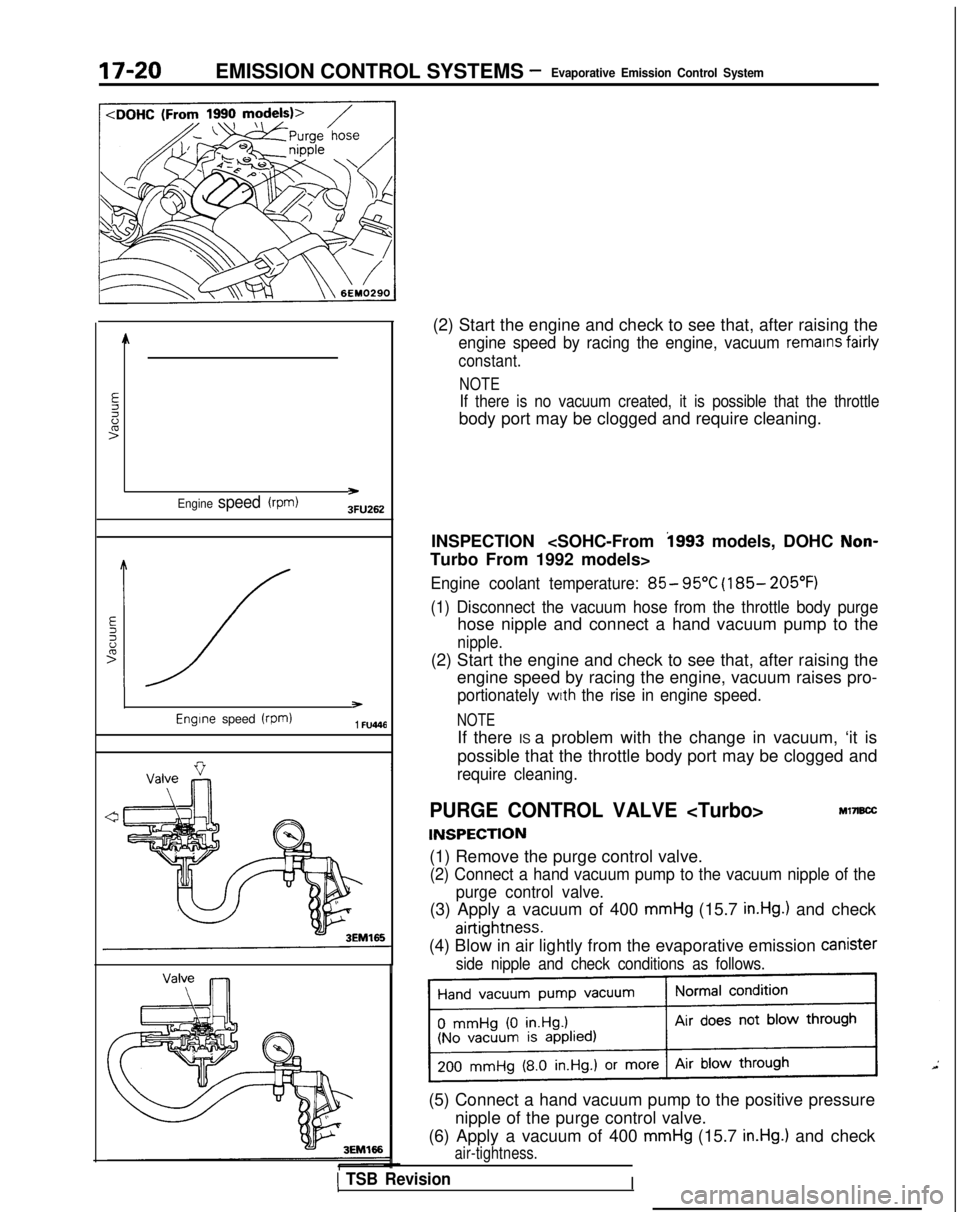
(2) Start the engine and check to see that, after raising the
engine speed by racing the engine, vacuum remains fairly
constant.
NOTE
If there is no vacuum created, it is possible that the throttle
body port may be clogged and require cleaning.
INSPECTION
Turbo From 1992 models>
Engine coolant temperature: 85- 95°C (185- 205°F)
(1) Disconnect the vacuum hose from the throttle body purge
hose nipple and connect a hand vacuum pump to the
nipple.
(2) Start the engine and check to see that, after raising the engine speed by racing the engine, vacuum raises pro-
portionately with the rise in engine speed.
NOTE
If there IS a problem with the change in vacuum, ‘it is
possible that the throttle body port may be clogged and
require cleaning.
PURGE CONTROL VALVE
INSPECTION
Ml7B.X
(1) Remove the purge control valve.
(2) Connect a hand vacuum pump to the vacuum nipple of the
purge control valve.
(3) Apply a vacuum of 400 mmHg (15.7 in.Hg.) and check
airtightness.
(4) Blow in air lightly from the evaporative emission Canister
side nipple and check conditions as follows.
(5) Connect a hand vacuum pump to the positive pressure
nipple of the purge control valve.
(6) Apply a vacuum of 400
mmHg (15.7 in.Hg.) and check
air-tightness.
I
Page 641 of 1273

EMISSION CONTROL SYSTEMS -Evaporative Emission Control System17-21EC1510
6EM137
EVAPORATIVE EMlS$lON
PURGE SOLENOID
INSPECTIONM17lBFD
NOTE
When disconnecting the vacuum hose, make an identification
mark on it so that it can be reconnected to the original posi-
tion.
(1) Disconnect the vacuum hoses (non stripe and red stripe
hoses) from the solenoid valve
(2) Disconnect the harness connector from solenoid valve.
(3) Connect a hand vacuum pump to the nipple to which the red-striped vacuum hose was connected.
(4) Apply a vacuum and check for air-tightness when voltage applied directly to the evaporative emission purge solenoid
when the voltage is discontinued.
Battery voltageResult
Non-Turbo When appliedVacuum leaks
When discontinued Vacuum is maintained
TurboWhen appliedVacuum is maintained
When discontinued Vacuum leaks
(5) Measure the resistance between the terminals of the sole-
noid valve.
Standard value: 36-44 Q [at 20°C (68”F)l
VOLUME AIR FLOW SENSOR, ENGINE
COOLANT TEMPERATURE SENSOR AND
INTAKE AIR TEMPERATURE SENSOR
M17IBGB
To inspect these parts, refer to GROUP 13-On-Vehicle Inspec-
tion of
MFI Components.
AIR CONDITIONING SWITCH Ml7IBHB
To inspect the air conditioning switch, refer to GROUP
55-Air
Conditioning Switch.
FUEL TANK PRESSURE CONTROL VALVE MI’IIBEB
To inspect the fuel tank pressure control valve, refer to GROUP
13-Fuel
Tank.
EVAPORATIVE EMISSION CANISTERM17lBlB
To inspect the evaporative emission canister, refer to GROUP
13-Fuel Line and Vapor Line.
FUEL TANK FILLER TUBE CAP INSPECTIONM,7,w~
Check the gasket of the fuel tank filler tube cap, and the filler
cap itself, for damage or deformation; replace the
cap if neces-
sary.
TSB RevisionI
Page 645 of 1273

EMISSION CONTROL SYSTEMS -Exhaust Gas Recirculation (EGR) System17-25
.
EGR SYSTEM INSPECTION
(1) Disconnect the vacuum hose (green stripe) from the throttle body, and connect a hand vacuum pump to the
vacuum hose.
(2) Under the engine conditions described below, provide a
vacuum by using the hand vacuum pump, and then check.
WhenEngine is Cold-
coolant temperature 50°C (122°F) or below
Engine operatingconditionApplying vacuumResul
t
IdlingTry applying vacuum Vacuum leaks
When Engine is Hot-
coolant temperature 85”-95°C (185”-205°F) or higher
Engine operatingconditionApplying vacuumResult
Idling45 mmHg(1.7 in.Hg.1Vacuum is maintained
Changes from
idling to slightlyunstable
Vacuum is maintained
EGR SYSTEM INSPECTION
(1) Disconnect the vacuum hose (green striped hose) from the exhaust gas recirculation
(EGR) valve, and then connect a
manual vacuum pump via the three-way terminal.
(2) Check the following points when the engine is cold [enginecoolant temperature is
20°C (68°F) or below] and when the
engine is warm [engine coolant temperature is
70°C (158°F)
or higher].
116EMOZW
TSB Revision