check engine MITSUBISHI GALANT 1989 Service Repair Manual
[x] Cancel search | Manufacturer: MITSUBISHI, Model Year: 1989, Model line: GALANT, Model: MITSUBISHI GALANT 1989Pages: 1273, PDF Size: 37.62 MB
Page 752 of 1273
23-46AUTOMATIC TRANSAXLE - Troubleshootincl
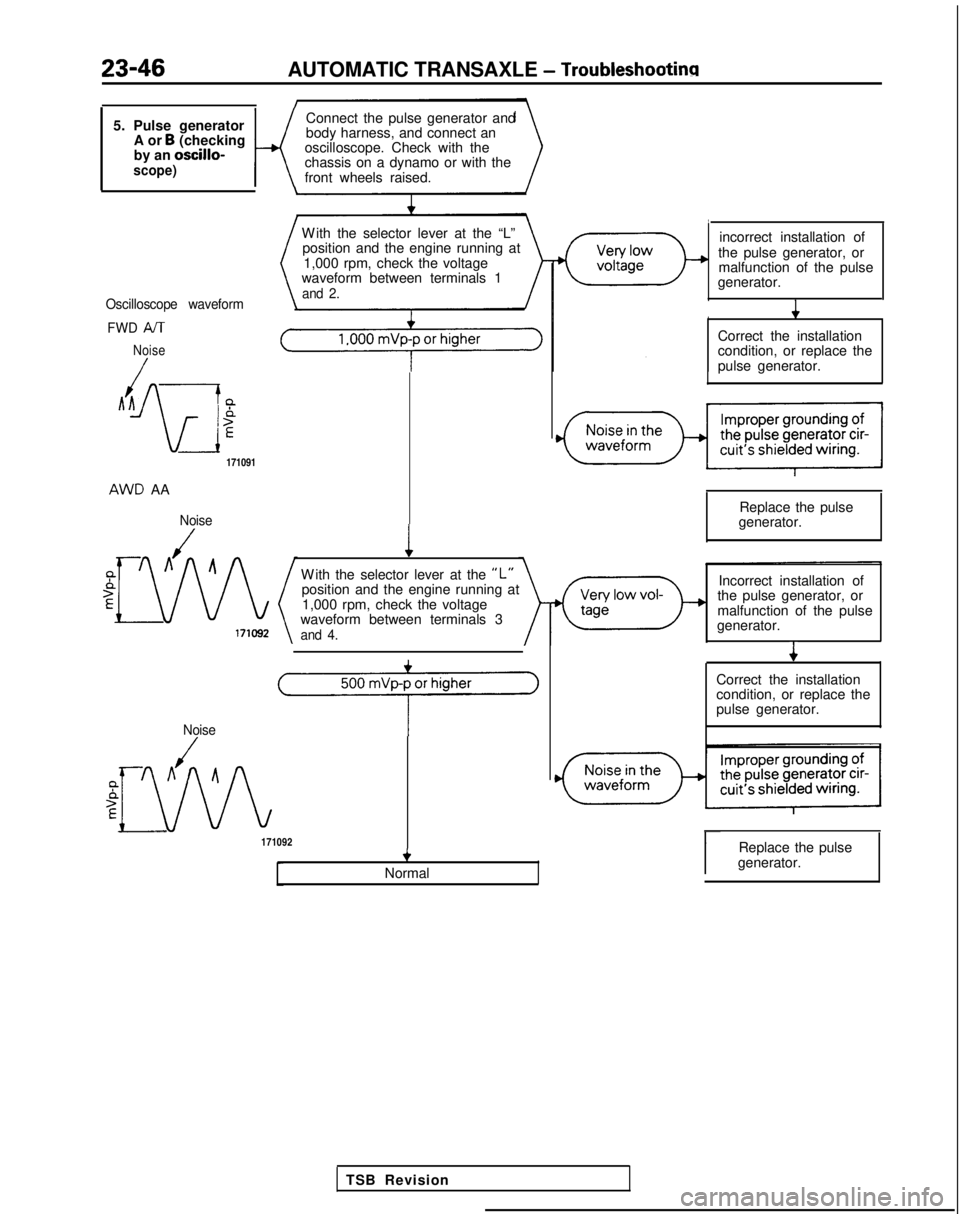
5. Pulse generatorA or B (checking
by an oscillo-
scope)K
Connect the pulse generator and
body harness, and connect an
oscilloscope. Check with the
chassis on a dynamo or with the
front wheels raised.
Oscilloscope waveform
FWD
/VT
Noise
/Ah --L
Ar
IP
-iE
171091 AWD
AA
Noise
W
ith the selector lever at the “L”
position and the engine running at
1,000 rpm, check the voltage
waveform between terminals 1
and 2.
1
W
ith the selector lever at the
“L”position and the engine running at
1,000 rpm, check the voltage
waveform between terminals 3
and 4.
Noise
A
(6
171092+
Normal incorrect installation of
the pulse generator, or malfunction of the pulse
generator. 4
Correct the installation
condition, or replace the
pulse generator.
Replace the pulse
generator.
Incorrect installation of
the pulse generator, or
malfunction of the pulse
generator. 4
Correct the installation
condition, or replace the
pulse generator.r
Replace the pulse
generator.
TSB Revision
Page 758 of 1273
23-52AUTOMATIC TRANSAXLE - Troubleshooting
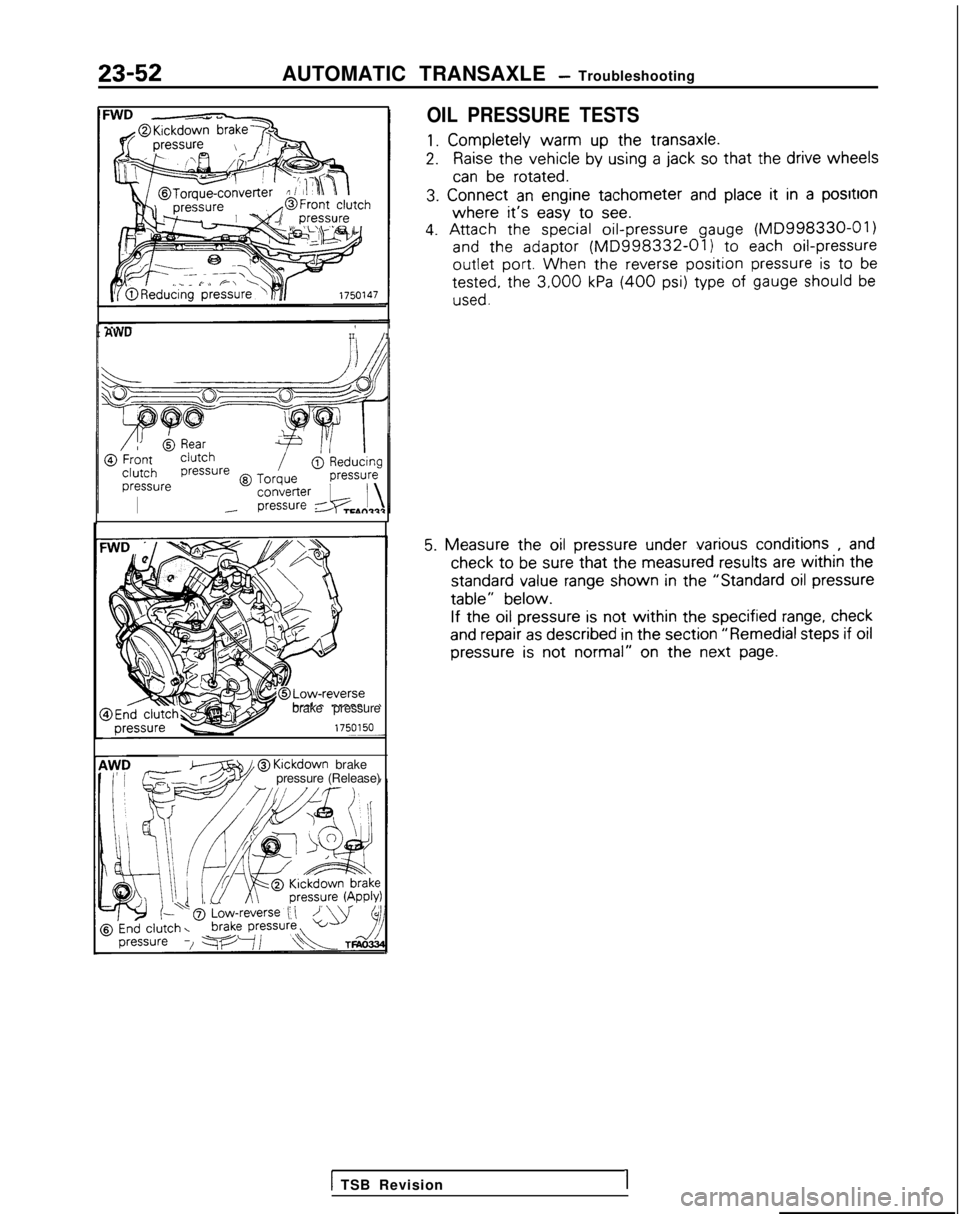
OIL PRESSURE TESTS
1. Completely
warm
up the
transaxle.
2.Raise the
vehicle
by
using
a jack so that the
drive
wheels
can be
rotated.
3.
Connect
an engine
tachometer
and place it
in a positron
where it’s easy
to
see.
4. Attach
the
special oil-pressure
gauge (MD998330-01)
and
the
adaptor
(MD998332-01) to
each oil-pressure
outlet
port. When
the
reverse position pressure is to
be tested,
the
3,000 kPa (400 psi) type
of gauge should be
used.
I AWUII/I
brake pressure
zT?ziw@
Klckdown
brake
pressure (Release)
5. Measure
the
oil pressure
under
various
conditions
, and check
to be sure that the
measured
results
are within the
standard
value
range shown
in the
“Standard
oil pressure
table”
below.
If the
oil pressure
is not
within the
specified
range, check
and repair
as described
in the
section
“Remedial
steps
if oil
pressure
is not
normal”
on the next
page.
1 TSB Revision1
Page 765 of 1273
AUTOMATIC TRANSAXLE - Troubleshooting23-59
ring
brake
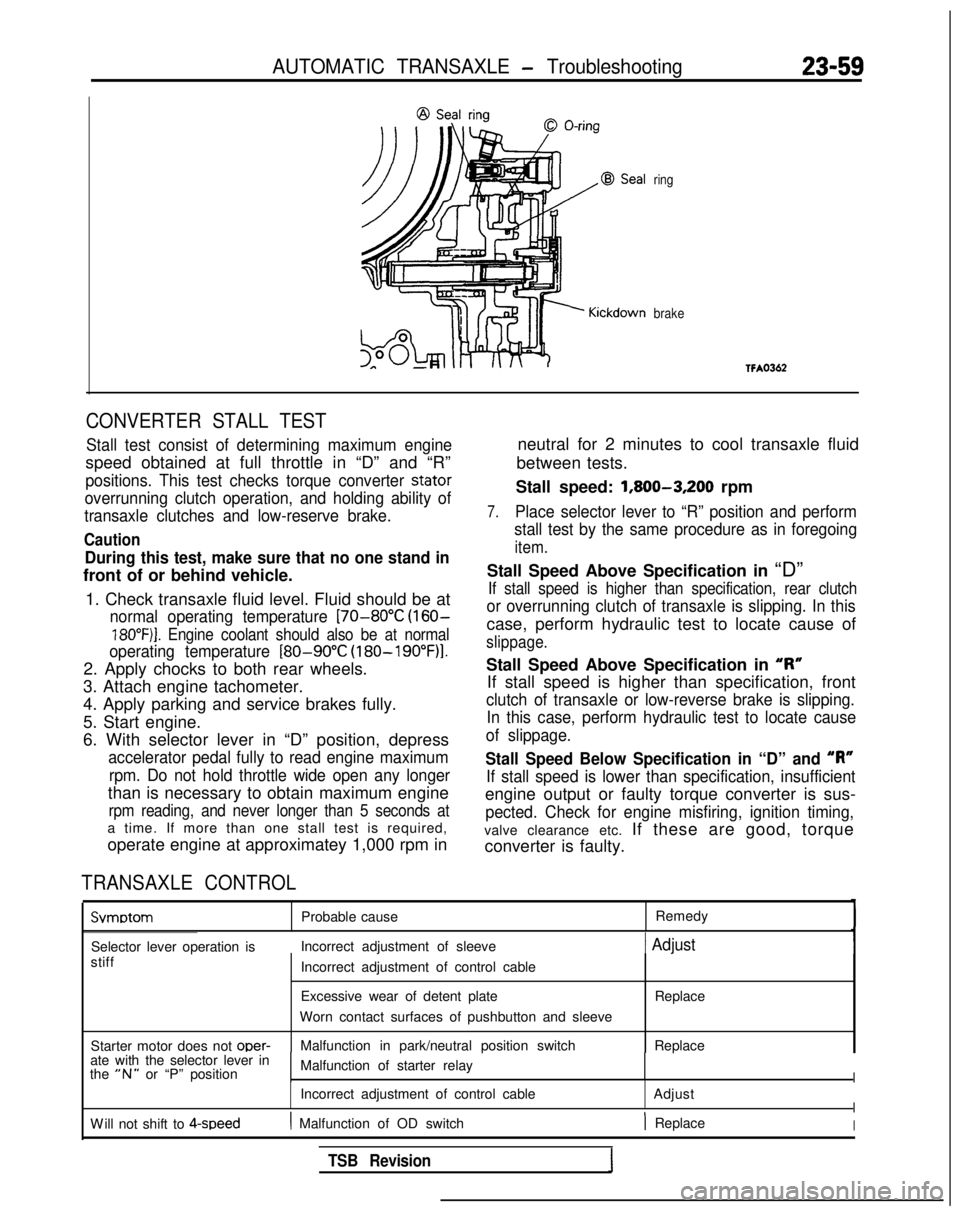
CONVERTER STALL TEST
Stall test consist of determining maximum engine
speed obtained at full throttle in “D” and “R”
positions. This test checks torque converter stator
overrunning clutch operation, and holding ability of
transaxle clutches and low-reserve brake.
Caution
During this test, make sure that no one stand in
front of or behind vehicle.
1. Check transaxle fluid level. Fluid should be at
normal operating temperature [70-80°C (160-
18O”F)j. Engine coolant should also be at normal
operating temperature
[80-90°C (180-19O”F)l.
2. Apply chocks to both rear wheels.
3. Attach engine tachometer.
4. Apply parking and service brakes fully.
5. Start engine.
6. With selector lever in “D” position, depress
accelerator pedal fully to read engine maximum
rpm. Do not hold throttle wide open any longer
than is necessary to obtain maximum engine
rpm reading, and never longer than 5 seconds at
a time. If more than one stall test is required,
operate engine at approximatey 1,000 rpm in
TRANSAXLE CONTROL
neutral for 2 minutes to cool transaxle fluid
between tests.
Stall speed: 1,800-3,200
rpm
7.Place selector lever to “R” position and perform
stall test by the same procedure as in foregoing
item.
Stall Speed Above Specification in “D”
If stall speed is higher than specification, rear clutch
or overrunning clutch of transaxle is slipping. In this
case, perform hydraulic test to locate cause of
slippage.
Stall Speed Above Specification in “I?”
If stall speed is higher than specification, front
clutch of transaxle or low-reverse brake is slipping. In this case, perform hydraulic test to locate cause
of slippage.
Stall Speed Below Specification in “D” and “R”
If stall speed is lower than specification, insufficient
engine output or faulty torque converter is sus-
pected. Check for engine misfiring, ignition timing,
valve clearance etc. If these are good, torque
converter is faulty. Svmotom
Probable cause
Remedy
Selector lever operation is Incorrect adjustment of sleeve
1 Adjust
stiff
Starter motor does not oper-
Incorrect adjustment of control cable
Excessive wear of detent plate
Worn contact surfaces of pushbutton and sleeve
Malfunction in park/neutral position switch Replace
Replace
ate with the selector lever in
the
“N” or “P” position Malfunction of starter relayI
Incorrect adjustment of control cable
AdjustI
W
ill not shift to 4-speed
( Malfunction of OD switch) ReplaceI
TSB Revision
Page 789 of 1273
AUTOMATIC TRANSAXLE - Service Adjustment Procedures23-83
I:
I’
4989 models>
09A0140
6% Button pressed (while brakepedal is depressed)
c Button not pressed
0 Button pressed
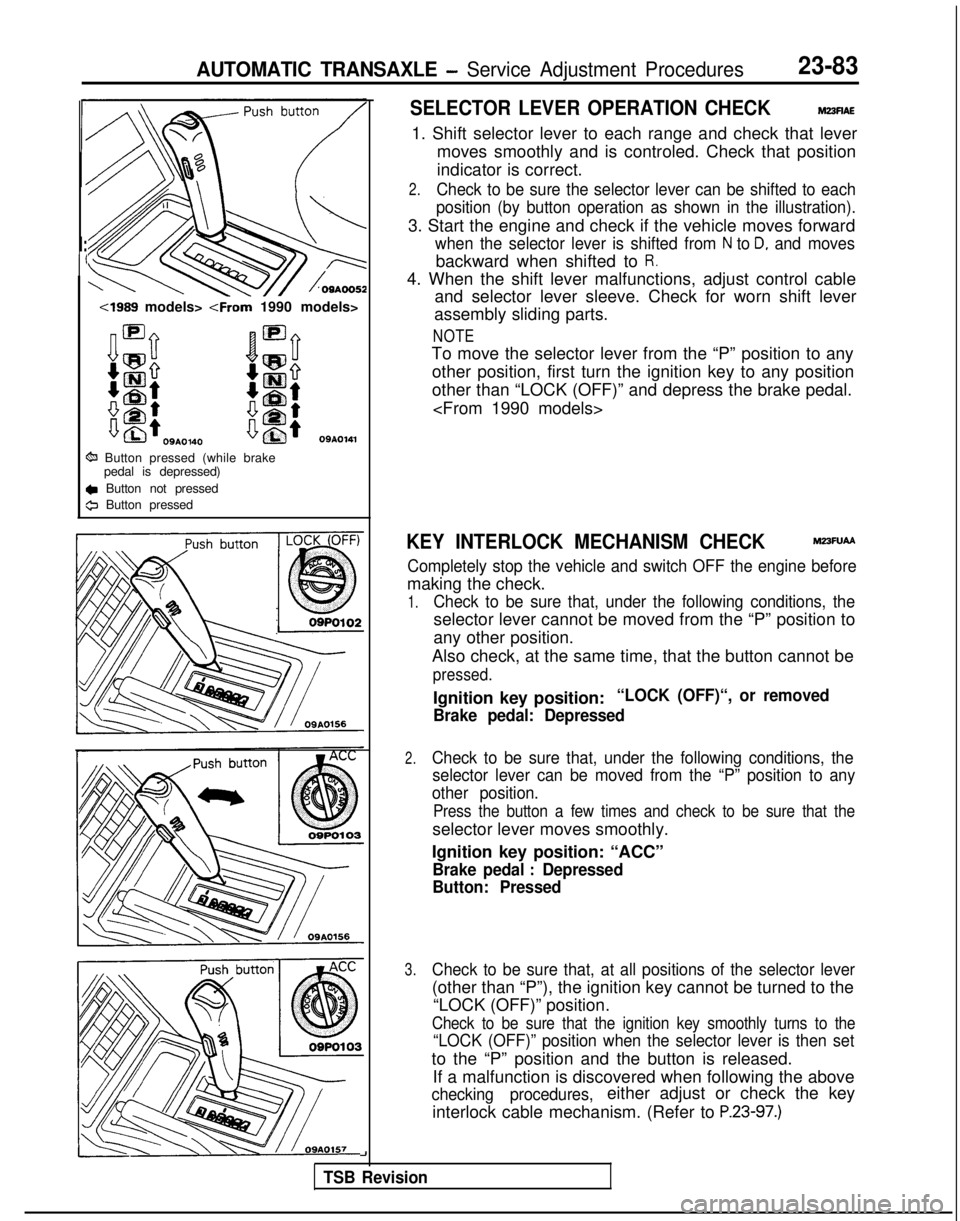
SELECTOR LEVER OPERATION CHECKM23flAE
1. Shift selector lever to each range and check that lever
moves smoothly and is controled. Check that position
indicator is correct.
2.Check to be sure the selector lever can be shifted to each
position (by button operation as shown in the illustration).
3. Start the engine and check if the vehicle moves forward
when the selector lever is shifted from N to D, and moves
backward when shifted to R.
4. When the shift lever malfunctions, adjust control cable and selector lever sleeve. Check for worn shift lever
assembly sliding parts.
NOTE
To move the selector lever from the “P” position to any
other position, first turn the ignition key to any position
other than “LOCK (OFF)” and depress the brake pedal.
KEY INTERLOCK MECHANISM CHECKM23FUAA
Completely stop the vehicle and switch OFF the engine before
making the check.
1.Check to be sure that, under the following conditions, the
selector lever cannot be moved from the “P” position to
any other position.
Also check, at the same time, that the button cannot be
pressed.
Ignition key position:“LOCK (OFF)“, or removed
Brake pedal: Depressed
2.Check to be sure that, under the following conditions, the selector lever can be moved from the “P” position to any
other position.
Press the button a few times and check to be sure that the
selector lever moves smoothly.
Ignition key position: “ACC”
Brake pedal : Depressed
Button: Pressed
3.Check to be sure that, at all positions of the selector lever
(other than “P”), the ignition key cannot be turned to the
“LOCK (OFF)” position.
Check to be sure that the ignition key smoothly turns to the
“LOCK (OFF)” position when the selector lever is then set
to the “P” position and the button is released.
If a malfunction is discovered when following the above
checking procedures,either adjust or check the key
interlock cable mechanism. (Refer to
P.23-97.)
-I
TSB Revision
Page 909 of 1273
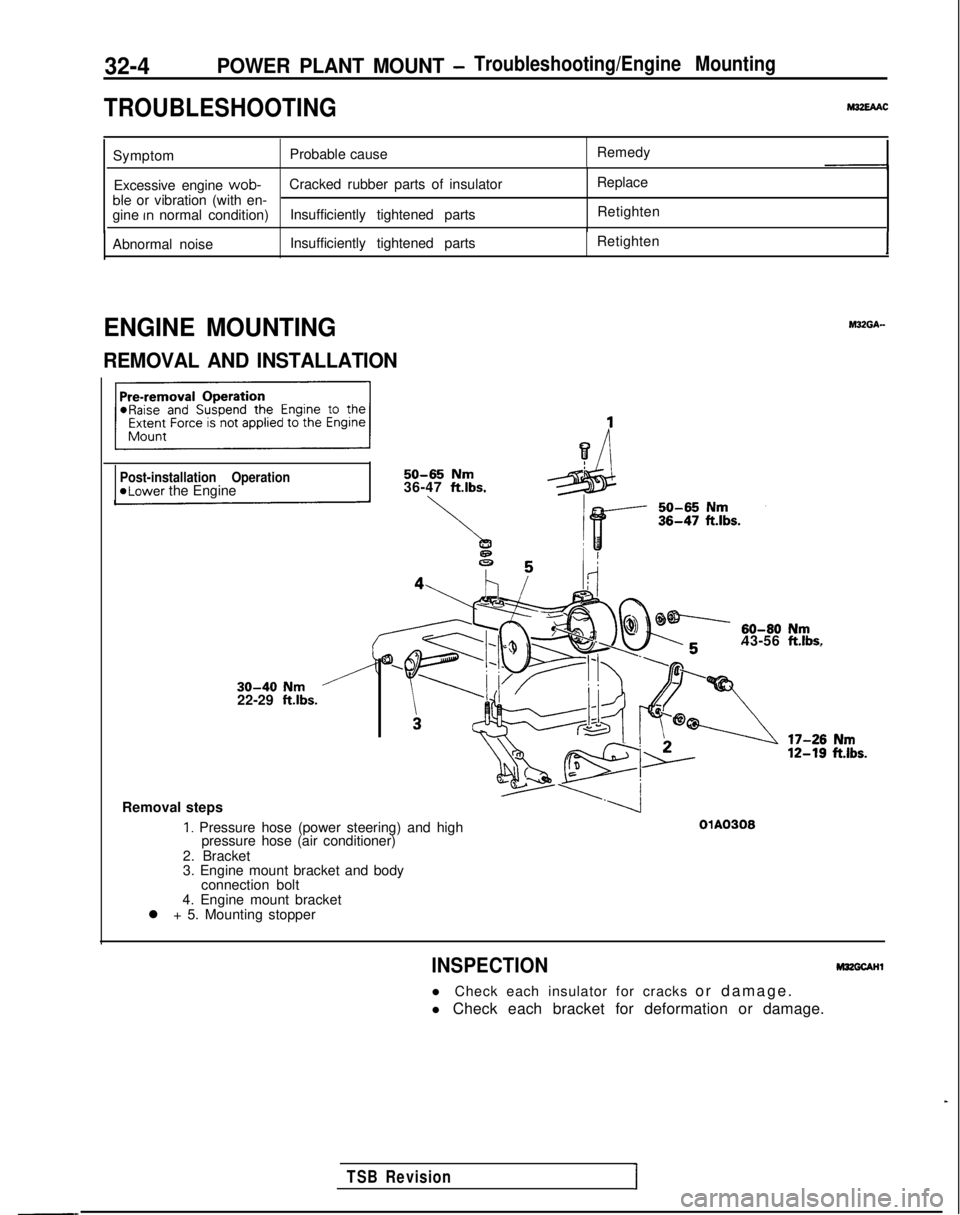
32-4POWER PLANT MOUNT -Troubleshooting/Engine Mounting
TROUBLESHOOTING
SymptomProbable cause Remedy
Excessive engine wob-
Cracked rubber parts of insulator Replace
ble or vibration (with en-
gine rn normal condition) Insufficiently tightened parts Retighten
Abnormal noise Insufficiently tightened parts Retighten
ENGINE MOUNTING
REMOVAL AND INSTALLATION
.
TSB RevisionI
30-40 Nm22-29 ft.lbs.
Removal steps
Post-installation Operation@Lower the Engine
50-65 Nm36-47 ftlbs.
43-56 ft.lbs.
1. Pressure hose (power steering) and high
pressure hose (air conditioner)
2. BracketOIA0306
3. Engine mount bracket and body connection bolt
4. Engine mount bracket
l + 5. Mounting stopper
INSPECTION
l Check each insulator for cracks or damage
.
l Check each bracket for deformation or damage.
Page 910 of 1273
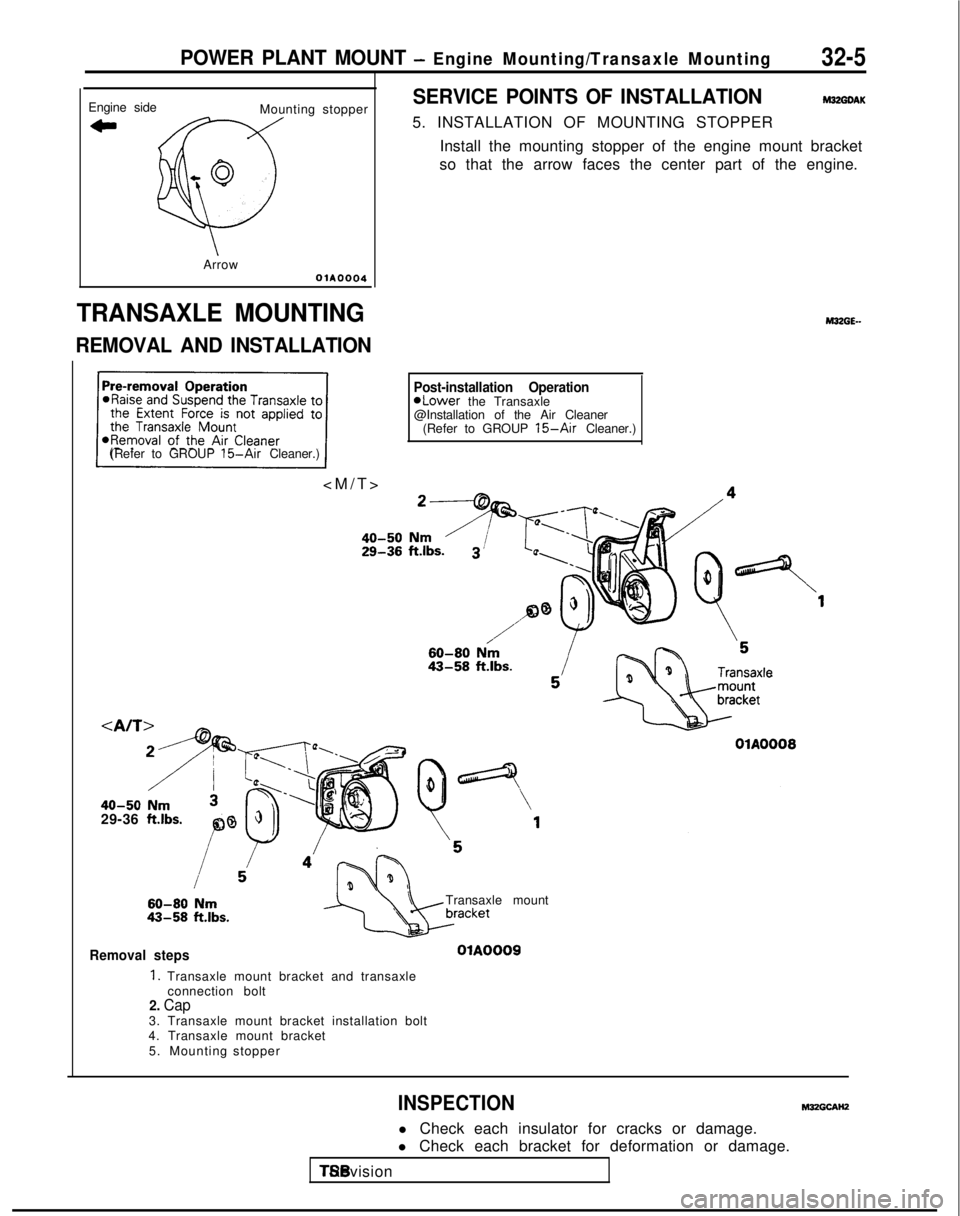
POWER PLANT MOUNT - Engine Mounting/Transaxle Mounting32-5
Engine side
1
Mounting stopper
Arrow 01AQOO4
TRANSAXLE MOUNTING
REMOVAL AND INSTALLATION
(Refer to GROUP 15-Air Cleaner.)
SERVICE POINTS OF INSTALLATIONM32GDAK
5. INSTALLATION OF MOUNTING STOPPER
Install the mounting stopper of the engine mount bracket
so that the arrow faces the center part of the engine.
Post-installation Operation @Lower
the Transaxle
@Installation of the Air Cleaner
(Refer to GROUP
15-Air Cleaner.)
60-60Nm43-58ft.lbs.
40-50Nm29-36ft.lbs.
60-80 Nm43-58 ft.lbs.
Transaxle mount
Removal steps
1. Transaxle mount bracket and transaxle
connection bolt
2. Cap3. Transaxle mount bracket installation bolt
4. Transaxle mount bracket
5. Mounting stopper
OlA0009
INSPECTIONNUZGCAHZ
l Check each insulator for cracks or damage.
l Check each bracket for deformation or damage. TSB Revision
Page 911 of 1273
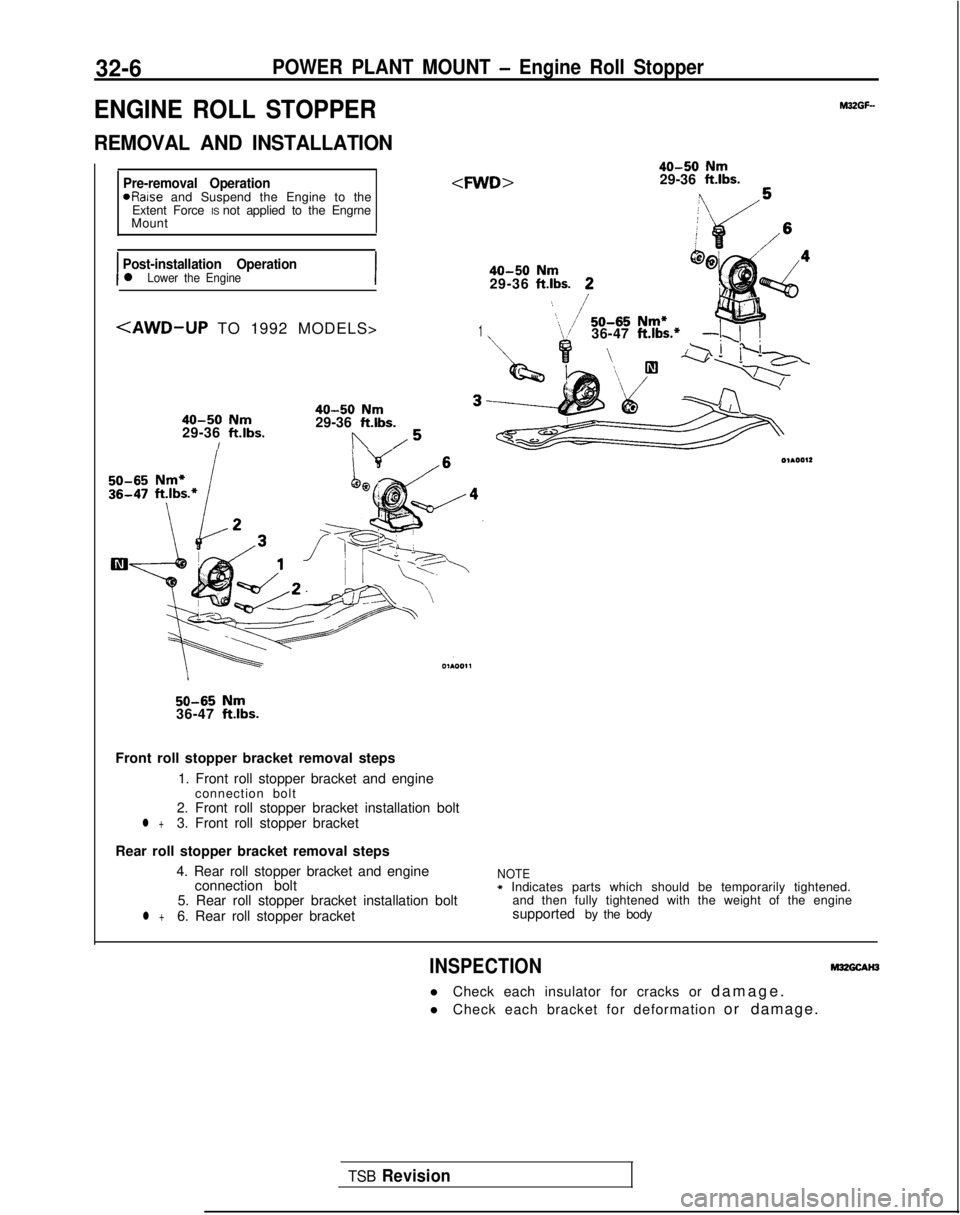
32-6POWER PLANT MOUNT - Engine Roll Stopper
ENGINE ROLL STOPPER
REMOVAL AND INSTALLATION
M32GF-
Pre-removal Operation*Raise and Suspend the Engine to the
Extent Force IS not applied to the Engrne
Mount
I
Post-installation Operationl Lower the EngineI
40-50 Nm29-36 ftlbs.I
40-50 Nm29-36 ft.lbs.
nA5
40-50 Nm29-36 ft.lbs.
40-50Nm29-36ft.lbs. 2
136-47
ft.lbs.*
50-65 Nm36-47 ft.lbs.
Front roll stopper bracket removal steps
1. Front roll stopper bracket and engineconnection bolt
2. Front roll stopper bracket installation bolt
l +3. Front roll stopper bracket
Rear roll stopper bracket removal steps 4. Rear roll stopper bracket and engineconnection bolt
5. Rear roll stopper bracket installation bolt
l +6. Rear roll stopper bracket
NOTE+ Indicates parts which should be temporarily tightened. and then fully tightened with the weight of the engine
supported by the body
INSPECTIONM32GcAH3
l Check each insulator for cracks or damage
.
l Check each bracket for deformation or damage.
TSB Revision
Page 956 of 1273
![MITSUBISHI GALANT 1989 Service Repair Manual ACTIVE-ELECTRONIC CONTROL SUSPENSION - Troubleshooting 33B-17
CHECKING ACCORDING TO CHARTS CLASSIFIED BY THE MALFUNCTION SYMPTOM
[A] DIAGNOSTIC TROUBLE CODE NO.54
No
Yes
b Excessive vehicle-height ad-](/img/19/57312/w960_57312-955.png "MITSUBISHI GALANT 1989 Service Repair Manual ACTIVE-ELECTRONIC CONTROL SUSPENSION - Troubleshooting 33B-17
CHECKING ACCORDING TO CHARTS CLASSIFIED BY THE MALFUNCTION SYMPTOM
[A] DIAGNOSTIC TROUBLE CODE NO.54
No
Yes
b Excessive vehicle-height ad-")
ACTIVE-ELECTRONIC CONTROL SUSPENSION - Troubleshooting 33B-17
CHECKING ACCORDING TO CHARTS CLASSIFIED BY THE MALFUNCTION SYMPTOM
[A] DIAGNOSTIC TROUBLE CODE NO.54
No
Yes
b Excessive vehicle-height ad-justment
(overload) overload). time (due to -Unload the vehicle and turn* the ignition key to OFF; then
restart the engine and check
whether or not the system
functions normally.
Is the installation position of Nothe height sensor correct?
Yes Improper setting of the heightc sensor, or malfunction of the
height sensor. l Correct the installationcposition of the height sen-
sor, or adjust the vehicle
-height sensor rod.
l Check the height sensor. Refer to troubleshooting
hints [IO] and
[ll]classified by circuit.
Are the front strut and rear
NoMalfunction of the rolling
shock absorber unit air spr-* diaphragm.
Repair the rolling diaphragm,
or replace the shock absorber
ings in normal condition?Lunit.
(become folded)
Yes
Is the sound of operation
NoThe solenoid valves remain
heard from each solenoid closed, or there is air leakage
valve necessary for th
e
’ due to a malfunction of the
vehicle-height adjustment? valve seat.
Yes
Is the air pressure in the
vehicle-height adjustment
Nopressure line 950 kPa (135
psi) or higher?
I
Yes Damaged or disconnected
wiring of the high-pressure
switch, or incorrect vehicle
-height adjustment pressureline.
l Check the high-pressure switch circuit.
* Refer to troubleshooting hint [5] classified by circuit.
l Correct the clogging pro-
blem, or replace the air
tube.
Control unit malfunction.
[B] DIAGNOSTIC TROUBLE CODE NO.55
- No
Does the compressor func-
tion normally?
Yes Replace the control unit.c l Power is not supplied to
the compressor.Refer to troubleshooting
hint
[18] classified by cir-
cuit.
0 Improper compressor com- pression.
Is the air pressure in the
Novehicle-height adjustment
pressure line 760 kPa (108psi) or lower? High-pressure
switch
isRefer to troubleshooting hint
shorted____* [5] classified by circuit.
Yes Air leakage.
TSB RevisionI
Page 957 of 1273
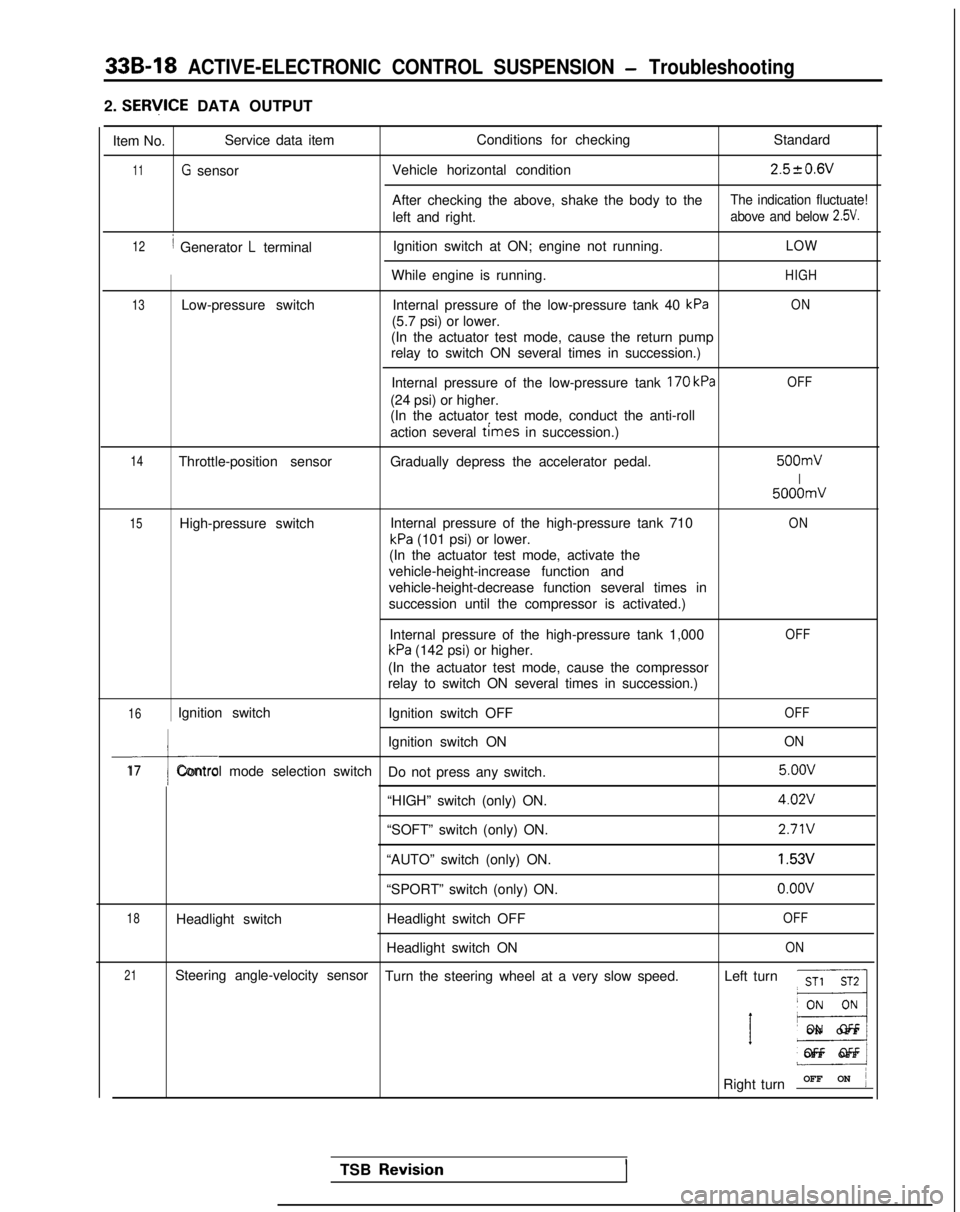
33B-18 ACTIVE-ELECTRONIC CONTROL SUSPENSION - Troubleshooting
2. SERlflCE DATA OUTPUT
Item No. Service data item
Conditions for checking
Standard
11G sensorVehicle horizontal condition2.520.6V
After checking the above, shake the body to theThe indication fluctuate!
left and right.above and below 2.5V.
12/ Generator L terminalIgnition switch at ON; engine not running.LOW
While engine is running.HIGH
13Low-pressure switch
Internal pressure of the low-pressure tank 40 kPaON
(5.7 psi) or lower.
(In the actuator test mode, cause the return pump
relay to switch ON several times in succession.)
Internal pressure of the low-pressure tank
170 kPa
(24 psi) or higher.
(In the actuator test mode, conduct the anti-roll
action several
times in succession.)
OFF
14Throttle-position sensor Gradually depress the accelerator pedal. 500mV
I
5000mV
15High-pressure switch
Internal pressure of the high-pressure tank 710ON
kPa (101 psi) or lower.
(In the actuator test mode, activate the
vehicle-height-increase function and
vehicle-height-decrease function several times in
succession until the compressor is activated.)
Internal pressure of the high-pressure tank 1,000
kPa (142 psi) or higher.
OFF
(In the actuator test mode, cause the compressor
relay to switch ON several times in succession.)
16Ignition switch Ignition switch OFFOFF
I
Ignition switch ONON
17Control mode selection switch
Do not press any switch. 5.oov
“HIGH” switch (only) ON.
4.02V
“SOFT” switch (only) ON.2.71V
“AUTO” switch (only) ON.1.53V
“SPORT” switch (only) ON.o.oov
18Headlight switch Headlight switch OFFOFF
Headlight switch ONON
21Steering angle-velocity sensor
Turn the steering wheel at a very slow speed. Left turnST1 ST2
__I
’ E3
ON OF
F
OFF OFF
Right turn OFF ON
j
TSB Revisio.nI
Page 964 of 1273
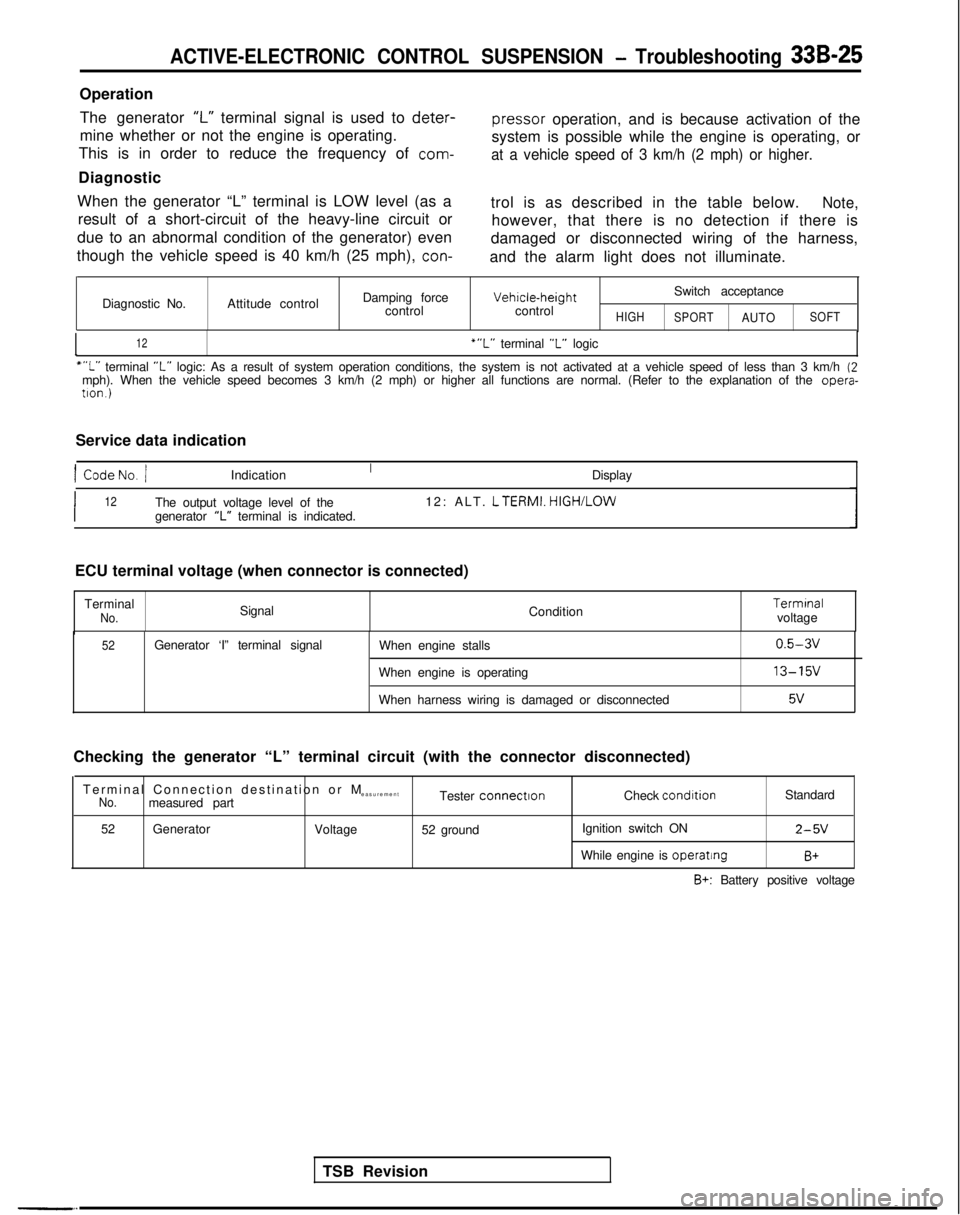
ACTIVE-ELECTRONIC CONTROL SUSPENSION - Troubleshooting 33B-25
OperationThe generator
‘I-” terminal signal is used to deter-
pressor
operation, and is because activation of the
mine whether or not the engine is operating.
This is in order to reduce the frequency of
com-
system is possible while the engine is operating, or
at a vehicle speed of 3 km/h (2 mph) or higher.
Diagnostic
When the generator “L” terminal is LOW level (as a result of a short-circuit of the heavy-line circuit or
due to an abnormal condition of the generator) even
though the vehicle speed is 40 km/h (25 mph),
con-
trol is as described in the table below.Note,
however, that there is no detection if there is
damaged or disconnected wiring of the harness,
and the alarm light does not illuminate.
Diagnostic No. Attitude control Damping force
control Vehrcle-height
control
HIGH
Switch acceptance
SPORTAUTOSOFT
I12‘“L” terminal “L” logic
““L” terminal “L” logic: As a result of system operation conditions, the system is not ac\
tivated at a vehicle speed of less than 3 km/h (2mph). When the vehicle speed becomes 3 km/h (2 mph) or higher all fun\
ctions are normal. (Refer to the explanation of the opera-
tron.)
Service data indication
1 CodeNo. /Indication Display
I12The output voltage level of the12: ALT. LTERMI.
HIGH/LOW
generator “L” terminal is indicated.
TSB Revision
ECU terminal voltage (when connector is connected)
Terminal
No.Signal Condition Termrnal
voltage
52Generator ‘I” terminal signal When engine stalls
When engine is operating
When harness wiring is damaged or disconnected0.5-3v
13-15v
5v
Checking the generator “L” terminal circuit (with the connector d\
isconnected)
Terminal Connection destination or
M
easurement
No.measured part Tester connectronCheck condrtion
Standard
52 Generator
Voltage52 ground Ignition switch ON
2-5V
While engine is operatingB+
B+: Battery positive voltage