light MITSUBISHI GALANT 1989 Service Owner's Manual
[x] Cancel search | Manufacturer: MITSUBISHI, Model Year: 1989, Model line: GALANT, Model: MITSUBISHI GALANT 1989Pages: 1273, PDF Size: 37.62 MB
Page 192 of 1273
13-50 FUEL SYSTEM
INSPECTION
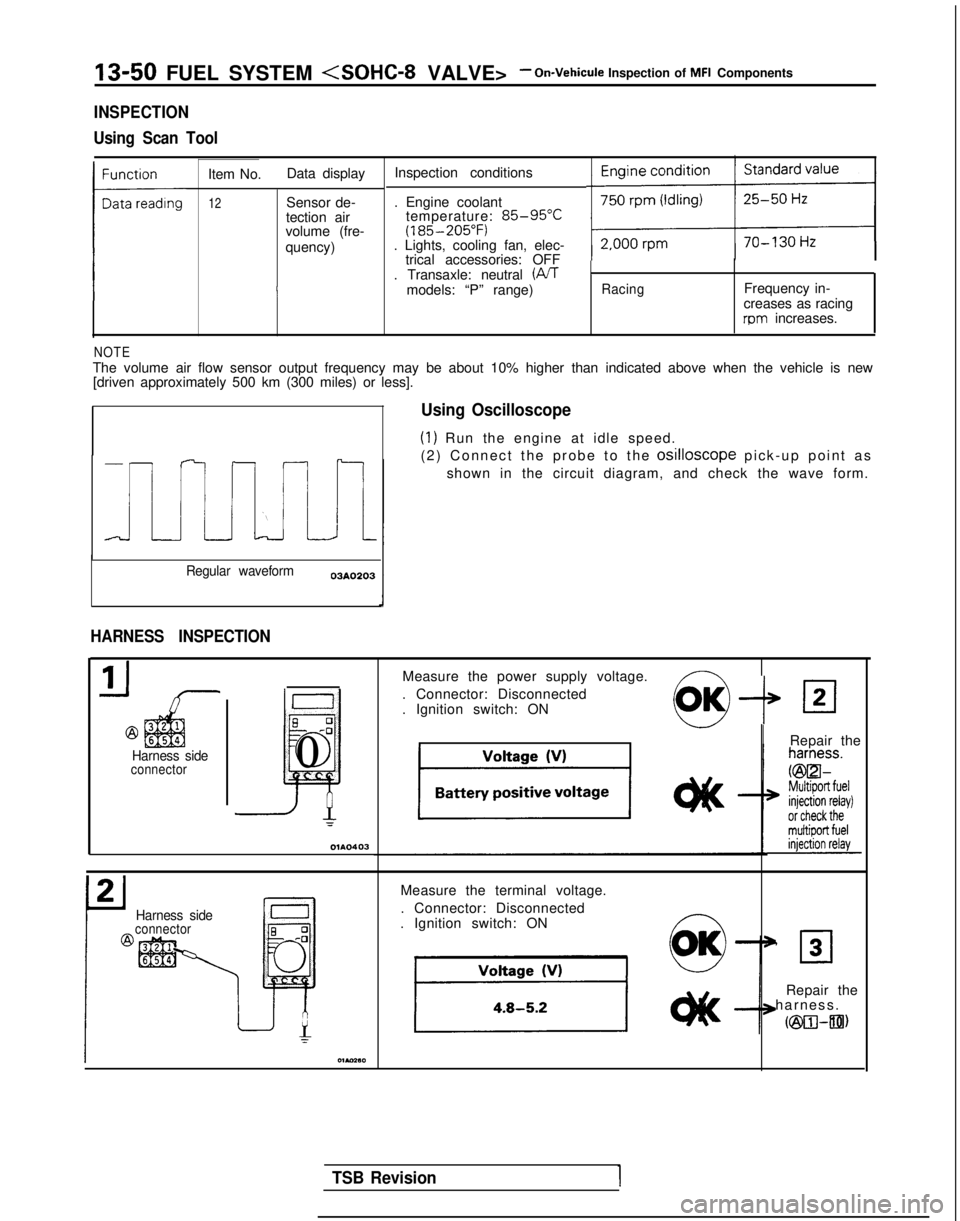
Using Scan Tool
Item No. Data display Inspection conditions
12Sensor de-
tection air
volume (fre-
quency) . Engine coolant
temperature: 85-95°C(185-205°F). Lights, cooling fan, elec-
trical accessories: OFF
. Transaxle: neutral (iVT
models: “P” range)
RacingFrequency in-
creases as racing
rpm increases.
NOTEThe volume air flow sensor output frequency may be about 10% higher than\
indicated above when the vehicle is new [driven approximately 500 km (300 miles) or less].
Regular waveform 03A0203
HARNESS INSPECTION
@
Harness sideconnector
6
0-0
~
0
=
Using Oscilloscope
(1) Run the engine at idle speed.
(2) Connect the probe to the
osilloscope pick-up point a
s
shown in the circuit diagram, and check the wave form.
Measure the power supply voltage.
. Connector: Disconnected
. Ignition switch: ON
--P
IRepair the
Harness sideconnector
Measure the terminal voltage.
. Connector: Disconnected
. Ignition switch: ON ~
0
OK’ 30
Repair the
harness
.
cm-an)
TSB Revision1
Page 204 of 1273
13-62 FUEL SYSTEM
INSPECTION
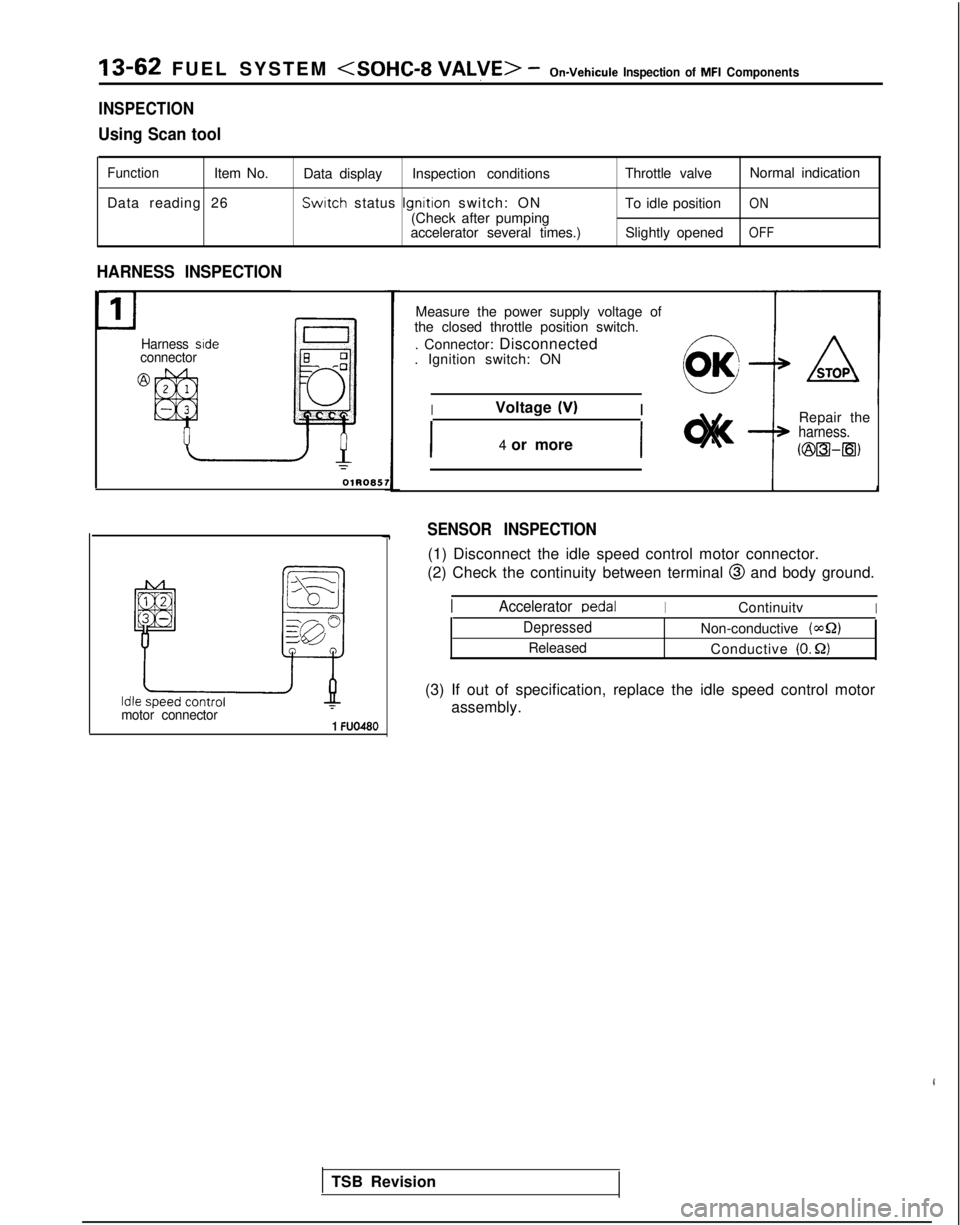
Using Scan tool
FunctionItem No.
Data reading 26 Data display
Inspection conditions Switch
status Ignition
switch: ON
(Check after pumping
accelerator several times.) Throttle valve
Normal indication
To idle position
ON
Slightly openedOFF
HARNESS INSPECTION
Harness sideconnector
Y
OlR085
motor connector1 FUO480
Measure the power supply voltage of
the closed throttle position switch.
. Connector: Disconnected
. Ignition switch: ON
IVoltage (V)I
I4 or moreI
Repair theharness.
c@a-m)
SENSOR INSPECTION
(1) Disconnect the idle speed control motor connector.
(2) Check the continuity between terminal
@ and body ground.
TSB Revision
IAccelerator DedalIContinuitvI
DepressedNon-conductive (42)
Released Conductive (0. Q)
(3) If out of specification, replace the idle speed control motor
assembly.
Page 207 of 1273
FUEL SYSTEM
(1) Improper adjustment of the basic idling speed.
(2) Deposits adhering to the ttirottle valve.
(3) Air being taken into the intake manifold due to a gasket leak, etc.
OPERATION
ISC motor position sensor is a variable resistor type,
and is integrated in the
ISC motor system. The slid-
ing pin of
ISC motor position sensor is in contact
with the end of the plunger. Therefore, as the plun- ger moves, the internal resistance of
ISC motor pos-
ition sensor varies. This leads to the variation of the (4) Improper seating of the EGR valve seat.
(5) lmcomplete combustion within a cylinder. (Mal-
function of spark plugs, ignition coil, injectors,
compression pressure, etc.)
the plunger position of the
ISC motor system, and
sends the signal to ECM. ECM processes the
ISC
motor position sensor signal, idle signal, coolant
temperature signal, load signal (A/T &
A/C) and ve-
hicle speed signal to control the opening angle of
the throttle valve and revolution speed during
en-
output voltage. ISC motor position sensor detects gine idling.
TROUBLESHOOTING HINTS
Since idling is not controlled when ISC motor posi-
tion sensor is troubled, idling may not be evenly
maintained.
INSPECTION
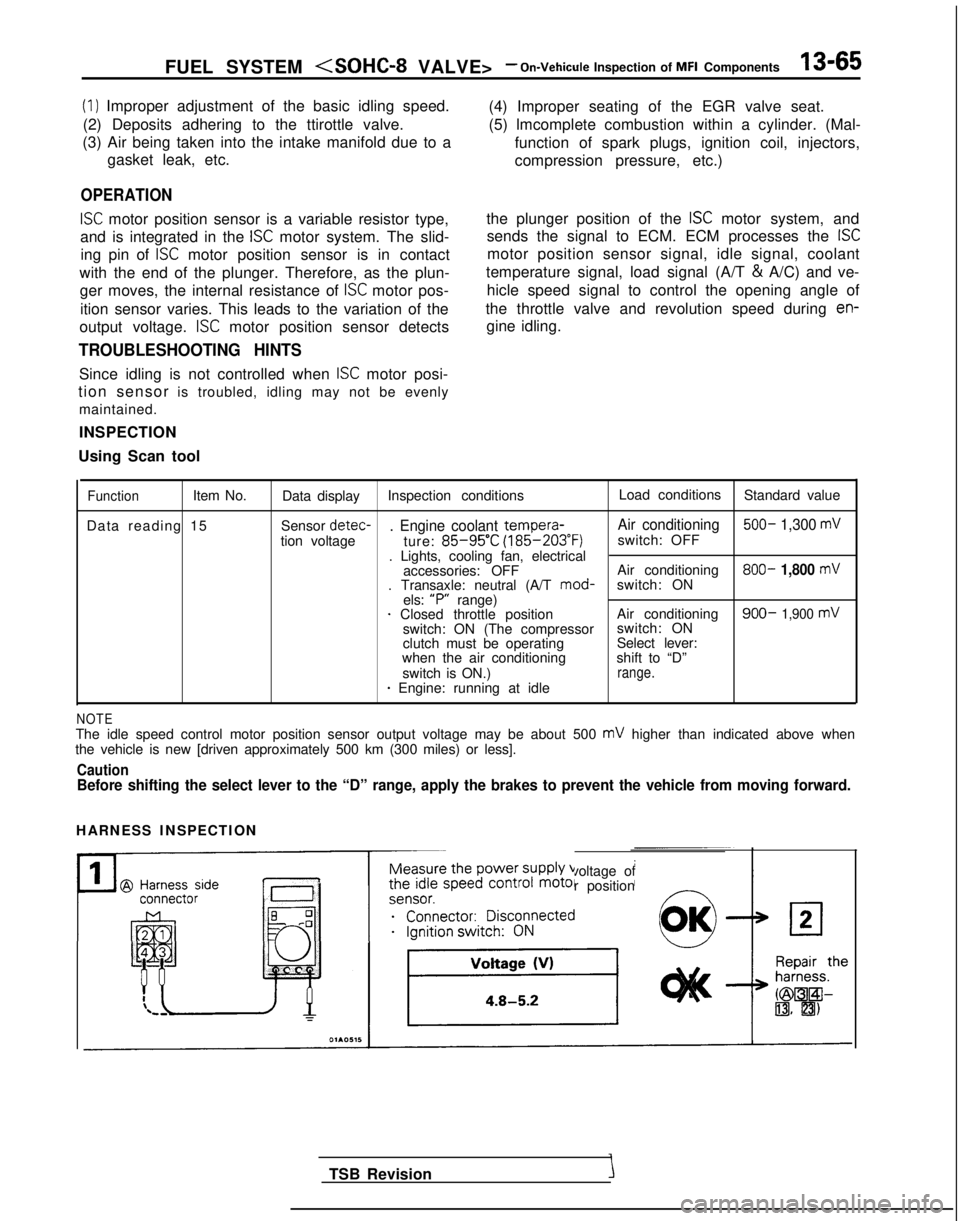
Using Scan tool
FunctionItem No. Data display Inspection conditions Load conditions
Standard value
Data reading 15 Sensor detec-
. Engine coolant tempera-
Air conditioning 500- 1,300 mV
tion voltage
ture: 85-95’C (185-203°F)
switch: OFF
. Lights, cooling fan, electrical accessories: OFF Air conditioning 800-
1,800 mV. Transaxle: neutral (A/T
mod-
switch: ON
els: “P”
range)
1 Closed throttle position Air conditioning900- 1,900 mVswitch: ON (The compressorswitch: ON
clutch must be operating Select lever:
when the air conditioning shift to “D”
switch is ON.)
range.* Engine: running at idle
NOTEThe idle speed control motor position sensor output voltage may be about\
500 mV higher than indicated above when
the vehicle is new [driven approximately 500 km (300 miles) or less].
CautionBefore shifting the select lever to the “D” range, apply the brake\
s to prevent the vehicle from moving forward.
HARNESS INSPECTION
Measure the power supply voltage of
the idle speed control motor position
ei;;;it;;sco$ected
__...._ -.-
TSB Revision
Page 233 of 1273
FUEL SYSTEM
Inspection of MFI Components13-91
INSPECTION
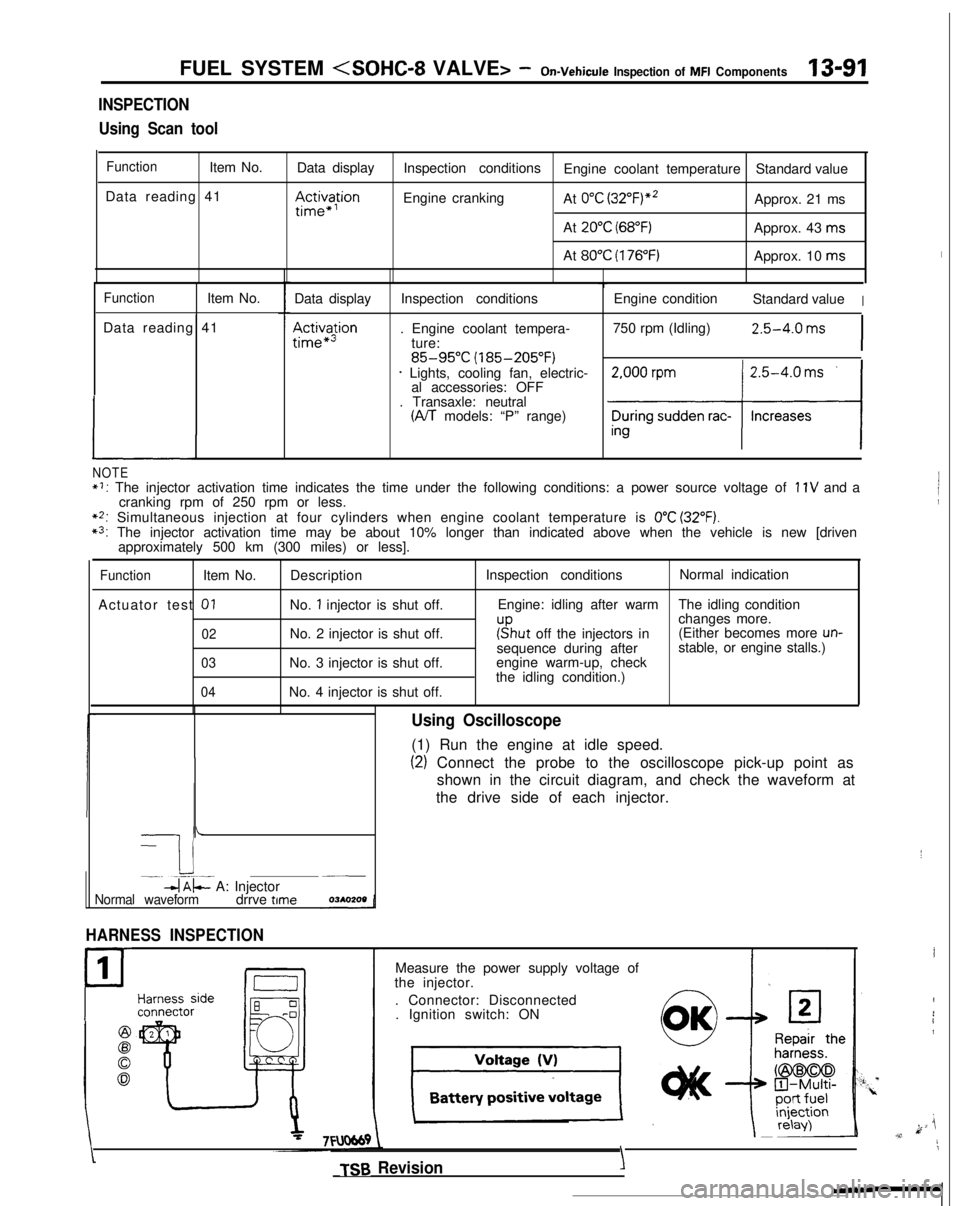
Using Scan tool
FunctionItem No. Data display
Data reading 41
III~~~ion
Inspection conditions Engine coolant temperature Standard value
Engine cranking At
0°C (3~2°F)“~Approx. 21 ms
At
20°C (68°F)Approx. 43 ms
At
80°C (176°F)Approx. 10 ms
FunctionItem No.
Data reading 41
L
Data display
Ac&a$ion
Inspection conditions
. Engine coolant tempera- ture:
85-95°C (185-205°F)* Lights, cooling fan, electric-al accessories: OFF
. Transaxle: neutral
(A/T models: “P” range) Engine condition
Standard value
I
750 rpm (Idling)2.5-4.0 ms
I
NOTE*I: The injector activation time indicates the time under the following con\
ditions: a power source voltage of 11V and a
cranking rpm of 250 rpm or less.
**: Simultaneous injection at four cylinders when engine coolant temperatur\
e is 0°C (32°F).*3: The injector activation time may be about 10% longer than indicated abo\
ve when the vehicle is new [driven approximately 500 km (300 miles) or less].
FunctionItem No.
Actuator test
01
02
03
04
Description
No.
1 injector is shut off.
No. 2 injector is shut off.
No. 3 injector is shut off.
No. 4 injector is shut off. Inspection conditions
Normal indication
Engine: idling after warm The idling condition
changes more.
r”sput off the injectors in(Either becomes more un-sequence during after stable, or engine stalls.)
engine warm-up, check
the idling condition.)
-
I i-. --.-~-db$- A: Injector~__
Normal waveformdrrve time
HARNESS INSPECTION
1
P
Using Oscilloscope
(1) Run the engine at idle speed.
(2) Connect the probe to the oscilloscope pick-up point as
shown in the circuit diagram, and check the waveform at
the drive side of each injector.
Measure the power supply voltage of
the injector.
. Connector: Disconnected. Ignition switch: ON
TSB Revision
I
I
4
i1
k ji,v,11
\
YIY’.
Page 238 of 1273
13-96 FUEL SYSTEM
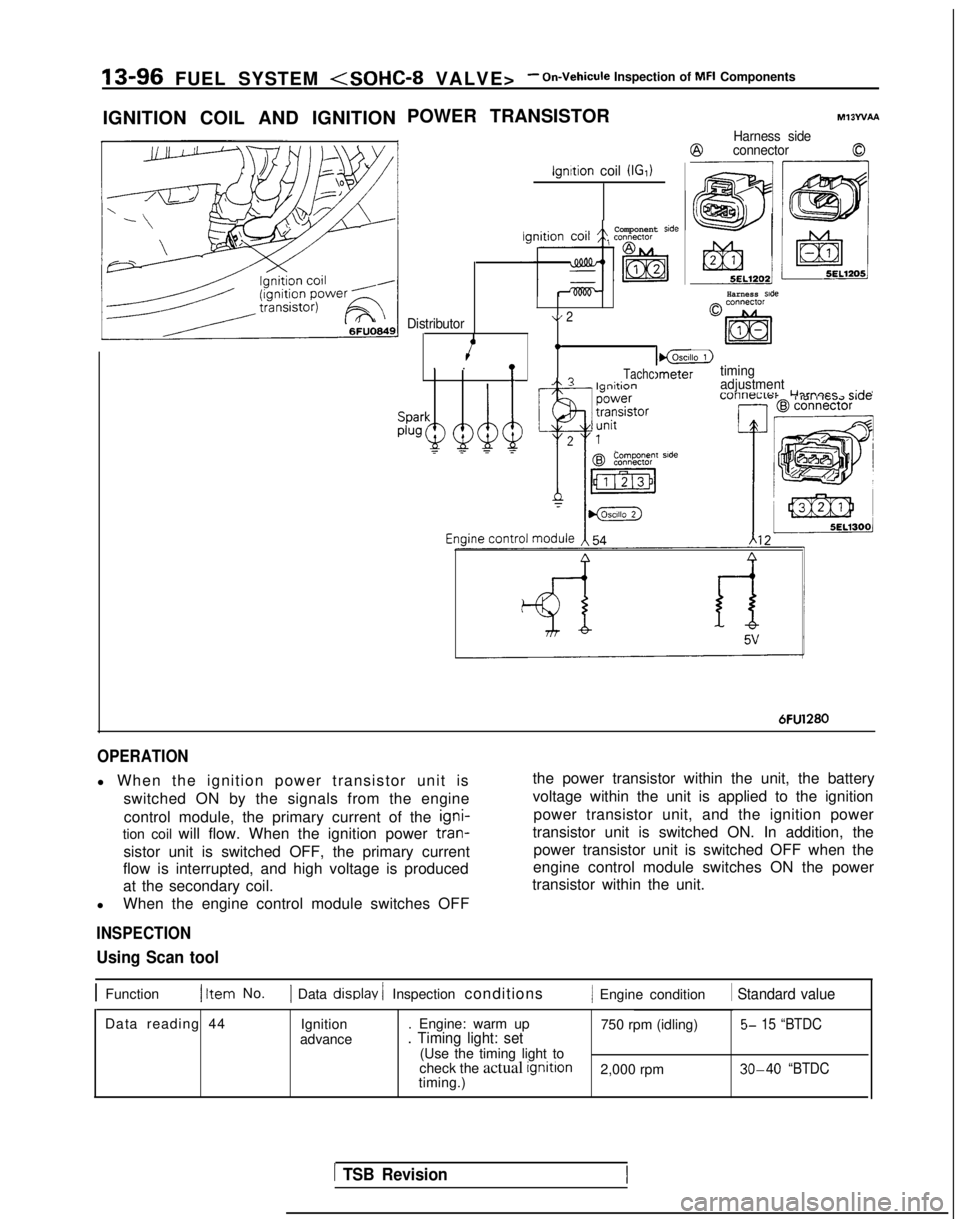
IGNITION COIL AND IGNITION POWER TRANSISTOR
ignition coil (IGI)
Ml3WAA
Harness side
@connector0
Harness side
Component side
Distributor\/ 2
4.I_lgnltion. .!
I@LZ)
TachcImetertimingA? I--:*:^^adjustment-_
Lllrnacr
r;rlnI 101 i IG.72 Jl”F
Componenr side
6FU1280
OPERATION
l When the ignition power transistor unit is
switched ON by the signals from the engine
control module, the primary current of the igni-
tion coil will flow. When the ignition power tran-
sistor unit is switched OFF, the primary current
flow is interrupted, and high voltage is produced
at the secondary coil.
l When the engine control module switches OFF
INSPECTION
the power transistor within the unit, the battery
voltage within the unit is applied to the ignition
power transistor unit, and the ignition power
transistor unit is switched ON. In addition, the power transistor unit is switched OFF when the
engine control module switches ON the power
transistor within the unit.
Using Scan tool
1 Function1 Item No.1 Data display / Inspection conditions/ Engine condition 1 Standard value
Data reading 44
Ignition
advance . Engine: warm up
750 rpm (idling)5- 15 “BTDC. Timing light: set(Use the timing light to
check the actual ignition
2,000 rpm 30-40 “BTDCtiming.)
1 TSB Revision
Page 248 of 1273
13-106
FUEL SYSTEM
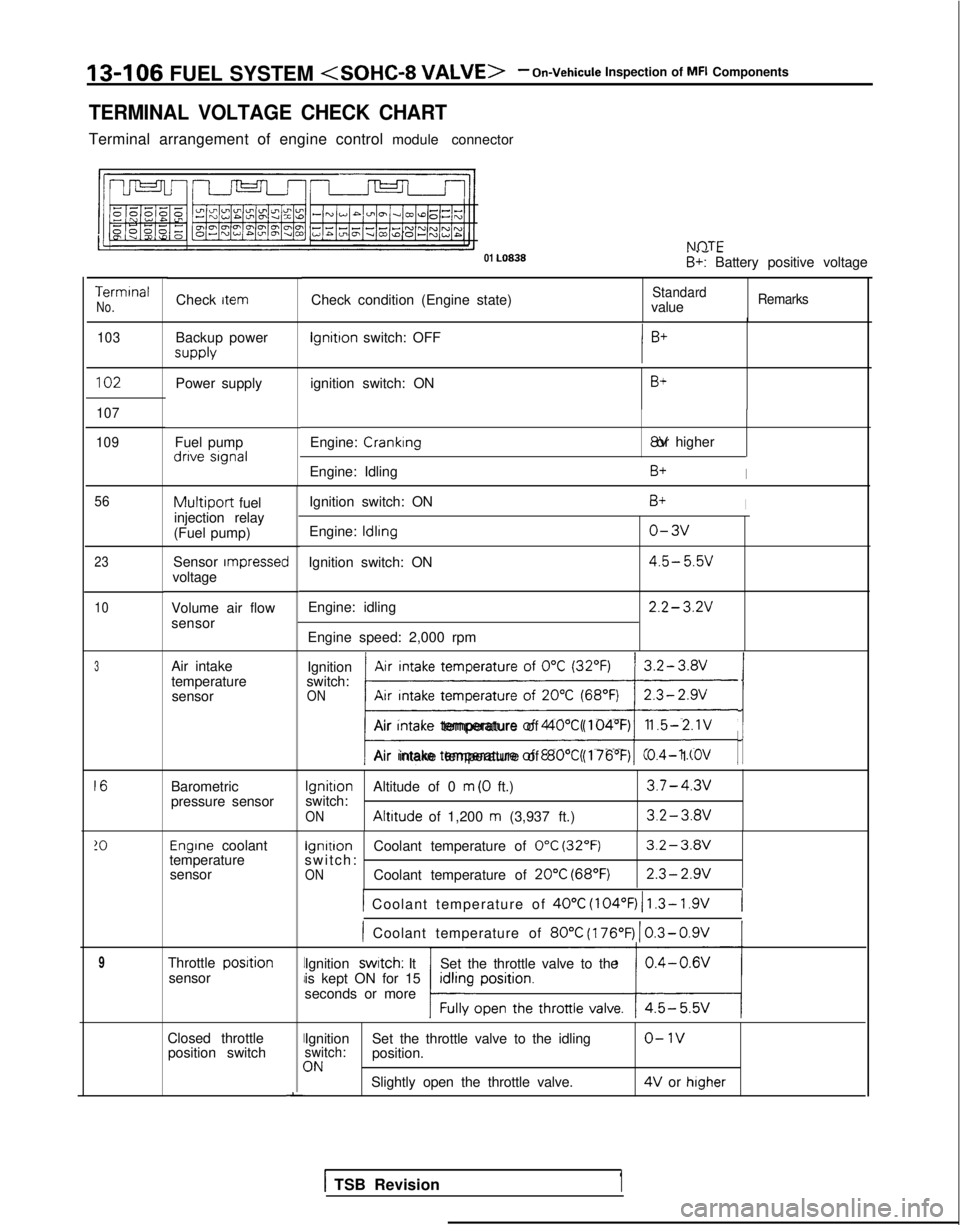
TERMINAL VOLTAGE CHECK CHART
Terminal arrangement of engine control module connector NflTF
01 LO838
. .- -B+: Battery positive voltage
Terminal
No.Check condition (Engine state)StandardvalueRemarksCheck item
103
Backup power supply lgnitron
switch: OFF
102Power supply ignition switch: ONB+
107
109
Fuel pump dnve signal
Engine: Cranking 8V or higher
Engine: Idling
B+I
Ignition switch: ON
Engine:
ldlrng
Ignition switch: ON
Engine: idling
Engine speed: 2,000 rpm
B+I
o-3v
4.5- 5.5v
2.2- 3.2V
56
23
10
Multiport fuel
injection relay
(Fuel pump)
Sensor
rmpressecvoltage
Volume air flow
sensor
Air intake
temperature sensor Ignition
Air intake temperature of
0°C (32°F)switch:ONAir Intake temperature of 20°C (68°F); ji/
Air Intake temperature of 40°C (104°F)1.5-2.1V
Air intake temperature of 80°C (176’F)0.4- 1 .OV
Barometric
pressure sensor
Ignition
Altitude of 0 m (0 ft.)3.7-4.3vswitch:ON Altitude
of 1,200 m (3,937 ft.)3.2-3.av
Engrne coolant lgnitron
Coolant temperature of 0°C (32°F)3.2-3.Wtemperature switch: -sensorONCoolant temperature of 20°C (68°F)2.3-2.9v
1 Coolant temperature of 40°C
(104°F) 1 1.3- 1.9V(
) Coolant temperature of 80°C
(176’F)
1 0.3-0.9V
Throttle posrtionsensor Ignition swatch: It
Set the throttle valve to the
is kept ON for 15
seconds or more
Closed throttle position switchII
I
I
-
Ignition Set the throttle valve to the idlingo-1vswitch:position.3NSlightly open the throttle valve. 4V
or higher
3
16
!O
9
1 TSB Revision1
Page 249 of 1273
FUEL SYSTEM
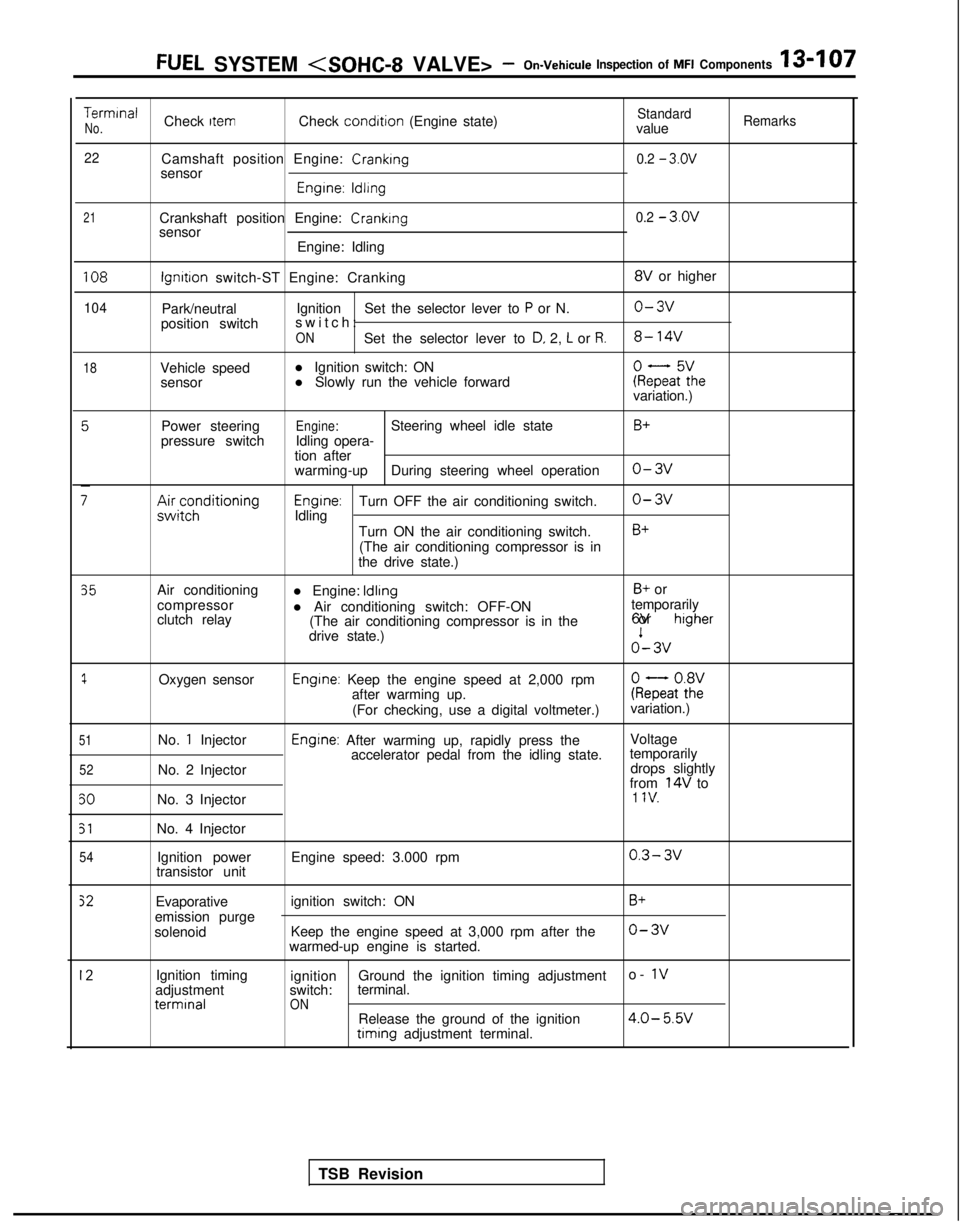
TerminalCheck ItemCheck condition
(Engine state)StandardNo.valueRemarks
22
Camshaft position Engine: Cranking0.2 - 3.ov
sensor
Engrne: ldllng
21Crankshaft position Engine: Crankingsensor
Engine: Idling0.2 - 3.ov
108
104
18
lgnrtron switch-ST Engine: Cranking 8V
or higher
Park/neutral Ignition
Set the selector lever to
P or N.o-3v
position switch switch
:
ONSet the selector lever to D, 2, L or R.8- 14V
Vehicle speed
l Ignition switch: ON
sensor l Slowly run the vehicle forwardkeFaF:hevariation.)
Power steering
pressure switch
;;ir;z;ditioning
Engine:Steering wheel idle state
Idling opera-
tion after
warming-up During steering wheel operation
Engrne:Turn OFF the air conditioning switch.
Idling
Turn ON the air conditioning switch.(The air conditioning compressor is in
the drive state.)
B+
o-3v
o-3v
B+
35
1
51
52
50
51
54
Air conditioning
compressor
clutch relay
Oxygen sensor
No.
1 Injector
No. 2 Injector
No. 3 Injector
No. 4 Injector Ignition power
transistor unit l Engine: Idling
B+ or
l Air conditioning switch: OFF-ON temporarily
(The air conditioning compressor is in the 6V or
higher
drive state.)o’- 3v
Engine: Keep the engine speed at 2,000 rpm
after warming up. kQatot8h2:
(For checking, use a digital voltmeter.) variation.)
Engine: After warming up, rapidly press the
Voltage
accelerator pedal from the idling state. temporarily
drops slightly
from
14V to1 IV.
Engine speed: 3.000 rpm0.3- 3v
Evaporative
emission purge
solenoid ignition switch: ON
Keep the engine speed at 3,000 rpm after the
warmed-up engine is started.B+
o-3v
12Ignition timing
adjustment terminal
ignition
Ground the ignition timing adjustment o- 1vswitch:
terminal.ONRelease the ground of the ignition4.0- 5.W timing
adjustment terminal.
TSB Revision
Page 250 of 1273
13-108 FUEL SYSTEM
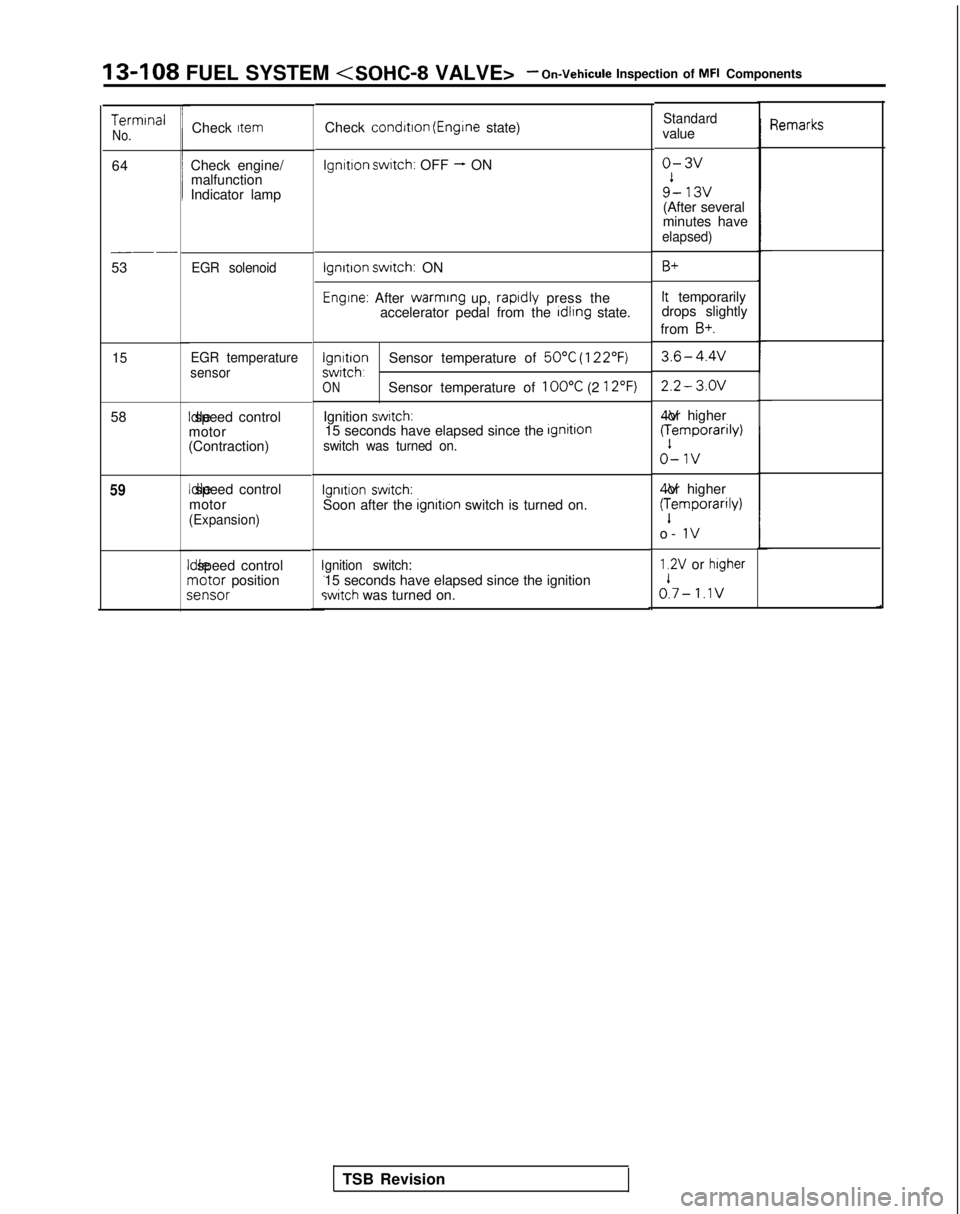
TermrnalNo.
64
__-
53
15
58
59
Check Item
Check engine/
malfunction
Indicator lamp
EGR solenoid
EGR temperature
sensor Idle speed control
motor
(Contraction) Idle speed control
motor
(Expansion)
II
dle speed controlrnotor positions
;ensor
Check
condrtron (Engrne state)
lgnrtron swatch: OFF - ON
lgnrtron swatch: ON
Engine: After warming
up, raprdly press the
accelerator pedal from the rdlrng state.
lgnrtronSensor temperature of 50°C (122°F)swrtch,ONSensor temperature of 100°C (2 12°F)
Ignition swatch:15 seconds have elapsed since the IgnitlOnswitch was turned on.
Ignition switch:Soon after the ignitron switch is turned on.
gnition switch:15 seconds have elapsed since the ignitionswitch was turned on.
Standardvalue
o-3v
9’- 13v(After several
minutes have
elapsed)
B+
It temporarily
drops slightly
from
B+.
3.6-4.4v
2.2- 3.OV 4V or higher
(:emporarily)
o-1v
4V or higher
(:emporarily)
o-
IV
1.2V or higher
A- 1.1v
qemarks
TSB Revision
Page 252 of 1273
Fuel tank pressurecontrol valve
Rubber hose
n-110FUEL SYSTEM
INSPECTIONMl3GCAI
l Check the hoses and the pipes for crack or damage.
lCheck the fuel tank filler tube cap for malfunction.
lCheck the fuel tank for deformation, corrosion or crack.
l Check the fuel tank for dust or foreign material.
NOTE
If the inside of the fuel tank is to be cleaned, use any one
of the following:
(1) Kerosene
(2) Trichloroethylene
(3) A neutral emulsion type detergent
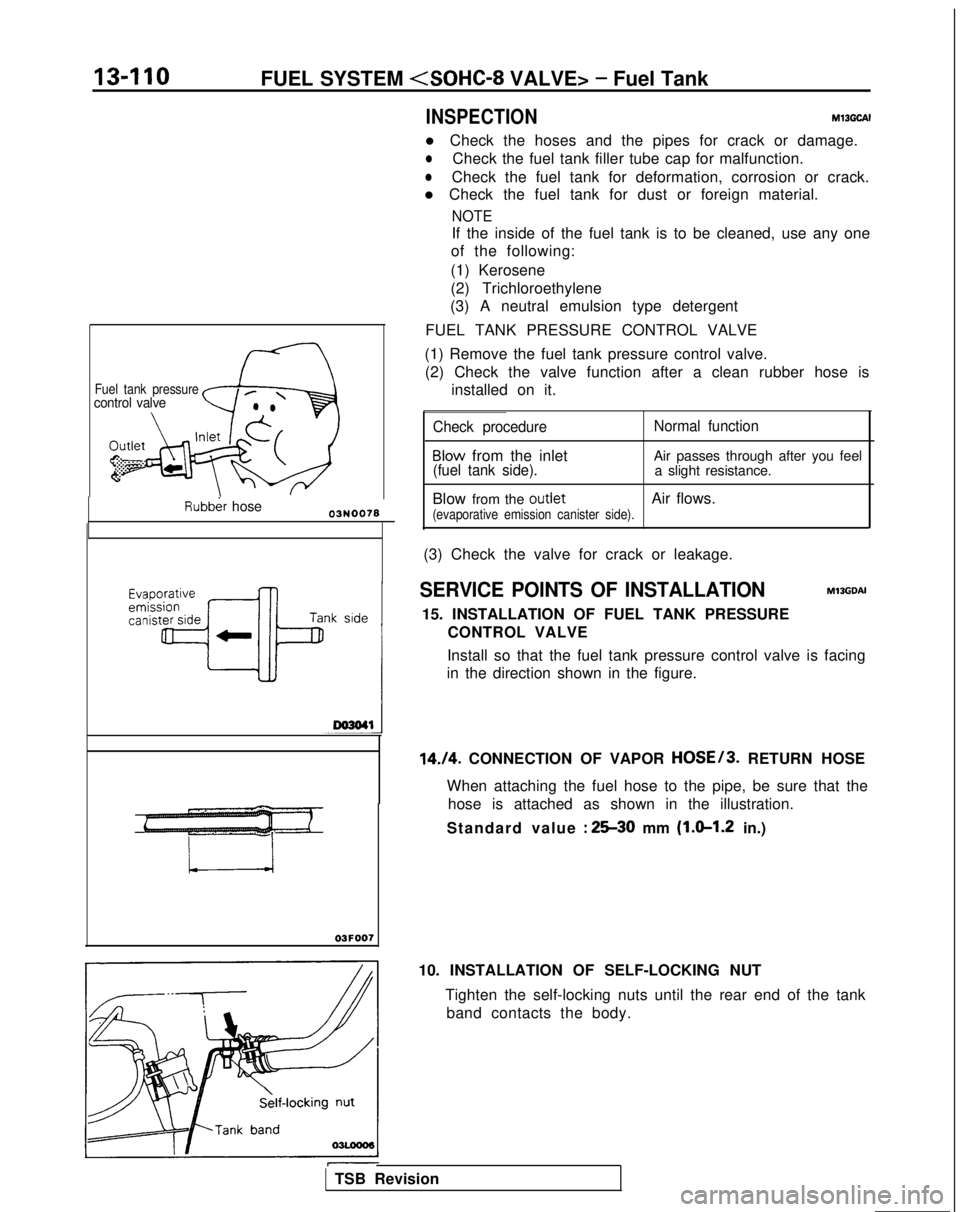
FUEL TANK PRESSURE CONTROL VALVE
(1) Remove the fuel tank pressure control valve. (2) Check the valve function after a clean rubber hose is installed on it.
Check procedure Normal function
Blow from the inlet
Air passes through after you feel(fuel tank side).a slight resistance.
Blow from the
outletAir flows.(evaporative emission canister side).
(3) Check the valve for crack or leakage.
SERVICE POINTS OF INSTALLATIONM13GDAI
15. INSTALLATION OF FUEL TANK PRESSURE CONTROL VALVE
Install so that the fuel tank pressure control valve is facing
in the direction shown in the figure.
14./4. CONNECTION OF VAPOR HOSE/3. RETURN HOSE
When attaching the fuel hose to the pipe, be sure that the hose is attached as shown in the illustration.
Standard value
: 2530 mm (l.sl.2 in.)
03F007
10. INSTALLATION OF SELF-LOCKING NUT
Tighten the self-locking nuts until the rear end of the tankband contacts the body.
TSB Revision
Page 262 of 1273
13-120FUEL SYSTEM
CHH;K
ENGINE/MALFUNCTION INDICATOR
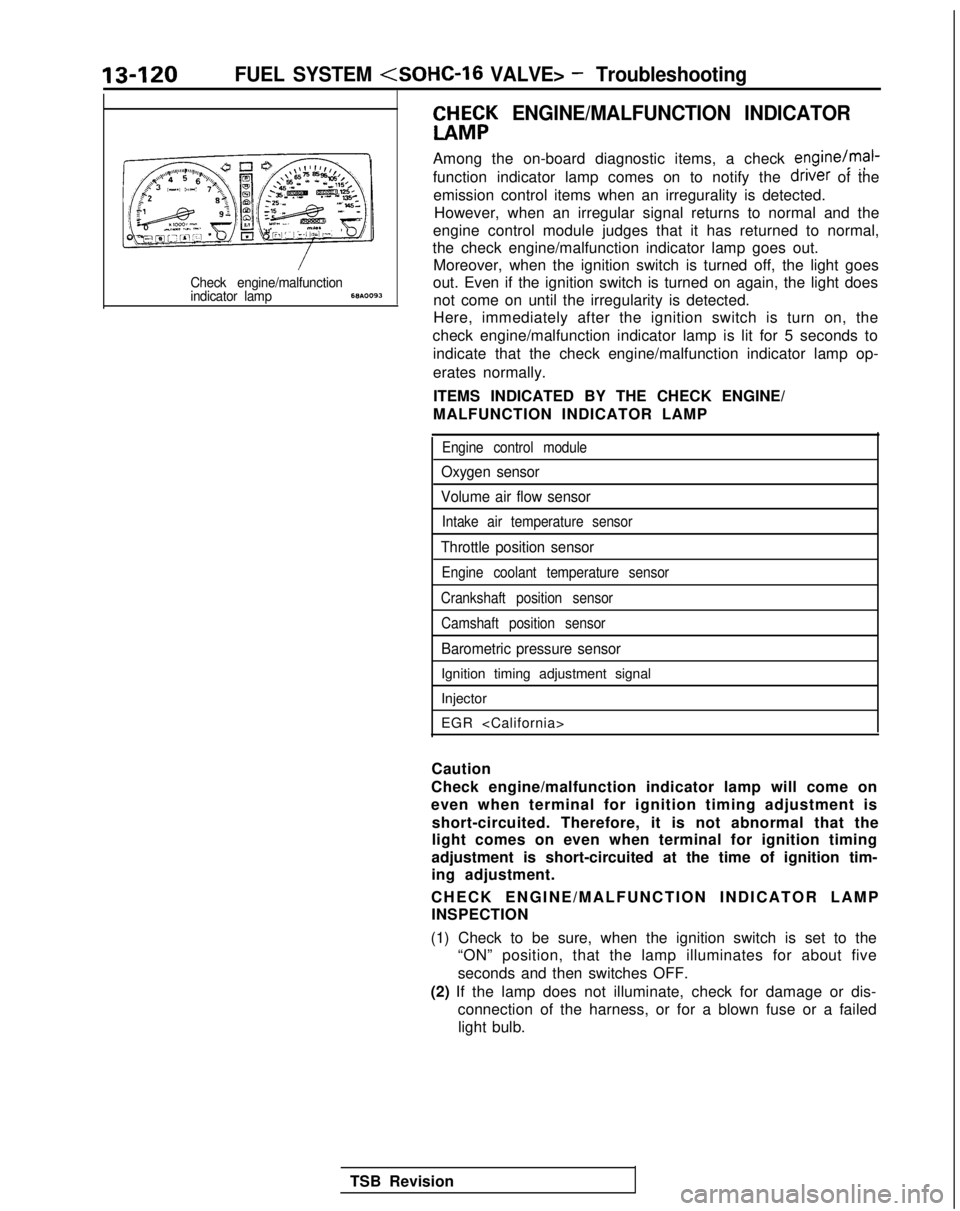
Among the on-board diagnostic items, a check engine/mal-
function indicator lamp comes on to notify the driver
of the
emission control items when an irregurality is detected. However, when an irregular signal returns to normal and the
engine control module judges that it has returned to normal,
the check engine/malfunction indicator lamp goes out. Moreover, when the ignition switch is turned off, the light goes
Check engine/malfunctionout. Even if the ignition switch is turned on again, the light doesindicator lamp68A.0093not come on until the irregularity is detected.
Here, immediately after the ignition switch is turn on, the
check engine/malfunction indicator lamp is lit for 5 seconds to indicate that the check engine/malfunction indicator lamp op-
erates normally.
ITEMS INDICATED BY THE CHECK ENGINE/
MALFUNCTION INDICATOR LAMP
Engine control module
Oxygen sensor
Volume air flow sensor
Intake air temperature sensor
Throttle position sensor
Engine coolant temperature sensor
Crankshaft position sensor Camshaft position sensor
Barometric pressure sensor
Ignition timing adjustment signal
Injector
EGR
Caution
Check engine/malfunction indicator lamp will come on
even when terminal for ignition timing adjustment is short-circuited. Therefore, it is not abnormal that the
light comes on even when terminal for ignition timing
adjustment is short-circuited at the time of ignition tim-
ing adjustment.
CHECK ENGINE/MALFUNCTION INDICATOR LAM
P
INSPECTION
(1) Check to be sure, when the ignition switch is set to the “ON” position, that the lamp illuminates for about five
seconds and then switches OFF.
(2) If the lamp does not illuminate, check for damage or dis- connection of the harness, or for a blown fuse or a failedlight bulb.
TSB Revision