wiring MITSUBISHI LANCER EVOLUTION 2007 Service Repair Manual
[x] Cancel search | Manufacturer: MITSUBISHI, Model Year: 2007, Model line: LANCER EVOLUTION, Model: MITSUBISHI LANCER EVOLUTION 2007Pages: 1449, PDF Size: 56.82 MB
Page 1310 of 1449

SRS -AirBagModuleandSeatBeltPre-tensioner
Disposal Procedures52B-66
Front passenger’s air bag module
(1) Remove the glove box.
(Refer to GROUP 52A – Instrument Panel.)
(2) Disconnect the front passenger’s air bag module 2-pin
connector (red) and instrument panel wiring harness
connector (2-pin, red).
NOTE
Once disconnected from the instrument panel wiring
harness, both electrodes of the front passenger’s air
bag module short automatically. This prevents the
front passenger air bag from accidental deployment
caused by static, etc.
(3) Connect deployment harnesses longer than 6 m to
each SRS air bag adapter harness and insulate the
connections with plastic tape.
Also, connect the deployment harnesses in the other
ends to short, thereby preventing the front
passenger’s air bag from accidental deployment
caused by static etc.
(4) Connect the SRS air bag adapter harness to the
front passenger’s air bag module 2-pin connector
(red) and route the deployment harnesses out of the
vehicle.
(5) Close all the doors with the windows fully closed and
put a cover over the vehicle to minimize report.
Caution
The cover is required as the glass, if already
damaged, may break.
Instrument panel wiring
harness connector
(2-pin, red)
Front passen-
ger’s air bag
module 2-pin
connector (red)
SRS air bag
adapter harness
MB686560Shorted
6 m or longer
Insulation
tape Deployment harnesses
Deployment
harnesses SRS air bag
adapter harness
MB686560
Front passenger’s
air bag module 2-pin
connector (red)
Cover
Deployment
harnesses
Page 1311 of 1449
SRS -AirBagModuleandSeatBeltPre-tensioner
Disposal Procedures52B-67
(6) Separate the deployment harnesses as far from the
vehicle as possible and connect to the terminals of the
battery removed from the vehicle. Then deploy.
Caution
1) Before deploying the air bag, see that no one is
in and near the vehicle. Also, put on safety
glasses.
2) The deployment makes the inflator of the front
passenger’s air bag very hot. Before handling
the inflator, wait more than 30 minutes for
cooling.
3) If the front passenger’s air bag module fails to
deploy although the procedure is respected,
do not go near the module. Contact your local
distributor.
(7) Discard the deployed air bag module according to
Deployed Air Bag Module Disposal Procedures.
(Refer to P.52B-75.)
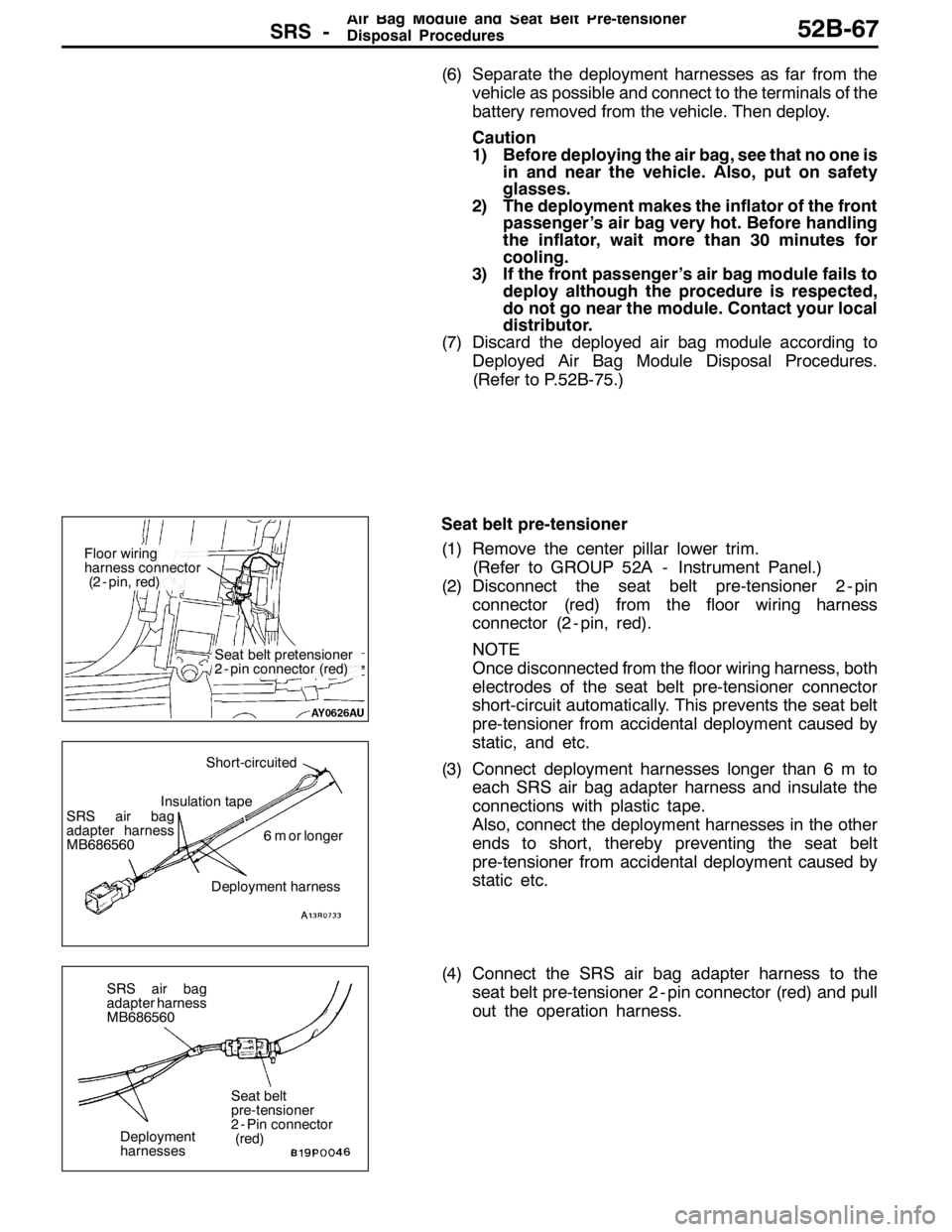
Seat belt pre-tensioner
(1) Remove the center pillar lower trim.
(Refer to GROUP 52A - Instrument Panel.)
(2) Disconnect the seat belt pre-tensioner 2 - pin
connector (red) from the floor wiring harness
connector (2 - pin, red).
NOTE
Once disconnected from the floor wiring harness, both
electrodes of the seat belt pre-tensioner connector
short-circuit automatically. This prevents the seat belt
pre-tensioner from accidental deployment caused by
static, and etc.
(3) Connect deployment harnesses longer than 6 m to
each SRS air bag adapter harness and insulate the
connections with plastic tape.
Also, connect the deployment harnesses in the other
ends to short, thereby preventing the seat belt
pre-tensioner from accidental deployment caused by
static etc.
(4) Connect the SRS air bag adapter harness to the
seat belt pre-tensioner 2 - pin connector (red) and pull
out the operation harness.
Seat belt pretensioner
2 - pin connector (red)
Floor wiring
harness connector
(2 - pin, red)
SRS air bag
adapter harness
MB686560
Insulation tapeShort-circuited
6 m or longer
Deployment harness
Deployment
harnesses SRS air bag
adapter harness
MB686560
Seat belt
pre-tensioner
2 - Pin connector
(red)
Page 1321 of 1449

CHASSIS ELECTRICAL 54A....................................
SMART WIRING SYSTEM (SWS) 54B............................
54A-1
CHASSIS
ELECTRICAL
CONTENTS
Page 1326 of 1449

CHASSIS ELECTRICAL -Ignition Switch and Immobilizer System54A-6
IGNITION SWITCH AND IMMOBILIZER SYSTEM
SPECIAL TOOLS
ToolNumberNameUse
MB991502MUT-IISub as-
semblyChecking the immobilizer system
MB990784Ornament removerInstrument panel under cover and column
cover removal
TROUBLESHOOTING
IGNITION SWITCH
The ignition switch is controlled by the Smart Wiring System (SWS). For troubleshooting procedures,
refer to GROUP 54B.
IMMOBILIZER
STANDARD FLOW OF DIAGNOSIS TROUBLESHOOTING
Refer to GROUP 00 - How to Use Troubleshooting/Inspection Service Points.
DIAGNOSIS FUNCTION
READING DIAGNOSIS CODES
The diagnosis codes can be read using the MUT-IIor by using the Simple Check Diagnosis mode. (Refer
to GROUP 00 - How to Use Troubleshooting/Inspection Service Points.)
NOTE
Connect the MUT-IIto the 16-pin diagnosis connector (black).
DIAGNOSIS CODE MEMORY ERASING PROCEDURE
Refer to GROUP 00 - How to Use Troubleshooting/Inspection Service Points.
INSPECTION USING SIMPLE CHECK DIAGNOSIS MODE
1. Change to Simple Check Diagnosis mode and activate switch diagnosis mode. (Refer to GROUP
00 - How to Use Troubleshooting/Inspection Service Points.)
2. In this condition, the input signals for the following switches can be checked.
CHART CLASSIFIED BY DIAGNOSIS CODES
Code No.Diagnosis contentsReference page
11Problem related to communication with the ignition key54A-7
12Ignition key is not registered, or encrypted code from ignition key does not match.54A-7
Page 1344 of 1449

CHASSIS ELECTRICAL -Headlamp Assembly54A-24
HEADLAMP ASSEMBLY
SERVICE SPECIFICATIONS
ItemStandard valueLimit
Headlamp aimingLow beamVertical
direction120mm (0.69_) below hor-
izontal line (H)±0.29_
Horizontal
directionPosition at which the
startup point of 15_is
crossed with vertical line
(V)±0.5_
High beamVertical
directionThe center of high intensi-
ty zone is on the point of
intersection of line (H) and
line (V).- 0.5_of the point of
intersection of line (H)
Horizontal
directionThe center of high intensi-
ty zone is on the point of
intersection of line (V).±0.5_of the center of
line (V)
Measurement of headlamp illuminous intensity
(at high beam)–30,000 cd or more per
one headlamp
NOTES ON HEADLAMP ASSEMBLY:
Plastic outer lens are equipped with headlamp assembly. For handling, care should be taken for
the following items:
DHeadlamps should not be illuminated for more than 3 minutes with scratch preventive protectors,
etc. covered on them.
DMasking such as taping should not be attached on outer lens.
DOuter lens surface should not be rubbed with a sharp-edged tool, etc.
DSpecified wax remover should be used for insistently washing.
DAuthorized Mitsubishi Genuine bulbs should be used.
TROUBLESHOOTING
Headlamps are controlled smart wiring system (SWS). For troubleshooting, refer to GROUP 54B.
NOTE
When ETACS-ECU is defective, headlamps can be illuminated only in a low beam mode as fail-safe
function.
ON-VEHICLE SERVICE
HEADLAMP AIMING
PRE-AIMING INSTRUCTION
1. Inspect for badly rusted or faulty headlamp assemblies.
2. These conditions must be corrected before a satisfactory
adjustment can be made.
3. Inspect tyres inflation, and adjust if necessary.
Page 1349 of 1449
CHASSIS ELECTRICAL -Headlamp AssemblyCHASSIS ELECTRICAL -Headlamp AssemblyCHASSIS ELECTRICAL -Headlamp Assembly54A-29
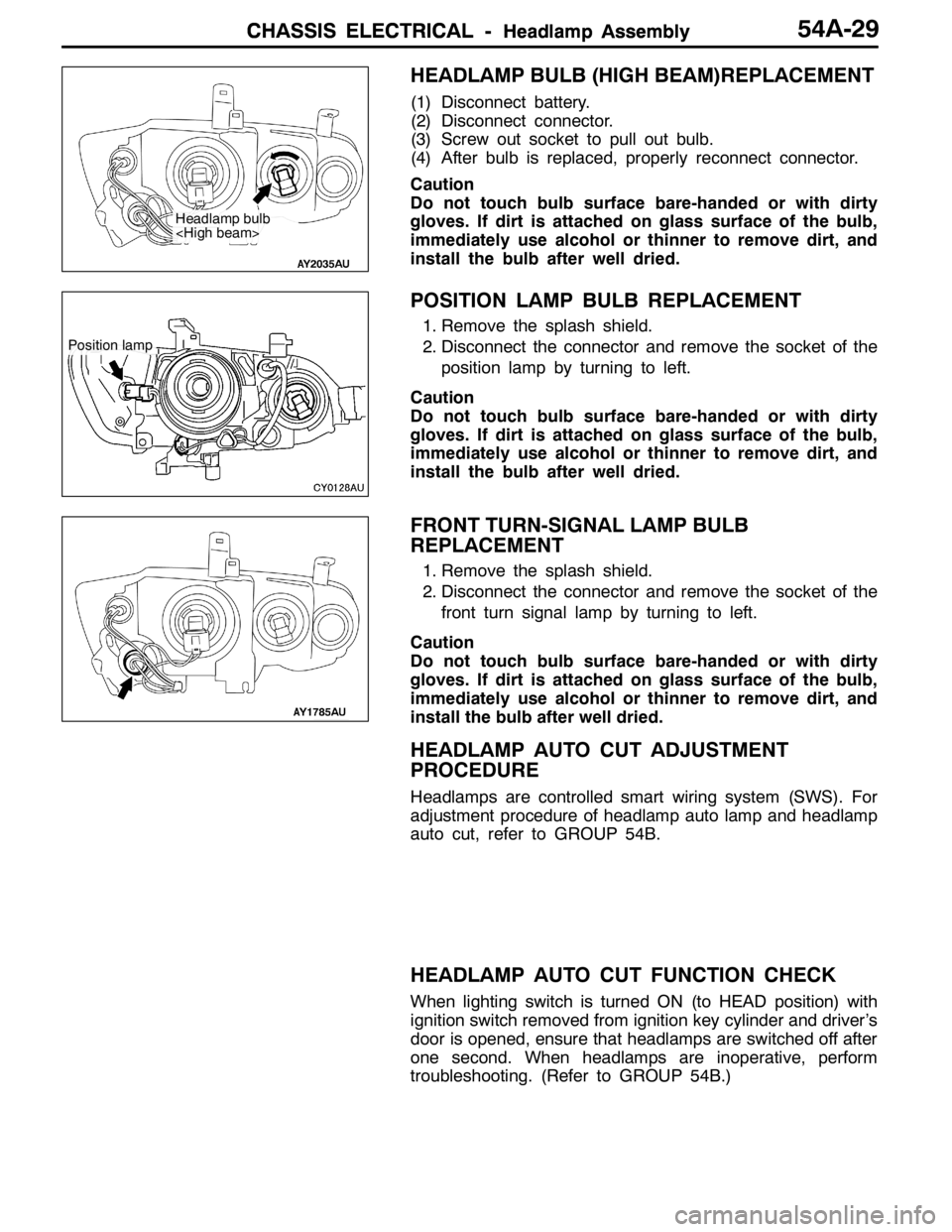
HEADLAMP BULB (HIGH BEAM)REPLACEMENT
(1) Disconnect battery.
(2) Disconnect connector.
(3) Screw out socket to pull out bulb.
(4) After bulb is replaced, properly reconnect connector.
Caution
Do not touch bulb surface bare-handed or with dirty
gloves. If dirt is attached on glass surface of the bulb,
immediately use alcohol or thinner to remove dirt, and
install the bulb after well dried.
POSITION LAMP BULB REPLACEMENT
1. Remove the splash shield.
2. Disconnect the connector and remove the socket of the
position lamp by turning to left.
Caution
Do not touch bulb surface bare-handed or with dirty
gloves. If dirt is attached on glass surface of the bulb,
immediately use alcohol or thinner to remove dirt, and
install the bulb after well dried.
FRONT TURN-SIGNAL LAMP BULB
REPLACEMENT
1. Remove the splash shield.
2. Disconnect the connector and remove the socket of the
front turn signal lamp by turning to left.
Caution
Do not touch bulb surface bare-handed or with dirty
gloves. If dirt is attached on glass surface of the bulb,
immediately use alcohol or thinner to remove dirt, and
install the bulb after well dried.
HEADLAMP AUTO CUT ADJUSTMENT
PROCEDURE
Headlamps are controlled smart wiring system (SWS). For
adjustment procedure of headlamp auto lamp and headlamp
auto cut, refer to GROUP 54B.
HEADLAMP AUTO CUT FUNCTION CHECK
When lighting switch is turned ON (to HEAD position) with
ignition switch removed from ignition key cylinder and driver’s
door is opened, ensure that headlamps are switched off after
one second. When headlamps are inoperative, perform
troubleshooting. (Refer to GROUP 54B.)
Headlamp bulb
Position lamp
Page 1365 of 1449

54B-1
SMART WIRING
SYSTEM (SWS)
CONTENTS
SPECIAL TOOLS 2...........................
TROUBLESHOOTING 2.......................
Before Commencing Troubleshooting 2...........
Standard Flow of Diagnostic Troubleshooting 2...
Diagnostic Functions 2.........................Diagnosis Code Chart 3........................
Diagnosis Code Inspection Procedures 4.........
Trouble Symptom Chart 7.......................
Inspection Procedures for Trouble Symptoms 10..
Check at ECU Terminals 34.....................