wiring MITSUBISHI LANCER EVOLUTION 2007 Service Manual Online
[x] Cancel search | Manufacturer: MITSUBISHI, Model Year: 2007, Model line: LANCER EVOLUTION, Model: MITSUBISHI LANCER EVOLUTION 2007Pages: 1449, PDF Size: 56.82 MB
Page 640 of 1449

MPI -Troubleshooting13A-108
Item
No.Reference
page Inspection
procedure
No. Normal condition Inspection contents Drive contents Inspection
item
21Fan
controllerRadiator fan
motor is
driven.Ignition switch: “ON”Fan motor rotates
at high speed.Procedure
No. 2413A-87
36Secondary
air control
solenoid
valveSolenoid valve
turns from
OFF to ON.Ignition switch: “ON”Sound of opera-
tion can be heard
when solenoid
valve is driven.Procedure
No. 2913A-96
37Condenser
fan (HI)Condensor
fan motor is
driven.Ignition switch: “ON”Fan motor rotates
at high speed.Procedure
No. 2513A-89
38Condenser
fan (LOW)Second air
control
solenoid valveIgnition switch: “ON”Fan motor rotates
at low speed.
CHECK AT THE ENGINE-ECU TERMINALS
TERMINAL VOLTAGE CHECK CHART
1. Connect a needle-nosed wire probe (test harness:
MB991223 or paper clip) to a voltmeter probe.
2. Insert the needle-nosed wire probe into each of the
engine-ECU connector terminals from the wire side, and
measure the voltage while referring to the check chart.
NOTE
(1) Make the voltage measurement with the engine-ECU
connectors connected.
(2) You may find it convenient to pull out the engine-ECU
to make it easier to reach the connector terminals.
(3) The checks can be carried out off the order given
in the chart.
Caution
Short-circuiting the positive (+) probe between a
connector terminal and earth could damage the
vehicle wiring, the sensor, engine-ECU or all of them.
Be careful to prevent this!
3. If voltmeter shows any division from standard value, check
the corresponding sensor, actuator and related electrical
wiring, then repair or replace.
4. After repair or replacement, recheck with the voltmeter
to confirm that the repair has corrected the problem.
Needle-nosed wire probe
Page 646 of 1449

MPI -Troubleshooting13A-114
CHECK CHART FOR RESISTANCE AND CONTINUITY
BETWEEN TERMINALS
1. Turn the ignition switch to “LOCK” (OFF) position.
2. Disconnect the engine-ECU connector.
3. Measure the resistance and check for continuity between
the terminals of the engine-ECU harness-side connector
while referring to the check chart.
NOTE
(1) When measuring resistance and checking continuity,
a harness for checking contact pin pressure should
be used instead of inserting a test probe.
(2) Checking need not be carried out in the order given
in the chart.
Caution
If the terminals that should be checked are mistaken,
or if connector terminals are not correctly shorted
to earth, damage may be caused to the vehicle wiring,
sensors, engine-ECU and/or ohmmeter.
Be careful to prevent this!
4. If the ohmmeter shows any deviation from the standard
value, check the corresponding sensor, actuator and
related electrical wiring, and then repair or replace.
5. After repair or replacement, recheck with the ohmmeter
to confirm that the repair or replacement has corrected
the problem.
Engine-ECU Harness Side Connector Terminal Arrangement
Terminal No.Inspection itemNormal condition (Check condition)
1-12No. 1 injector2-3Ω(at 20_C)
14 - 12No. 2 injector
2-12No. 3 injector
15 - 12No. 4 injector
Page 736 of 1449

ENGINE ELECTRICAL -Charging System16-4
ON-VEHICLE SERVICE
ALTERNATOR OUTPUT LINE VOLTAGE DROP TEST
Alternator
Terminal BVoltmeterAmmeter
Battery
+-
+-
This test determines whether the wiring from the
alternator “B” terminal to the battery (+) terminal
(including the fusible line) is in a good condition
or not.
(1) Always be sure to check the following before
the test.
DAlternator installation
DAlternator drive belt tension
(Refer to GROUP 11 - On-vehicle Service.)
DFusible link
DAbnormal noise from the alternator while
the engine is running
(2) Turn the ignition switch to the “LOCK” (OFF)
position.
(3) Disconnect the negative battery cable.
(4) Disconnect the alternator output wire from the
alternator “B” terminal and connect a DC test
ammeter with a range of 0 - 100 A in seriesbetween the “B” terminal and the disconnected
output wire. (Connect the (+) lead of the
ammeter to the “B” terminal, and then connect
the ( - ) lead of the ammeter to the disconnected
output wire.)
NOTE
An inductive-type ammeter which enables
measurements to be taken without
disconnecting the alternator output wire should
be recommended. Using this equipment will
lessen the possibility of a voltage drop caused
by a loose “B” terminal connection.
(5) Connect a digital-type voltmeter between the
alternator “B” terminal and the battery (+)
terminal. (Connect the (+) lead of the voltmeter
to the “B” terminal and the connect the ( - ) lead
of the voltmeter to the battery (+) cable.)
Page 737 of 1449

ENGINE ELECTRICAL -Charging System16-5
(6) Reconnect the negative battery cable.
(7) Connect a tachometer or the MUT-II.
(Refer to GROUP 11 - On-vehicle Service.)
(8) Leave the hood open.
(9) Start the engine.
(10)With the engine running at 2,500 r/min, turn
the headlamps and other lamps on and off
to adjust the alternator load so that the value
displayed on the ammeter is slightly above 30
A.
Adjust the engine speed by gradually
decreasing it until the value displayed on the
ammeter is 30 A. Take a reading of the value
displayed on the voltmeter at this time.
Limit: max. 0.3 V
NOTE
When the alternator output is high and the value
displayed on the ammeter does not decrease
until 30 A, set the value to 40 A. Read the
value displayed on the voltmeter at this time.
When the value range is 40 A, the limit is max.
0.4 V.(11) If the value displayed on the voltmeter is above
the limit value, there is probably a malfunction
in the alternator output wire, so check the wiring
between the alternator “B” terminal and the
battery (+) terminal (including fusible link).
If a terminal is not sufficiently tight or if the
harness has become discolored due to
overheating, repair and then test again.
(12)After the test, run the engine at idle.
(13)Turn off all lamps and the ignition switch.
(14)Remove the tachometer or the MUT-II.
(15)Disconnect the negative battery cable.
(16)Disconnect the ammeter and voltmeter.
(17)Connect the alternator output wire to the
alternator “B” terminal.
(18)Connect the negative battery cable.
OUTPUT CURRENT TEST
Charging warning lampVoltmeter
Ammeter
Ignition switch
Alternator relayLoad
Battery
Engine-ECUAlternatorFR
L
S
G
+ -+-
B
Page 810 of 1449

22A-2
MANUAL
TRANSMISSION
CONTENTS
GENERAL 3.................................
Outline of Changes 3...........................
GENERAL INFORMATION 3..................
SERVICE SPECIFICATION 3..................
LUBRICANTS 3..............................
SPECIAL TOOLS 4...........................
TROUBLESHOOTING
ON-VEHICLE SERVICE 40....................
Transmission Oil Check 40......................
Transmission Oil Replacement 40................
Transfer Oil Check 40..........................
Transfer Oil Replacement 40....................
Fluid Check
Bleeding
Hydraulic Pressure Check
Wheel Speed Sensor Output Voltage
Measurement
TRANSMISSION CONTROL* 46...............
TRANSFER ASSEMBLY 49...................
TRANSMISSION ASSEMBLY 52...............
4WD-ECU
SENSOR, SWITCH AND RELAY
AYC> 56.....................................
HYDRAULIC UNIT Refer to GROUP27B.......
WARNING REGARDING SERVICING OF SUPPLEMENTAL RESTRAINT SYSTEM (SRS) EQUIPPED VEHICLES
WARNING!
(1) Improper service or maintenance of any component of the SRS, or any SRS-related component, can lead to personal
injury or death to service personnel (from inadvertent firing of the air bag) or to driver and passenger (from rendering
the SRS inoperative).
(2) Service or maintenance of any SRS component or SRS-related component must be performed only at an authorized
MITSUBISHI dealer.
(3) MITSUBISHI dealer personnel must thoroughly review this manual, and especially its GROUP 52B - Supplemental
Restraint System (SRS) before beginning any service or maintenance of any component of the SRS or any SRS-related
component.
NOTE
The SRS includes the following components: SRS-ECU, SRS warning lamp, air bag module, clock spring, and interconnecting
wiring. Other SRS-related components (that may have to be removed/installed in connection with SRS service or maintenance) are
indicated in the table of contents by an asterisk (*).
Page 1015 of 1449

32-1
POWER PLANT
MOUNT
CONTENTS
GENERAL INFORMATION 2..................
SPECIAL TOOL 3............................
ENGINE MOUNTING 4........................TRANSMISSION MOUNTING 5................
ENGINE ROLL STOPPER, CENTERMEMBER
6 ............................................
CROSSMEMBER* 8..........................
WARNING REGARDING SERVICING OF SUPPLEMENTAL RESTRAINT SYSTEM (SRS) EQUIPPED VEHICLES
WARNING!
(1) Improper service or maintenance of any component of the SRS, or any SRS-related component, can lead to personal
injury or death to service personnel (from inadvertent firing of the air bag) or to driver and passenger (from rendering
the SRS inoperative).
(2) Service or maintenance of any SRS component or SRS-related component must be performed only at an authorized
MITSUBISHI dealer.
(3) MITSUBISHI dealer personnel must thoroughly review this manual, and especially its GROUP 52B - Supplemental
Restraint System (SRS) before beginning any service or maintenance of any component of the SRS or any SRS-related
component.
NOTE
The SRS includes the following components: SRS-ECU, SRS warning lamp, air bag module, clock spring, and interconnecting
wiring. Other SRS-related components (that may have to be removed/installed in connection with SRS service or maintenance) are
indicated in the table of contents by an asterisk (*).
Page 1079 of 1449
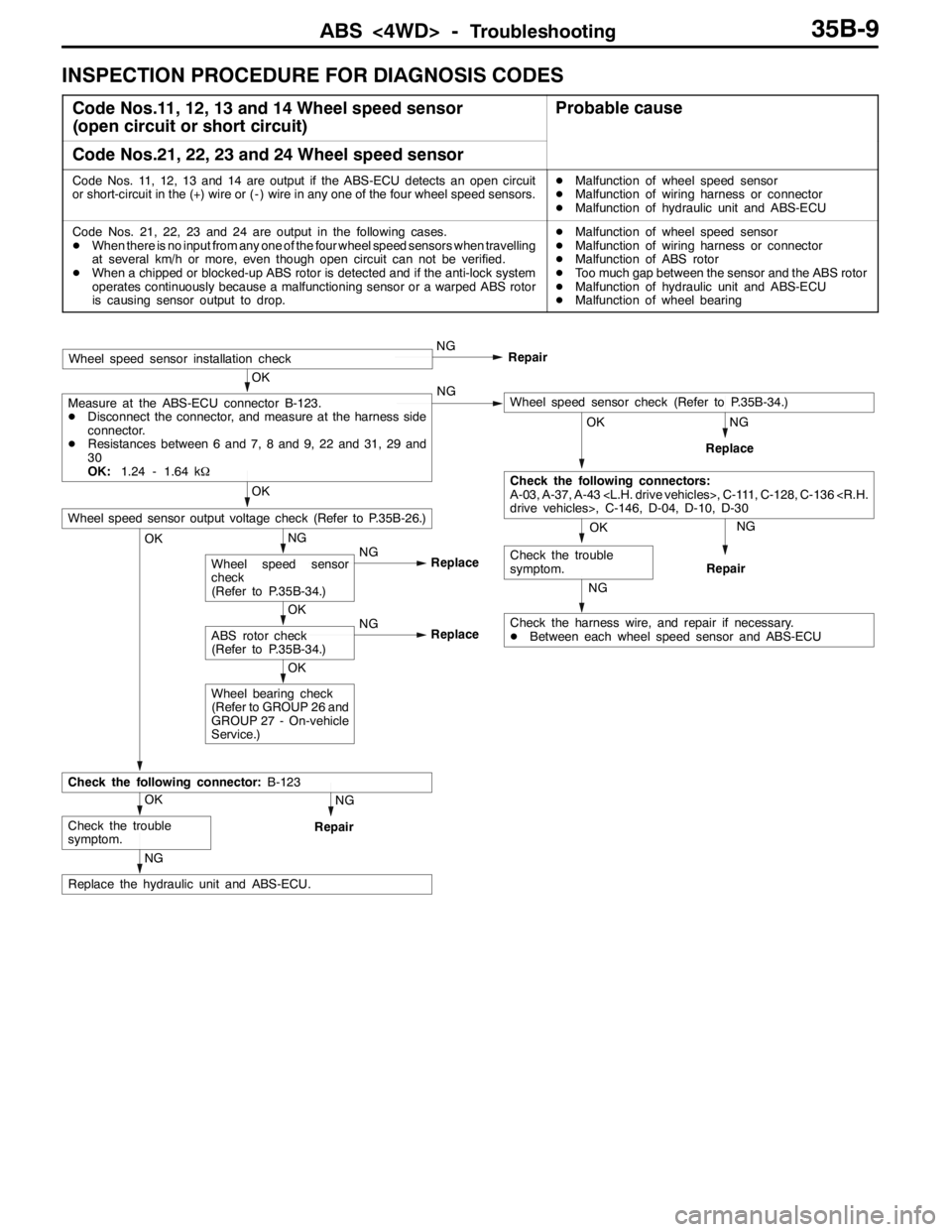
ABS <4WD> -Troubleshooting35B-9
INSPECTION PROCEDURE FOR DIAGNOSIS CODES
Code Nos.11, 12, 13 and 14 Wheel speed sensor
(open circuit or short circuit)Probable cause
Code Nos.21, 22, 23 and 24 Wheel speed sensor
Code Nos. 11, 12, 13 and 14 are output if the ABS-ECU detects an open circuit
or short-circuit in the (+) wire or ( - ) wire in any one of the four wheel speed sensors.DMalfunction of wheel speed sensor
DMalfunction of wiring harness or connector
DMalfunction of hydraulic unit and ABS-ECU
Code Nos. 21, 22, 23 and 24 are output in the following cases.
DWhen there is no input from any one of the four wheel speed sensors when travelling
at several km/h or more, even though open circuit can not be verified.
DWhen a chipped or blocked-up ABS rotor is detected and if the anti-lock system
operates continuously because a malfunctioning sensor or a warped ABS rotor
is causing sensor output to drop.DMalfunction of wheel speed sensor
DMalfunction of wiring harness or connector
DMalfunction of ABS rotor
DToo much gap between the sensor and the ABS rotor
DMalfunction of hydraulic unit and ABS-ECU
DMalfunction of wheel bearing
NG
NG
Replace
OK
Check the harness wire, and repair if necessary.
DBetween each wheel speed sensor and ABS-ECU
NG
Repair
OK
Wheel bearing check
(Refer to GROUP 26 and
GROUP 27 - On-vehicle
Service.)
NG
Repair
NG
Replace the hydraulic unit and ABS-ECU.
OK
Check the trouble
symptom.
Check the following connector:B-123
OK
ABS rotor check
(Refer to P.35B-34.)NG
Replace
NG
Wheel speed sensor
check
(Refer to P.35B-34.)NG
Replace
OK
Wheel speed sensor output voltage check (Refer to P.35B-26.)OK
Check the trouble
symptom.
OK
Check the following connectors:
A-03, A-37, A-43
OK
Measure at the ABS-ECU connector B-123.
DDisconnect the connector, and measure at the harness side
connector.
DResistances between 6 and 7, 8 and 9, 22 and 31, 29 and
30
OK:1.24 - 1.64 kΩNGWheel speed sensor check (Refer to P.35B-34.)
Wheel speed sensor installation checkNG
Repair
Page 1080 of 1449
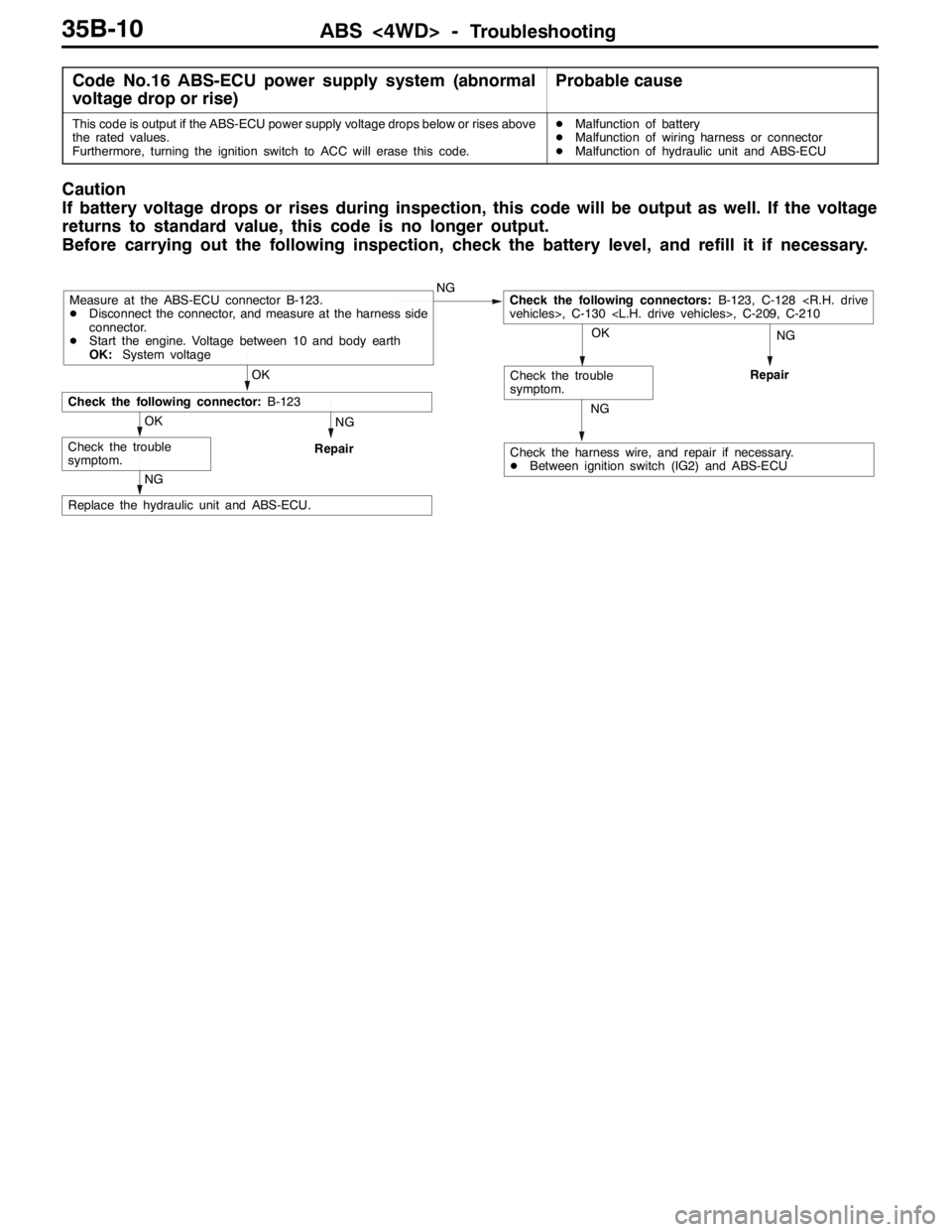
ABS <4WD> -Troubleshooting35B-10
Code No.16 ABS-ECU power supply system (abnormal
voltage drop or rise)Probable cause
This code is output if the ABS-ECU power supply voltage drops below or rises above
the rated values.
Furthermore, turning the ignition switch to ACC will erase this code.DMalfunction of battery
DMalfunction of wiring harness or connector
DMalfunction of hydraulic unit and ABS-ECU
Caution
If battery voltage drops or rises during inspection, this code will be output as well. If the voltage
returns to standard value, this code is no longer output.
Before carrying out the following inspection, check the battery level, and refill it if necessary.
NGNG
Repair
NG
Replace the hydraulic unit and ABS-ECU.
NG
Repair
Check the harness wire, and repair if necessary.
DBetween ignition switch (IG2) and ABS-ECU
OK
Check the trouble
symptom.
OK
Check the trouble
symptom.
OK
Check the following connector:B-123
NGCheck the following connectors:B-123, C-128
DDisconnect the connector, and measure at the harness side
connector.
DStart the engine. Voltage between 10 and body earth
OK:System voltage
Page 1081 of 1449
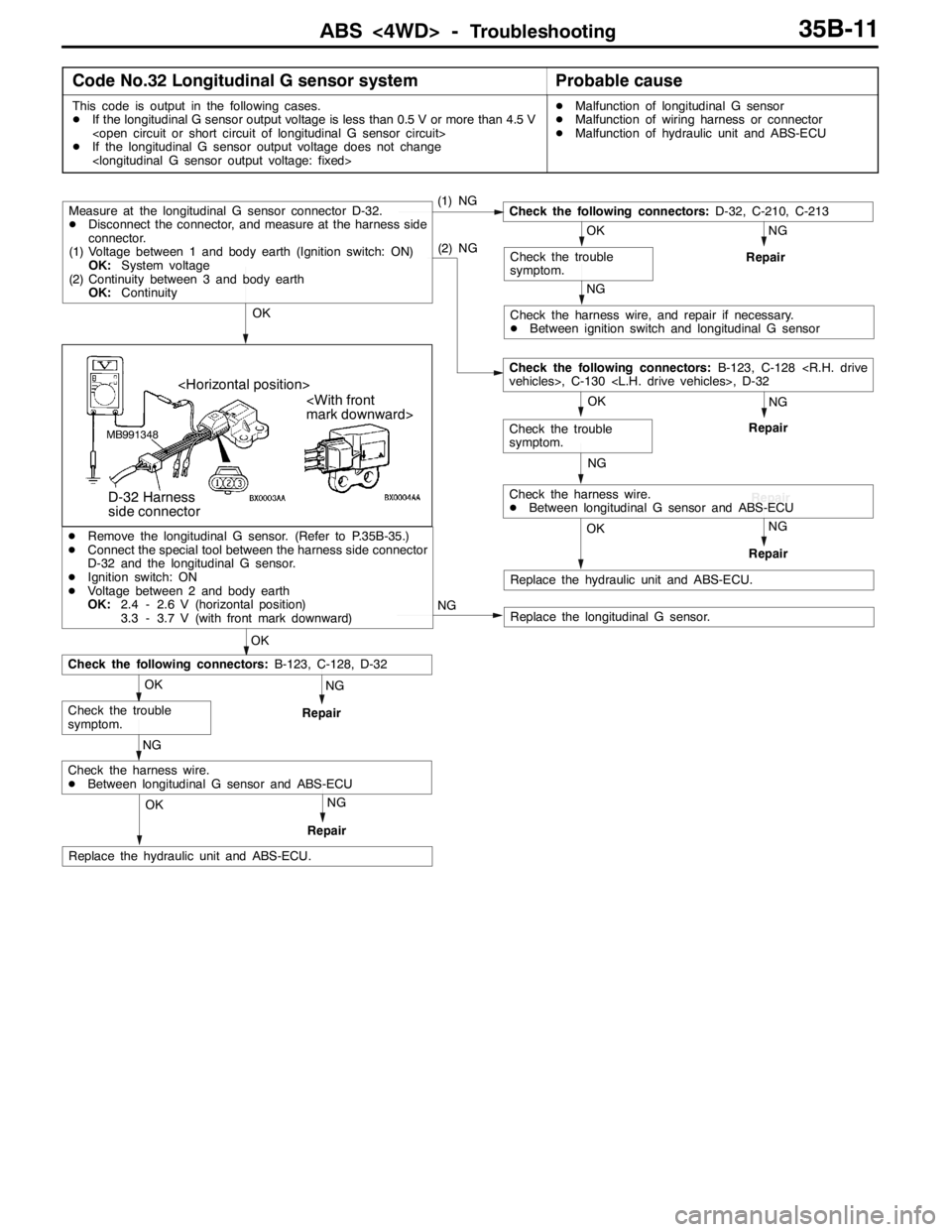
ABS <4WD> -Troubleshooting35B-11
Code No.32 Longitudinal G sensor systemProbable cause
This code is output in the following cases.
DIf the longitudinal G sensor output voltage is less than 0.5 V or more than 4.5 V
DIf the longitudinal G sensor output voltage does not change
DMalfunction of wiring harness or connector
DMalfunction of hydraulic unit and ABS-ECU
(1) NG
NG
Repair
NG
Check the harness wire, and repair if necessary.
DBetween ignition switch and longitudinal G sensor
OK
Check the trouble
symptom.
Check the following connectors:D-32, C-210, C-213
NG
Repair
NG
OK
Check the trouble
symptom. OK
(2) NG
Measure at the longitudinal G sensor connector D-32.
DDisconnect the connector, and measure at the harness side
connector.
(1) Voltage between 1 and body earth (Ignition switch: ON)
OK:System voltage
(2) Continuity between 3 and body earth
OK:Continuity
Repair
Check the following connectors:B-123, C-128
NGOK
Repair
Check the harness wire.
DBetween longitudinal G sensor and ABS-ECU
Replace the hydraulic unit and ABS-ECU.
MB991348
D-32 Harness
side connector
NG
OK
NG
Repair
NG
OK
Check the trouble
symptom.
Check the following connectors:B-123, C-128, D-32
DRemove the longitudinal G sensor. (Refer to P.35B-35.)
DConnect the special tool between the harness side connector
D-32 and the longitudinal G sensor.
DIgnition switch: ON
DVoltage between 2 and body earth
OK:2.4 - 2.6 V (horizontal position)
3.3 - 3.7 V (with front mark downward)
NGOK
Repair
Check the harness wire.
DBetween longitudinal G sensor and ABS-ECU
Replace the hydraulic unit and ABS-ECU.
Replace the longitudinal G sensor.
Page 1082 of 1449
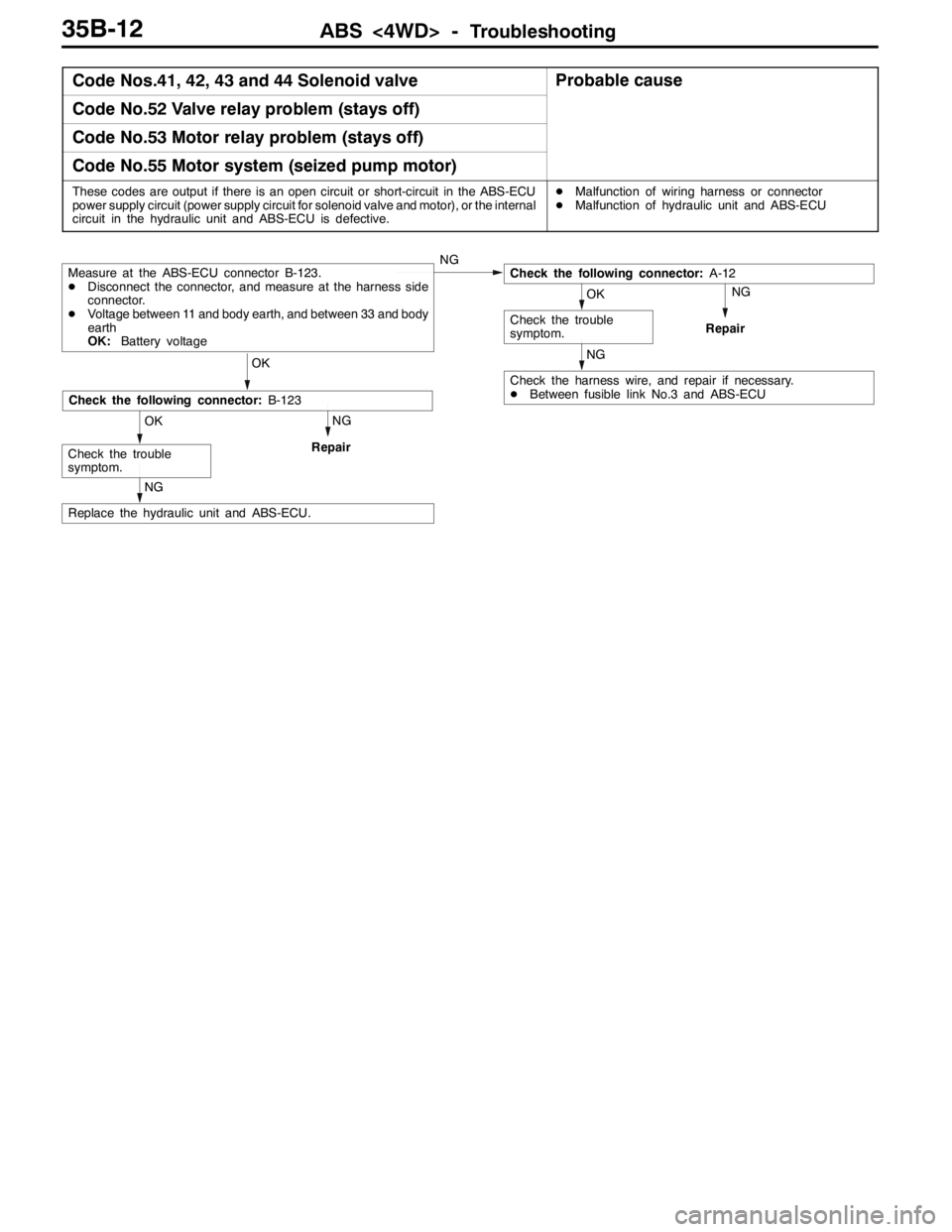
ABS <4WD> -Troubleshooting35B-12
Code Nos.41, 42, 43 and 44 Solenoid valveProbable cause
Code No.52 Valve relay problem (stays off)
Code No.53 Motor relay problem (stays off)
Code No.55 Motor system (seized pump motor)
These codes are output if there is an open circuit or short-circuit in the ABS-ECU
power supply circuit (power supply circuit for solenoid valve and motor), or the internal
circuit in the hydraulic unit and ABS-ECU is defective.DMalfunction of wiring harness or connector
DMalfunction of hydraulic unit and ABS-ECU
NG
Repair
NG
Check the harness wire, and repair if necessary.
DBetween fusible link No.3 and ABS-ECU
NG
Repair
NG
Replace the hydraulic unit and ABS-ECU.
OK
Check the trouble
symptom.
Check the following connector:B-123
OK
OK
Check the trouble
symptom.
Check the following connector:A-12Measure at the ABS-ECU connector B-123.
DDisconnect the connector, and measure at the harness side
connector.
DVoltage between 11 and body earth, and between 33 and body
earth
OK:Battery voltageNG