wiring MITSUBISHI LANCER EVOLUTION 2007 Service Owners Manual
[x] Cancel search | Manufacturer: MITSUBISHI, Model Year: 2007, Model line: LANCER EVOLUTION, Model: MITSUBISHI LANCER EVOLUTION 2007Pages: 1449, PDF Size: 56.82 MB
Page 1083 of 1449
ABS <4WD> -Troubleshooting35B-13
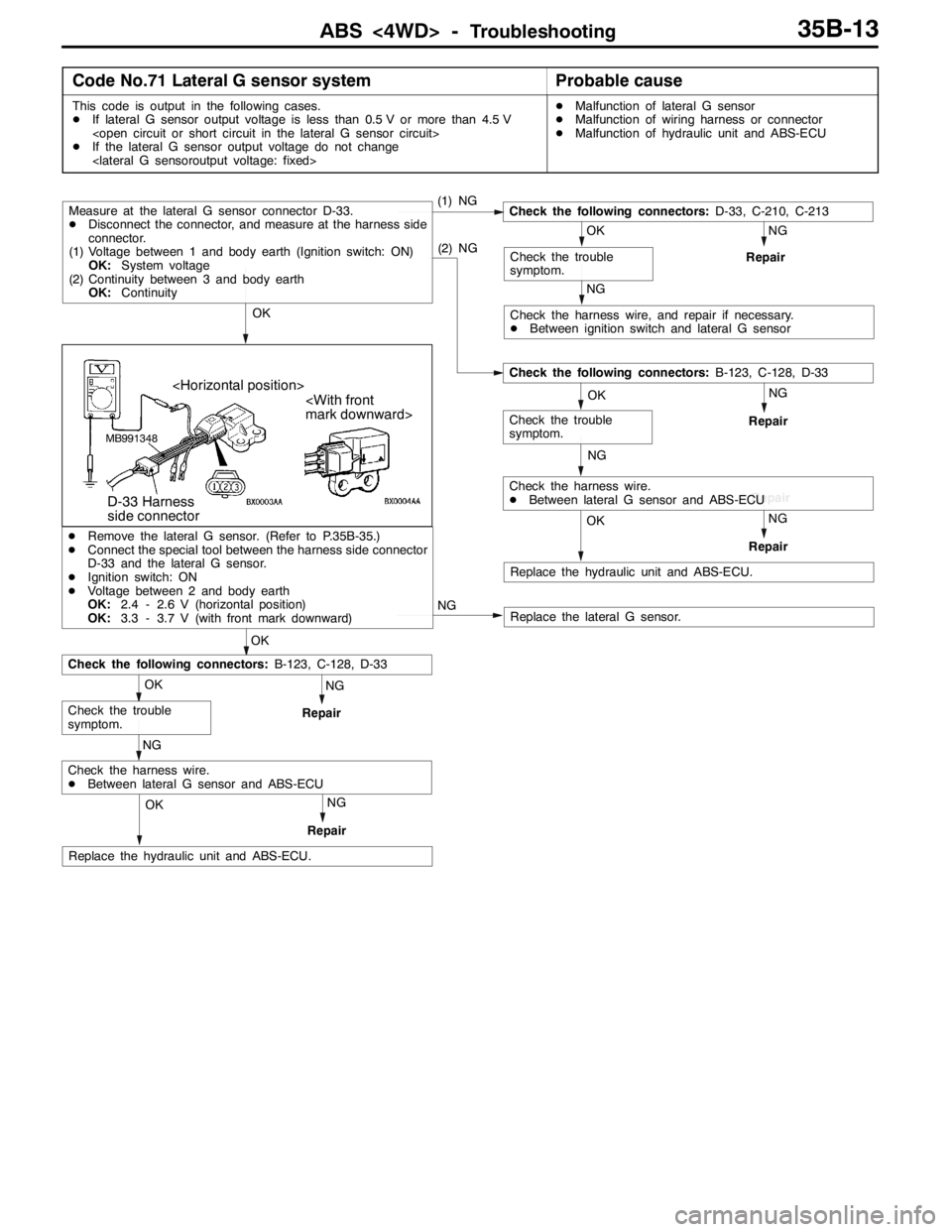
Code No.71 Lateral G sensor systemProbable cause
This code is output in the following cases.
DIf lateral G sensor output voltage is less than 0.5 V or more than 4.5 V
DIf the lateral G sensor output voltage do not change
DMalfunction of wiring harness or connector
DMalfunction of hydraulic unit and ABS-ECU
(1) NG
NG
Repair
NG
Check the harness wire, and repair if necessary.
DBetween ignition switch and lateral G sensor
OK
Check the trouble
symptom.
Check the following connectors:D-33, C-210, C-213
NG
Repair
NG
OK
Check the trouble
symptom. OK
(2) NG
Measure at the lateral G sensor connector D-33.
DDisconnect the connector, and measure at the harness side
connector.
(1) Voltage between 1 and body earth (Ignition switch: ON)
OK:System voltage
(2) Continuity between 3 and body earth
OK:Continuity
Repair
Check the following connectors:B-123, C-128, D-33
NGOK
Repair
Check the harness wire.
DBetween lateral G sensor and ABS-ECU
Replace the hydraulic unit and ABS-ECU.
MB991348
D-33 Harness
side connector
NG
OK
NG
Repair
NG
OK
Check the trouble
symptom.
Check the following connectors:B-123, C-128, D-33
DRemove the lateral G sensor. (Refer to P.35B-35.)
DConnect the special tool between the harness side connector
D-33 and the lateral G sensor.
DIgnition switch: ON
DVoltage between 2 and body earth
OK:2.4 - 2.6 V (horizontal position)
OK:3.3 - 3.7 V (with front mark downward)
NGOK
Repair
Check the harness wire.
DBetween lateral G sensor and ABS-ECU
Replace the hydraulic unit and ABS-ECU.
Replace the lateral G sensor.
Page 1084 of 1449
ABS <4WD> -Troubleshooting35B-14
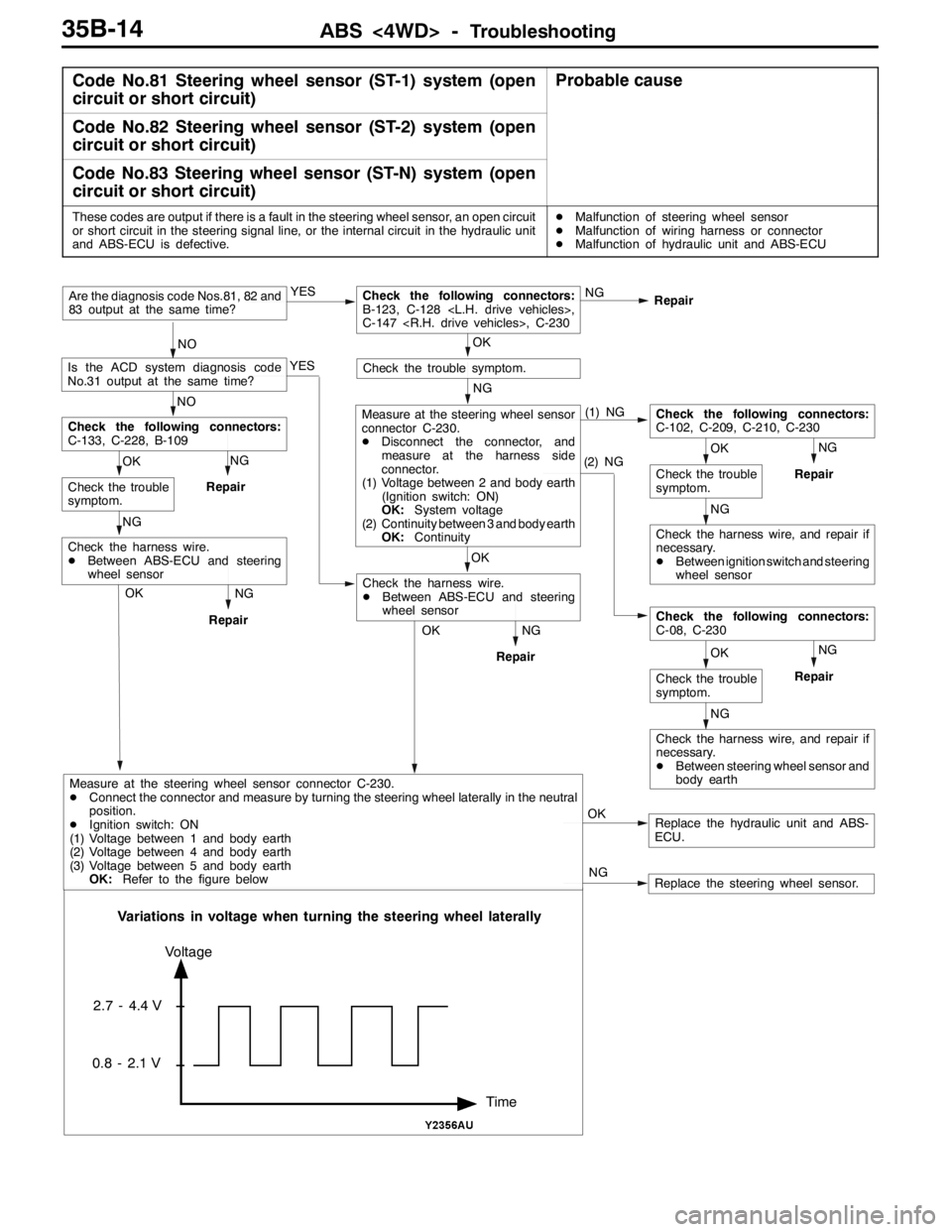
Code No.81 Steering wheel sensor (ST-1) system (open
circuit or short circuit)Probable cause
Code No.82 Steering wheel sensor (ST-2) system (open
circuit or short circuit)
Code No.83 Steering wheel sensor (ST-N) system (open
circuit or short circuit)
These codes are output if there is a fault in the steering wheel sensor, an open circuit
or short circuit in the steering signal line, or the internal circuit in the hydraulic unit
and ABS-ECU is defective.DMalfunction of steering wheel sensor
DMalfunction of wiring harness or connector
DMalfunction of hydraulic unit and ABS-ECU
NG
Repair
Replace the hydraulic unit and ABS-
ECU. OK NG YES
Repair
NOAre the diagnosis code Nos.81, 82 and
83 output at the same time?
OKCheck the following connectors:
B-123, C-128
C-147
YES
NO
Is the ACD system diagnosis code
No.31 output at the same time?
NG
Check the trouble symptom.
(1) NG
(2) NGNG
Repair
NG
OK
Check the trouble
symptom.
Check the following connectors:
C-102, C-209, C-210, C-230
Check the harness wire, and repair if
necessary.
DBetween ignition switch and steering
wheel sensor
NG
OK
Check the trouble
symptom.
Check the following connectors:
C-08, C-230
Check the harness wire, and repair if
necessary.
DBetween steering wheel sensor and
body earth
OK
Measure at the steering wheel sensor
connector C-230.
DDisconnect the connector, and
measure at the harness side
connector.
(1) Voltage between 2 and body earth
(Ignition switch: ON)
OK:System voltage
(2) Continuity between 3 and body earth
OK:Continuity
NG
RepairOK
Check the harness wire.
DBetween ABS-ECU and steering
wheel sensor NG
Repair
NG OK
Check the trouble
symptom.
Check the following connectors:
C-133, C-228, B-109
NG
Repair
Check the harness wire.
DBetween ABS-ECU and steering
wheel sensor
OK
Replace the steering wheel sensor. NG
Time Voltage
2.7 - 4.4 V
0.8 - 2.1 V
Variations in voltage when turning the steering wheel laterally
Measure at the steering wheel sensor connector C-230.
DConnect the connector and measure by turning the steering wheel laterally in the neutral
position.
DIgnition switch: ON
(1) Voltage between 1 and body earth
(2) Voltage between 4 and body earth
(3) Voltage between 5 and body earth
OK:Refer to the figure below
Page 1086 of 1449
ABS <4WD> -Troubleshooting35B-16
INSPECTION PROCEDURE FOR TROUBLE SYMPTOMS
Inspection Procedure 1
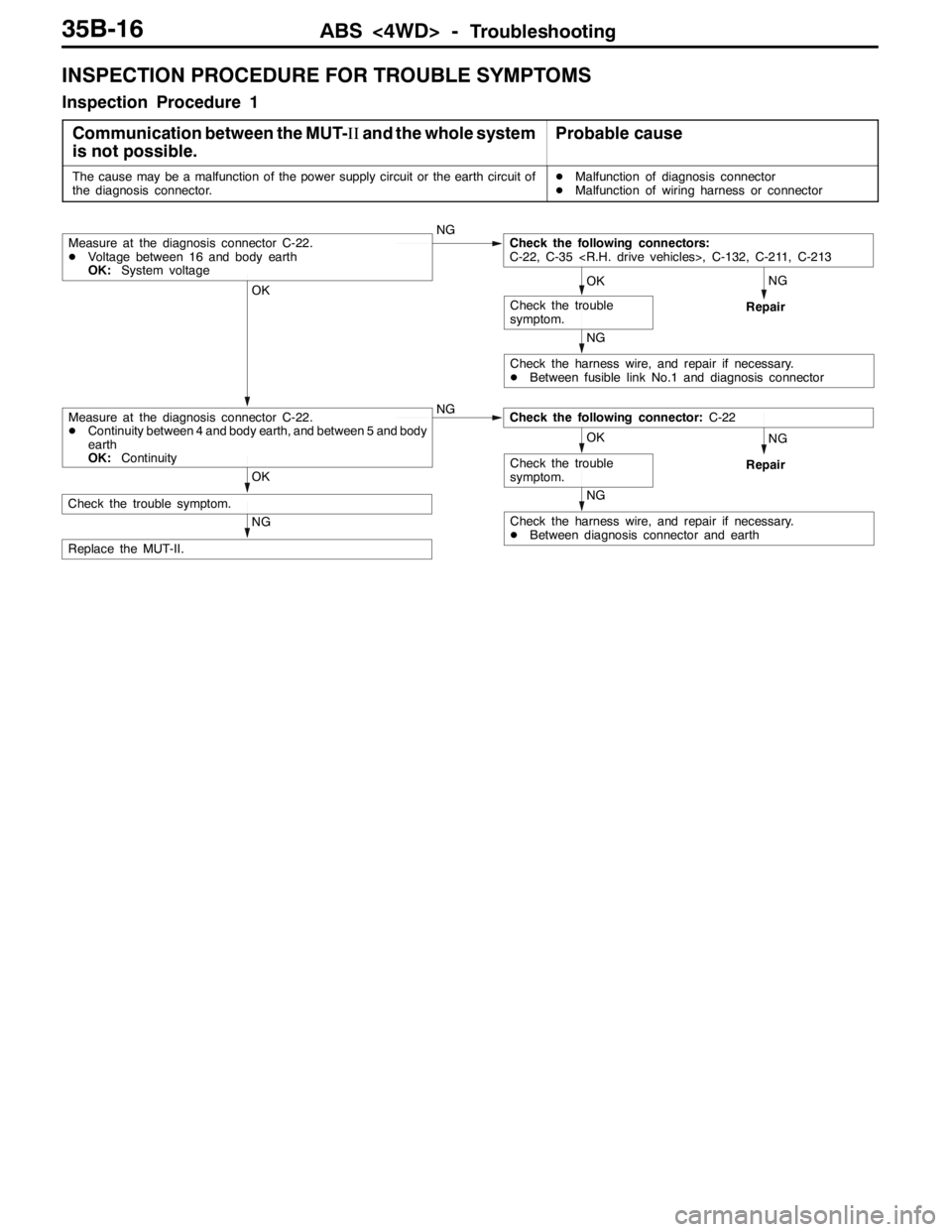
Communication between the MUT-IIand the whole system
is not possible.
Probable cause
The cause may be a malfunction of the power supply circuit or the earth circuit of
the diagnosis connector.DMalfunction of diagnosis connector
DMalfunction of wiring harness or connector
NG
Repair
NG
Check the harness wire, and repair if necessary.
DBetween fusible link No.1 and diagnosis connectorOK
Check the trouble
symptom.
NG
Replace the MUT-II.
NG
Repair
NG
Check the harness wire, and repair if necessary.
DBetween diagnosis connector and earth
OK
Check the trouble
symptom.OK
Check the trouble symptom.
Measure at the diagnosis connector C-22.
DContinuity between 4 and body earth, and between 5 and body
earth
OK:ContinuityNGCheck the following connector:C-22
OK
Measure at the diagnosis connector C-22.
DVoltage between 16 and body earth
OK:System voltageNGCheck the following connectors:
C-22, C-35
Page 1087 of 1449
ABS <4WD> -Troubleshooting35B-17
Inspection Procedure 2
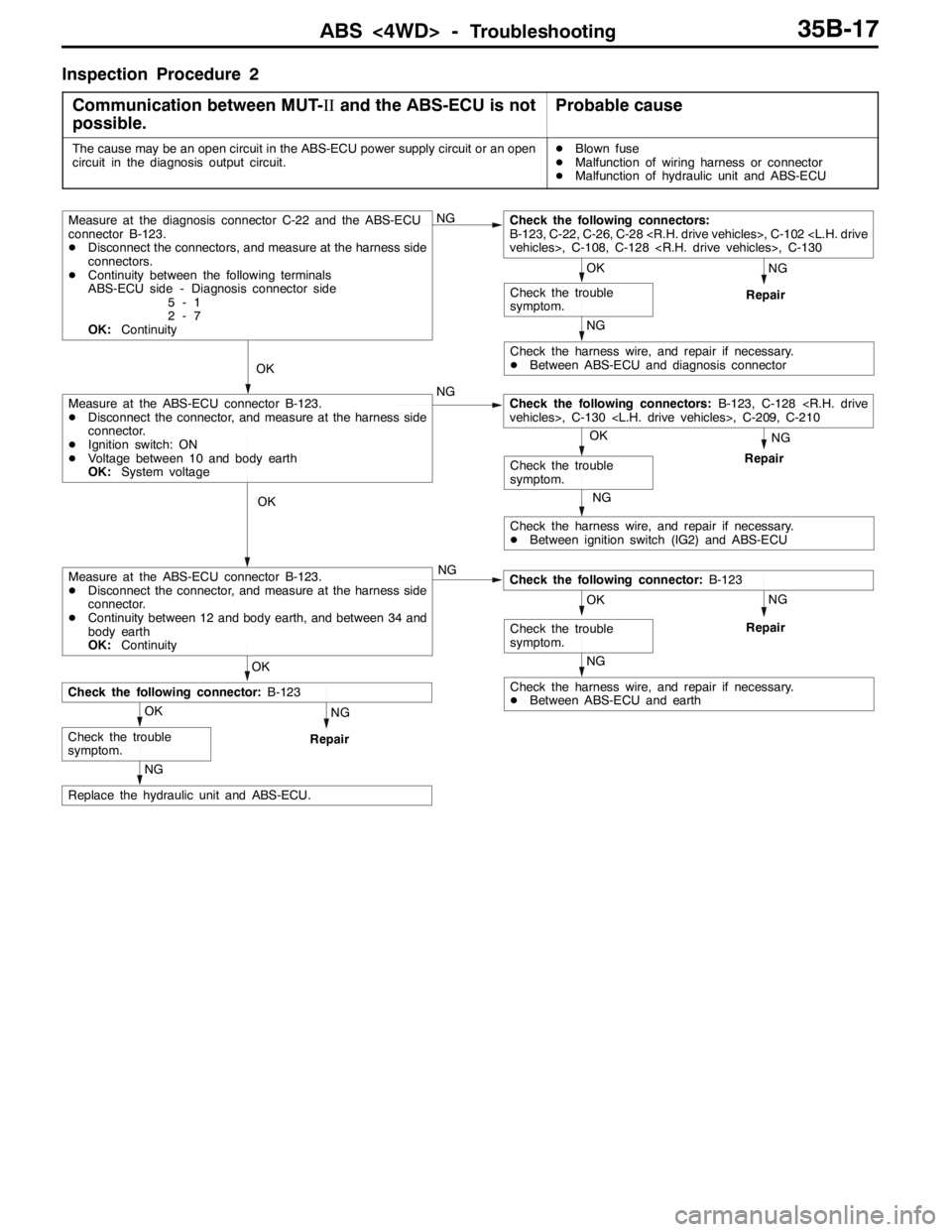
Communication between MUT-IIand the ABS-ECU is not
possible.
Probable cause
The cause may be an open circuit in the ABS-ECU power supply circuit or an open
circuit in the diagnosis output circuit.DBlown fuse
DMalfunction of wiring harness or connector
DMalfunction of hydraulic unit and ABS-ECU
NG OK
NG
NG NG
Repair
Check the harness wire, and repair if necessary.
DBetween ABS-ECU and diagnosis connector
OK
NG
Repair
NG
Check the harness wire, and repair if necessary.
DBetween ignition switch (IG2) and ABS-ECU
OK
NG
Repair
NG
Check the harness wire, and repair if necessary.
DBetween ABS-ECU and earth
NG
Repair
NG
Replace the hydraulic unit and ABS-ECU.
OK
Check the trouble
symptom.
OK
Check the trouble
symptom.
OK
Check the following connector:B-123
Measure at the ABS-ECU connector B-123.
DDisconnect the connector, and measure at the harness side
connector.
DContinuity between 12 and body earth, and between 34 and
body earth
OK:ContinuityCheck the following connector:B-123
OK
Check the trouble
symptom.
Measure at the ABS-ECU connector B-123.
DDisconnect the connector, and measure at the harness side
connector.
DIgnition switch: ON
DVoltage between 10 and body earth
OK:System voltageCheck the following connectors:B-123, C-128
Check the trouble
symptom.
Measure at the diagnosis connector C-22 and the ABS-ECU
connector B-123.
DDisconnect the connectors, and measure at the harness side
connectors.
DContinuity between the following terminals
ABS-ECU side - Diagnosis connector side
5-1
2-7
OK:ContinuityNGCheck the following connectors:
B-123, C-22, C-26, C-28
Page 1088 of 1449
ABS <4WD> -Troubleshooting35B-18
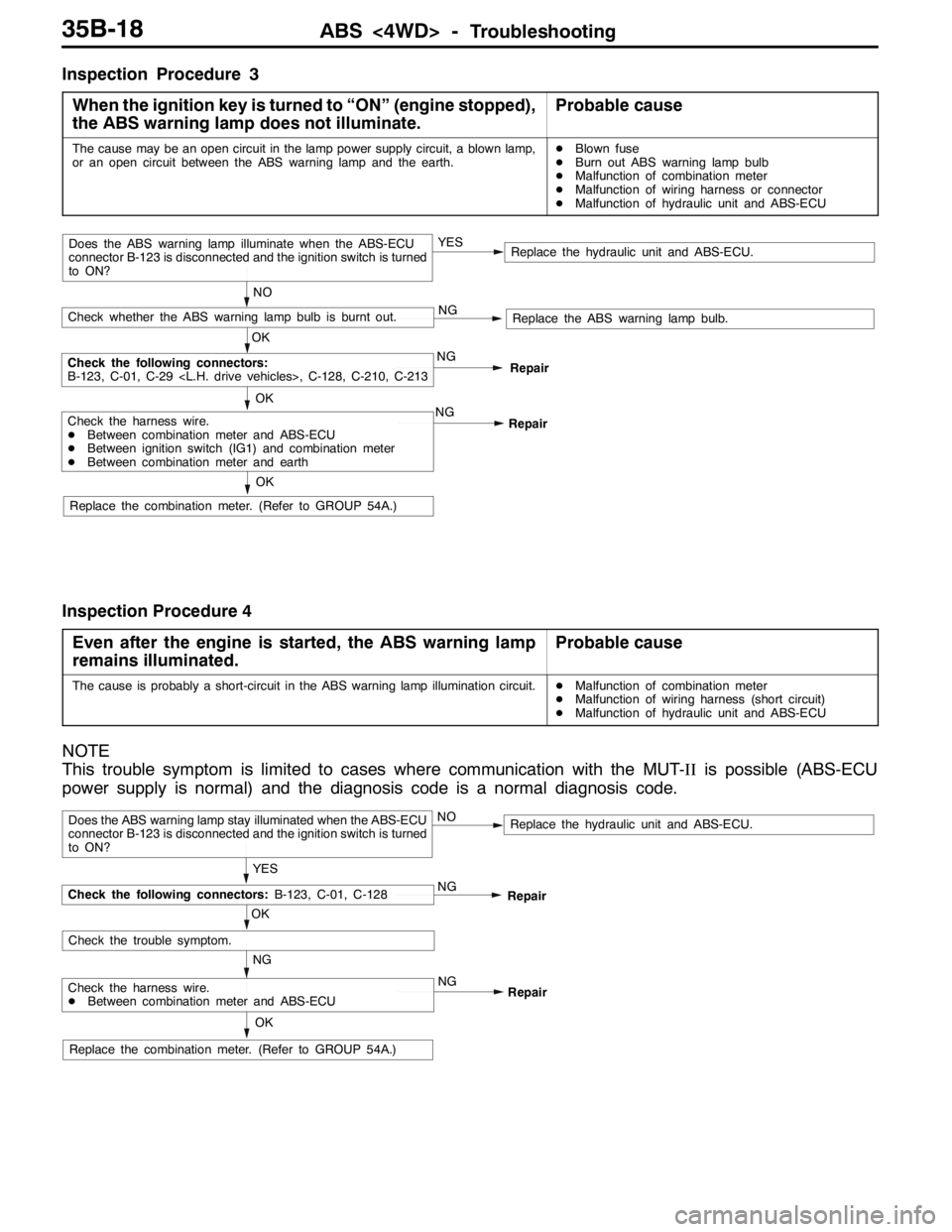
Inspection Procedure 3
When the ignition key is turned to “ON” (engine stopped),
the ABS warning lamp does not illuminate.
Probable cause
The cause may be an open circuit in the lamp power supply circuit, a blown lamp,
or an open circuit between the ABS warning lamp and the earth.DBlown fuse
DBurn out ABS warning lamp bulb
DMalfunction of combination meter
DMalfunction of wiring harness or connector
DMalfunction of hydraulic unit and ABS-ECU
NO
NG
Replace the ABS warning lamp bulb.
Check the harness wire.
DBetween combination meter and ABS-ECU
DBetween ignition switch (IG1) and combination meter
DBetween combination meter and earth
Replace the hydraulic unit and ABS-ECU.
OKNG
OK
Check the following connectors:
B-123, C-01, C-29
OK
Check whether the ABS warning lamp bulb is burnt out.
Does the ABS warning lamp illuminate when the ABS-ECU
connector B-123 is disconnected and the ignition switch is turned
to ON?YES
Repair
Replace the combination meter. (Refer to GROUP 54A.)NG
Repair
Inspection Procedure 4
Even after the engine is started, the ABS warning lamp
remains illuminated.
Probable cause
The cause is probably a short-circuit in the ABS warning lamp illumination circuit.DMalfunction of combination meter
DMalfunction of wiring harness (short circuit)
DMalfunction of hydraulic unit and ABS-ECU
NOTE
This trouble symptom is limited to cases where communication with the MUT-IIis possible (ABS-ECU
power supply is normal) and the diagnosis code is a normal diagnosis code.
YES
NG
Check the harness wire.
DBetween combination meter and ABS-ECU
Replace the hydraulic unit and ABS-ECU.
OK
NG
OK
Check the trouble symptom.
Does the ABS warning lamp stay illuminated when the ABS-ECU
connector B-123 is disconnected and the ignition switch is turned
to ON?NO
Repair
Replace the combination meter. (Refer to GROUP 54A.)NG
Repair
Check the following connectors:B-123, C-01, C-128
Page 1089 of 1449
ABS <4WD> -Troubleshooting35B-19
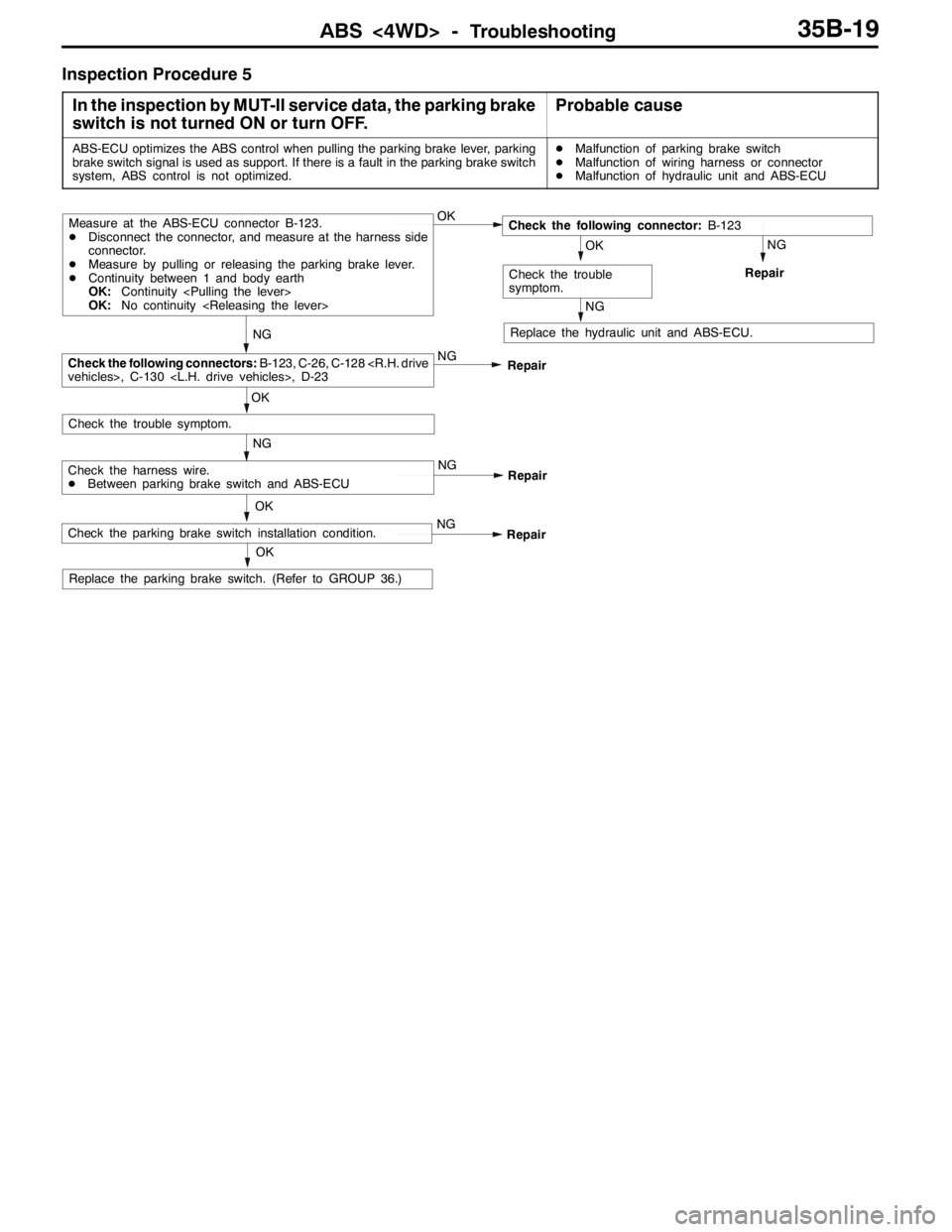
Inspection Procedure 5
In the inspection by MUT-II service data, the parking brake
switch is not turned ON or turn OFF.
Probable cause
ABS-ECU optimizes the ABS control when pulling the parking brake lever, parking
brake switch signal is used as support. If there is a fault in the parking brake switch
system, ABS control is not optimized.DMalfunction of parking brake switch
DMalfunction of wiring harness or connector
DMalfunction of hydraulic unit and ABS-ECU
OK
NG
NG
Check the harness wire.
DBetween parking brake switch and ABS-ECU
Replace the hydraulic unit and ABS-ECU.
OK
NG
OK
Check the trouble symptom.
Repair
NG
RepairCheck the following connectors:B-123, C-26, C-128
Measure at the ABS-ECU connector B-123.
DDisconnect the connector, and measure at the harness side
connector.
DMeasure by pulling or releasing the parking brake lever.
DContinuity between 1 and body earth
OK:Continuity
OK:No continuity
NG
Repair
NG
OK
Check the trouble
symptom.
Check the following connector:B-123
OK
Replace the parking brake switch. (Refer to GROUP 36.)
NG
RepairCheck the parking brake switch installation condition.
Page 1091 of 1449
ABS <4WD> -Troubleshooting35B-21
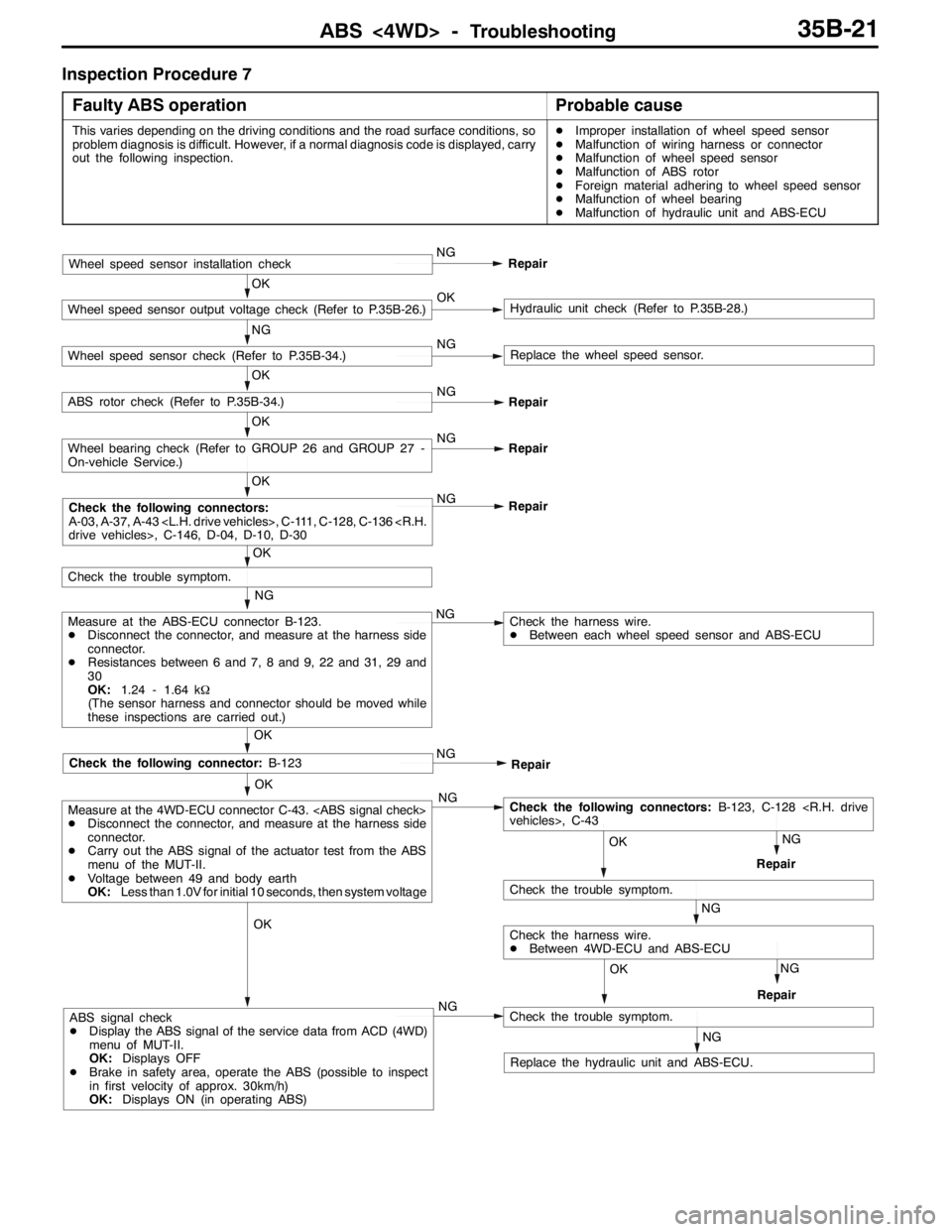
Inspection Procedure 7
Faulty ABS operation
Probable cause
This varies depending on the driving conditions and the road surface conditions, so
problem diagnosis is difficult. However, if a normal diagnosis code is displayed, carry
out the following inspection.DImproper installation of wheel speed sensor
DMalfunction of wiring harness or connector
DMalfunction of wheel speed sensor
DMalfunction of ABS rotor
DForeign material adhering to wheel speed sensor
DMalfunction of wheel bearing
DMalfunction of hydraulic unit and ABS-ECU
OK
OK
Check the following connector:B-123
NG
Measure at the ABS-ECU connector B-123.
DDisconnect the connector, and measure at the harness side
connector.
DResistances between 6 and 7, 8 and 9, 22 and 31, 29 and
30
OK:1.24 - 1.64 kΩ
(The sensor harness and connector should be moved while
these inspections are carried out.)NG
OK
Check the trouble symptom.
OK
NG
Repair
OK
Wheel bearing check (Refer to GROUP 26 and GROUP 27 -
On-vehicle Service.)NG
Repair
OK
ABS rotor check (Refer to P.35B-34.)NG
Repair
NG
Wheel speed sensor check (Refer to P.35B-34.)NGReplace the wheel speed sensor.
OK
Wheel speed sensor output voltage check (Refer to P.35B-26.)OKHydraulic unit check (Refer to P.35B-28.)
Wheel speed sensor installation checkNG
Repair
Check the harness wire.
DBetween each wheel speed sensor and ABS-ECU
NG
Repair
NG
NG
RepairOK
Check the following connectors:B-123, C-128
NG
Check the trouble symptom.
RepairNG
OK
Check the harness wire.
DBetween 4WD-ECU and ABS-ECU OK
Measure at the 4WD-ECU connector C-43.
DDisconnect the connector, and measure at the harness side
connector.
DCarry out the ABS signal of the actuator test from the ABS
menu of the MUT-II.
DVoltage between 49 and body earth
OK:Less than 1.0V for initial 10 seconds, then system voltage
NGABS signal check
DDisplay the ABS signal of the service data from ACD (4WD)
menu of MUT-II.
OK:Displays OFF
DBrake in safety area, operate the ABS (possible to inspect
in first velocity of approx. 30km/h)
OK:Displays ON (in operating ABS)
NG
Check the trouble symptom.
Replace the hydraulic unit and ABS-ECU.
Check the following connectors:
A-03, A-37, A-43
Page 1115 of 1449

37A-1
STEERING
CONTENTS
GENERAL INFORMATION 2..................
SERVICE SPECIFICATIONS 4.................
LUBRICANTS 4..............................
SEALANT 4..................................
SPECIAL TOOLS 4...........................
ON-VEHICLE SERVICE 7.....................
Steering Wheel Free Play Check 7..............
Steering Angle Check 7........................
Tie Rod End Ball Joint Turning Torque Check 7..
Stationary Steering Effort Check 8...............
Checking Steering Wheel Return to Centre 8.....
Drive Belt Tension Check 8.....................Power Steering Fluid Level Check 9.............
Power Steering Fluid Replacement 9.............
Power Steering System Bleeding 9..............
Oil Pump Pressure Test 10.....................
Power Steering Oil Pressure Switch Check 11....
Ball Joint Dust Cover Check 11.................
STEERING WHEEL* 12.......................
STEERING SHAFT* 14.......................
POWER STEERING GEAR BOX AND
LINKAGE* 16................................
POWER STEERING OIL PUMP 29............
POWER STEERING OIL HOSES 30...........
WARNINGS REGARDING SERVICING OF SUPPLEMENTAL RESTRAINT SYSTEM (SRS) EQUIPPED VEHICLES
WARNING!
(1) Improper service or maintenance of any component of the SRS, or any SRS-related component, can lead to personal
injury or death to service personnel (from inadvertent firing of the air bag) or to the driver and passenger (from rendering
the SRS inoperative).
(2) Service or maintenance of any SRS component or SRS-related component must be performed only at an authorized
MITSUBISHI dealer.
(3) MITSUBISHI dealer personnel must thoroughly review this manual, and especially its GROUP 52B - Supplemental
Restraint System (SRS) before beginning any service or maintenance of any component of the SRS or any SRS-related
component.
NOTE
The SRS includes the following components: SRS-ECU, SRS warning lamp, air bag module, clock spring and interconnecting
wiring. Other SRS-related components (that may have to be removed/installed in connection with SRS service or maintenance) are
indicated in the table of contents by an asterisk (*).
Page 1168 of 1449
BODY -DoorsBODY -Doors42-20
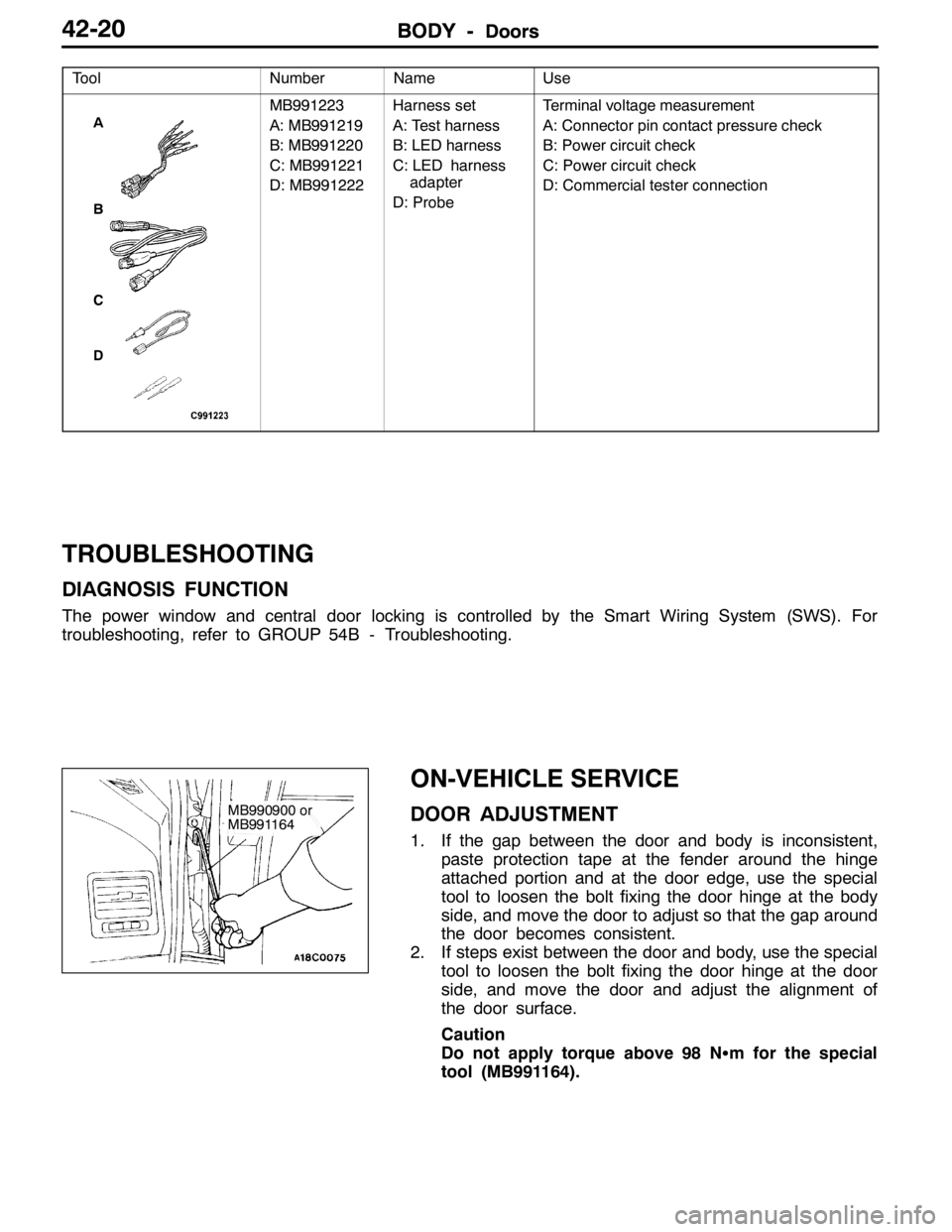
Tool UseName Number
A
B
C
D
MB991223
A: MB991219
B: MB991220
C: MB991221
D: MB991222Harness set
A: Test harness
B: LED harness
C: LED harness
adapter
D: ProbeTerminal voltage measurement
A: Connector pin contact pressure check
B: Power circuit check
C: Power circuit check
D: Commercial tester connection
TROUBLESHOOTING
DIAGNOSIS FUNCTION
The power window and central door locking is controlled by the Smart Wiring System (SWS). For
troubleshooting, refer to GROUP 54B - Troubleshooting.
ON-VEHICLE SERVICE
DOOR ADJUSTMENT
1. If the gap between the door and body is inconsistent,
paste protection tape at the fender around the hinge
attached portion and at the door edge, use the special
tool to loosen the bolt fixing the door hinge at the body
side, and move the door to adjust so that the gap around
the door becomes consistent.
2. If steps exist between the door and body, use the special
tool to loosen the bolt fixing the door hinge at the door
side, and move the door and adjust the alignment of
the door surface.
Caution
Do not apply torque above 98 NSm for the special
tool (MB991164).
MB990900 or
MB991164
Page 1205 of 1449

EXTERIOR -Windshield Wiper and Washer51-13
WINDSHIELD WIPER AND WASHER
SERVICE SPECIFICATIONS
ItemStandard value
Stopposition of the windshield wiper arm/blade assembly(distance between the edgeof34±5Stoppositionofthewindshieldwiperarm/bladeassembly(distancebetweentheedgeof
the wiper blade and the end of the deck garnish) mm
34±5
TROUBLESHOOTING
The windshield wiper-washer is controlled by the smart wiring system (SWS). Refer to Group 54B for
troubleshooting.
NOTE
If ETACS-ECU is faulty, the windshield wiper can be operable in LO mode only as the fail - safe function.
(Normally the windshield wiper is operable when the ignition switch is turned to the ACC position. When
the fail - safe function is enabled, it is operable only when the ignition switch is turned to the ON position.)
ON-VEHICLE SERVICE
WINDSHIELD INTERMITTENT WIPER
INSPECTIONS
(1) Check the change in the intermittent time of the wiper
operation by using the windshield intermittent wiper
volume.
(2) Carry out troubleshooting if any of them is faulty.
(Refer to Group 54B.)