battery MITSUBISHI LANCER EVOLUTION 2007 Service User Guide
[x] Cancel search | Manufacturer: MITSUBISHI, Model Year: 2007, Model line: LANCER EVOLUTION, Model: MITSUBISHI LANCER EVOLUTION 2007Pages: 1449, PDF Size: 56.82 MB
Page 358 of 1449

INDEX - In order of connector No.C-2
Wiring diagram
page Circuit diagram page Parts name Connector
No.
AA-45Condenser fan motorB-177,183B-7,9
A-46Condenser fan motorB-177,183B-7,9
A-47A/C compressorB-178,184B-7,9
A-48Power steering oil pressure switchB-90,98B-7,9
BB-01Windshield wiper motorB-186,190B-10,14
B-02Throttle position sensorB-89,97,215,223,231,241B-10,14
B-03Vehicle speed sensorB-92,100,150,154,197B-10,14
B-04Brake fluid level switchB-157B-10,14
B-05XEngine speed detection connectorB-73,82,83,90,98B-10,14
B-06XNo connectionB-73B-10,14
B-07XNo connectionB-73B-10,14
B-08XNo connectionB-73B-10,14
B-09XIgnition coil relay
connection
B-10XNo connectionB-73B-10,14
B-11XEngine control relayB-73,86,94,252,254B-10,14
B-12XA/C compressor relayB-73,178,184B-10,14
B-14Control wiring harness and battery
wiring harness combinationB-79,84,91,99,157B-10,14
B-18StarterB-79B-11,15
B-19StarterB-79B-11,15
B-20Oil pressure switchB-157B-11,15
B-21AlternatorB-84B-11,15
B-22AlternatorB-84B-11,15
B-23Purge control solenoid valveB-91,99B-11,15
B-24Injector 4B-89,97B-11,15
B-25Injector 3B-89,97B-11,15
B-26Injector 2B-89,97B-11,15
B-27Injector 1B-89,97B-11,15
B-31Air flow sensorB-90,98B-11,15
B-34Oxygen sensorB-88,96B-11,15
B-36Waste gate solenoid valveB-91,99B-11,15
B-37Fuel pressure solenoid valveB-90,98B-11,15
Page 368 of 1449

INDEX - In order of parts nameC-12
Wiring diagram
page Circuit diagram page Connector
No. Parts name
CColumn switchC-203B-104,107,112,116,125,128,137,141,
187,191B-22,28
Combination meterC-01B-84,87,95,103,106,118,122,126,129,
135,139,148,149,152,153,156,157,
198,206,214,222,230,240,248,250,
256, 258B-18,24
Combination meterC-02B-110,115,118,122,126,129,135,139,
148,149,152,153,156,157,198,206,
248, 250,256,258B-18,24
Condenser fan motorA-45B-177,183B-7,9
Condenser fan motorA-46B-177,183B-7,9
Condenser fan relay (HI)A-07XB-73,177,183B-6,8
Condenser fan relay (LO)A-06XB-73,177,183B-6,8
Control wiring harness and battery
wiring harness combinationB-14B-79,84,91,99,157B-10,14
Control wiring harness and floor wiring
harness (LH) combination
Crank angle sensorB-121B-88,96B-13,16
DDefogger (-)F-06B-185B-38,39
Defogger (+)F-19B-185B-38,39
Defogger relayC-214B-54,55,78,185B-23,29
Detonation sensorB-122B-89,97B-13,17
Diagnosis connectorC-22B-92,100,105,108,113,117,119,123,
125,128,137,141,150,154,158,164,
170,172,188,189,204,205,219,227,
237,247,248,250,252,254B-18,24
Diagnosis connectorC-23B-92,100B-18,24
Direction valve (LH)
Direction valve (RH)
Door lock actuator (Front:LH)E-08B-170,173B-34,36
Door lock actuator (Front:RH)E-18B-171,172B-35,37
Door lock actuator (Rear:LH)E-12B-171,173B-34,36
Door lock actuator (Rear:RH)E-23B-171,173B-35,37
Door lock key cylinder switch (LH)E-17B-172B-37
Door lock key cylinder switch (RH)E-16B-170B-35
Door switch (Front:LH)D-13B-105,112,120,121,158B-30,32
Door switch (Front:RH)D-01B-108,116,120,121,164B-30,32
Page 383 of 1449
GENERAL -How to Use This Manual00-5
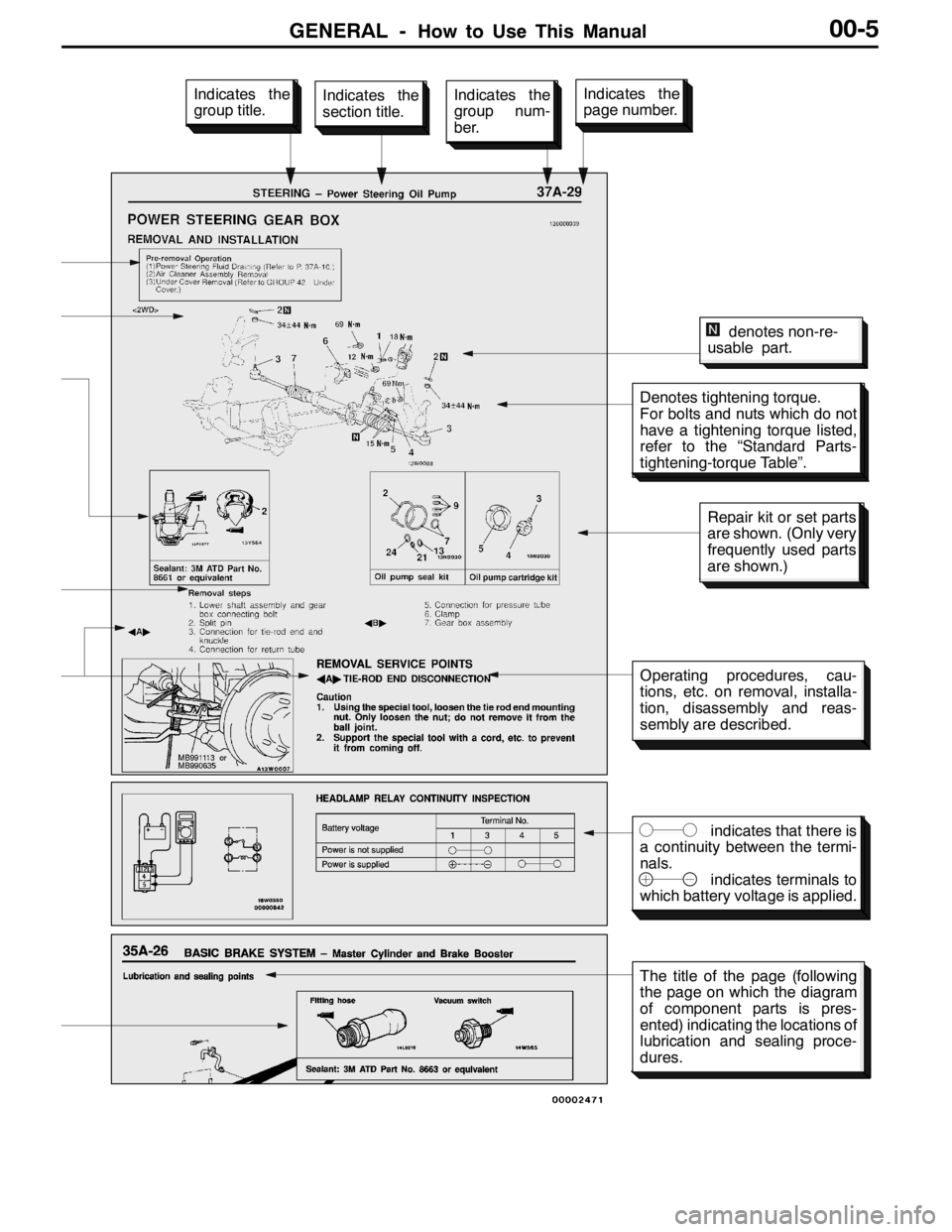
Denotes tightening torque.
For bolts and nuts which do not
have a tightening torque listed,
refer to the “Standard Parts-
tightening-torque Table”.
indicates that there is
a continuity between the termi-
nals.
indicates terminals to
which battery voltage is applied.
Indicates the
section title.Indicates the
group num-
ber.Indicates the
page number.Indicates the
group title.
denotes non-re-
usable part.
Repair kit or set parts
are shown. (Only very
frequently used parts
are shown.)
Operating procedures, cau-
tions, etc. on removal, installa-
tion, disassembly and reas-
sembly are described.
The title of the page (following
the page on which the diagram
of component parts is pres-
ented) indicating the locations of
lubrication and sealing proce-
dures.
Page 386 of 1449
GENERAL -How to Use Troubleshooting/Inspection Service Points00-8
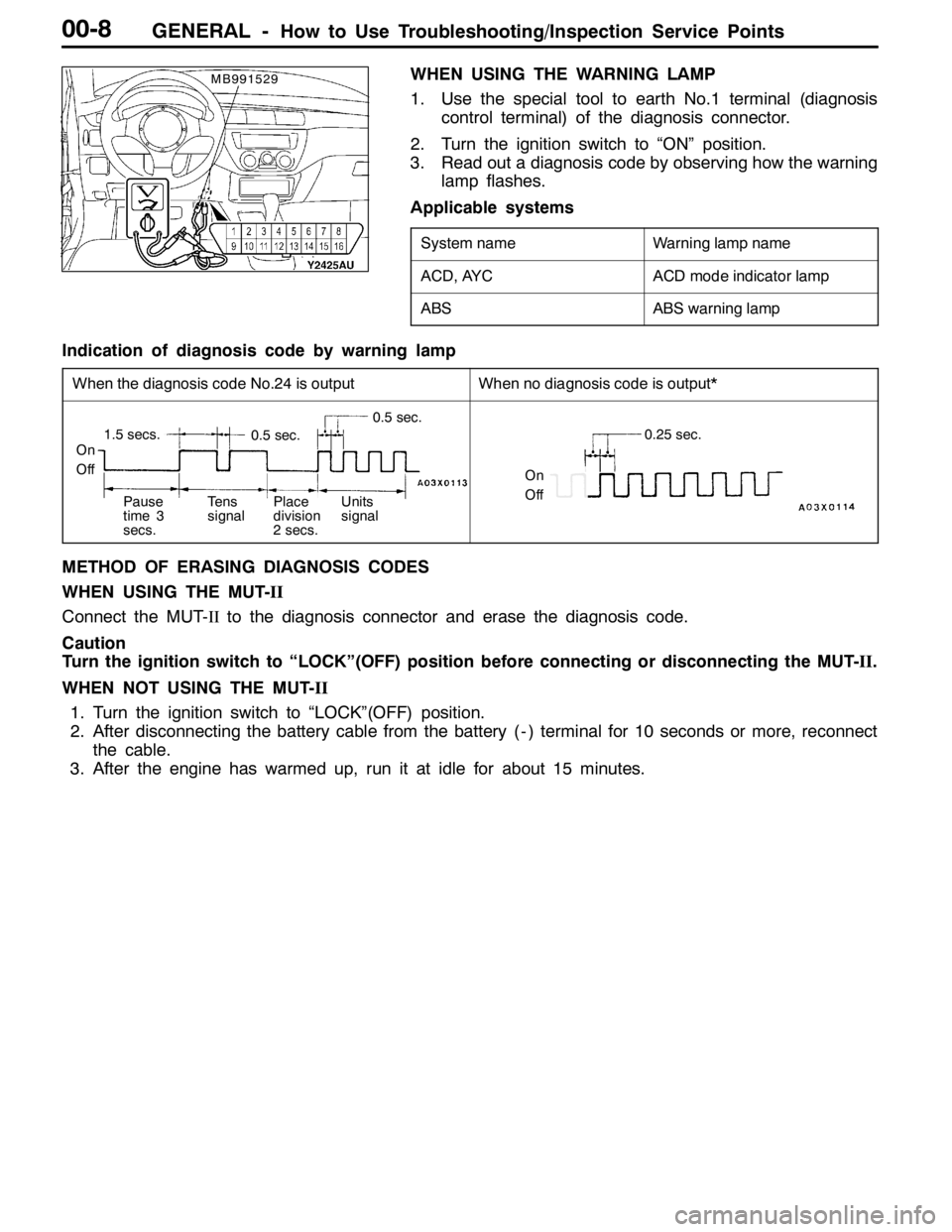
WHEN USING THE WARNING LAMP
1. Use the special tool to earth No.1 terminal (diagnosis
control terminal) of the diagnosis connector.
2. Turn the ignition switch to “ON” position.
3. Read out a diagnosis code by observing how the warning
lamp flashes.
Applicable systems
System nameWarning lamp name
ACD, AYCACD mode indicator lamp
ABSABS warning lamp
Indication of diagnosis code by warning lamp
When the diagnosis code No.24 is outputWhen no diagnosis code is output*
On
Off
1.5 secs.0.5 sec.
0.5 sec.
Pause
time 3
secs.Tens
signalPlace
division
2 secs.Units
signal
On
Off
0.25 sec.
METHOD OF ERASING DIAGNOSIS CODES
WHEN USING THE MUT-II
Connect the MUT-IIto the diagnosis connector and erase the diagnosis code.
Caution
Turn the ignition switch to “LOCK”(OFF) position before connecting or disconnecting the MUT-II.
WHEN NOT USING THE MUT-II
1. Turn the ignition switch to “LOCK”(OFF) position.
2. After disconnecting the battery cable from the battery ( - ) terminal for 10 seconds or more, reconnect
the cable.
3. After the engine has warmed up, run it at idle for about 15 minutes.
MB991529
Page 391 of 1449
GENERAL -How to Use Troubleshooting/Inspection Service Points00-13
INSPECTION SERVICE POINTS FOR A BLOWN
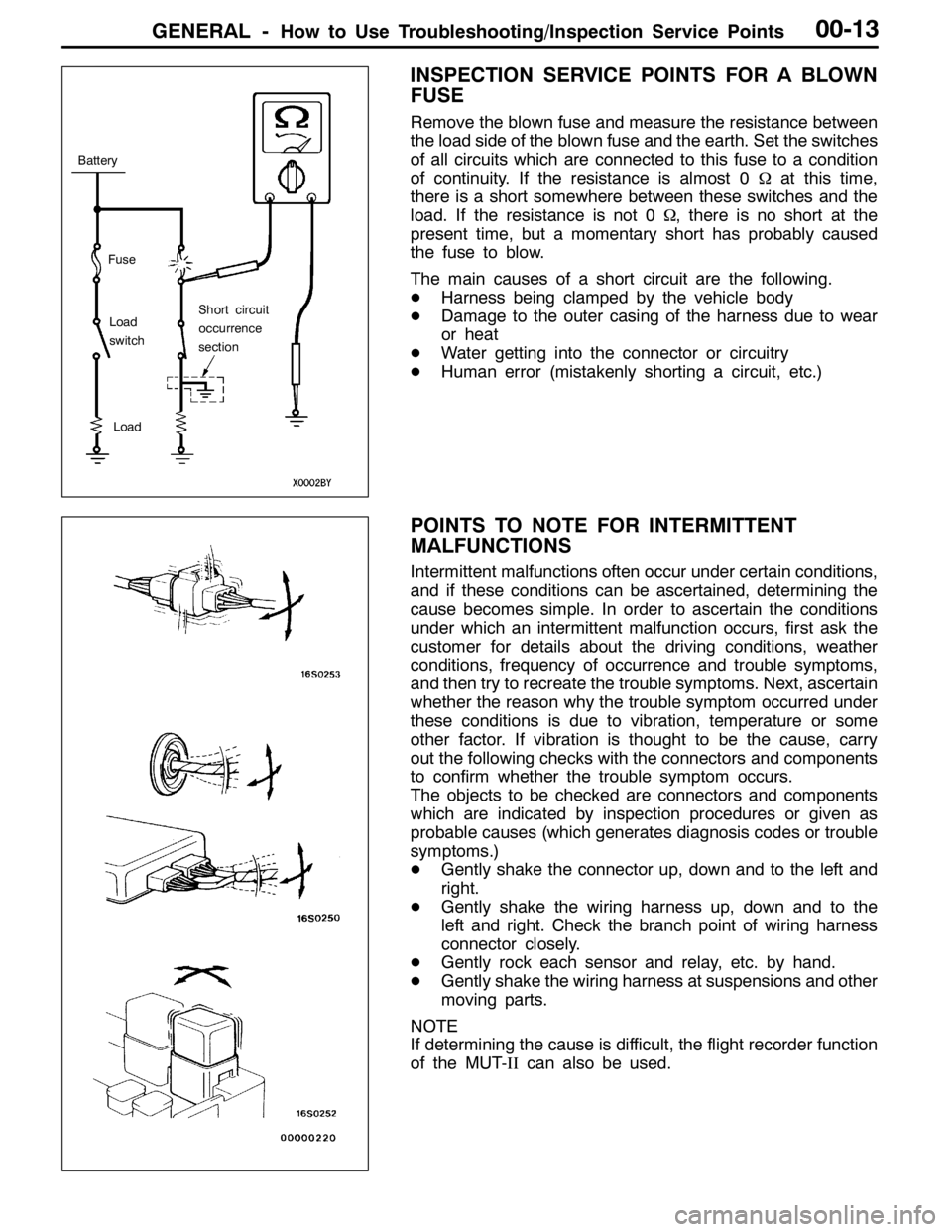
FUSE
Remove the blown fuse and measure the resistance between
the load side of the blown fuse and the earth. Set the switches
of all circuits which are connected to this fuse to a condition
of continuity. If the resistance is almost 0Ωat this time,
there is a short somewhere between these switches and the
load. If the resistance is not 0Ω, there is no short at the
present time, but a momentary short has probably caused
the fuse to blow.
The main causes of a short circuit are the following.
DHarness being clamped by the vehicle body
DDamage to the outer casing of the harness due to wear
or heat
DWater getting into the connector or circuitry
DHuman error (mistakenly shorting a circuit, etc.)
POINTS TO NOTE FOR INTERMITTENT
MALFUNCTIONS
Intermittent malfunctions often occur under certain conditions,
and if these conditions can be ascertained, determining the
cause becomes simple. In order to ascertain the conditions
under which an intermittent malfunction occurs, first ask the
customer for details about the driving conditions, weather
conditions, frequency of occurrence and trouble symptoms,
and then try to recreate the trouble symptoms. Next, ascertain
whether the reason why the trouble symptom occurred under
these conditions is due to vibration, temperature or some
other factor. If vibration is thought to be the cause, carry
out the following checks with the connectors and components
to confirm whether the trouble symptom occurs.
The objects to be checked are connectors and components
which are indicated by inspection procedures or given as
probable causes (which generates diagnosis codes or trouble
symptoms.)
DGently shake the connector up, down and to the left and
right.
DGently shake the wiring harness up, down and to the
left and right. Check the branch point of wiring harness
connector closely.
DGently rock each sensor and relay, etc. by hand.
DGently shake the wiring harness at suspensions and other
moving parts.
NOTE
If determining the cause is difficult, the flight recorder function
of the MUT-IIcan also be used.
Fuse
Battery
Load
switch
Load
Short circuit
occurrence
section
Page 396 of 1449

GENERAL -Precautions Before Service00-18
PRECAUTIONS BEFORE SERVICE
SUPPLEMENTAL RESTRAINT SYSTEM (SRS)
1. Items to follow when servicing SRS
(1) Be sure to read GROUP 52B - Supplemental Restraint System (SRS).
For safe operations, please follow the directions and heed all warnings.
(2) Wait at least 60 seconds after disconnecting the battery cable before doing any further work.
The SRS system is designed to retain enough voltage to deploy the air bag even after the battery
has been disconnected. Serious injury may result from unintended air bag deployment if work
is done on the SRS system immediately after the battery cable is disconnected.
(3) Warning labels must be heeded when servicing or handling SRS components. Warning labels
are located in the following locations.
DSun visor
DGlove box
DSRS-ECU
DSteering wheel
DSteering Joint Cover
DAir bag module (driver’s side and front passenger’s side)
DClock spring
DSeat belt with pre-tensioner
(4) Always use the designated special tools and test equipment.
(5) Store components removed from the SRS in a clean and dry place.
The air bag module should be stored on a flat surface and placed so that the pad surface is
facing upward.
Do not place anything on top of it.
(6) Never attempt to disassemble or repair the SRS components (SRS-ECU, air bag module, clock
spring and seat belt with pre-tensioner).
(7) Whenever you finish servicing the SRS, check the SRS warning lamp operation to make sure
that the system functions properly.
(8) Be sure to deploy the air bag before disposing of the air bag module or disposing of a vehicle
equipped with an air bag. (Refer to GROUP 52B - Air Bag Module Disposal Procedures.)
2. Observe the following when carrying out operations on places where SRS components are installed,
including operations not directly related to the SRS air bag.
(1) When removing or installing parts do not allow any impact or shock to the SRS components.
(2) SRS components should not be subjected to heat, so remove the SRS components before drying
or baking the vehicle after painting.
DSRS-ECU, air bag module, clock spring: 93_C or more
DSeat belt with pre-tensioner: 90_C or more
After re-installing them, check the SRS warning lamp operation to make sure that the system
functions properly.
Page 397 of 1449

GENERAL -Precautions Before ServiceGENERAL -Precautions Before Service00-19
SERVICING THE ELECTRICAL SYSTEM
Before replacing a component related to the electrical system
and before undertaking any repair procedures involving the
electrical system, be sure to first disconnect the negative
( - ) cable from the battery in order to avoid damage caused
by short-circuiting.
Caution
Before connecting or disconnecting the negative ( - ) cable,
be sure to turn off the ignition switch and the lighting
switch.
(If this is not done, there is the possibility of
semiconductor parts being damaged.)
APPLICATION OF ANTI-CORROSION AGENTS
AND UNDERCOATS
If oil or grease gets onto the oxygen sensor, it will cause
a drop in the performance of the sensor.
Cover the oxygen sensor with a protective cover when applying
anti-corrosion agents and undercoats.
PRE-INSPECTION CONDITION
“Pre-inspection condition” refers to the condition that the
vehicle must be in before proper engine inspection can be
carried out. If you see the words “Set the vehicle to the
pre-inspection condition”. in this manual, it means to set the
vehicle to the following condition.
DEngine coolant temperature: 80 to 90_C
DLamps, electric cooling fan and all accessories: OFF
DM/T: Neutral
DA/T: P range
VEHICLE WASHING
If high-pressure car-washing equipment or steam car-washing
equipment is used to wash the vehicle, be sure to note the
following information in order to avoid damage to plastic
components, etc.
DSpray nozzle distance: Approx. 40 cm or more
DSpray pressure: 3,900 kPa or less
DSpray temperature: 82_C or less
DTime of concentrated spray to one point: within 30 sec.
Approx.
40 cm
Page 400 of 1449

GENERAL -Supplemental Restraint System (SRS)00-22
SRS SERVICE PRECAUTIONS
1. In order to avoid injury to yourself or others
from accidental deployment of the air bag and
accidental operation of the seat belt with
pre-tensioner during servicing, read and
carefully follow all the precautions and
procedures described in this manual.
2. Do not use any electrical test equipment on
or near SRS components, except those
specified on P.52B-6.
3. Never Attempt to Repair the Following
Components:
DSRS air bag control unit (SRS-ECU)
DClock spring
DDriver’s and front passenger’s air bag
modules
DSeat belt with pre-tensionerNOTE
If any of these components are diagnosed as
faulty, they should only be replaced, in
accordance with the INDIVIDUAL COM-
PONENTS SERVICE procedures in this
manual. (Refer to P.52B-49.)
4. After disconnecting the negative (–) battery cable,
wait 60 seconds at least before any service and
insulate the disconnected cable with tape. The SRS
retain enough voltage to deploy the air bags for a
short time even after the disconnection of the battery.
So, serious injury may result by accidental air bag
deployment if a work is done on the SRS just after
the disconnection of the battery.
5. Do not attempt to repair the wiring harness connectors
of the SRS. If the connector(s) are diagnosed as defective,
replace the wiring harness(es). If the harness(es) are
diagnosed as faulty, replace or repair the wiring
harness(es) according to the table that follows.
Insulating tape
Battery
SRS-ECU connector
Page 412 of 1449

ENGINE -Special Tools11A-6
Tool UseName Number
MB991367Special spannerFor retaining the crankshaft sprocket
MB991385Pin
MB991704Battery harnessMeasuring the timing belt B tension
(used together with MUT-II)
MD998767Tensioner pulley
socket wrenchFor adjusting timing belt tension
MD998738Adjusting boltFor retaining the tensioner arm and the
auto-tensioner
MB991453Engine hanger
attachment
setSupporting the engine assembly during
removal and installation of the transmission
GENERAL
SERVICE
TOOL
MZ203827Engine lifter
Page 417 of 1449

ENGINE -On-vehicle ServiceENGINE -On-vehicle ServiceENGINE -On-vehicle Service11A-11
10. Turn the ignition switch to the “LOCK” (OFF) position
and then remove the MUT-II.
COMPRESSION PRESSURE CHECK
1. Before inspection, check that the engine oil, starter and
battery are normal. In addition, set the vehicle to the
pre-inspection condition.
2. Remove the ignition coils and spark plug cables.
3. Remove all of the spark plugs.
4. Disconnect the crank angle sensor connector.
NOTE
Doing this will prevent the engine-ECU from carrying out
ignition and fuel injection.
5. Cover the spark plug hole with a shop towel etc., and
after the engine has been cranked, check that no foreign
material is adhering to the shop towel.
Caution
(1) Keep away from the spark plug hole when
cranking.
(2) If compression is measured with water, oil, fuel,
etc., that has come from cracks inside the cylinder,
these materials will become heated and will gush
out from the spark plug hole, which is dangerous.
6. Set compression gauge to one of the spark plug holes.
7. Crank the engine with the throttle valve fully open and
measure the compression pressure.
Standard value (at engine speed of 250 r/min):
1,128 kPa
Limit (at engine speed of 250 r/min):
Min. 951 kPa
8. Measure the compression pressure for all the cylinders,
and check that the pressure differences of the cylinders are
below the limit.
Limit: Max. 98 kPa
9. If there is a cylinder with compression or a compression
difference that is outside the limit, pour a small amount
of engine oil through the spark plug hole, and repeat
the operations in steps 7 and 8.
(1) If the compression increases after oil is added, the
cause of the malfunction is a worn or damaged piston
ring and/or cylinder inner surface.
(2) If the compression does not rise after oil is added,
the cause is a burnt or defective valve seat, or pressure
is leaking from the gasket.
10. Connect the crank angle sensor connector.
11. Install the spark plugs.
Crank angle sensor
connector