light MITSUBISHI LANCER EVOLUTION 2007 Service User Guide
[x] Cancel search | Manufacturer: MITSUBISHI, Model Year: 2007, Model line: LANCER EVOLUTION, Model: MITSUBISHI LANCER EVOLUTION 2007Pages: 1449, PDF Size: 56.82 MB
Page 210 of 1449

CIRCUIT DIAGRAMS
H1J08X23BA
B-112
TAIL LAMP, POSITION LAMP, LICENCE PLATE LAMP AND LIGHTING MONITOR
BUZZER
Page 212 of 1449

CIRCUIT DIAGRAMS
H1J08X21AA
B-114
TAIL LAMP, POSITION LAMP, LICENCE PLATE LAMP AND
LIGHTING MONITOR BUZZER
R.H. drive vehicles
Page 214 of 1449

CIRCUIT DIAGRAMS
H1J08X21BA
B-116
TAIL LAMP, POSITION LAMP, LICENCE PLATE LAMP AND LIGHTING MONITOR
BUZZER
Page 293 of 1449

CIRCUIT DIAGRAMS
H1J14X13AA
B-195
CIGARETTE LIGHTER AND ASHTRAY ILLUMINATION LAMP
Page 364 of 1449

INDEX - In order of connector No.C-8
Wiring diagram
page Circuit diagram page Parts name Connector
No.
CC-223Fuel pump relay 1B-54,55,87,95B-23,29
C-224Power window relayB-54,55,158,159,165B-23,29
C-225No connectionB-54,55,78B-23,29
C-226ETACS-ECUB-54,55,105,108,112,113,116,117,118,
119,120,121,122,123,125,126,128,
129,134,136,137,138,140,141,158,
164,165, 170,171,172,173,188,189B-23,29
C-227ETACS-ECUB-125,128,170,172B-23,29
C-228ETACS-ECUB-105,108,112,113,116,117,118,119,
122,123,125,126,128,129,136,137,
140,141,158,159,164,165,170,171,
172,173, 188,189,258B-23,29
C-230Steering wheel sensorB-202,210,218,226,236,246B-23,29
DD-01Door switch (Front:RH)B-108,116,120,121,164B-30,32
D-02Floor wiring harness (RH) and rear door
wiring harness (RH) combinationB-160,166,171,173B-30,32
D-03Room lampB-118,122B-30,32
D-04Wheel speed sensor (Rear:RH)
D-05Rear room lampB-118,122B-30,32
D-06Door switch (Rear:RH)B-120,121B-30,32
D-08Door switch (Rear:LH)B-120,121B-30,32
D-09Fuel pump and fuel gauge unit (Main)B-93,101,148,152,156B-30,32
D-10Wheel speed sensor (Rear:LH)
D-12Floor wiring harness (LH) and rear door
wiring harness (LH) combinationB-161,167,171,173B-30,32
D-13Door switch (Front:LH)B-105,112,120,121,158B-30,32
D-15Instrument panel wiring harness and
console wiring harness combinationB-195B-31,32
D-18Cigarette lighterB-195B-31,33
D-19Cigarette lighterB-195B-31,33
D-20Ashtray illumination lampB-195B-31,33
D-21Cigarette lighter illumination lampB-195B-31,33
D-22Oxygen sensor (Rear)B-88,96B-31,33
D-23Parking brake switchB-157,201,209,213,221,232,242B-31,33
D-26Seat belt pretensioner (RH)B-249,251B-31,33
Page 367 of 1449

INDEX - In order of parts nameC-11
INDEX
In order of parts name
Parts nameConnector
No.Circuit diagram pageWiring diagram
page
4WD-ECU
219,220,221,222,223,224,226,227,
228,230,231,232,234,236,237,238,
240,241,242,244, 246,247B-19,25
4WD-ECU
221,224,225,227,228,229,232,234,
235,237,238,239,242,244,245,247B-19,25
AA/C compressorA-47B-178,184B-7,9
A/C compressor relayB-12XB-73,178,184B-10,14
A/C-ECU or heater control unitC-32B-175,181,185B-19,25
ABS-ECUB-123B-198,200,201,202,203,204,205,206,
208,209,210,211,229,232,233,239,
242,243B-13,17
ACD mode changeover switchC-142B-214,222,230,240B-21,27
Air bag module (squib)
Air bag module (squib)
Air flow sensorB-31B-90,98B-11,15
AlternatorB-21B-84B-11,15
AlternatorB-22B-84B-11,15
Ashtray illumination lampD-20B-195B-31,33
BBack-up lamp switchB-108B-142,143B-12,16
Blower motorC-14B-174,180B-18,24
Blower relayC-215B-54,55,174,180B-23,29
Blower switchC-131B-174,180B-21,27
Brake fluid level switchB-04B-157B-10,14
CCamshaft position sensorB-116B-88,96B-12,16
Cigarette lighterD-18B-195B-31,33
Cigarette lighterD-19B-195B-31,33
Cigarette lighter illumination lampD-21B-195B-31,33
ClockC-04B-194B-18,24
Clock spring
Clock spring
Page 391 of 1449
GENERAL -How to Use Troubleshooting/Inspection Service Points00-13
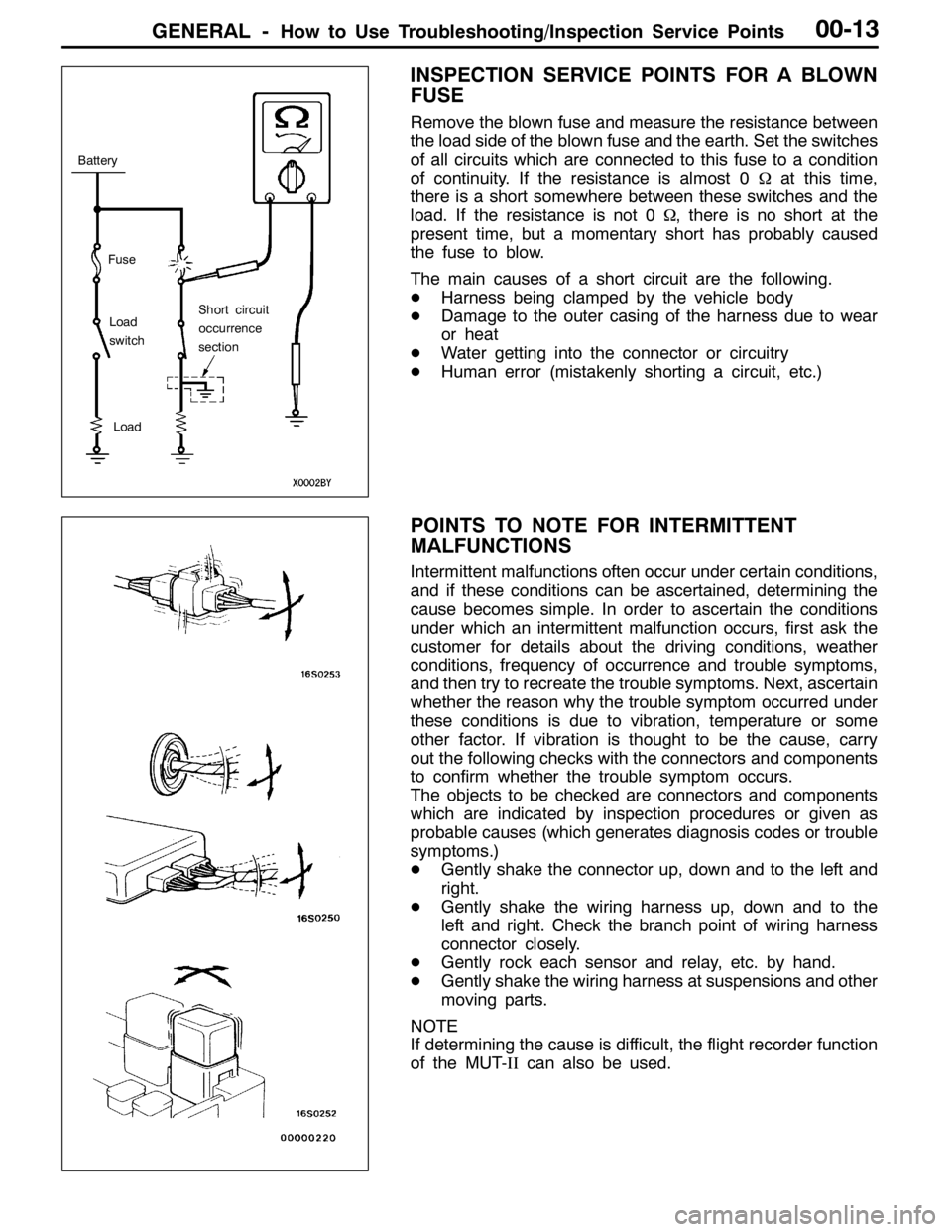
INSPECTION SERVICE POINTS FOR A BLOWN
FUSE
Remove the blown fuse and measure the resistance between
the load side of the blown fuse and the earth. Set the switches
of all circuits which are connected to this fuse to a condition
of continuity. If the resistance is almost 0Ωat this time,
there is a short somewhere between these switches and the
load. If the resistance is not 0Ω, there is no short at the
present time, but a momentary short has probably caused
the fuse to blow.
The main causes of a short circuit are the following.
DHarness being clamped by the vehicle body
DDamage to the outer casing of the harness due to wear
or heat
DWater getting into the connector or circuitry
DHuman error (mistakenly shorting a circuit, etc.)
POINTS TO NOTE FOR INTERMITTENT
MALFUNCTIONS
Intermittent malfunctions often occur under certain conditions,
and if these conditions can be ascertained, determining the
cause becomes simple. In order to ascertain the conditions
under which an intermittent malfunction occurs, first ask the
customer for details about the driving conditions, weather
conditions, frequency of occurrence and trouble symptoms,
and then try to recreate the trouble symptoms. Next, ascertain
whether the reason why the trouble symptom occurred under
these conditions is due to vibration, temperature or some
other factor. If vibration is thought to be the cause, carry
out the following checks with the connectors and components
to confirm whether the trouble symptom occurs.
The objects to be checked are connectors and components
which are indicated by inspection procedures or given as
probable causes (which generates diagnosis codes or trouble
symptoms.)
DGently shake the connector up, down and to the left and
right.
DGently shake the wiring harness up, down and to the
left and right. Check the branch point of wiring harness
connector closely.
DGently rock each sensor and relay, etc. by hand.
DGently shake the wiring harness at suspensions and other
moving parts.
NOTE
If determining the cause is difficult, the flight recorder function
of the MUT-IIcan also be used.
Fuse
Battery
Load
switch
Load
Short circuit
occurrence
section
Page 397 of 1449

GENERAL -Precautions Before ServiceGENERAL -Precautions Before Service00-19
SERVICING THE ELECTRICAL SYSTEM
Before replacing a component related to the electrical system
and before undertaking any repair procedures involving the
electrical system, be sure to first disconnect the negative
( - ) cable from the battery in order to avoid damage caused
by short-circuiting.
Caution
Before connecting or disconnecting the negative ( - ) cable,
be sure to turn off the ignition switch and the lighting
switch.
(If this is not done, there is the possibility of
semiconductor parts being damaged.)
APPLICATION OF ANTI-CORROSION AGENTS
AND UNDERCOATS
If oil or grease gets onto the oxygen sensor, it will cause
a drop in the performance of the sensor.
Cover the oxygen sensor with a protective cover when applying
anti-corrosion agents and undercoats.
PRE-INSPECTION CONDITION
“Pre-inspection condition” refers to the condition that the
vehicle must be in before proper engine inspection can be
carried out. If you see the words “Set the vehicle to the
pre-inspection condition”. in this manual, it means to set the
vehicle to the following condition.
DEngine coolant temperature: 80 to 90_C
DLamps, electric cooling fan and all accessories: OFF
DM/T: Neutral
DA/T: P range
VEHICLE WASHING
If high-pressure car-washing equipment or steam car-washing
equipment is used to wash the vehicle, be sure to note the
following information in order to avoid damage to plastic
components, etc.
DSpray nozzle distance: Approx. 40 cm or more
DSpray pressure: 3,900 kPa or less
DSpray temperature: 82_C or less
DTime of concentrated spray to one point: within 30 sec.
Approx.
40 cm
Page 404 of 1449

GENERAL -Support Locations for Lifting and Jacking00-26
PLATE TYPE LIFT
To avoid damaging the side sill garnish, put a wooden block between the side sill and a lift.
NOTE
The wooden block should be 100 mm wide and 50 mm high.
SUPPORT POSITIONS AND SUPPORT METHOD
FOR AN H-BAR LIFT
Caution
When service procedures require removing the rear
suspension, fuel tank, spare tyre and rear bumper, place
additional weight on rear end of vehicle or anchor vehicle
to hoist to prevent tipping of centre of gravity changes.
When H-bar lift is used to lift up vehicles, use of metallic
attachment attached to the H-bar lift may cause damage
to the suspension arm etc. Therefore, lift up the vehicle by
the following procedure.
1. Place the vehicle on the H-bar lift (same direction).
2. Place attachments on the H-bar lift at the designated
chassis-support positions. When making the attachments,
refer to the section concerning making them.
Caution
If support is at any location other than the designated
positions, the body or suspension might be deformed
or otherwise damaged, so care should be taken to
support only at the correct (designated) positions.
3. Raise the H-bar lift to the height at which the vehicle
is slightly raised and check to be sure that the vehicle
is correctly and sufficiently secured; then raise the vehicle.
H-bar lift
H-bar lift
A
Chassis-sup-
port position
(side sill)
Attachment
H-bar liftSection A - A
Side sill
AttachmentH-bar lift
A
Page 415 of 1449

ENGINE -On-vehicle ServiceENGINE -On-vehicle Service11A-9
IGNITION TIMING CHECK
1. Before inspection, set the vehicle to the pre-inspection
condition.
2. Turn the ignition switch to “LOCK” (OFF) position and
then connect the MUT-IIto the diagnosis connector.
3. Set up a timing light.
4. Start the engine and run at idle.
5. Check that engine idle speed is within the standard value.
Standard value: 850±100 r/min
6. Select No.17 of the MUT-IIActuator test.
7. Check that basic ignition timing is within the standard
value.
Standard value: 5_BTDC±3_
8. If the basic ignition timing is outside the standard value,
inspect the MPI system while referring to GROUP 13A
- Troubleshooting.
9. Press the MUT-IIclear key (Select a forced driving cancel
mode) to release the Actuator test.
Caution
If the test is not cancelled, a forced driving will
continue for 27 minutes. Driving under this condition
may damage the engine.
10. Check that ignition timing is at the standard value.
Standard value: approximately 5_BTDC
NOTE
(1) Ignition timing is variable within about±7, even under
normal operating.
(2) And it is automatically further advanced by
approximately 5_from standard value at higher
altitudes.
11. Remove the timing light.
12. Turn the ignition switch to “LOCK” (OFF) position and
then remove the MUT-II.
IDLE SPEED CHECK
1. Before inspection, set the vehicle to the pre-inspection
condition.
2. Turn the ignition switch to “LOCK” (OFF) position, and
then connect the MUT-IIto the diagnosis connector.
3. Set the timing light.
4. Check that the basic ignition timing is within the standard
value.
MUT-II
MUT-II