light MITSUBISHI LANCER EVOLUTION 2007 Service Owner's Manual
[x] Cancel search | Manufacturer: MITSUBISHI, Model Year: 2007, Model line: LANCER EVOLUTION, Model: MITSUBISHI LANCER EVOLUTION 2007Pages: 1449, PDF Size: 56.82 MB
Page 416 of 1449

ENGINE -On-vehicle ServiceENGINE -On-vehicle Service11A-10
Standard value: 5_BTDC±3_
5. Run the engine at idle for 2 minutes.
6. Check the idle speed. Select item No. 22 and take a
reading of the idle speed.
Curb idle speed: 850±100 r/min
NOTE
The idle speed is controlled automatically by the idle speed
control (ISC) system.
7. If the idle speed is outside the standard value, check
the MPI components by referring to GROUP 13A -
Troubleshooting.
8. Remove the timing light.
9. Turn the ignition switch to the “LOCK” (OFF) position
and then remove the MUT-II.
IDLE MIXTURE CHECK
1. Before inspection, set the vehicle to the pre-inspection
condition.
2. Turn the ignition switch to the “LOCK” (OFF) position,
and then connect the MUT-IIto the diagnosis connector.
3. Set the timing light.
4. Check that the basic ignition timing is within the standard
value.
Standard value: 5_BTDC±3_
5. Run the engine at 2,500 r/min for 2 minutes.
6. Set the CO, HC tester.
7. Check the CO contents and the HC contents at idle.
Standard value
CO contents: 0.1% or less
HC contents: 100 ppm or less
8. If there is a deviation from the standard value, check the
following items:
DDiagnosis output
DClosed-loop control (When the closed-loop control
is normal, the output signal of the oxygen sensor
changes between 0 - 400 mV and 600 - 1,000 mV
at idle.)
DFuel pressure
DInjector
DIgnition coil, spark plug cable, spark plug
DEvaporative emission control system
DCompression pressure
NOTE
Replace the three way catalyst when the CO and HC
contents are not within the standard value, even though
the result of the inspection is normal on all items.
9. Remove the timing light.
MUT-II
Page 449 of 1449

ENGINE -Engine Assembly11A-43
ENGINE ASSEMBLY
REMOVAL AND INSTALLATION
Caution
1. If the vehicle is equipped with the Brembo disc brake, during maintenance, take care not to
contact the parts or tools to the caliper because the paint of caliper will be scratched.
2. Tightening sections indicated in the mark (*) should be finally tightened with engine weight
applied on the body after lightly tightening.
Pre-removal and Post-installation Operation
DFuel Outflow Preventive Operation (Refer to GROUP 13A - On-vehicle Service.)
DFuel Leak Check
DRemoval and Installation of Hood (Refer to GROUP 42.)
DRemoval and Installation of Strut Tower Bar (Refer to GROUP 42.)
DRemoval and Installation of Under Cover (Refer to GROUP 51 - Front Bumper.)
DRemoval and Installation of Side Cover.
DDrive Belt Tension Check (Refer to P.11A - 7.)
DAccelerator Cable Adjustment (Refer to GROUP 17 - On-vehicle Service.)
DDrainage and Refilling Engine Oil(Refer to GROUP 12 - On-vehicle Service.)
DDrainage and Refilling of Engine Coolant (Refer to GROUP 14 - On-vehicle Service.)
DAir Cleaner Removal and Installation (Refer to GROUP 15)
DRemoval and Installation of Air Pipe C, Air Pipe B and Air Hose A (Refer to GROUP 15 - Intercooler.)
DBattery and Battery Tray Removal and Installation
DRemoval and Installation of Center Cover (Refer to P.11A - 17.)
DRemoval and Installation of Accelerator Cable (Refer to GROUP 17.)
DRemoval and Installation of Radiator (Refer to GROUP 14.)
DRemoval and Installation of Crossmember Bar (Refer to GROUP 32 - Engine Roll Stopper, Centermember.)
DRemoval and Installation of Front Exhaust Pipe (Refer to GROUP 15.)
DRemoval and Installation of Air Outlet Fitting (Refer to GROUP 15 - Exhaust manifold.)
Page 462 of 1449

ENGINE OVERHAUL -Specifications11B-8
SEALANTS
ItemSpecified sealantQuantity
Engine support bracket bolt3MTMAAD Part No. 8672 or equivalentAs required
Semi-circular packing3MTMAAD Part No. 8672 or equivalentAs required
Rocker cover3MTMAAD Part No. 8672 or equivalentAs required
Water outlet fittingMitsubishi Genuine Part No. MD970389 or
equivalentAs required
Engine coolant temperature gauge unit3MTMAAD Part No. 8672 or equivalentAs required
Engine coolant temperature sensor3MTMAAD Part No. 8672 or equivalentAs required
Cylinder head (camshaft bearing cap mounting
section)3MTMAAD Part No. 8672 or equivalentAs required
Cam position sensor supportMitsubishi Genuine Part No. MD970389 or
equivalentAs required
Oil pressure switch3MTMAAD Part No. 8672 or equivalentAs required
Oil panMitsubishi Genuine Part No. MD970389 or
equivalentAs required
Oil seal caseMitsubishi Genuine Part No. MD970389 or
equivalentAs required
FORM-IN-PLACE-GASKET
FIPG is used for several members of this engine. With this gasket, caution is required to the application
amount, application procedure and state of the application surface so that the performance is sufficiently
attained.
If sufficient gasket is not applied, leaks could occur, and if too much is applied, the gasket could protrude
and plug or restrict the oil and water flow passage. Thus, to prevent leaks from the joined sections,
it is absolutely necessary to evenly apply the correct amount.
The FIPG used for the engine parts reacts with moisture in the air and hardens so use it for the normal
metal flange parts.
DISASSEMBLY
The parts assembled with FIPG can be easily disassembled without special means. However, in some
cases, the sealant on the seams must be broken by lightly tapping with a wood hammer or similar tool.
A smooth and thin gasket scraper can be lightly tapped into the seams but in this case, take care not
to damage the seams.
The special tool oil pan remover (MD998727) is set for this purpose.
WASHING THE GASKET SURFACE
Completely remove all matters adhered on the gasket surfaces with a gasket scraper or wire brush.
Confirm that the FIPG application surface is smooth. There must be no grease or foreign matter on
the gasket surface.
Always remove the old FIPG that has entered the mounting holes and screw holes.
APPLICATION PROCEDURES
Apply an even coat of FIPG within the predetermined radius. Completely cover the areas around the
mounting holes. The FIPG can be wiped off if it has not hardened. Install at the set position while the
FIPG is still wet (within 15 minutes). When installing, maker sure that the FIPG does not get on areas
other than the required areas. After installing, do not subject the application areas to oil or water or
start the engine until the FIPG has sufficiently hardened (approx. one hour). The FIPG application procedures
differ according to the member, so follow the procedures given in this manual and apply the FIPG.
Page 471 of 1449
ENGINE OVERHAUL -Timing Belt11B-17
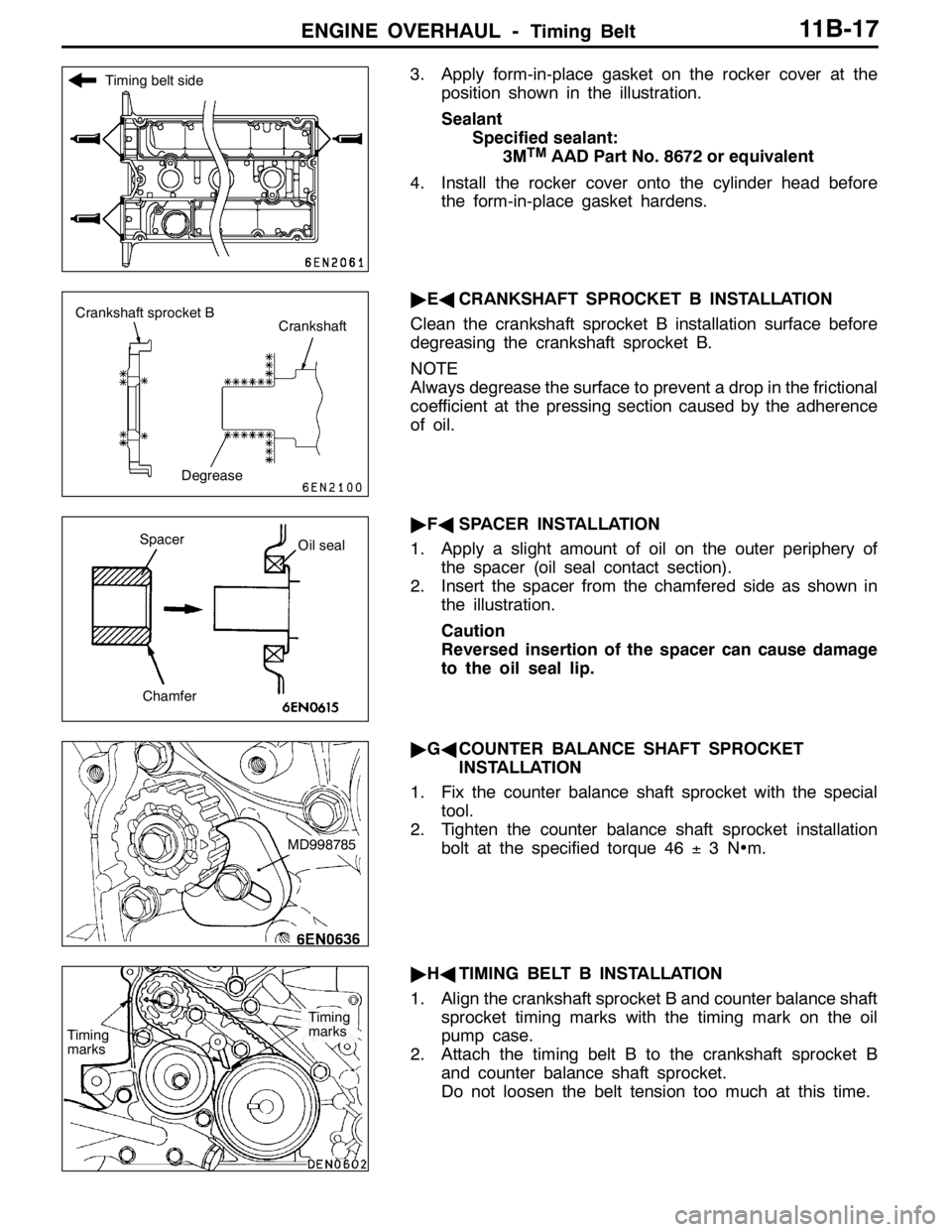
3. Apply form-in-place gasket on the rocker cover at the
position shown in the illustration.
Sealant
Specified sealant:
3M
TMAAD Part No. 8672 or equivalent
4. Install the rocker cover onto the cylinder head before
the form-in-place gasket hardens.
"EACRANKSHAFT SPROCKET B INSTALLATION
Clean the crankshaft sprocket B installation surface before
degreasing the crankshaft sprocket B.
NOTE
Always degrease the surface to prevent a drop in the frictional
coefficient at the pressing section caused by the adherence
of oil.
"FASPACER INSTALLATION
1. Apply a slight amount of oil on the outer periphery of
the spacer (oil seal contact section).
2. Insert the spacer from the chamfered side as shown in
the illustration.
Caution
Reversed insertion of the spacer can cause damage
to the oil seal lip.
"GACOUNTER BALANCE SHAFT SPROCKET
INSTALLATION
1. Fix the counter balance shaft sprocket with the special
tool.
2. Tighten the counter balance shaft sprocket installation
bolt at the specified torque 46±3N•m.
"HATIMING BELT B INSTALLATION
1. Align the crankshaft sprocket B and counter balance shaft
sprocket timing marks with the timing mark on the oil
pump case.
2. Attach the timing belt B to the crankshaft sprocket B
and counter balance shaft sprocket.
Do not loosen the belt tension too much at this time.
Timing belt side
Crankshaft sprocket B
Crankshaft
Degrease
Spacer
Oil seal
Chamfer
MD998785
Timing
marks
Timing
marks
Page 472 of 1449

ENGINE OVERHAUL -Timing Belt11B-18
3. Confirm that the tensioner B centre and bolt centre are
positioned as shown in the illustration.
4. Apply tension on the timing belt by lifting tensioner B
in the direction of the arrow with a finger, and tension
the tension side until it is “tight”. Fix tensioner B in this
state by tightening the bolt.
NOTE
Make sure that the tensioner B shaft does not rotate
when tightening the bolt. If the shaft rotates, the timing
belt becomes too tense.
5. Connect the special tool (MB991704) to MUT-IIand the
battery.
6. Connect the special tool (MB991668) to MUT-II.
7. Rotate the crankshaft clockwise two turns, and align each
timing mark.
8. Select “Belt Tension Measurement” from the MUT-IImenu
screen.
9. Separate the special tool (MB991668) 10 to 20 mm from
the centre back between the sprockets (shown with an
arrow), and hold so that it is vertical (inclination within
±15_) in respect to the belt.
10. Lightly tap the section shown with an arrow with fingers,
and measure the belt vibration frequency. If the results
are deviated from the standard value, loosen the bolt,
tension the belt again, and then measure the vibration
frequency again. Repeat this step until the standard value
is attained. Tighten the bolt when the standard value
is attained.
Standard value:
ItemWhen
checkWhen
adjustedWhen
replaced
Vibration frequency Hz52 - 9276 - 9276 - 92
Deflection
(Reference value) mm5-105-75-7
Tensioner
B centre
Installation
bolt centre
Timing
belt B
Belt tension side
Tensioner
B
MB991668
15_ 15_
10 - 20 mm
Page 475 of 1449
ENGINE OVERHAUL -Timing Belt11B-21
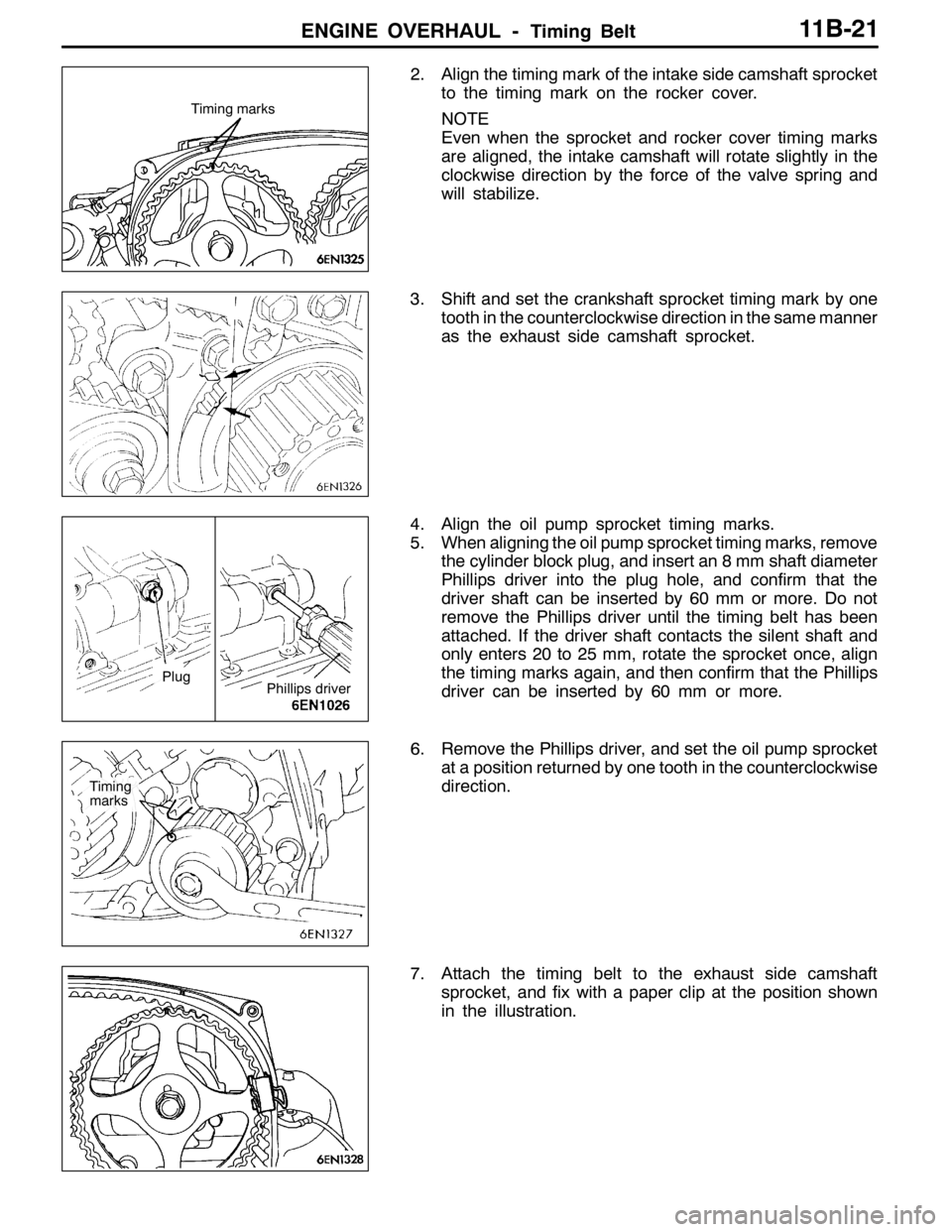
2. Align the timing mark of the intake side camshaft sprocket
to the timing mark on the rocker cover.
NOTE
Even when the sprocket and rocker cover timing marks
are aligned, the intake camshaft will rotate slightly in the
clockwise direction by the force of the valve spring and
will stabilize.
3. Shift and set the crankshaft sprocket timing mark by one
tooth in the counterclockwise direction in the same manner
as the exhaust side camshaft sprocket.
4. Align the oil pump sprocket timing marks.
5. When aligning the oil pump sprocket timing marks, remove
the cylinder block plug, and insert an 8 mm shaft diameter
Phillips driver into the plug hole, and confirm that the
driver shaft can be inserted by 60 mm or more. Do not
remove the Phillips driver until the timing belt has been
attached. If the driver shaft contacts the silent shaft and
only enters 20 to 25 mm, rotate the sprocket once, align
the timing marks again, and then confirm that the Phillips
driver can be inserted by 60 mm or more.
6. Remove the Phillips driver, and set the oil pump sprocket
at a position returned by one tooth in the counterclockwise
direction.
7. Attach the timing belt to the exhaust side camshaft
sprocket, and fix with a paper clip at the position shown
in the illustration.
Timing marks
Phillips driverPlug
Timing
marks
Page 476 of 1449
ENGINE OVERHAUL -Timing Belt11B-22
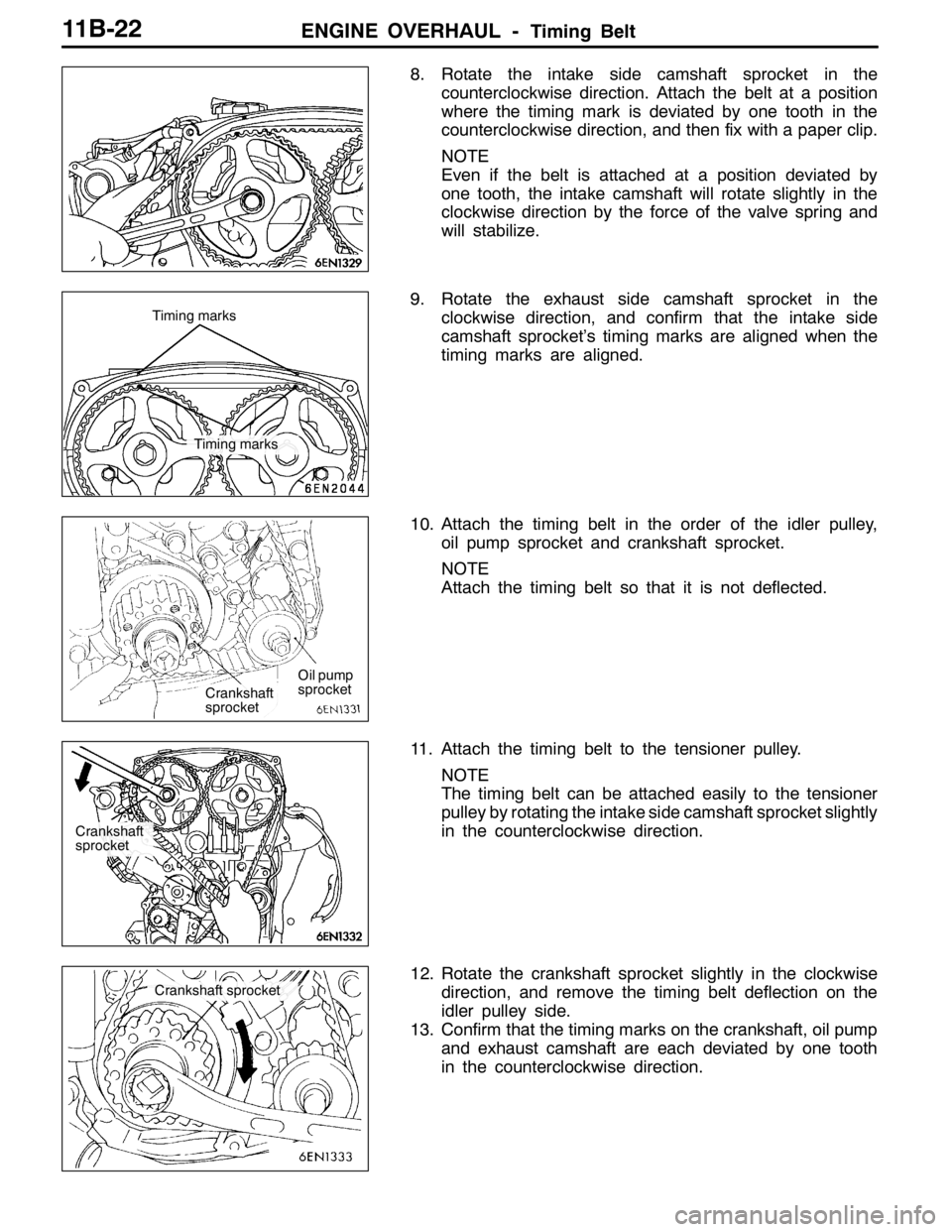
8. Rotate the intake side camshaft sprocket in the
counterclockwise direction. Attach the belt at a position
where the timing mark is deviated by one tooth in the
counterclockwise direction, and then fix with a paper clip.
NOTE
Even if the belt is attached at a position deviated by
one tooth, the intake camshaft will rotate slightly in the
clockwise direction by the force of the valve spring and
will stabilize.
9. Rotate the exhaust side camshaft sprocket in the
clockwise direction, and confirm that the intake side
camshaft sprocket’s timing marks are aligned when the
timing marks are aligned.
10. Attach the timing belt in the order of the idler pulley,
oil pump sprocket and crankshaft sprocket.
NOTE
Attach the timing belt so that it is not deflected.
11. Attach the timing belt to the tensioner pulley.
NOTE
The timing belt can be attached easily to the tensioner
pulley by rotating the intake side camshaft sprocket slightly
in the counterclockwise direction.
12. Rotate the crankshaft sprocket slightly in the clockwise
direction, and remove the timing belt deflection on the
idler pulley side.
13. Confirm that the timing marks on the crankshaft, oil pump
and exhaust camshaft are each deviated by one tooth
in the counterclockwise direction.
Timing marks Timing marks
Crankshaft
sprocketOil pump
sprocket
Crankshaft
sprocket
Crankshaft sprocket
Page 477 of 1449
ENGINE OVERHAUL -Timing Belt11B-23
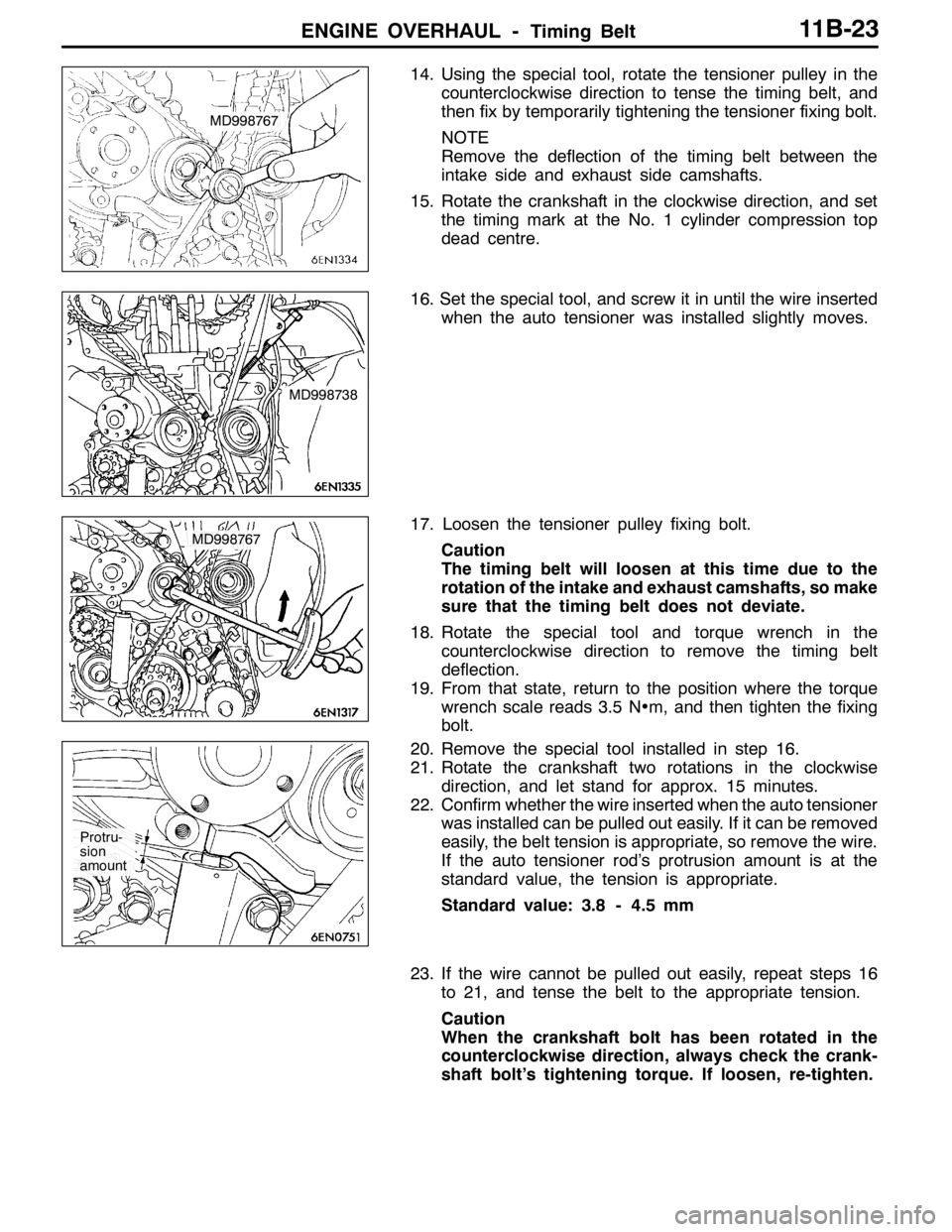
14. Using the special tool, rotate the tensioner pulley in the
counterclockwise direction to tense the timing belt, and
then fix by temporarily tightening the tensioner fixing bolt.
NOTE
Remove the deflection of the timing belt between the
intake side and exhaust side camshafts.
15. Rotate the crankshaft in the clockwise direction, and set
the timing mark at the No. 1 cylinder compression top
dead centre.
16. Set the special tool, and screw it in until the wire inserted
when the auto tensioner was installed slightly moves.
17. Loosen the tensioner pulley fixing bolt.
Caution
The timing belt will loosen at this time due to the
rotation of the intake and exhaust camshafts, so make
sure that the timing belt does not deviate.
18. Rotate the special tool and torque wrench in the
counterclockwise direction to remove the timing belt
deflection.
19. From that state, return to the position where the torque
wrench scale reads 3.5 N•m, and then tighten the fixing
bolt.
20. Remove the special tool installed in step 16.
21. Rotate the crankshaft two rotations in the clockwise
direction, and let stand for approx. 15 minutes.
22. Confirm whether the wire inserted when the auto tensioner
was installed can be pulled out easily. If it can be removed
easily, the belt tension is appropriate, so remove the wire.
If the auto tensioner rod’s protrusion amount is at the
standard value, the tension is appropriate.
Standard value: 3.8 - 4.5 mm
23. If the wire cannot be pulled out easily, repeat steps 16
to 21, and tense the belt to the appropriate tension.
Caution
When the crankshaft bolt has been rotated in the
counterclockwise direction, always check the crank-
shaft bolt’s tightening torque. If loosen, re-tighten.
MD998767
MD998738
MD998767
Protru-
sion
amount
Page 485 of 1449

ENGINE OVERHAUL -Exhaust Manifold11B-31
INSTALLATION SERVICE POINTS
"AAEXHAUST MANIFOLD INSTALLATION
1. Lightly tighten the installation nut for the exhaust manifold.
2. Following the tightening order shown in the illustration,
tighten the M8 nuts at the tightening torque 29 N•m.
3. Following the tightening order shown in the illustration,
tighten the M10 nuts at the tightening torque 49 N•m.
4. Following the tightening order shown in the illustration,
tighten the M8 nuts again at the tightening torque 29
N•m.
5. Finally, following the tightening order shown in the
illustration, tighten the M10 nuts at the tightening torque
55±10 N•m, and tighten the M8 nuts at the tightening
torque 33±6N•m.
"BAOIL RETURN PIPE GASKET INSTALLATION
Assembly so that the protrusion of the oil return pipe gasket
on the oil pan side is at the position shown in the illustration.
NOTE
There is no designated assembly direction for the gasket
on the turbocharger side.
"CAAIR OUTLET FITTING GASKET
Assembly so that the protrusion of the air outlet fitting gasket
is at the position shown in the illustration.
7982 13456
Protrusion
Protrusion
AA
Page 490 of 1449

ENGINE OVERHAUL -Rocker Arm and Camshaft11B-36
3. Apply sealant on the contact surfaces with the head shown
in the illustration.
Sealant
Specified sealant:
3M
TMAAD Part No. 8672 or equivalent
4. Install the bearing caps onto the cylinder head, and in
two to three steps tighten strongly.
5. Finally, tighten at the specified torque 20±1N•m.
6. Confirm that the rocker arm is correctly installed.
NOTE
Wipe off all excessive sealant.
"DACAMSHAFT OIL SEAL INSTALLATION
Install the oil seal using the special tool.
"EACAM POSITION SENSOR SUPPORT
INSTALLATION
Apply a 3 mm width of form-in-place gasket at the position
shown in the illustration.
Form-in-place gasket
Specified gasket:
Mitsubishi Genuine Part No. MD970389 or
equivalent
"FACAM POSITION SENSING CYLINDER
INSTALLATION
1. Set the exhaust camshaft at the No. 1 compression top
dead centre.
NOTE
The shaft will rotate slightly in the counterclockwise
direction by the force of the exhaust valve spring.
2. Install the cam position sensing cylinder’s vane (small)
and vane (large) at the positions shown in the illustration.
MD998713
Vane (small)
Cam position
sensorVane (large)