height MITSUBISHI LANCER EVOLUTION 2007 Service Owner's Guide
[x] Cancel search | Manufacturer: MITSUBISHI, Model Year: 2007, Model line: LANCER EVOLUTION, Model: MITSUBISHI LANCER EVOLUTION 2007Pages: 1449, PDF Size: 56.82 MB
Page 1049 of 1449
BASIC BRAKE SYSTEM -On-vehicle Service35A-7
ON-VEHICLE SERVICE
BRAKE PEDAL CHECK AND ADJUSTMENT
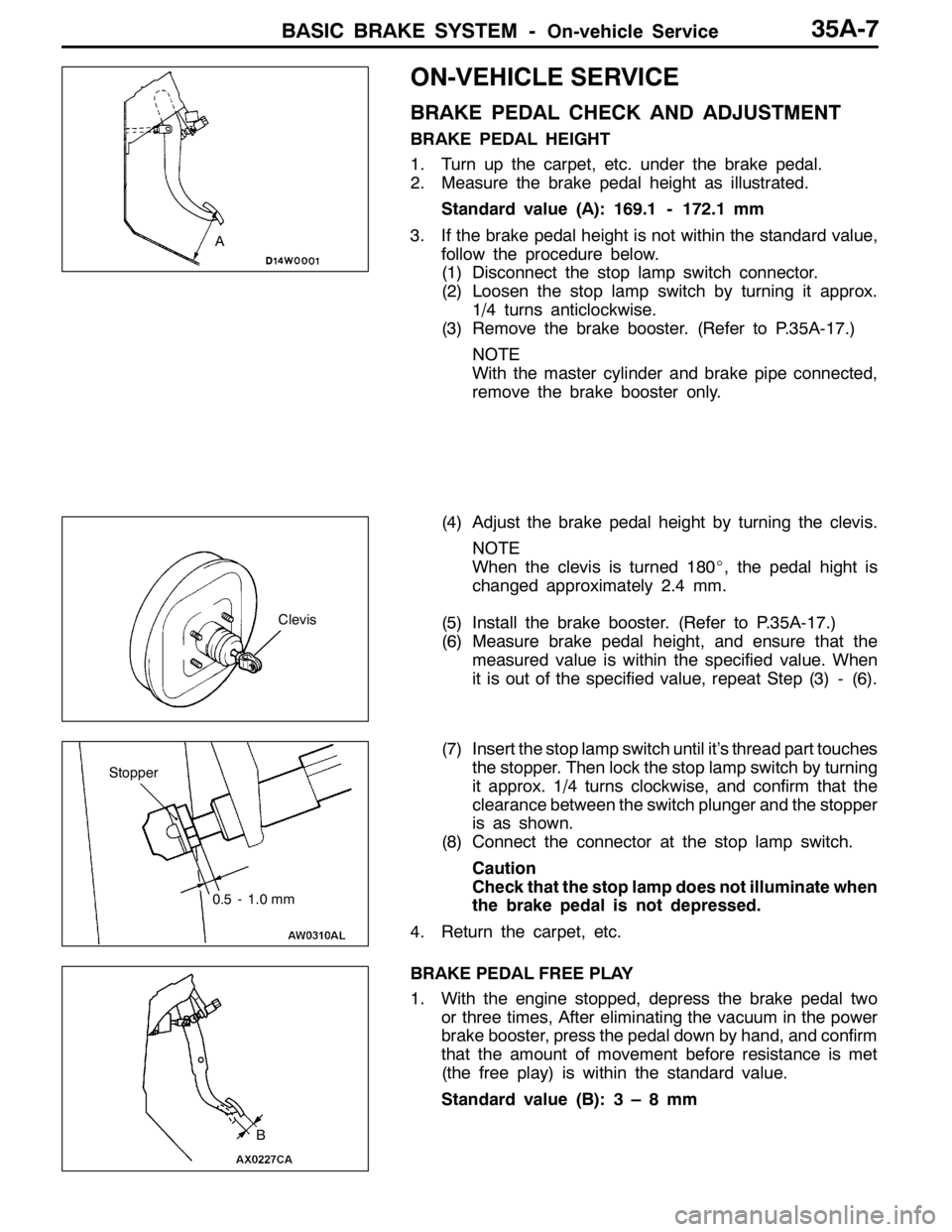
BRAKE PEDAL HEIGHT
1. Turn up the carpet, etc. under the brake pedal.
2. Measure the brake pedal height as illustrated.
Standard value (A): 169.1 - 172.1 mm
3. If the brake pedal height is not within the standard value,
follow the procedure below.
(1) Disconnect the stop lamp switch connector.
(2) Loosen the stop lamp switch by turning it approx.
1/4 turns anticlockwise.
(3) Remove the brake booster. (Refer to P.35A-17.)
NOTE
With the master cylinder and brake pipe connected,
remove the brake booster only.
(4) Adjust the brake pedal height by turning the clevis.
NOTE
When the clevis is turned 180_, the pedal hight is
changed approximately 2.4 mm.
(5) Install the brake booster. (Refer to P.35A-17.)
(6) Measure brake pedal height, and ensure that the
measured value is within the specified value. When
it is out of the specified value, repeat Step (3) - (6).
(7) Insert the stop lamp switch until it’s thread part touches
the stopper. Then lock the stop lamp switch by turning
it approx. 1/4 turns clockwise, and confirm that the
clearance between the switch plunger and the stopper
is as shown.
(8) Connect the connector at the stop lamp switch.
Caution
Check that the stop lamp does not illuminate when
the brake pedal is not depressed.
4. Return the carpet, etc.
BRAKE PEDAL FREE PLAY
1. With the engine stopped, depress the brake pedal two
or three times, After eliminating the vacuum in the power
brake booster, press the pedal down by hand, and confirm
that the amount of movement before resistance is met
(the free play) is within the standard value.
Standard value (B):3–8mm
A
Clevis
Stopper
0.5 - 1.0 mm
B
Page 1050 of 1449

BASIC BRAKE SYSTEM -On-vehicle Service35A-8
2. If the brake pedal play is not within the standard value,
check the following, and adjust or replace if necessary:
DExcessive play between the brake pedal and the clevis
pin, or between the clevis pin and the brake booster
operating rod
DBrake pedal height
DInstallation position of the stop lamp switch, etc.
CLEARANCE BETWEEN BRAKE PEDAL AND FLOOR
BOARD
1. Turn up the carpet etc. under the brake pedal.
2. Start the engine, depress the brake pedal with
approximately 500 N of force, and measure the clearance
between the brake pedal and the floorboard.
Standard value (C): 90 mm or more
3. If the clearance is outside the standard value, check for
air trapped in the brake line and thickness of the disc
brake pad and dragging in the parking brake.
Adjust and replace defective parts as required.
4. Return the carpet, etc.
BRAKE BOOSTER OPERATING TEST
For simple checking of the brake booster operation, carry
out the following tests:
1. Run the engine for one or two minutes, and then stop
it.
If the pedal depresses fully the first time but gradually
becomes higher when depressed succeeding times, the
booster is operating properly. If the pedal height remains
unchanged, the booster is defective.
2. With the engine stopped, step on the brake pedal several
times.
Then start the engine while the brake pedal is stepped
on.
If the pedal moves downward slightly, the booster is in
good condition. If there is no change, the booster is
defective.
3. With the engine running, step on the brake pedal and
then stop the engine.
Hold the pedal depressed for 30 seconds. If the pedal
height does not change, the booster is in good condition.
If the pedal rises, the booster is defective.
If the above three tests are okay, the booster performance
can be determined as good.
If one of the above three tests is not okay at least, the check
valve, vacuum hose, or booster will be defective.
C
Good No good
When engine is
stoppedWhen engine is
started
GoodNo good
Page 1069 of 1449

BASIC BRAKE SYSTEM -Disc Brake35A-27
DISASSEMBLY SERVICE POINTS
Caution: Brembo disc brake
Take care not to contact the parts or tools to the caliper
because the paint of caliper will be scratched. And if
there is brake fluid on the caliper, wipe out quickly.
AA"PISTON BOOT/PISTON REMOVAL
Remove the piston boot by pumping in air slowly from the
brake hose connection. Be sure to use the handle of a plastic
hammer and adjust the height of the two pistons while so
that the pistons protrude evenly.
Caution
Do not remove one piston completely before trying to
remove the other piston, because it will become
impossible to remove the second piston.
Use a piece of wood to protect the caliper body outer side,
and then apply compressed air through the brake hose
connection hole to withdraw the piston and piston boot.
Caution
If air is blown into the caliper body suddenly, the piston
will pop out, causing damage to the caliper body. Be
sure to apply compressed air gradually.
AB"PISTON SEAL REMOVAL
1. Remove the piston seal with finger tip.
Caution
Do not use a flat-tipped screwdriver or other tool to
prevent damage to inner cylinder.
2. Clean piston surface and inner bore with trichloroethylene,
alcohol or the specified brake fluid.
Specified brake fluid: DOT3 or DOT4
REASSEMBLY SERVICE POINT
Caution: Brembo disc brake
Take care not to contact the parts or tools to the caliper
because the paint of caliper will be scratched. And if
there is brake fluid on the caliper, wipe out quickly.
Page 1149 of 1449

42-1
BODY
CONTENTS
HOOD2 .................................
ON-VEHICLE SERVICE 2..................
Adjustment of Clearance around Hood 2......
Adjustment of Alignment of Hood Stepped
Portion and Hood Striker 2..................
Adjustment of Hood Height 2.................
HOOD 3..................................
FENDER4 ..............................
SPECIAL TOOL 4.........................
FENDER 5................................
FUEL FILLER DOOR7 .................
STRUT TOWER BAR AND REAR END
CROSS BAR8 ...........................
WINDOW GLASS9 .....................
ADHESIVE 9..............................
SPECIAL TOOLS 9........................
WINDOW REPAIR 9.......................
WINDSHIELD 11...........................
REAR WINDOW GLASS 16................
DOORS19 ..............................
SERVICE SPECIFICATIONS 19.............ADHESIVES 19............................
SPECIAL TOOLS 19.......................
TROUBLESHOOTING 20...................
ON-VEHICLE SERVICE 20.................
Door Adjustment 20.........................
Door Window Glass Adjustment 21...........
Adjustment and Replacement during Power
Window Malfunction 22......................
Power Window Safety Mechanism Check 22..
Power Window Timer Function Check 22......
Door Outside Handle Looseness Check 23....
Power Window Operation Current Check 23...
Circuit Breaker Check 23....................
Power Window Check 23....................
Door Inside Handle Looseness Check and
Adjustment 24...............................
DOOR ASSEMBLY 25......................
DOOR TRIM AND
WATERPROOF FILM 27....................
DOOR GLASS AND REGULATOR 32.......
DOOR HANDLE AND LATCH 35...........
WINDOW GLASS RUNCHANNEL AND
DOOR OPENING WEATHERSTRIP 38.......
TRUNK LID41 ..........................
Page 1150 of 1449

BODY -Hood42-2
HOOD
ON - VEHICLE SERVICE
ADJUSTMENT OF CLEARANCE AROUND
HOOD
ADJUSTMENT OF ALIGNMENT OF HOOD
STEPPED PORTION AND HOOD STRIKER
ADJUSTMENT OF HOOD HEIGHT
With the marker as guide, turn the hood bumper to adjust
the hood height. The hood bumper height changes approx.
3mm (new hood bumper with one complete turn).
A
A
Section A-A
16.3 mmHood
Hood bumper
Page 1238 of 1449

INTERIOR -Seat52A-20
DISASSEMBLY AND REASSEMBLY
HIGHT ADJUSTER SEAT
8, 9
20
Section A - A
Claw
1
2345
6
7
8
910
11 12
13
14
15
1720
44±10 NSm
44±10 NSm 12±2NSm
A
A
A9±2NSm
18
1619
A
Disassembly steps
1. Reclining knob
2. Pin
3. Height adjuster knob
4. Front seat cushion assembly
5. Front seat cushion cover
6. Front seat cushion pad
7. Front seat cushion frame
8. Reclining cover
9. Shield cover
10. Front seatback assembly
AA"11. Headrest guide
12. Front seatback cover
13. Front seatback pad
14. Front seatback frame
15. Inner seat belt
16. Shaft
17. Seat slide handle
18. Shaft
19. Shaft protector
20. Seat slide adjuster
Page 1334 of 1449

CHASSIS ELECTRICAL -Combination Meter54A-14
COMBINATION METER
Caution
Never remove pointer of combination meter. This may cause damage of combination meter.
SERVICE SPECIFICATIONS
ItemStandard valueLimit value
Indication range of speedometer km/hAt 40 km/h37 - 45–gp
At 80 km/h75 - 88–
At 120 km/h113 - 132–
At 160 km/h150 - 176–
Deflection of speedometer pointer (Vehicle speed: 35 km/h or more)–±3
Indication allowance of tachometer rpmEngine Speed: 700 rpm±70–p
Engine Speed: 2,000 rpm- 100 +150–
Engine Speed: 3,000 rpm- 100 +225–
Engine Speed: 4,000 rpm- 125 +275–
Engine Speed: 5,000 rpm- 125 +325–
Engine Speed: 6,000 rpm- 125 +375–
Engine Speed: 7,000 rpm- 100 +400–
Engine Speed: 8,000 rpm+400–
Basic resistance of fuel gauge unit
Mi(SUb)Ω
Position F2±1(2±1)–gg
Main (SUb)ΩPosition E41±1 (69±1)–
Float height of fuel gauge unit
Mi(SUb)
Position F33.3 (10.7)–ggg
Main (SUb) mmPosition E121.9 (138.6)–
Basic resistance of water temperature gauge unitΩ70_C104±13.5–
Internal resistance of combination meterΩTerminal No. 1 - 50233±3–
Terminal No. 1 - 51181±2–
SEALANT
ItemSpecified sealantRemark
Water temperature gauge unit3M ATD Part No.1215 or equivalentSemi-drying sealant
Page 1341 of 1449

CHASSIS ELECTRICAL -Combination Meter54A-21
FLOAT HEIGHT OF FUEL GAUGE UNIT
When float is moved to contact float arm on stopper,
ensure that Position F (A) and E (B) are within standard
value.
Standard Value:
FloatPositionMainfuelgaugeunitSubfuelgaugeunitFloatPositionMainfuelgaugeunitSubfuelgaugeunit
Position F (A)33.3 mm10.7 mm
Position E (B)121.9 mm138.6 mm
ENGINE COOLANT TEMPERATURE GAUGE
UNIT CHECK
1. Drain coolant. (Refer to GROUP 14 - On-vehicle Service)
2. Remove water temperature gauge unit.
3. Put water temperature gauge unit into the hot water in
specified temperature, and ensure that basic resistance
is within standard value.
Standard value: 70_C 104±13.5Ω
Reference value:
TemperatureResistanceΩ
50_C230
60_C155
80_C73
4. After inspection, apply specified sealant at threads of
water temperature gauge unit, and tighten to the specified
torque.
Semi-drying sealant: 3M ATD Part No.1215 or
equivalent
5. Refill coolant. (Refer to GROUP 14 - On-vehicle Service.)
Main fuel gauge unit
Sub fuel gauge unit
A
B
A
B
ThermometerCircuit tester
11±1 N·m