PAG MITSUBISHI MIRAGE 2017 6.G Owners Manual
[x] Cancel search | Manufacturer: MITSUBISHI, Model Year: 2017, Model line: MIRAGE, Model: MITSUBISHI MIRAGE 2017 6.GPages: 307, PDF Size: 9.02 MB
Page 10 of 307
2-1
2
If this warning light comes on or
flashes while you’re driving...
Quick index
N00200702250
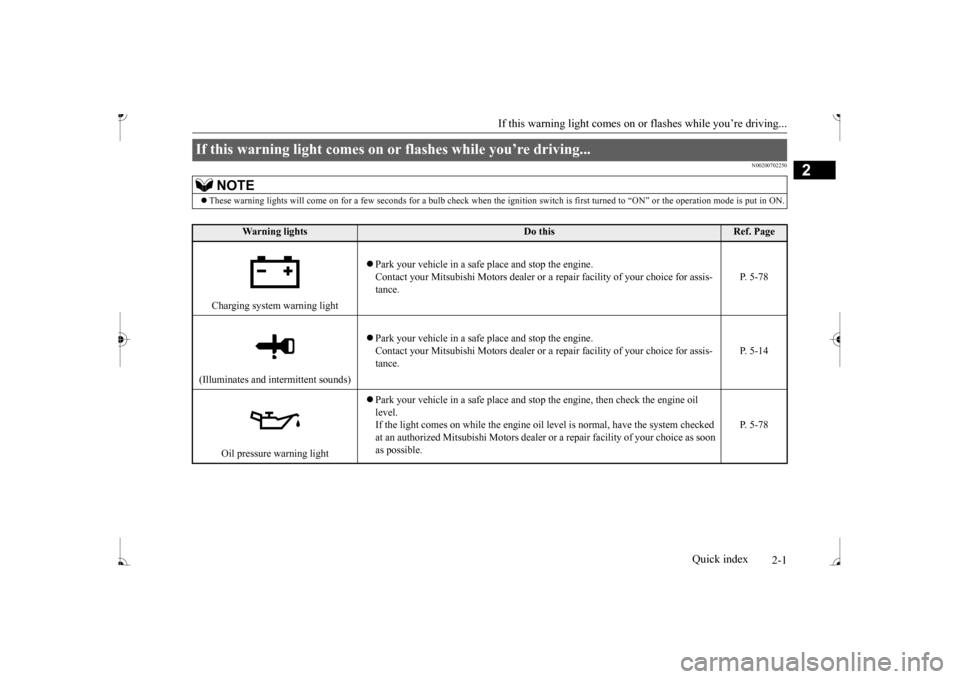
If this warning light comes on
or flashes while you’re driving...
NOTE
These warning lights will co
me on for a few seconds for a bulb check when the i
gnition switch is
first turned to “ON” or the op
eration mode is put in ON.
Wa rn in g l ig h t s
Do this
Ref. Page
Charging system warning light
Park your vehicle in a safe
place and stop the engine.
Contact your Mitsubishi Motors dealer or a re
pair facility of your choice for assis-
tance.
P. 5-78
(Illuminates and intermittent sounds)
Park your vehicle in a safe
place and stop the engine.
Contact your Mitsubishi Motors dealer or a re
pair facility of your choice for assis-
tance.
P. 5-14
Oil pressure warning light
Park your vehicle in a safe
place and stop the engine, then check the engine oil
level.If the light comes on while the engine oil le
vel is normal, have the system checked
at an authorized Mitsubishi Motors dealer
or a repair facility of
your choice as soon
as possible.
P. 5-78
BK0236100US.book 1 ページ 2016年2月1日 月曜日 午前10時15分
Page 11 of 307
If this warning light comes on or flashes while you’re driving... 2-2 Quick index
2
or
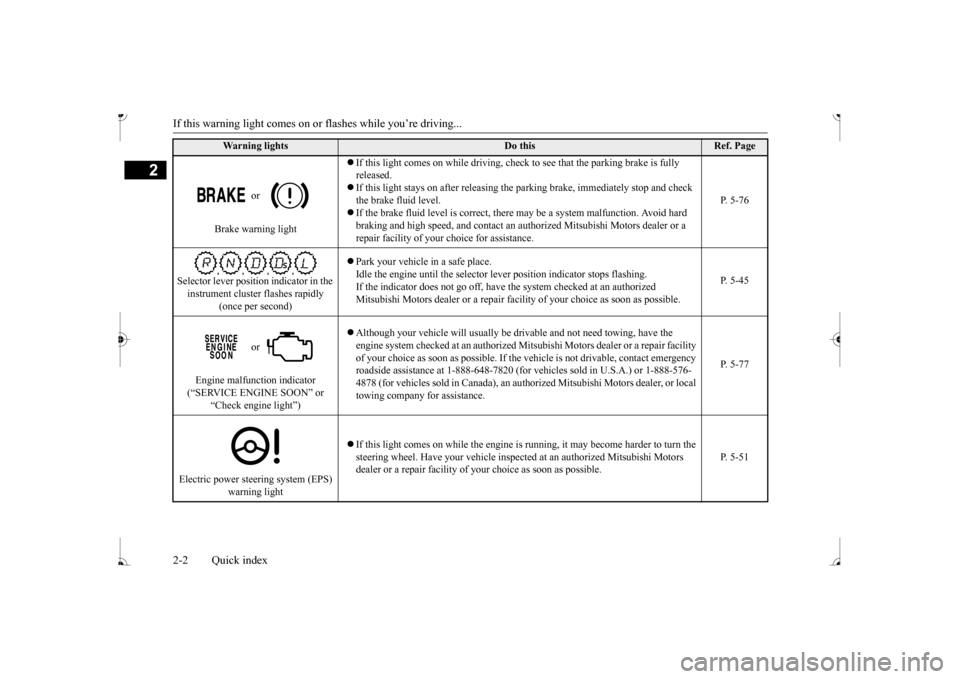
Brake warning light
If this light comes on while driving, chec
k to see that the parking brake is fully
released. If this light stays on after releasing the
parking brake, immediately stop and check
the brake fluid level. If the brake fluid level is correct, there
may be a system malfunction. Avoid hard
braking and high speed, and contact an au
thorized Mitsubishi Motors dealer or a
repair facility of your
choice for assistance.
P. 5-76
Selector lever position indicator in the instrument cluster flashes rapidly
(once per second)
Park your vehicle in a safe place. Idle the engine until the selector le
ver position indicato
r stops flashing.
If the indicator does not go off, have
the system checked at an authorized
Mitsubishi Motors dealer or a repair facili
ty of your choice as soon as possible.
P. 5-45
or
Engine malfunction indicator (“SERVICE ENGINE SOON” or
“Check engine light”)
Although your vehicle will usually be dr
ivable and not need towing, have the
engine system checked at an authorized M
itsubishi Motors dealer
or a repair facility
of your choice as soon as possible. If the
vehicle is not drivab
le, contact emergency
roadside assistance at 1-888-648-7820 (for
vehicles sold in U.S.A.) or 1-888-576-
4878 (for vehicles sold in Canada), an auth
orized Mitsubishi Moto
rs dealer, or local
towing company for assistance.
P. 5-77
Electric power stee
ring system (EPS)
warning light
If this light comes on while the engine is
running, it may become harder to turn the
steering wheel. Have your ve
hicle inspected at an aut
horized Mitsubishi Motors
dealer or a repair facility of
your choice as soon as possible.
P. 5-51
Warning lights
Do this
Ref. Page
BK0236100US.book 2 ページ 2016年2月1日 月曜日 午前10時15分
Page 12 of 307
If this warning light comes on or
flashes while you’re driving...
Quick index 2-3
2
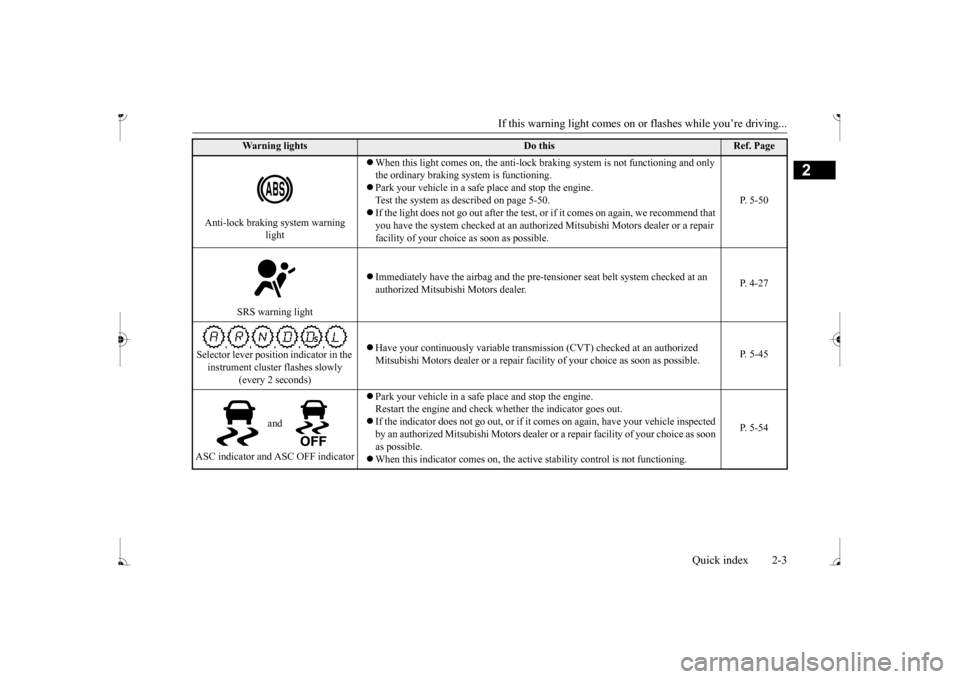
Anti-lock braking system warning
light
When this light comes on,
the anti-lock braking system
is not functioning and only
the ordinary braking system is functioning. Park your vehicle in a safe
place and stop the engine.
Test the system as described on page 5-50. If the light does not go out after
the test, or if it comes on
again, we recommend that
you have the system checked at an authorized
Mitsubishi Motors dealer or a repair
facility of your choice
as soon as possible.
P. 5-50
SRS warning light
Immediately have the airbag and the pre-te
nsioner seat belt sy
stem checked at an
authorized Mitsubishi Motors dealer.
P. 4-27
Selector lever position indicator in the instrument cluste
r flashes slowly
(every 2 seconds)
Have your continuously variable transmis
sion (CVT) checked at an authorized
Mitsubishi Motors dealer or
a repair facility of your
choice as soon as possible.
P. 5-45
and
ASC indicator and ASC OFF indicator
Park your vehicle in a safe
place and stop the engine.
Restart the engine and check
whether the indicator goes out.
If the indicator does not go out, or if it
comes on again, have
your vehicle inspected
by an authorized Mitsubishi Motors dealer or
a repair facility of your choice as soon
as possible. When this indicator comes on, the activ
e stability control is not functioning.
P. 5-54
Wa rn in g l ig h t s
Do this
Ref. Page
BK0236100US.book 3 ページ 2016年2月1日 月曜日 午前10時15分
Page 14 of 307
If this problem occurs...
Quick index 2-5
2
N00200901978
If this problem occurs...
Problem
Do this
Ref. Page
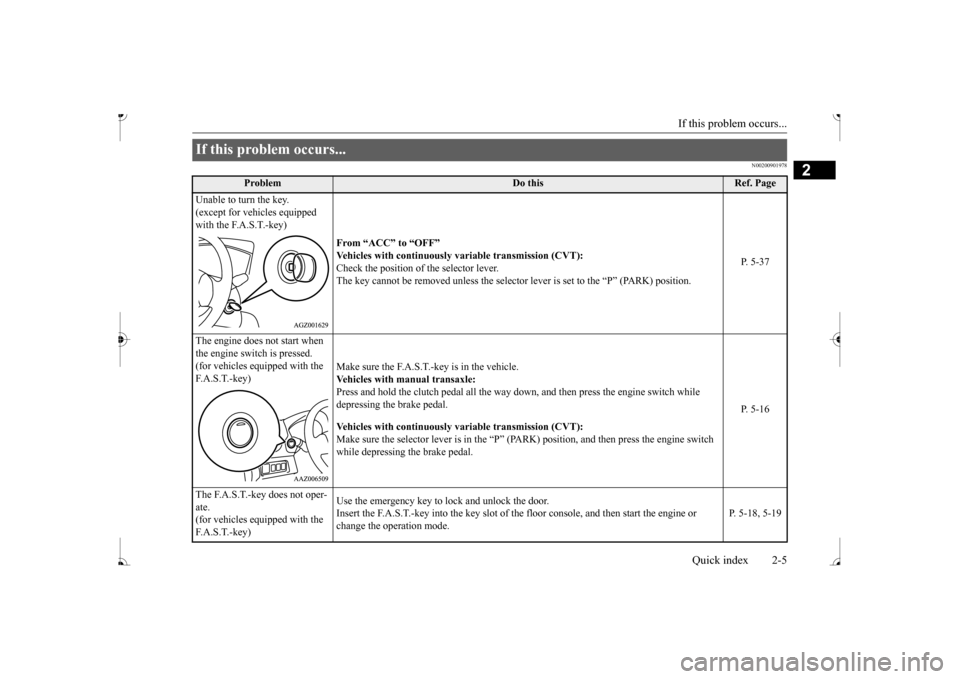
Unable to turn the key. (except for vehicles equipped with the F.A.S.T.-key)
From “ACC” to “OFF” Vehicles with cont
inuously variable
transmission (CVT):
Check the position of the selector lever. The key cannot be removed unless the selector
lever is set to the “P” (PARK) position.
P. 5-37
The engine does not start when the engine switch is pressed. (for vehicles equipped with the F. A . S . T. - k e y )
Vehicles with ma
nual transaxle:
Press and hold the clutch pedal all the way dow
n, and then press the
engine switch while
depressing the brake pedal. Vehicles with cont
inuously variable
transmission (CVT):
Make sure the selector lever is in the “P” (P
ARK) position, and then press the engine switch
while depressing the brake pedal.
P. 5-16
The F.A.S.T.-key does not oper- ate. (for vehicles equipped with the F. A . S . T. - k e y )
Insert the F.A.S.T.-key into the key slot of th
e floor console, and then start the engine or
change the operation mode.
P. 5-18, 5-19
BK0236100US.book 5 ページ 2016年2月1日 月曜日 午前10時15分
Page 15 of 307
If this problem occurs... 2-6 Quick index
2
Cannot shift the selector lever from the “P” (PARK) position.(for vehicles with continuously variable transmission (CVT))
Shift the selector lever while pressing the brake pedal. Check that the ignition switch
or the operation mode is in ON.
P. 5-42
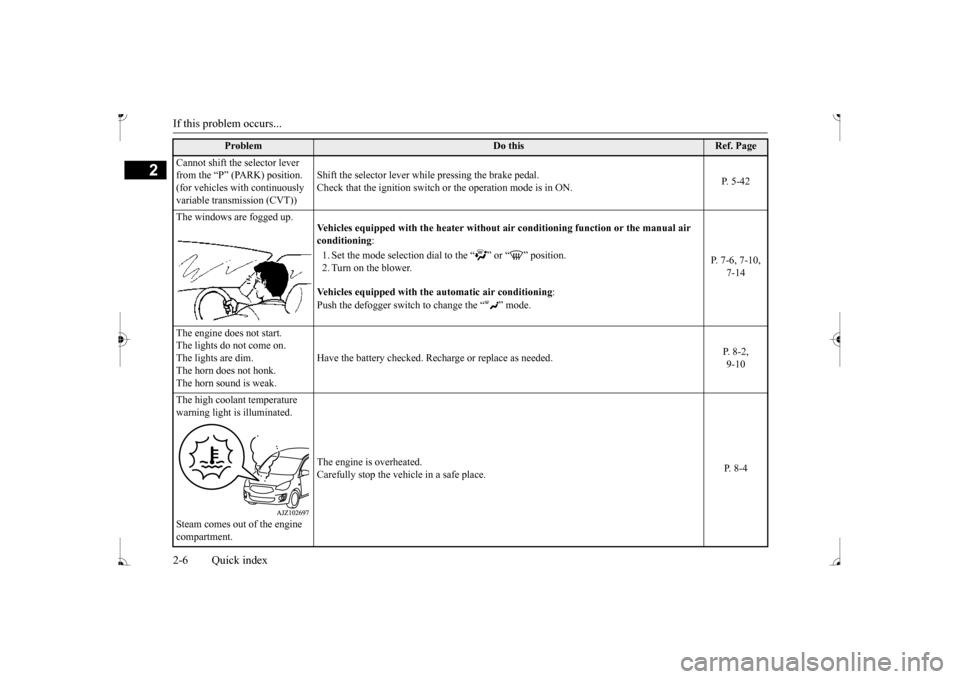
The windows are fogged up.
Vehicles equipped with the he
ater without air conditioning
function or th
e manual air
conditioning
:
1. Set the mode selection dial
to the “ ” or “ ” position.
2. Turn on the blower. Vehicles equipped with th
e automatic air conditioning
:
Push the defogger switch
to change the “ ” mode.
P. 7-6, 7-10,
7-14
The engine does not start. The lights do not come on. The lights are dim. The horn does not honk.The horn sound is weak.
Have the battery checked. Rech
arge or replace as needed.
P. 8-2, 9-10
The high coolant temperature warning light is illuminated. Steam comes out of the engine compartment.
The engine is overheated. Carefully stop the vehicle in a safe place.
P. 8-4
Problem
Do this
Ref. Page
BK0236100US.book 6 ページ 2016年2月1日 月曜日 午前10時15分
Page 16 of 307
If this problem occurs...
Quick index 2-7
2
The vehicle is
stuck in sand,
mud or snow
Rock your vehicle back and forth to free it. P. 8-13
WA R N I N G When attempting to rock your vehicle out of
a stuck position, be sure that
no one is near the vehicl
e. The rocking motion may c
ause the vehicle to
suddenly lurch forward or backward, possibly injuring bystanders. Avoid revving the engine or spin
ning the wheels. Prolonged efforts to free a st
uck vehicle may result in
overheating and transa
xle failure.
If the vehicle remains stuck after several rocking attempts, have a towing service pull the vehicle out.
Problem
Do this
Ref. Page
The brakes are not functioning properly after crossing a puddle or stream.
Dry out the brakes by driving slowly while
lightly pressing the brake pedal. P. 6-5
The continuously variable trans- mission (CVT) makes no shift change when accelerating. The initial movement of the vehicle is slow when the vehicle starts moving.(for vehicles with CVT)
There may be a problem in the CVT. Have the vehicle inspected by an
authorized Mitsubishi Motors dealer or a repair facility of
your choice.
P. 5-45
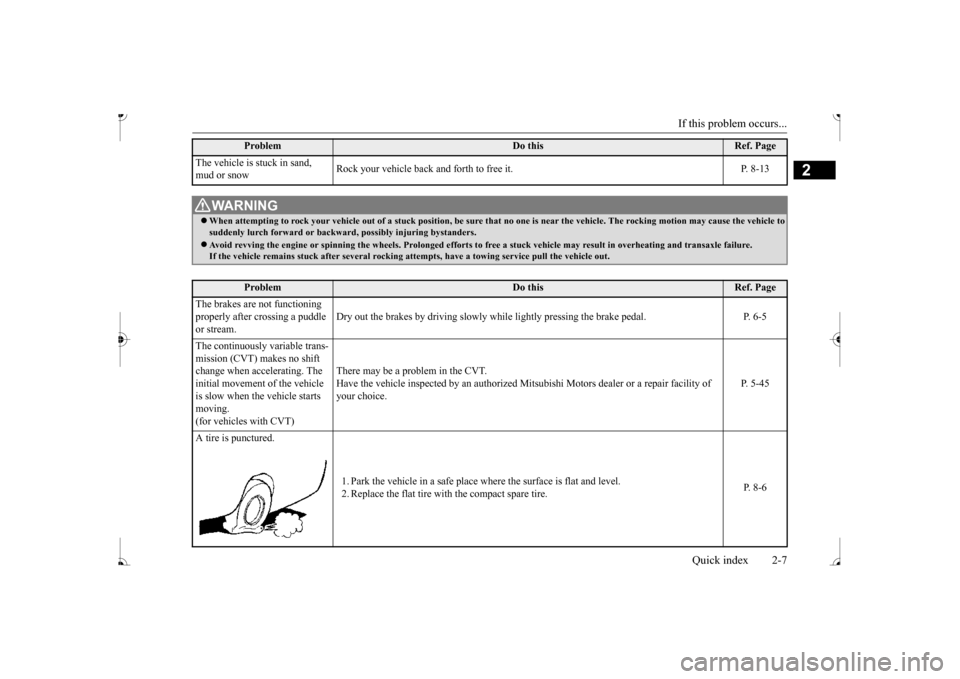
A tire is punctured.
1. Park the vehicle in a safe place where the surface is flat and level. 2. Replace the flat tire with the compact spare tire.
P. 8 - 6
Problem
Do this
Ref. Page
BK0236100US.book 7 ページ 2016年2月1日 月曜日 午前10時15分
Page 27 of 307
Seats 4-2 Seat and restraint systems
4
N00408401577
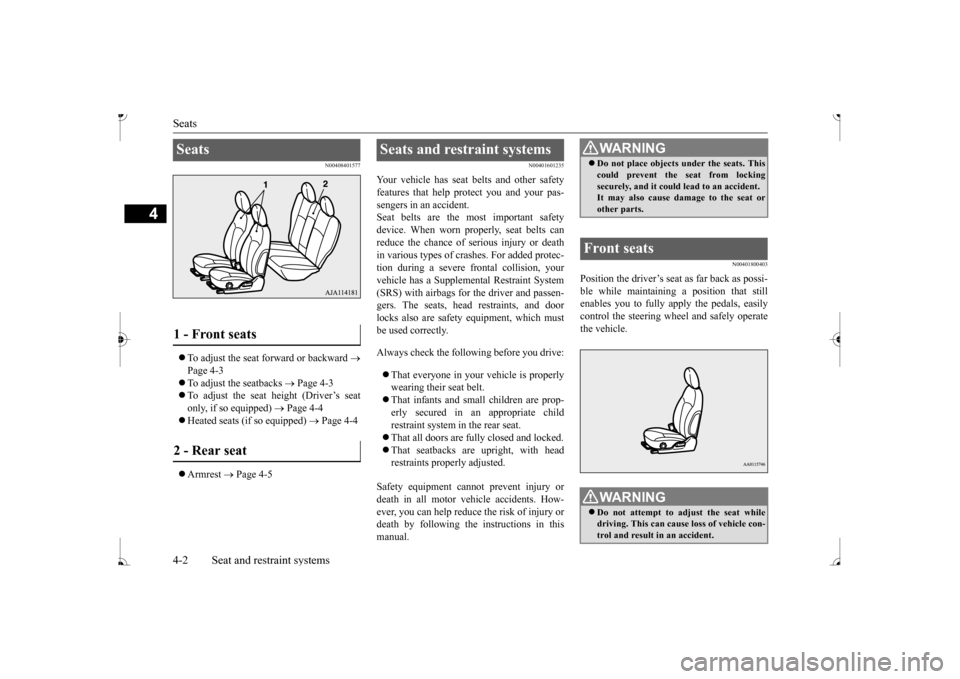
To adjust the seat forward or backward
Page 4-3 To adjust the seatbacks
Page 4-3
To adjust the seat height (Driver’s seat only, if so equipped)
Page 4-4
Heated seats (if so equipped)
Page 4-4
Armrest
Page 4-5
N00401601235
Your vehicle has seat
belts and other safety
features that help
protect you and your pas-
sengers in an accident.Seat belts are the most important safety device. When worn properly, seat belts can reduce the chance of serious injury or deathin various types of cras
hes. For added protec-
tion during a severe fr
ontal collision, your
vehicle has a Supplemen
tal Restraint System
(SRS) with airbags for the driver and passen- gers. The seats, head restraints, and doorlocks also are safety equipment, which must be used correctly. Always check the follow
ing before you drive:
That everyone in your vehicle is properly wearing their seat belt. That infants and small children are prop- erly secured in an appropriate child restraint system in
the rear seat.
That all doors are fully closed and locked. That seatbacks are upright, with head restraints properly adjusted.
Safety equipment cannot prevent injury or death in all motor ve
hicle accidents. How-
ever, you can help reduce the risk of injury or death by following the
instructions in this
manual.
N00401800403
Position the driver’s seat as far back as possi-ble while maintaining a position that stillenables you to fully a
pply the pedals, easily
control the steering wheel and safely operate the vehicle.
Seats 1 - Front seats 2 - Rear seat
Seats and restraint systems
WA R N I N G Do not place objects under the seats. This could prevent the seat from lockingsecurely, and it could lead to an accident.It may also cause damage to the seat or other parts.
Front seats
WA R N I N G Do not attempt to adjust the seat while driving. This can cause loss of vehicle con- trol and result
in an ac
cident.
BK0236100US.book 2 ページ 2016年2月1日 月曜日 午前10時15分
Page 30 of 307
Rear seat
Seat and restraint systems 4-5
4
N00402501257 N00403001334
To use the arm rest, tilt the arm rest down for use as shown. The arm rest includes a cup holder. (Refer to“Cup holder” on page 5-117.
N00404301637
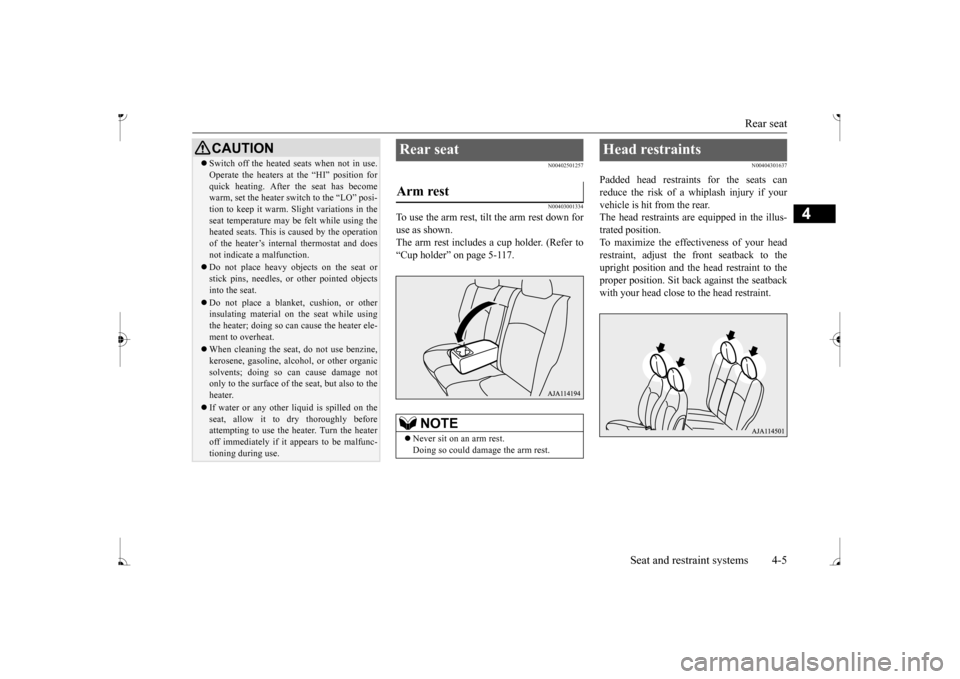
Padded head restraints for the seats can reduce the risk of a whiplash injury if your vehicle is hit from the rear.The head restraints are equipped in the illus- trated position. To maximize the effectiveness of your headrestraint, adjust the front seatback to the upright position and the
head restraint to the
proper position. Sit back against the seatback with your head close to the head restraint.
CAUTION Switch off the heated seats when not in use. Operate the heaters at the “HI” position forquick heating. After the seat has becomewarm, set the heater switch to the “LO” posi- tion to keep it warm. Sl
ight variations in the
seat temperature may be felt while using theheated seats. This is caused by the operation of the heater’s internal thermostat and does not indicate
a malfunction.
Do not place heavy objects on the seat or stick pins, needles, or
other pointed objects
into the seat. Do not place a blanket,
cushion, or other
insulating material on the seat while using the heater; doing so can
cause the heater ele-
ment to overheat. When cleaning the seat, do not use benzine, kerosene, gasoli
ne, alcohol, or other organic
solvents; doing so can cause damage not only to the surface of the seat, but also to the heater. If water or any other liquid is spilled on the seat, allow it to dry thoroughly beforeattempting to use the heater. Turn the heater off immediately if it a
ppears to be malfunc-
tioning during use.
Rear seat Arm rest
NOTE
Never sit on an arm rest. Doing so could damage the arm rest.
Head restraints
BK0236100US.book 5 ページ 2016年2月1日 月曜日 午前10時15分
Page 32 of 307
Seat belts
Seat and restraint systems 4-7
4
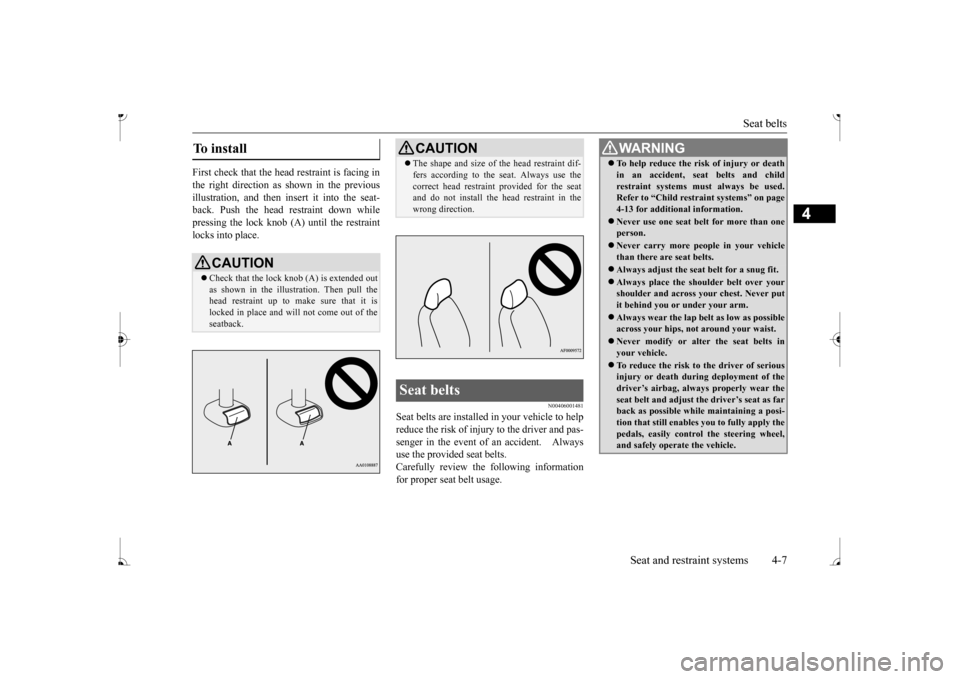
First check that the head restraint is facing in the right direction as shown in the previous illustration, and then insert it into the seat- back. Push the head restraint down whilepressing the lock knob (A
) until the restraint
locks into place.
N00406001481
Seat belts are installed in your vehicle to help reduce the risk of injury to the driver and pas- senger in the event of an accident. Always use the provided seat belts.Carefully review the following information for proper seat belt usage.
To install
CAUTION Check that the lock knob (A) is extended out as shown in the illustration. Then pull the head restraint up to make sure that it islocked in place and will
not come out of the
seatback.
CAUTION The shape and size of the head restraint dif- fers according to the seat. Always use thecorrect head restraint provided for the seatand do not install the he
ad restraint in the
wrong direction.
Seat belts
WA R N I N G To help reduce the risk of injury or death in an accident, se
at belts and child
restraint systems must always be used.Refer to “Child restra
int systems” on page
4-13 for additional information. Never use one seat belt for more than one person. Never carry more peop
le in your vehicle
than there are seat belts. Always adjust the seat
belt for a snug fit.
Always place the shou
lder belt over your
shoulder and across you
r chest. Never put
it behind you or
under your arm.
Always wear the lap belt as low as possible across your hips, not around your waist. Never modify or alter the seat belts in your vehicle. To reduce the risk to the driver of serious injury or death durin
g deployment of the
driver’s airbag, always
properly wear the
seat belt and adjust th
e driver’s seat as far
back as possible while maintaining a posi- tion that still enables
you to fully apply the
pedals, easily control the steering wheel, and safely operate the vehicle.
BK0236100US.book 7 ページ 2016年2月1日 月曜日 午前10時15分
Page 34 of 307
Seat belts
Seat and restraint systems 4-9
4
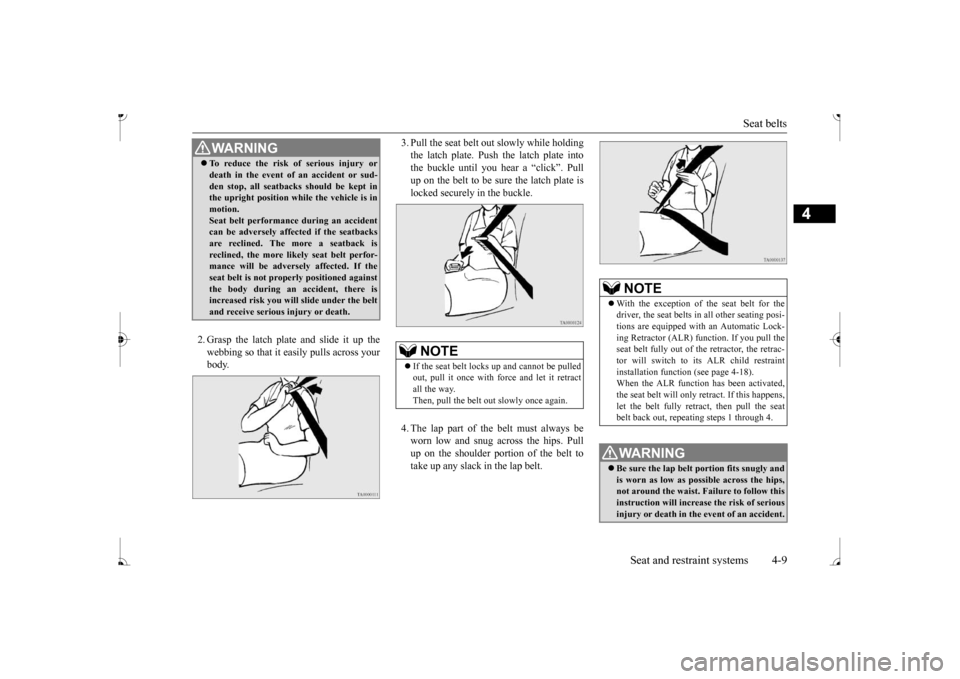
2. Grasp the latch plate and slide it up the webbing so that it easily pulls across your body.
3. Pull the seat belt out slowly while holding the latch plate. Push the latch plate intothe buckle until you hear a “click”. Pull up on the belt to be sure the latch plate is locked securely in the buckle. 4. The lap part of the belt must always be worn low and snug across the hips. Pullup on the shoulder portion of the belt to take up any slack in the lap belt.
WA R N I N G To reduce the risk of serious injury or death in the event of
an accident or sud-
den stop, all seatbacks should be kept inthe upright position wh
ile the vehicle is in
motion. Seat belt performance during an accidentcan be adversely affect
ed if the seatbacks
are reclined. The more a seatback is reclined, the more likely seat belt perfor-mance will be advers
ely affected. If the
seat belt is not prop
erly positioned against
the body during an accident, there isincreased risk you will slide under the belt and receive serious
injury or death.
NOTE
If the seat belt locks
up and cannot be pulled
out, pull it once with force and let it retract all the way. Then, pull the belt out
slowly once again.
NOTE
With the exception of the seat belt for the driver, the seat belts in all other seating posi- tions are equipped with an Automatic Lock- ing Retractor (ALR) function. If you pull theseat belt fully out of the retractor, the retrac- tor will switch to its ALR child restraint installation function
(see page 4-18).
When the ALR function has been activated, the seat belt will only re
tract. If this happens,
let the belt fully retract, then pull the seatbelt back out, repeating steps 1 through 4.WA R N I N G Be sure the lap belt portion fits snugly and is worn as low as possible across the hips, not around the waist. Failure to follow thisinstruction will increase the risk of serious injury or death in the
event of an accident.
BK0236100US.book 9 ページ 2016年2月1日 月曜日 午前10時15分