PAG MITSUBISHI MIRAGE 2017 6.G User Guide
[x] Cancel search | Manufacturer: MITSUBISHI, Model Year: 2017, Model line: MIRAGE, Model: MITSUBISHI MIRAGE 2017 6.GPages: 307, PDF Size: 9.02 MB
Page 38 of 307
Child restraint systems
Seat and restraint systems 4-13
4
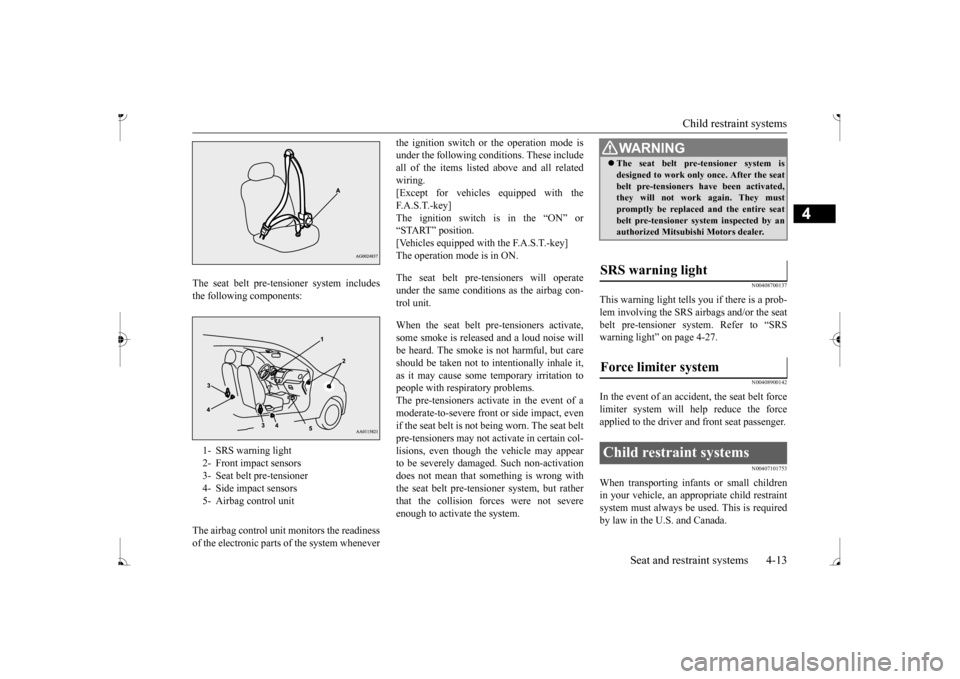
The seat belt pre-tensioner system includes the following components: The airbag control unit monitors the readiness of the electronic parts of the system whenever
the ignition switch or the operation mode is under the following conditions. These includeall of the item
s listed above a
nd all related
wiring. [Except for vehicles equipped with theF.A.S.T.-key] The ignition switch is in the “ON” or “START” position.[Vehicles equipped with the F.A.S.T.-key] The operation mode is in ON. The seat belt pre-tens
ioners will operate
under the same conditions
as the airbag con-
trol unit. When the seat belt pre-tensioners activate, some smoke is released
and a loud noise will
be heard. The smoke is
not harmful, but care
should be taken not to in
tentionally inhale it,
as it may cause some
temporary irritation to
people with respiratory problems. The pre-tensioners activa
te in the event of a
moderate-to-severe front
or side impact, even
if the seat belt is not being worn. The seat belt pre-tensioners may not ac
tivate in certain col-
lisions, even though the vehicle may appearto be severely damage
d. Such non-activation
does not mean that something is wrong with the seat belt pre-tens
ioner system, but rather
that the collision forc
es were not severe
enough to activate the system.
N00408700137
This warning light tells you if there is a prob- lem involving the SRS airbags and/or the seat belt pre-tensioner system. Refer to “SRS warning light” on page 4-27.
N00408900142
In the event of an accident, the seat belt forcelimiter system will help reduce the forceapplied to the driver a
nd front seat passenger.
N00407101753
When transporting infants or small children in your vehicle, an appr
opriate child restraint
system must always be
used. This is required
by law in the U.S. and Canada.
1- SRS warning light 2- Front impact sensors 3- Seat belt
pre-tensioner
4- Side impact sensors 5- Airbag control unit
WA R N I N G The seat belt pre-tensioner system is designed to work only
once. After the seat
belt pre-tensioners have been activated,they will not work again. They must promptly be replaced and the entire seat belt pre-tensioner system inspected by anauthorized Mitsubis
hi Motors dealer.
SRS warning light Force limiter system Child restraint systems
BK0236100US.book 13 ページ 2016年2月1日 月曜日 午前10時15分
Page 41 of 307
Child restraint systems 4-16 Seat and restraint systems
4
N00418801183
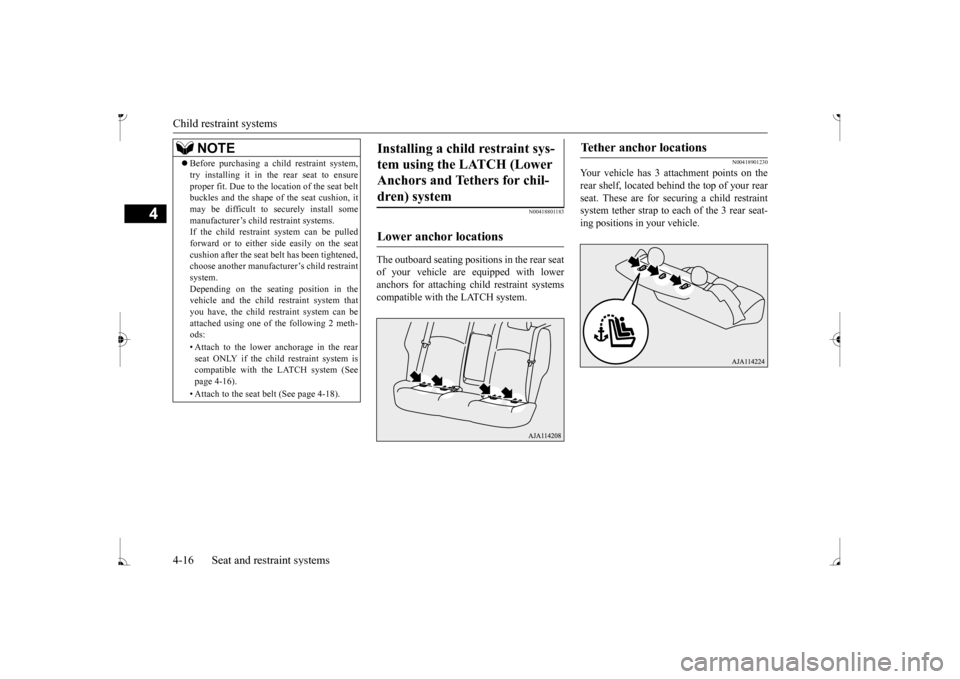
The outboard seating positions in the rear seat of your vehicle are equipped with lower anchors for attaching child restraint systems compatible with the LATCH system.
N00418901230
Your vehicle has 3 attachment points on the rear shelf, located behind the top of your rear seat. These are for securing a child restraintsystem tether strap to each of the 3 rear seat- ing positions in your vehicle.
NOTE
Before purchasing a child restraint system, try installing it in the rear seat to ensureproper fit. Due to the location of the seat beltbuckles and the shape of the seat cushion, it may be difficult to securely install some manufacturer’s child restraint systems.If the child restraint system can be pulled forward or to either side easily on the seat cushion after the seat
belt has been tightened,
choose another manufactu
rer’s child restraint
system. Depending on the seating position in thevehicle and the child restraint system that you have, the child restraint system can be attached using one of
the following 2 meth-
ods: • Attach to the lower anchorage in the rear seat ONLY if the child restraint system is compatible with the LATCH system (See page 4-16).
Page 45 of 307
Child restraint systems 4-20 Seat and restraint systems
4
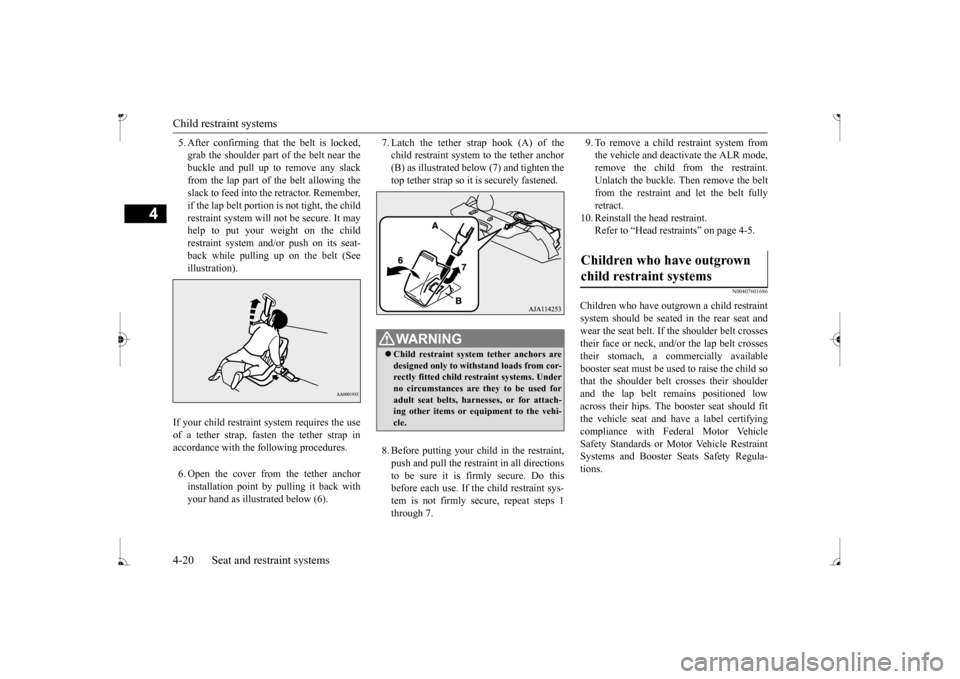
5. After confirming that the belt is locked, grab the shoulder part of the belt near thebuckle and pull up to remove any slack from the lap part of the belt allowing the slack to feed into the retractor. Remember,if the lap belt portion is not tight, the child restraint system will
not be secure. It may
help to put your weight on the childrestraint system and/or push on its seat- back while pulling up on the belt (See illustration). 6. Open the cover from the tether anchor installation point by pulling it back with your hand as illustrated below (6).
7. Latch the tether strap hook (A) of the child restraint system to the tether anchor(B) as illustrated below (7) and tighten the top tether strap so it is securely fastened. 8. Before putting your child in the restraint, push and pull the restraint in all directions to be sure it is firmly secure. Do this before each use. If the child restraint sys-tem is not firmly s
ecure, repeat steps 1
through 7.
9. To remove a child restraint system from the vehicle and deactivate the ALR mode,remove the child from the restraint. Unlatch the buckle. Then remove the belt from the restraint and let the belt fullyretract.
10. Reinstall the head restraint.
Refer to “Head rest
raints” on page 4-5.
N00407601686
Children who have outgrown a child restraint system should be
seated in the rear seat and
wear the seat belt. If the shoulder belt crossestheir face or neck, and/or the lap belt crosses their stomach, a commercially available booster seat must be used
to raise the child so
that the shoulder belt
crosses their shoulder
and the lap belt re
mains positioned low
across their hips. The
booster seat should fit
the vehicle seat and ha
ve a label certifying
compliance with Federal Motor Vehicle Safety Standards or Motor Vehicle RestraintSystems and Booster Se
ats Safety Regula-
tions.
If your child restraint system requires the use of a tether strap, fasten the tether strap in accordance with the following procedures.
WA R N I N G Child restraint system tether anchors are designed only to with
stand loads from cor-
rectly fitted child restraint systems. Underno circumstances are they to be used for adult seat belts, harnesses, or for attach- ing other items or eq
uipment to the vehi-
cle.
Children who have outgrown child restraint systems
BK0236100US.book 20 ページ 2016年2月1日 月曜日 午前10時15分
Page 47 of 307
Supplemental Restraint System (SRS) - airbag 4-22 Seat and restraint systems
4
tion from the vehicle through side windows in both side impact an
d rollover type acci-
dents. The SRS airbags are NOT a substitute for use of the seat belts. For maximum protection in all types of accident
s, seat belts must
ALWAYS be worn by everyone who drives or rides in this vehicle (with infants and small children in an appropriate child restraint sys-tem in the rear seat, and older children buck- led in the rear seat). Refer to “Child restraint systems” on page 4-13.
WA R N I N G IT IS VERY IMPORTANT TO ALWAYS WEAR YOUR SEAT BELT PROPERLY EVEN WITH AN AIRBAG.• Seat belts help keep the driver and pas-sengers properly positioned. This reduces the risk of injury in all collisions,and reduces the risk of serious injuries or death when the airbags inflate. During sudden brakin
g just before a col-
lision, an unrestra
ined or improperly
restrained driver or passengers can move forward into direct contact with, orwithin close proximity to, the airbag when it begins to inflate. The beginning stage of
airbag inflation is
the most forceful and can cause serious injuries or death if the occupant comes in contact with the ai
rbag at this time.
• Seat belts reduce the risk of injury in rear impact collisions, and in lower-speed frontal collisions because the air-bags are not designed to inflate in those situations.• Seat belts reduce the risk of beingthrown from your vehi
cle in a collision or
rollover.
IT IS VERY IMPORTANT TO BE PROP- ERLY SEATED.• A driver or front passenger sitting tooclose to the steering wheel or instrumentpanel during airbag deployment can be seriously injure
d or killed.
• Airbags inflate ve
ry quickly and with
great force. If the driver and front pas- senger are not properly seated andrestrained, the airbag may not provide the proper protection, and can cause serious injuries or death when it inflates.• To reduce the risk to the driver of seriousinjury or death due to a deployingdriver’s airbag, al
ways properly wear
your seat belt and ad
just the driver’s seat
as far back as possible, maintaining aposition that still
allows the driver to
have good control of the steering wheel, brake, accelerator,
and other vehicle con-
trols.WA R N I N G
• To reduce the risk to the front passengerof serious injury or
death from a deploy-
ing passenger’s airbag, make sure thepassenger always wears the seat belt properly, remains seat
ed upright and all
the way back in the
seat, and positions
the seat as far back as possible.• Seat all infants and children in the rearseat, properly restrain
ed in an appropri-
ate child restraint system.
Airbags inflate very
quickly and with
great force. Do not sit on the edge of the seat or sit with your
lower legs too close to
the instrument panel,
or lean your head or
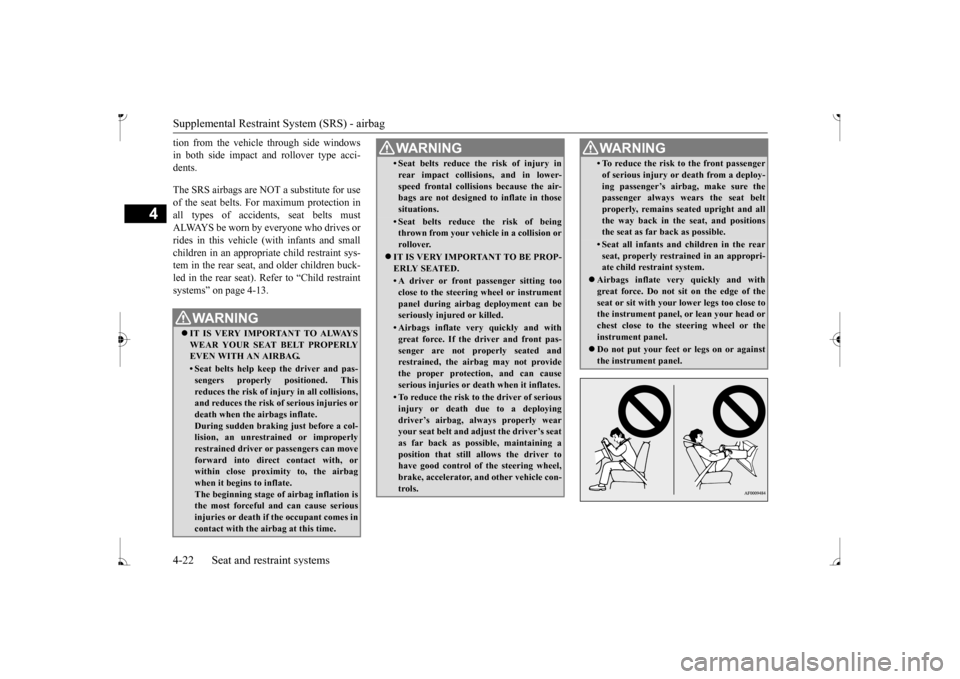
chest close to the steering wheel or the instrument panel. Do not put your feet or
legs on or against
the instrument panel.WA R N I N G
BK0236100US.book 22 ページ 2016年2月1日 月曜日 午前10時15分
Page 48 of 307
Supplemental Restraint System (SRS) - airbag
Seat and restraint systems 4-23
4
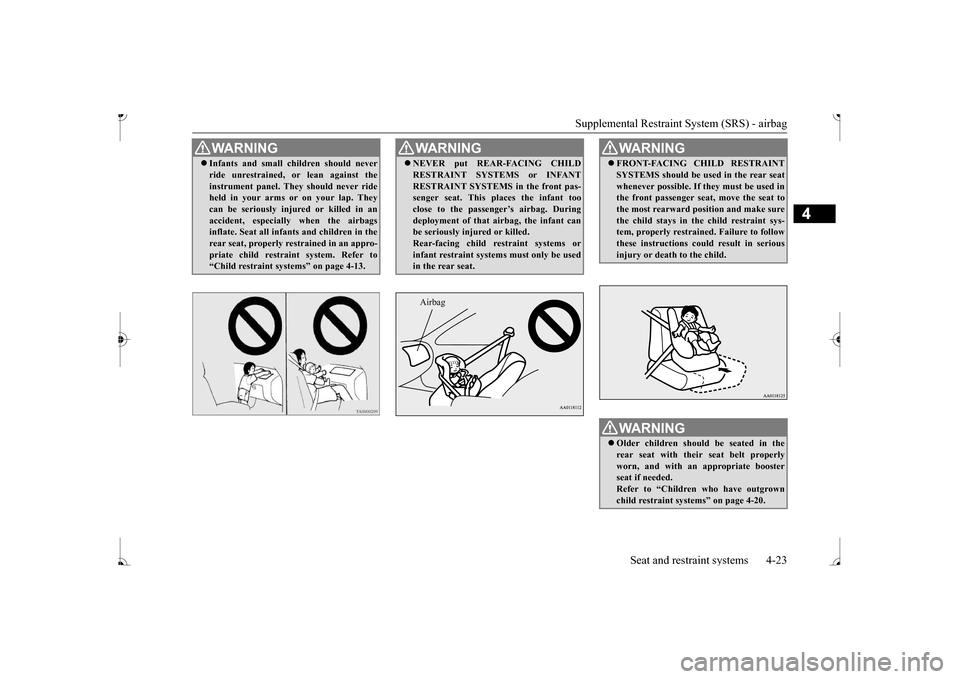
WA R N I N G Infants and small children should never ride unrestrained,
or lean against the
instrument panel. They should never rideheld in your arms or on your lap. They can be seriously inju
red or killed in an
accident, especially when the airbagsinflate. Seat all infants and children in the rear seat, properly re
strained in an appro-
priate child restraint system. Refer to“Child restraint syst
ems” on page 4-13.
WA R N I N GNEVER put REAR-FACING CHILD RESTRAINT SYSTEMS or INFANTRESTRAINT SYSTEMS in the front pas-senger seat. This places the infant too close to the passenger’s airbag. During deployment of that airbag, the infant canbe seriously inju
red or killed.
Rear-facing child restraint systems or infant restraint systems must only be usedin the rear seat.Airbag
WA R N I N G FRONT-FACING CHILD RESTRAINT SYSTEMS should be used in the rear seatwhenever possible. If they must be used inthe front passenger seat, move the seat to the most rearward position and make sure the child stays in the child restraint sys-tem, properly restrained. Failure to follow these instructions could result in serious injury or death to the child.WA R N I N G Older children should be seated in the rear seat with their seat belt properly worn, and with an
appropriate booster
seat if needed.Refer to “Children
who have outgrown
child restraint syst
ems” on page 4-20.
BK0236100US.book 23 ページ 2016年2月1日 月曜日 午前10時15分
Page 50 of 307
Supplemental Restraint System (SRS) - airbag
Seat and restraint systems 4-25
4
The main purpose of an EDR is to record, in certain crash or near
crash-like situations,
such as an airbag deployment or hitting a road obstacle, data that
will assist in under-
standing how a vehicl
e’s systems performed.
The EDR is designed to record data related to vehicle dynamics and safety systems for a short period of time,
typically 30 seconds or
less. The EDR in this vehicle is designed to record such data as: How various systems
in your vehicle were
operating; Whether or not the driver and front pas- senger safety belts we
re buckled/fastened;
How far (if at all) the driver was depress- ing the accelerator and/or brake pedal; and, How fast the vehicle was traveling.
These data can help provide a better under- standing of the circumstances in which crashes and injuries occur.
To read data recorded by an EDR, special equipment is required, and access to the vehi-cle or the EDR is needed. In addition to the vehicle manufacturer, ot
her parties, such as
law enforcement, that have the special equip-ment, can read the information if they have access to the vehicle or the EDR.
N00417900223
The driver’s seat position sensor is attachedto the seat rail and provides the airbag control unit with information on the seat’s fore-aftposition. The airbag control unit controls deployment of the driver’s front airbag in accordance with the information it receivesfrom this sensor. If there is a problem involving the driver’s seat position sensor, the SRS warning light inthe instrument panel will come on. Refer to
“SRS warning light” on page 4-27.
N00418000364
The passenger’s seat oc
cupant classification
sensor system is attach
ed to the front passen-
ger seat cushion and provides the airbag con- trol unit with information regarding theoccupant on the front passenger seat. The air- bag control unit controls deployment of the
NOTE
EDR data are recorded by your vehicle only if a non-trivial crash si
tuation occurs; no data
are recorded by the EDR under normal driv-ing conditions and no personal data (e.g., name, gender, age, a
nd crash location) are
recorded. However, ot
her parties, such as
law enforcement, could combine the EDR data with the type of
personally identifying
data routinely acquire
d during a crash inves-
tigation.
Driver’s seat position sensor
WA R N I N G If the SRS warning
light comes on, have
the vehicle inspected by an authorized Mitsubishi Motors dealer as soon as possi-ble. Please observe the following instructions to ensure that the driver’s seat position sensor can operate correctly.• Adjust the seat to the correct position,and sit well back
against the seatback.
Refer to “Front seats” on page 4-2.• Do not recline the seatback more thannecessary when driving.• Do not place metallic objects or luggageunder the front seat.
If the vehicle is involved in a severe impact, have the SRS sensor inspected byan authorized
Mitsubishi Motors dealer as
soon as possible.
Passenger’s seat occupant clas- sification sensor system
BK0236100US.book 25 ページ 2016年2月1日 月曜日 午前10時15分
Page 51 of 307

Supplemental Restraint System (SRS) - airbag 4-26 Seat and restraint systems
4
passenger’s front airbag in accordance with the information it receives from this system.The passenger’s front airbag will not deploy in an impact when the system senses no occu- pant on the front passenger
seat or a child in a
child restraint system.
In this case, the pas-
senger’s airbag off indicator will illuminate. Refer to “Passenger’s ai
rbag off indicator” on
page 4-26. If there is a problem involving the passen- ger’s seat occupant cl
assification sensor sys-
tem, the SRS warning light in the instrument panel will come on.Refer to “SRS warning light” page 4-27.
N00418101359
The passenger’s airbag off indicator islocated at shown in the illustration. The indicator normally comes on when the ignition switch is turned to the “ON” position or the operation mode is put in ON, and goes out a few seconds later.
In the following situ-
ations, the indicator will stay on to show that the passenger front airb
ag is not operational.
The front passenger se
at is not occupied.
WA R N I N GIf any of the follow
ing conditions occur,
you should immediatel
y have your vehicle
inspected by an au
thorized Mitsubishi
Motors dealer as soon as possible:• The SRS warning light does not initiallycome on when the ignition switch or theoperation mode is under the following conditions.• [Except for vehicles equipped with theF. A . S . T. - k e y ] The ignition switch is in the “ON” or“START” position. [Vehicles equipped with the F.A.S.T.-key] The operation mode is in ON.• The SRS warning light does not go outafter several seconds.
• The SRS warning li
ght comes on while
you are driving.
To ensure that the passenger’s seat occu- pant classification sensor system can sense correctly, observe the following instruc-tions. Failure to follow these instructions can adversely affect
the performance of
the passenger’s airbag system.• Adjust the seat to the correct position,and sit well back
against the seatback.
Refer to “Front seats” on page 4-2.• Do not recline the seatback more thannecessary.• Never have more th
an one person (adult
or child) sitting on the seat.• Do not place anything between the seatand the floor console.• When attaching a child restraint system,secure it firmly.• Do not place luggage or other objects onthe seat.• Do not use a seat cover or a cushion.• Do not modify or re
place the seat and
seat belt.• Do not place luggage or other objectsunder the seat.• Do not place and use
an electronic device
such as a computer on the seat.• Do not place heavy obje
cts on the seat or
stick pins, needles, or other objects intoit.• Do not remove the seat cushion skin.WA R N I N G
• If any liquid is spilled on the seat, wipe itand dry the seat immediately.
If the vehicle is involved in a severe impact, have the SRS sensors inspected by an authorized
Mitsubishi Motors dealer as
soon as possible.
Passenger’s airbag off indicator
WA R N I N G
BK0236100US.book 26 ページ 2016年2月1日 月曜日 午前10時15分
Page 59 of 307

Supplemental Restraint System (SRS) - airbag 4-34 Seat and restraint systems
4
N00408201588
The side airbag and curtain airbag are designed to deploy when the vehicle suffers a moderate to seve
re side impact to the middle
of the passenger compartment. Also when the vehicle
detects rollover of the
vehicle, the curtain ai
r bags will deploy.
Typical situations are
shown in the illustra-
tion.
The seat belts in your
vehicle are your pri-
mary means of protecti
on in an accident. The
SRS side airbags and curtain airbags are designed to provide
additional protection.
Therefore, for your safety and the safety of alloccupants, be sure to always wear your seat belts properly. In certain types of side
collisions, the side air-
bag and curtain airbag
may not deploy, even
if the deformation of the body seems to belarge, because the vehicle’s body structure is designed to absorb the impact and to deform in order to help protect the occupants. Thereare also cases where the side airbag and cur- tain airbag may not deploy at the same time, depending on the location of the impact.Some typical situations where the side air- bags and curtain airb
ags may not deploy are
shown in the illustra
tions on the following
page. Since the side airbags and curtain airbags do not protect the occupant
in all types of side
collisions, be sure to
always wear the seat
belts properly.
Deployment of side airbag and curtain airbag The side airbag and curtain airbag ARE DESIGNED TO DEPLOY when... Moderate to severe impact to the middle of the vehicle body’s side structure When the vehicle detects rollover of the vehicle (Curtain airbag only)
The side airbag and curtain airbag MAY NOT DEPLOY when...
Side impact in an area away from the passenger compartment Motorcycle or other similar small vehicle colli- sion with the side of vehicle Collision with a utility pole
, tree or other narrow
object
BK0236100US.book 34 ページ 2016年2月1日 月曜日 午前10時15分
Page 63 of 307
Break-in recommendations 5-2 Features and controls
5
N00508701382
Advanced automobile manufacturing tech- niques permit you to operate your new vehi- cle without requiring
a long break-in period
of low-speed driving. However, you can add to the future perfor- mance and economy of your vehicle byobserving the followi
ng precautions during
the first 300 miles (500 km). Drive your vehicle at moderate speeds during the break-in period. Avoid revving the engine. Avoid rough driving such as sudden starts, sudden acceleration, prolonged high- speed driving and sudden braking. These would have a detrimen
tal effect on the
engine and also cause increased fuel and oil consumption, wh
ich could result in
malfunction of the engine components. Beparticularly careful to
avoid full accelera-
tion while in low shift position (low gears). Do not overload the ve
hicle. Stay within
the seating capacity. (Refer to “Cargo load precautions” on page 6-10.) Do not use this vehi
cle for trailer towing.
N00508801703
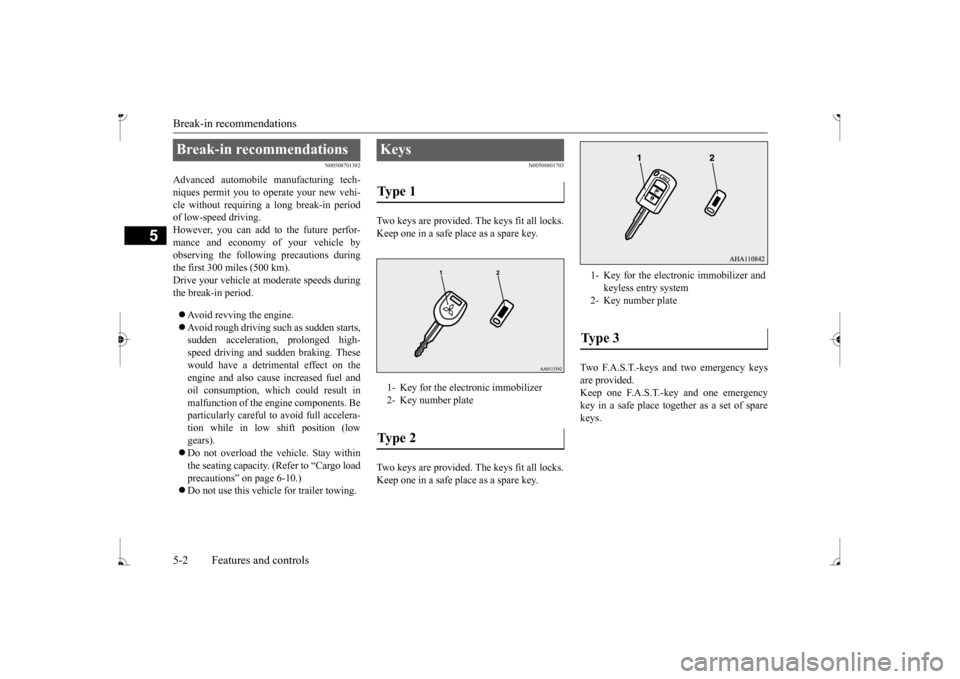
Two keys are provided. The keys fit all locks. Keep one in a safe place as a spare key. Two keys are provided. The keys fit all locks. Keep one in a safe place as a spare key.
Two F.A.S.T.-keys and two emergency keys are provided. Keep one F.A.S.T.-key and one emergency key in a safe place together as a set of sparekeys.
Break-in recommendations
Keys Type 1 1- Key for the electronic immobilizer2- Key number plateType 2
1- Key for the electr
onic immobi
lizer and
keyless entry system
2- Key number plateTy p e 3
BK0236100US.book 2 ページ 2016年2月1日 月曜日 午前10時15分
Page 64 of 307
![MITSUBISHI MIRAGE 2017 6.G User Guide Electronic immobilizer (Ant
i-theft starting system)
Features and controls 5-3
5
N00509100780
[For vehicles equipped with the Free-hand Advanced Security Transmitter (F.A.S.T.-key)] For information o](/img/19/7512/w960_7512-63.png "MITSUBISHI MIRAGE 2017 6.G User Guide Electronic immobilizer (Ant
i-theft starting system)
Features and controls 5-3
5
N00509100780
[For vehicles equipped with the Free-hand Advanced Security Transmitter (F.A.S.T.-key)] For information o")
Electronic immobilizer (Ant
i-theft starting system)
Features and controls 5-3
5
N00509100780
[For vehicles equipped with the Free-hand Advanced Security Transmitter (F.A.S.T.-key)] For information on operations for vehicles equipped with the Free-hand Advanced Secu-rity Transmitter (F.A
.S.T.-key), refer to
“Free-hand Advanced
Security Transmitter
(F.A.S.T.-key): Electr
onic immobilizer (Anti-
theft starting system)” on page 5-19. [Except for vehicles e
quipped with the Free-
hand Advanced Secu
rity Transmitter
(F.A.S.T.-key)]The electronic immobilizer is designed to sig- nificantly reduce the
possibility of vehicle
theft. The purpose of the system is to immo-bilize the vehicle if an invalid start is
1- F.A.S.T.-key
(with electronic immobilizer and key-less entry system function)
2- Emergency key 3- Key number plate
NOTE
The keyless entry key and F.A.S.T.-key are a precision electr
onic device wi
th a built-in
signal transmitter. Please observe the follow- ing in order to prevent damage. • Do not leave where it may be exposed to heat caused by direct sunlight, such as on top of the dashboard. • Do not take the remote
control transmitter
apart. • Do not excessively bend the key or subject it to strong impacts. • Keep the remote control transmitter dry. • Keep away from magne
tic objects such as
key rings.
• Keep away from devi
ces that produce mag-
netism, such as audio systems, computersand televisions. • Keep away from device
s that emit strong
electromagnetic waves, such as cellularphones, wireless devices and high fre- quency equipment (i
ncluding medical
devices). • Do not clean with ultrasonic cleaners. • Do not leave the key where it may be exposed to high temperature or high humid- ity.
If you lose your key, to prevent the theft of the vehicle immediatel
y contact an autho-
rized Mitsubishi Motors dealer. If you notify an authorized Mitsubishi Motors dealer of the key number, they canmake a new key. The key number is stamped on the key number plate. Keep the key num- ber plate in a safe pl
ace separate from the
key itself. No keys other than those registered in advance can be used to start the engine. Refer to “Electronic immobilizer (Anti-theft starting system)” on page 5-3.Refer to “Free-hand Advanced Security Transmitter (F.A.S.T.-key): “Electronic immobilizer (Anti-thef
t starting system)” on
page 5-19.NOTE
When the theft-alarm is in the system opera- tional status, the alar
m operates if a door is
opened after using th
e key, the door lock
knob or the power door lock switch to unlock the vehicle. The system does not enter the preparation status if the keyless entry system or the F.A.S.T.-key was not used to lock the vehi-cle.
Electronic immobilizer (Anti-theft starting system)
NOTE
BK0236100US.book 3 ページ 2016年2月1日 月曜日 午前10時15分