belt MITSUBISHI MONTERO 1987 1.G Owner's Manual
[x] Cancel search | Manufacturer: MITSUBISHI, Model Year: 1987, Model line: MONTERO, Model: MITSUBISHI MONTERO 1987 1.GPages: 284, PDF Size: 14.74 MB
Page 267 of 284
AIR-CONDITIONING-Service Adiustment Procedures 24-31
FREEZE UP CONTROL
Evaporator freeze up is controlled by a thermistor attached to the
evaporator fins. The control is an electronic type and consists of
two parts_(thermo relay and thermistor.) It is connected to the
magnetic clutch of the compressor in series. When the tempera-
ture of the evaporator drops below 3°C (37.4”F), the compressor is
turned OFF.
To Test the Thermistor
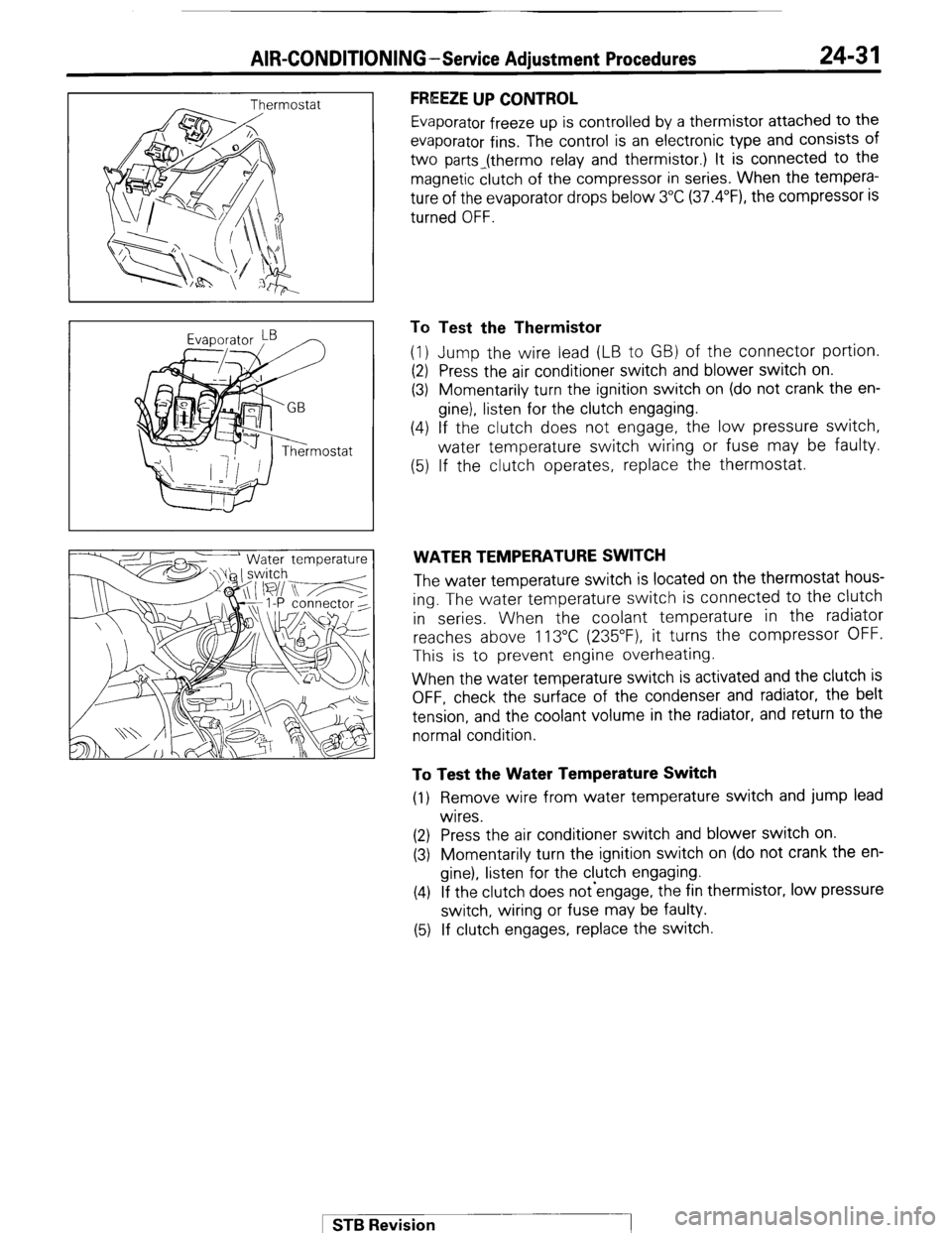
(1) Jump the wire lead (LB to GB) of the connector portion.
(2) Press the air conditioner switch and blower switch on.
(3) Momentarily turn the ignition switch on (do not crank the en-
gine), listen for the clutch engaging.
(4) If the clutch does not engage, the low pressure switch,
water temperature switch wiring or fuse may be faulty.
(5) If the clutch operates, replace the thermostat.
WATER TEMPERATURE SWITCH
The water temperature switch is located on the thermostat hous-
ing. The water temperature switch is connected to the clutch
in series. When the coolant temperature in the radiator
reaches above 113°C (235”F), it turns the compressor OFF.
This is to prevent engine overheating.
When the water temperature switch is activated and the clutch is
OFF, check the surface of the condenser and radiator, the belt
tension, and the coolant volume in the radiator, and return to the
normal condition.
To Test the Water Temperature Switch
(1) Remove wire from water temperature switch and jump lead
wires.
(2) Press the air conditioner switch and blower switch on.
(3) Momentarily turn the ignition switch on (do not crank the en-
gine), listen for the clutch engaging.
(4) If the clutch does not-engage, the fin thermistor, low pressure
switch, wiring or fuse may be faulty.
(5) If clutch engages, replace the switch.
1 STB Revision
Page 276 of 284
24-40 AIR-CONDITIONING-Service Adjustment Procedures
Nut
I Union
20110267
Tension pulley IOON (22 Ibs.1 Compressor
Crankshaft
pulley
I 2OY907 1 O-RING INSTALLATION
(1) Clean sealing surface.
(2) Make sure O-ring does not have any scratches.
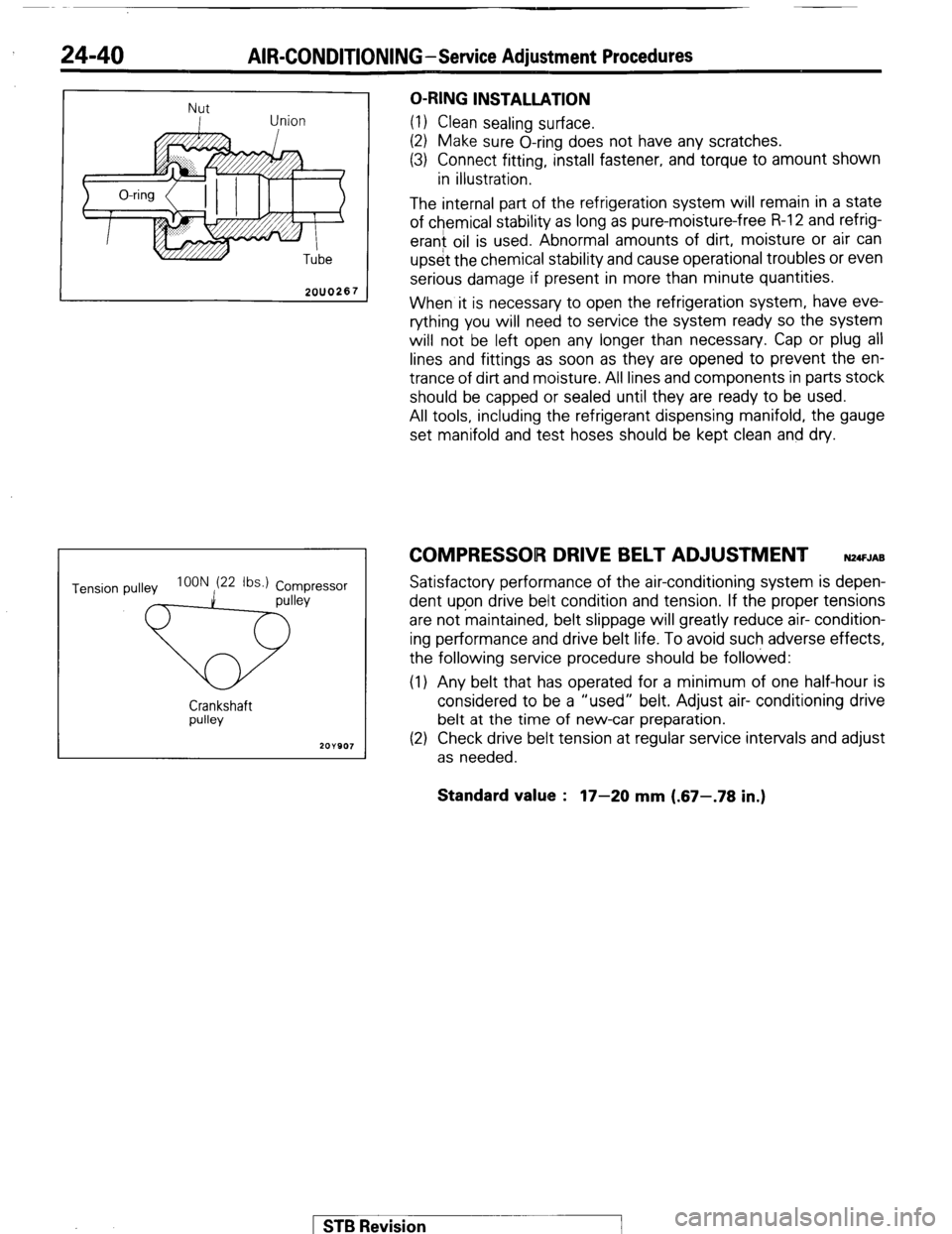
(3) Connect fitting, install fastener, and torque to amount shown
in illustration.
The internal part of the refrigeration system will remain in a state
of chemical stability as long as pure-moisture-free R-l 2 and refrig-
erant oil is used. Abnormal amounts of dirt, moisture or air can
upset the chemical stability and cause operational troubles or even
serious damage if present in more than minute quantities.
When it is necessary to open the refrigeration system, have eve-
rything you will need to service the system ready so the system
will not be left open any longer than necessary. Cap or plug all
lines and fittings as soon as they are opened to prevent the en-
trance of dirt and moisture. All lines and components in parts stock
should be capped or sealed until they are ready to be used.
All tools, including the refrigerant dispensing manifold, the gauge
set manifold and test hoses should be kept clean and dry.
COMPRESSOR DRIVE BELT ADJUSTMENT N24FJAE
Satisfactory performance of the air-conditioning system is depen-
dent upon drive belt condition and tension. If the proper tensions
are not maintained, belt slippage will greatly reduce air- condition-
ing performance and drive belt life. To avoid such adverse effects,
the following service procedure should be followed:
(1) Any belt that has operated for a minimum of one half-hour is
considered to be a “used” belt. Adjust air- conditioning drive
belt at the time of new-car preparation.
(2) Check drive belt tension at regular service intervals and adjust
as needed.
Standard value :
17-20 mm (.67-.78 in.)
1 STB Revision
-7
Page 277 of 284
AIR-CONDITIONING -Service Adjustment Procedures 24-41
COMPRESSOR NOISE NWLM
When investigating an air conditioning related noise, you must first know the conditions when the noise occurs.
These conditions are: weather, vehicle speed, in gear or neutral, engine temperature or any other special
conditions.
Noises that develop during air- conditioning operation can often be misleading. For example: what sounds like a
failed front bearing or connecting rod, may be caused by loose bolts, nuts, mounting brackets, or a loose clutch
assembly. Verify accessory drive belt tension (power
steering, alternator or air pump). Improper accessory drive belt
tension can cause a misleading noise when the compressor is engaged and little or no noise when the compressor
is disengaged.
Drive belts are speed sensitive. That is, at different engine speeds, and depending upon belt tension, belts can
develop unusual noises that are often mistaken for mechanical problems within the compressor.
Adjustment Procedures
(1) Select a quiet area for testing. Duplicate conditions as much as possible. Switch compressor on and off several
times to clearly identify compressor noise.
To duplicate high ambient conditions (high head pressure), restrict air-flow through
condenser. Install
manifold gauge set to make sure discharge pressure does not exceed 2,070 kPa (300 psi).
(2) Tighten all compressor mounting bolts, clutch mounting bolt, and compressor drive belt. Check to assure clutch
coil is tight (no rotation or wobble).
(3) Check refrigerant hoses for rubbing or interference that can cause unusual noises.
(4) Check refrigerant charge (See “Charging the System”).
(5) Recheck compressor noise as in Step 1.
(6) If noise still exists, loosen compressor mounting bolts and retorque. Repeat Step 1.
(7) If noise continues, replace compressor and repeat Step 1.
1 STB Revision
Page 281 of 284
AIR-CONDITIONING - Receiver drier, Condenser, Compressor Clutch Assembly 24-45
RECEIVER DRIER, CONDESER, COMPRESSOR CLUTCH ASSEMBLY
REMOVAL AND INSTALLATION N24TA--
Pre-removal Operation l Discharge the Refrigerant. (Refer to
P.24-36)
l Remove the Radiator Grille. (Refer
to GROUP 23 BODY-Grille, Garnish,
Moulding)
l Disconnect the Liquid Pipes and
Hoses.
Post-installation Operation
l Install the Radiator Grille. (Refer to
GROUP 23 BODY-Grille, Garnish,
Moulding)
l Charge the Refrigerant. (Refer to
P.24.37)
l Adjustment of the Tension of the
Air Conditioner Drive Belt. (Refer to
P.24-40)
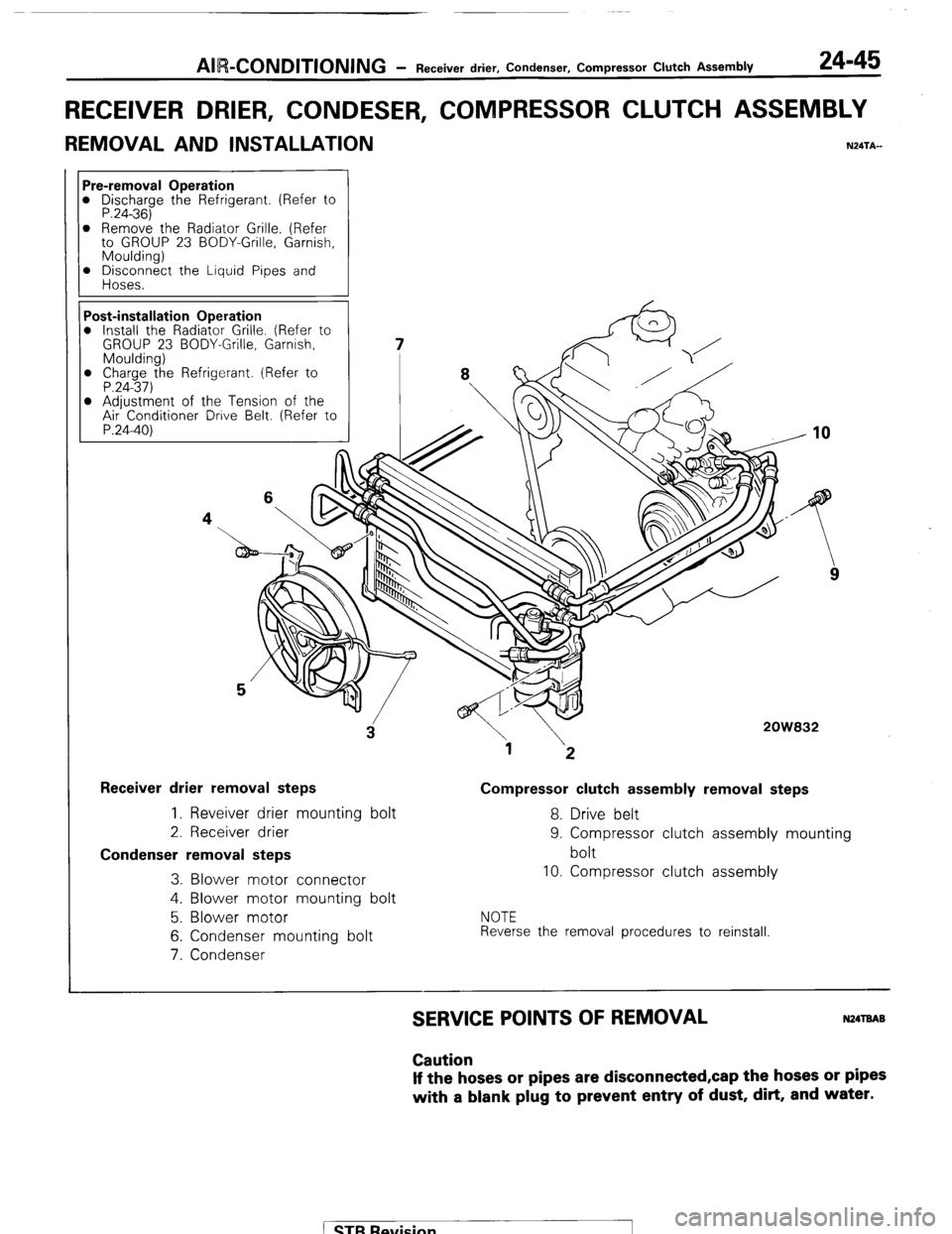
2OW832 Receiver drier removal steps
Compressor clutch assembly removal steps
1. Reveiver drier mounting bolt
8. Drive belt
2. Receiver drier
9. Compressor clutch assembly mounting
Condenser removal steps
3. Blower motor connector
4. Blower motor mounting bolt
5. Blower motor
6. Condenser mounting bolt
7. Condenser bolt
10. Compressor clutch assembly
NOTE
Reverse the removal procedures to reinstall.
SERVICE POINTS OF REMOVAL N24TBAB 1 STB Revision Caution
If the hoses or pipes are disconnected,cap the hoses or pipes
with a blank plug to prevent entry of dust, dirt, and water.