Vacuum MITSUBISHI MONTERO 1987 1.G Workshop Manual
[x] Cancel search | Manufacturer: MITSUBISHI, Model Year: 1987, Model line: MONTERO, Model: MITSUBISHI MONTERO 1987 1.GPages: 284, PDF Size: 14.74 MB
Page 59 of 284
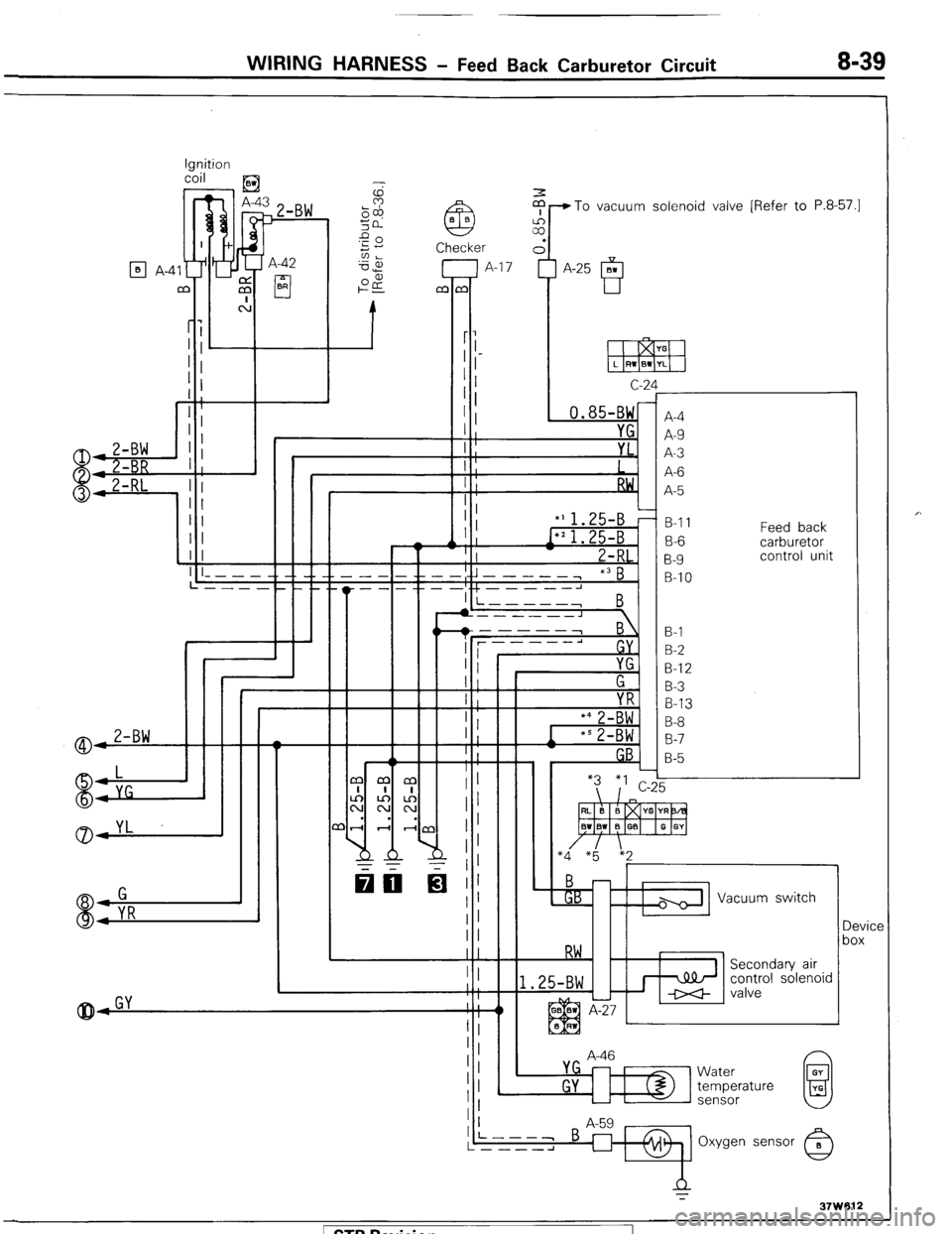
WIRING HARNESS - Feed Back Carburetor Circuit 8-39
Ignition
coil
) _ ,E3
$-To vacuum solenoid valve [Refer to P.8-57.1
7 A-42
cl BR
q A-4
c-2
, 0.85-BW
I YG
I ;
I : YL.
I
I ;
RW,
I :
‘A
f
r
A-4
A-9
A-3
A-6
A-5
B-l 1
B-6
B-9
B-IO Feed back
carburetor
control unit
I
II
II
(I I
1 I ! ! I I- - - - -. -_ __ __
L---- __._._
I +L----J I i-----,
B
B-l
B-2
B-l 2
B-3
B-13
B-8
B-7
B-5
A-46 Vacuum switch
Device
box
control solenoid
L
L
Water
temperature
sensor 1 STB Revision
Page 60 of 284
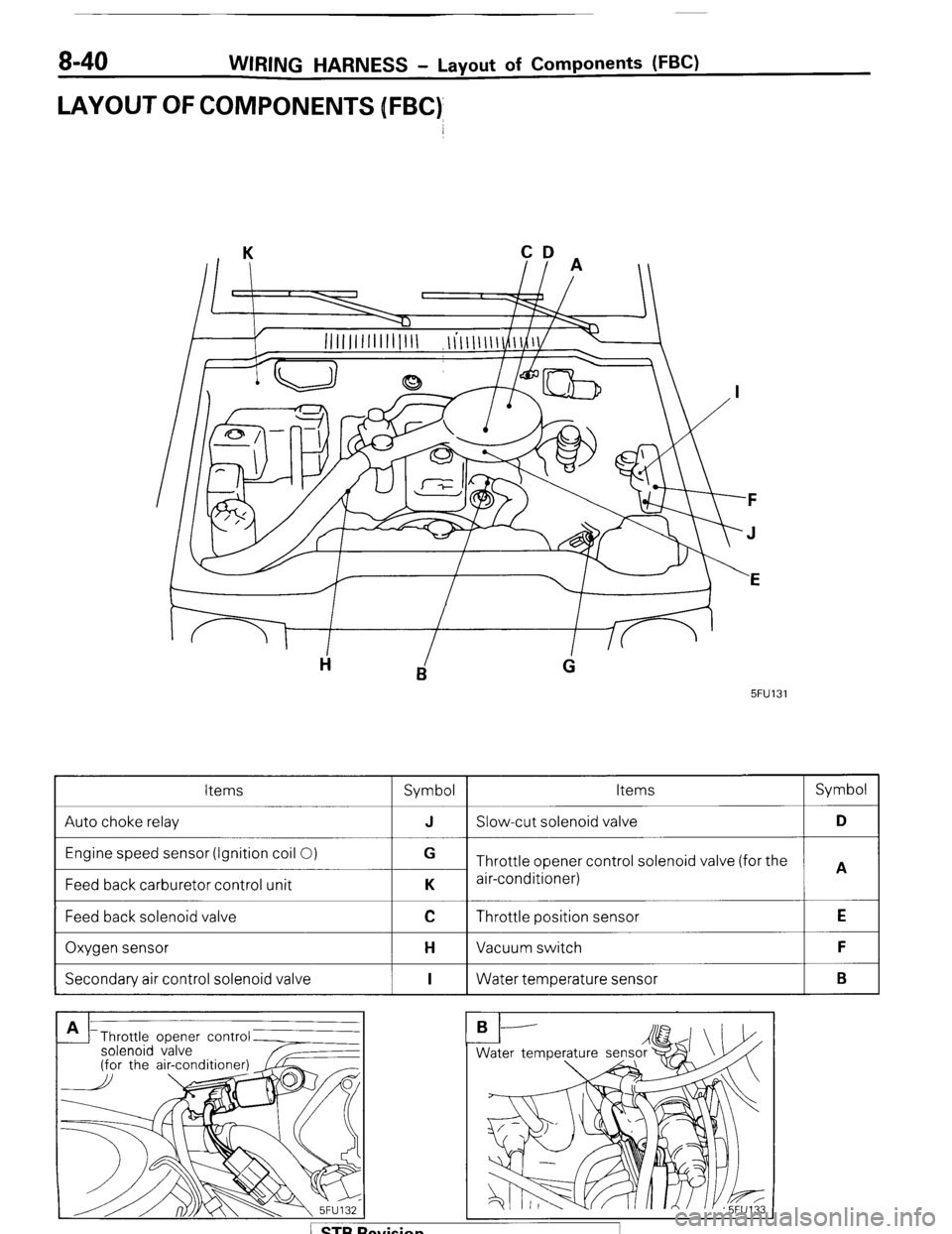
8-40 WIRING HARNESS - Layout of Components WC)
LAYOUT OFCOMPONENJS [FBC)
CD
II A
5FU131
Items
Symbol Items Symbol
Auto choke relay J Slow-cut solenoid valve D
Engine speed sensor (Ignition coil 0)
Feed back carburetor control unit G
Throttle opener control solenoid valve (for the
A
K air-conditioner)
Feed back solenoid valve
I
C Throttle position sensor
I E
Oxygen sensor
I H Vacuum switch
I F
Secondary air control solenoid valve
I I 1 Water temperature sensor
I B
Throttle opener contr
solenoid valve
Page 77 of 284
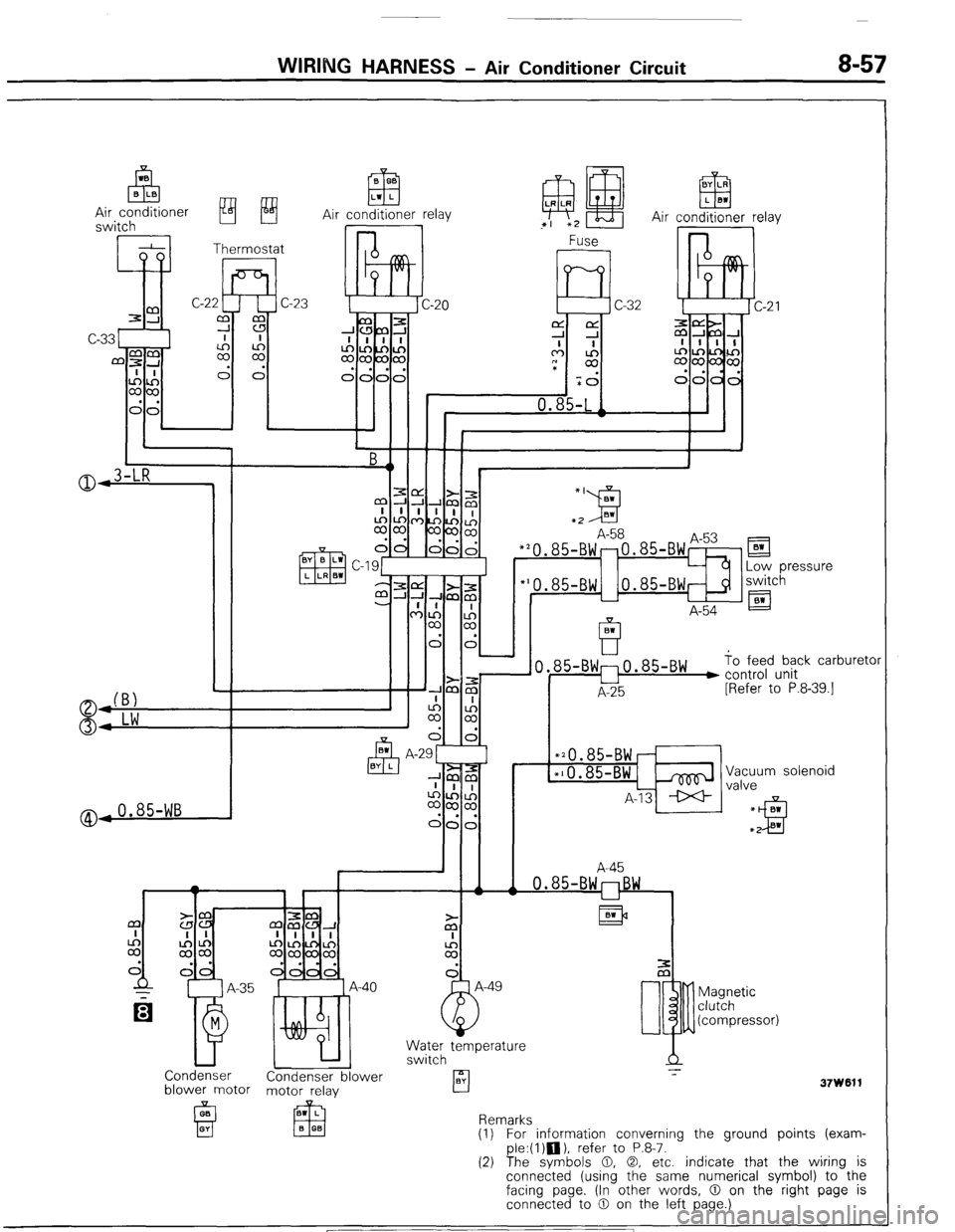
WIRING HARNESS - Air Conditioner Circuit 8-57
0
(Bl
0: Lw
@,0.85-WB B 0.3
ElFI Lvf L
Air conditioner relay I @ H ‘I *2 Air :on!$!er rela
85-Bw:o.85-Bw ) to feed back carburetor
u control unit
A-25 [Refer to P.8-39.1
l 20.85-BWr
l 10.85-BWL&
A-13 * Vacuum solenoid
valve
A-45
0.85-BWnBW
Is*la
Magnetic
clutch
(compressor)
U
Water temperature
switch
Condenser
Condenser blower -I-
BY
blower motor motor relay rl
37W611
Remarks
(1) For information converning the ground points (exam-
ple:(l)n), refer to P.8-7.
(2) The svmbols 0, 0, etc. indicate that the wiring is
connedted (using the same numerical symbol) to-the
facing page. (In other words, 0 on the right page is
connected to 0 on the left page.) ) STB Revision
Page 125 of 284
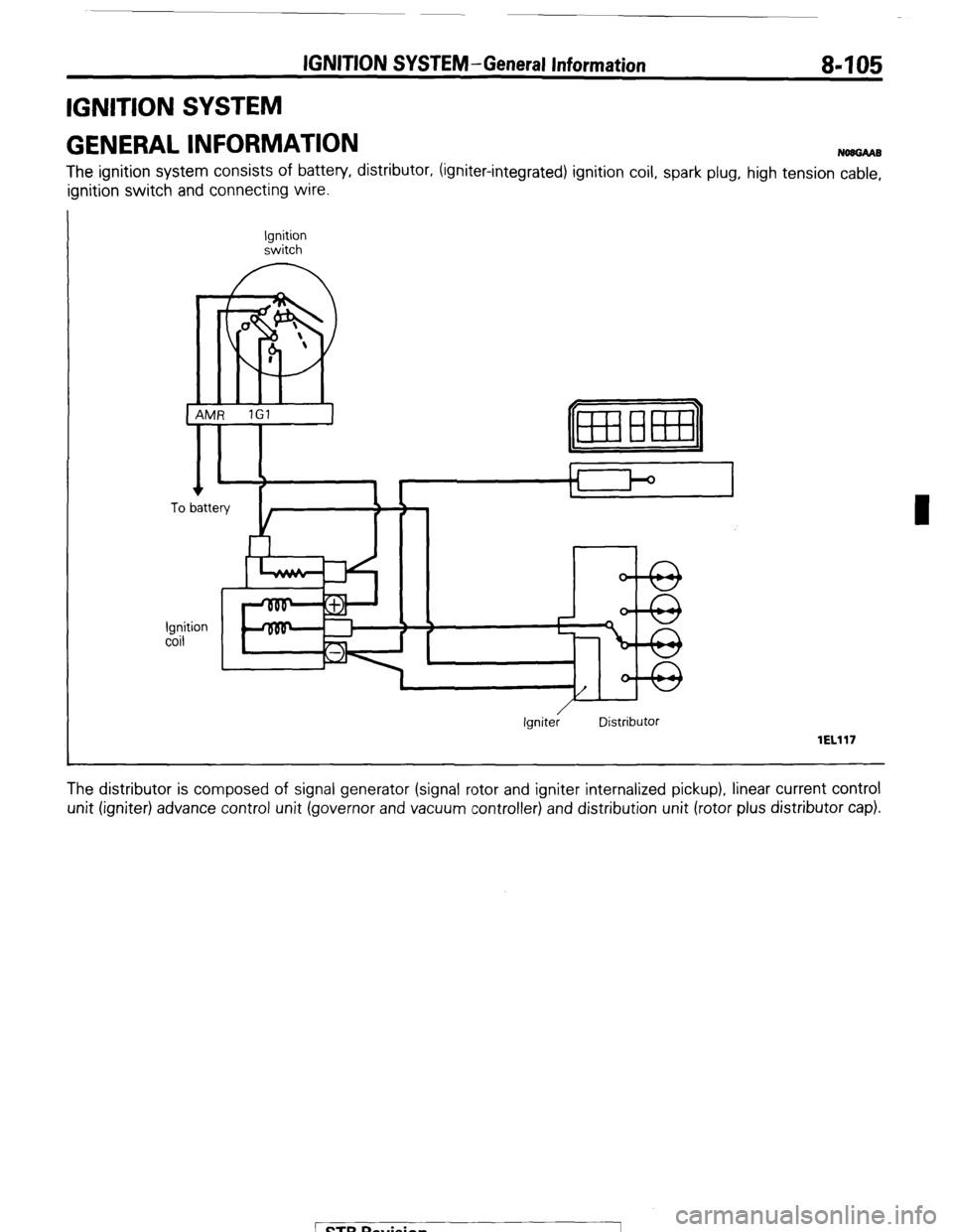
IGNITION SYSTEM -General Information 8-105
IGNITION SYSTEM
GENERAL INFORMATION
NOUGAAB
The ignition system consists of battery, distributor, (igniter-integrated) ignition coil, spark plug, high tension cable,
ignition switch and connecting wire.
Ignition
switch
0
m
I
1 AMR 1Gl
I
Ignition
coil
r
Ignite; Distributor
lEL117
The distributor is composed of signal generator (signal rotor and igniter internalized pickup), linear current control
unit (igniter) advance control unit (governor and vacuum controller) and distribution unit (rotor plus distributor cap).
Page 126 of 284
IGNITION SYSTEM-General Information
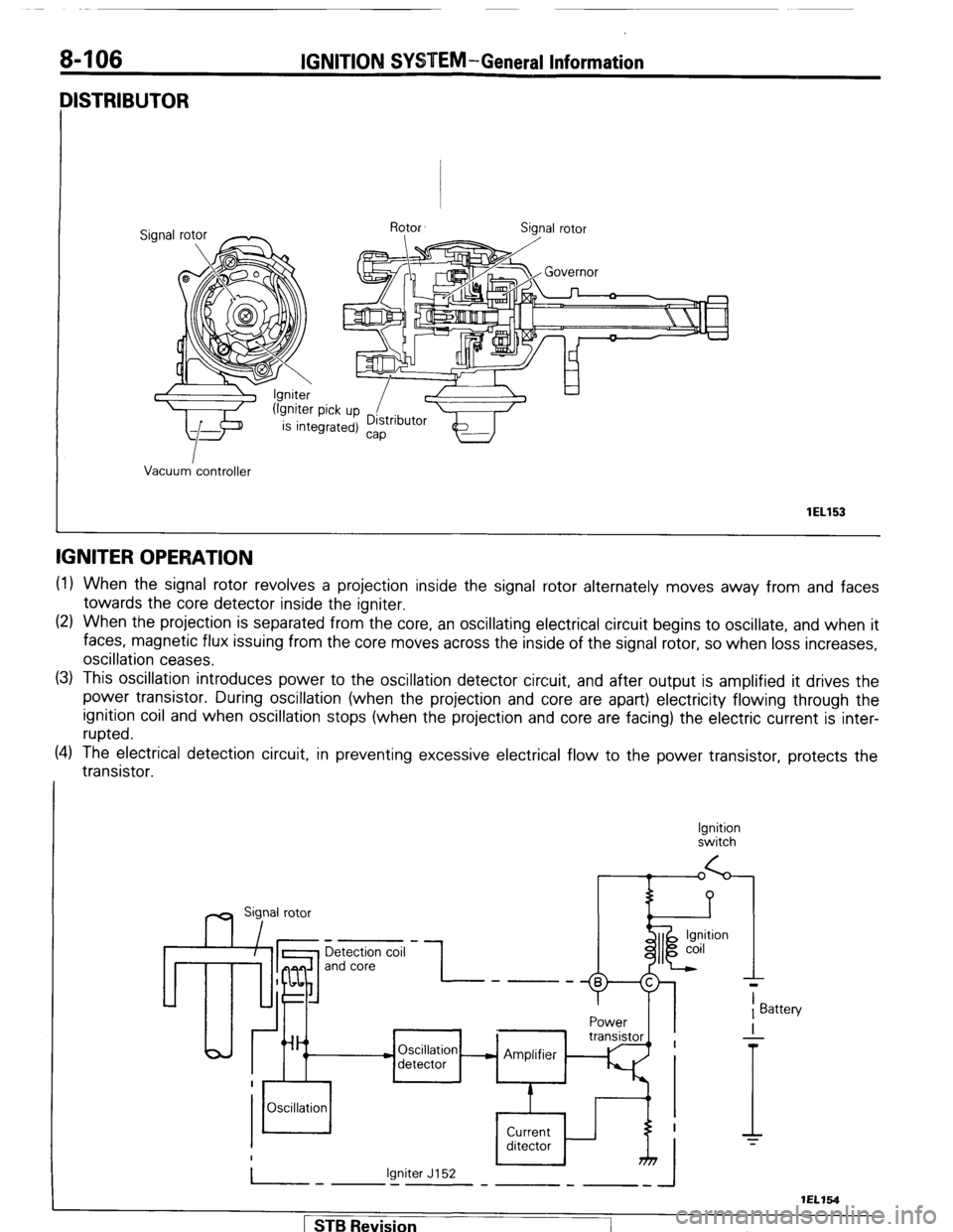
IISTRIBUTOR
Vacuum controller
lEL153
IGNITER OPERATION
(1) When the signal rotor revolves a projection inside the signal rotor alternately moves away from and faces
towards the core detector inside the igniter.
(2) When the projection is separated from the core, an oscillating electrical circuit begins to oscillate, and when it
faces, magnetic flux issuing from the core moves across the inside of the signal rotor, so when loss increases,
oscillation ceases.
(3) This oscillation introduces power to the oscillation detector circuit, and after output is amplified it drives the
power transistor. During oscillation (when the projection and core are apart) electricity flowing through the
ignition coil and when oscillation stops (when the projection and core are facing) the electric current is inter-
rupted.
(4) The electrical detection circuit, in preventing excessive electrical flow to the power transistor, protects the
transistor.
Ignition
switch
m Sig,nal rotor
Detection coil
and core -I- ----
Power
Oscillation - Amplifier
detector
Oscillation
Current
ditector
Igniter J152
-.I-
T
1 Battery
I
-
T
1 STB Revision
-7
Page 128 of 284
8408 IGNITION SYSTEM - Specifications
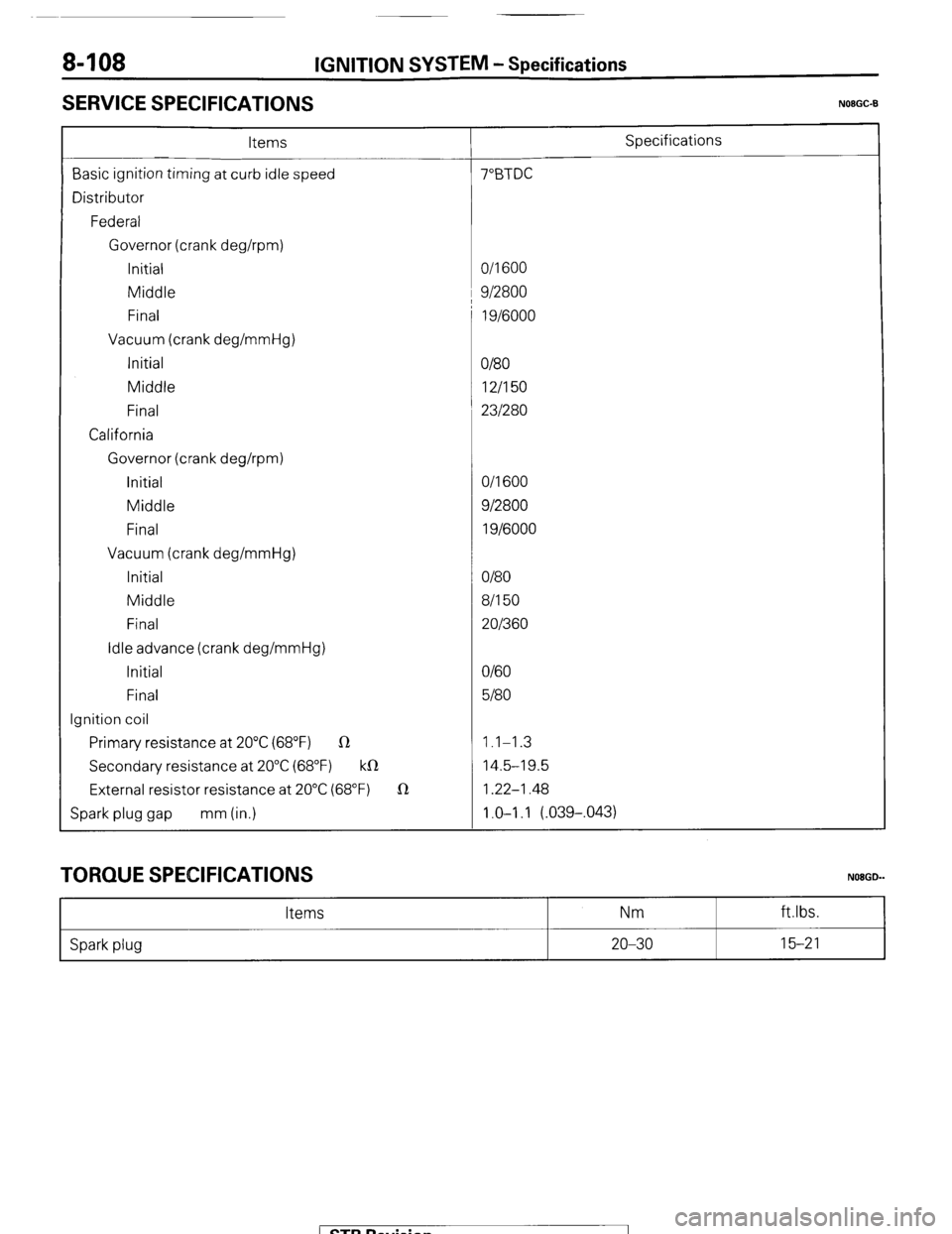
SERVICE SPECIFICATIONS
N08GC-B
Items Specifications
Basic ignition timing at curb idle speed 7”BTDC
Distributor
Federal
Governor (crank deghpm)
Initial O/l 600
Middle 1 9/2800
Final 1 g/6000
Vacuum (crank deg/mmHg)
Initial
O/80
Middle 12/I 50
Final 231280
California
Governor (crank deghpm)
initial O/l 600
Middle 912800
Final 1 g/6000
Vacuum (crank deg/mmHg)
Initial O/80
Middle 8/l 50
Final 201360
Idle advance (crank deg/mmHg)
Initial O/60
Final 5180
Ignition coil
Primary resistance at 20°C (68°F) R 1.1-1.3
Secondary resistance at 20°C (68°F) k0 14.5-19.5
External resistor resistance at 20°C (68°F) 1R 1.22-1.48
Spark plug gap mm (in.) 1.0-I .I (.039-,043)
TORQUE SPECIFICATIONS
Items Nm
NOBGD-
ft.lbs.
Spark plug 20-30 15-21
1 STB Revision
Page 131 of 284
IGNITION SYSTEM - Service Adjustment Procedures 8-111
SERVICE ADJUSTMENT PROCEDURES
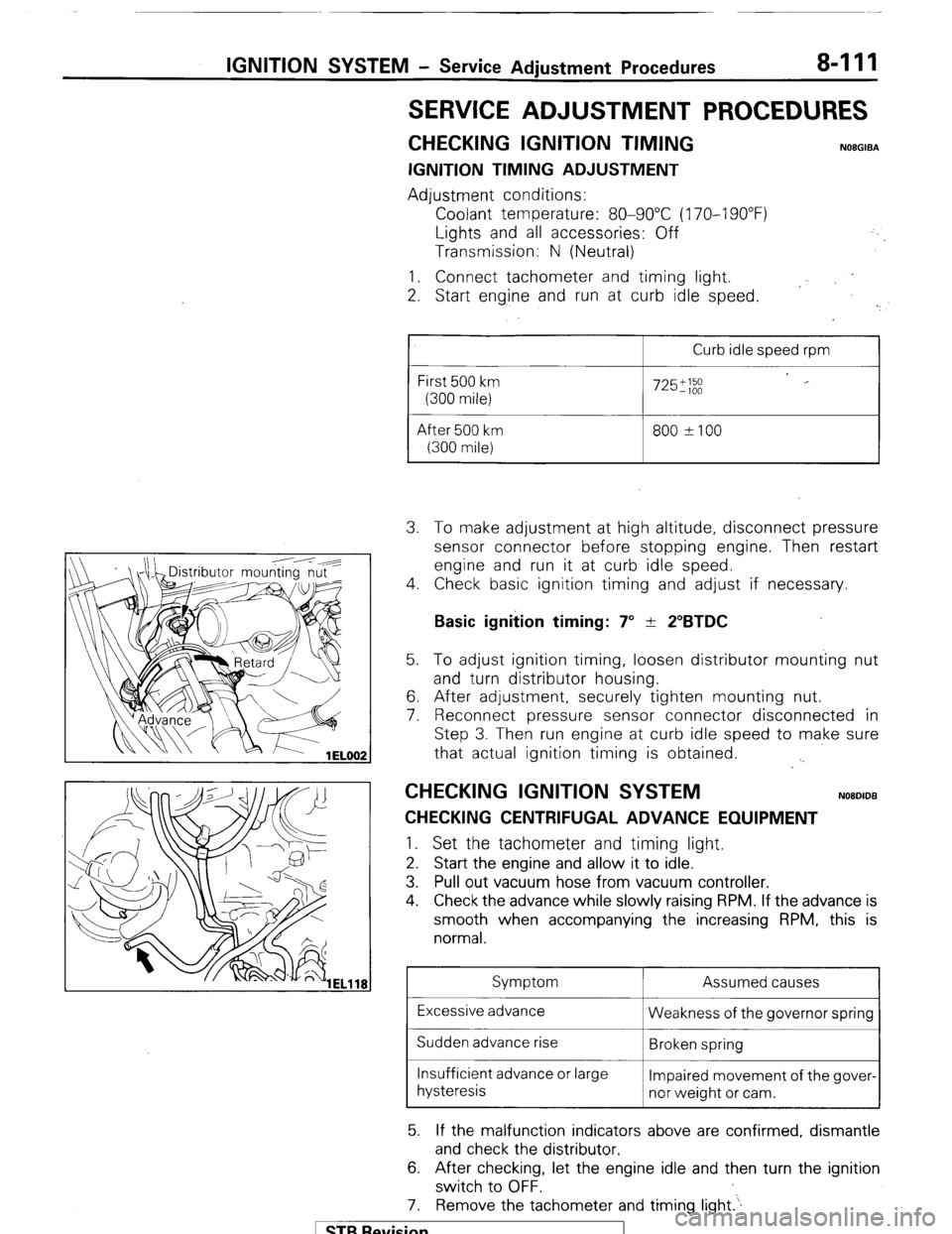
CHECKING IGNITION TIMING NOEGIBA
IGNITION TIMING ADJUSTMENT
Adjustment conditions:
Coolant temperature: 80-90°C (170-I 90°F)
Lights and all accessories: Off
Transmission: N (Neutral)
1. Connect tachometer and timing light.
2. Start eng.ine and run at curb idle speed.
I
Curb idle speed rpm
First 500 km
(300 mile)
After 500 km
(300 mile)
725';;;
800 ?I00 3. To make adjustment at high altitude, disconnect pressure
sensor connector before stopping engine. Then restart
engine and run it at curb idle speed.
4. Check basic ignition timing and adjust if necessary.
Basic ignition timing: 7” + 2”BTDC 5. To adjust ignition timing, loosen distributor mounting nut
and turn distributor housing.
6. After adjustment, securely tighten mounting nut.
7. Reconnect pressure sensor connector disconnected in
Step 3. Then run engine at curb idle speed to make sure
that actual ignition timing is obtained.
. .
CHECKING IGNITION SYSTEM NOBDIDB
CHECKING CENTRIFUGAL ADVANCE EQUIPMENT 1.
Set the tachometer and timing light.
2. Start the engine and allow it to idle.
3. Pull out vacuum hose from vacuum controller.
4. Check the advance while slowly raising RPM. If the advance is
smooth when accompanying the increasing RPM, this is
normal.
Symptom Assumed causes
Excessive advance
Weakness of the governor spring
Sudden advance rise
Broken spring
Insufficient advance or large
Impaired movement of the gover-
hysteresis
nor weight or cam.
5. If the malfunction indicators above are confirmed, dismantle
and check the distributor.
6. After checking, let the engine idle and then turn the ignition
switch to OFF.
7. Remove the tachometer and timing light.‘.
1 STB Revision
Page 132 of 284
8-112 IGNITION SYSTEM - Service Adjustment Procedures
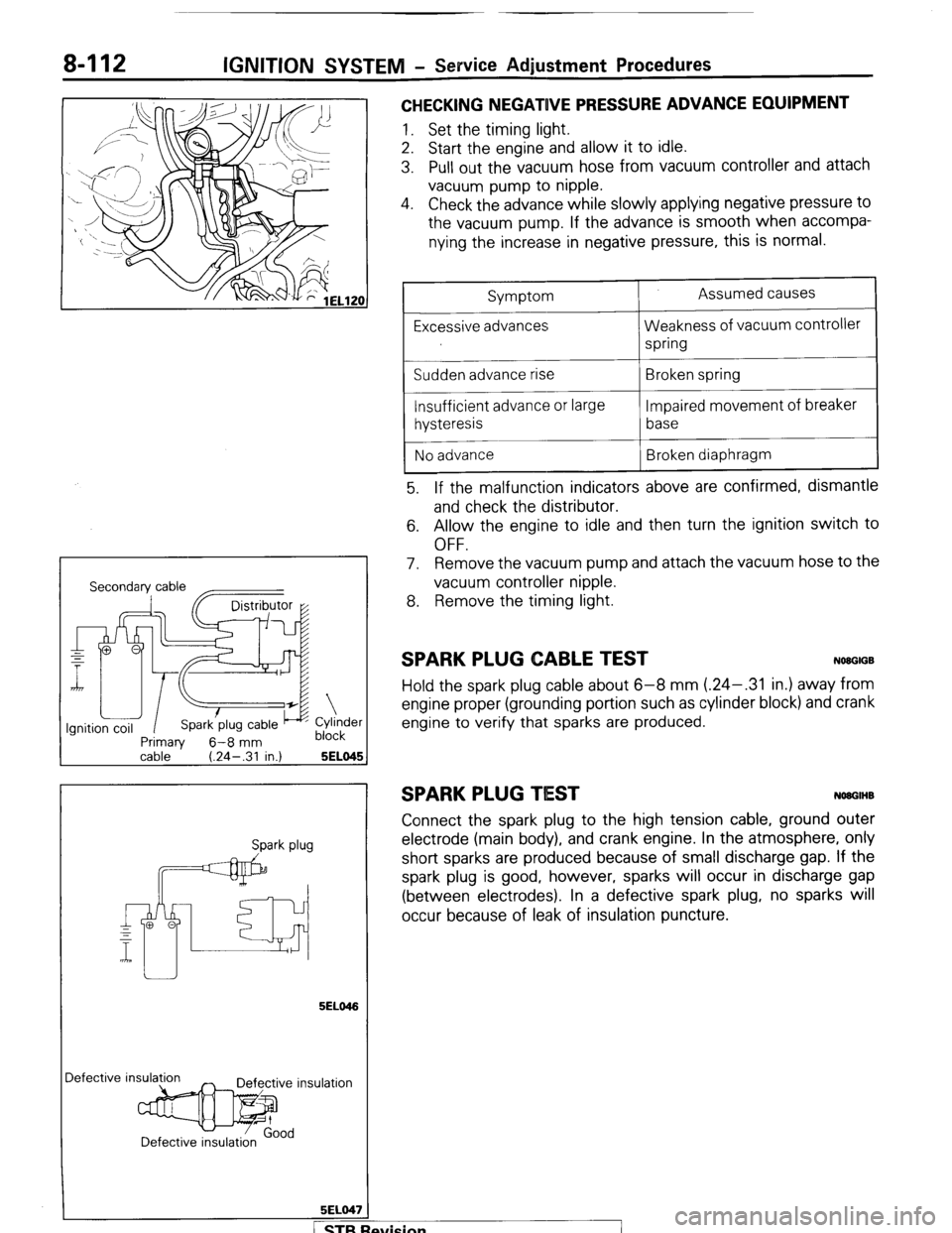
CHECKING NEGATIVE PRESSURE ADVANCE EQUIPMENT
1. Set the timing light.
2. Start the engine and allow it to idle.
3. Pull out the vacuum hose from vacuum controller and attach
vacuum pump to nipple.
4. Check the advance while slowly applying negative pressure to
the vacuum pump. If the advance is smooth when accompa-
nying the increase in negative pressure, this is normal.
Secondary cable
~~
Primaw 6-8 mm
Cylinder
block
cable ’ (.24-.31 in.) 5ELO45 1
Spark plug
5ELO46
Iefective insula
5ELO47
/
Symptom
Excessive advances
Sudden advance rise
Insufficient advance or large
hysteresis
No advance Assumed causes
Weakness of vacuum controller
spring
Broken spring
Impaired movement of breaker
base
Broken diaphragm
5. If the malfunction indicators above are confirmed, dismantle
and check the distributor.
6. Allow the engine to idle and then turn the ignition switch to
OFF.
7. Remove the vacuum pump and attach the vacuum hose to the
vacuum controller nipple.
8. Remove the timing light.
SPARK PLUG CABLE TEST NWGIGB
Hold the spark plug cable about 6-8 mm (.24-.31 in.) away from
engine proper (grounding portion such as cylinder block) and crank
engine to verify that sparks are produced.
SPARK PLUG TIEST NOUGIHB
Connect the spark plug to the high tension cable, ground outer
electrode (main body), and crank engine. In the atmosphere, only
short sparks are produced because of small discharge gap. If the
spark plug is good, however, sparks will occur in discharge gap
(between electrodes). In a defective spark plug, no sparks will
occur because of leak of insulation puncture.
fvision
I
Page 134 of 284
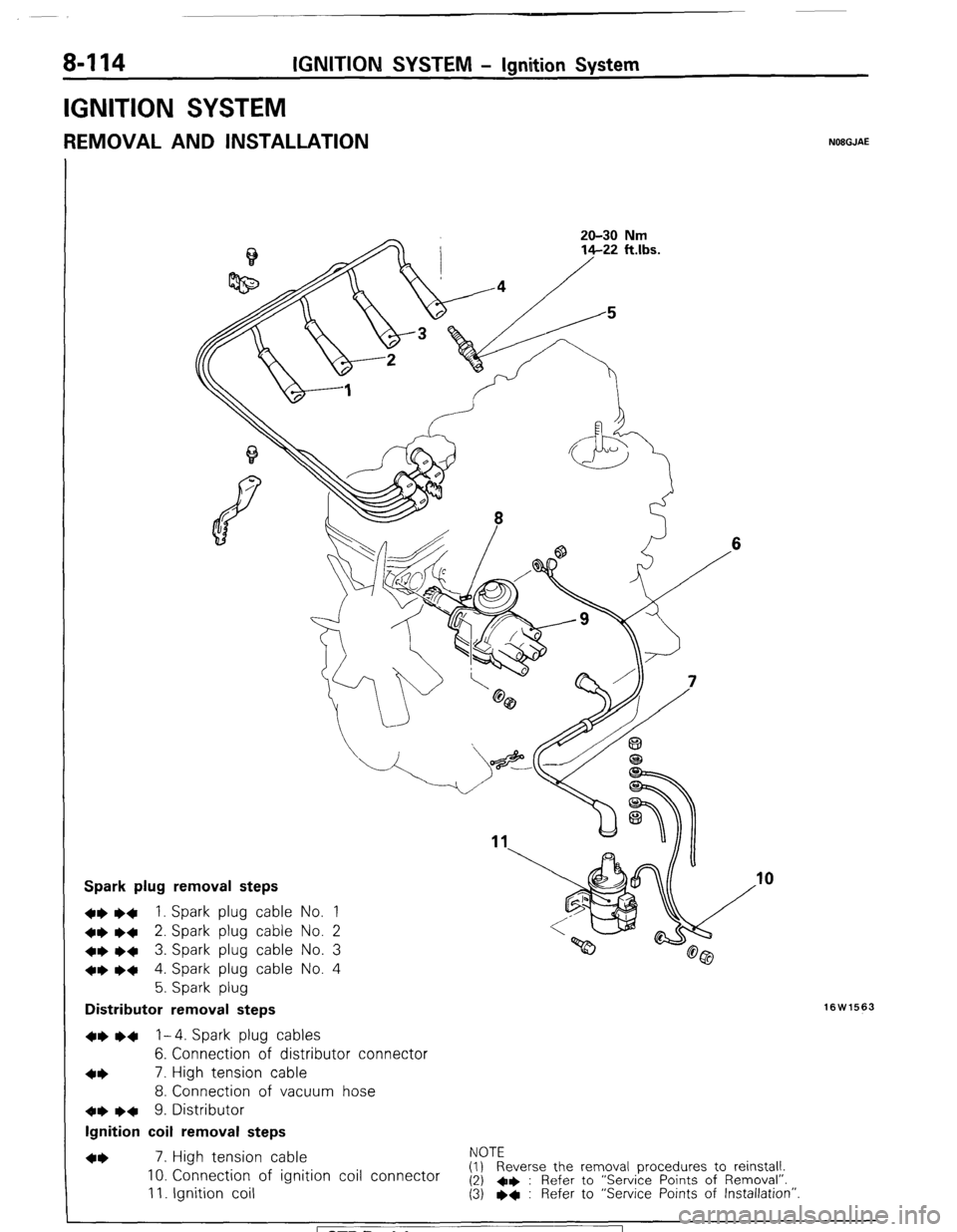
8-114 IGNITION SYSTEM - Ignition System
IGNITION SYSTEM
REMOVAL AND INSTALLATION NOEGJAE
20-30
Nm
Spark plug removal steps
+e l
+ 1. Spark plug cable No. 1
~~ ~~ 2. Spark plug cable No. 2
+e e+ 3. Spark plug cable No. 3
*e e+ 4. Spark plug cable No. 4
5. Spark plug
Distributor removal steps
16W1563
~~ l + 1-4. Spark plug cables
6. Connection of distributor connector
+* 7. High tension cable
8. Connection of vacuum hose
de l
q 9. Distributor
Ignition coil removal steps
7. High tension cable NOTE
10. Connection of ignition coil connector (1) Reverse the removal procedures to reinstall.
(2) +e : Refer to “Service Points of Removal”. 11. Ignition coil (3) l + : Refer to “Service Points of Installation”
I
1 STB Revision
Page 139 of 284
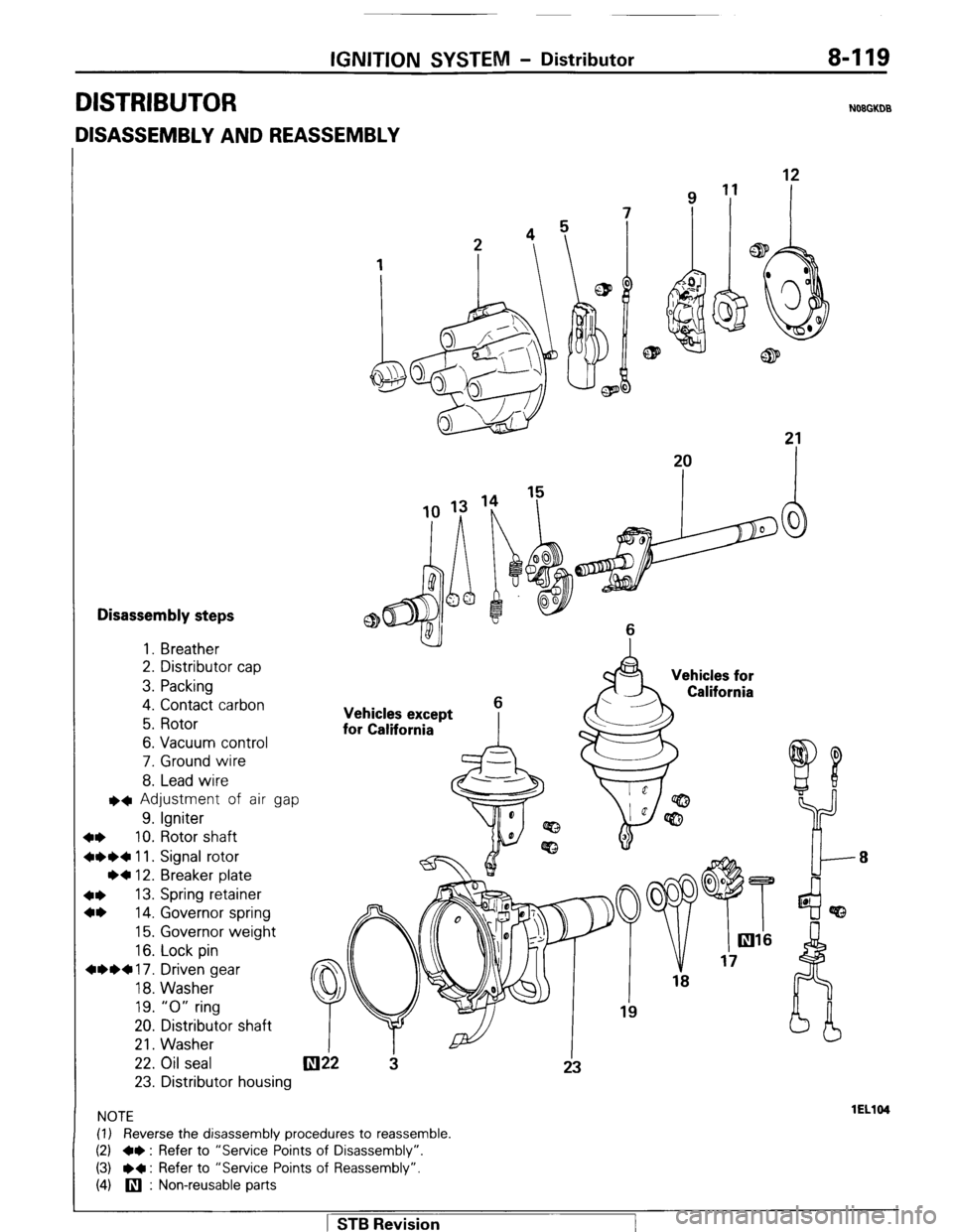
IGNITION SYSTEM - Distributor
DISTRIBUTOR
DISASSEMBLY AND REASSEMBLY
8-119
Disassembly steps
1. Breather
2. Distributor cap
3. Packing
4. Contact carbon
5. Rotor
6. Vacuum control
7. Ground wire
8. Lead wire
l + Adjustment of air gap
9. Igniter
4* 10. Rotor shaft
+*** 11. Signal rotor
l * 12. Breaker plate
4* 13. Spring retainer
4* 14. Governor spring
15. Governor weight
16. Lock pin
- Vehicles for
California
Vehicles except
for California
8
4**+ 17. Driven gear
18. Washer
19. “0” ring
20. Distributor shaft
21. Washer
22. Oil seal
23. Distributor housing
NOTE
(1) Reverse the disassembly procedures to reassemble.
(2) +e : Refer to “Service Points of Disassembly”.
(3) Hw: Refer to “Service Points of Reassembly”.
(4)
q : Non-reusable parts
lEL104 1 STB Revision