belt MITSUBISHI MONTERO 2000 Service Manual PDF
[x] Cancel search | Manufacturer: MITSUBISHI, Model Year: 2000, Model line: MONTERO, Model: MITSUBISHI MONTERO 2000Pages: 1839, PDF Size: 29.19 MB
Page 1563 of 1839

I
N DIV ID UAL CO M PO NEN T SER VIC E
I f th e se atb elt w it h pre -te nsio ner are to be re m ove d or re pla ce d as a re su lt o fm ain te nance ,tr o uble sh ootin g,
e tc ., fo llo w each pro ce dure (P .5 2B -1 0 -P.5 2B -1 3.)
C au tio n
1 . The seat belt w it h pre -te n sio ner sh ould not be su bje cte d to te m pera tu re 90_C ,so re m ove th e
s eat belt s wit h pre -te n sio ner befo re dry in g or bakin g th e veh ic le afte r pain tin g.
2 . If th e seat belt wit h pre -te n sio ner are re m oved fo r th e purp ose of ch eck, sh eet m eta l re p air ,
p ain tin g, etc ., th ey sh ould be sto re d in acle an , dry pla ce until th ey are re in sta lle d .
W ARNIN G /C AUTIO N LA BELS
C autio n la bels on th e se at belt w it h pre -te nsio ner
a re atta ch ed in th e ve hic le as sh ow n. Follo w la bel
i n str u ctio ns when se rv ic in g th e se at belt wit h p
re -te nsio ner. If th e la bel( s ) are dir ty or dam aged,
r e pla ce wit h new one(s ).
Page 1564 of 1839
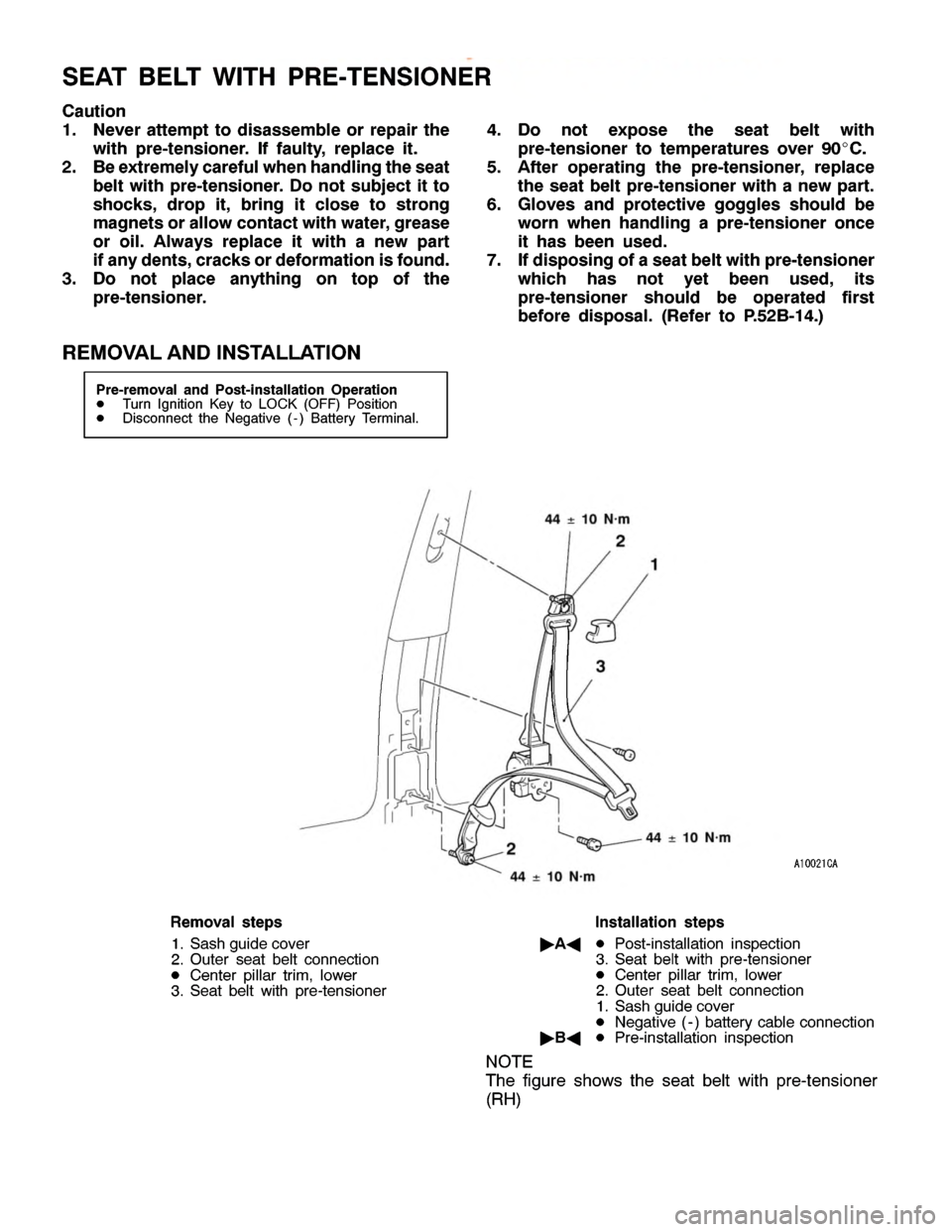
S
EAT BELT WIT H PR E-T E N SIO NER
C au tio n
1 . Never atte m pt to dis assem ble or re p air th e
w it h pre -te n sio ner. If fa u lt y , re p la ce it .
2 . Be extr e m ely care fu lw hen han dlin g th e seat
b elt w it h pre -te n sio ner. D o not su bje ct it to
s h ocks, dro p it , brin g it clo se to str o ng
m ag nets or allo w co nta ct w it h wate r, g re ase
o r oil. Alw ays re p la ce it wit h anew part
i f an y den ts ,c ra cks or defo rm atio n is fo und.
3 . Do not pla ce an yth in g on to p of th e
p re -te n sio ner. 4
. Do not exp ose th e seat belt wit h
p re -te n sio ner to te m pera tu re s over 90_C .
5 . Afte r opera tin g th e pre -te n sio ner, re p la ce
t h e seat belt pre -te n sio ner w it h anew part.
6 . Glo ves an d pro te ctiv e goggle s sh ould be
w orn when han dlin g apre -te n sio ner once
i t has been used .
7 . If d is p osin g ofa seat b elt w it h pre -te n sio ner
w hic h has not yet been used , it s
p re -te n sio ner sh ould be opera te d fir s t
b efo re dis p osal. (R efe r to P.5 2B -1 4.)
R EM OVA L AND IN STA LLA TIO N
Page 1566 of 1839

SRS -Seat Belt Pre-tensioner Disposal Procedures52B-14
SEAT BELT PRE-TENSIONER DISPOSAL PROCEDURES
Before disposing of a vehicle which is equipped
with seat belts with pre-tensioner, or when disposing
of the seat belts with pre-tensioner themselves,the following procedures must be used to deploy
the pre-tensioners before disposal.
UNDEPLOYED SEAT BELT PRE-TENSIONER
DISPOSAL
Caution
1. If the vehicle is to be scrapped or otherwise disposed
of, operate the pre-tensioners inside the vehicle. If
the vehicle is still to be used and only the seat belt
pre-tensioner are to be disposed of, operate the
pre-tensioners outside the vehicle.
2. Since a large amount of smoke is produced when
the pre-tensioner is operated, avoid residential areas
whenever possible.
3. Since there is a loud noise when the pre-tensioners
are operated, avoid residential areas whenever
possible. If anyone is nearby, give warning of the
impending noise.
4. Suitable ear protection should be worn by personnel
performing these procedures or by people in the
immediate area.
DEPLOYMENT INSIDE THE VEHICLE
1. Move the vehicle to an isolated spot.
2. Disconnect the negative ( - ) and positive (+) battery cables
from the battery terminals, and then remove the battery
from the vehicle.
Caution
Wait at least 60 seconds after disconnecting the
battery cables before doing any further work.
(Refer to P.52B-4.)
3. Operate the pre-tensioner as specified in the service
procedures that follows.
(1) Remove the center pillar trim, lower.
www.WorkshopManuals.co.uk
Purchased from www.WorkshopManuals.co.uk
Page 1568 of 1839

SRS -Seat Belt Pre-tensioner Disposal ProceduresSRS -Seat Belt Pre-tensioner Disposal Procedures52B-16
Caution
1) Before operating the pre-tensioner, see that
no one is in and near the vehicle.
2) The operation of the pre-tensioner makes the
inflator very hot. Before handling the inflator,
wait more than 30 minutes for cooling.
3) If the pre-tensioner fails to operate when the
procedures above are followed, do not go near
the pre-tensioner. Contact your local
distributor.
(7) After operation of the pre-tensioner, discard as
specified in the procedure. (Refer to P.52B-18.)
DEPLOYMENT OUTSIDE THE VEHICLE
Caution
1) This should be carried out in a wide, flat area at least
6 m away from obstacles and other people.
2) Do not operate outside if wind is high. Even in a soft
wind, ignite to windward of the pre-tensioner.
1. Disconnect the negative ( - ) and positive (+) battery cables
from the battery terminals, and then remove the battery
from the vehicle.
Caution
Wait at least 60 seconds after disconnecting the
battery cables before doing any further work. (Refer
to P.52B-4.)
2. Operate pre-tensioner as specified in the service
procedures that follows.
(1) Remove the seat belt pre-tensioner from the vehicle.
(Refer to P.52B-12.)
Caution
The pre-tensioner should be stored on a flat
surface and placed so that the pre-tensioner
operation surfaces are facing upward. Do not
place anything on top of them.
www.WorkshopManuals.co.uk
Purchased from www.WorkshopManuals.co.uk
Page 1569 of 1839
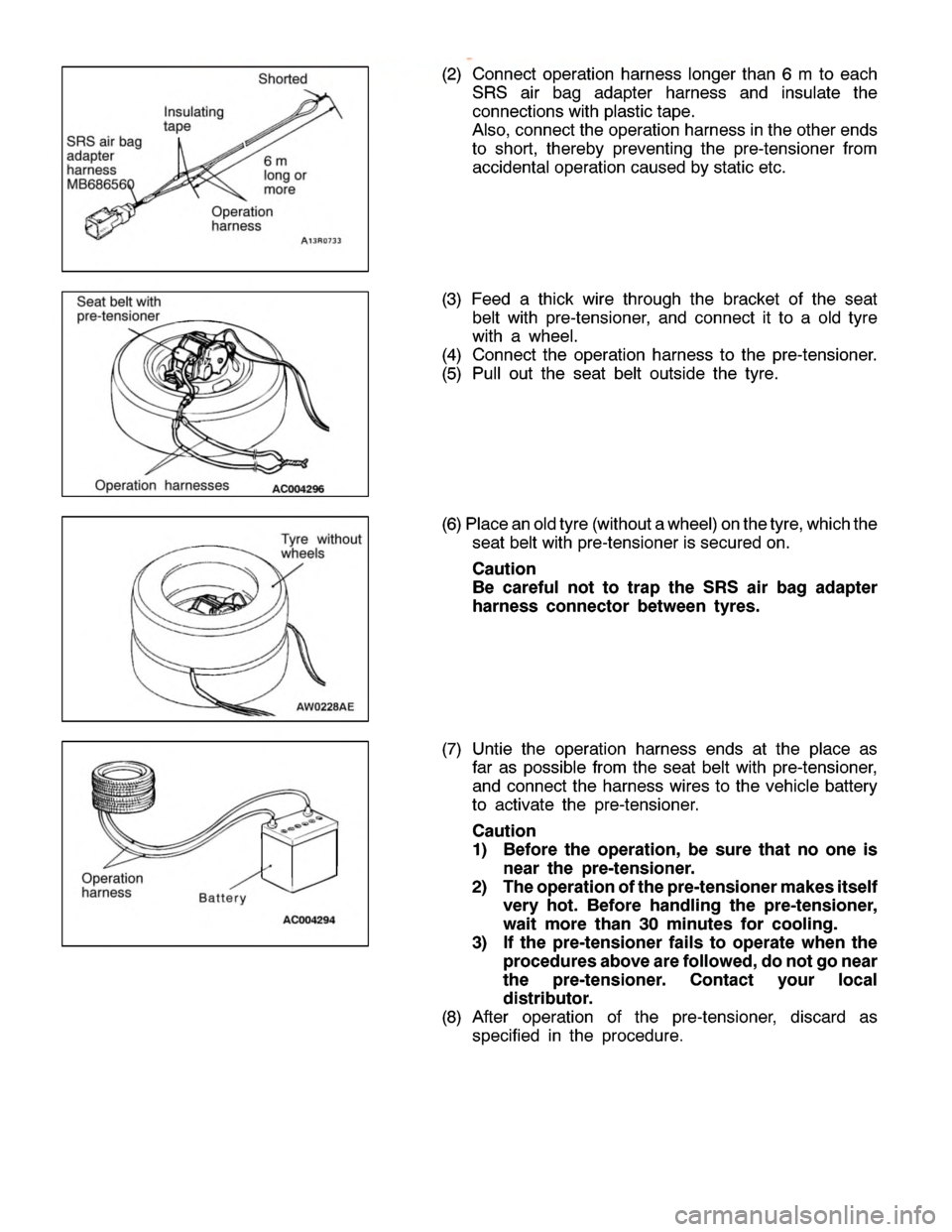
I
n su la tin g
t a pe S
horte d 6
m
l o ng or
m ore O
pera tio n
h arn ess
S eat belt w it h
p re -te nsio ner O
pera tio n harn esse s T
yre wit h out
w heels
Page 1570 of 1839

S
eat belt
p re -te nsio ner
w
ww.W ork sh opM an uals .c o .u k
P urc h ased f r o m w ww.W ork sh opM an uals .c o .u k
Page 1748 of 1839

55A-2
HEATER, AIR
CONDITIONER AND
VENTILATION
CONTENTS
SERVICE SPECIFICATIONS 3.................
LUBRICANTS 3..............................
TROUBLESHOOTING
TROUBLESHOOTING
ON-VEHICLE SERVICE 9.....................
Refrigerant Level Test through Performance Test 9.
Magnetic Clutch Test 10.........................
Receiver Drier Test 10..........................
Compressor Drive Belt Adjustment 10.............
Dual Pressure Switch Check 10..................
Charging 11...................................
Performance Test 15............................
Front Blower Relay and Rear Blower Relay
Continuity Check 18............................
Continuity Check of A/C Compressor Relay and
Condernser Fan Relay 18.......................
PTC Heater Relay Continuity Check 19...........
Idle-up Operation Check
Vacuum Actuator Check
Idle-up Solenoid Valve Check 21.................
Clean Air Filter Replacement Procedure 22........
FRONT A/C 23..............................
Air Conditioner Control Panel Assembly and
A/C Switch 23.................................
Heater Unit and Blower Assembly 26.............
Blower Motor and Resistor 29....................
Inside/Outside Air Changeover Damper Motor 30...
Automatic Compressor-ECU and
Air Thermo Sensor Assembly 31.................
REAR HEATER AND REAR COOLER 32.....
Rear A/C Switch, Front Rear Fan Switch 32.......
Rear A/C Control Unit 34........................
Rear Heater Unit 34............................
Rear Heater Unit and Rear Blower Assembly 37....
HEAT SWITCH 40...........................
COMPRESSOR 41...........................
CONDENSER ASSEMBLY AND
CONDENSER FAN 45........................
REFRIGERANT LINE 47.....................
ENGINE COOLANT TEMPERATURE SWITCH
51 ..........................................
IDLE-UP SYSTEM 53........................
DUCTS 54..................................
VENTILATION 56............................
www.WorkshopManuals.co.uk
Purchased from www.WorkshopManuals.co.uk
Page 1763 of 1839

HEATER, AIR CONDITIONER AND VENTILATION - On-vehicle Service55A-17
REFRIGERANT LEAK REPAIR
LOST CHARGE
If the system has lost all charge due to a leak:
1. Evacuate the system. (See procedure.)
2. Charge the system with approximately one
pound of refrigerant.
3. Check for leaks.
4. Discharge the system.
5. Repair leaks.
6. Replace receiver drier.
Caution
Replacement filter-drier units must be
sealed while in storage. The drier used in
these units will saturate water quickly upon
exposure to the atmosphere. When
installing a drier, have all tools and supplies
ready for quick reassembly to avoid keeping
the system open any longer than necessary.
7. Evacuate and charge system.
LOW CHARGE
If the system has not lost all of its refrigerant charge;
locate and repair all leaks. If it is necessary to
increase the system pressure to find the leak
(because of an especially low charge) add
refrigerant. If it is possible to repair the leak without
discharging the refrigerant system, use the
procedure for correcting low refrigerant level.HANDLING TUBING AND FITTINGS
Kinks in the refrigerant tubing or sharp bends in
the refrigerant hose lines will greatly reduce the
capacity of the entire system. High pressures are
produced in the system when it is operating.
Extreme care must be exercised to make sure that
all connections are pressure tight. Dirt and moisture
can enter the system when it is opened for repair
or replacement of lines or components. The
following precautions must be observed. The
system must be completely discharged before
opening any fitting of connection in the refrigeration
system. Open fittings with caution even after the
system has been discharged. If any pressure is
noticed as a fitting is loosened, allow trapped
pressure to bleed off very slowly.
Never attempt to rebend formed lines to fit. Use
the correct line for the installation you are servicing.
A good rule for the flexible hose lines is keep the
radius of all bends at least 10 times the diameter
of the hose.
Sharper bends will reduce the flow of refrigerant.
The flexible hose lines should be routed so that
they are at least 80 mm from the exhaust manifold.
It is good practice to inspect all flexible hose lines
at least once a year to make sure they are in good
condition and properly routed.
Unified plumbing connections with O-rings, these
O-rings are not reusable.
COMPRESSOR NOISE
You must first know the conditions when the noise
occurs. These conditions are: weather, vehicle
speed, in gear or neutral, engine temperature or
any other special conditions.
Noises that develop during A/C operation can often
be misleading. For example: what sounds like a
failed front bearing or connecting rod, may be
caused by loose bolts, nuts, mounting brackets,
or a loose clutch assembly. Verify accessory drive
belt tension (power steering or alternator).
Improper accessory drive belt tension can cause
a misleading noise when the compressor is
engaged and little or no noise when the compressor
is disengaged.
Drive belts are speed-sensitive. That is, at different
engine speeds, and depending upon belt tension,
belts can develop unusual noises that are often
mistaken for mechanical problems within the
compressor.ADJUSTMENT
1. Select a quiet area for testing. Duplicate
conditions as much as possible. Switch
compressor on and off several times to clearly
identify compressor noise. To duplicate high
ambient conditions (high head pressure),
restrict air flow through condenser. Install
manifold gauge set to make sure discharge
pressure doesn’t exceed 2,070 kPa.
2. Tighten all compressor mounting bolts, clutch
mounting bolt, and compressor drive belt.
Check to assure clutch coil is tight (no rotation
or wobble).
3. Check refrigerant hoses for rubbing or
interference that can cause unusual noises.
4. Check refrigerant charge. (See “Charging
System”.)
5. Recheck compressor noise as in Step 1.
6. If noise still exists, loosen compressor mounting
bolts and retorque. Repeat Step 1.
7. If noise continues, replace compressor and
repeat Step 1.
www.WorkshopManuals.co.uk
Purchased from www.WorkshopManuals.co.uk
Page 1787 of 1839
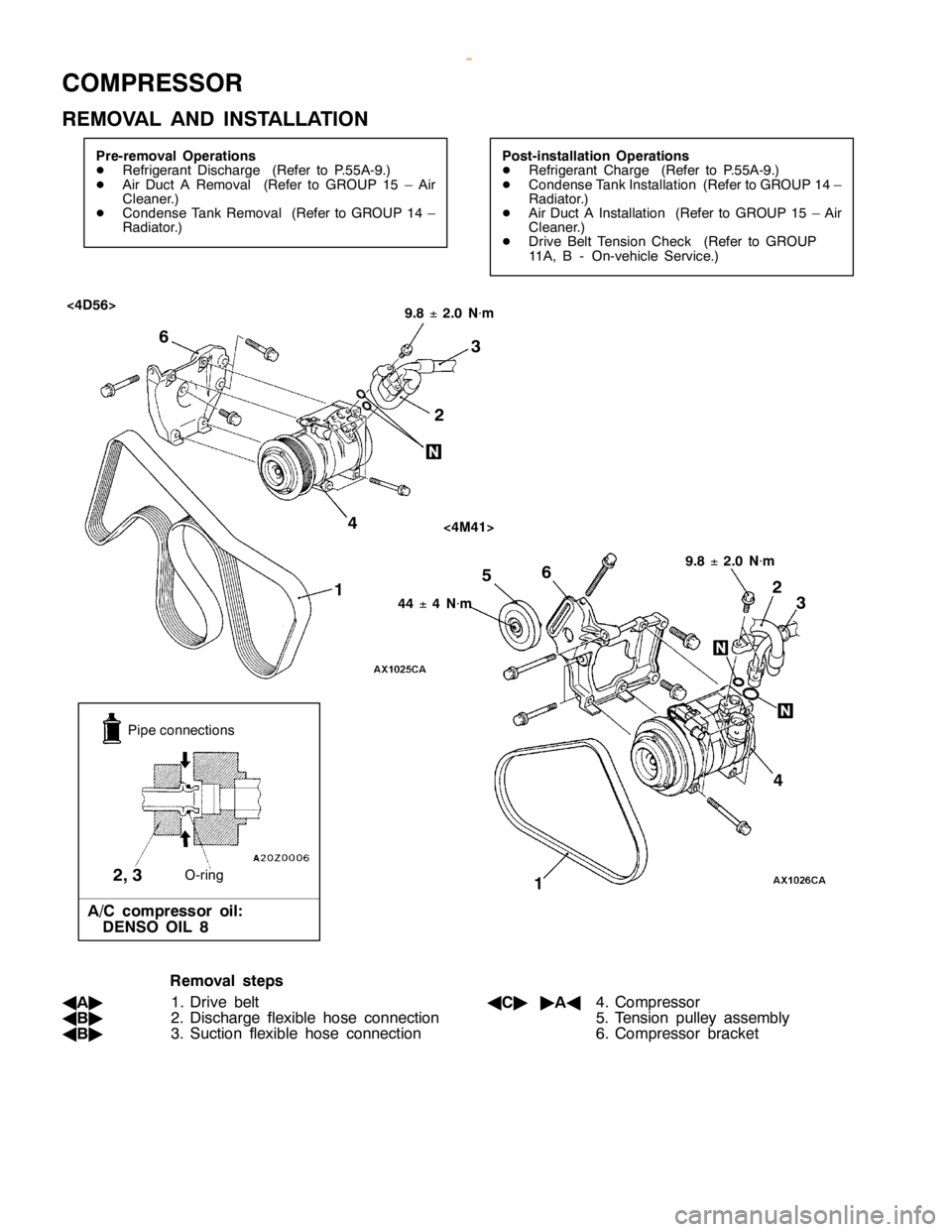
C
O M PR ESSO R
R EM OVA L AND IN STA LLA TIO N P
ip e co nnectio ns
O -rin g
A /C co m pre sso r oil:
D EN SO OIL 8 9
.8
±2
.0 N
×m
R em oval ste p s
A A"
1. D riv e belt
A B"
2. D is ch arg e fle xib le hose co nnectio n
A B"
3. S uctio n fle xib le hose co nnectio n A
C"
"
AA
4. C om pre sso r
5 . Te nsio n pulle y asse m bly
6 . C om pre sso r bra cke t
w
ww.W ork sh opM an uals .c o .u k
P urc h ased f r o m w ww.W ork sh opM an uals .c o .u k