brake light MITSUBISHI SHOGUN 2003 Owner's Manual (in English)
[x] Cancel search | Manufacturer: MITSUBISHI, Model Year: 2003, Model line: SHOGUN, Model: MITSUBISHI SHOGUN 2003Pages: 392, PDF Size: 14.34 MB
Page 3 of 392
Instruments and Controls
B21A601T
LHD
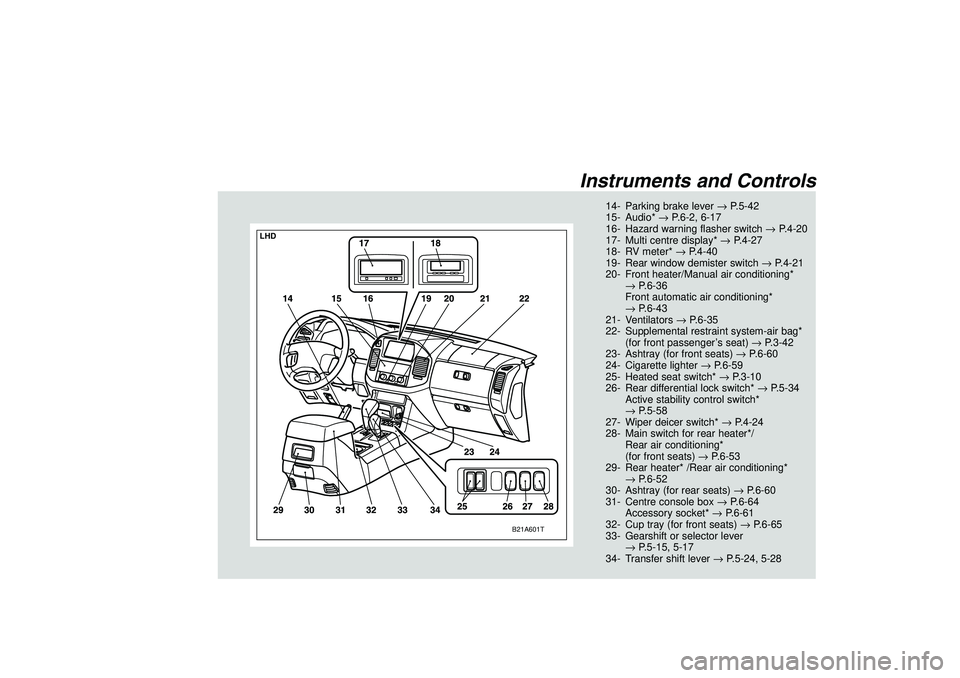
14- Parking brake lever→P.5-42
15- Audio*→P.6-2, 6-17
16- Hazard warning flasher switch→P.4-20
17- Multi centre display*→P.4-27
18- RV meter*→P.4-40
19- Rear window demister switch→P.4-21
20- Front heater/Manual air conditioning*
→P.6-36
Front automatic air conditioning*
→P.6-43
21- Ventilators→P.6-35
22- Supplemental restraint system-air bag*
(for front passenger’s seat)→P.3-42
23- Ashtray (for front seats)→P.6-60
24- Cigarette lighter→P.6-59
25- Heated seat switch*→P.3-10
26- Rear differential lock switch*→P.5-34
Active stability control switch*
→P.5-58
27- Wiper deicer switch*→P.4-24
28- Main switch for rear heater*/
Rear air conditioning*
(for front seats)→P.6-53
29- Rear heater* /Rear air conditioning*
→P.6-52
30- Ashtray (for rear seats)→P.6-60
31- Centre console box→P.6-64
Accessory socket*→P.6-61
32- Cup tray (for front seats)→P.6-65
33- Gearshift or selector lever
→P.5-15, 5-17
34- Transfer shift lever→P.5-24, 5-28
Div:
Out put date:
Page 5 of 392
Instruments and Controls
B21A571T
RHD
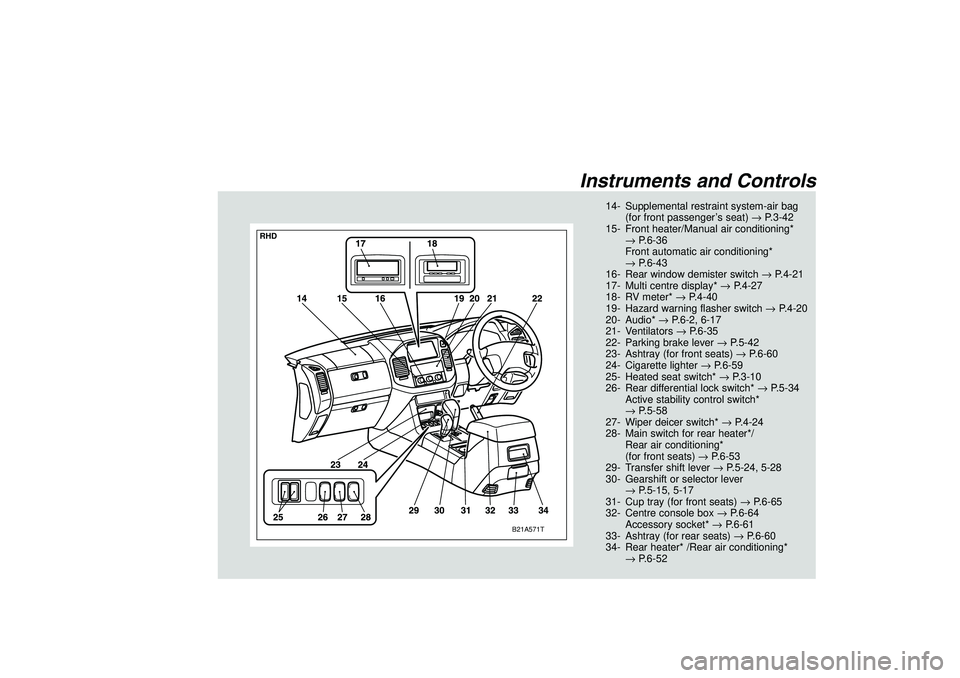
14- Supplemental restraint system-air bag
(for front passenger’s seat)→P.3-42
15- Front heater/Manual air conditioning*
→P.6-36
Front automatic air conditioning*
→P.6-43
16- Rear window demister switch→P.4-21
17- Multi centre display*→P.4-27
18- RV meter*→P.4-40
19- Hazard warning flasher switch→P.4-20
20- Audio*→P.6-2, 6-17
21- Ventilators→P.6-35
22- Parking brake lever→P.5-42
23- Ashtray (for front seats)→P.6-60
24- Cigarette lighter→P.6-59
25- Heated seat switch*→P.3-10
26- Rear differential lock switch*→P.5-34
Active stability control switch*
→P.5-58
27- Wiper deicer switch*→P.4-24
28- Main switch for rear heater*/
Rear air conditioning*
(for front seats)→P.6-53
29- Transfer shift lever→P.5-24, 5-28
30- Gearshift or selector lever
→P.5-15, 5-17
31- Cup tray (for front seats)→P.6-65
32- Centre console box→P.6-64
Accessory socket*→P.6-61
33- Ashtray (for rear seats)→P.6-60
34- Rear heater* /Rear air conditioning*
→P.6-52
Div:
Out put date:
Page 63 of 392
WARNING
(4) Seat belts should always be
worn by every adult who drives
or rides in this vehicle, and by all
children who are large enough
to wear seat belts properly.
(5) Remove any twists when using
the belt.
(6) No modifications or additions
should be made by the user
which will either prevent the seat
belt adjusting devices from oper-
ating to remove slack, or pre-
vent the seat belt assembly from
being adjusted to remove slack.
(7) To reduce risk of serious or fatal
injury in an accident, including
from a deploying driver air bag,
the driver should adjust the driv-
er’s seat to the most rear posi-
tion that still allows good
visibility and good control of the
steering wheel, the brake and
accelerator, and vehicle con-
trols.
G28A089A
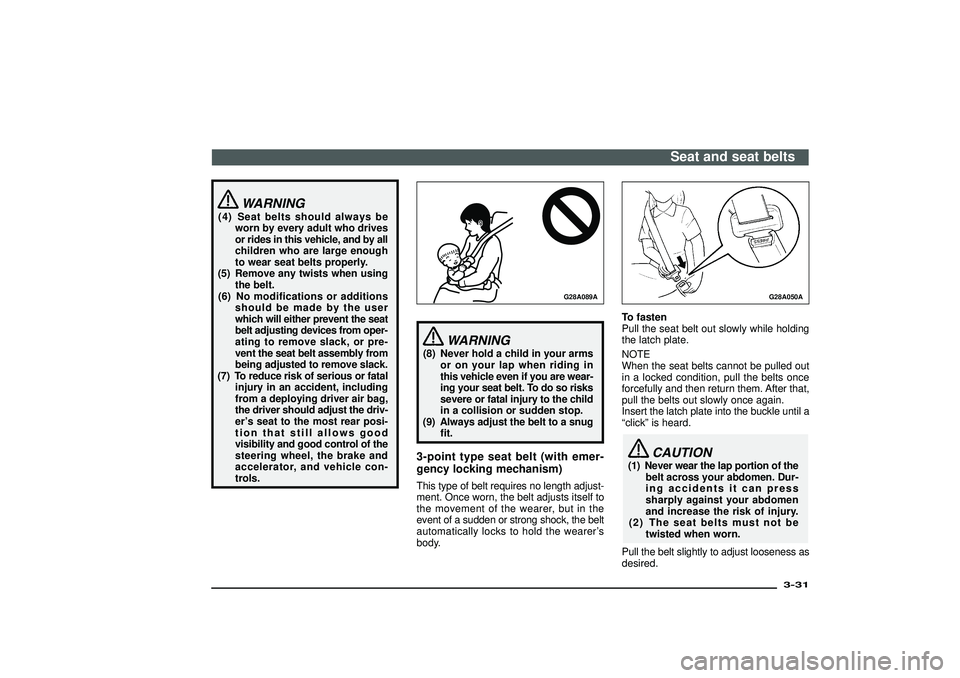
WARNING
(8) Never hold a child in your arms
or on your lap when riding in
this vehicle even if you are wear-
ing your seat belt. To do so risks
severe or fatal injury to the child
in a collision or sudden stop.
(9) Always adjust the belt to a snug
fit.3-point type seat belt (with emer-
gency locking mechanism)This type of belt requires no length adjust-
ment. Once worn, the belt adjusts itself to
the movement of the wearer, but in the
event of a sudden or strong shock, the belt
automatically locks to hold the wearer’s
body.
G28A050A
To fasten
Pull the seat belt out slowly while holding
the latch plate.
NOTE
When the seat belts cannot be pulled out
in a locked condition, pull the belts once
forcefully and then return them. After that,
pull the belts out slowly once again.
Insert the latch plate into the buckle until a
“click”is heard.
CAUTION
(1) Never wear the lap portion of the
belt across your abdomen. Dur-
ing accidents it can press
sharply against your abdomen
and increase the risk of injury.
(2) The seat belts must not be
twisted when worn.
Pull the belt slightly to adjust looseness as
desired.
Seat and seat belts
3-31
Div:
Out put date:
Page 165 of 392
(8) Stop driving the vehicle if you think the
performance is noticeably low, or that
there is unnecessary engine rotation, or
any other engine trouble, such as with
the ignition, etc.
If it is impractical to stop driving imme-
diately, reduce the speed and drive for
only a short time. Have an inspection
made by your nearest authorized
MITSUBISHI dealer as soon as pos-
sible.
(9) In unusual situations involving grossly
malfunctioning engine operation, a
burnt smell may indicate severe and
abnormal catalyst overheating.
If this occurs, the vehicle should be
stopped in a safe place, the engine
switched off and the vehicle allowed to
cool. Once the engine is cool, a ser-
vice, including a tune-up to manufac-
turer’s specifications, should be
obtained immediately.
Economical driving
EC19AAX
For economical driving, there are some
technical requirements that have to be met.
The prerequisite for low fuel consumption
is a properly adjusted engine. In order to
achieve longer life of the vehicle and the
most economical operation, have the
vehicle serviced by an authorized
MITSUBISHI dealer at regular intervals in
accordance with the service standards.
Fuel economy and generation of exhaust
gas and noise are highly influenced by per-
sonal driving habits as well as the particu-
lar operating conditions. The following
points should be observed in order to mini-
mize wear of brakes, tyres and engine as
well as to reduce environmental pollu-
tion.
(1)Starting
Avoid rapid acceleration and sudden
starts; such operation will result in
higher fuel consumption.
(2)Shifting
Shift only at an appropriate speed and
engine speed. Always use the high-
est gear possible.
The transfer shift lever should be set to
“2H”when driving on normal roads and
express ways to obtain best possible
fuel economy.(3)City traffic
Frequent starting and stopping
increases the average fuel consump-
tion. Use roads with smooth traffic flow
whenever possible. When driving on
congested roads, avoid use of a low
gear at high engine speeds.
(4)Idling
The vehicle consumes fuel even dur-
ing idling. Avoid extended idling when-
ever possible.
(5)Speed
The higher the vehicle speed, the more
fuel consumed. Avoid driving at full
speed. Even a slight release of the
accelerator pedal will save a signifi-
cant amount of fuel.
(6)Tyre inflation pressure
Check the tyre inflation pressures at
regular intervals. Low tyre inflation
pressure increases road resistance and
fuel consumption. In addition, low tyre
pressures adversely affect tyre wear
and driving stability.
Starting and driving
5-7
Div:
Out put date:
Page 168 of 392
mm
3-door models 5-door models
1 512.5 794
2 526*
1, 476*
2
526*
1, 476*
2
3 15*
1, 35*
2
15*
1, 35*
2
4 124 179
5 131 131
644 44
755 55
8 - 149
9 86*
1, 136.8*
2
75*
1, 125.3*
2
10 516.5*
1, 465.7*
2
531*
1, 480.3*
2
11 499.7 499.7
12 538 538
13 - 547
14 576.3 576.3
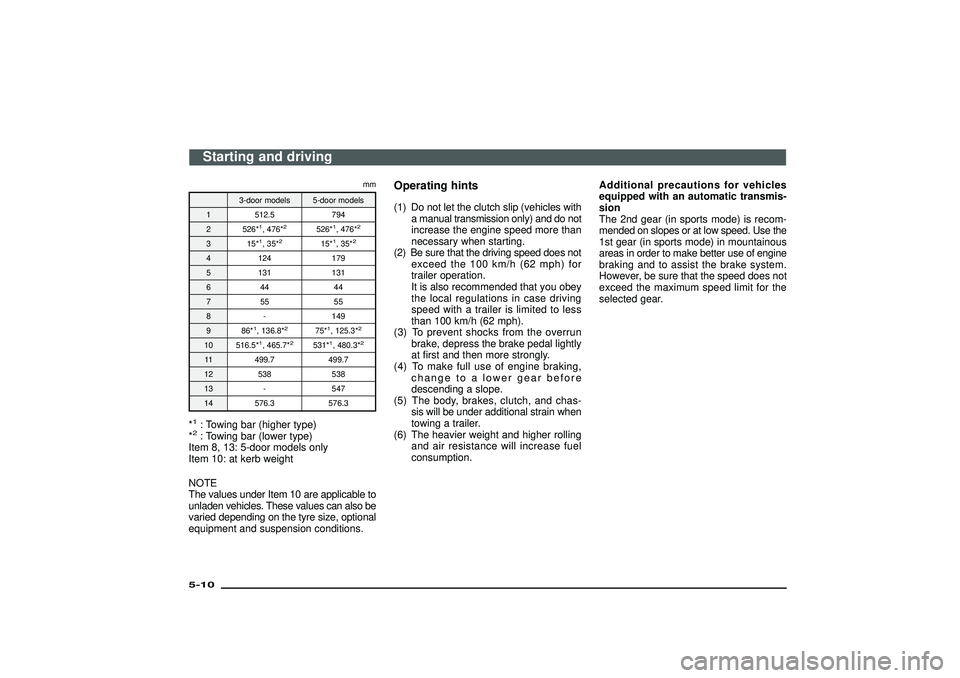
*1: Towing bar (higher type)
*2: Towing bar (lower type)
Item 8, 13: 5-door models only
Item 10: at kerb weight
NOTE
The values under Item 10 are applicable to
unladen vehicles. These values can also be
varied depending on the tyre size, optional
equipment and suspension conditions.
Operating hints(1) Do not let the clutch slip (vehicles with
a manual transmission only) and do not
increase the engine speed more than
necessary when starting.
(2) Be sure that the driving speed does not
exceed the 100 km/h (62 mph) for
trailer operation.
It is also recommended that you obey
the local regulations in case driving
speed with a trailer is limited to less
than 100 km/h (62 mph).
(3) To prevent shocks from the overrun
brake, depress the brake pedal lightly
at first and then more strongly.
(4) To make full use of engine braking,
change to a lower gear before
descending a slope.
(5) The body, brakes, clutch, and chas-
sis will be under additional strain when
towing a trailer.
(6) The heavier weight and higher rolling
and air resistance will increase fuel
consumption.Additional precautions for vehicles
equipped with an automatic transmis-
sion
The 2nd gear (in sports mode) is recom-
mended on slopes or at low speed. Use the
1st gear (in sports mode) in mountainous
areas in order to make better use of engine
braking and to assist the brake system.
However, be sure that the speed does not
exceed the maximum speed limit for the
selected gear.
Starting and driving
5-10Div:
Out put date:
Page 170 of 392
(3) For vehicles equipped with the Day-
time Running Lamp, when the igni-
tion switch is“ON”, the headlamp low
beams etc. are turned on.
Refer to“Headlamps”.
(4) As your vehicle is equipped with an
electronic immobilizer, to start the
engine, the ID code which the tran-
sponder inside the key sends must
match the one registered to the immo-
bilizer computer. (Refer to page 2-2).
CAUTION
(1) Do not remove the ignition key
from the ignition switch while
driving. The steering wheel will
be locked, causing loss of con-
trol.
(2) If the engine is stopped while
driving, the brake servomecha-
nism will cease to function and
braking efficiency will deterio-
rate. Also, power steering sys-
tem will not function and it will
require greater manual effort to
operate the steering.
(3) Do not leave the key in the“ON”
position for a long time when the
engine is not running; doing so
will cause the battery to be dis-
charged.
(4) Do not turn the key to the
“START”position when the
engine is running; doing so
could damage the starter motor.
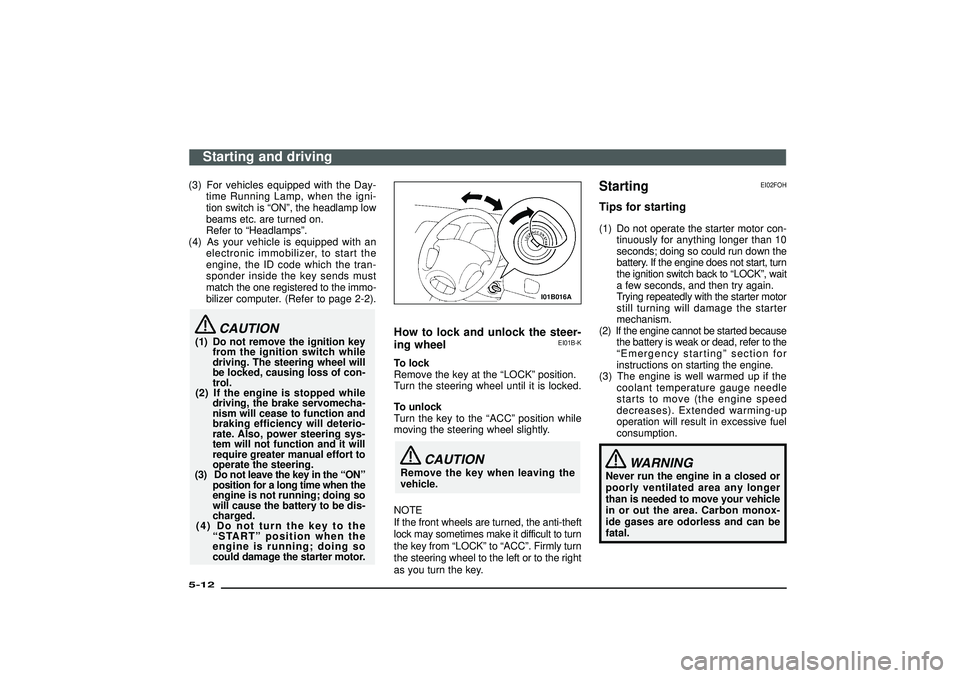
I01B016A
How to lock and unlock the steer-
ing wheel
EI01B-K
To lock
Remove the key at the“LOCK”position.
Turn the steering wheel until it is locked.
To unlock
Turn the key to the“ACC”position while
moving the steering wheel slightly.
CAUTION
Remove the key when leaving the
vehicle.
NOTE
If the front wheels are turned, the anti-theft
lock may sometimes make it difficult to turn
the key from“LOCK”to“ACC”. Firmly turn
the steering wheel to the left or to the right
as you turn the key.
Starting
EI02FOH
Tips for starting(1) Do not operate the starter motor con-
tinuously for anything longer than 10
seconds; doing so could run down the
battery. If the engine does not start, turn
the ignition switch back to“LOCK”, wait
a few seconds, and then try again.
Trying repeatedly with the starter motor
still turning will damage the starter
mechanism.
(2) If the engine cannot be started because
the battery is weak or dead, refer to the
“Emergency starting”section for
instructions on starting the engine.
(3) The engine is well warmed up if the
coolant temperature gauge needle
starts to move (the engine speed
decreases). Extended warming-up
operation will result in excessive fuel
consumption.
WARNING
Never run the engine in a closed or
poorly ventilated area any longer
than is needed to move your vehicle
in or out the area. Carbon monox-
ide gases are odorless and can be
fatal.
Starting and driving
5-12Div:
Out put date:
Page 197 of 392
CAUTION
(1) Do not force the vehicle or drive
recklessly on sandy surfaces. In
comparison with normal road
surfaces, the engine and other
drive-system components are
put under excessive strain when
driving on such a surface, and
this could lead to accidents.
(2) If any of following conditions
occur while the vehicle is being
driven, immediately park your
vehicle in a safe place and fol-
low these procedures:
•The needle in the tempera-
ture gauge approaches the
overheating zone.
Refer to the“Engine
overheating”on page 8-21.
•A/T fluid temperature warning
lamp illuminates.
Refer to the“A/T fluid tempera-
ture warning lamp”on page
4-11.
WARNING
When attempting to rock your vehicle
out of a stuck position, be sure that
the area around the vehicle is clear of
people and physical objects. The
rocking motion may cause the
vehicle to suddenly launch forward
or backward, causing injury or dam-
age to nearby people or objects.
NOTE
(1) Avoid sudden braking, acceleration, and
turning; such operations could result in
the vehicle becoming stuck.
(2) If the vehicle becomes stuck in sandy
or muddy roads, it can often be moved
a rocking motion. Move the selector
lever rhythmically between the“D”
(DRIVE) and“R”(REVERSE) posi-
tion (with manual transmission,
between 1st and Reverse), while apply-
ing slight pressure to the accelerator
pedal.
(3) It is recommended to start the vehicle
with parking brake partially, but not
completely, applied by slightly pulling
the parking brake lever.
After the vehicle has become free, do
not forget to release the parking brake.NOTE
(4) If it is necessary to drive in extremely
muddy conditions, the use of tyre
chains is recommended. Because the
extent of muddy conditions is difficult to
judge and the vehicle could become
bogged down very deeply, operation
should be at a low speed. If possible,
get out of the vehicle and check the
conditions ahead before proceeding.
(5) Driving over roads in coastal areas or
roads on which anti-skid preparations
have been spread can cause rust on
the vehicle; wash the vehicle thor-
oughly as soon as possible after such
use.
Climbing sharp gradesSet the transfer shift lever to“4L”(part time
4WD) or“4LLc”(super select 4WD II) to
maximize the engine torque.
WARNING
(1) Go straight up. Do not try to
traverse across a steep slope.
(2) If you begin to lose traction, ease
off the accelerator pedal and
gently turn the steering wheel
alternatively left and right to
regain adequate traction again.
Starting and driving
5-39
Div:
Out put date:
Page 198 of 392
NOTE
(1) Choose a slope as smooth as pos-
sible with few stones or other
obstacles.
(2) Before attempting to drive up the slope,
walk it up to confirm that the vehicle
can handle the grade.Descending sharp gradesSet the transfer shift lever to“4L”(part time
4WD) or“4LLc”(super select 4WD II), use
the engine brake (downshifting) and
descend slowly.
WARNING
Avoid snaking down a sharp grade.
Descend the grade as straight as
possible.NOTE
(1) When descending a sharp grade, if the
brakes are applied suddenly because
of an obstacle encountered, control of
the vehicle could be lost. Before
descending the slope, walk it down and
confirm the path.
(2) Before descending a grade, it is nec-
essary to choose the appropriate gear.
Avoid changing gears or depressing
the clutch while descending the grade.
(3) MITSUBISHI is not responsible to the
operator for any damage or injury
caused or liability incurred by the
improper and negligent operation of a
vehicle. All techniques of vehicle opera-
tion described herein depend on the
skill and experience of the operator and
other participating parties and any
deviation from the recommended
operation instructions above is at their
own risk.
Turning sharp cornersWhen turning a sharp corner in“4H”or“4L”
position (part time 4WD), or“4HLc”or
“4LLc”position (super select 4WD II) at low
speed, a slight difference in steering may
be experienced similar to as if the brakes
were applied. This is called tight corner
braking and results from each of the four
tyres being at a different distance from the
corner.
The phenomenon is peculiar to 4-wheel
drive vehicles. If this occurs, either
straighten the steering wheel, or change to
rear-wheel drive.
Starting and driving
5-40Div:
Out put date:
Page 199 of 392
Crossing a stream4-wheel drive vehicles are not necessar-
ily waterproof. If the electrical circuits
become wet, further operation of the
vehicle will be impossible; therefore, avoid
crossing streams unless absolutely nec-
essary. If crossing a stream is unavoid-
able, use the following procedure:
(1) Check depths of the stream and geo-
graphical features before attempting to
cross a stream and ford the stream
where the water is as shallow as prac-
ticable.
(2) Cross at a place where the water is less
than 6 cm deep.
(3) Set the transfer shift lever to“4L”(part
time 4WD) or“4LLc”(super select 4WD
II).
(4) Drive slowly at a speed of approxi-
mately 5 km/h (3 mph) to avoid splash-
ing too much water.
CAUTION
Do not attempt to cross a stream at
a place where the water is more than
60 cm deep.
Frequent crossing of streams can
adversely affect the life span of the
vehicle; consult an authorized
MITSUBISHI dealer and take the nec-
essary measures to prepare, inspect,
and repair the vehicle.
After crossing a stream, apply the brakes
to be sure they are functioning properly. If
the brakes are wet and not functioning
properly, dry them out by driving slowly
while lightly depressing the brake pedal.
Inspect each part of the vehicle carefully.
Inspection and maintenance follow-
ing rough road operationAfter operating the vehicle in rough road
conditions, be sure to perform the follow-
ing inspection and maintenance proce-
dures :
(1) Check that the vehicle has not been
damaged by rocks, gravel, etc.
(2) Carefully wash the vehicle with water.
Drive the vehicle slowly while lightly
depressing the brake pedal in order to
dry out the brakes. If the brakes still do
not function properly, contact an autho-
rized MITSUBISHI dealer as soon as
possible to have the brakes checked.
(3) Remove insects, dried grass, etc. clog-
ging the radiator core.
(4) If a stream has been crossed, check
the engine, transmission, and differen-
tial oil. If the oil or grease is milky or
cloudy because of water contamina-
tion, it must be replaced with new oil.
(5) Check the inside of the vehicle. If
ingress of water is found, dry the car-
pet etc.
(6) Inspect the headlamps. If the head-
lamp bulb is flooded with water, have
the bulb drained off at an authorized
MITSUBISHI dealer.
(7) Have an authorized MITSUBISHI
dealer replace grease in the wheel
bearings.
Starting and driving
5-41
Div:
Out put date:
Page 200 of 392
Cautions on handling of 4WD
vehicles
EI49A-Xa
Tyre and disc wheelsSince the driving torque can be applied to
the 4 wheels, the performance of the
vehicle when operating in 4WD is greatly
affected by the condition of the tyres.
Pay close attention to the tyres.
•Install specified tyres on all wheels. Refer
to“Tyre and wheels”on page 10-10.
•Be sure to equip the car with all four tyres
and wheels of the same size and type.
When replacement of any of the tyres or
wheels is necessary, replace all of them.
•All tyres should be rotated whenever the
wear difference between front and rear
tyres is recognizable.
Good vehicle performance cannot be
expected if there is a difference in wear
between tyres. Refer to the“Tyre rotation”
on page 9-15.
•Check the tyre inflation pressure regu-
larly.
CAUTION
Always use tyres of the same size,
same type, and same brand, which
have no wear differences.
Using the tyres of differ in size, type,
brand or a different degree of wear
will cause excessive loading, result-
ing in possible damage to the drive
system.Jacking up a 4-wheel drive vehicles
WARNING
Do not crank the engine while jack-
ing up the vehicle.
The tyre on the ground may turn and
the vehicle may roll off the jack.Operate clutch pedal slowly and
positivelyQuick or slight clutch engagement made
while the engine is running at high speed
will cause damage to the clutch and trans-
mission because the tractive force is very
great.
Operate the pedal slowly and positively.
I07A002A
1
Parking brake
EI07AAEd
To park the vehicle, first bring it to a com-
plete stop, fully engage the parking brake,
and then move the gearshift lever to 1st (on
an uphill) or Reverse (on a downhill) posi-
tion, for vehicles with a manual transmis-
sion or set the selector lever to“P”(PARK)
position on automatic transmission
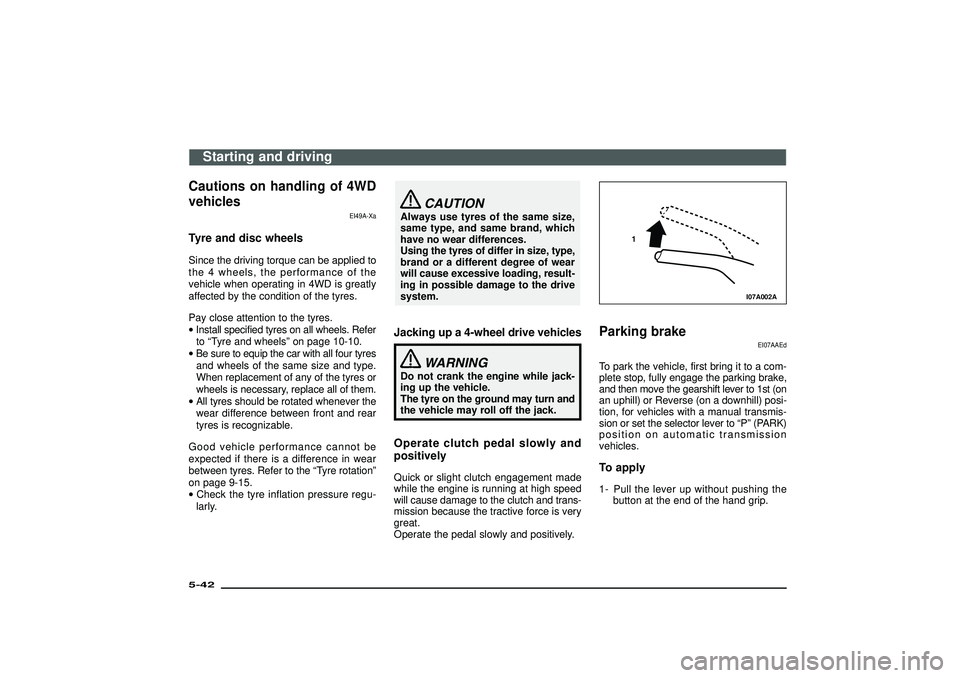
vehicles.To apply1- Pull the lever up without pushing the
button at the end of the hand grip.
Starting and driving
5-42Div:
Out put date: