ABS MITSUBISHI SPYDER 1990 Service User Guide
[x] Cancel search | Manufacturer: MITSUBISHI, Model Year: 1990, Model line: SPYDER, Model: MITSUBISHI SPYDER 1990Pages: 2103, PDF Size: 68.98 MB
Page 532 of 2103
ENGINE (TURBO)
AND
ENGINE> Troubleshooting
3 . H e a t e d o x y g e n s e n s o r m o n i t o r
Test conditions/procedure
1. All of the following conditions should be satisf ied when the drive test is out.
(1) Engine coolant temperature: or higher (when engine is fully warmed up)
(2) Outside air temperature: or higher
(3) condition:
lSelector lever position: range
l Overdrive switch: ON.
lPower/economy changeover switch: Power
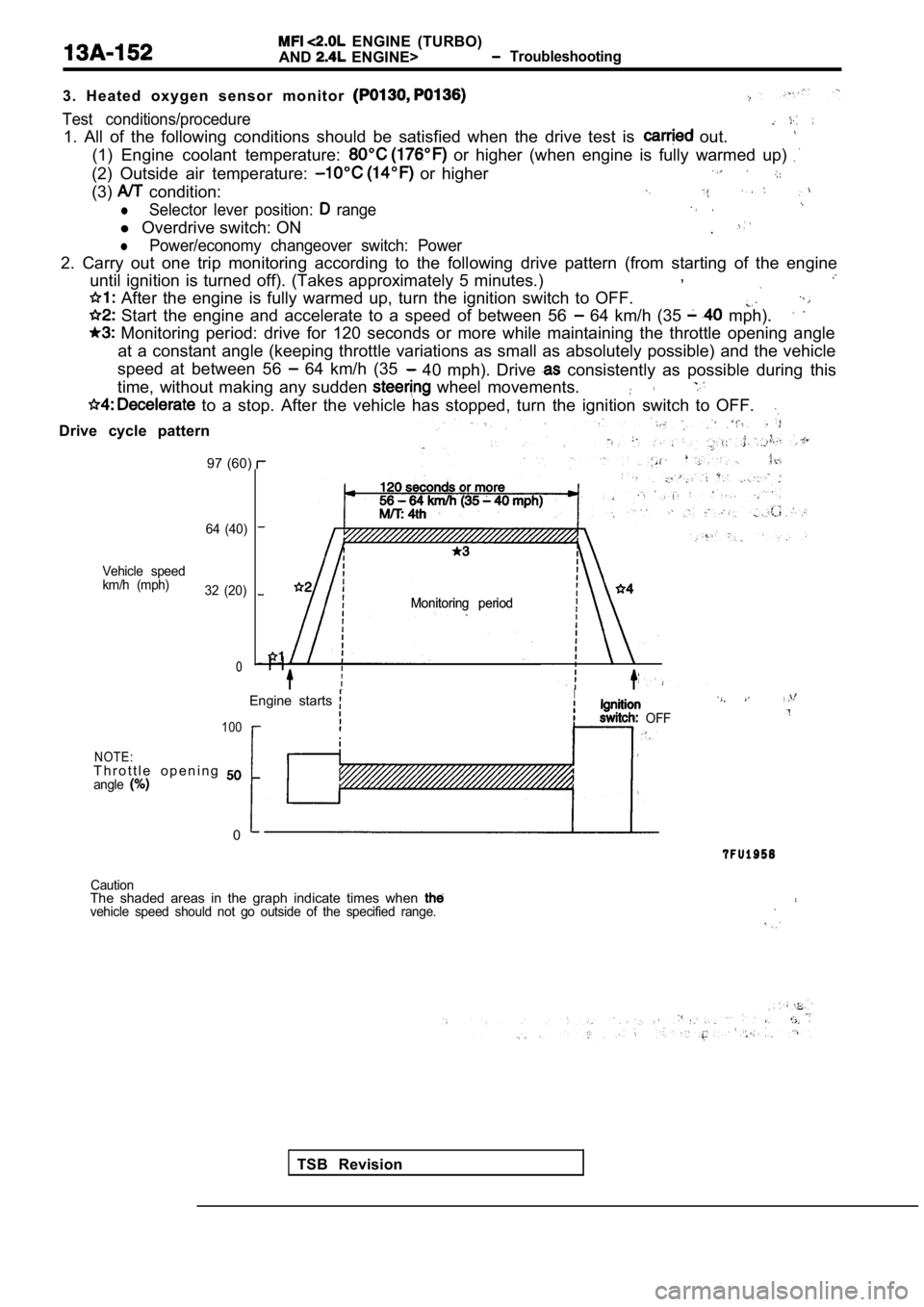
2. Carry out one trip monitoring according to the f ollowing drive pattern (from starting of the engine
until ignition is turned off). (Takes approximately 5 minutes.),
After the engine is fully warmed up, turn the igni
tion switch to OFF.
Start the engine and accelerate to a speed of betw een 56 64 km/h (35 mph).
Monitoring period: drive for 120 seconds or more w hile maintaining the throttle opening angle
at a constant angle (keeping throttle variations as small as absolutely possible) and the vehicle
speed at between 56
64 km/h (35 40 mph). Drive consistently as possible during this
time, without making any sudden
wheel movements.
to a stop. After the vehicle has stopped, turn the ignition switch to OFF.
Drive cycle pattern
97 (60)
64 (40)
Vehicle speed
km/h (mph) 32 (20)
0
Monitoring period
Monitoring period
TSB Revision
Engine starts
I. .
OFF100
NOTE:T h r o t t l e o p e n i n g angle
0
CautionThe shaded areas in the graph indicate times when vehicle speed should not go outside of the specifie
d range.
Page 574 of 2103
![MITSUBISHI SPYDER 1990 Service User Guide E N G I N E
A N D ,
Code No. Differential
Malfunction
[Comment]BackgroundManifold differential se.
l pressure in the intake manifold. o r l o o s e Engine control. lThe engine co](/img/19/57345/w960_57345-573.png "MITSUBISHI SPYDER 1990 Service User Guide E N G I N E
A N D ,
Code No. Differential
Malfunction
[Comment]BackgroundManifold differential se.
l pressure in the intake manifold. o r l o o s e Engine control. lThe engine co")
E N G I N E
A N D ,
Code No. Differential
Malfunction
[Comment]BackgroundManifold differential se.
l pressure in the intake manifold. o r l o o s e Engine control. lThe engine control module checks whether the voltage output by manifold differential sure sensor is within a specified range.
Check Area, Judgement Criteria.
1. Check Areal min or more have passed after the engine was start ed.[However, this is only when the engine coolant temperature is or lower
when the engine is started.]
Engine coolant temperature is not lower than Intake air temperature is not lower than Barometric pressure is 76 (11 psi.) or higher. Volumetric efficiency is 30% 55%.
Judgement Criteria . ,
Sensor output voltage has continued to be not lowe
r than [corresponding toan absolute pressure of 118 (17 psi) or higher] for 4 sec.orSensoroutput voltage has continued to be not higher than 0.1 [corresponding to ---
an absolute pressure of 2.4 (0.3 psi) or lower] for 4 sec.
2. Check Area
8 min or more have passed engine Started.
[However, this is only when the engine coolant or lower when the engine is Engine coolant temperature is not lower than Intake air temperature is not lower than Barometric pressure is 76 (11 psi.) or higher. Volumetric efficiency is 30% or lower.
Judgement Criteria ,
l Sensor output voltage is 4.2 or higher for 4 seconds [absolute pressure is 108 (16 psi.) or more]
Check Area 8 min or more have passed after the engine was sta rted.
,
.
. , ,
[However, this is only when the engine coolant temperature is or lowerwhen engine is started.]
l Engine coolant temperature is not lower than .l Intake air temperature is not lower than l Barometric pressure is 76 (11 psi.) or higher. Volumetric efficiency is 70% or higher.
Judgement Criterial Sensor output voltage is or lower for 4 seconds [absolute pressure is 46 (6.7 psi.) or less]I
TSB Revision.
Page 639 of 2103
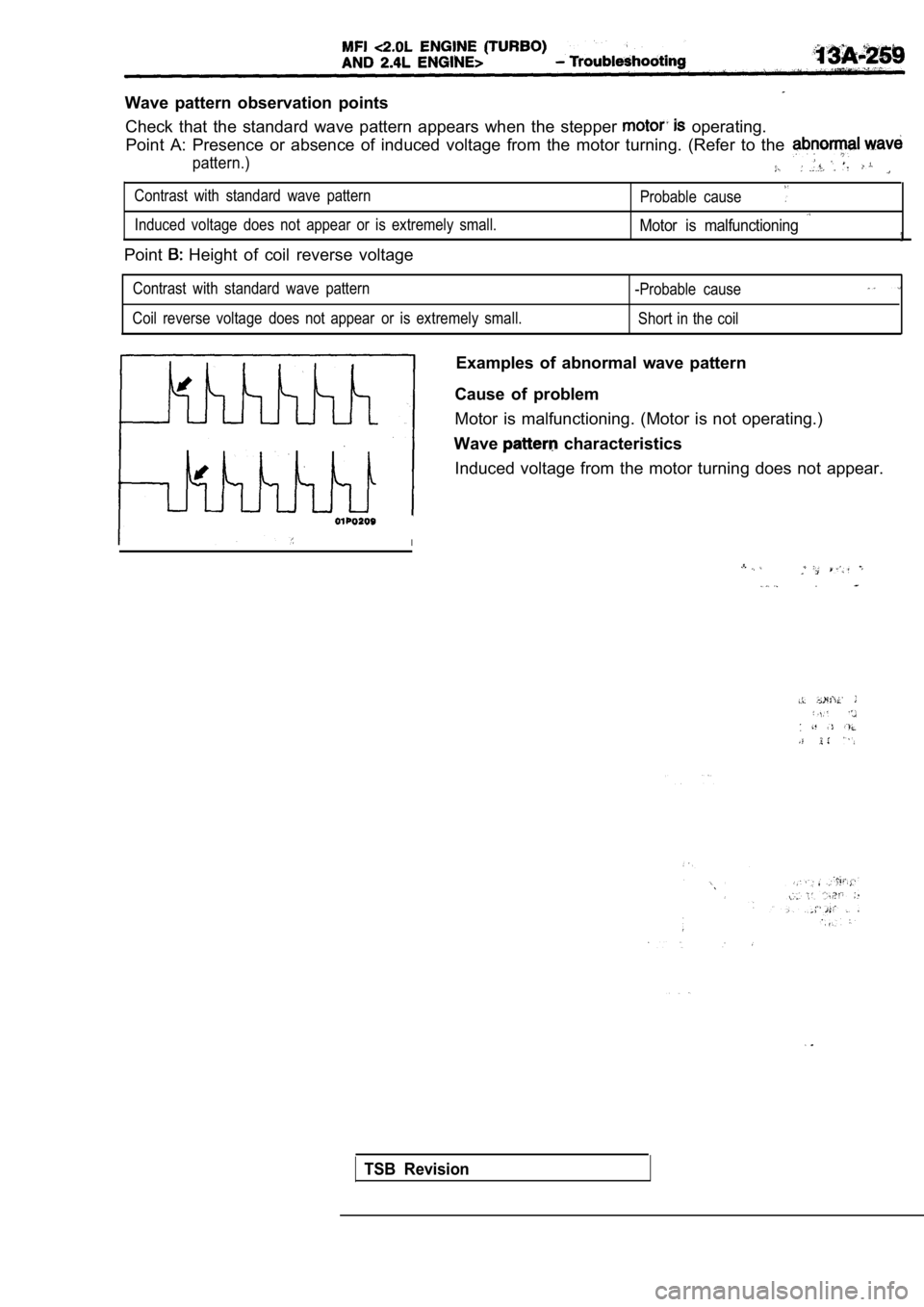
Wave pattern observation pointsCheck that the standard wave pattern appears when t he stepper
operating.
Point A: Presence or absence of induced voltage fro m the motor turning. (Refer to the
pattern.)
Contrast with standard wave pattern
Probable cause
Induced voltage does not appear or is extremely small.Motor is malfunctioning
Point Height of coil reverse voltage
Contrast with standard wave pattern
-Probable cause
Coil reverse voltage does not appear or is extremely small.
Short in the coil
Examples of abnormal wave pattern
Cause of problem
Motor is malfunctioning. (Motor is not operating.)
Wave
characteristics
Induced voltage from the motor turning does not app ear.
I
.
TSB Revision
Page 692 of 2103
14-2ENGINE COOLING General Information
GENERAL INFORMATION , ,
The cooling system is designed to keep every partthat the heat absorbed by the coolant may be of the engine at appropriate temperature in diated into the air.
er condition the engine may be operated.
The cooling of the water-cooled, pressureThe water pump is of the centrifugal type and is
driven by the
the
forced circulation type in which the water pump crankshaft. .
pressurizes coolant and circulates it throughout th e
engine: If the coolant temperature exceeds the
scribed temperature, the thermostat opens to circu-
late the coolant through the radiator as well so
and is cooled the
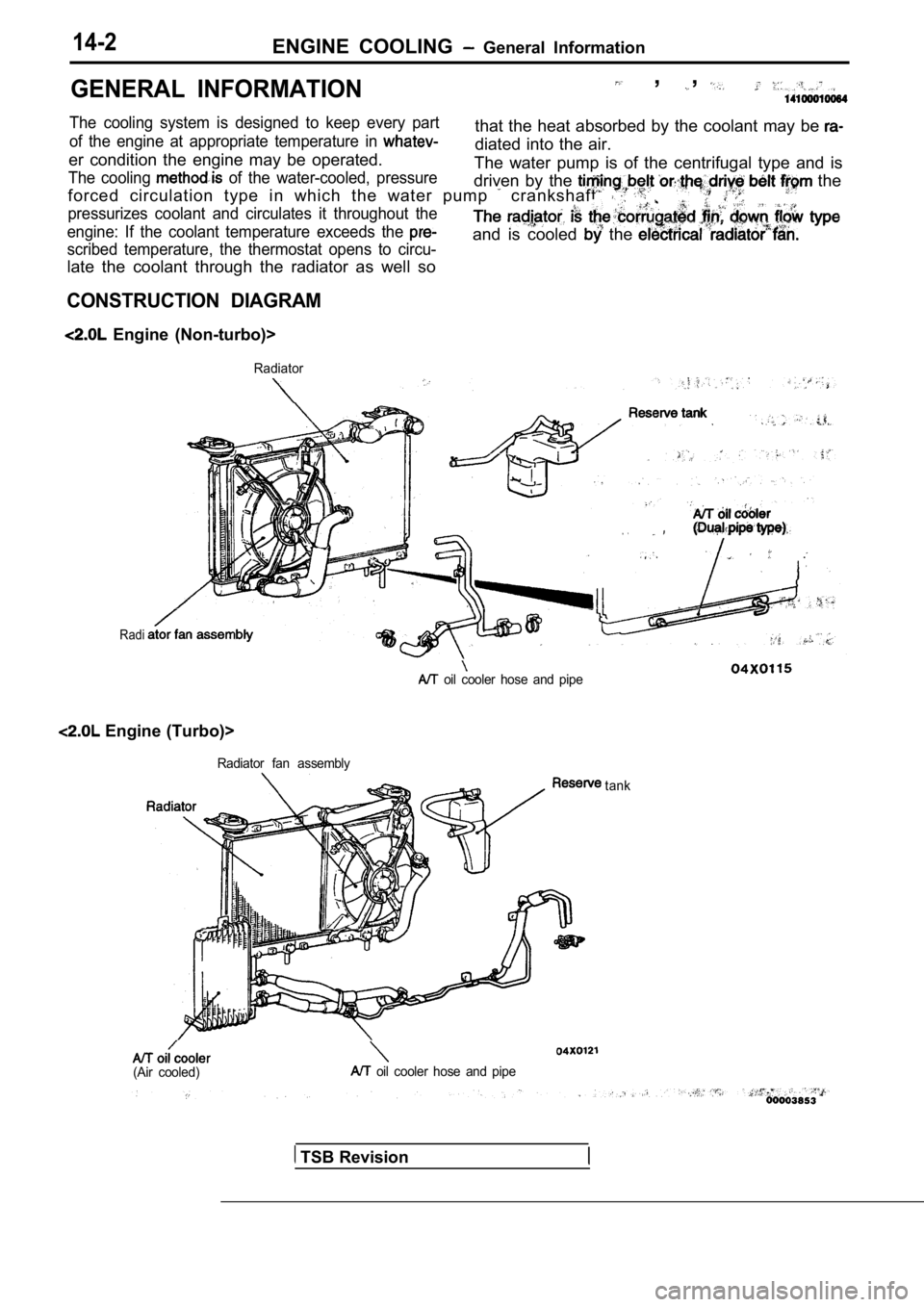
CONSTRUCTION DIAGRAM
Engine (Non-turbo)>
Radiator
Radi
.
oil cooler hose and pipe
Engine (Turbo)>
Radiator fan assembly
(Air cooled) oil cooler hose and pipetank
TSB Revision
Page 704 of 2103
ENGINE Thermostat
EngineJiggle valve
Engine Jiggle valve
Rubber
ring
Projection
Walter outlet fitting or
water inlet fitting
R E M O V A L S E R V I C E P O I N T
UPPER HOSE
(Non-turbo)> OR ROSE
Engine and. ,
D I S C O N N E C T I O N ,
Place a mating mark on the and the clamp.
Then, disconnect the hose.
INSTALLATION SERVICE POINTS
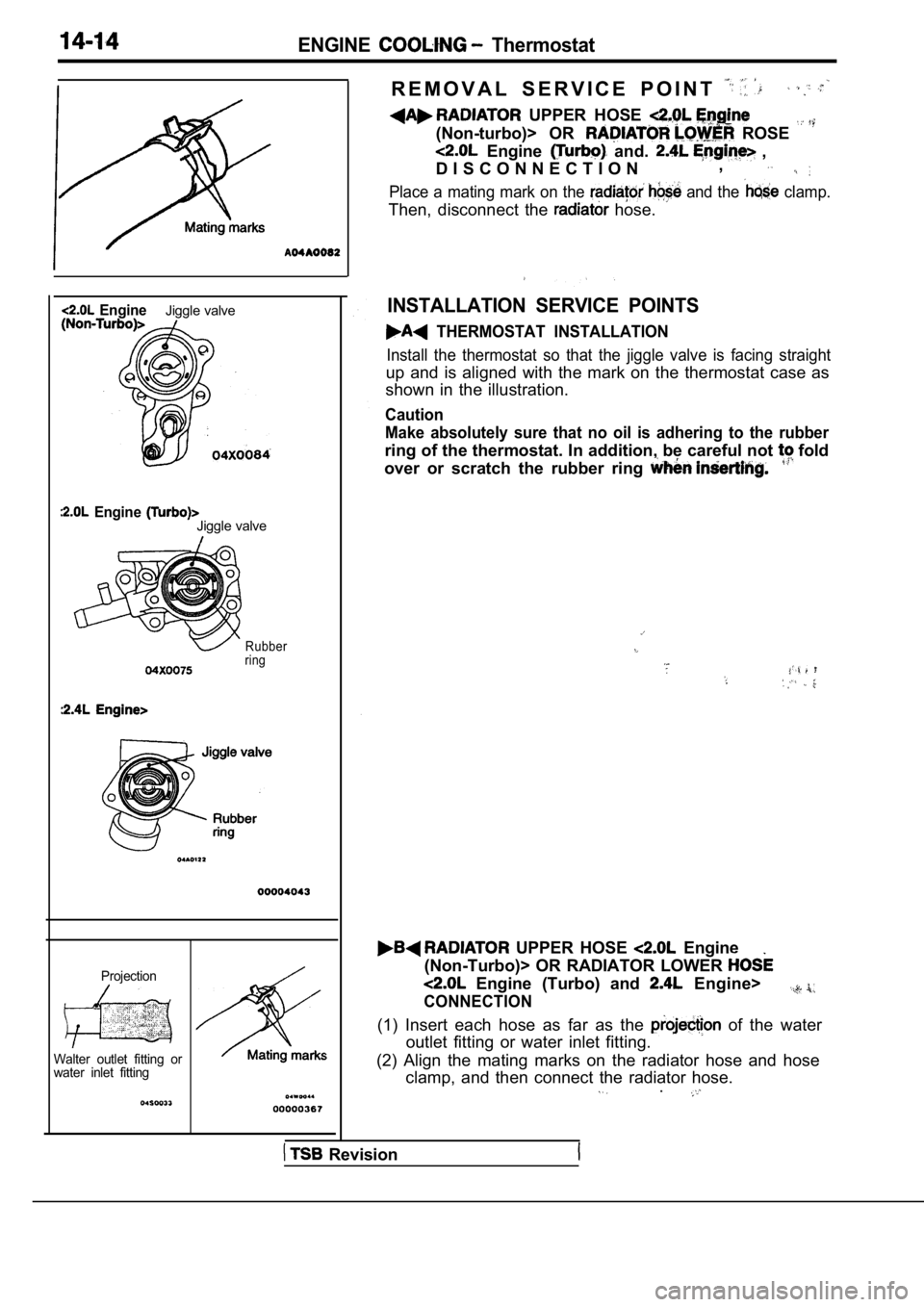
THERMOSTAT INSTALLATION
Install the thermostat so that the jiggle valve is
facing straight
up and is aligned with the mark on the thermostat c ase as
shown in the illustration.
Caution
Make absolutely sure that no oil is adhering to the rubber
ring of the thermostat. In addition, be careful not fold
over or scratch the rubber ring
UPPER HOSE Engine
(Non-Turbo)> OR RADIATOR LOWER
Engine (Turbo) and Engine>
CONNECTION
(1) Insert each hose as far as the of the water
outlet fitting or water inlet fitting.
(2) Align the mating marks on the radiator hose and hose
clamp, and then connect the radiator hose.
.
Revision
Page 740 of 2103
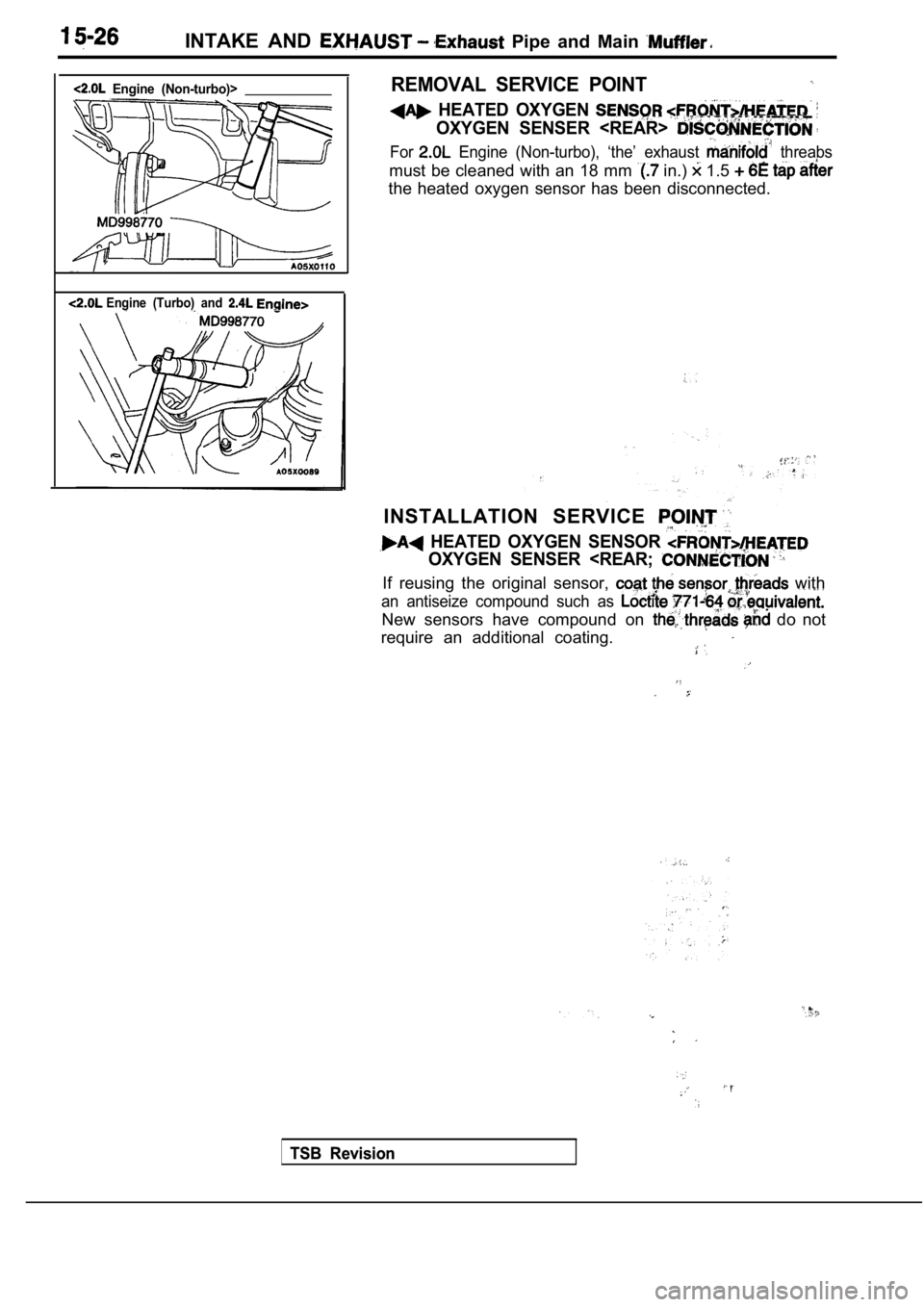
INTAKE AND Pipe and Main
Engine (Non-turbo)>
Engine (Turbo) and
REMOVAL SERVICE POINT
HEATED OXYGEN
OXYGEN SENSER
For Engine (Non-turbo), ‘the’ exhaust threabs
must be cleaned with an 18 mm in.) 1.5
the heated oxygen sensor has been disconnected.
INSTALLATION SERVICE
HEATED OXYGEN SENSOR
OXYGEN SENSER
an antiseize compound such as
New sensors have compound on do not
require an additional coating.
TSB Revision
TSB Revision
Page 772 of 2103
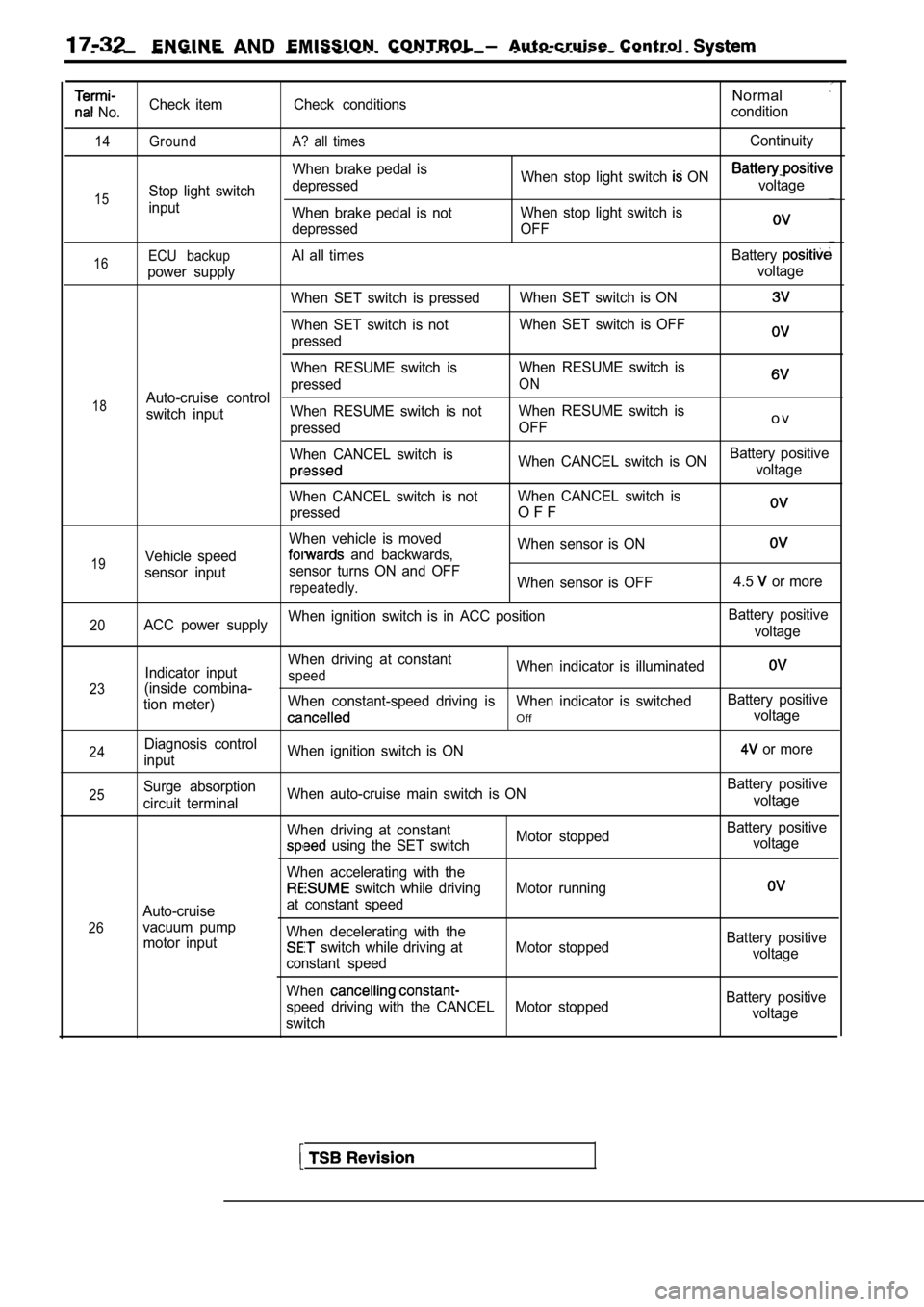
E N G I N E EMISSION CONTROL Auto-cruise Control
No.
14
15
Check item
Ground
Stop light switch
inputCheck conditions
A? all times
When brake pedal is
depressed
When brake pedal is not
depressed
Normal
condition
Continuity
When stop light switch ON voltage
When stop light switch is
OFF
16
18
19ECU backupAl all times Battery
power supply voltage
When SET switch is pressed When SET switch is ON
When SET switch is notWhen SET switch is OFF
pressed
When RESUME switch is When RESUME switch is
pressed
ONAuto-cruise control
switch input When RESUME switch is not
When RESUME switch is
pressed OFF
o v
When CANCEL switch is
When CANCEL switch is ONBattery positivevoltage
When CANCEL switch is not When CANCEL switch is
pressed
O F F
When vehicle is moved When sensor is ON
Vehicle speed and backwards,
sensor input sensor turns ON and OFF
repeatedly.When sensor is OFF
4.5 or more
20ACC power supplyWhen ignition switch is in ACC position
Battery positive
voltage
23
24
Indicator input
(inside combina-
tion meter)
Diagnosis control
input When driving at constantspeedWhen indicator is illuminated
When constant-speed driving is When indicator is swi
tchedBattery positive
Offvoltage
When ignition switch is ON
or more
25
26Surge absorption
circuit terminal
Auto-cruise
vacuum pump motor input When auto-cruise main switch is ON
When driving at constant
Motor stopped
using the SET switch
When accelerating with the
switch while driving Motor running
at constant speed
When decelerating with the
switch while driving at Motor stopped
constant speed
When
speed driving with the CANCEL Motor stopped
switch Battery positive
voltage
Battery positive voltage
Battery positivevoltage
Battery positive voltage
Page 808 of 2103
17-68ENGINEAND EMISSION CONTROL (Turbo) and
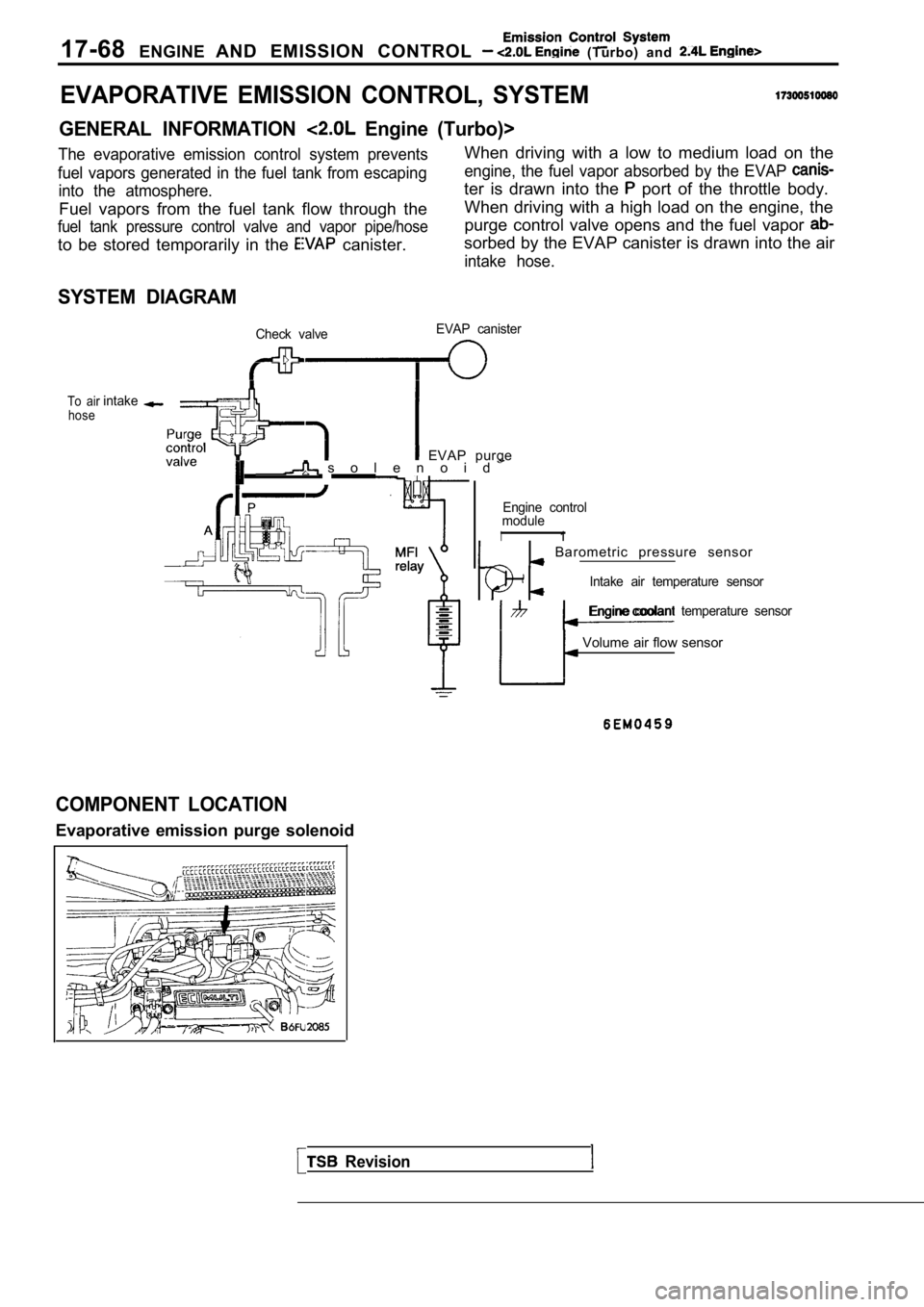
EVAPORATIVE EMISSION CONTROL, SYSTEM
GENERAL INFORMATION Engine (Turbo)>
The evaporative emission control system preventsWhen driving with a low to medium load on the
fuel vapors generated in the fuel tank from escapin gengine, the fuel vapor absorbed by the EVAP
into the atmosphere.ter is drawn into the port of the throttle body.
Fuel vapors from the fuel tank flow through the When driving with a high load on the engine, the
fuel tank pressure control valve and vapor pipe/hos
epurge control valve opens and the fuel vapor
to be stored temporarily in the canister.sorbed by the EVAP canister is drawn into the air
intake hose.
SYSTEM DIAGRAM
Check valve EVAP canister
To air
hoseintake
EVAP purge s o l e n o i d
Revision
Engine control
module
I1
Barometric pressure sensor
Intake air temperature sensor
Engine coolant temperature sensor
Volume air flow sensor
COMPONENT LOCATION
Evaporative emission purge solenoid
Page 1171 of 2103

AUTOMATIC TRANSAXLE
ENGINE (NON-TURBO)>: On-vehicle _ _
AUTOMATIC
COMPONENT CHECK
SPEED SENSOR
(1) Disconnect the input speed sensor connector.
(2) Measure the resistance
the input speed
side connector terminals 1 and 2.
Standard value:,
(3) If the resistance is outside the standard value , replace
the input speed sensor.
OUTPUT SPEED SENSOR CHECK
(1) Disconnect the output speed sensor connector.
(2) Measure the resistance between the input speed
side connector terminals 1 2.
Standard value:
(3) If the resistance is outside the standard value , replace
the output speed sensor.
TRANSAXLE RANGE SENSOR CONTINUITY CHECK
Refer to
OVERDRIVE SWITCH CONTINUITY CHECK
Refer to
POSITION SENSOR (TPS) CHECK
Refer to GROUP On-vehicle Inspection of Compo-
nents.
ENGINE COOLANT TEMPERATURE SENSOR CHECK
.
Refer to GROUP On-vehicle Inspection of
nents.
CRANKSHAFT CHECK
Refer to GROUP Troubleshooting.
ABSOLUTE PRESSURE SENSOR
Refer to On-vehicle Inspection of
nents.
Revision
Page 1453 of 2103
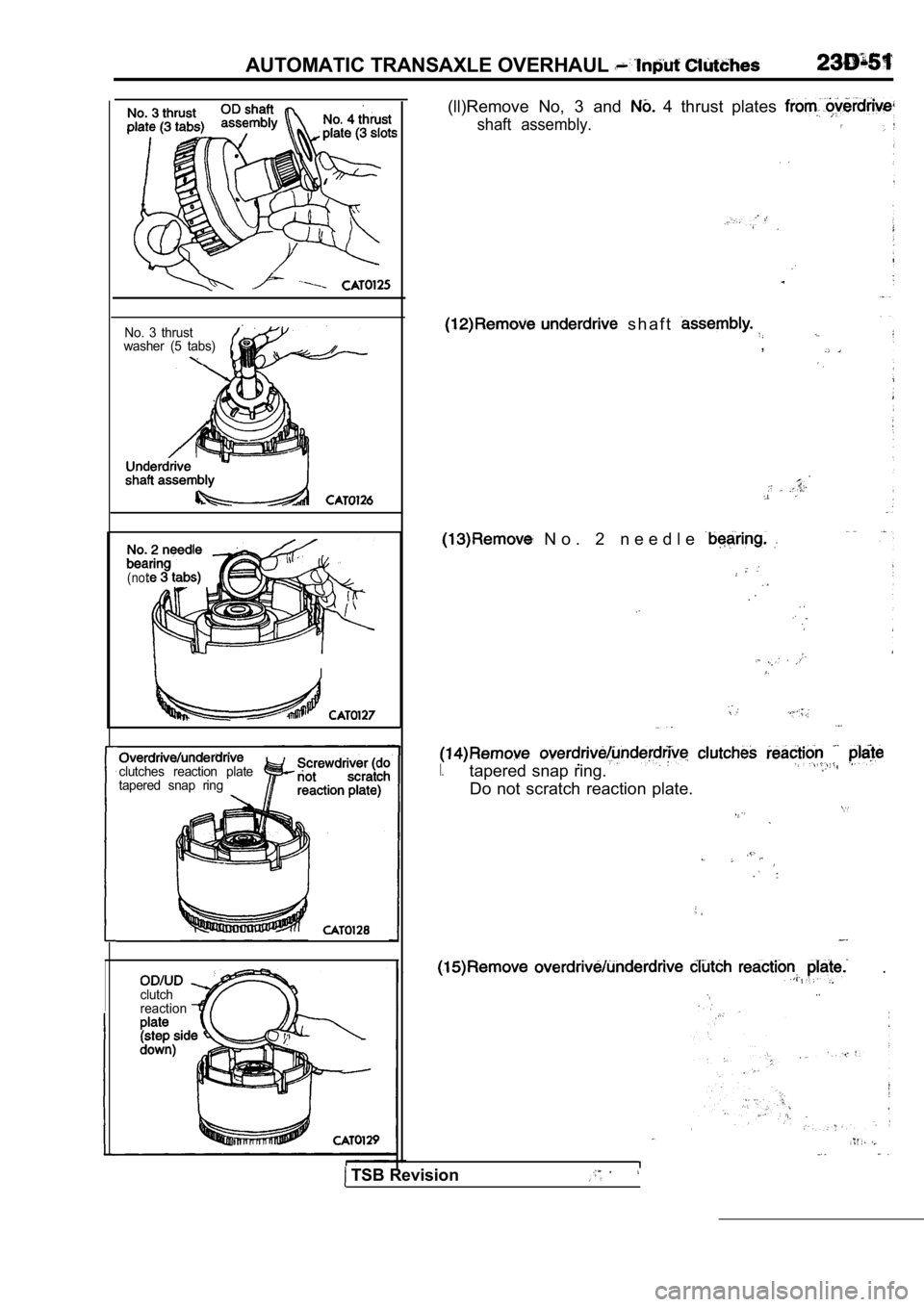
AUTOMATIC TRANSAXLE OVERHAUL
No. 3 thrust
washer (5 tabs)
(not
I
clutches reaction plate
tapered snap ring
clutch
reaction
(ll)Remove No, 3 and 4 thrust plates
shaft assembly.
s h a f t
,
N o . 2 n e e d l e
I.tapered snap ring.
Do not scratch reaction plate.
.
TSB Revision