display MITSUBISHI SPYDER 1990 Service User Guide
[x] Cancel search | Manufacturer: MITSUBISHI, Model Year: 1990, Model line: SPYDER, Model: MITSUBISHI SPYDER 1990Pages: 2103, PDF Size: 68.98 MB
Page 510 of 2103
On-vehicle of
ENGINE ( N O N - T U R B O ) >
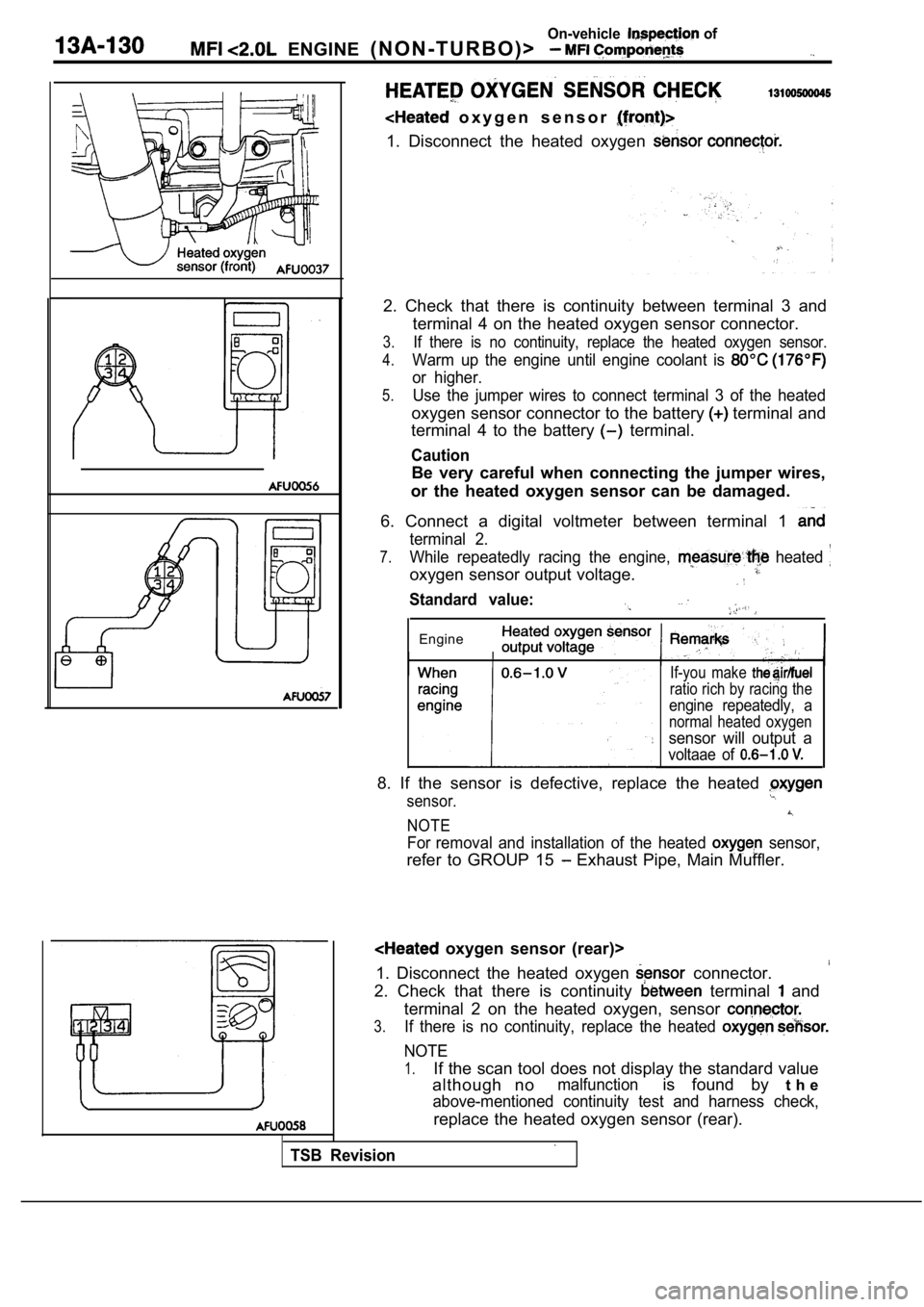
o x y g e n s e n s o r
1. Disconnect the heated oxygen
2. Check that there is continuity between terminal 3 and
terminal 4 on the heated oxygen sensor connector.
3.If there is no continuity, replace the heated oxyge n sensor.
4.Warm up the engine until engine coolant is
or higher.
5.Use the jumper wires to connect terminal 3 of the h eated
oxygen sensor connector to the battery terminal and
terminal 4 to the battery
terminal.
Caution
Be very careful when connecting the jumper wires,
or the heated oxygen sensor can be damaged.
6. Connect a digital voltmeter between terminal 1
terminal 2.
7.While repeatedly racing the engine, heated
oxygen sensor output voltage.
Standard value:
Engine
TSB Revision
If-you make
ratio rich by racing the
engine repeatedly, a
normal heated oxygen
sensor will output a
voltaae of
8. If the sensor is defective, replace the heated
sensor.
NOTE
For removal and installation of the heated sensor,
refer to GROUP 15 Exhaust Pipe, Main Muffler.
oxygen sensor (rear)>
1. Disconnect the heated oxygen
connector.
2. Check that there is continuity terminal and
terminal 2 on the heated oxygen, sensor
3.If there is no continuity, replace the heated
NOTE
1.If the scan tool does not display the standard valu e
although no
malfunctionis found by t h e
above-mentioned continuity test and harness check,
replace the heated oxygen sensor (rear).
Page 607 of 2103
![MITSUBISHI SPYDER 1990 Service User Guide ENGINE (TURBO)
AND
ENGINE> Troubleshooting
INSPECTION PROCEDURE 35
Idle air control motor (DC motor) Engine>P r o b a b l e c a u s e
[Comment]l Malfunction of idle air control mo](/img/19/57345/w960_57345-606.png "MITSUBISHI SPYDER 1990 Service User Guide ENGINE (TURBO)
AND
ENGINE> Troubleshooting
INSPECTION PROCEDURE 35
Idle air control motor (DC motor) Engine>P r o b a b l e c a u s e
[Comment]l Malfunction of idle air control mo")
ENGINE (TURBO)
AND
ENGINE> Troubleshooting
INSPECTION PROCEDURE 35
Idle air control motor (DC motor) Engine>P r o b a b l e c a u s e
[Comment]l Malfunction of idle air control motor
The ECM controls the intake air volume during idlin g by opening and closing the I m p r o p e r c o n n e c t o r open “circuit’ servo valve located in the bypass passage.
l Malfunction of the
at the idle air control motor connector Connect the connector. (Use test harness: Voltage between 5 and ground (Ignition switch: ON)
OK: 2 or more to 0 (momentarily) Voltage between 6 and ground (Ignition switch: ON)OK: 4 or more to 0 (momentarily)
OK
the idle air control motor.1
Check symptom.
Replace
INSPECTION PROCEDURE 36
Scan tool: Inspection when no initial combustion oc curs
SCAN TOOL Data listNGCheck the power and ignition 16 Voltage of ECM power source (Refer to (Refer to I PROCEDURE 27.)
(Whenoil filler cap is removed.)
SCAN TOOL DTC
Are the diagnostic trouble codes output
Check timing belt for breakage.
INSPECTION CHART FOR TROUBLE CODES.
(Refer to
SCAN TOOL list NG
22 Crankshaft position sensor OK: Cranking speed is displayed.
OK
Check the crankshaft position sensor circuit malfu nction. (Refer to INSPECTION PROCEDURE FOR DIAGNOSTIC
TROUBLE CODES
SCAN TOOL Actuator testCheck the fuel pump system Engine 07 Fuel pump (Refer to (Refer to INSPECTION PROCEDURE 28.)
OKCheck the fuel pump system (Refer to INSPECTION PROCEDURE 29) .
SCAN TOOL list21 Check the engine coolant temperature circuit (Refer to INSPECTION PROCEDURE FOR DIAGNOSTICTROUBLE CODES
TSB Revision
Page 608 of 2103
ENGINE (TURBO)
AND ENGINE> Troubleshooting
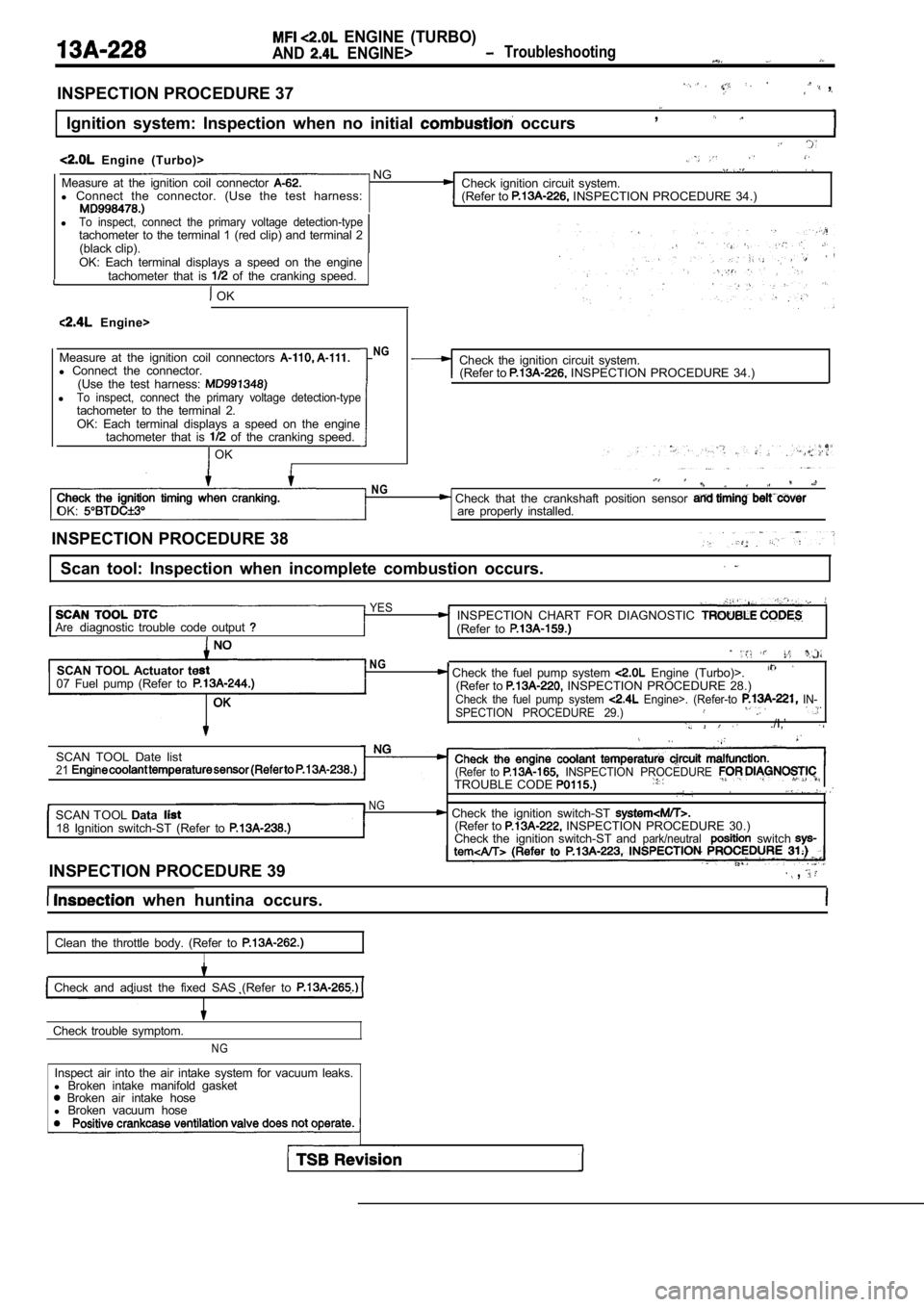
INSPECTION PROCEDURE 37 ,
Ignition system: Inspection when no initial occurs,
Engine (Turbo)> NGMeasure at the ignition coil connector Check ignition circuit system.
l Connect the connector. (Use the test harness:
(Refer to INSPECTION PROCEDURE 34.)
lTo inspect, connect the primary voltage detection-typetachometer to the terminal 1 (red clip) and terminal 2
(black clip).
OK: Each terminal displays a speed on the engine tachometer that is
of the cranking speed.
OK
Engine>
Measure at the ignition coil connectors
l Connect the connector.
(Use the test harness:
lTo inspect, connect the primary voltage detection-t ypetachometer to the terminal 2.OK: Each terminal displays a speed on the engine
tachometer that is of the cranking speed.
OK
NGCheck the ignition circuit system.(Refer to INSPECTION PROCEDURE 34.)
OK:
NG Check that the crankshaft position sensor are properly installed.
INSPECTION PROCEDURE 38
Scan tool: Inspection when incomplete combustion oc curs.
YESINSPECTION CHART FOR DIAGNOSTIC Arediagnostic trouble code output (Refer to
SCAN TOOL Actuator te
07 Fuel pump (Refer toNG, Check the fuel pump system Engine (Turbo)>.(Refer to INSPECTION PROCEDURE 28.)Check the fuel pump system Engine>. (Refer-to IN-
SPECTION PROCEDURE 29.)
./I,’
SCAN TOOL Date list21(Refer to INSPECTION PROCEDURE TROUBLE CODE
NGSCAN TOOL Data Check the ignition switch-ST 18 Ignition switch-ST (Refer to (Refer to INSPECTION PROCEDURE 30.)
Check the ignition switch-ST andpark/neutralswitch
INSPECTION PROCEDURE 39 ,
when huntina occurs.
Clean the throttle body. (Refer to
I
Check and adiust the fixed SAS (Refer to
Check trouble symptom.
NG
Inspect air into the air intake system for vacuum l eaks.
l Broken intake manifold gasket
Broken air intake hose
l Broken vacuum hose
Page 633 of 2103
ENGINE (TURBO)
AND
ENGINE> Troubleshooting
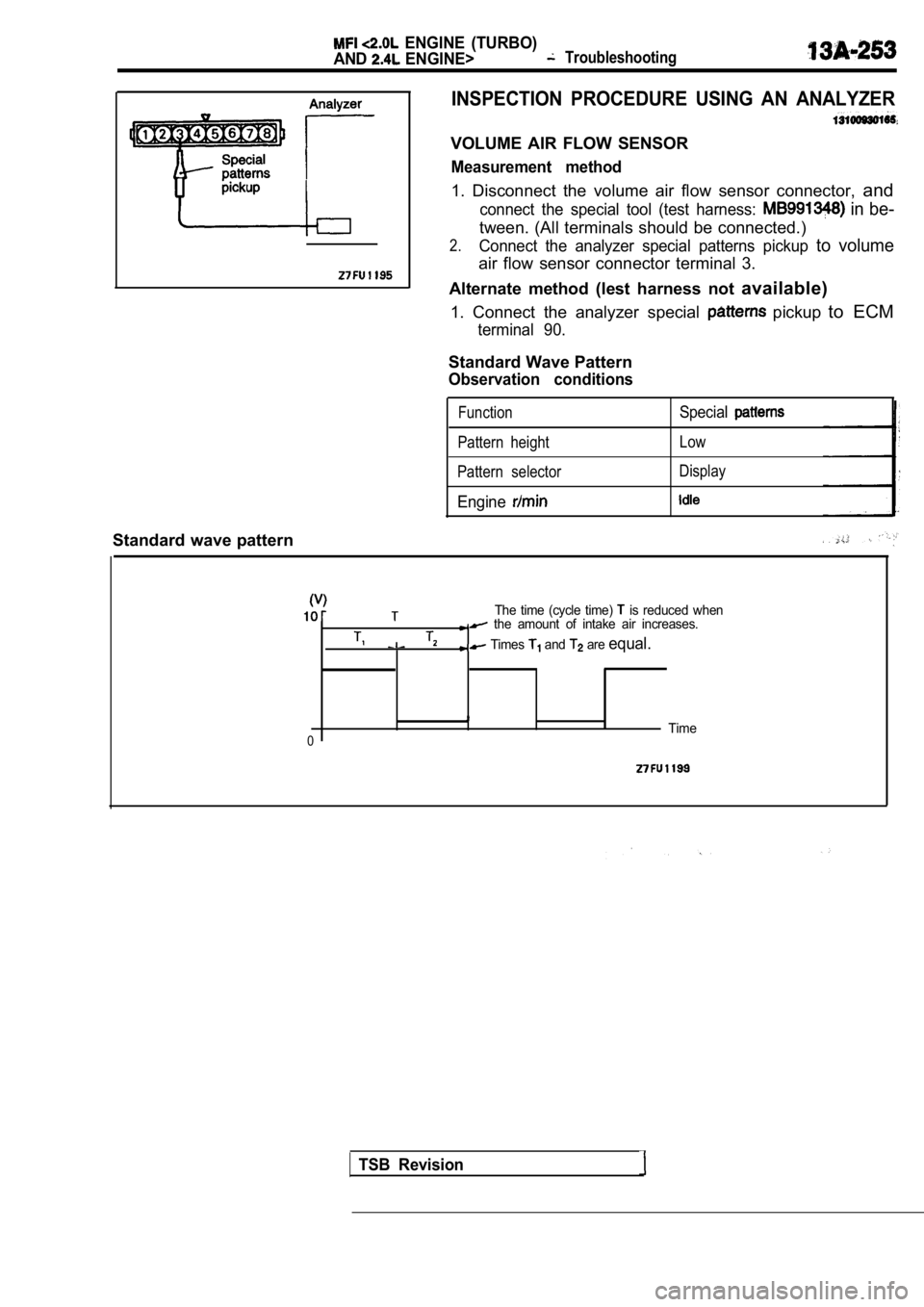
INSPECTION PROCEDURE USING AN ANALYZER
VOLUME AIR FLOW SENSOR
Measurement method
1. Disconnect the volume air flow sensor connector, and
connect the special tool (test harness: in be-
tween. (All terminals should be connected.)
2.Connect the analyzer special patterns pickup to volume
air flow sensor connector terminal 3.
Alternate method (lest harness not available)
1. Connect the analyzer special
pickup to ECM
terminal 90.
Standard Wave Pattern
Observation conditions
FunctionSpecial
Pattern height Low
Pattern selector Display
Engine
Standard wave pattern
The time (cycle time) is reduced when the amount of intake air increases.
Times and are equal.
0Time
TSB Revision
Page 635 of 2103
ENGINE (TURBO)
AND ENGINE>
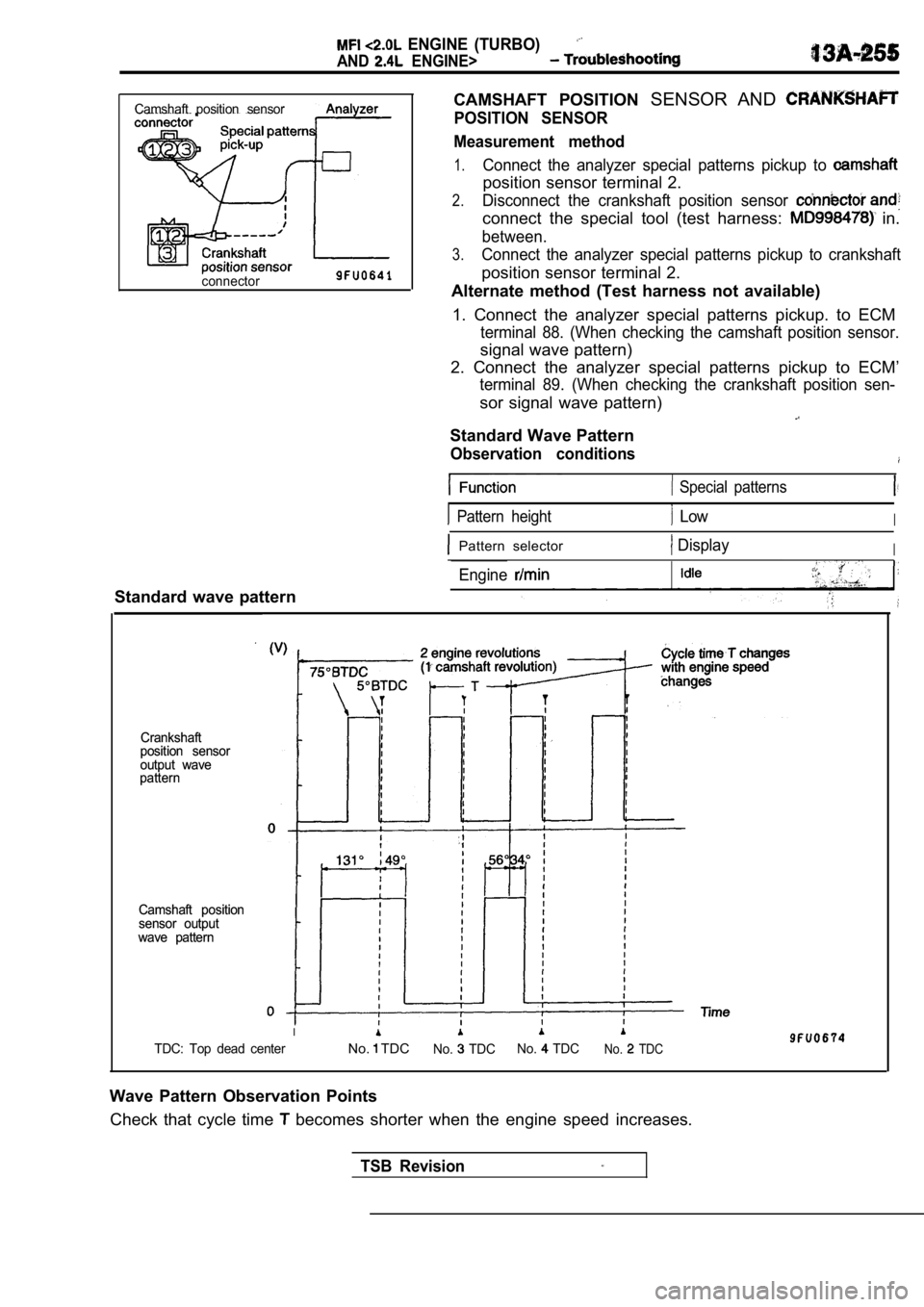
CAMSHAFT POSITION SENSOR AND
POSITION SENSOR
Measurement method
1.Connect the analyzer special patterns pickup to
position sensor terminal 2.
2.Disconnect the crankshaft position sensor
connect the special tool (test harness: in.
between.
3.Connect the analyzer special patterns pickup to cra nkshaft
position sensor terminal 2.
Alternate method (Test harness not available)
1. Connect the analyzer special patterns pickup. to ECM
terminal 88. (When checking the camshaft position sensor.
signal wave pattern)
2. Connect the analyzer special patterns pickup to ECM’
terminal 89. (When checking the crankshaft position sen-
sor signal wave pattern)
Standard Wave Pattern
Observation conditions
Camshaft position sensor
connector
Standard wave pattern
Crankshaft
Crankshaft
position sensor
position sensor
output wave
output wave
pattern
pattern
Camshaft position
Camshaft position
sensor output
sensor output
wave pattern
wave pattern
Special patterns
Pattern height LowI
Pattern selector DisplayI
Engine
I
TDC: Top dead centerNo. TDCNo. TDC No. TDCNo. TDC
Wave Pattern Observation Points
Check that cycle time
becomes shorter when the engine speed increases.
TSB Revision
Page 637 of 2103
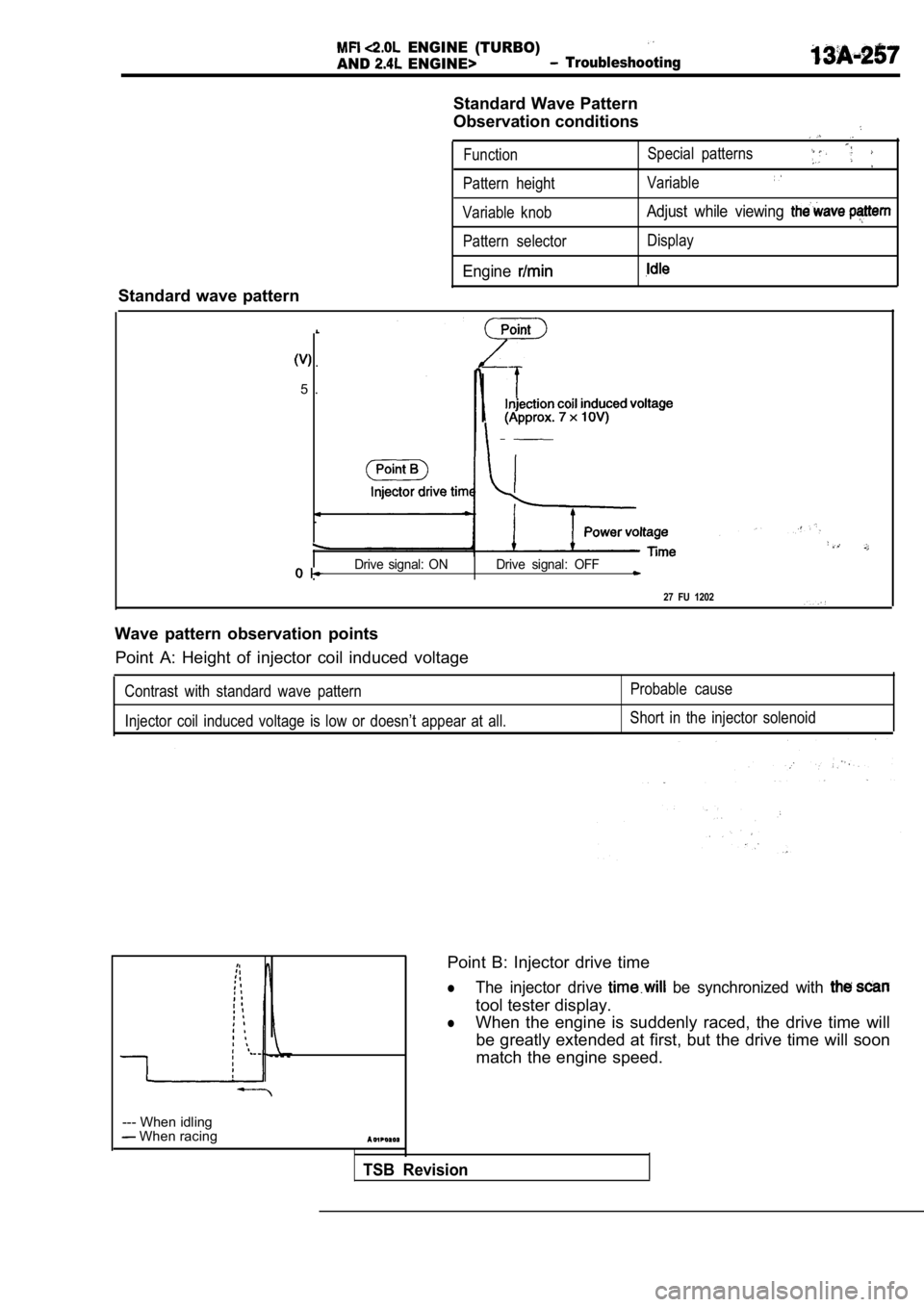
ENGINE (TURBO)
AND ENGINE> Troubleshooting
Standard Wave Pattern
Observation conditions
FunctionSpecial patterns
Pattern height
Variable
Standard wave pattern
Variable knobAdjust while viewing
Pattern selector Display
Engine
.
5 .
Drive signal: ON Drive signal: OFF
27 FU 1202
Wave pattern observation points Point A: Height of injector coil induced voltage
Contrast with standard wave pattern
Injector coil induced voltage is low or doesn’t app ear at all.Probable cause
Short in the injector solenoid
TSB Revision
--- When idling When racing
Point B: Injector drive time
lThe injector drive be synchronized with
tool tester display.
lWhen the engine is suddenly raced, the drive time w ill
be greatly extended at first, but the drive time wi ll soon
match the engine speed.
Page 638 of 2103
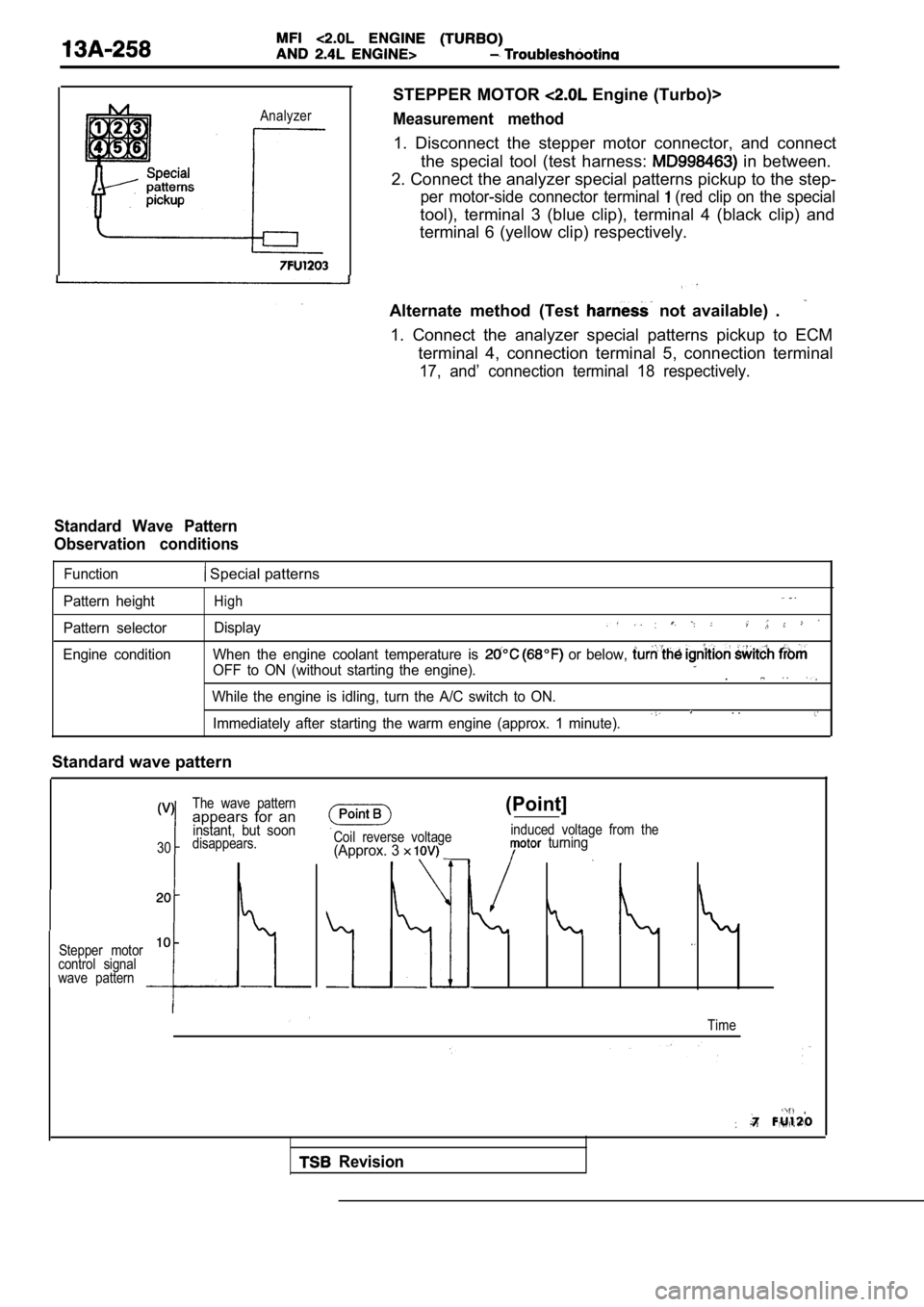
Analyzer
STEPPER MOTOR Engine (Turbo)>
Measurement method
1. Disconnect the stepper motor connector, and connect
the special tool (test harness:
in between.
2. Connect the analyzer special patterns pickup to the step-
per motor-side connector terminal (red clip on the special
tool), terminal 3 (blue clip), terminal 4 (black clip) and
terminal 6 (yellow clip) respectively.
Alternate method (Test
not available) .
1. Connect the analyzer special patterns pickup to ECM
terminal 4, connection terminal 5, connection termi nal
17, and’ connection terminal 18 respectively.
Standard Wave Pattern
Observation conditions
Function Special patterns
Pattern height
Pattern selector
Engine conditionHigh
Display
When the engine coolant temperature is or below,
OFF to ON (without starting the engine)..
While the engine is idling, turn the A/C switch to ON.. .Immediately after starting the warm engine (approx. 1 minute).
Standard wave pattern
The wave patternappears for aninstant, but soon
30disappears.
Stepper motor
10
control signal
wave pattern
Coil reverse voltage(Approx. 3
(Point]
induced voltage from the turning
Time
Revision
Page 664 of 2103
ENGINE (TURBO)
ENGINE>of Components’
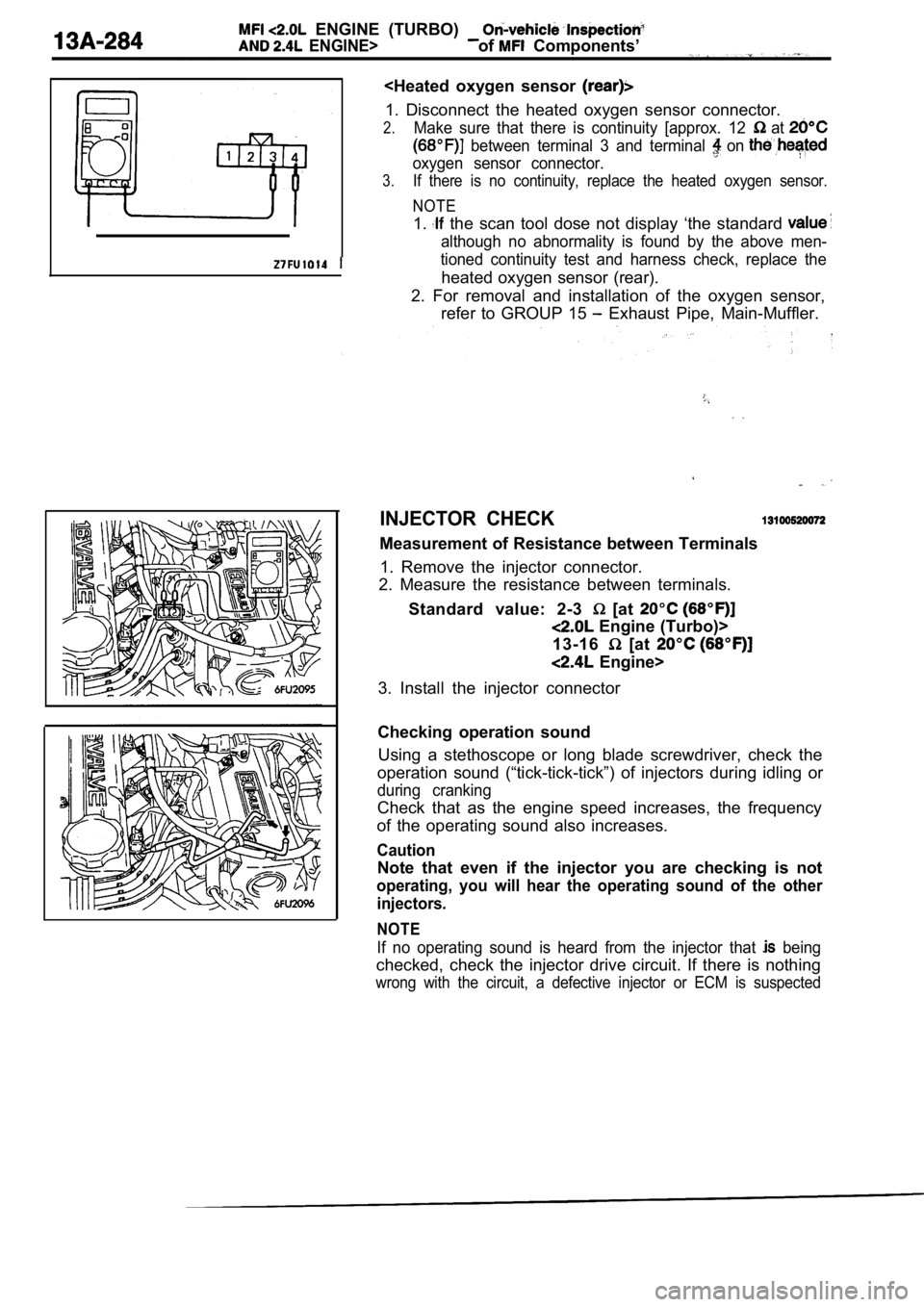
2.Make sure that there is continuity [approx. 12 at
between terminal 3 and terminal on
oxygen sensor connector.
3.If there is no continuity, replace the heated oxyge n sensor.
NOTE
1. the scan tool dose not display ‘the standard
although no abnormality is found by the above men-
tioned continuity test and harness check, replace t he
heated oxygen sensor (rear).
2. For removal and installation of the oxygen senso r,
refer to GROUP 15
Exhaust Pipe, Main-Muffler.
INJECTOR CHECK
Measurement of Resistance between Terminals
1. Remove the injector connector.
2. Measure the resistance between terminals.
Standard value: 2-3
[at
Engine (Turbo)>
13-16
[at
Engine>
3. Install the injector connector
Checking operation sound Using a stethoscope or long blade screwdriver, chec k the
operation sound (“tick-tick-tick”) of injectors dur ing idling or
during cranking
Check that as the engine speed increases, the frequ ency
of the operating sound also increases.
Caution
Note that even if the injector you are checking is not
operating, you will hear the operating sound of the other
injectors.
NOTE
If no operating sound is heard from the injector th at being
checked, check the injector drive circuit. If there is nothing
wrong with the circuit, a defective injector or ECM is suspected
Page 749 of 2103
ENGINE AND EMISSION CONTROL Auto-cruise Control
TROUBLESHOOTING ENGINE (NON-TURBO)>
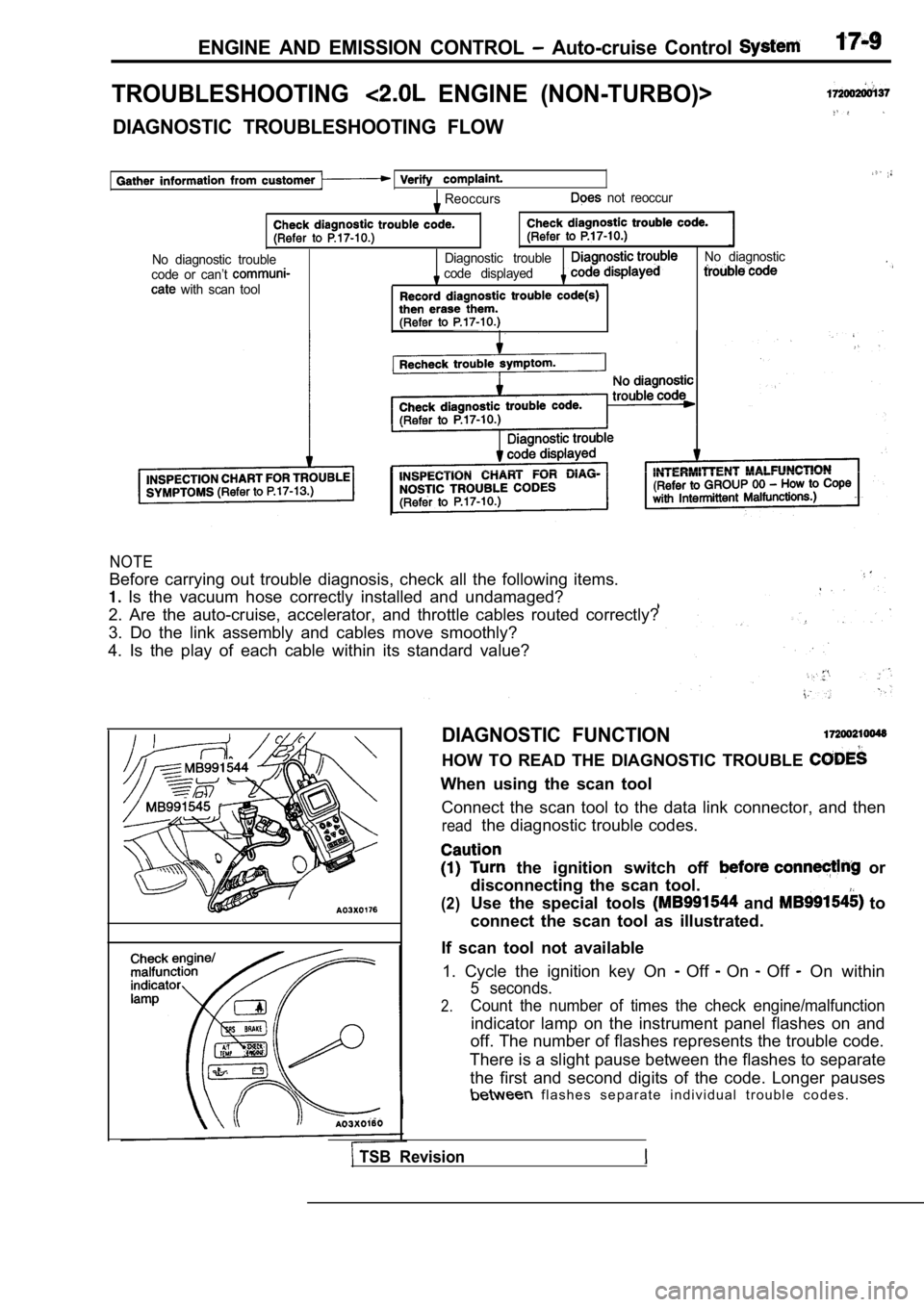
DIAGNOSTIC TROUBLESHOOTING FLOW
Reoccurs not reoccur
No diagnostic troubleDiagnostic troubleNo diagnostic
code or can’t code displayed
with scan tool
NOTE
Before carrying out trouble diagnosis, check all th e following items.
Is the vacuum hose correctly installed and undamag ed?
2. Are the auto-cruise, accelerator, and throttle c ables routed correctly?
3. Do the link assembly and cables move smoothly?
4. Is the play of each cable within its standard va lue?
DIAGNOSTIC FUNCTION
HOW TO READ THE DIAGNOSTIC TROUBLE
When using the scan tool
Connect the scan tool to the data link connector, a nd then
readthe diagnostic trouble codes.
the ignition switch off or
disconnecting the scan tool.
(2)Use the special tools and to
connect the scan tool as illustrated.
If scan tool not available 1. Cycle the ignition key On
Off On Off On within
5 seconds.
2.Count the number of times the check engine/malfunct ion
indicator lamp on the instrument panel flashes on and
off. The number of flashes represents the trouble c ode.
There is a slight pause between the flashes to sepa rate
the first and second digits of the code. Longer pau ses
f l a s h e s s e p a r a t e i n d i v i d u a l t r o u b l e c o d e s .
TSB Revision
Page 757 of 2103
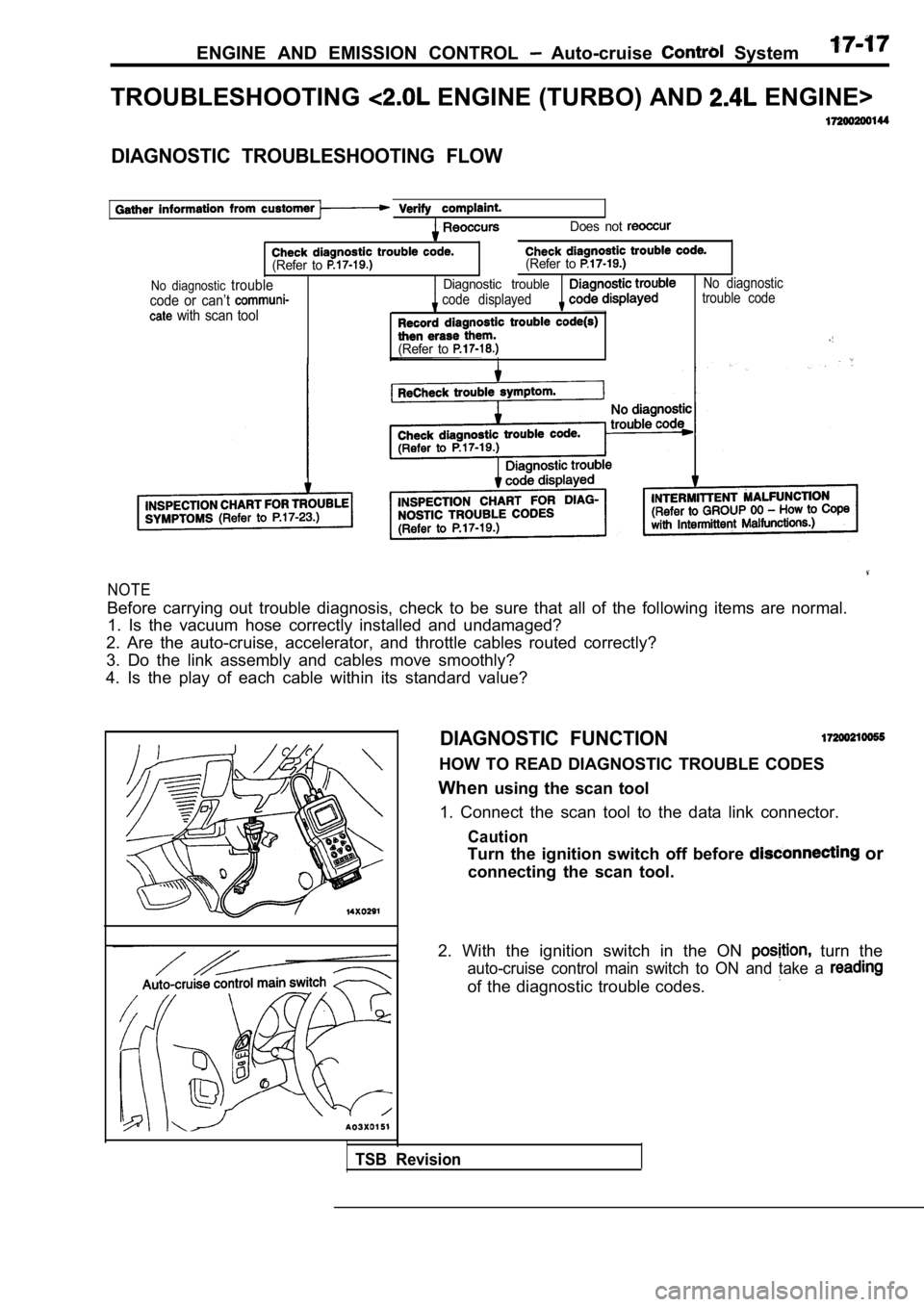
ENGINE AND EMISSION CONTROL Auto-cruise System
TROUBLESHOOTING ENGINE (TURBO) AND ENGINE>
DIAGNOSTIC TROUBLESHOOTING FLOW
Does not
(Refer to (Refer to
No diagnostic troubleDiagnostic troubleNo diagnostic
code or can’t code displayedtrouble code
with scan tool
(Refer to
NOTE
Before carrying out trouble diagnosis, check to be
sure that all of the following items are normal.
1. Is the vacuum hose correctly installed and undam aged?
2. Are the auto-cruise, accelerator, and throttle c ables routed correctly?
3. Do the link assembly and cables move smoothly?
4. Is the play of each cable within its standard va lue?
DIAGNOSTIC FUNCTION
HOW TO READ DIAGNOSTIC TROUBLE CODES
When using the scan tool
1. Connect the scan tool to the data link connector .
Caution
Turn the ignition switch off before or
connecting the scan tool.
2. With the ignition switch in the ON
turn the
auto-cruise control main switch to ON and take a
of the diagnostic trouble codes.
TSB Revision