brakes MITSUBISHI SPYDER 1990 Service Repair Manual
[x] Cancel search | Manufacturer: MITSUBISHI, Model Year: 1990, Model line: SPYDER, Model: MITSUBISHI SPYDER 1990Pages: 2103, PDF Size: 68.98 MB
Page 47 of 2103
GENERAL Maintenance, Service
5. Tighten filler plug to specified torque.
Specified torque:
Engine (Non-turbo)>30 Nm (22
Engine (Turbo) and Engine>
32 Nm (24
12. AUTOMATIC TRANSAXLE FLUID
(Check ‘fluid level)
Engine (Non-turbo)>
1. Position the vehicle on a level surface.
2. Start engine and allow to idle in PARK for at le ast 60
seconds. The warmer the transaxle fluid, the more
accurate the reading.
3.While sitting in driver seat, apply brakes and plac e gear
selector in each position. Return gear selector to PARK.
4. Raise hood and remove transaxle fluid level indi cator
(dipstick) and wipe clean with a suitable shop towe l.
5.
dipstick and verify it is seated in fill tube.
Caution
Do not overfill automatic transaxle, leakage or dam age
can result.
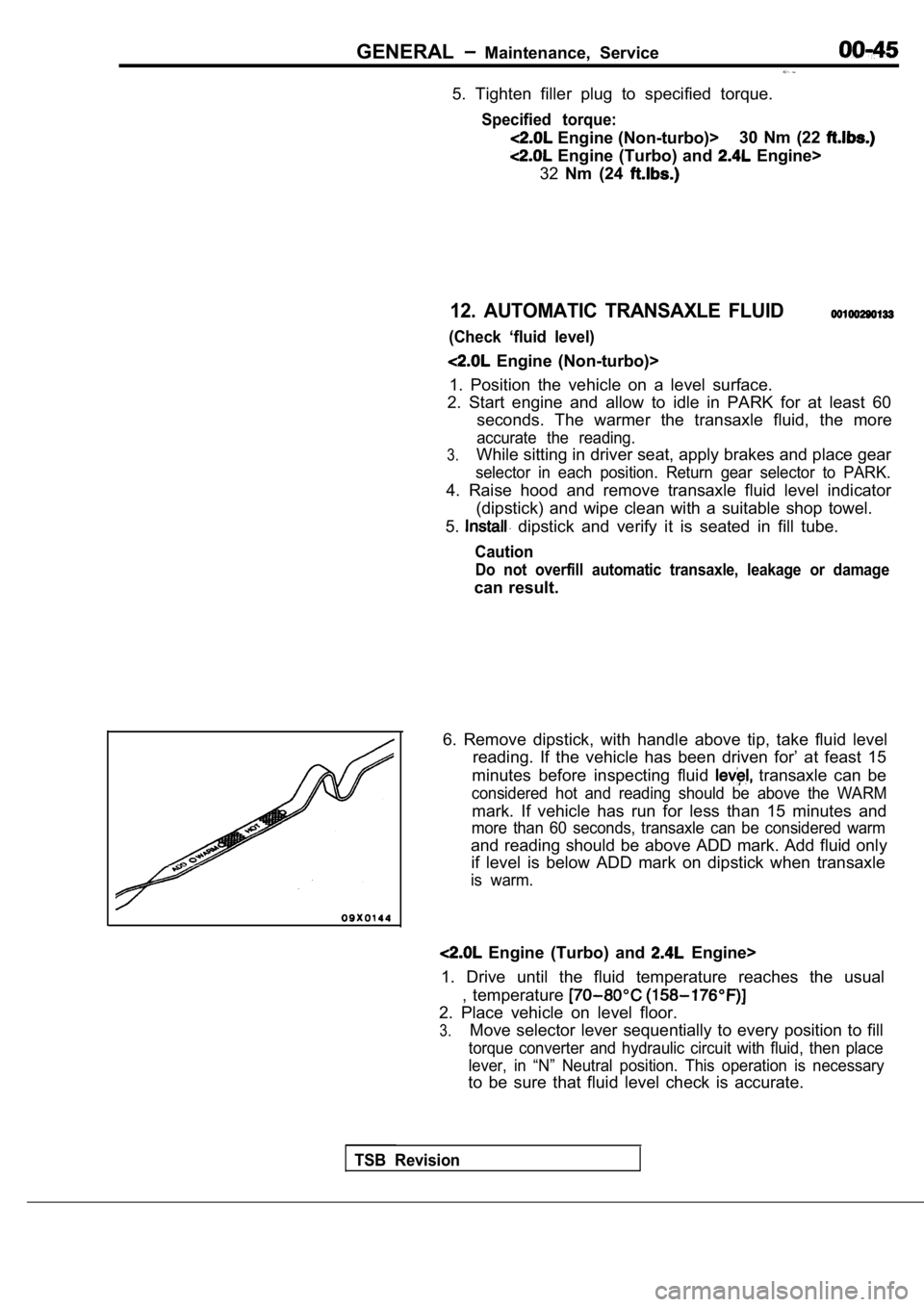
6. Remove dipstick, with handle above tip, take flu id level
reading. If the vehicle has been driven for’ at fea st 15
minutes before inspecting fluid
transaxle can be
considered hot and reading should be above the WARM
mark. If vehicle has run for less than 15 minutes a nd
more than 60 seconds, transaxle can be considered w arm
and reading should be above ADD mark. Add fluid onl y
if level is below ADD mark on dipstick when transax le
is warm.
Engine (Turbo) and Engine>
1. Drive until the fluid temperature reaches the us ual
, temperature
2. Place vehicle on level floor.
3.Move selector lever sequentially to every position to fill
torque converter and hydraulic circuit with fluid, then place
lever, in “N” Neutral position. This operation is n ecessary
to be sure that fluid level check is accurate.
TSB Revision
Page 420 of 2103
![MITSUBISHI SPYDER 1990 Service Repair Manual ENGINE
I Scan tool 35
Code General scan tool
No.No Vehicle Speed Sensor Signal
15
[Comment]
Background
lThe speed sensor serves as a PCM input switching voltage between 0 an](/img/19/57345/w960_57345-419.png "MITSUBISHI SPYDER 1990 Service Repair Manual ENGINE
I Scan tool 35
Code General scan tool
No.No Vehicle Speed Sensor Signal
15
[Comment]
Background
lThe speed sensor serves as a PCM input switching voltage between 0 an")
ENGINE
I Scan tool 35
Code General scan tool
No.No Vehicle Speed Sensor Signal
15
[Comment]
Background
lThe speed sensor serves as a PCM input switching voltage between 0 and 5volts.lOnce the vehicle is in motion and the throttle is open, information from the sensor is
sampled every 11 milliseconds and compared to a min imum threshold equal to 1 mph.
lIf the sensors output voltage indicates a speed higher than this threshold, the sensor
is considered to be operating normally.
lFailure of the sensor would be quite noticeable bec ause the speedometer would fail tooperate.Diagnostic features that depend on the speed sensor may never execute if this component
fails.
of Check Engine coolant temperature: or more Transaxle: Other than or range only). 31 seconds after starting engine Brakes not applied Throffle valve: Open Engine: 1600 or more Difference between the atmospheric pressure and in take manifold pressure:
34 (10 or more Condition Vehicle speed: Less than lmph for 11 seconds
Measure at the speed sensor connector
l Disconnect the connector, and measure at the harnes s side.
l Voltage between 1 and ground
(Ignition switch: ON)
O K :
l Continuity between 2 and ground
OK: Continuity
OK
OK
Check trouble
Open or shorted. circuitS p e e d o m e t e r d a m a g e d Open supply circuit
Open sensor ground circuit
Vehicle speed sensor failed PCM failed
Repair
Check the harness wire between the PCM and the spee d sensor
connector. Repair, if necessary.
N G Check the following connectors: I Repair
SCAN TOOL SENSOR READ TESTS (Data list)
Replace the vehicle speed sensor.
connector.
N G NG
Repair
TSB Revision
Page 492 of 2103
ENGINE (NON-TURBO)> Troubleshooting
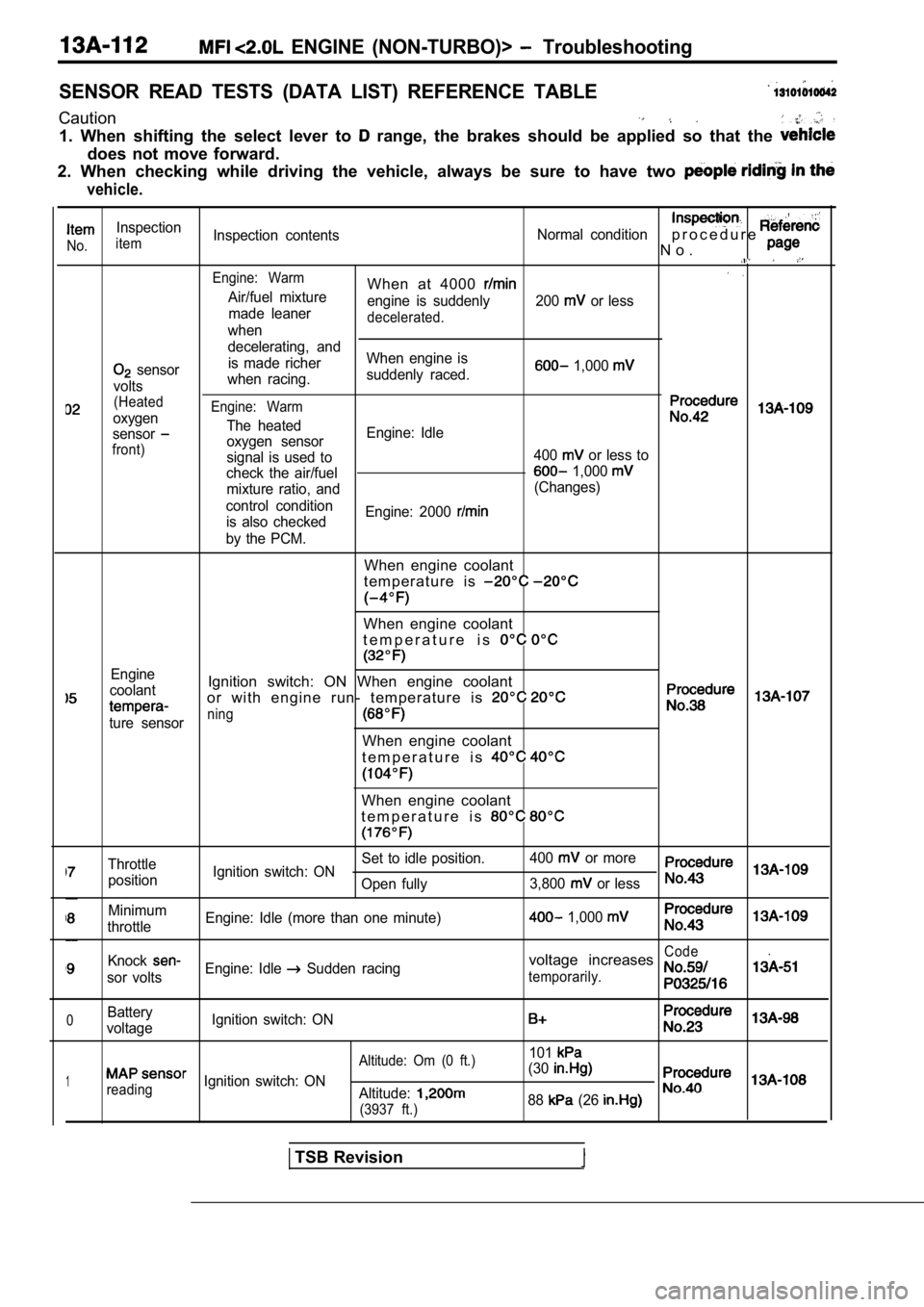
SENSOR READ TESTS (DATA LIST) REFERENCE TABLE
Caution
1. When shifting the select lever to range, the brakes should be applied so that the
does not move forward.
2. When checking while driving the vehicle, always be sure to have two
vehicle.
Inspection
No.itemInspection contents
Normal conditionp r o c e d u r e
N o .
Engine: WarmWhen at 4000 Air/fuel mixture
engine is suddenly 200 or less
made leaner
decelerated.when
decelerating, and
sensor is made richer
When engine is 1,000
voltswhen racing.
suddenly raced.
(Heated
oxygenEngine: Warm
The heatedsensoroxygen sensor Engine: Idlefront)signal is used to
400 or less to
check the air/fuel
1,000
mixture ratio, and (Changes)
control condition is also checked Engine: 2000
by the PCM.
When engine coolant
t e m p e r a t u r e i s
When engine coolant
t e m p e r a t u r e i s
Engine
coolantIgnition switch: ON When engine coolant
or with engine run- temperature is
ture sensorning
When engine coolant
t e m p e r a t u r e i s
When engine coolant
t e m p e r a t u r e i s
Throttle Set to idle position.
400 or more
position Ignition switch: ON
Open fully 3,800
or less
Minimum
throttle Engine: Idle (more than one minute) 1,000
KnockCode
sor voltsEngine: Idle Sudden racingvoltage increases
temporarily.
0Battery
voltage Ignition switch: ON
101
1
Altitude: Om (0 ft.)
reading
Ignition switch: ON (30Altitude:
(3937 ft.)88 (26
TSB Revision
Page 533 of 2103
ENGINE (TURBO)
AND
ENGINE> Troubleshooting
4. Exhaust gas recirculation (EGR) system monitor
Test conditions/procedure
1. All of the following conditions should be satisfied when the drive test is carried out.
(1) Engine coolant temperature:
or higher (when engine is
(2) Outside air temperature: or higher
(3) A/T condition:
lSelector lever position: range
l Overdrive switch: ON
lPower/economy changeover switch: Power
(4) A/C switch:
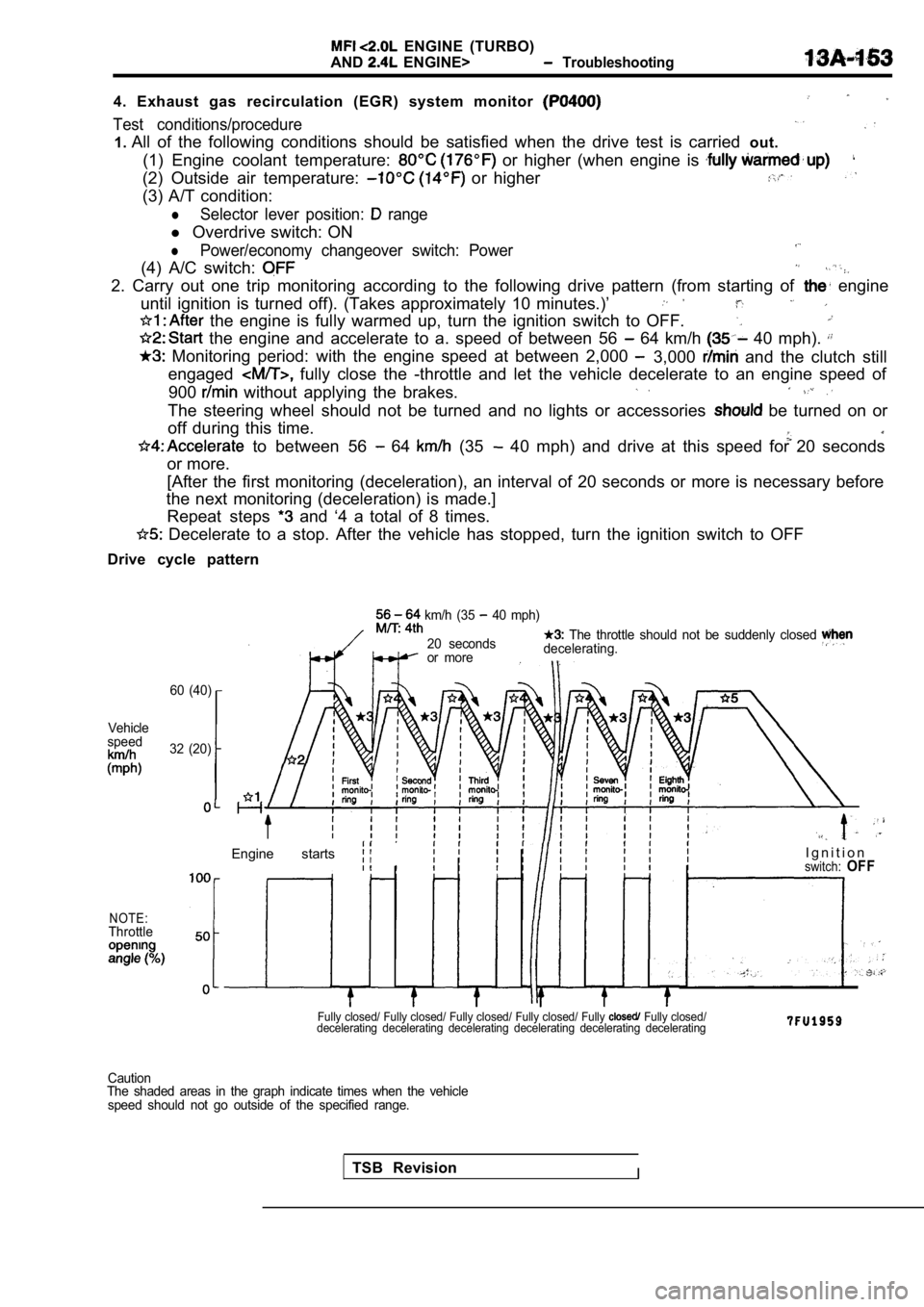
2. Carry out one trip monitoring according to the f ollowing drive pattern (from starting of engine
until ignition is turned off). (Takes approximately 10 minutes.)’
the engine is fully warmed up, turn the ignition s witch to OFF.
the engine and accelerate to a. speed of between 5 6 64 km/h 40 mph).
Monitoring period: with the engine speed at between 2,000 3,000 and the clutch still
engaged
fully close the -throttle and let the vehicle dece lerate to an engine speed of
900
without applying the brakes.
The steering wheel should not be turned and no ligh ts or accessories be turned on or
off during this time.
to between 56 64 (35 40 mph) and drive at this speed for 20 seconds
or more.
[After the first monitoring (deceleration), an inte rval of 20 seconds or more is necessary before
the next monitoring (deceleration) is made.]
Repeat steps
and ‘4 a total of 8 times.
Decelerate to a stop. After the vehicle has stoppe d, turn the ignition switch to OFF
Drive cycle pattern
60 (40)
Vehicle
speed
32 (20)
NOTE:Throttle
km/h (35 40 mph)
20 seconds
The throttle should not be suddenly closed
or more decelerating.
Engine starts I g n i t i o nswitch:OFF
Fully closed/ Fully closed/ Fully closed/ Fully clo
sed/ Fully Fully closed/
decelerating decelerating decelerating decelerating decelerating decelerating
TSB RevisionI
Caution
The shaded areas in the graph indicate times when t he vehicle
speed should not go outside of the specified range.
Page 619 of 2103
ENGINE (TURBO)
AND ENGINE>
Caution
1. Always apply the brakes when shifting the select or lever to ran&, or vehicle will
forward.
2. Driving tests always need another personnel.
NOTE
In a new vehicle [driven approximately 500 km (300 mile) or less], the volume air sensor output
is sometimes 10 higher than the standard frequency.
The injector drive time represents the time when the cranking speed is at 250 or below when the
supply voltage is 11 V.
In a new vehicle [driven approximately 500 km (300 mile) or less], the injector drive time is sometimes
longer than the standard time.
Fuel is injected into all cylinders simultaneously.
In a new vehicle [driven approximately km (300 mile) or less], the step of the stepper mo tor is sometimes
30 steps greater than the standard value.
If the throttle position sensor voltage rises 100 from the voltage when the engine is at idle and th e
closed throttle position switch turns from on to of f at this time, the sensors are normal. If the throttle position
sensor voltage rises 100
from the voltage when the engine is at idle, the t hrottle valve opens, and the
closed throttle position switch turns from on to of f at this, time, the sensors should be adjusted.
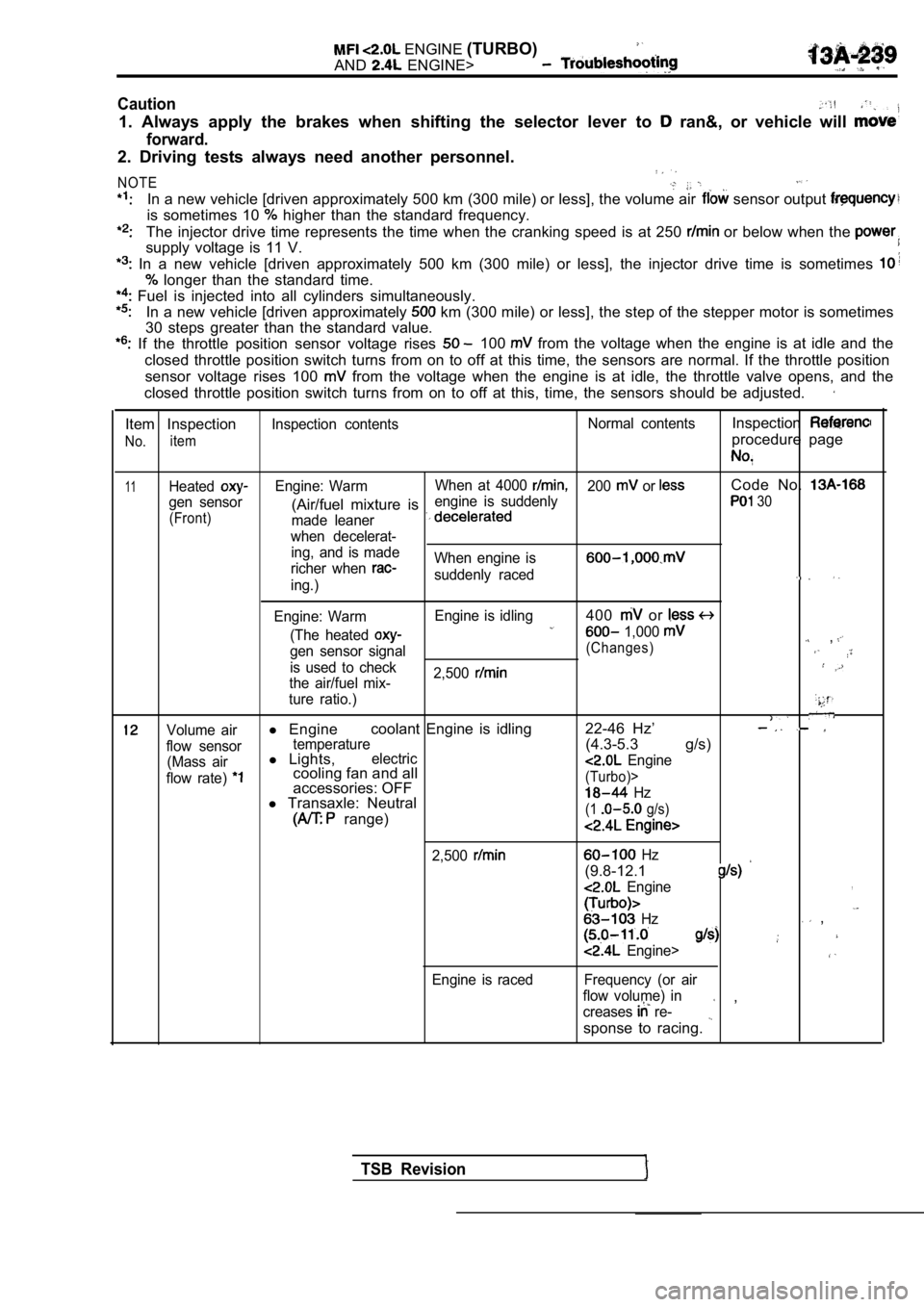
Item Inspection
No.item
Inspection contents Normal contentsInspection
procedure page
11HeatedEngine: WarmWhen at 4000 200 or Code No.
gen sensor engine is suddenly(Air/fuel mixture is 30
(Front)
made leaner
when decelerat- ing, and is made
richer when
When engine is
suddenly raceding.)
Engine: Warm Engine is idling
400 or
(The heated 1,000 ,gen sensor signal(Changes)
is used to check
2,500
the air/fuel mix-
ture ratio.)
Volume airl Engine coolant Engine is idling 22-46 Hz’
flow sensortemperature(4.3-5.3 g/s)
(Mass airl
Lights,electric
flow rate) cooling fan and all Engine
accessories: OFF(Turbo)>
l Transaxle: Neutral Hz
range)(1 g/s)
2,500
Engine is raced
Hz
(9.8-12.1
Engine,
Hz ,
Engine>
Frequency (or air
flow volume) in
creases
re- ,
sponse to racing.
TSB Revision
Page 1048 of 2103
![MITSUBISHI SPYDER 1990 Service Repair Manual AUTOMATIC TRANSAXLE
ENGINE (TURBO) AND ENGINE>
INSPECTION PROCEDURE 10.
l Shocks and flare shifts
[Comment]l Malfunction of servo switch
Shocks occur when driving due to upshiftin](/img/19/57345/w960_57345-1047.png "MITSUBISHI SPYDER 1990 Service Repair Manual AUTOMATIC TRANSAXLE
ENGINE (TURBO) AND ENGINE>
INSPECTION PROCEDURE 10.
l Shocks and flare shifts
[Comment]l Malfunction of servo switch
Shocks occur when driving due to upshiftin")
AUTOMATIC TRANSAXLE
ENGINE (TURBO) AND ENGINE>
INSPECTION PROCEDURE 10.
l Shocks and flare shifts
[Comment]l Malfunction of servo switch
Shocks occur when driving due to upshifting or down shifting. In addition, the engine speed l
during shifting increases abnormally in comparison to normal shifting. In such cases, the cause lAbnormal reducing pressure
Malfunction of valve body
is probably abnormal reducing pressure or a defecti ve servo switch.
l Malfunction of closed throttle positron switchMalfunction of pressure control solenoid l Malfunction of clutches and brakes
SCAN
l 21 servo switchOK: Turns momentarily from ON to OFF when engineis in and the accelerator pedal is
Refer to Automatic Transaxle Overhaul
(Refer to servo adjustment (Refer to I
NG
depressed from the fully
closed position.
After completion
Closed
position switch check
l Check the closed throttle position
switch system according to inspec-tion procedures 17.
(Refer to
Valve body disassembly, cleaning andreassemblyl of bolts, and to damage, chipping
or slippage of valve inter-
mediate plate and body.
lIf it is considered that the damageor chipping cannot be repaired, re-place the valve body assembly.
TSB Revision
SCAN TOOL Test
l 01
lMeasure the servo brakeapplication pressure in range
while the engine is idling and the
fluid temperature is (178
Standard value:245 294 (35-42 psi)
[when PCSV DUTY is 50%)
Pressure control
valve checklCheck for sound of opera-tion in range while the
engine is idling.
lCheck to be sure that the
valve is not sticking due
to foreign materials being
clamped.lIf there is an abnormality,
replace the solenoid valve
assembly.
Clutch and brake
check
lCheck each end play, andif they exceed the stan-dard values, adjust so thatthey are within the stan-
dard values.
Page 1049 of 2103
![MITSUBISHI SPYDER 1990 Service Repair Manual AUTOMATIC TRANSAXLE
ENGINE (TURBO) AND Troubleshooting
INSPECTION PROCEDURE 11
l All points (Early, late shifting points) P r o b a b l e c a u s e
[Comment]l
Malfunction of pulse gen](/img/19/57345/w960_57345-1048.png "MITSUBISHI SPYDER 1990 Service Repair Manual AUTOMATIC TRANSAXLE
ENGINE (TURBO) AND Troubleshooting
INSPECTION PROCEDURE 11
l All points (Early, late shifting points) P r o b a b l e c a u s e
[Comment]l
Malfunction of pulse gen")
AUTOMATIC TRANSAXLE
ENGINE (TURBO) AND Troubleshooting
INSPECTION PROCEDURE 11
l All points (Early, late shifting points) P r o b a b l e c a u s e
[Comment]l
Malfunction of pulse generator All shift points occurs early, late while driving.
In such cases, the cause is probably a defectivelMalfunction of shift control solenoid A orpulse generator (PG-B) or shift control solenoid valve A or B).l Malfunction of lAbnormal reducing pressure or servobrake application pressure
l Malfunction of clutches and brakes
l Malfunction, of ‘valve body,
Refer to Automatic Transaxle Overhaul
OK
SCAN TOOL Data list
l 32
Pulse generator (PG-B)
OK: Increases in proportion to vehicle speed
NG
Code Nos. 32, 82 Pulse generator system
check (Refer to 27 Shift control solenoid valve A and drive signals
OK
Replace the TCM.Hydraulic pressure (Refer to l kickdown: servo brake applicationpressure in range at 2,500
StandardReducing pressure psi)
servo brake application psi).
Valve body disassembly, cleaning and
Pay particular attention to bolts, and to damage, chipping
or slippage of O-rings, valve inter-
mediate plate and body.
lIf it is that the damageor chipping cannot be repaired, place the valve body assembly.
TSB Revision
Page 1051 of 2103
![MITSUBISHI SPYDER 1990 Service Repair Manual AUTOMATIC TRANSAXLE
ENGINE (TURBO) AND ENGINE,
INSPECTION PROCEDURE 14
Poor accelerationI
[Comment]l Malfunction of clutches and brakesWhile driving, acceleration is poor even if](/img/19/57345/w960_57345-1050.png "MITSUBISHI SPYDER 1990 Service Repair Manual AUTOMATIC TRANSAXLE
ENGINE (TURBO) AND ENGINE,
INSPECTION PROCEDURE 14
Poor accelerationI
[Comment]l Malfunction of clutches and brakesWhile driving, acceleration is poor even if")
AUTOMATIC TRANSAXLE
ENGINE (TURBO) AND ENGINE,
INSPECTION PROCEDURE 14
Poor accelerationI
[Comment]l Malfunction of clutches and brakesWhile driving, acceleration is poor even if downshi fting is performed. In such cases, the causeMalfunction of engine system
is probably a defective clutch or brake, or a defec tive engine system.
Refer to Automatic Transaxle Overhaul
Engine system check
lCheck the control system, ignition system, fuel sys temand main engine system, and confirm that everything
is normal.
lIf there is an abnormality, repair or replace the enginesystem.
After completion
Clutch and brake check
lCheck each end play, and if they exceed the standar d
l Check for burning and wear in each facing.
INSPECTION PROCEDURE 15 ,
l VibrationProbable cause
[Comment] l Abnormal torque converter pressure
Vibration occurs when driving at constant speed or when accelerating in top range. In such l
Malfunction of engine system
cases, the cause is probably abnormal torque conver ter clutch pressure or a defective torque
Malfunction of torque converter converter. o f v a l v e b o d y
Refer to Automatic
sensor connector is disconnected?
No
Yes
Standard value: (64-92 psi)
OK
If it is considered that the damage or chipping can not
be repaired, replace the valve body assembly.
TSB Revision
Page 1072 of 2103
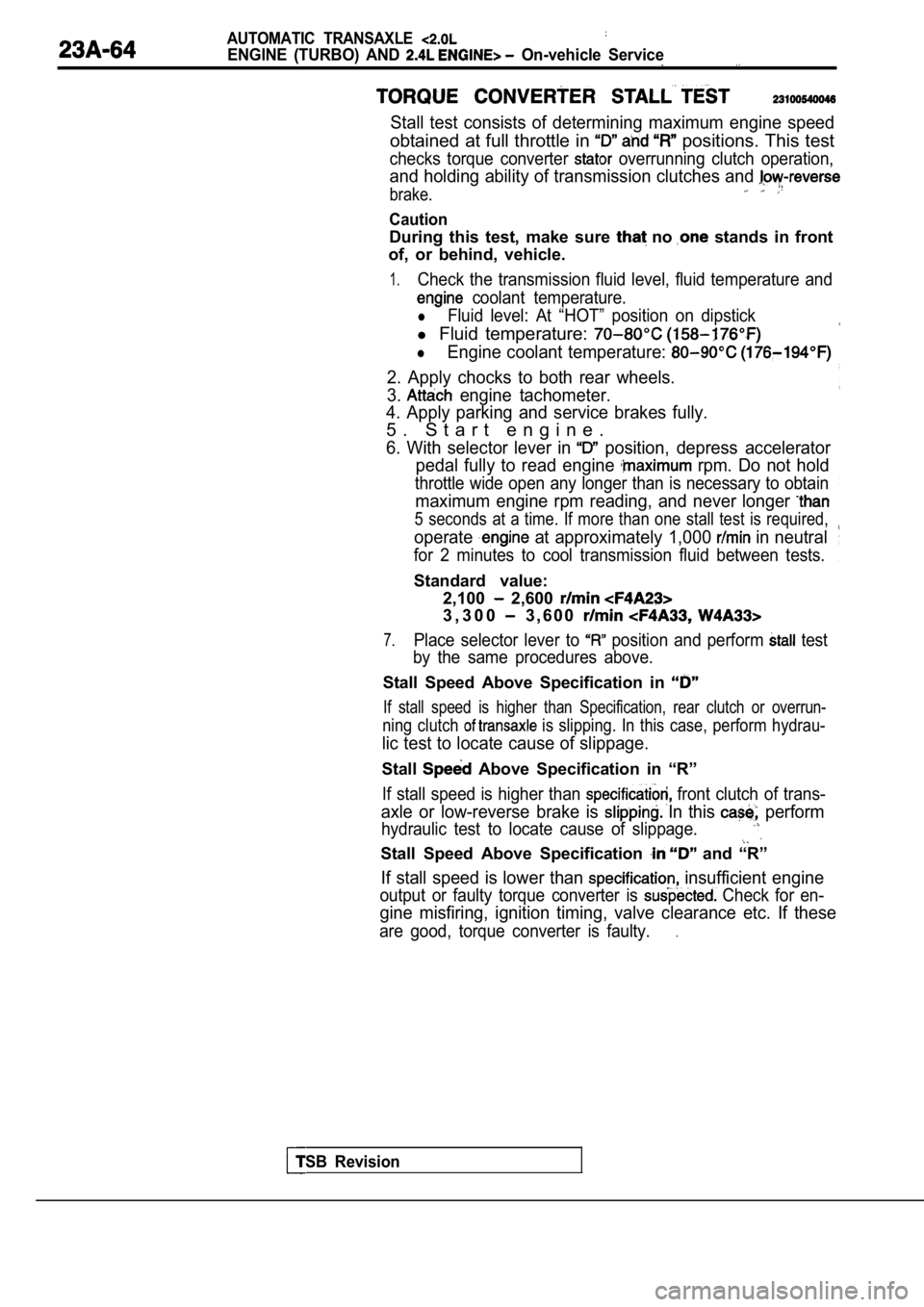
AUTOMATIC TRANSAXLE
ENGINE (TURBO) AND On-vehicle Service
Stall test consists of determining maximum engine speed
obtained at full throttle in positions. This test
checks torque converter overrunning clutch operation,
and holding ability of transmission clutches and
brake.
Caution
During this test, make sure no stands in front
of, or behind, vehicle.
1.Check the transmission fluid level, fluid temperatu re and
coolant temperature.
lFluid level: At “HOT” position on dipstick
l Fluid temperature:
lEngine coolant temperature:
2. Apply chocks to both rear wheels.
3.
engine tachometer.
4. Apply parking and service brakes fully.
5 . S t a r t e n g i n e .
6. With selector lever in position, depress accelerator
pedal fully to read engine
rpm. Do not hold
throttle wide open any longer than is necessary to obtain
maximum engine rpm reading, and never longer
5 seconds at a time. If more than one stall test is required,
operate at approximately 1,000 in neutral
for 2 minutes to cool transmission fluid between te sts.
Standard value:
TSB Revision
2,100 2,600
3 , 3 0 0 3 , 6 0 0
7.Place selector lever to position and perform test
by the same procedures above.
Stall Speed Above Specification in
If stall speed is higher than Specification, rear c lutch or overrun-
ning clutch is slipping. In this case, perform hydrau-
lic test to locate cause of slippage.
Stall Above Specification in “R”
If stall speed is higher than front clutch of trans-
axle or low-reverse brake is In this perform
hydraulic test to locate cause of slippage.
Stall Speed Above Specification and “R”
If stall speed is lower than insufficient engine
output or faulty torque converter is Check for en-
gine misfiring, ignition timing, valve clearance etc. If these
are good, torque converter is faulty..
Page 1174 of 2103
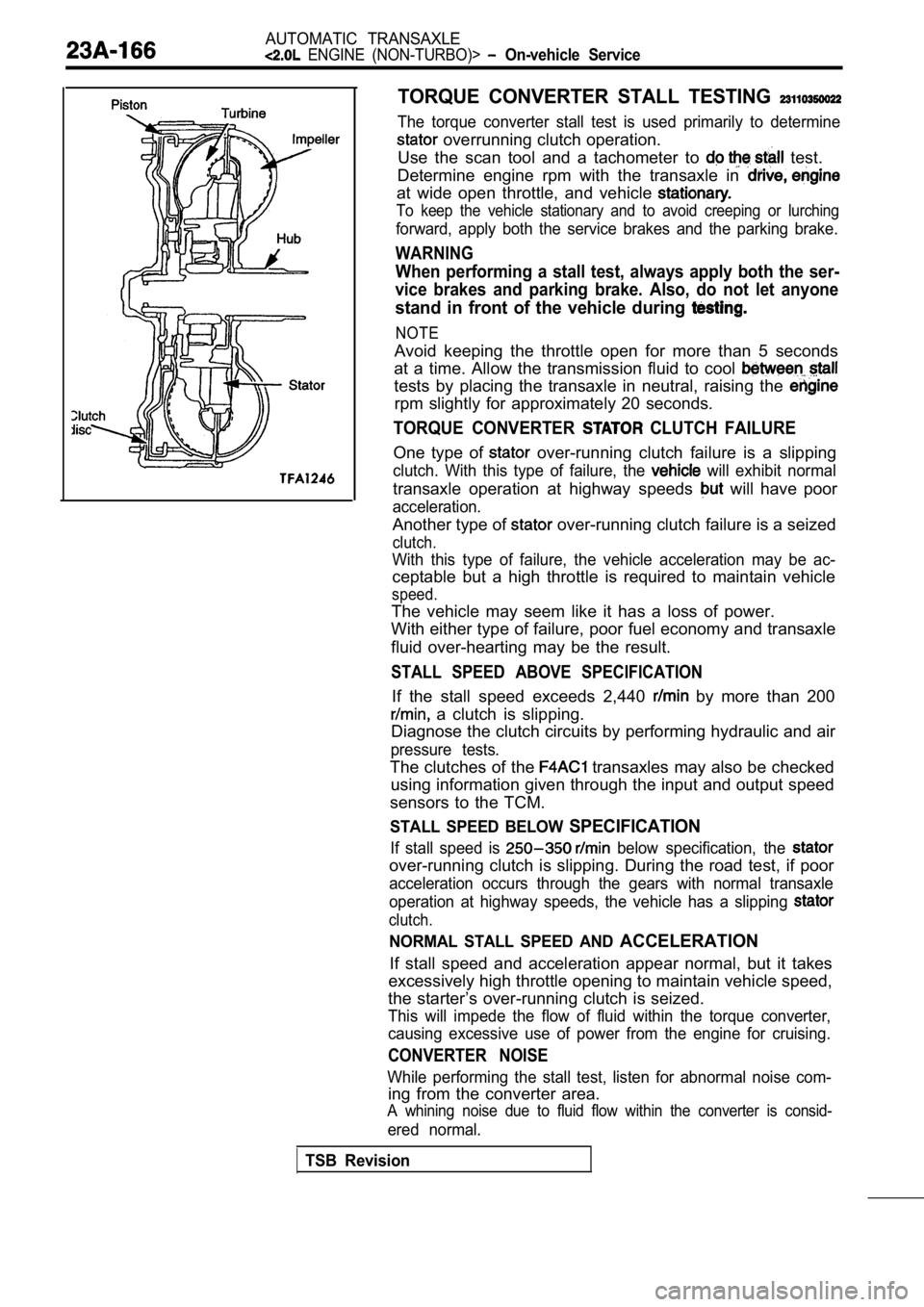
AUTOMATIC TRANSAXLE
ENGINE (NON-TURBO)> On-vehicle Service
TORQUE CONVERTER STALL TESTING
The torque converter stall test is used primarily to determine
overrunning clutch operation.
Use the scan tool and a tachometer to
test.
Determine engine rpm with the transaxle in
at wide open throttle, and vehicle
To keep the vehicle stationary and to avoid creepin g or lurching
forward, apply both the service brakes and the parking brake.
WARNING
When performing a stall test, always apply both the ser-
vice brakes and parking brake. Also, do not let any one
stand in front of the vehicle during
NOTE
Avoid keeping the throttle open for more than 5 seconds
at a time. Allow the transmission fluid to cool
tests by placing the transaxle in neutral, raising the
rpm slightly for approximately 20 seconds.
TORQUE CONVERTER CLUTCH FAILURE
One type of over-running clutch failure is a slipping
clutch. With this type of failure, the will exhibit normal
transaxle operation at highway speeds will have poor
acceleration.
Another type of over-running clutch failure is a seized
clutch.
With this type of failure, the vehicle acceleration may be ac-
ceptable but a high throttle is required to maintai n vehicle
speed.
The vehicle may seem like it has a loss of power.
With either type of failure, poor fuel economy and transaxle
fluid over-hearting may be the result.
STALL SPEED ABOVE SPECIFICATION
If the stall speed exceeds 2,440 by more than 200
a clutch is slipping.
Diagnose the clutch circuits by performing hydrauli c and air
pressure tests.
The clutches of the transaxles may also be checked
using information given through the input and outpu t speed
sensors to the TCM.
STALL SPEED BELOW SPECIFICATION
If stall speed is below specification, the
over-running clutch is slipping. During the road te st, if poor
acceleration occurs through the gears with normal t ransaxle
operation at highway speeds, the vehicle has a slip ping
clutch.
NORMAL STALL SPEED AND ACCELERATION
If stall speed and acceleration appear normal, but it takes
excessively high throttle opening to maintain vehic le speed,
the starter’s over-running clutch is seized.
This will impede the flow of fluid within the torqu e converter,
causing excessive use of power from the engine for cruising.
CONVERTER NOISE
While performing the stall test, listen for abnormal noise com-
ing from the converter area.
A whining noise due to fluid flow within the conver ter is consid-
ered normal.
TSB Revision