check engine NISSAN 300ZX 1984 Z31 Engine Fuel And Emission Control System User Guide
[x] Cancel search | Manufacturer: NISSAN, Model Year: 1984, Model line: 300ZX, Model: NISSAN 300ZX 1984 Z31Pages: 79, PDF Size: 2.15 MB
Page 51 of 79
ELECTRONIC CONTROL SYSTEM INSPECTION
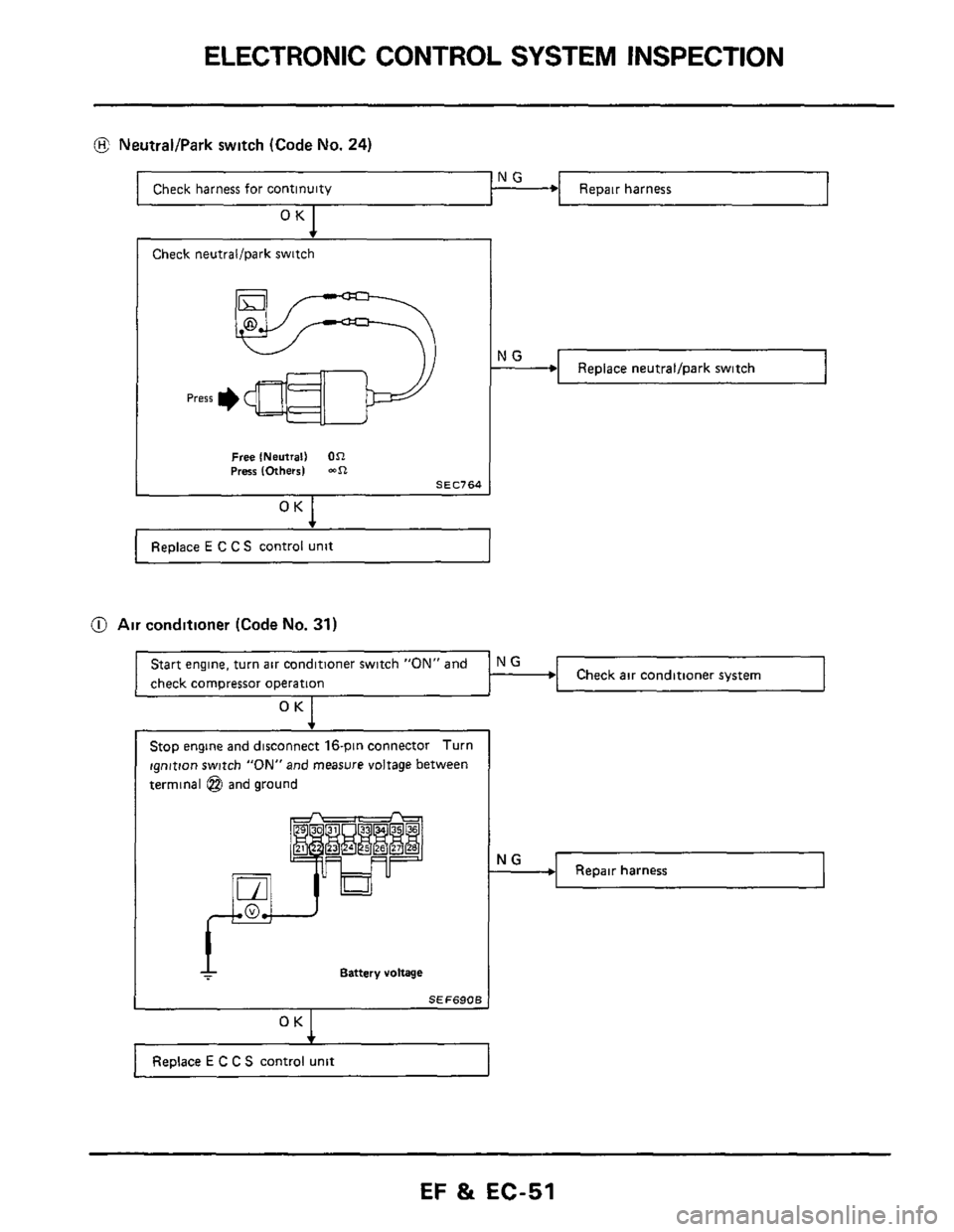
Start engine, turn air conditioner switch "ON" and
check compressor operation
@! NeutraVPark switch (Code No. 24)
N G + Check air conditioner system
Check harness for continuity F.1 Repair harness
OK I
NG -
Check neutrallpark swltch
Repair harness
Press I)
Free INeutrall 057 press IOtherrl -57 SEC764
OK I
Replace neutrallpark switch
I"
Replace E C C S control unit
0 Air condttloner (Code No. 31)
Stop engine and disconnect 16-pin connector Turn
ignition switch
"ON" and measure voltage between
terminal
@ and ground
I Battery voltage
SEF690B
OK I
+
Replace E C C S control unit
EF & EC-51
Page 52 of 79
ELECTRONIC CONTROL SYSTEM INSPECTION
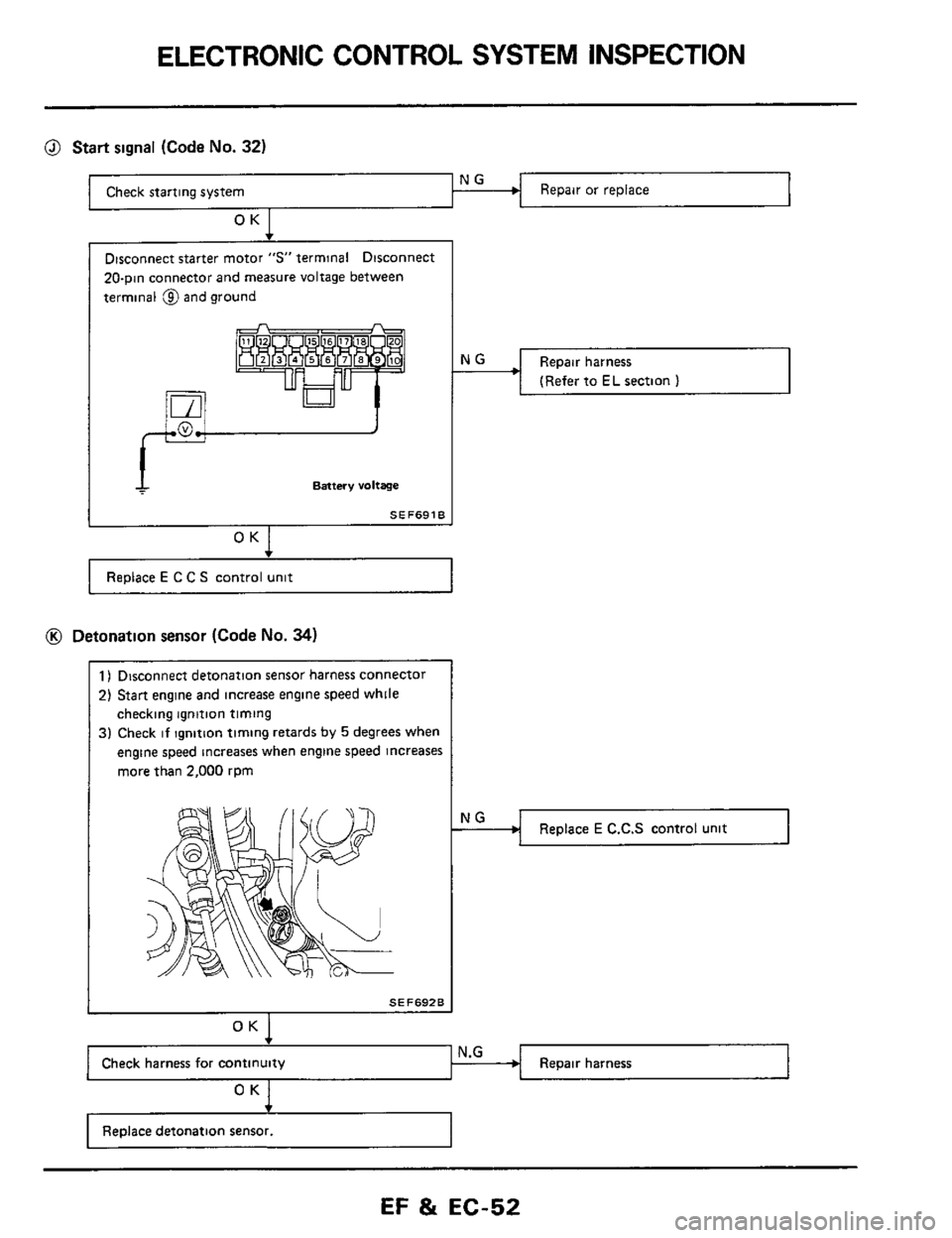
@ Start signal (Code No. 32)
Repair or replace NG Check starting system 1
OK
20-pin connector and measure voltage between
terminal and ground
Emery voltage
SE F691 B I OK I
Replace E C C S control unit
@ Detonation sensor (Code No. 34)
1 ) Disconnect detonation sensor harness connector
2)
Start engine and increase engine speed while
checking ignition timing
3) Check if ignition timing retards by 5 degrees when
engine speed increases when engine speed increases
more than 2,000 rpm
I SEF692B
Repair harness
(Refer to
EL section I
Replace E C.C.S control unit
Repair harness N.G OK1
Replace detonation sensor.
EF & EC-52
Page 56 of 79
ELECTRONIC CONTROL SYSTEM INSPECTION
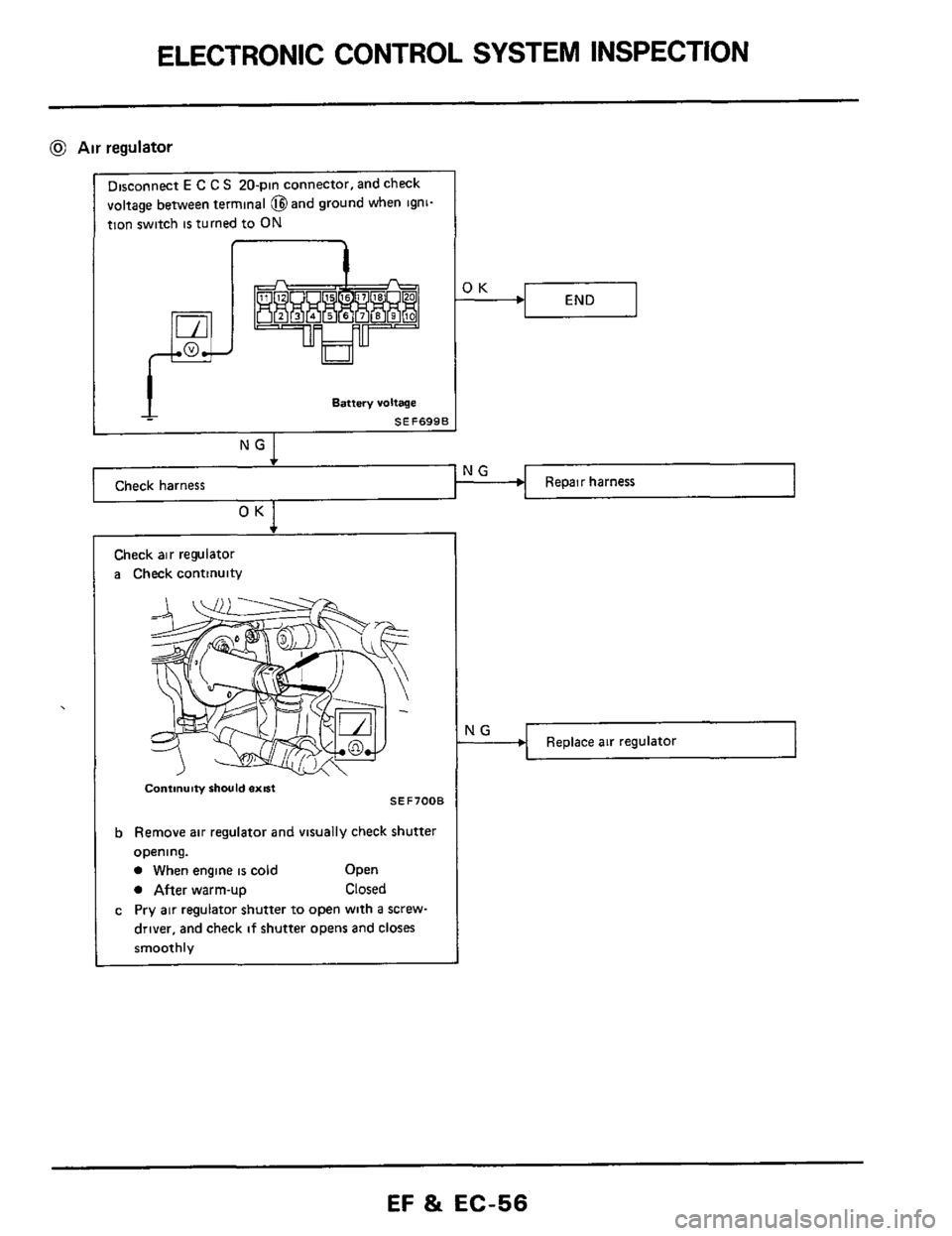
@ Air regulator
Disconnect E C C S 20-pin connector, and check
voltage between terminal @and ground when igni-
tion switch
is turned to ON
I I
Battery "Dltage
SEF699E
NG I
Check harness . Repair harness
Check air regulator
a Check continuity
I
Continuiry should enst SEF700B
b Remove air regulator and visually check shutter
opening.
0 When engine is cold Open
0 After warm-up Closed
c Pry air regulator shutter to open with a screw-
driver, and check
if shutter opens and closes
smoothly
I
Replace air regulator
EF & EC-56
Page 60 of 79
MIXTURE RATIO FEEDBACK SYSTEM INSPECTION
SEF707B
START
-
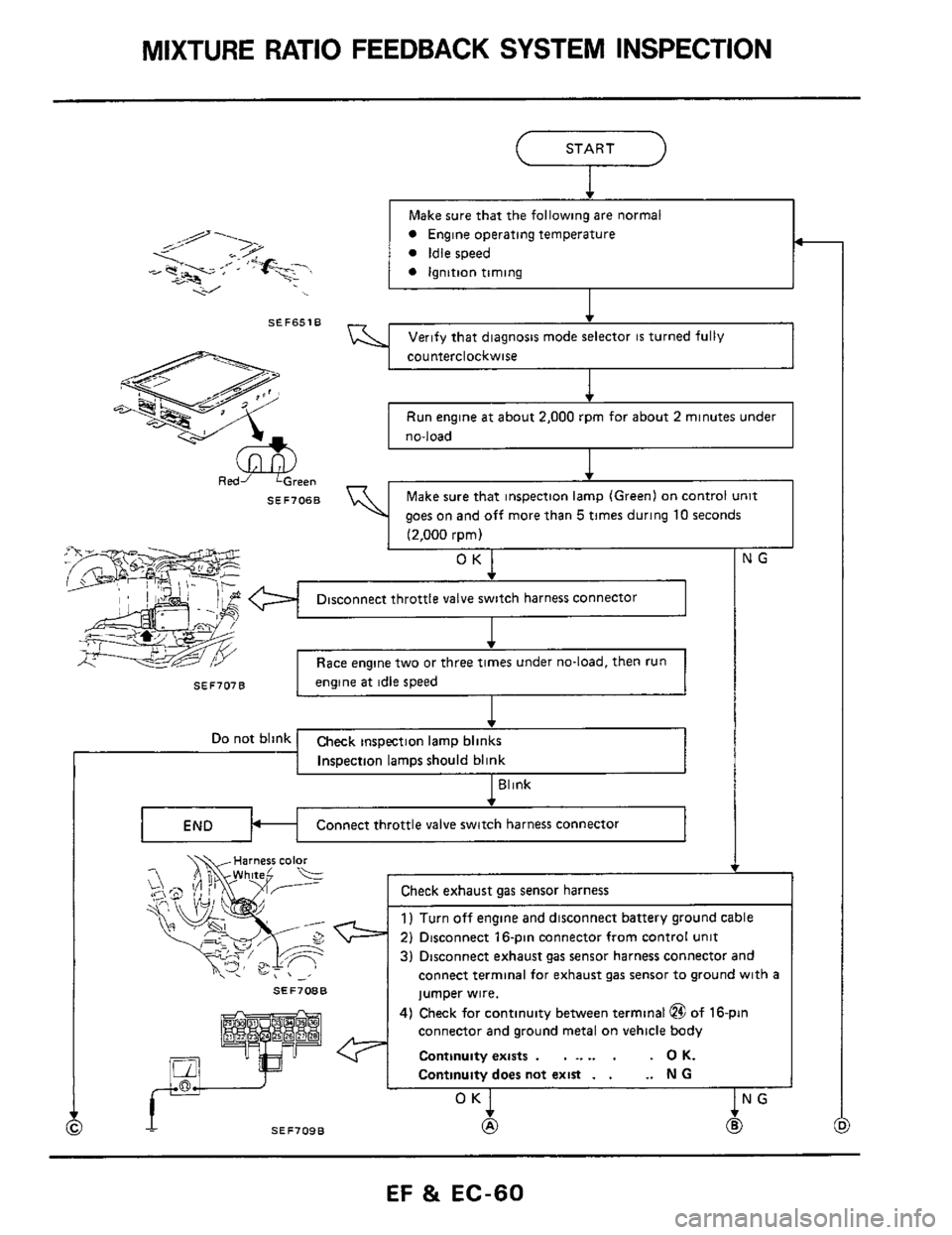
Make sure that the following are normal
engine at idle speed
SEF651B
SEF70BB
een
jumper wire.
connector and ground metal
on vehicle body
Continuity exists
. . .. .. . . 0 K.
Continuity does not exist . . .. N G
4) Check for continuity between terminal @ of 16-pin
SEF706B
t
Verify that diagnosis mode selector is turned fully
cou nterclockwise
1
Run engine at about 2,000 rpm for about 2 minutes under
no-load
I
4
Make sure that inspection lamp (Green) on control unit
aoes
on and off more than 5 times durinq 10 seconds
I i2~000 rom) .. .~,. ~ ~
OK
Disconnect throttle valve switch harness connector
1
I Race engine two or three times under no-load, then run I
I JG
1
SEF709B
EF 81 EC-60
Page 61 of 79
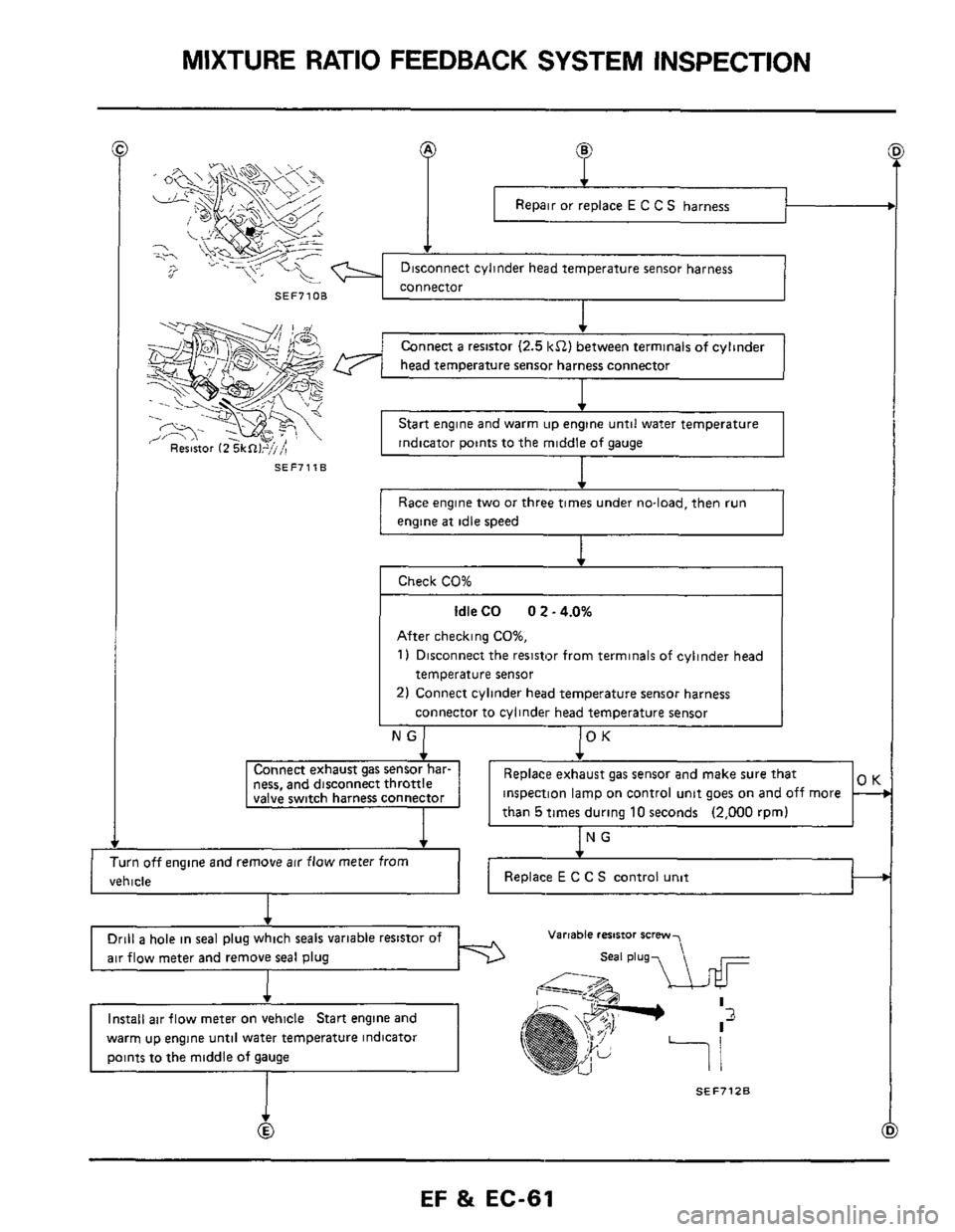
MIXTURE RATIO FEEDBACK SYSTEM INSPECTION
Repair or replace E C C S harness
SEF71OB
SEF7118
f
Connect a resistor (2.5 kS2) between terminals of cylinder
head temperature sensor harness connector
I
Start engine and warm up engine until water temperature
indicator points to the middle
of gauge
Race engine two or three times under no-load. then run
engine
at idle speed
After checking CO%,
1) Disconnect the resistor from terminals of cylinder head
temperature sensor
2) Connect cylinder head temperature sensor harness
connector to cylinder head temperature sensor
ness, and disconnect throttle inspection lamp on control unit goes on and off more
I
Turn off engine and remove air flow meter from
vehicle ~~
Drill a hole
in seal plug which seals variable resistor of
air flow meter and remove seal plug
warm up engine until water temperature indicator
Varrable resistor scmw
SEF7128
Page 63 of 79
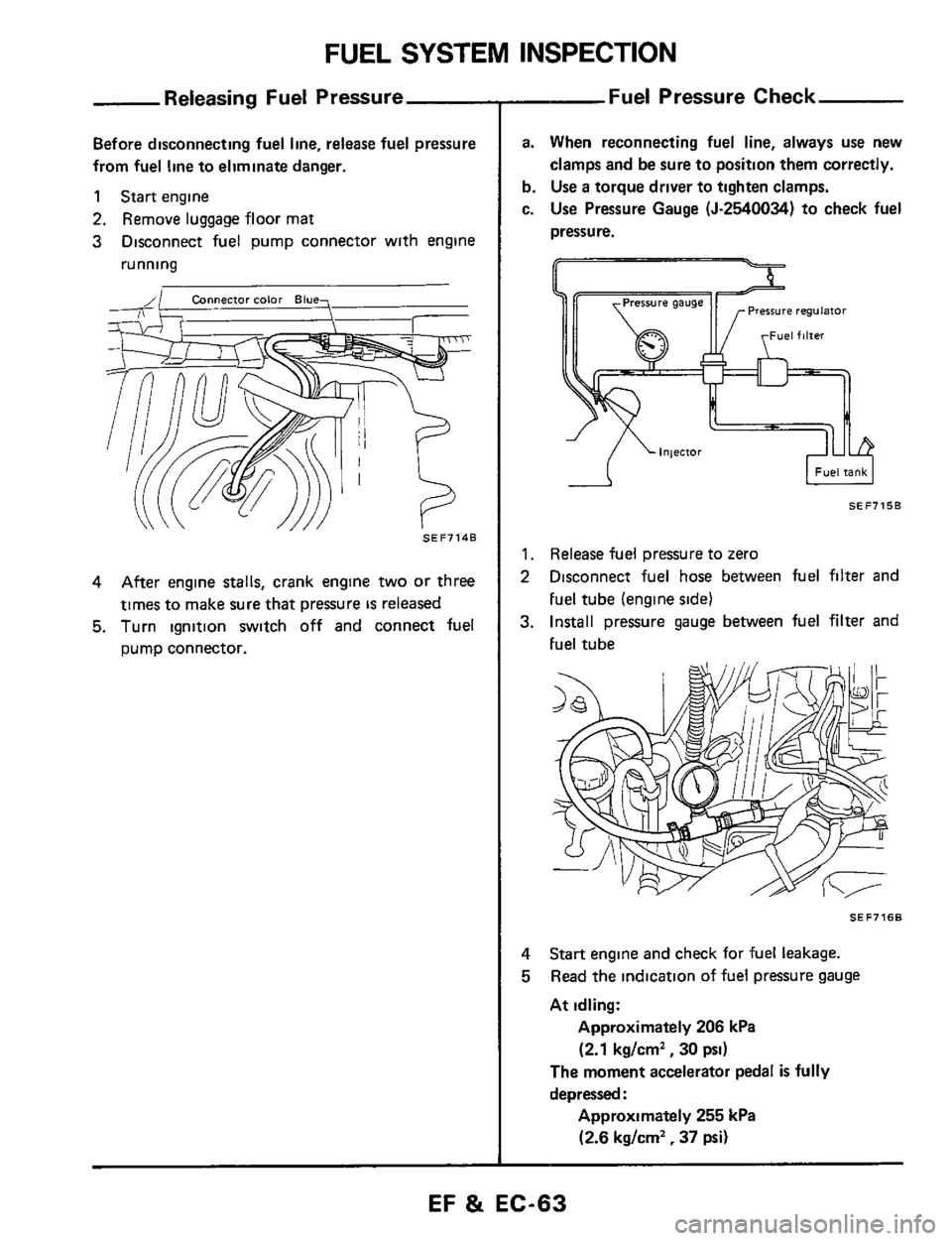
FUEL SYSTEM INSPECTION
Releasing Fuel Pressure
Before disconnecting fuel line, release fuel pressure
from fuel line to eliminate danger.
1 Start engine
2. Remove luggage floor mat
3 Disconnect fuel pump connector with engine
running
SEF7148
4 After engine stalls, crank engine two or three
times to make sure that pressure
IS released
5. Turn ignition switch off and connect fuel
pump connector.
--Fuel Pressure Check
a. When reconnecting fuel line, always use new
clamps and be sure to position them correctly.
b. Use a torque driver to tighten clamps.
c.
Use Pressure Gauge (5-2540034) to check fuel
pressure.
I Fuel tank I -A
SEF7158
1. Release fuel pressure to zero
2 Disconnect fuel hose between fuel filter and
Fuel tube (engine side1
3. Install pressure gauge between fuel filter and
Fuel tube
SEF7168
4
5
Start engine and check for fuel leakage.
Read the indication of fuel pressure gauge
At idling:
Approximately 206 kPa
(2.1 kg/cm2, 30 psi)
The moment accelerator pedal is fully
depressed
:
Approximately 255 kPa
(2.6 kg/cm2, 37 psi)
EF & EC-63
Page 64 of 79
FUEL SYSTEM INSPECTION
Fuel Pressure Check (Cont'd)
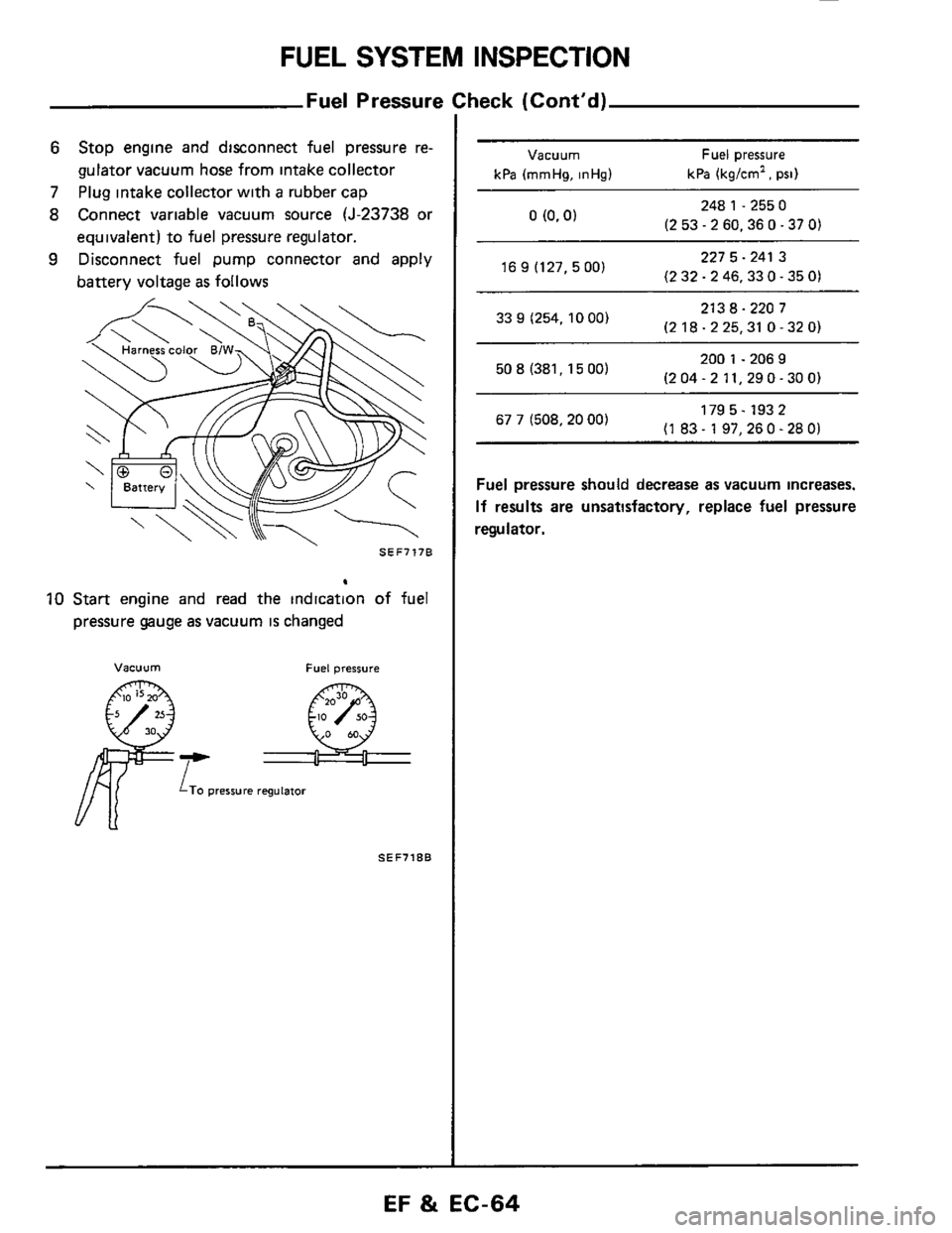
6 Stop engine and disconnect fuel pressure re-
gulator vacuum hose from intake collector
7
Plug intake collector with a rubber cap
8 Connect variable vacuum source (J-23738 or
equivalent) to fuel pressure regulator.
9 Disconnect fuel pump connector and apply
battery voltage
as follows
SEF717B
10 Start engine and read the indication of fuel
pressure gauge as vacuum is changed
Vacuum Fuel prerrure
SEF718B
Vacuum Fuel pressure
kPa (mmHg, inHg) kPa (kg/cm2, psi1
0 (0.01 248 1 .255 0
(2 53
- 2 60.36 0.37 01
227 5.241 3
(2 32.2 46,330.35
01 16 9 (127, 5 00)
213 8.220 7
(2 18.2 25,31 0 - 32 01 33 9 (254. 10 001
200 1 - 206 9
(2 04
- 2 11.29 0- 30 01 50 8 (381,15 00)
179 5. 193 2
(1 83-197.260-280) 67 7 (508.20 00)
Fuel pressure should decrease as vacuum increases.
If results are unsatisfactory, replace fuel pressure
regulator.
EF 8t EC-64
Page 73 of 79
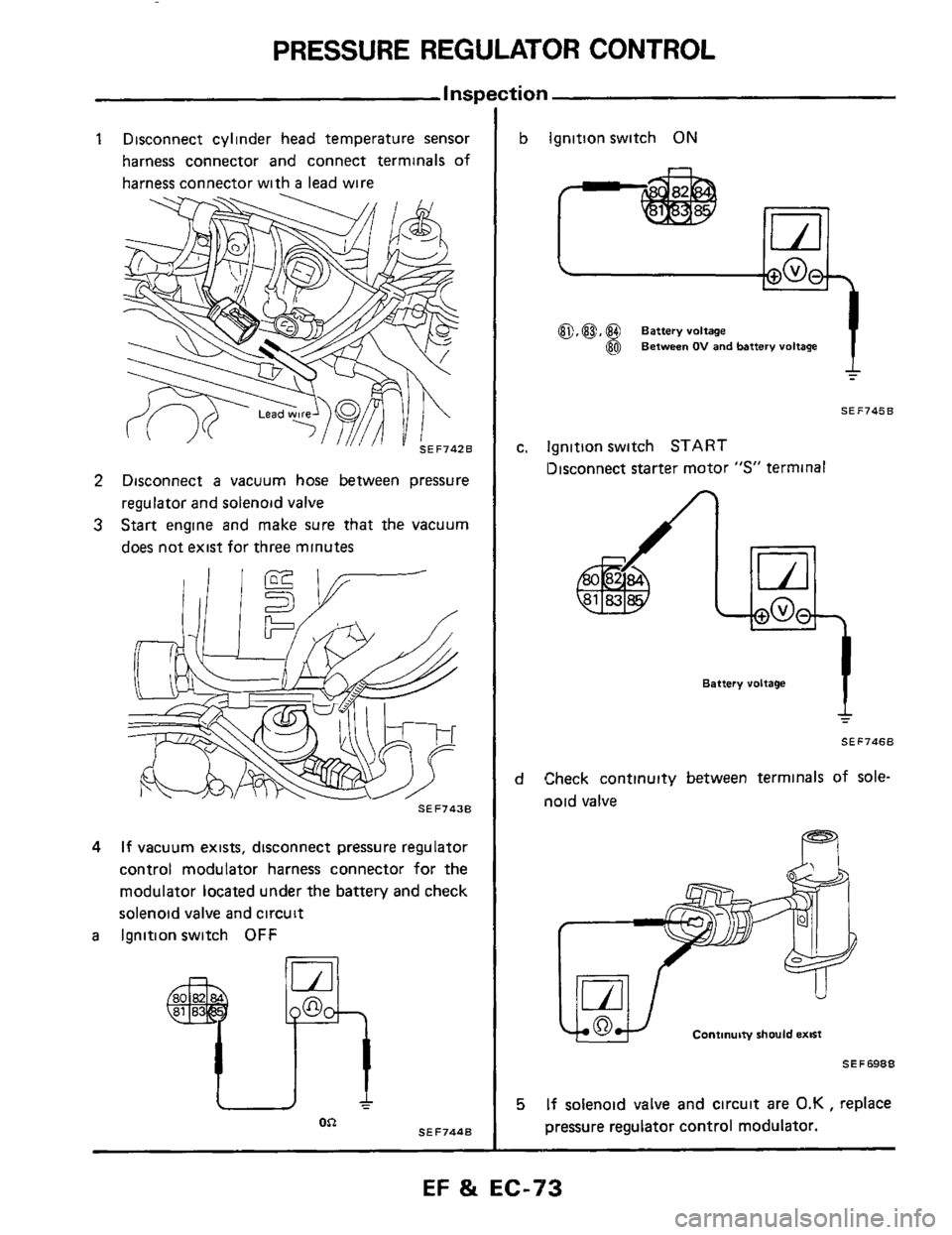
PRESSURE REGULATOR CONTROL
I nspi
1 Disconnect cylinder head temperature sensor
harness connector and connect terminals of
harness connector with
a lead wire
2 Disconnect a vacuum hose between pressure
regulator and solenoid valve
3 Start engine and make sure that the vacuum
does not exist for three minutes
SEF743B
4 If vacuum exists, disconnect pressure regulator
control modulator harness connector for the
modulator located under the battery and check
solenoid valve and circuit
a Ignition switch OFF
SEF744B OR
b Ignition switch ON
a,@, @ Battery voltage
@ Between OV and battery voltage
SEF745B
c. lgnitlon switch START
13isconnect starter motor "S" terminal
I
Battery voltage
4
SEF7468
d Check continuity between terminals of sole-
noid valve
Continuity should emst
SE F 6988
5 If solenoid valve and circuit are 0.K , replace
pressure regulator control modulator.
-
EF & EC-73
Page 76 of 79
EVAPORATIVE EMISSION CONTROL SYSTEM
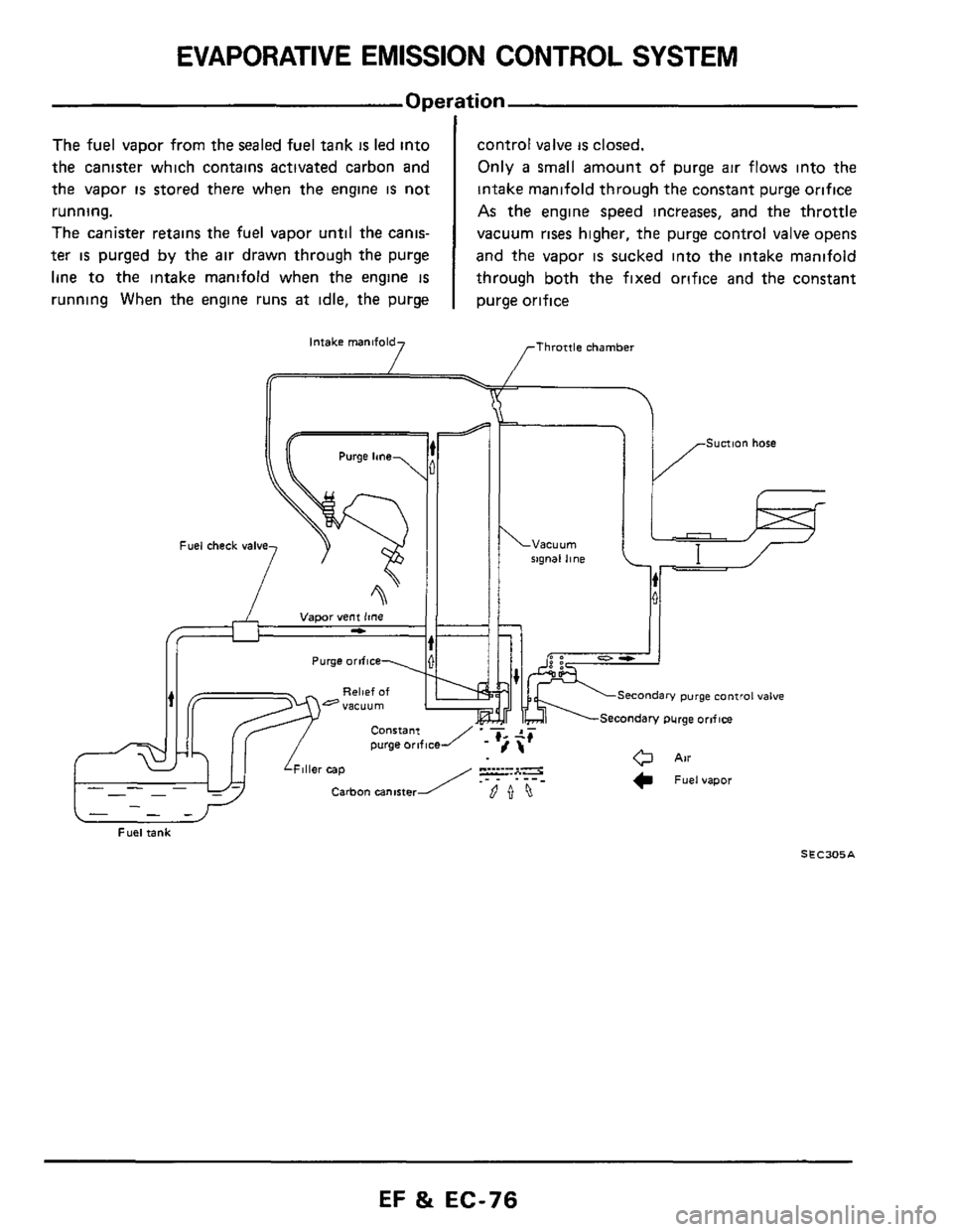
The fuel vapor from the sealed fuel tank is led into
the canister which contains activated carbon and
the vapor
is stored there when the engine is not
running.
The canister retains the fuel vapor until the canis-
ter is purged by the air drawn through the purge
line to the intake manifold when the engine
IS
running When the engine runs at idle, the purge
control valve is closed.
Only
a small amount of purge air flows into the
intake manifold through the constant purge orifice
As the engine speed increases, and the throttle
vacuum
rises higher, the purge control valve opens
and the vapor
is sucked into the intake manifold
through both the fixed orifice and the constant
purge orifice
Intake manifold [Throttle chamber 7 I /F
Sunion hose Purge lane
rxgnal line Fuel check valve
I /F
Sunion hose Purge lane
. ___ -. . . rxgnal line
Purge orifice
i, II
hi II
bl+;fr'
Secondary purge control valve
\Secondary purge orlflce
- -- -
Fuel tank
S E C305 A
EF & EC-76
Page 77 of 79
EVAPORATIVE EMISSION CONTROL SYSTEM
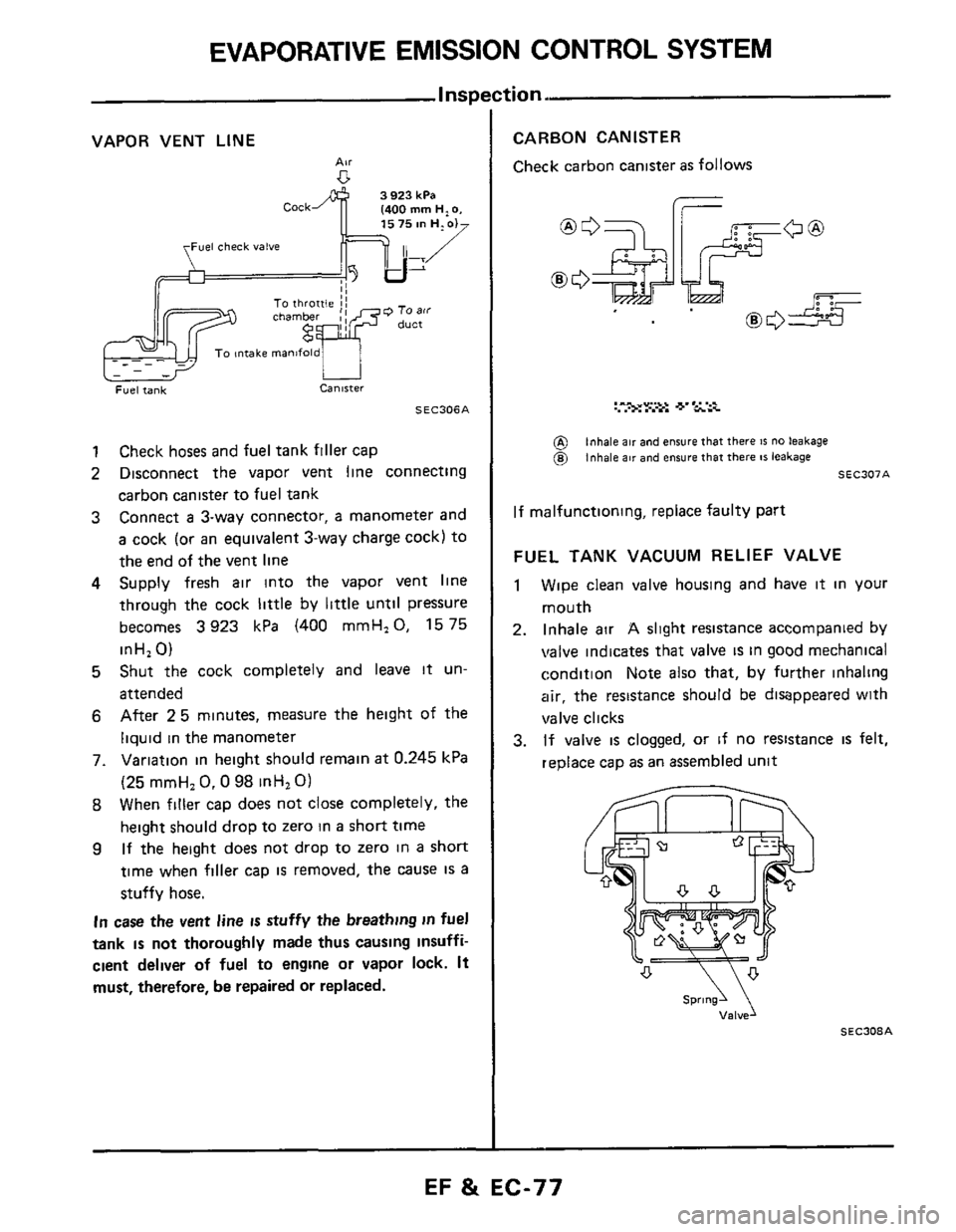
VAPOR VENT LINE
AN
Fuel check valve
SEC306A
1 Check hoses and fuel tank filler cap
2 Disconnect the vapor vent line connecting
carbon canister to fuel tank
3 Connect a 3-way connector, a manometer and
a cock (or an equivalent 3-way charge cock) to
the end of the vent line
4 Supply fresh air into the vapor vent line
through the cock
little by little untll pressure
becomes
3923 kPa (400 mmH,O, 1575
inH,
0)
5 Shut the cock completely and leave it un-
attended
6 After 25 minutes, measure the height of the
liquid
in the manometer
7. Variation in height should remain
at 0.245 kPa
(25 mmH,
0.0 98 inHl 0)
8 When filler cap does not close completely, the
height should drop to zero in
a short time
9 If the height does not drop to zero in a short
time when filler cap is removed, the cause IS a
stuffy hose.
In case the vent line is stuffy the breathing in fuel
tank
is not thoroughly made thus causing insuffi-
cient deliver of fuel to engine or vapor lock. It
must, therefore, be repaired or replaced.
tion.
CARBON CANISTER
Check carbon canister as follows
I-
UL
@ @)
inhale air and ensure that there IS no leakage inhale air and ensure that there 81 leakage
SEC307A
If malfunctioning, replace faulty part
FUEL TANK VACUUM RELIEF VALVE
1 Wipe clean valve housing and have it in your
mouth
2. Inhale air A slight resistance accompanied by
valve indicates that valve is in good mechanical
condition Note also that, by further inhaling
air, the resistance should be disappeared with
valve clicks
3. If valve is clogged, or if no resistance is felt,
replace cap
as an assembled unit
SEC308A
EF & EC-77