engine NISSAN ALMERA N15 1995 Service Manual
[x] Cancel search | Manufacturer: NISSAN, Model Year: 1995, Model line: ALMERA N15, Model: NISSAN ALMERA N15 1995Pages: 1701, PDF Size: 82.27 MB
Page 743 of 1701
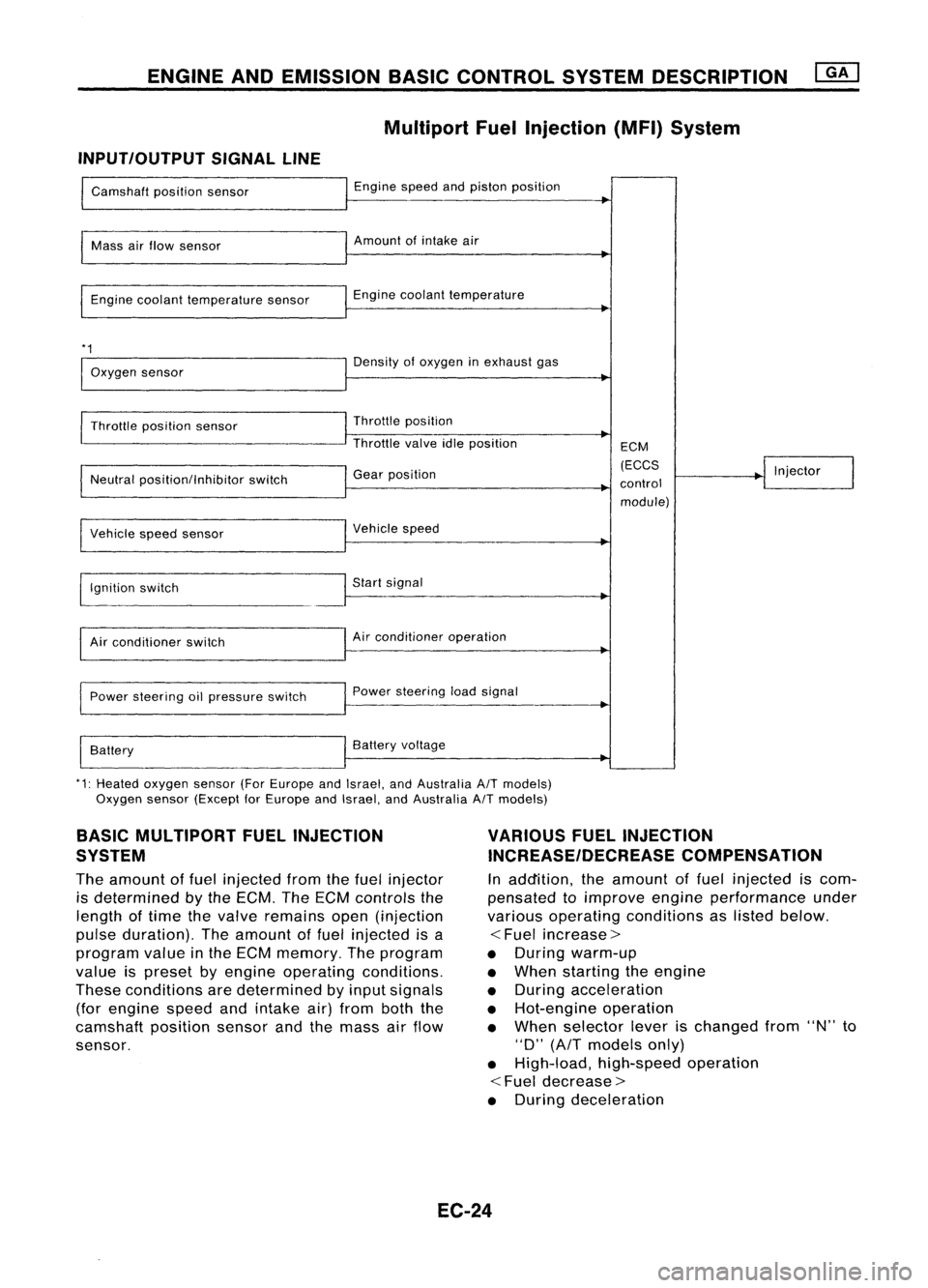
ENGINEANDEMISSION BASICCONTROL SYSTEMDESCRIPTION
Multipart FuelInjection (MFI)System
INPUT/OUTPUT SIGNALLINE
Camshaft positionsensor
Mass airflow sensor
Engine coolant temperature sensor
*1
Oxygen sensor
Throttle position sensor
Neutral position/Inhibitor switch
Vehicle speedsensor
~gnition switch
Air conditioner switch
Power steering oilpressure switch
Battery Engine
speedandpiston position
Amount ofintake air
Engine coolant temperature
Density ofoxygen inexhaust gas
Throttle position
Throttle valveidleposition
Gear position
Vehicle speed
Start signal
Air conditioner operation
Power steering loadsignal
Battery voltage ECM
(ECCS
control module) Injector
*1: Heated oxygen sensor(ForEurope andIsrael, andAustralia A/Tmodels)
Oxygen sensor(Except forEurope andIsrael, andAustralia A/Tmodels)
BASIC MULTIPORT FUELINJECTION
SYSTEM
The amount offuel injected fromthefuel injector
is determined bythe ECM. TheECM controls the
length oftime thevalve remains open(injection
pulse duration). Theamount offuel injected isa
program valueinthe ECM memory. Theprogram
value ispreset byengine operating conditions.
These conditions aredetermined byinput signals
(for engine speedandintake air)from boththe
camshaft positionsensorandthemass airflow
sensor.
VARIOUS
FUELINJECTION
INCREASE/DECREASE COMPENSATION
In addition, theamount offuel injected iscom-
pensated toimprove engineperformance under
various operating conditions aslisted below.
<
Fuel increase>
• During warm-up
• When starting theengine
• During acceleration
• Hot-engine operation
• When selector leverischanged from"N"to
"D"
(AfT
models only)
• High-load, high-speed operation
<
Fuel decrease>
• During deceleration
EC-24
Page 744 of 1701

•
OPEN
LOOPCONTROL
The open loopsystem condition referstowhen theECM detects
any ofthe following conditions. Feedbackcontrolstopsinorder
to maintain stabilized fuelcombustion.
• Deceleration andacceleration
• High-load, high-speed operation
• Engine idling
• Malfunction ofoxygen sensor*1 orits circuit
• Insufficient activationofoxygen sensor*1 atlow engine
coolant temperature
• High-engine coolanttemperature
• After shifting from"N"to"D"
• During warm-up
• When starting theengine
ENGINE
ANDEMISSION BASICCONTROL SYSTEMDESCRIPTION
[ill
Multipart FuelInjection (MFI)System (Cant'd)
MIXTURE RATIOFEEDBACK CONTROL(CLOSEDLOOP
CONTROL)
The mixture ratiofeedback systemprovides thebest air-fuel
mixture ratiofordriveability andemission control.Thethree
way catalyst canthen better reduce CO,HCand NOx emissions.
This system usesanoxygen sensor*1 inthe exhaust manifold
to monitor ifthe engine operation isrich orlean. TheECM
adjusts theinjection pulsewidthaccording tothe sensor volt-
age signal. Thismaintains themixture ratiowithin therange of
stoichiometric (idealair-fuel mixture).
MEF025DC
Thisstage isreferred toas the closed loopcontrol condition .
Feedback
signal
CLOSED
LOOP
CONTROL
MIXTURERATIOSELF-LEARNING CONTROL
The mixture ratiofeedback controlsystem monitors themixture
ratio signal transmitted fromtheoxygen sensor*1. Thisfeed-
back signal isthen senttothe ECM. TheECM controls thebasic
mixture ratioasclose tothe theoretical mixtureratioaspossi-
ble. However, thebasic mixture ratioisnot necessarily con-
trolled asoriginally designed. Bothmanufacturing differences
(i.e., mass airflow sensor hotfilm) andcharacteristic changes
during operation (i.e.,injector clogging) directlyaffectmixture
ratio.
Accordingly, thedifference betweenthebasic andtheoretical
mixture ratiosismonitored inthis system. Thisisthen com-
puted interms of"injection pulseduration" toautomatically
compensate forthe difference betweenthetwo ratios.
* 1: Heated oxygen sensor(ForEurope andIsrael, andAustra-
lia AIT models)
Oxygen sensor(Except forEurope andIsrael, andAustralia
AIT
models)
EC-25
Page 745 of 1701
![NISSAN ALMERA N15 1995 Service Manual
Twotypes ofsystems areused.
ENGINE
ANDEMISSION BASICCONTROL SYSTEMDESCRIPTION
@K]
Multipart FuelInjection (MFI)System (Cont'd)
FUEL INJECTION TIMING
/ Injection pUlse
No.1 cylinder
---r:T _](/img/5/57349/w960_57349-744.png "NISSAN ALMERA N15 1995 Service Manual
Twotypes ofsystems areused.
ENGINE
ANDEMISSION BASICCONTROL SYSTEMDESCRIPTION
@K]
Multipart FuelInjection (MFI)System (Cont'd)
FUEL INJECTION TIMING
/ Injection pUlse
No.1 cylinder
---r:T _")
Twotypes ofsystems areused.
ENGINE
ANDEMISSION BASICCONTROL SYSTEMDESCRIPTION
@K]
Multipart FuelInjection (MFI)System (Cont'd)
FUEL INJECTION TIMING
/ Injection pUlse
No.1 cylinder
---r:T _
No.2 cylinder
rL
No.3 cylinder
n.... _
No.4 cylinder
n....__
Sequential
multiportfuelinjection system
Fuel isinjected intoeach cylinder duringeachengine cycle
according tothe firing order. Thissystem isused when the
engine isrunning.
~ 1engine cycle
----j
Sequential multiportfuelinjection system
MEF522D
No. 1cylinder
jl
n
n-
No.2 cylinder
jl
n
n-
No. 3cylinder
.n
n
rL-
No.4 cylinder
j1~
n....
rL-
f---
1engine cycle
-l
Simultaneous multiportfuelinjection system
MEF523D Simultaneous
multiportfuelinjection system
Fuel isinjected simultaneously intoallfour cylinders twiceeach
engine cycle.Inother words, pulsesignals ofthe same width
are simultaneously transmittedfromtheECM.
The four injectors willthen receive thesignals twotimes for
each engine cycle.
This system isused when theengine isbeing started and/orif
the fail-safe system(CPU)isoperating.
FUEL SHUT-OFF
Fuel toeach cylinder iscut offduring deceleration oroperation
of the engine andthevehicle atexcessively highspeeds.
EC-26
Page 746 of 1701

ENGINEANDEMISSION BASICCONTROL SYSTEMDESCRIPTION
Distributor Ignition(DI)System
INPUT/OUTPUT SIGNALLINE
Camshaft positionsensor
Mass airflow sensor
Engine coolant temperature sensor
Throttle position sensor
Vehicle speedsensor
Ignition switch
*1
Knock sensor
Neutral position/Inhibitor switch
Battery
*1: Except forEurope andIsrael Engine
speedandpiston position
Amount ofintake air
Engine coolant temperature
Throttle position
Throttle valveidleposition
Vehicle speed
Start signal
Engine knocking
Gear position
Battery voltage ECM
(ECCS
control
module) Power
transistor
•
Tp
(msec)
1.75
~ 1.50
.~
~ 1.25
"S
0.
C
1.00
o
. ~ 0.75
E
A
N
600 1,000 1,4001,8002,200
Engine speed(rpm) SEF742M
SYSTEM
DESCRIPTION
The ignition timingiscontrolled bythe ECM tomaintain thebest
air-fuel ratioforevery running condition ofthe engine.
The ignition timingdataisstored inthe ECM. Thisdata forms
the map shown.
The ECM receives information suchasthe injection pulsewidth
and camshaft positionsensorsignal.Computing thisinforma-
tion, ignition signals aretransmitted tothe power transistor .
e.g., N:1,800 rpm,Tp:1.50 msec
AOBTDC
During thefollowing conditions, theignition timingisrevised by
the ECM according tothe other datastored inthe ECM.
• Atstarting
• During warm-up
• Atidle
• Hot engine operation
• During acceleration
• During high-load operation (VTCon)-GA 16DE except for
Europe andIsrael
Except forEurope andIsrael
The knock sensor retardsystem isdesigned onlyforemergen-
cies. Thebasic ignition timingisprogrammed withintheanti-
knocking zone,ifrecommended fuelisused under drycondi-
tions. Theretard system doesnotoperate undernormal driv-
ing conditions.
If engine knocking occurs,theknock sensor monitors thecon-
dition. Thesignal istransmitted tothe ECM (ECCS control mod-
ule). TheECM retards theignition timingtoeliminate theknock-
ing condition.
EC-27
Page 747 of 1701

ENGINEANDEMISSION BASICCONTROL SYSTEMDESCRIPTION ~
Air Conditioning CutControl
INPUT/OUTPUT SIGNALLINE
Air conditioner switch
Neutral position/Inhibitor switch
Throttle position sensor
Camshaft positionsensor
Engine coolant temperature sensor
Ignition switch
Vehicle speedsensor
Power steering oilpressure switch Air
conditioner "ON"signal
Neutral position
Throttle
valve
opening angle
Engine speed
Engine coolant temperature
Start signal
Vehicle speed
Power steering loadsignal ECM
(ECCS
control
module) Air
conditioner
relay
SYSTEM DESCRIPTION
This system improves acceler8.tion whentheairconditioner isused.
When theaccelerator pedalisfully depressed, theairconditioner isturned offfor afew seconds.
Fuel CutControl (atnoload
&
high engine
speed)
INPUT/OUTPUT SIGNALLINE
Vehicle speedsensor
Neutral position/Inhibitor switchVehicle
speed
Neutral position
Throttle position sensor
Engine coolant temperature sensor
Camshaft positionsensor Throttle
position
Engine coolant temperature
Engine speed ECM
(ECCS
control
module) Injectors
If the engine speedisabove 2,500rpmwith noload (for
example, inneutral andengine speedover2,500 rpm)fuelwill
be cut offafter some time.Theexact timewhen thefuel iscut
off varies basedonengine speed.
Fuel cutwill operate untiltheengine speedreaches 2,000rpm,
then fuelcutiscancelled.
NOTE:
This function isdifferent thandeceleration controllistedunder
"Multiport FuelInjection (MFI)System" onEC-24.
EC-28
Page 748 of 1701
EVAPORATIVEEMISSIONSYSTEM
•
SEF126R
EVAP
canister
'1
EVAP canister
purge control
solenoid valve
or
'2 EGR valve
&
EVAP canister
purge control
solenoid
valve To
EGR
I
valve
I
,
I
1
1
I
I
I
Vacuum :
signal line I
I
I
I
I
I
I
-- -- --- -- ------ __....J
r---
------- -------- ---------,
Fuel fillercap
with vacuum
relief valve
------------,
I
I
I
I
I
I
I
I
I
I
I
'-
Throttle
valve~
I
Fuel check valve
Intake
manifold
'1 :GA 16DE M/Tmodels exceptforEurope,
Israel andAustralia
'2 :For Europe, IsraelandAustralia,
and GA15DE
M/T
models
~ :GA 15, 16DE AlTmodels exceptfor
Europe, IsraelandAustralia
.. :Air
Q :
Fuel vapor
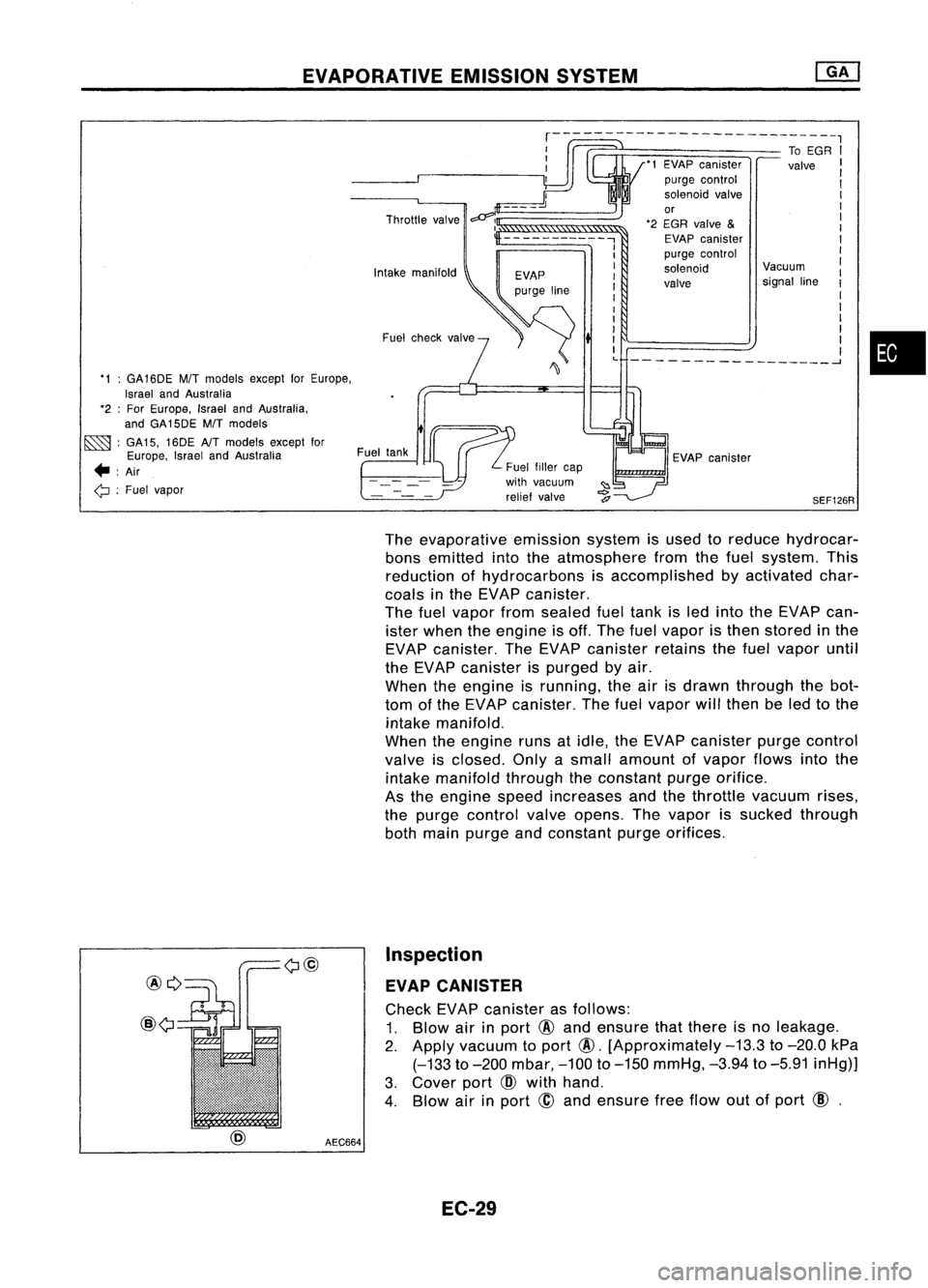
Theevaporative emissionsystemisused toreduce hydrocar-
bons emitted intotheatmosphere fromthefuel system. This
reduction ofhydrocarbons isaccomplished byactivated char-
coals inthe EVAP canister.
The fuelvapor fromsealed fueltank isled into theEVAP can-
ister when theengine isoff. The fuelvapor isthen stored inthe
EVAP canister. TheEVAP canister retainsthefuel vapor until
the EVAP canister ispurged byair.
When theengine isrunning, theairisdrawn through thebot-
tom ofthe EVAP canister. Thefuel vapor willthen beled tothe
intake manifold.
When theengine runsatidle, theEVAP canister purgecontrol
valve isclosed. Onlyasmall amount ofvapor flowsintothe
intake manifold throughtheconstant purgeorifice.
As the engine speedincreases andthethrottle vacuum rises,
the purge control valveopens. Thevapor issucked through
both main purge andconstant purgeorifices.
@Q
@
AEC664Inspection
EVAP CANISTER
Check EVAPcanister asfollows:
1. Blow airinport
@
and ensure thatthere isno leakage.
2.
Apply vacuum toport
@.
[Approximately
-13.3
to
-20.0
kPa
(-133
to
-200
mbar,
-100
to
-150
mmHg,
-3.94
to
-5.91
inHg)]
3. Cover port
CID
with hand.
4. Blow airinport
@
and ensure freeflow outofport
CID.
EC-29
Page 750 of 1701
POSITIVECRANKCASE VENTILATION
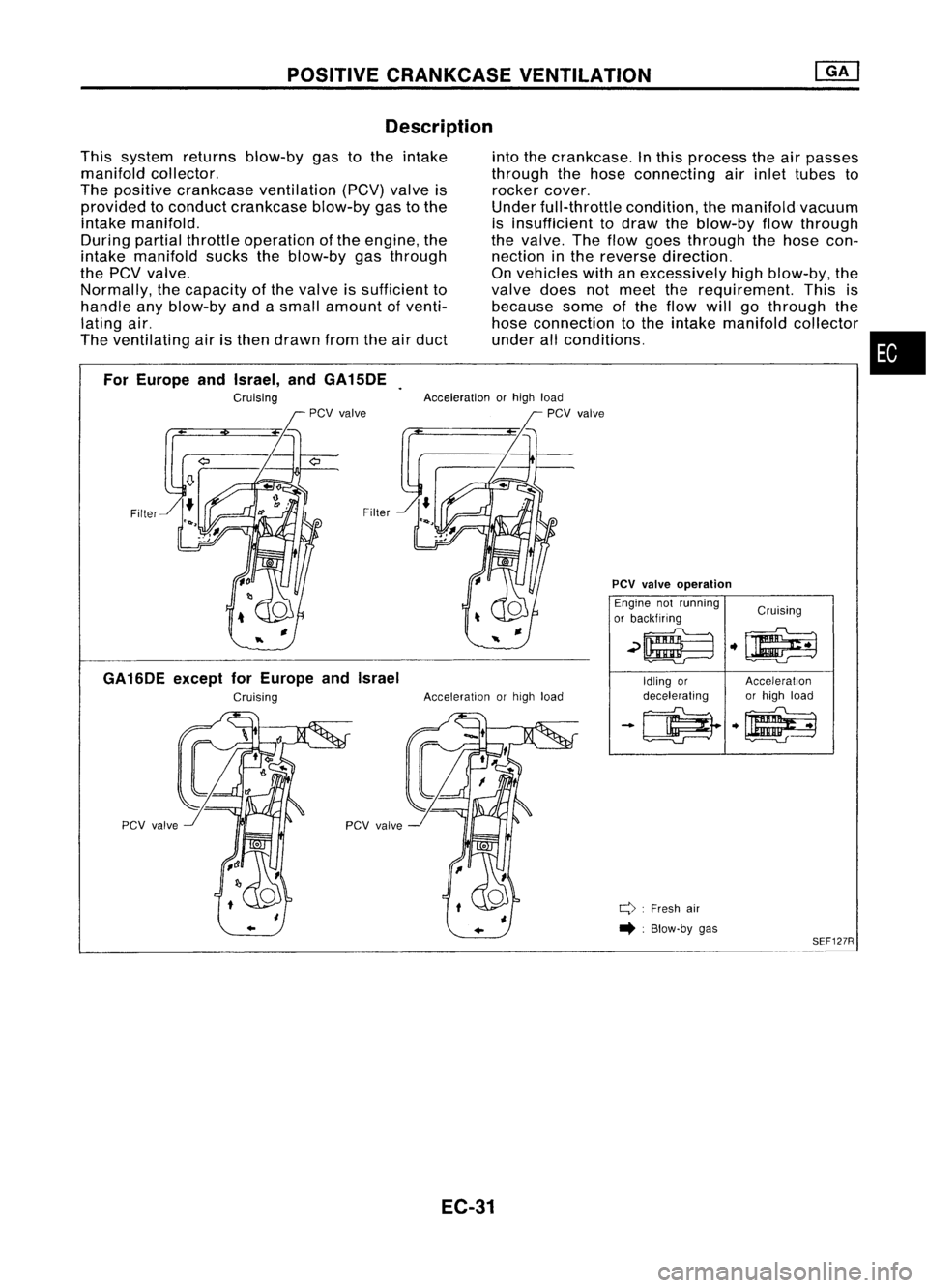
Description
intothecrankcase. Inthis process theairpasses
through thehose connecting airinlet tubes to
rocker cover.
Under full-throttle condition,themanifold vacuum
is insufficient todraw theblow-by flowthrough
the valve. Theflow goes through thehose con-
nection inthe reverse direction.
On vehicles withanexcessively highblow-by, the
valve doesnotmeet therequirement. Thisis
because someofthe flow willgothrough the
hose connection tothe intake manifold collector
under allconditions.
This
system returnsblow-by gastothe intake
manifold collector.
The positive crankcase ventilation (peV)valveis
provided toconduct crankcase blow-bygastothe
intake manifold.
During partialthrottle operation ofthe engine, the
intake manifold suckstheblow-by gasthrough
the
pev
valve.
Normally, thecapacity ofthe valve issufficient to
handle anyblow-by andasmall amount ofventi-
lating air.
The ventilating airisthen drawn fromtheairduct
•
SEF127R
Q:
Fresh air
• :Blow-by gas
PCV
valve
operation
Engine notrunning
Cruising
or backfiring
~~ .~
Idling or Acceleration
decelerating or
high load
-~ .~
..
Acceleration
orhigh load
Acceleration
orhigh load
pcv valve
Filter
For
Europe andIsrael, andGA15DE
Cruising
GA16DE exceptforEurope andIsrael
Cruising
EC-31
Page 751 of 1701
POSITIVECRANKCASE VENTILATION
Inspection
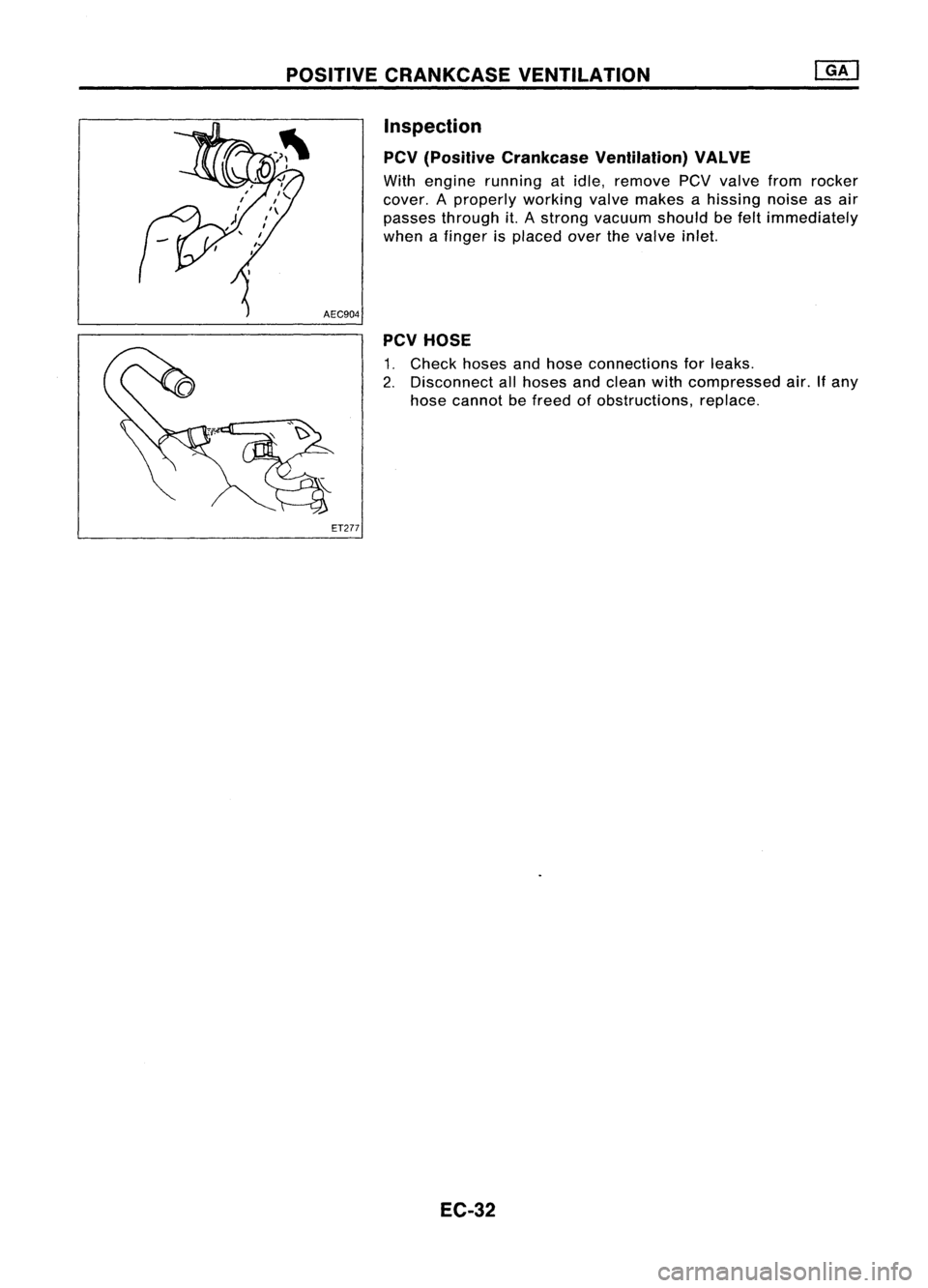
PCV (Positive Crankcase Ventilation) VALVE
With engine running atidle, remove PCVvalve fromrocker
cover. Aproperly workingvalvemakes ahissing noiseasair
passes through it.Astrong vacuum shouldbefelt immediately
when afinger isplaced overthevalve inlet.
AEC904 PCVHOSE
1. Check hosesandhose connections forleaks.
2. Disconnect allhoses andclean withcompressed air.Ifany
hose cannot befreed ofobstructions, replace.
ET277
EC-32
Page 752 of 1701
BASICSERVICE PROCEDURE
• FUEL PRESRELEASE. D
FUEL PUMP WILLSTOP BY
TOUCHING STARTDURING
IDLE.
CRANK AFEW TIMES AFTER
ENGINE STALL
---S-T~-RT--
SEF823K
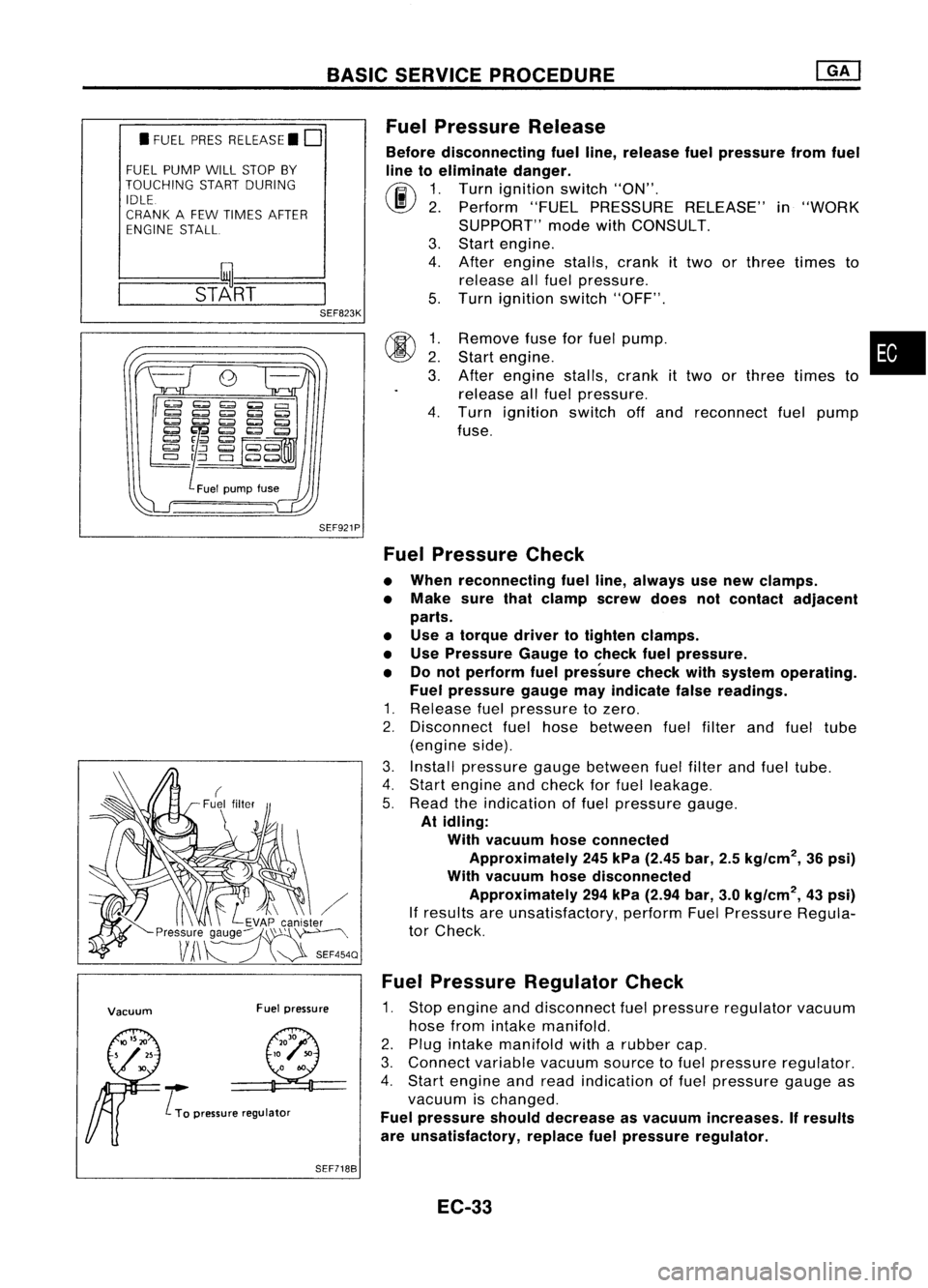
Fuel
Pressure Release
Before disconnecting fuelline, release fuelpressure fromfuel
line toeliminate danger.
(ij\
1.Turn ignition switch"ON".
~ 2.Perform "FUELPRESSURE RELEASE"in"WORK
SUPPORT" modewithCONSULT.
3. Start engine.
4. After engine stalls,crankittwo orthree times to
release allfuel pressure.
5. Turn ignition switch"OFF".
SEF921P
00
~:
3.
4.
Remove
fuseforfuel pump. •
Start engine.
After engine stalls,crankittwo orthree times to
release allfuel pressure.
Turn ignition switchoffand reconnect fuelpump
fuse.
Vacuum Fuelpressure
..... L
To pressure regulator
Fuel
Pressure Check
• When reconnecting fuelline, always usenew clamps.
• Make surethatclamp screwdoesnotcontact adjacent
parts.
• Use atorque drivertotighten clamps.
• Use Pressure Gaugetocheck fuelpressure.
• Donot perform fuelpressure checkwithsystem operating.
Fuel pressure gaugemayindicate falsereadings.
1. Release fuelpressure tozero.
2. Disconnect fuelhose between fuelfilter andfuel tube
(engine side).
3. Install pressure gaugebetween fuelfilter andfuel tube.
4. Start engine andcheck forfuel leakage.
5. Read theindication offuel pressure gauge.
At idling:
With vacuum hoseconnected
Approximately 245kPa (2.45 bar,2.5kg/cm
2,
36psi)
With vacuum hosedisconnected
Approximately 294kPa (2.94 bar,3.0kg/cm
2,
43psi)
If results areunsatisfactory, performFuelPressure Regula-
tor Check.
Fuel Pressure Regulator Check
1. Stop engine anddisconnect fuelpressure regulator vacuum
hose fromintake manifold.
2. Plug intake manifold witharubber cap.
3. Connect variablevacuumsourcetofuel pressure regulator.
4. Start engine andread indication offuel pressure gaugeas
vacuum ischanged.
Fuel pressure shoulddecrease asvacuum increases. Ifresults
are unsatisfactory, replacefuelpressure regulator.
SEF7188
EC-33
Page 753 of 1701
Looseninnumerical order
~~2.27 -3.04 N.m
"l!.ti!?n
(0.231-0.310 kg-m,
~ 20.1.26.9in-Ib)
r;m /
Injector
Upper J~tf /"a-ring ~.
insulator \~.......--: ~
~
Engine
front
o
0 -
Lower ins~~or ~ BASIC
SERVICE PROCEDURE
@[]
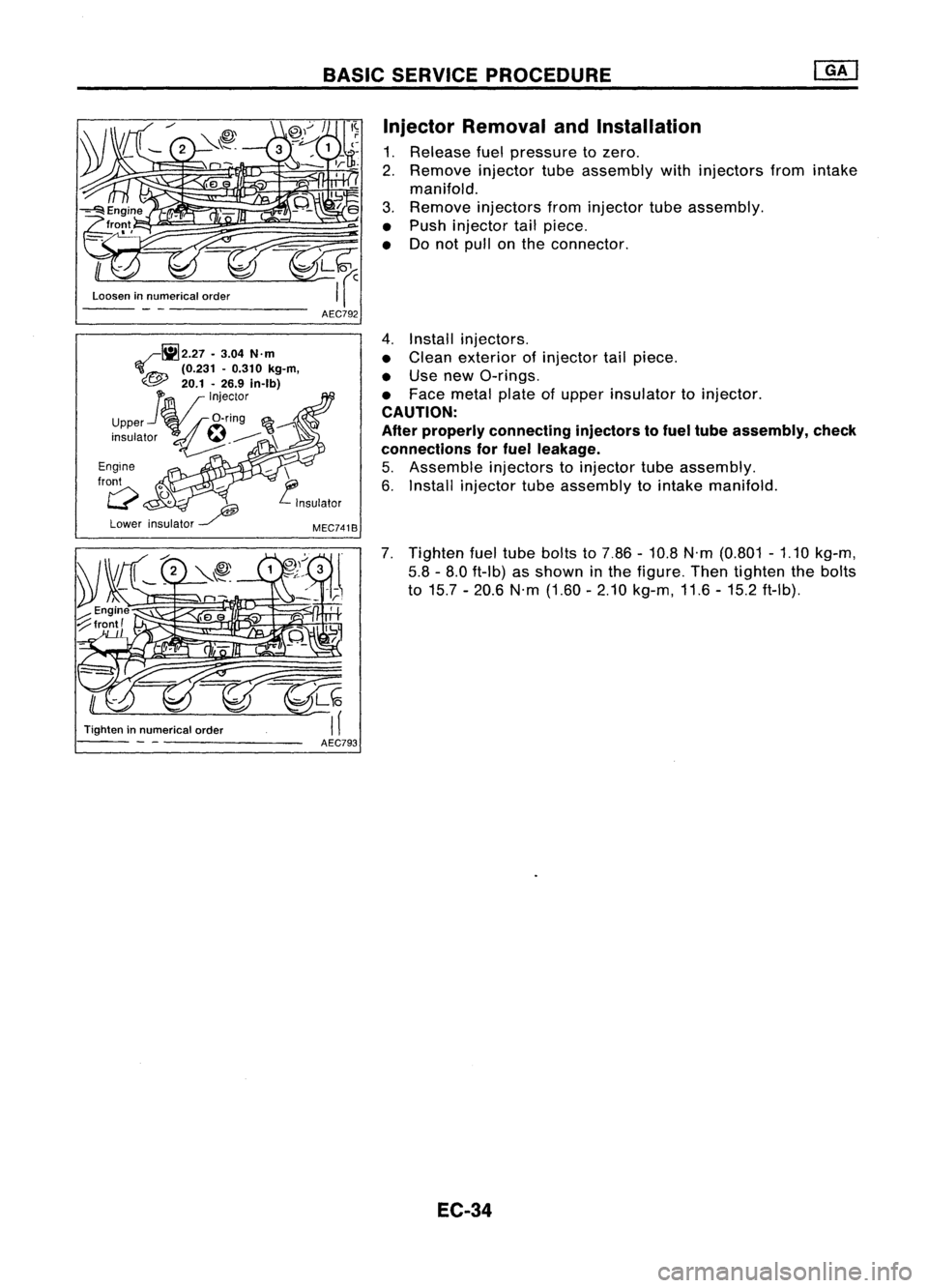
Injector Removal andInstallation
1. Release fuelpressure tozero.
2. Remove injectortubeassembly withinjectors fromintake
manifold.
3. Remove injectors frominjector tubeassembly.
• Push injector tailpiece.
• Donot pull onthe connector.
4. Install injectors.
• Clean exterior ofinjector tailpiece.
• Use new O-rings.
• Face metal plateofupper insulator toinjector.
CAUTION:
After properly connecting injectorstofuel tube assembly, check
connections forfuel leakage.
5. Assemble injectorstoinjector tubeassembly.
6. Install injector tubeassembly tointake manifold.
MEC741B
7.Tighten fueltube bolts to7.86 -10.8 N'm (0.801 -1.10 kg-m,
5.8 -8.0 ft-Ib) asshown inthe figure. Thentighten thebolts
to 15.7 -20.6 N'm (1.60 -2.10 kg-m, 11.6-15.2 ft-Ib).
EC-34