FLUID NISSAN ALMERA N16 2003 Electronic Repair Manual
[x] Cancel search | Manufacturer: NISSAN, Model Year: 2003, Model line: ALMERA N16, Model: NISSAN ALMERA N16 2003Pages: 3189, PDF Size: 54.76 MB
Page 2216 of 3189
It is not necessary to remove connecting bolt except for
disassembly or replacement of caliper assembly. In this
case, suspend cylinder body with wire so as not to stretch
brake hose.
Burnish the brake contact surfaces after refinishing or
replacing drums or rotors, after replacing pads or linings,
or if a soft pedal occurs at very low mileage.
Refer to “Brake Burnishing Procedure”, “ON-VEHICLE
SERVICE”, BR-7.
SBR764E
SBR916C
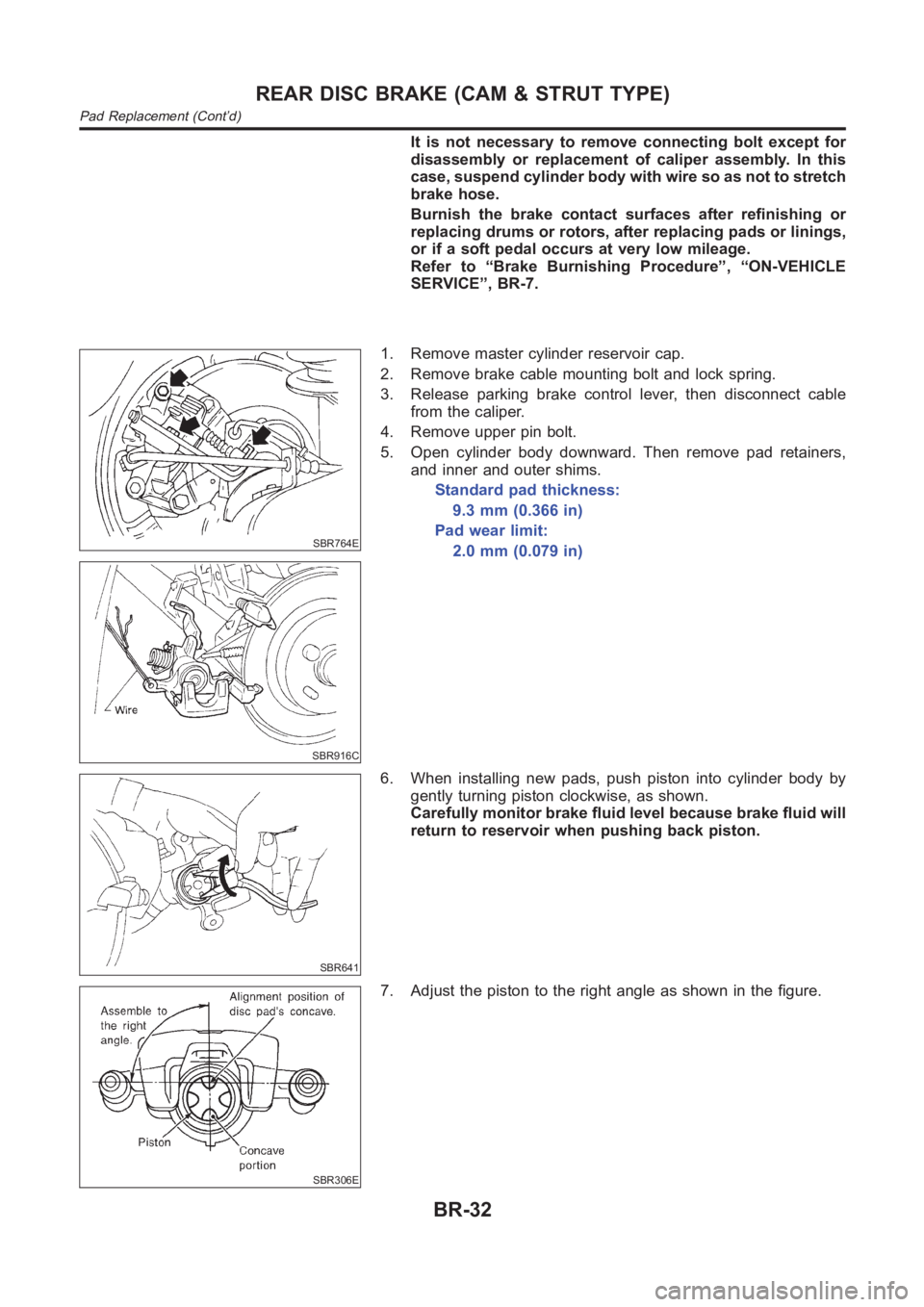
1. Remove master cylinder reservoir cap.
2. Remove brake cable mounting bolt and lock spring.
3. Release parking brake control lever, then disconnect cable
from the caliper.
4. Remove upper pin bolt.
5. Open cylinder body downward. Then remove pad retainers,
and inner and outer shims.
Standard pad thickness:
9.3mm(0.366in)
Pad wear limit:
2.0mm(0.079in)
SBR641
6. When installing new pads, push piston into cylinder body by
gently turning piston clockwise, as shown.
Carefully monitor brake fluid level because brake fluid will
return to reservoir when pushing back piston.
SBR306E
7. Adjust the piston to the right angle as shown in the figure.
REAR DISC BRAKE (CAM & STRUT TYPE)
Pad Replacement (Cont’d)
BR-32
Page 2218 of 3189
SBR088B
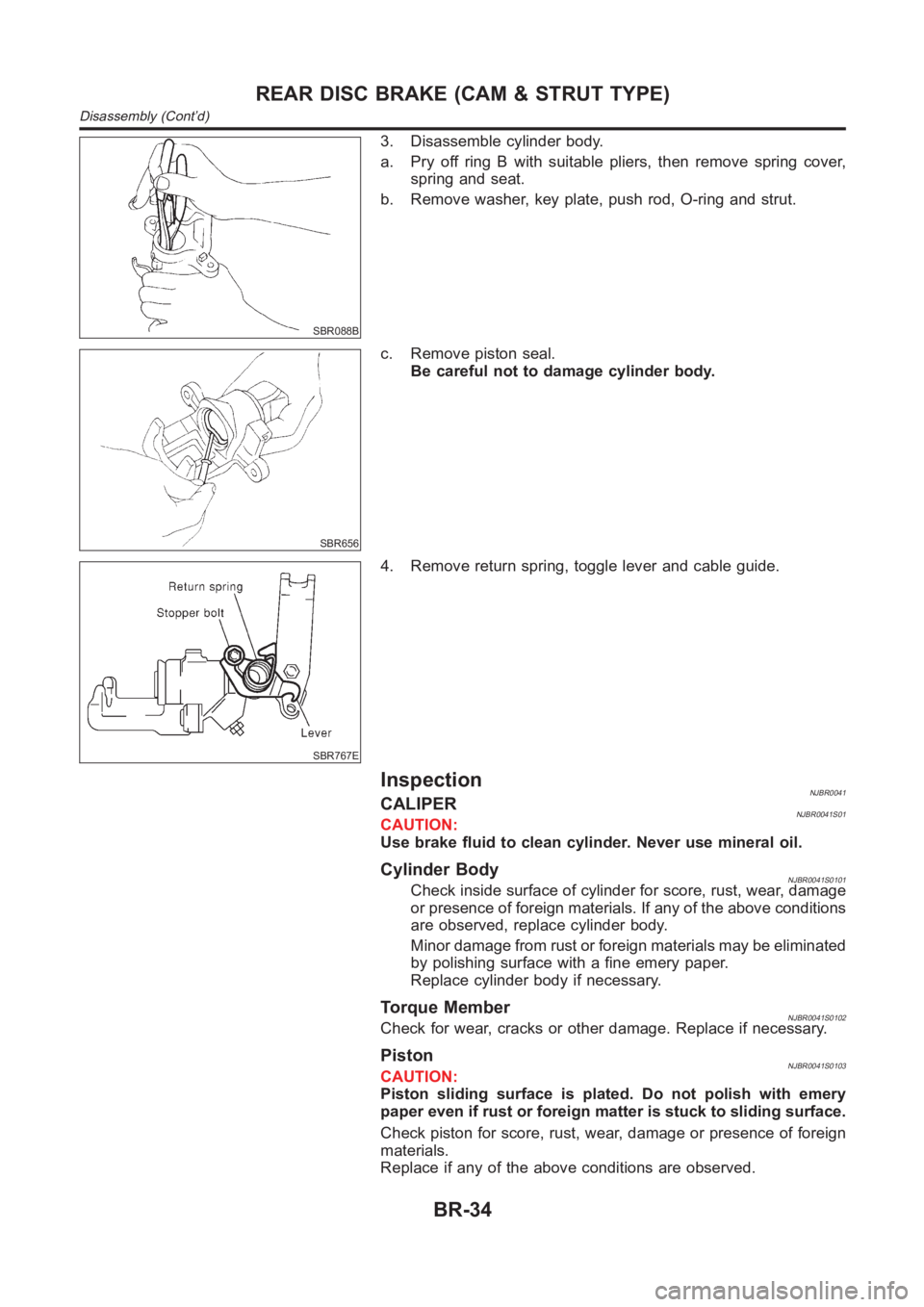
3. Disassemble cylinder body.
a. Pry off ring B with suitable pliers, then remove spring cover,
spring and seat.
b. Remove washer, key plate, push rod, O-ring and strut.
SBR656
c. Remove piston seal.
Be careful not to damage cylinder body.
SBR767E
4. Remove return spring, toggle lever and cable guide.
InspectionNJBR0041CALIPERNJBR0041S01CAUTION:
Use brake fluid to clean cylinder. Never use mineral oil.
Cylinder BodyNJBR0041S0101Check inside surface of cylinder for score, rust, wear, damage
or presence of foreign materials. If any of the above conditions
are observed, replace cylinder body.
Minor damage from rust or foreign materials may be eliminated
by polishing surface with a fine emery paper.
Replace cylinder body if necessary.
Torque MemberNJBR0041S0102Check for wear, cracks or other damage. Replace if necessary.
PistonNJBR0041S0103CAUTION:
Piston sliding surface is plated. Do not polish with emery
paper even if rust or foreign matter is stuck to sliding surface.
Check piston for score, rust, wear, damage or presence of foreign
materials.
Replace if any of the above conditions are observed.
REAR DISC BRAKE (CAM & STRUT TYPE)
Disassembly (Cont’d)
BR-34
Page 2222 of 3189
SBR307E
InstallationNJBR0043CAUTION:
Refill with new brake fluid “DOT 4”.
Never reuse drained brake fluid.
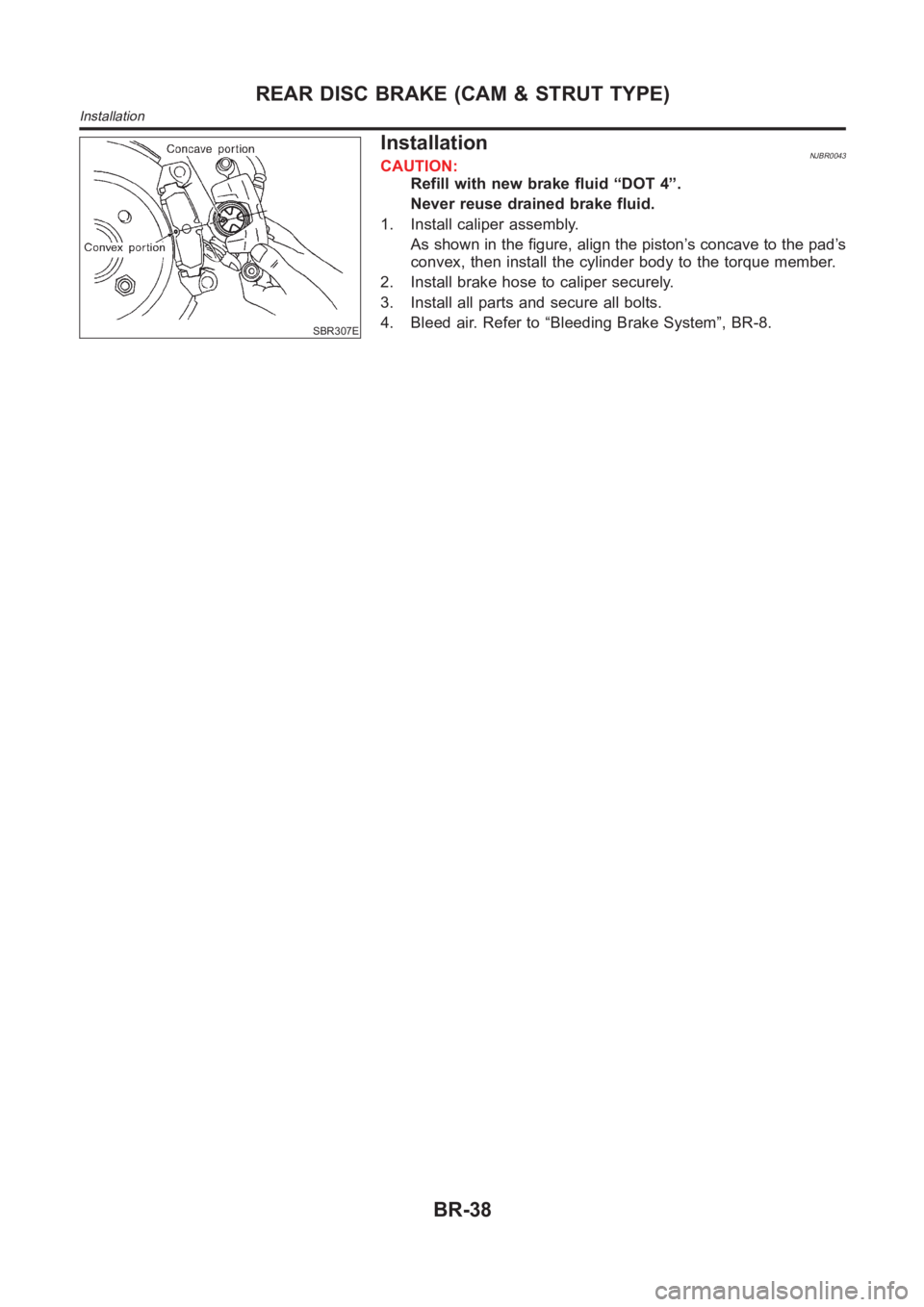
1. Install caliper assembly.
As shown in the figure, align the piston’s concave to the pad’s
convex, then install the cylinder body to the torque member.
2. Install brake hose to caliper securely.
3. Install all parts and secure all bolts.
4. Bleed air. Refer to “Bleeding Brake System”, BR-8.
REAR DISC BRAKE (CAM & STRUT TYPE)
Installation
BR-38
Page 2224 of 3189
NBR423
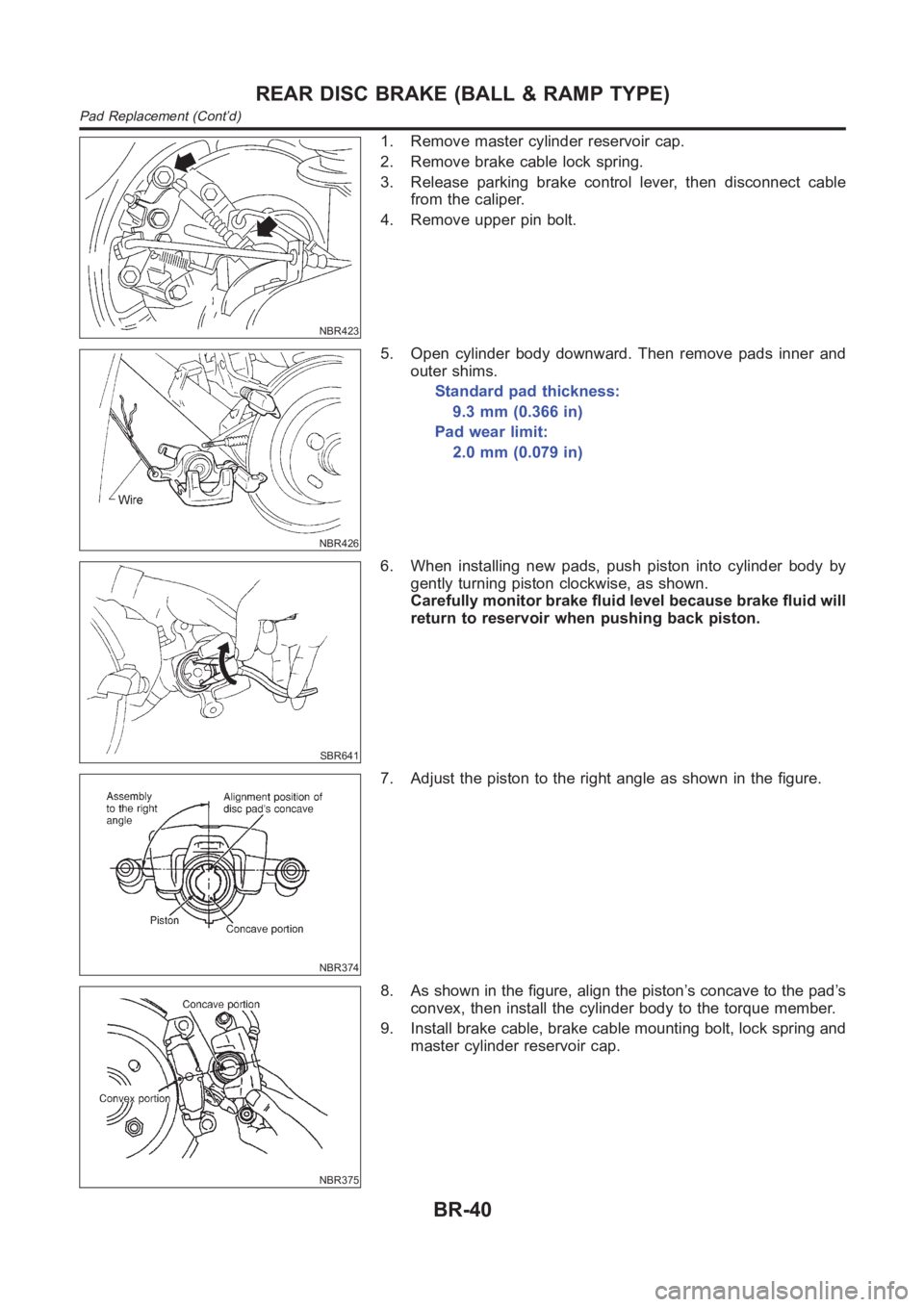
1. Remove master cylinder reservoir cap.
2. Remove brake cable lock spring.
3. Release parking brake control lever, then disconnect cable
from the caliper.
4. Remove upper pin bolt.
NBR426
5. Open cylinder body downward. Then remove pads inner and
outer shims.
Standard pad thickness:
9.3mm(0.366in)
Pad wear limit:
2.0mm(0.079in)
SBR641
6. When installing new pads, push piston into cylinder body by
gently turning piston clockwise, as shown.
Carefully monitor brake fluid level because brake fluid will
return to reservoir when pushing back piston.
NBR374
7. Adjust the piston to the right angle as shown in the figure.
NBR375
8. As shown in the figure, align the piston’s concave to the pad’s
convex, then install the cylinder body to the torque member.
9. Install brake cable, brake cable mounting bolt, lock spring and
master cylinder reservoir cap.
REAR DISC BRAKE (BALL & RAMP TYPE)
Pad Replacement (Cont’d)
BR-40
Page 2225 of 3189
NBR427
RemovalNJBR0143WARNING:
Clean brake pads with a vacuum dust collector to minimize the
hazard of airborne particles or other materials.
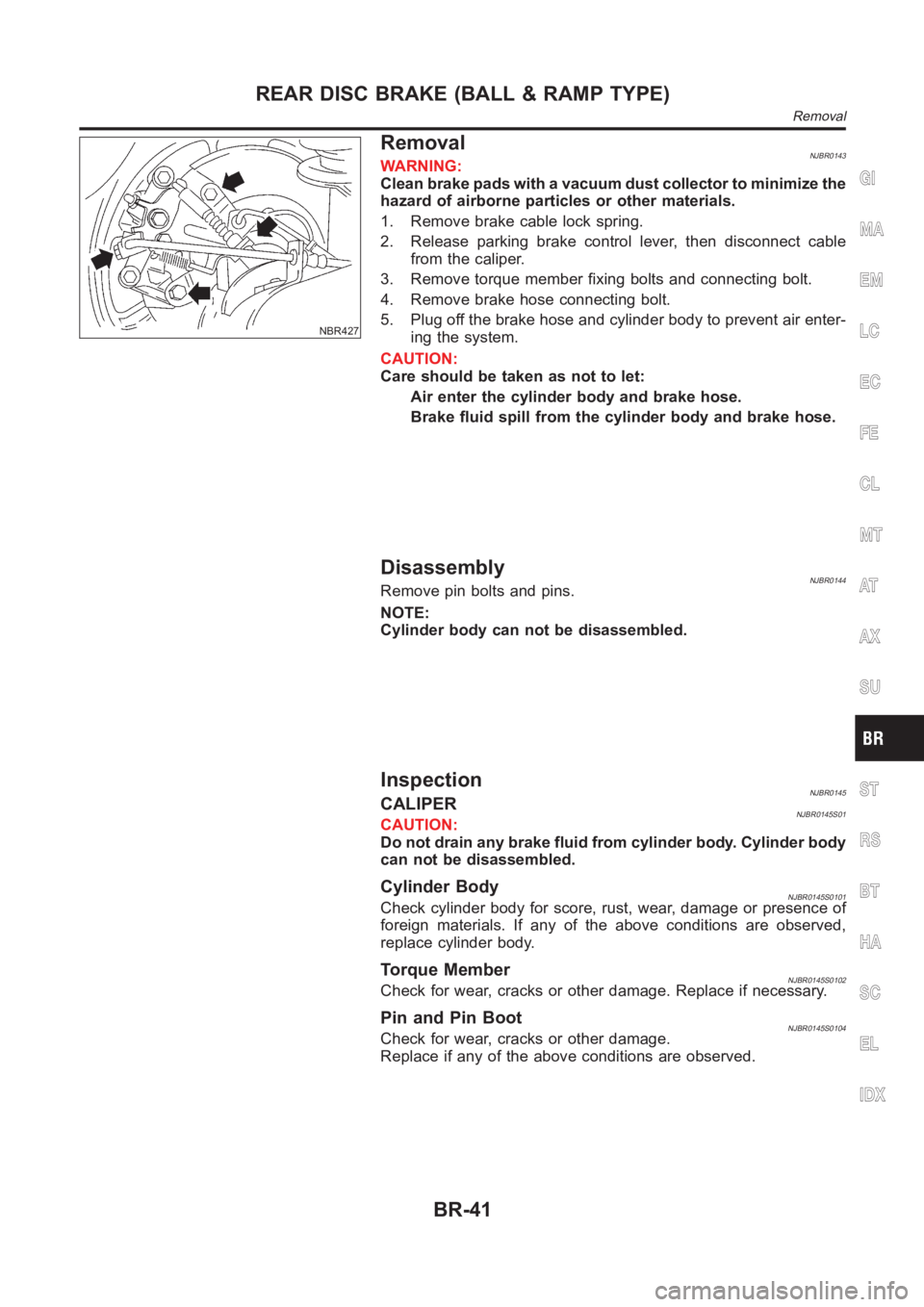
1. Remove brake cable lock spring.
2. Release parking brake control lever, then disconnect cable
from the caliper.
3. Remove torque member fixing bolts and connecting bolt.
4. Remove brake hose connecting bolt.
5. Plug off the brake hose and cylinder body to prevent air enter-
ing the system.
CAUTION:
Care should be taken as not to let:
Air enter the cylinder body and brake hose.
Brake fluid spill from the cylinder body and brake hose.
DisassemblyNJBR0144Remove pin bolts and pins.
NOTE:
Cylinder body can not be disassembled.
InspectionNJBR0145CALIPERNJBR0145S01CAUTION:
Do not drain any brake fluid from cylinder body. Cylinder body
can not be disassembled.
Cylinder BodyNJBR0145S0101Check cylinder body for score, rust, wear, damage or presence of
foreign materials. If any of the above conditions are observed,
replace cylinder body.
Torque MemberNJBR0145S0102Check for wear, cracks or other damage. Replace if necessary.
Pin and Pin BootNJBR0145S0104Check for wear, cracks or other damage.
Replace if any of the above conditions are observed.
GI
MA
EM
LC
EC
FE
CL
MT
AT
AX
SU
ST
RS
BT
HA
SC
EL
IDX
REAR DISC BRAKE (BALL & RAMP TYPE)
Removal
BR-41
Page 2226 of 3189
SBR219C
ROTORNJBR0145S02Rubbing SurfaceNJBR0145S0201Check rotor for roughness, cracks or chips.
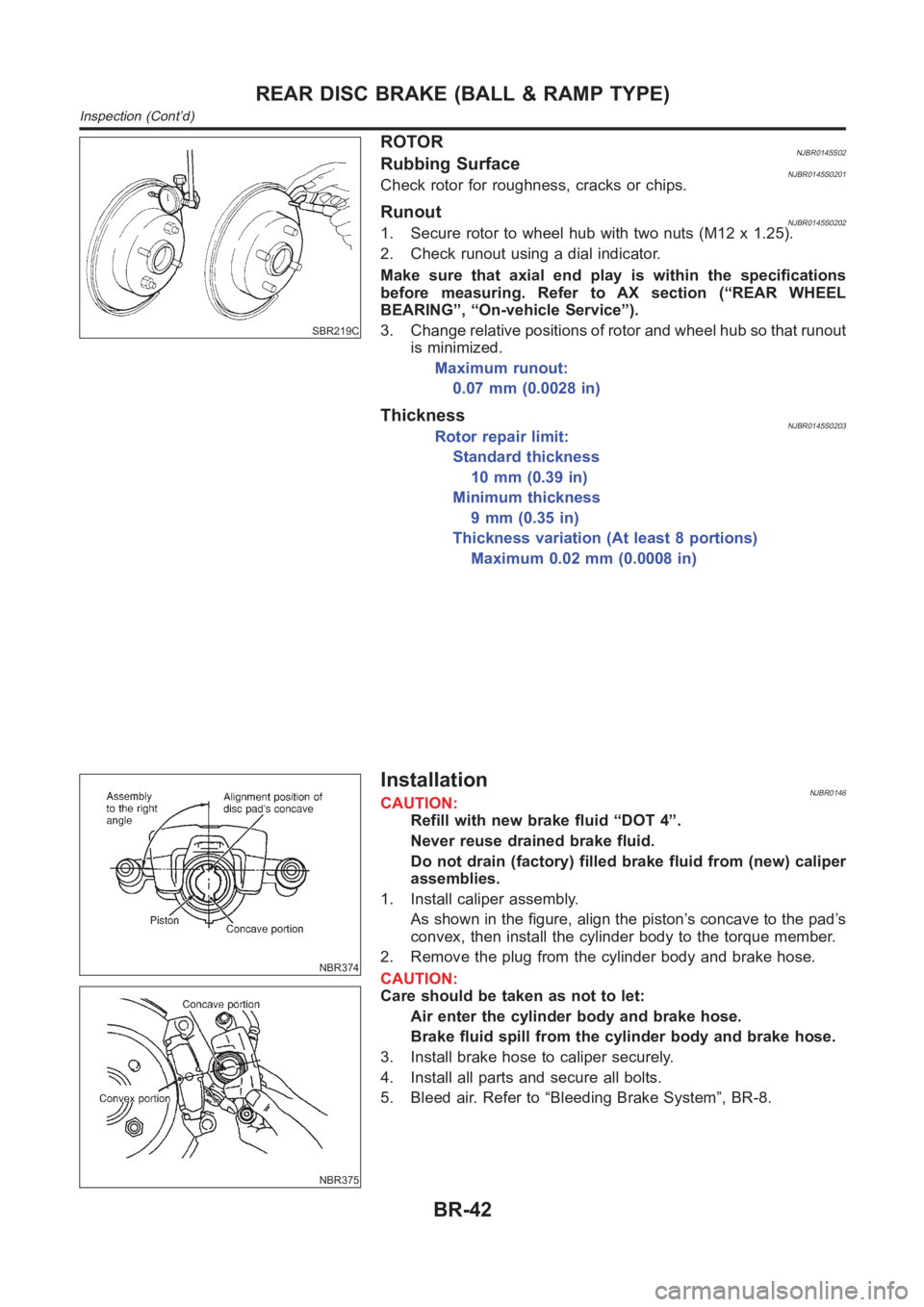
RunoutNJBR0145S02021. Secure rotor to wheel hub with two nuts (M12 x 1.25).
2. Check runout using a dial indicator.
Make sure that axial end play is within the specifications
before measuring. Refer to AX section (“REAR WHEEL
BEARING”, “On-vehicle Service”).
3. Change relative positions of rotor and wheel hub so that runout
is minimized.
Maximum runout:
0.07 mm (0.0028 in)
ThicknessNJBR0145S0203Rotor repair limit:
Standard thickness
10 mm (0.39 in)
Minimum thickness
9 mm (0.35 in)
Thickness variation (At least 8 portions)
Maximum 0.02 mm (0.0008 in)
NBR374
NBR375
InstallationNJBR0146CAUTION:
Refill with new brake fluid “DOT 4”.
Never reuse drained brake fluid.
Do not drain (factory) filled brake fluid from (new) caliper
assemblies.
1. Install caliper assembly.
As shown in the figure, align the piston’s concave to the pad’s
convex, then install the cylinder body to the torque member.
2. Remove the plug from the cylinder body and brake hose.
CAUTION:
Care should be taken as not to let:
Air enter the cylinder body and brake hose.
Brake fluid spill from the cylinder body and brake hose.
3. Install brake hose to caliper securely.
4. Install all parts and secure all bolts.
5. Bleed air. Refer to “Bleeding Brake System”, BR-8.
REAR DISC BRAKE (BALL & RAMP TYPE)
Inspection (Cont’d)
BR-42
Page 2231 of 3189
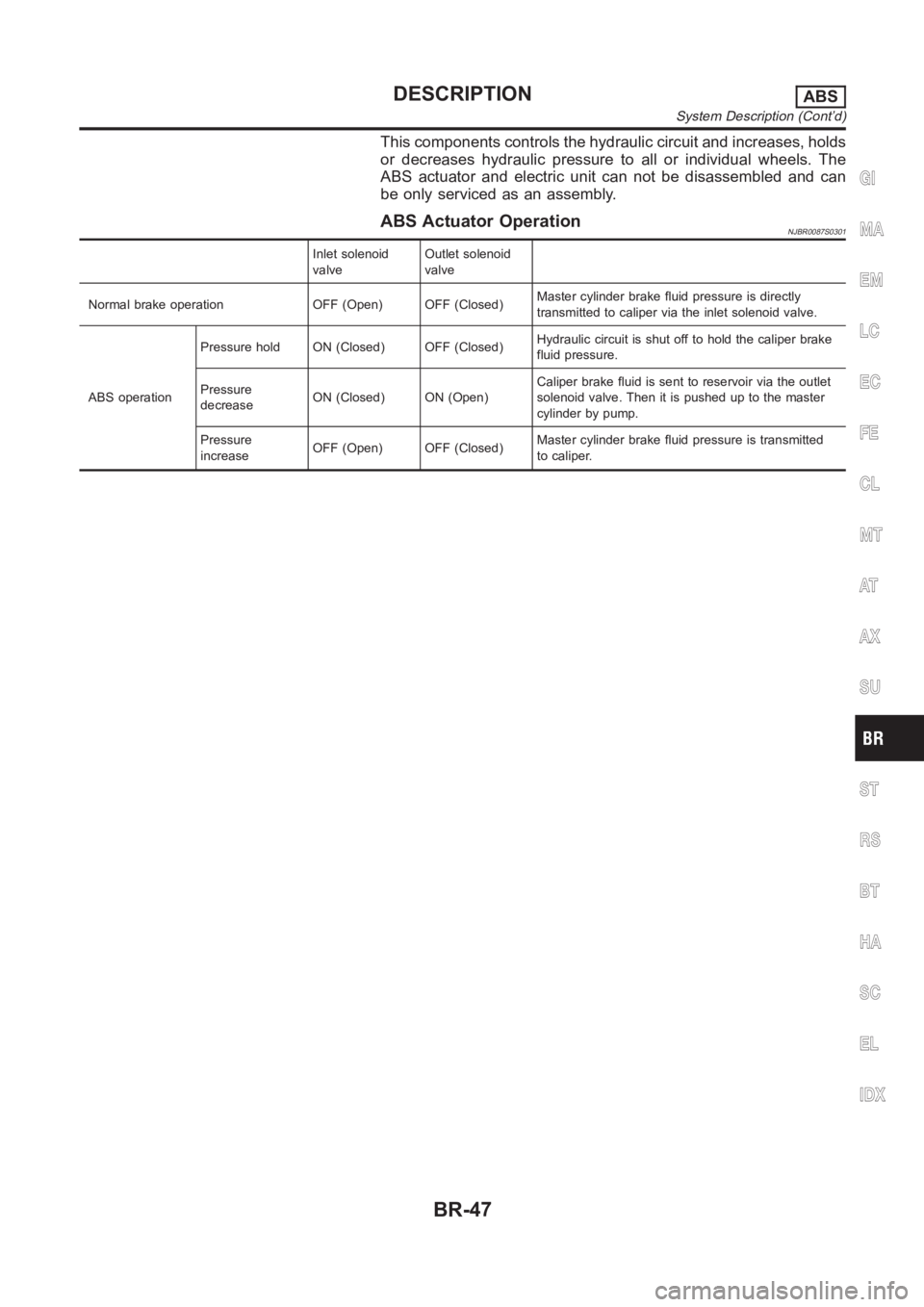
This components controls the hydraulic circuit and increases, holds
or decreases hydraulic pressure to all or individual wheels. The
ABS actuator and electric unit can not be disassembled and can
be only serviced as an assembly.
ABS Actuator OperationNJBR0087S0301
Inlet solenoid
valveOutlet solenoid
valve
Normal brake operation OFF (Open) OFF (Closed)Master cylinder brake fluid pressure is directly
transmitted to caliper via the inlet solenoid valve.
ABS operationPressure hold ON (Closed) OFF (Closed)Hydraulic circuit is shut off to hold the caliper brake
fluid pressure.
Pressure
decreaseON (Closed) ON (Open)Caliper brake fluid is sent to reservoir via the outlet
solenoid valve. Then it is pushed up to the master
cylinder by pump.
Pressure
increaseOFF (Open) OFF (Closed)Master cylinder brake fluid pressure is transmitted
to caliper.
GI
MA
EM
LC
EC
FE
CL
MT
AT
AX
SU
ST
RS
BT
HA
SC
EL
IDX
DESCRIPTIONABS
System Description (Cont’d)
BR-47
Page 2246 of 3189
YBR319
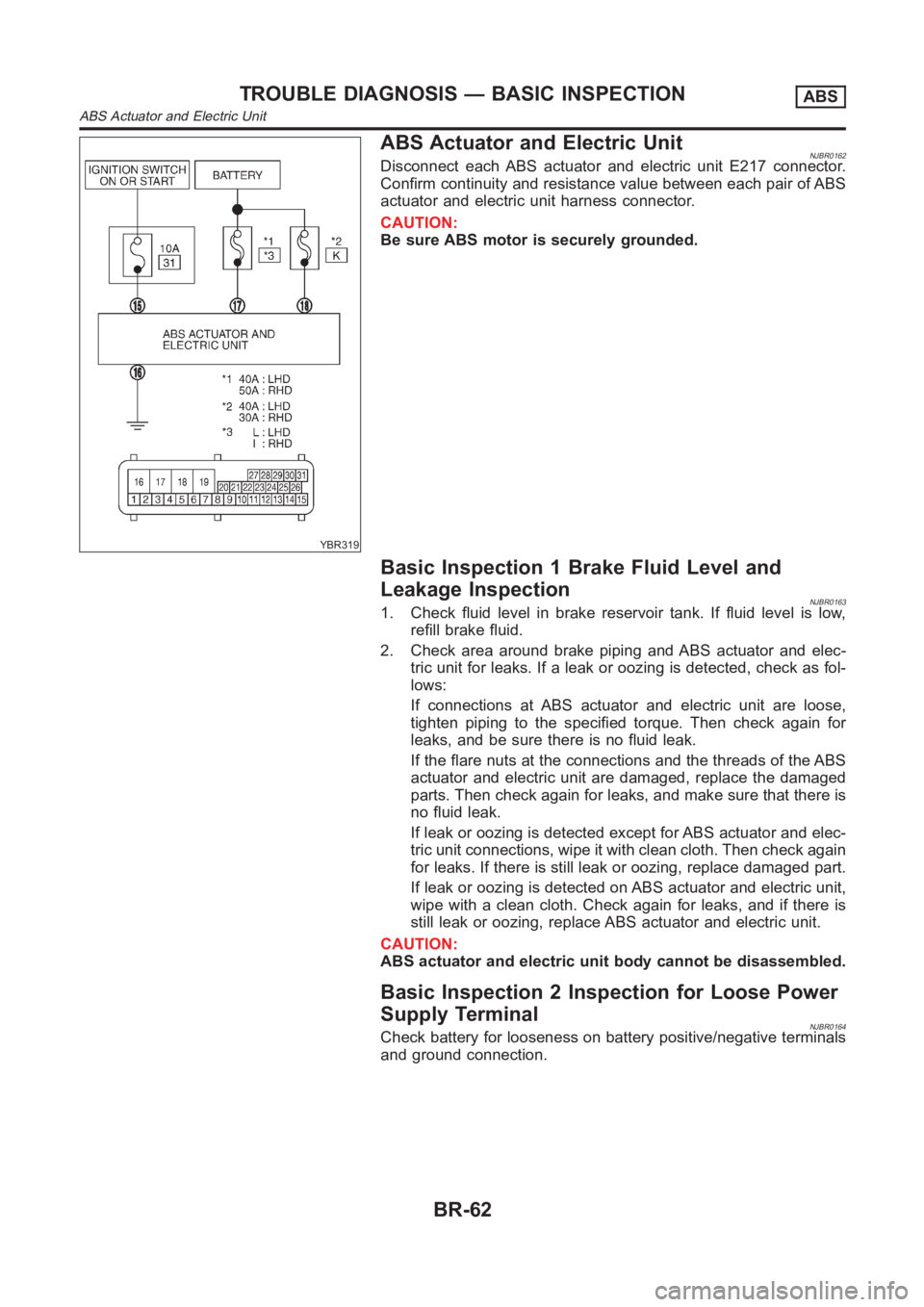
ABS Actuator and Electric UnitNJBR0162Disconnect each ABS actuator and electric unit E217 connector.
Confirm continuity and resistance value between each pair of ABS
actuator and electric unit harness connector.
CAUTION:
Be sure ABS motor is securely grounded.
Basic Inspection 1 Brake Fluid Level and
Leakage Inspection
NJBR01631. Check fluid level in brake reservoir tank. If fluid level is low,
refill brake fluid.
2. Check area around brake piping and ABS actuator and elec-
tric unit for leaks. If a leak or oozing is detected, check as fol-
lows:
If connections at ABS actuator and electric unit are loose,
tighten piping to the specified torque. Then check again for
leaks, and be sure there is no fluid leak.
If the flare nuts at the connections and the threads of the ABS
actuator and electric unit are damaged, replace the damaged
parts. Then check again for leaks, and make sure that there is
no fluid leak.
If leak or oozing is detected except for ABS actuator and elec-
tric unit connections, wipe it with clean cloth. Then check again
for leaks. If there is still leak or oozing, replace damaged part.
If leak or oozing is detected on ABS actuator and electric unit,
wipe with a clean cloth. Check again for leaks, and if there is
still leak or oozing, replace ABS actuator and electric unit.
CAUTION:
ABS actuator and electric unit body cannot be disassembled.
Basic Inspection 2 Inspection for Loose Power
Supply Terminal
NJBR0164Check battery for looseness on battery positive/negative terminals
and ground connection.
TROUBLE DIAGNOSIS — BASIC INSPECTIONABS
ABS Actuator and Electric Unit
BR-62
Page 2255 of 3189
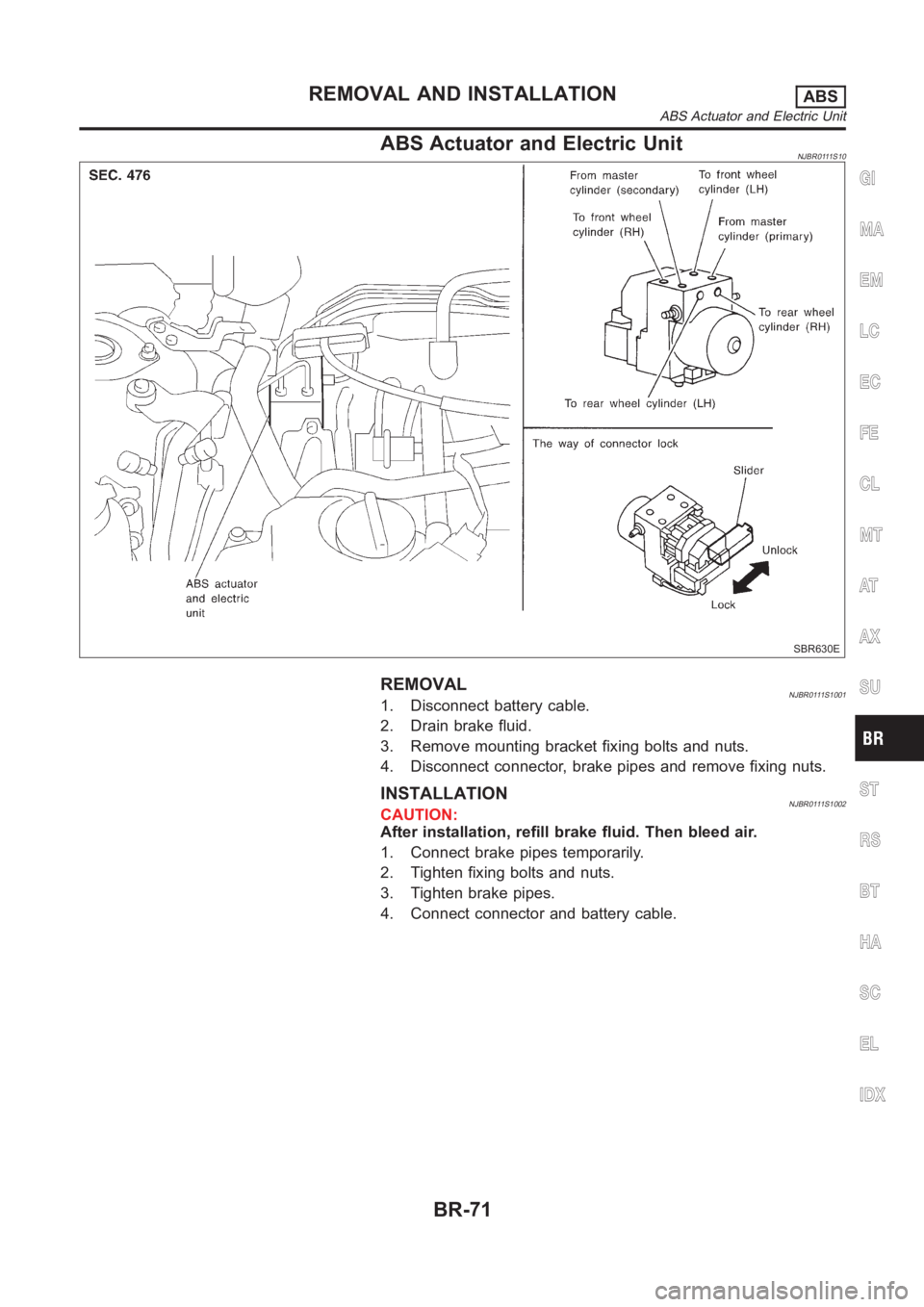
ABS Actuator and Electric UnitNJBR0111S10
SBR630E
REMOVALNJBR0111S10011. Disconnect battery cable.
2. Drain brake fluid.
3. Remove mounting bracket fixing bolts and nuts.
4. Disconnect connector, brake pipes and remove fixing nuts.
INSTALLATIONNJBR0111S1002CAUTION:
After installation, refill brake fluid. Then bleed air.
1. Connect brake pipes temporarily.
2. Tighten fixing bolts and nuts.
3. Tighten brake pipes.
4. Connect connector and battery cable.
GI
MA
EM
LC
EC
FE
CL
MT
AT
AX
SU
ST
RS
BT
HA
SC
EL
IDX
REMOVAL AND INSTALLATIONABS
ABS Actuator and Electric Unit
BR-71
Page 2257 of 3189
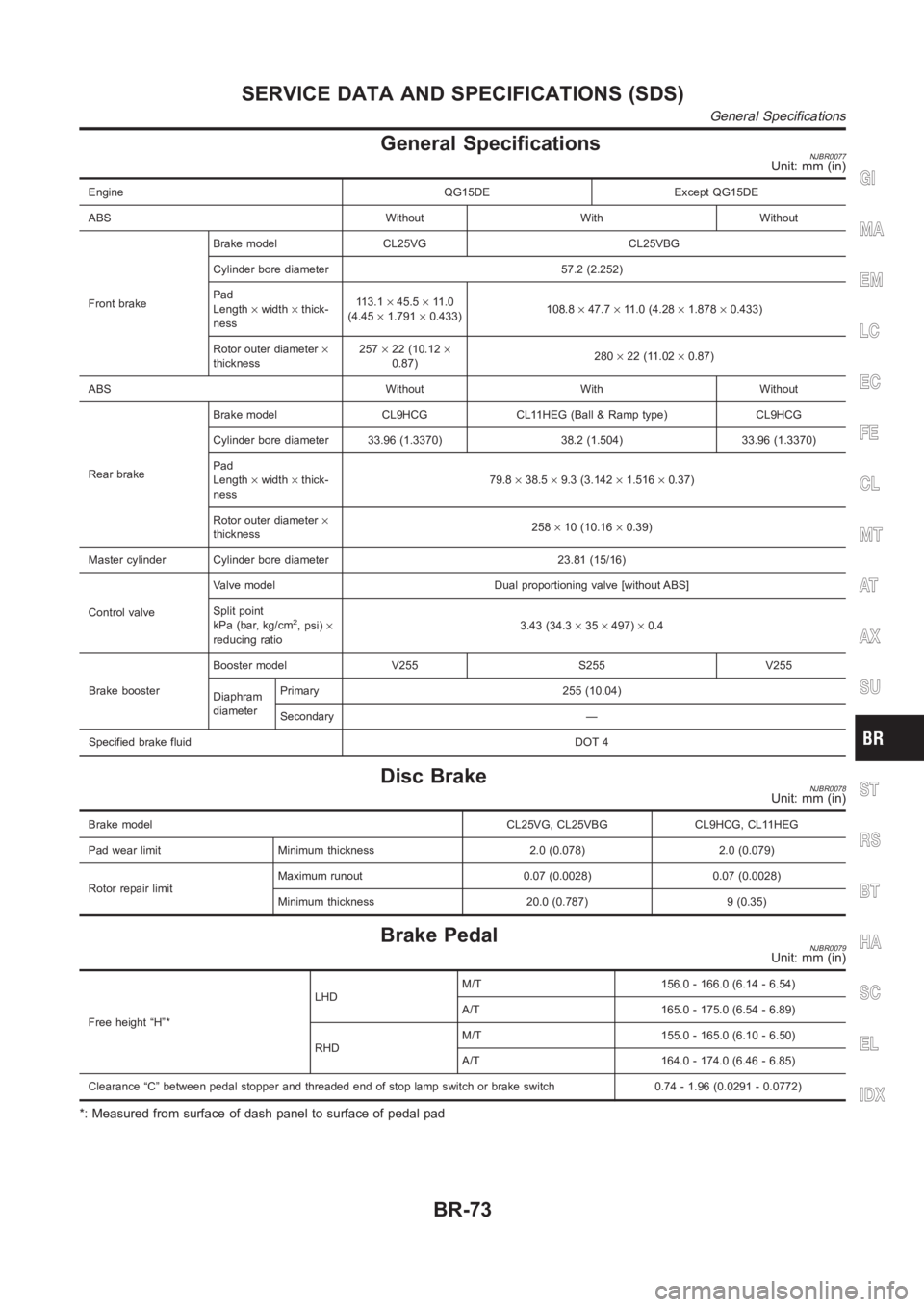
General SpecificationsNJBR0077Unit: mm (in)
Engine QG15DE Except QG15DE
ABS Without With Without
Front brakeBrake model CL25VG CL25VBG
Cylinder bore diameter 57.2 (2.252)
Pad
Length×width×thick-
ness11 3 . 1×45.5×11 . 0
(4.45×1.791×0.433)108.8×47.7×11.0 (4.28×1.878×0.433)
Rotor outer diameter×
thickness257×22 (10.12×
0.87)280×22 (11.02×0.87)
ABS Without With Without
Rear brakeBrake model CL9HCG CL11HEG (Ball & Ramp type) CL9HCG
Cylinder bore diameter 33.96 (1.3370) 38.2 (1.504) 33.96 (1.3370)
Pad
Length×width×thick-
ness79.8×38.5×9.3 (3.142×1.516×0.37)
Rotor outer diameter×
thickness258×10 (10.16×0.39)
Master cylinder Cylinder bore diameter 23.81 (15/16)
Control valveValve model Dual proportioning valve [without ABS]
Split point
kPa (bar, kg/cm
2, psi)×
reducing ratio3.43 (34.3×35×497)×0.4
Brake boosterBooster model V255 S255 V255
Diaphram
diameterPrimary 255 (10.04)
Secondary —
Specified brake fluidDOT 4
Disc BrakeNJBR0078Unit: mm (in)
Brake model CL25VG, CL25VBG CL9HCG, CL11HEG
Pad wear limit Minimum thickness 2.0 (0.078) 2.0 (0.079)
Rotor repair limitMaximum runout 0.07 (0.0028) 0.07 (0.0028)
Minimum thickness 20.0 (0.787) 9 (0.35)
Brake PedalNJBR0079Unit: mm (in)
Free height “H”*LHDM/T 156.0 - 166.0 (6.14 - 6.54)
A/T 165.0 - 175.0 (6.54 - 6.89)
RHDM/T 155.0 - 165.0 (6.10 - 6.50)
A/T 164.0 - 174.0 (6.46 - 6.85)
Clearance “C” between pedal stopper and threaded end of stop lamp switch orbrake switch 0.74 - 1.96 (0.0291 - 0.0772)
*: Measured from surface of dash panel to surface of pedal pad
GI
MA
EM
LC
EC
FE
CL
MT
AT
AX
SU
ST
RS
BT
HA
SC
EL
IDX
SERVICE DATA AND SPECIFICATIONS (SDS)
General Specifications
BR-73