maintenance NISSAN LEAF 2020 Owner´s Manual
[x] Cancel search | Manufacturer: NISSAN, Model Year: 2020, Model line: LEAF, Model: NISSAN LEAF 2020Pages: 596, PDF Size: 4.33 MB
Page 527 of 596
The cooling system is filled at the factory
with a pre-diluted mixture of 50% Genuine
NISSAN Long Life Antifreeze/Coolant (blue)
and 50% water to provide year-round anti-
freeze and coolant protection. The anti-
freeze solution contains rust and corrosion
inhibitors. Additional cooling system addi-
tives are not necessary.
WARNING
• Never remove the coolant reservoir
cap when the motor compartment is
hot. Wait until the motor compart-
ment cools down.
• The coolant reservoir is equipped
with a pressure type coolant reser-
voir cap. To prevent damage to the
motor compartment, use only a
Genuine NISSAN coolant reservoir
cap.
CAUTION
• Never use any additives in the cool-
ant such as radiator sealer in the
cooling system. This may cause
damage to electrical equipment
such as the motor and inverter. •
When adding or replacing coolant, be
sure to use only a Genuine NISSAN
Long Life Antifreeze/Coolant (blue)
or equivalent. Genuine NISSAN Long
Life Antifreeze/Coolant (blue) is pre-
diluted to provide antifreeze protec-
tion to −34°F (−37°C) . If additional
freeze protection is needed due to
the weather conditions where you
operate your vehicle, add Genuine
NISSAN Long Life Antifreeze/Coolant
(blue) concentrate following the di-
rections on the container. If an
equivalent coolant other than Genu-
ine NISSAN Long Life Antifreeze/
Coolant (blue) is used, follow the
coolant manufacture's instructions
to maintain minimum antifreeze
protection to −34°F (−37°C). The use
of other types of coolant solutions
other than Genuine NISSAN Long Life
Antifreeze/Coolant (blue) or equiva-
lent may damage the cooling
system. •
The life expectancy of the factory-fill
coolant is 125,000 miles (200,000
km) or 15 years. Mixing any other type
of coolant other than Genuine
NISSAN Long Life Antifreeze/Coolant
(blue)(or equivalent coolant), includ-
ing Genuine NISSAN Long Life
Antifreeze/Coolant (green), or the
use of non-distilled water may re-
duce the life expectancy of the
factory-filled coolant. For additional
information, refer to the NISSAN Ser-
vice and Maintenance Guide.
COOLING SYSTEM
8-8Maintenance and do-it yourself
Page 528 of 596
CHECKING COOLANT LEVEL
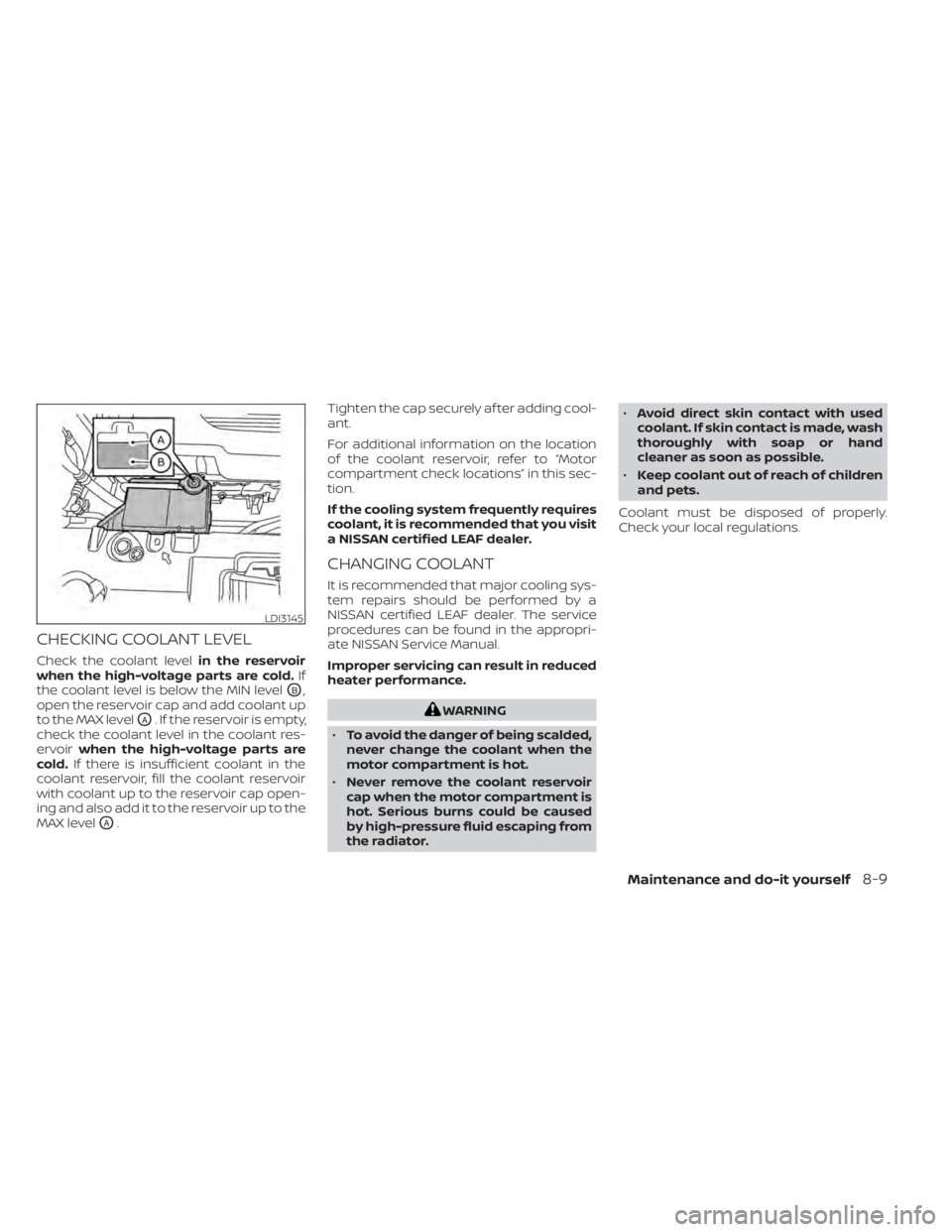
Check the coolant levelin the reservoir
when the high-voltage parts are cold. If
the coolant level is below the MIN level
OB,
open the reservoir cap and add coolant up
to the MAX level
OA. If the reservoir is empty,
check the coolant level in the coolant res-
ervoir when the high-voltage parts are
cold. If there is insufficient coolant in the
coolant reservoir, fill the coolant reservoir
with coolant up to the reservoir cap open-
ing and also add it to the reservoir up to the
MAX level
OA. Tighten the cap securely af ter adding cool-
ant.
For additional information on the location
of the coolant reservoir, refer to “Motor
compartment check locations” in this sec-
tion.
If the cooling system frequently requires
coolant, it is recommended that you visit
a NISSAN certified LEAF dealer.
CHANGING COOLANT
It is recommended that major cooling sys-
tem repairs should be performed by a
NISSAN certified LEAF dealer. The service
procedures can be found in the appropri-
ate NISSAN Service Manual.
Improper servicing can result in reduced
heater performance.
WARNING
• To avoid the danger of being scalded,
never change the coolant when the
motor compartment is hot.
• Never remove the coolant reservoir
cap when the motor compartment is
hot. Serious burns could be caused
by high-pressure fluid escaping from
the radiator. •
Avoid direct skin contact with used
coolant. If skin contact is made, wash
thoroughly with soap or hand
cleaner as soon as possible.
• Keep coolant out of reach of children
and pets.
Coolant must be disposed of properly.
Check your local regulations.
LDI3145
Maintenance and do-it yourself8-9
Page 529 of 596
When checking or replacement is required,
it is recommended that you visit a NISSAN
certified LEAF dealer for this service.
CAUTION
• Use only Genuine NISSAN Matic S ATF.
Do not mix with other fluids.
• Using reduction gear fluid other than
Genuine NISSAN Matic S ATF will
cause deterioration in driveability
and reduction gear durability, and
may damage the reduction gear,
which is not covered by the NISSAN
New Vehicle Limited Warranty. For additional brake fluid information, refer
to “Recommended fluids/lubricants and
capacities” in the “Technical and consumer
information” section of this manual.WARNING
• Use only new fluid from a sealed con-
tainer. Old, inferior or contaminated
fluid may damage the brake system.
The use of improper fluids can dam-
age the brake system, and affect the
vehicle’s stopping ability.
• Clean the filler cap before removing.
• Brake fluid is poisonous and should
be stored carefully in marked con-
tainers out of the reach of children.
CAUTION
Do not spill the fluid on any painted sur-
faces. This will damage the paint. If fluid
is spilled, immediately wash the sur-
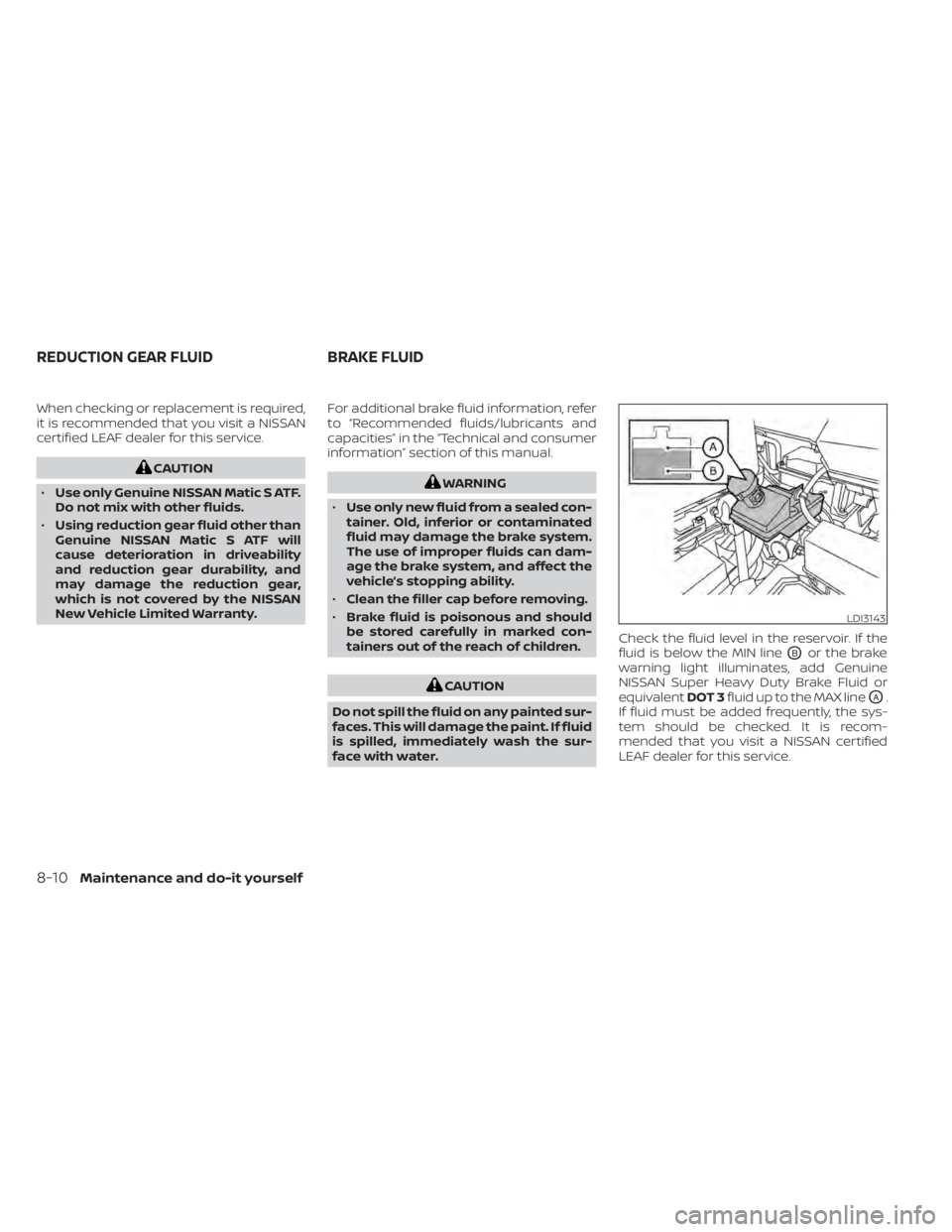
face with water. Check the fluid level in the reservoir. If the
fluid is below the MIN line
OBor the brake
warning light illuminates, add Genuine
NISSAN Super Heavy Duty Brake Fluid or
equivalent DOT 3fluid up to the MAX line
OA.
If fluid must be added frequently, the sys-
tem should be checked. It is recom-
mended that you visit a NISSAN certified
LEAF dealer for this service.
LDI3143
REDUCTION GEAR FLUID BRAKE FLUID
8-10Maintenance and do-it yourself
Page 530 of 596
Fill the windshield-washer fluid reservoir
periodically. Add windshield-washer fluid
when the “Low Washer Fluid” message ap-
pears on the vehicle information display.
For additional information, refer to “Vehicle
information display warnings and indica-
tors” in the “Instruments and controls” sec-
tion of this manual.
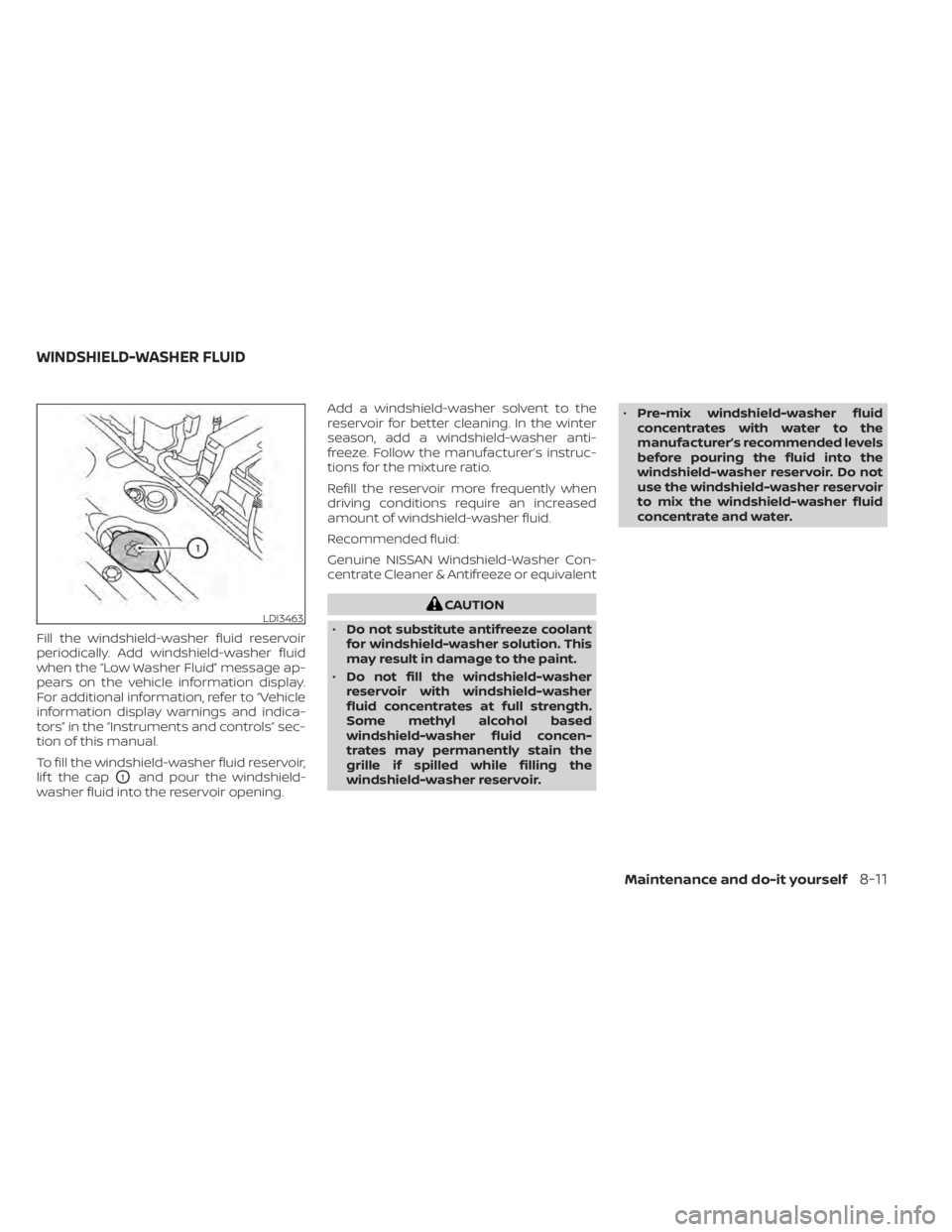
To fill the windshield-washer fluid reservoir,
lif t the cap
O1and pour the windshield-
washer fluid into the reservoir opening. Add a windshield-washer solvent to the
reservoir for better cleaning. In the winter
season, add a windshield-washer anti-
freeze. Follow the manufacturer’s instruc-
tions for the mixture ratio.
Refill the reservoir more frequently when
driving conditions require an increased
amount of windshield-washer fluid.
Recommended fluid:
Genuine NISSAN Windshield-Washer Con-
centrate Cleaner & Antifreeze or equivalent
CAUTION
• Do not substitute antifreeze coolant
for windshield-washer solution. This
may result in damage to the paint.
• Do not fill the windshield-washer
reservoir with windshield-washer
fluid concentrates at full strength.
Some methyl alcohol based
windshield-washer fluid concen-
trates may permanently stain the
grille if spilled while filling the
windshield-washer reservoir. •
Pre-mix windshield-washer fluid
concentrates with water to the
manufacturer’s recommended levels
before pouring the fluid into the
windshield-washer reservoir. Do not
use the windshield-washer reservoir
to mix the windshield-washer fluid
concentrate and water.LDI3463
WINDSHIELD-WASHER FLUID
Maintenance and do-it yourself8-11
Page 531 of 596
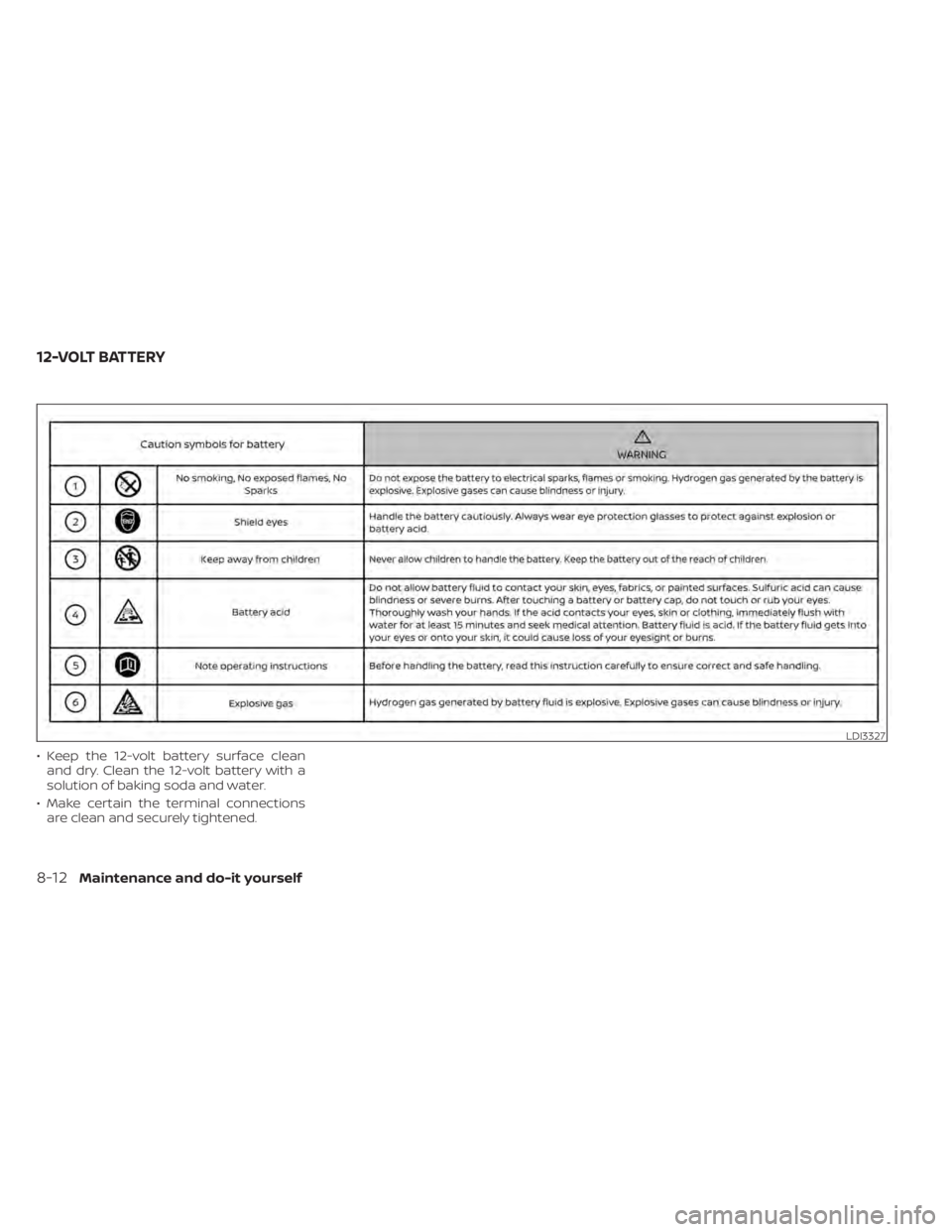
• Keep the 12-volt battery surface cleanand dry. Clean the 12-volt battery with a
solution of baking soda and water.
• Make certain the terminal connections are clean and securely tightened.
LDI3327
12-VOLT BATTERY
8-12Maintenance and do-it yourself
Page 532 of 596
NOTE:
Care should be taken to avoid situations
that can lead to potential battery dis-
charge and potential no-start conditions
such as:
1. Installation or extended use of elec-tronic accessories that consume bat-
tery power when the EV system is not
running (Phone chargers, GPS, DVD
players, etc.)
2. Vehicle is not driven regularly and/or only driven short distances.
In these cases, the battery may need to
be charged to maintain battery health
WARNING
• Do not expose the 12-volt battery to
flames or electrical sparks. Hydrogen
gas generated by the 12-volt battery
is explosive. Do not allow 12-volt bat-
tery fluid to contact your skin, eyes,
fabrics or painted surfaces. Af ter
touching a 12-volt battery or 12-volt
battery cap, do not touch or rub your
eyes. Thoroughly wash your hands. If
the acid contacts your eyes, skin or
clothing, immediately flush with wa-
ter for at least 15 minutes and seek
medical attention. •
Do not operate the vehicle if the fluid
in the 12-volt battery is low. Low 12-
volt battery fluid can cause a higher
load on the 12-volt battery which can
generate heat, reduce battery life,
and in some cases lead to an
explosion.
• When working on or near a 12-volt
battery, always wear suitable eye
protection and remove all jewelry.
• 12-volt battery posts, terminals and
related accessories contain lead and
lead compounds. Wash hands af ter
handling.
• Keep the 12-volt battery out of the
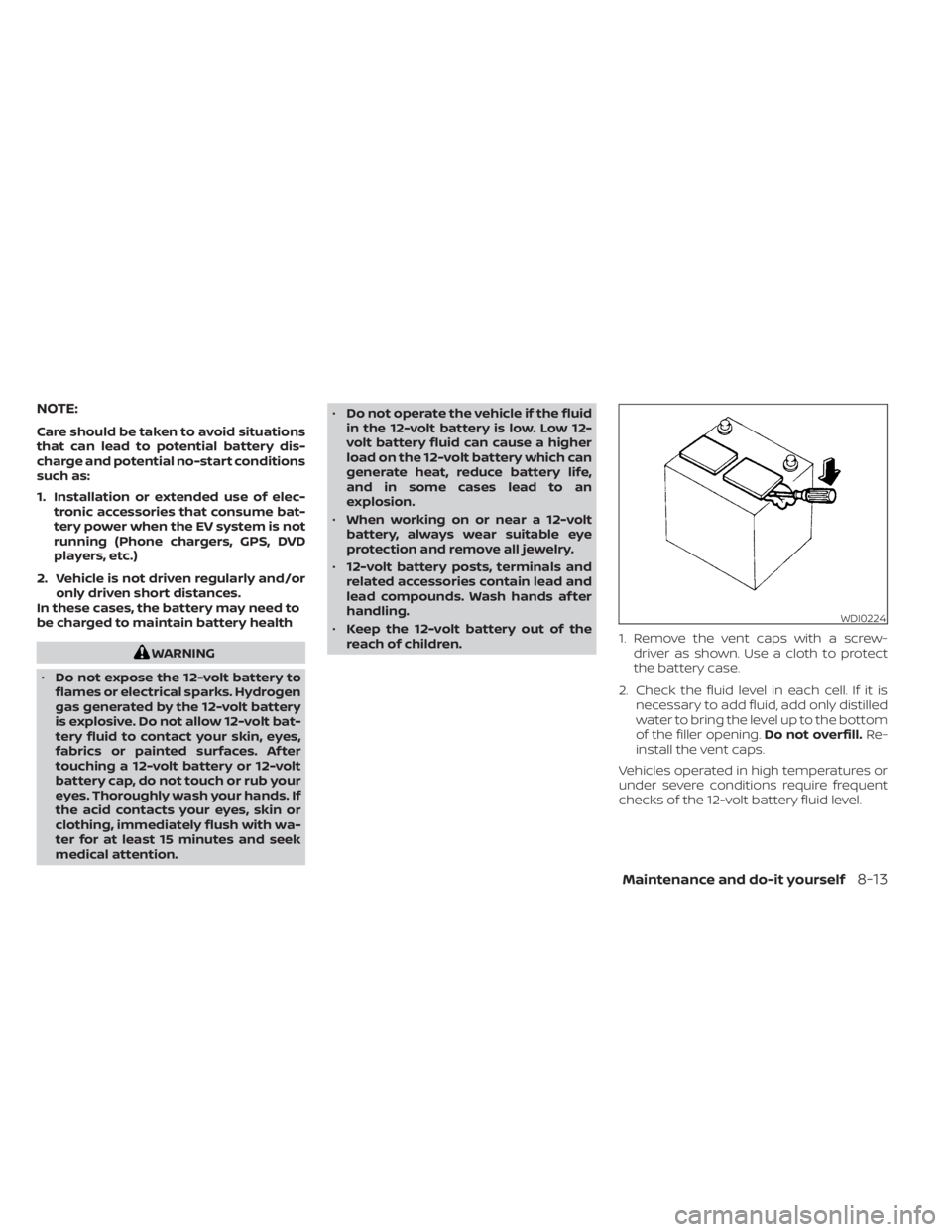
reach of children. 1. Remove the vent caps with a screw-
driver as shown. Use a cloth to protect
the battery case.
2. Check the fluid level in each cell. If it is necessary to add fluid, add only distilled
water to bring the level up to the bottom
of the filler opening. Do not overfill.Re-
install the vent caps.
Vehicles operated in high temperatures or
under severe conditions require frequent
checks of the 12-volt battery fluid level.
WDI0224
Maintenance and do-it yourself8-13
Page 533 of 596
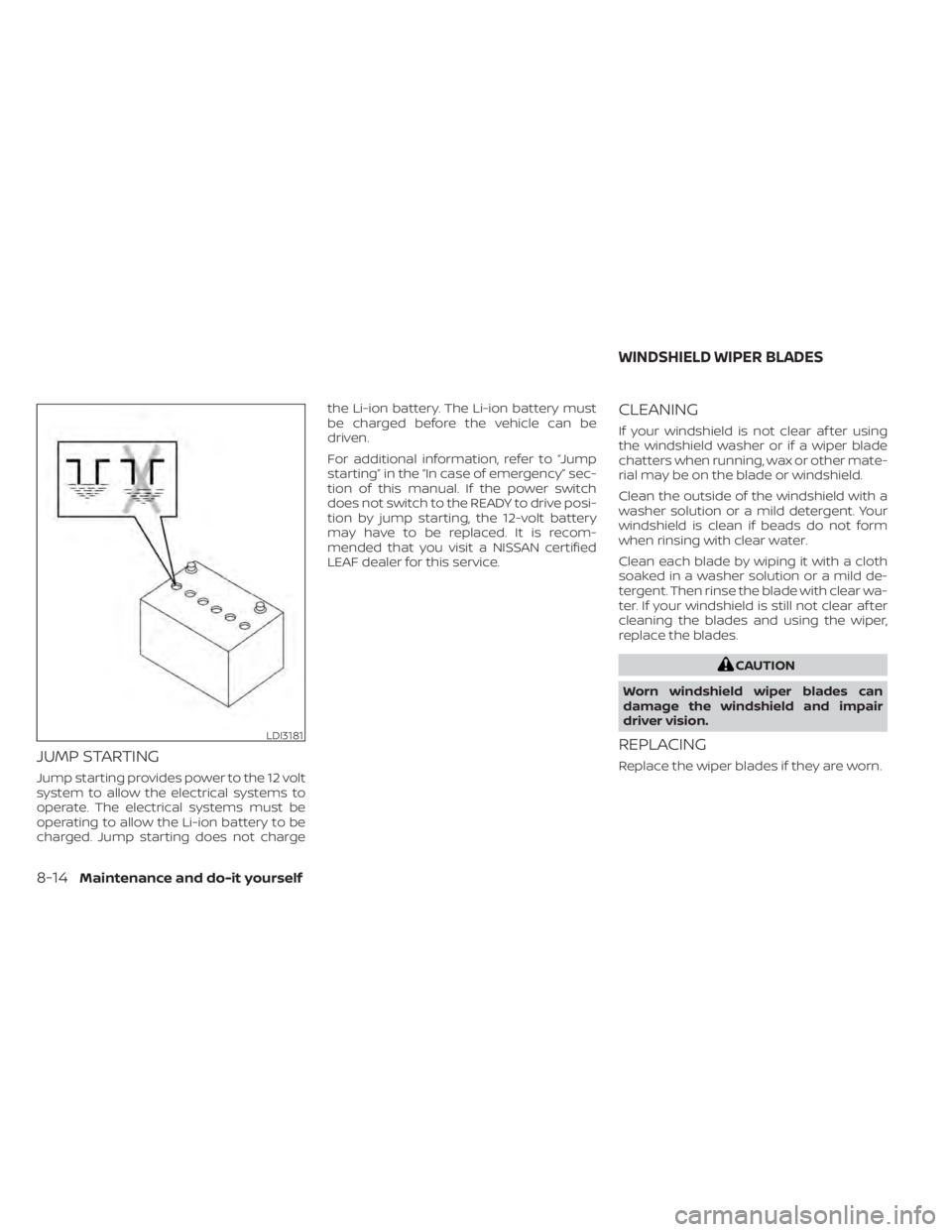
JUMP STARTING
Jump starting provides power to the 12 volt
system to allow the electrical systems to
operate. The electrical systems must be
operating to allow the Li-ion battery to be
charged. Jump starting does not chargethe Li-ion battery. The Li-ion battery must
be charged before the vehicle can be
driven.
For additional information, refer to “Jump
starting” in the “In case of emergency” sec-
tion of this manual. If the power switch
does not switch to the READY to drive posi-
tion by jump starting, the 12-volt battery
may have to be replaced. It is recom-
mended that you visit a NISSAN certified
LEAF dealer for this service.
CLEANING
If your windshield is not clear af ter using
the windshield washer or if a wiper blade
chatters when running, wax or other mate-
rial may be on the blade or windshield.
Clean the outside of the windshield with a
washer solution or a mild detergent. Your
windshield is clean if beads do not form
when rinsing with clear water.
Clean each blade by wiping it with a cloth
soaked in a washer solution or a mild de-
tergent. Then rinse the blade with clear wa-
ter. If your windshield is still not clear af ter
cleaning the blades and using the wiper,
replace the blades.
CAUTION
Worn windshield wiper blades can
damage the windshield and impair
driver vision.
REPLACING
Replace the wiper blades if they are worn.
LDI3181
WINDSHIELD WIPER BLADES
8-14Maintenance and do-it yourself
Page 534 of 596
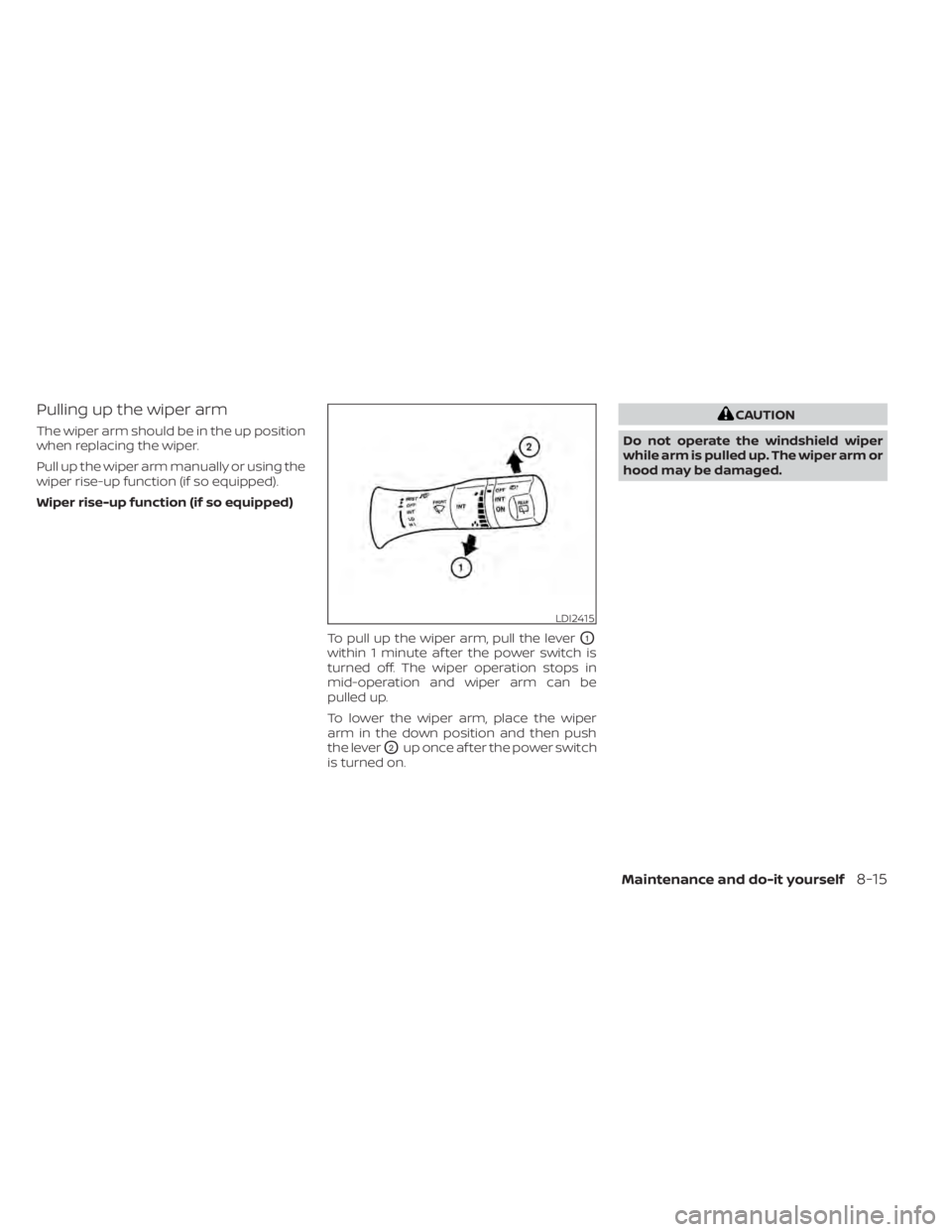
Pulling up the wiper arm
The wiper arm should be in the up position
when replacing the wiper.
Pull up the wiper arm manually or using the
wiper rise-up function (if so equipped).
Wiper rise-up function (if so equipped)To pull up the wiper arm, pull the lever
O1
within 1 minute af ter the power switch is
turned off. The wiper operation stops in
mid-operation and wiper arm can be
pulled up.
To lower the wiper arm, place the wiper
arm in the down position and then push
the lever
O2up once af ter the power switch
is turned on.
CAUTION
Do not operate the windshield wiper
while arm is pulled up. The wiper arm or
hood may be damaged.
LDI2415
Maintenance and do-it yourself8-15
Page 535 of 596
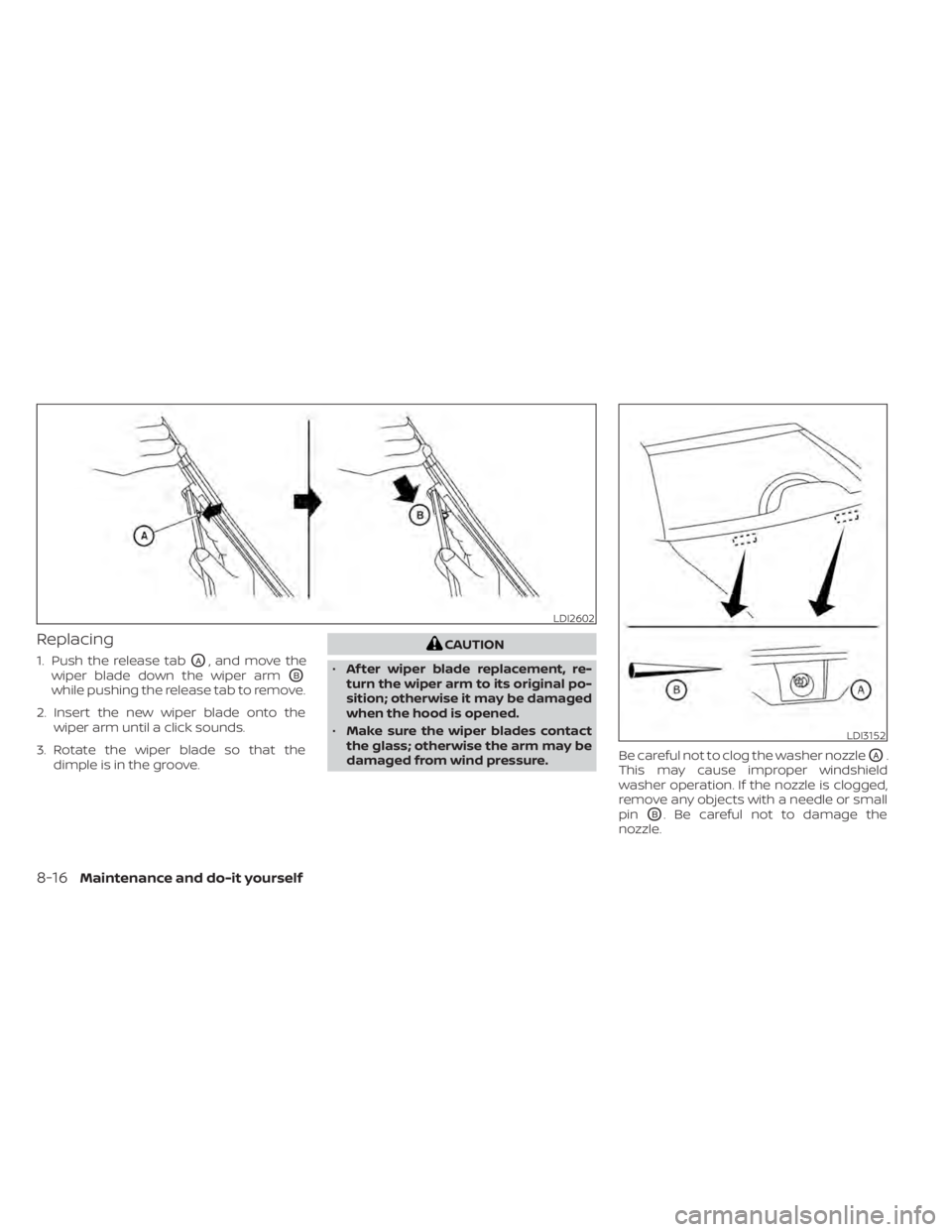
Replacing
1. Push the release tabOA, and move the
wiper blade down the wiper arm
OB
while pushing the release tab to remove.
2. Insert the new wiper blade onto the wiper arm until a click sounds.
3. Rotate the wiper blade so that the dimple is in the groove.
CAUTION
• Af ter wiper blade replacement, re-
turn the wiper arm to its original po-
sition; otherwise it may be damaged
when the hood is opened.
• Make sure the wiper blades contact
the glass; otherwise the arm may be
damaged from wind pressure. Be careful not to clog the washer nozzle
OA.
This may cause improper windshield
washer operation. If the nozzle is clogged,
remove any objects with a needle or small
pin
OB. Be careful not to damage the
nozzle.
LDI2602
LDI3152
8-16Maintenance and do-it yourself
Page 536 of 596
REAR WINDOW WIPER BLADE
It is recommended that you visit a NISSAN
certified LEAF dealer if checking or replace-
ment is required.If the brakes do not operate properly, have
the brakes checked. It is recommended
that you visit a NISSAN certified LEAF dealer
for this service.
WARNING
Do not adjust the height of the brake
pedal. Doing so could alter the effec-
tiveness of the brakes, which could re-
sult in a serious accident and personal
injury. If adjustment is required, it is
recommended that you visit a NISSAN
certified LEAF dealer for this service.
BRAKE PAD WEAR WARNING
The disc brake pads have audible wear
warnings. When a brake pad requires re-
placement, it will make a high pitched
scraping sound when the vehicle is in mo-
tion. This scraping sound will first occur
only when the brake pedal is depressed.
Af ter more wear of the brake pad, the
sound will always be heard even if the
brake pedal is not depressed. Have the
brakes checked as soon as possible if the
wear warning sound is heard. Under some driving or climate conditions,
occasional brake squeak, squeal or other
noise may be heard. Occasional brake
noise during light to moderate stops is nor-
mal and does not affect the function or
performance of the brake system.
Proper brake inspection intervals should
be followed.
For additional information, re-
fer to the maintenance log section of your
NISSAN Service and Maintenance Guide.
BRAKES
Maintenance and do-it yourself8-17