engine control NISSAN NAVARA 2005 Repair Workshop Manual
[x] Cancel search | Manufacturer: NISSAN, Model Year: 2005, Model line: NAVARA, Model: NISSAN NAVARA 2005Pages: 3171, PDF Size: 49.59 MB
Page 1072 of 3171
EC-92
DTC P0102, P0103 MAF SENSOR
DTC P0102, P0103 MAF SENSOR
PFP:22680
Component DescriptionEBS01KDV
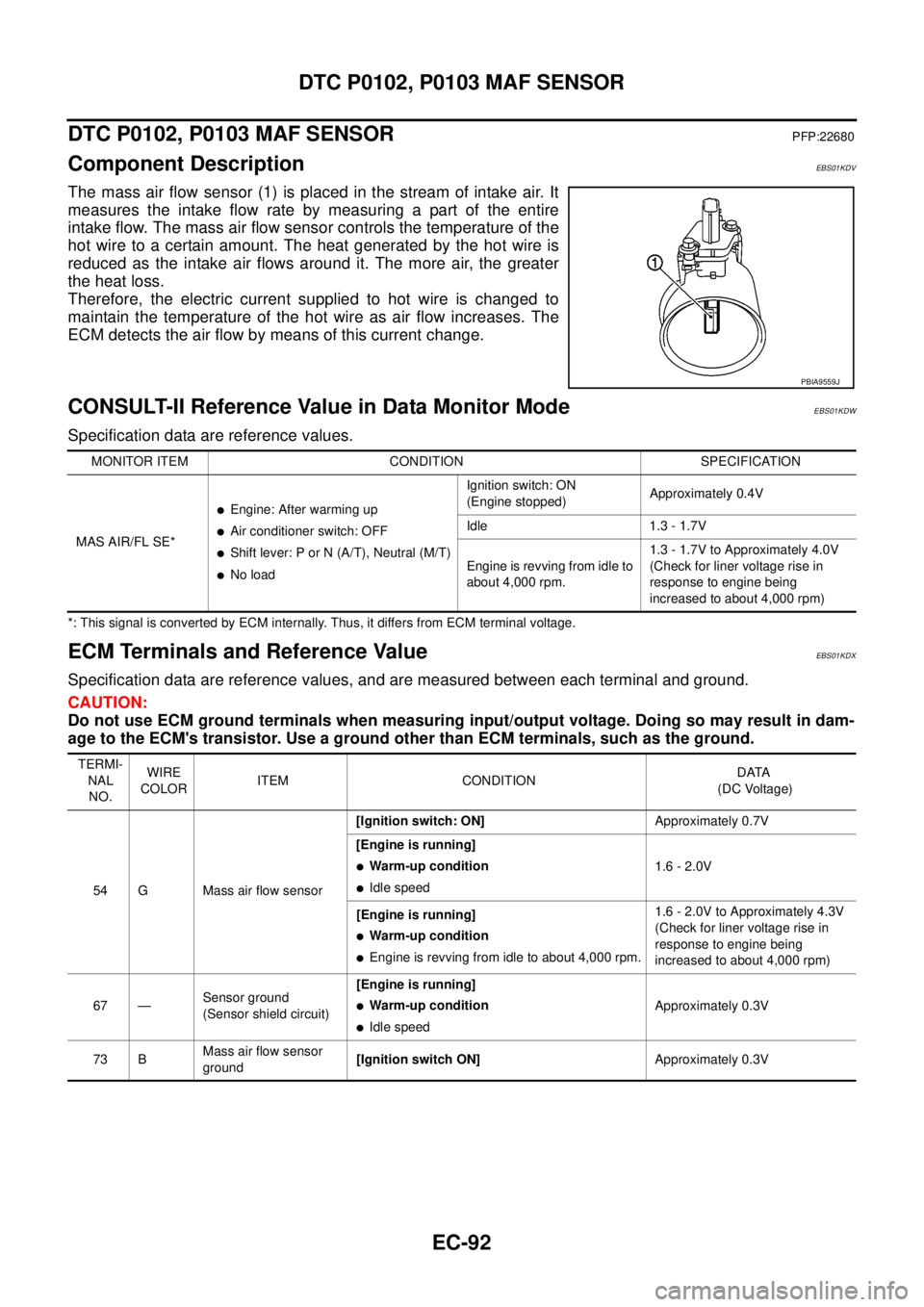
The mass air flow sensor (1) is placed in the stream of intake air. It
measures the intake flow rate by measuring a part of the entire
intake flow. The mass air flow sensor controls the temperature of the
hot wire to a certain amount. The heat generated by the hot wire is
reduced as the intake air flows around it. The more air, the greater
the heat loss.
Therefore, the electric current supplied to hot wire is changed to
maintain the temperature of the hot wire as air flow increases. The
ECM detects the air flow by means of this current change.
CONSULT-II Reference Value in Data Monitor ModeEBS01KDW
Specification data are reference values.
*: This signal is converted by ECM internally. Thus, it differs from ECM terminal voltage.
ECM Terminals and Reference ValueEBS01KDX
Specification data are reference values, and are measured between each terminal and ground.
CAUTION:
Do not use ECM ground terminals when measuring input/output voltage. Doing so may result in dam-
age to the ECM's transistor. Use a ground other than ECM terminals, such as the ground.
PBIA9559J
MONITOR ITEM CONDITION SPECIFICATION
MAS AIR/FL SE*
lEngine: After warming up
lAir conditioner switch: OFF
lShift lever: P or N (A/T), Neutral (M/T)
lNo loadIgnition switch: ON
(Engine stopped)Approximately 0.4V
Idle 1.3 - 1.7V
Engine is revving from idle to
about 4,000 rpm.1.3 - 1.7V to Approximately 4.0V
(Check for liner voltage rise in
response to engine being
increased to about 4,000 rpm)
TERMI-
NAL
NO.WIRE
COLORITEM CONDITIONDATA
(DC Voltage)
54 G Mass air flow sensor[Ignition switch: ON]Approximately 0.7V
[Engine is running]
lWarm-up condition
lIdle speed1.6 - 2.0V
[Engine is running]
lWarm-up condition
lEngine is revving from idle to about 4,000 rpm.1.6 - 2.0V to Approximately 4.3V
(Check for liner voltage rise in
response to engine being
increased to about 4,000 rpm)
67 —Sensor ground
(Sensor shield circuit)[Engine is running]
lWarm-up condition
lIdle speedApproximately 0.3V
73 BMass air flow sensor
ground[Ignition switch ON]Approximately 0.3V
Page 1086 of 3171
EC-106
DTC P0117, P0118 ECT SENSOR
Diagnostic Procedure
EBS01KEF
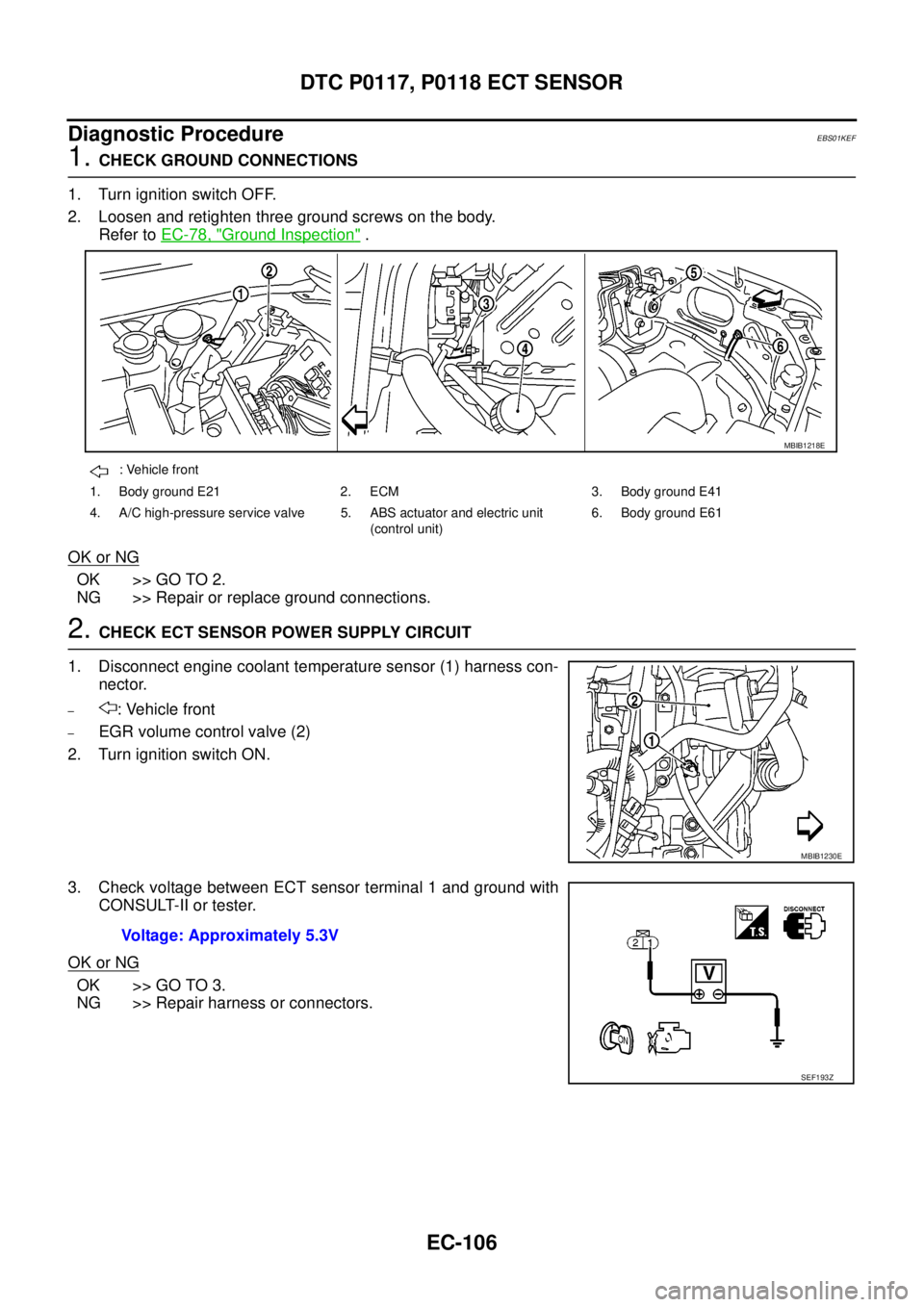
1.CHECK GROUND CONNECTIONS
1. Turn ignition switch OFF.
2. Loosen and retighten three ground screws on the body.
Refer toEC-78, "
Ground Inspection".
OK or NG
OK >> GO TO 2.
NG >> Repair or replace ground connections.
2.CHECK ECT SENSOR POWER SUPPLY CIRCUIT
1. Disconnect engine coolant temperature sensor (1) harness con-
nector.
–: Vehicle front
–EGR volume control valve (2)
2. Turn ignition switch ON.
3. Check voltage between ECT sensor terminal 1 and ground with
CONSULT-II or tester.
OK or NG
OK >> GO TO 3.
NG >> Repair harness or connectors.
: Vehicle front
1. Body ground E21 2. ECM 3. Body ground E41
4. A/C high-pressure service valve 5. ABS actuator and electric unit
(control unit)6. Body ground E61
MBIB1218E
MBIB1230E
Voltage: Approximately 5.3V
SEF193Z
Page 1098 of 3171

EC-118
DTC P0192, P0193 FRP SENSOR
DTC P0192, P0193 FRP SENSOR
PFP:16638
DescriptionEBS01KEZ
The fuel rail pressure (FRP) sensor is placed to the fuel rail. It measures the fuel pressure in the fuel rail. The
sensor sends voltage signal to the ECM. As the pressure increases, the voltage rises.
The ECM controls the fuel pressure in the fuel rail by the inlet throttling device. The ECM uses the signal from
fuel rail pressure sensor as a feedback signal.
CONSULT-II Reference Value in Data Monitor ModeEBS01KF0
Specification data are reference values.
ECM Terminals and Reference ValueEBS01KF1
Specification data are reference values and are measured between each terminal and ground.
CAUTION:
Do not use ECM ground terminals when measuring input/output voltage. Doing so may result in dam-
age to the ECM's transistor. Use a ground other than ECM terminals, such as the ground.
On Board Diagnosis LogicEBS01KF2
The MI will not light up for these self-diagnoses.
NOTE:
If DTC P0192 or P0193 is displayed with DTC P0652 or P0653, first perform the trouble diagnosis for
DTC P0652 or P0653. Refer toEC-227, "
DTC P0652, P0653 SENSOR POWER SUPPLY".
MONITOR CONDITION SPECIFICATOIN
ACT CR PRESS
lEngine: After warming up
lAir conditioner switch: OFF
lShift lever: P or N (A/T), Neutral (M/T)
lNo loadIdle 25 - 35 MPa
2,000 rpm 40 - 50 MPa
TERMI-
NAL
NO.WIRE
COLORITEM CONDITIONDATA
(DC Voltage)
48
49L
BFuel rail pressure sensor[Engine is running]
lWarm-up condition
lIdle speed1.7 - 2.0V
[Engine is running]
lWarm-up condition
lEngine speed: 2,000 rpm2.0 - 2.3V
63 RFuel rail pressure sensor power
supply[Ignition switch ON]Approximately 5.3V
67 —Sensor ground
(Sensor shield circuit)[Ignition switch ON]Approximately 0.3V
68 W Fuel rail pressure sensor ground[Ignition switch ON]Approximately 0.3V
DTC No. Trouble diagnosis name DTC detecting condition Possible cause
P0192
0192Fuel rail pressure sensor
circuit low inputAn excessively low voltage from the sensor is
sent to ECM.
lHarness or connectors
(The sensor circuit is open or
shorted.)
lFuel rail temperature sensor P0193
0193Fuel rail pressure sensor
circuit high inputAn excessively high voltage from the sensor is
sent to ECM.
Page 1105 of 3171
DTC P0201 - P0204 FUEL INJECTOR
EC-125
C
D
E
F
G
H
I
J
K
L
MA
EC
DTC P0201 - P0204 FUEL INJECTORPFP:16600
Component DescriptionEBS01KFB
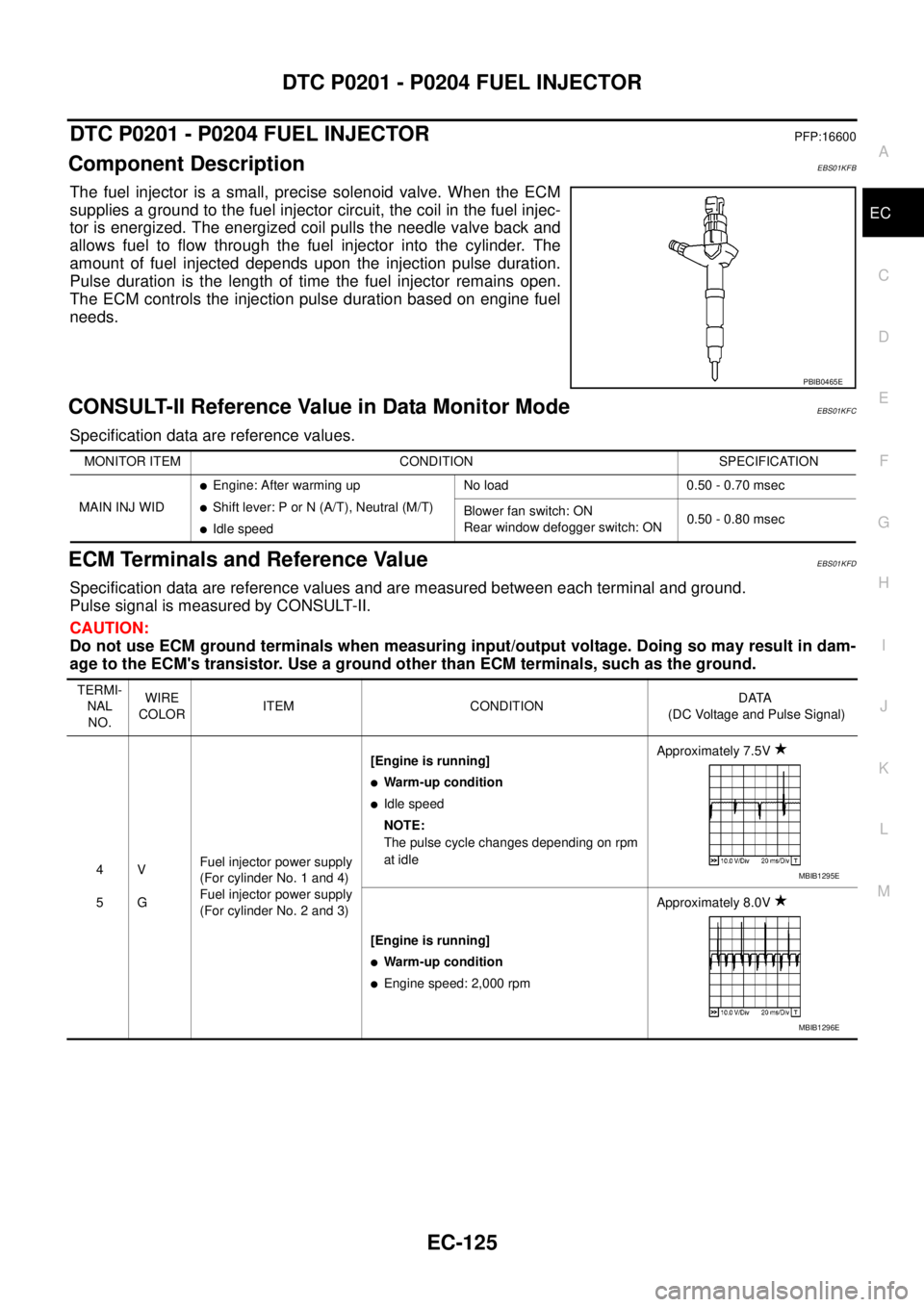
The fuel injector is a small, precise solenoid valve. When the ECM
supplies a ground to the fuel injector circuit, the coil in the fuel injec-
tor is energized. The energized coil pulls the needle valve back and
allows fuel to flow through the fuel injector into the cylinder. The
amount of fuel injected depends upon the injection pulse duration.
Pulse duration is the length of time the fuel injector remains open.
The ECM controls the injection pulse duration based on engine fuel
needs.
CONSULT-II Reference Value in Data Monitor ModeEBS01KFC
Specification data are reference values.
ECM Terminals and Reference ValueEBS01KFD
Specification data are reference values and are measured between each terminal and ground.
Pulse signal is measured by CONSULT-II.
CAUTION:
Do not use ECM ground terminals when measuring input/output voltage. Doing so may result in dam-
age to the ECM's transistor. Use a ground other than ECM terminals, such as the ground.
PBIB0465E
MONITOR ITEM CONDITION SPECIFICATION
MAIN INJ WID
lEngine: After warming up
lShift lever: P or N (A/T), Neutral (M/T)
lIdle speedNo load 0.50 - 0.70 msec
Blower fan switch: ON
Rear window defogger switch: ON0.50 - 0.80 msec
TERMI-
NAL
NO.WIRE
COLORITEM CONDITIONDATA
(DC Voltage and Pulse Signal)
4
5V
GFuel injector power supply
(For cylinder No. 1 and 4)
Fuel injector power supply
(For cylinder No. 2 and 3)[Engine is running]
lWarm-up condition
lIdle speed
NOTE:
The pulse cycle changes depending on rpm
at idleApproximately 7.5V
[Engine is running]
lWarm-up condition
lEngine speed: 2,000 rpmApproximately 8.0V
MBIB1295E
MBIB1296E
Page 1112 of 3171
EC-132
DTC P0217 ENGINE OVER TEMPERATURE
DTC P0217 ENGINE OVER TEMPERATURE
PFP:21481
DescriptionEBS01KFK
SYSTEM DESCRIPTION
NOTE:
If DTC P0217 is displayed with DTC U1000, first perform the trouble diagnosis for DTC U1000. Refer to
EC-79, "
DTC U1000 CAN COMMUNICATION LINE".
Cooling Fan Control
*: This signal is sent to ECM through CAN communication line.
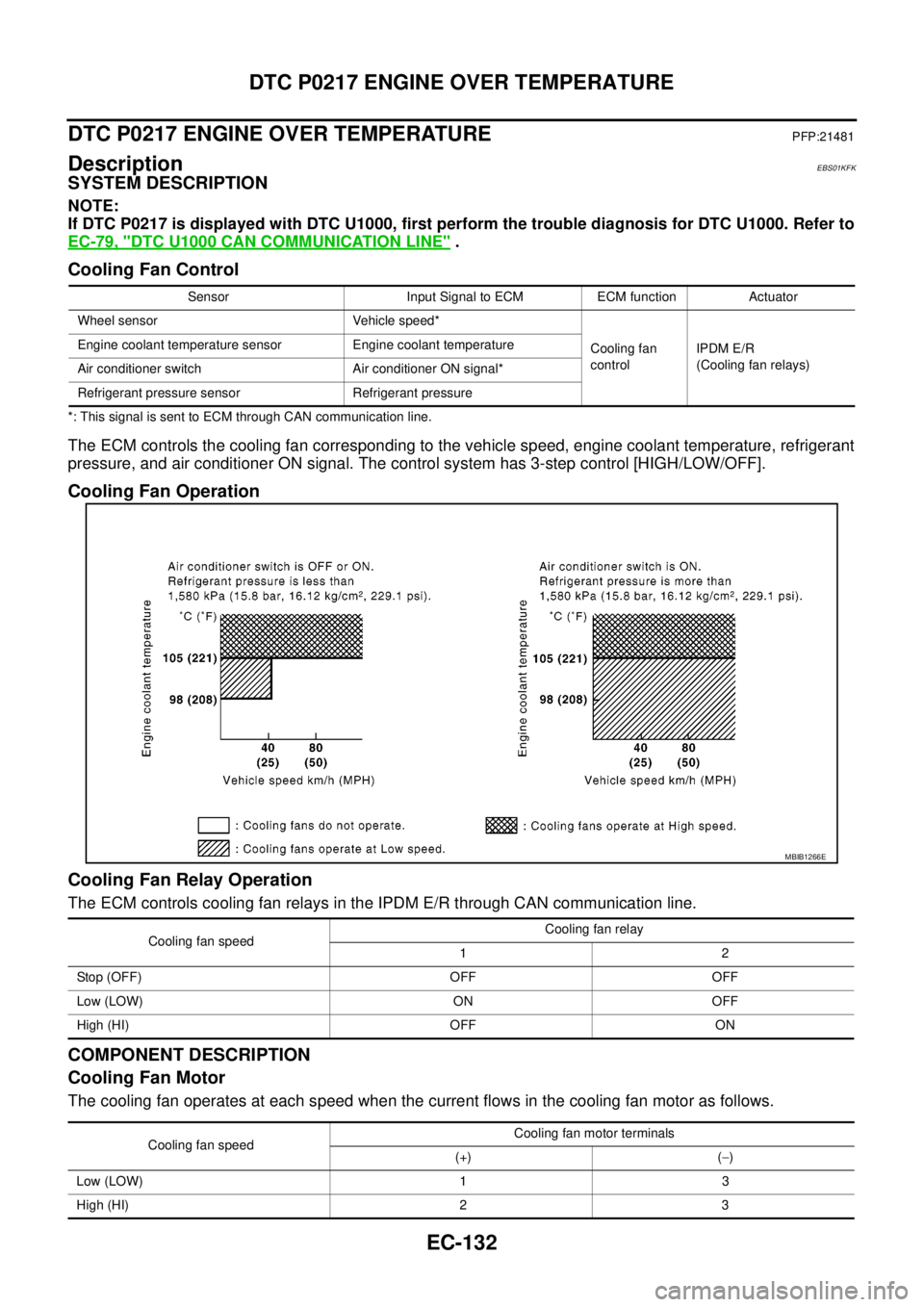
The ECM controls the cooling fan corresponding to the vehicle speed, engine coolant temperature, refrigerant
pressure, and air conditioner ON signal. The control system has 3-step control [HIGH/LOW/OFF].
Cooling Fan Operation
Cooling Fan Relay Operation
The ECM controls cooling fan relays in the IPDM E/R through CAN communication line.
COMPONENT DESCRIPTION
Cooling Fan Motor
The cooling fan operates at each speed when the current flows in the cooling fan motor as follows.
Sensor Input Signal to ECM ECM function Actuator
Wheel sensor Vehicle speed*
Cooling fan
controlIPDM E/R
(Cooling fan relays) Engine coolant temperature sensor Engine coolant temperature
Air conditioner switch Air conditioner ON signal*
Refrigerant pressure sensor Refrigerant pressure
MBIB1266E
Cooling fan speedCooling fan relay
12
Stop (OFF) OFF OFF
Low (LOW) ON OFF
High (HI) OFF ON
Cooling fan speedCooling fan motor terminals
(+) (-)
Low (LOW) 1 3
High (HI) 2 3
Page 1117 of 3171
DTC P0217 ENGINE OVER TEMPERATURE
EC-137
C
D
E
F
G
H
I
J
K
L
MA
EC
Diagnostic ProcedureEBS01KFP
1.CHECK COOLING FAN (CRANKSHAFT DRIVEN) OPERATION
1. Start engine and let it idle.
2. Make sure that cooling fan (crankshaft driven) operates normally.
OK or NG
OK (With CONSULT-II)>>GO TO 2.
OK (Without CONSULT-II)>>GO TO 3.
NG >> Check cooling fan (crankshaft driven). Refer toCO-19, "
Removal and Installation".
2.CHECK COOLING FAN OPERATION
With CONSULT-II
1. Start engine and let it idle.
2. Select “COOLING FAN” in “ACTIVE TEST” mode with CON-
SULT-II.
3. Make sure that cooling fan operate at each speed (LOW/HI).
OK or NG
OK >> GO TO 4.
NG >> Check cooling fan control circuit. (Go toEC-139, "
PRO-
CEDURE A".)
3.CHECK COOLING FAN OPERATION
Without CONSULT-II
1. Perform IPDM E/R auto active test and check cooling fan motors operation, refer toPG-19, "
Auto Active
Te s t".
2. Make sure that cooling fan operate at each speed (Low/High).
OK or NG
OK >> GO TO 4.
NG >> Check cooling fan control circuit. (Go toEC-139, "
PROCEDURE A".)
4.CHECK COOLING SYSTEM FOR LEAK
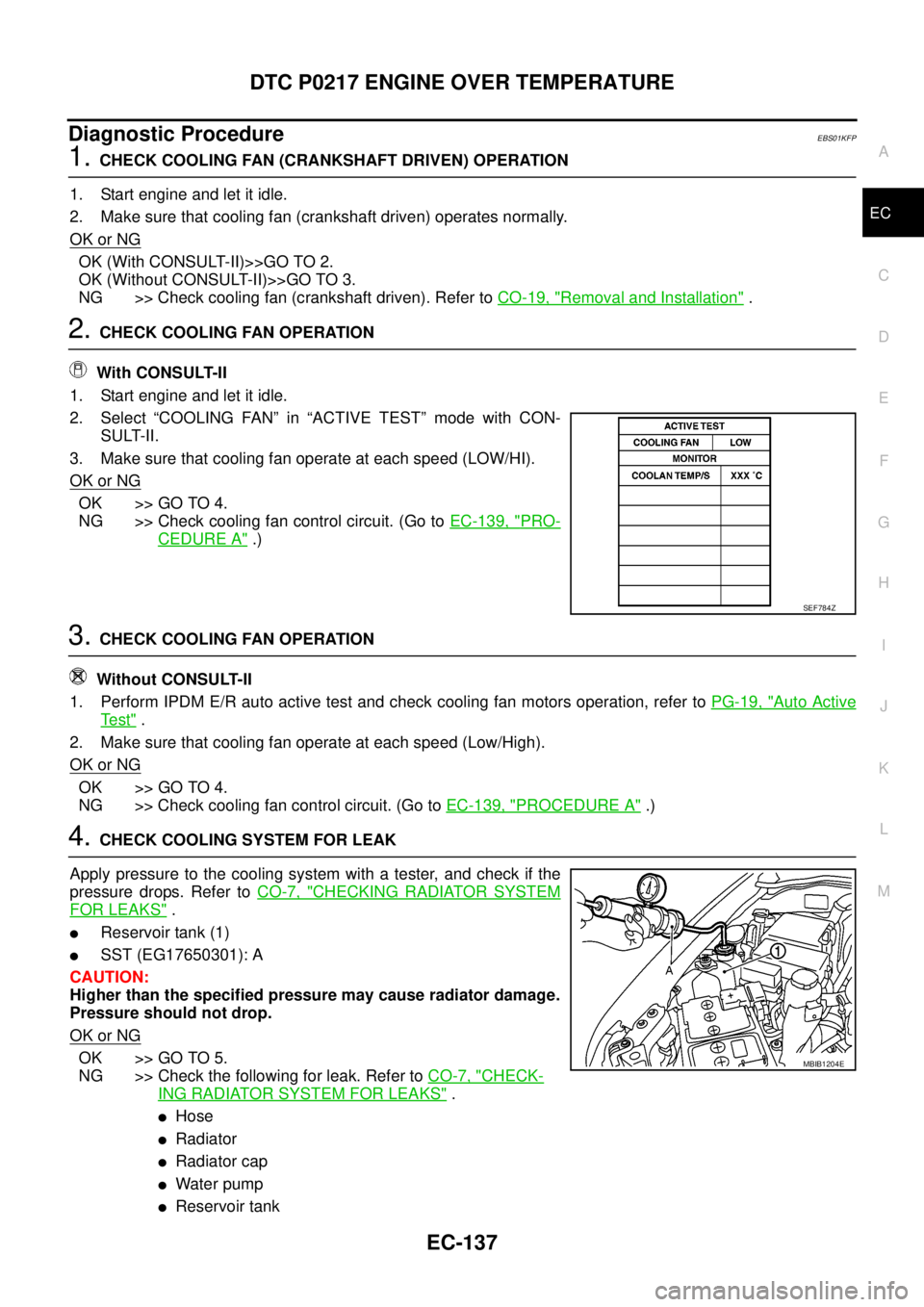
Apply pressure to the cooling system with a tester, and check if the
pressure drops. Refer toCO-7, "
CHECKING RADIATOR SYSTEM
FOR LEAKS".
lReservoir tank (1)
lSST (EG17650301): A
CAUTION:
Higher than the specified pressure may cause radiator damage.
Pressure should not drop.
OK or NG
OK >> GO TO 5.
NG >> Check the following for leak. Refer toCO-7, "
CHECK-
ING RADIATOR SYSTEM FOR LEAKS".
lHose
lRadiator
lRadiator cap
lWater pump
lReservoir tank
SEF784Z
MBIB1204E
Page 1127 of 3171
DTC P0234 TC SYSTEM
EC-147
C
D
E
F
G
H
I
J
K
L
MA
EC
DTCP0234TCSYSTEMPFP:14411
DescriptionEBS01KG1
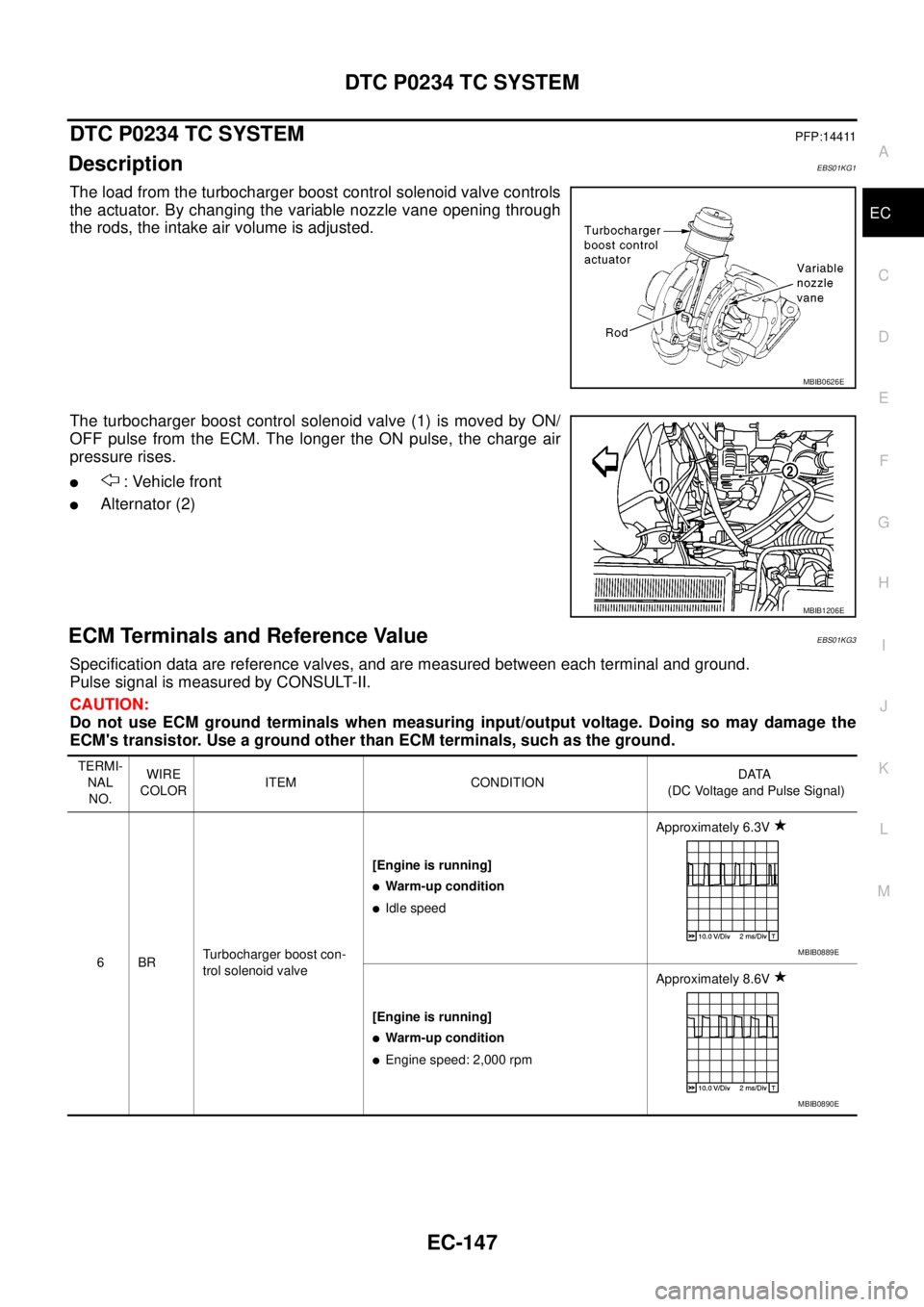
The load from the turbocharger boost control solenoid valve controls
the actuator. By changing the variable nozzle vane opening through
the rods, the intake air volume is adjusted.
The turbocharger boost control solenoid valve (1) is moved by ON/
OFF pulse from the ECM. The longer the ON pulse, the charge air
pressure rises.
l: Vehicle front
lAlternator (2)
ECM Terminals and Reference ValueEBS01KG3
Specification data are reference valves, and are measured between each terminal and ground.
Pulse signal is measured by CONSULT-II.
CAUTION:
Do not use ECM ground terminals when measuring input/output voltage. Doing so may damage the
ECM's transistor. Use a ground other than ECM terminals, such as the ground.
MBIB0626E
MBIB1206E
TERMI-
NAL
NO.WIRE
COLORITEM CONDITIONDATA
(DC Voltage and Pulse Signal)
6BRTurbocharger boost con-
trol solenoid valve[Engine is running]
lWarm-up condition
lIdle speedApproximately 6.3V
[Engine is running]
lWarm-up condition
lEngine speed: 2,000 rpmApproximately 8.6V
MBIB0889E
MBIB0890E
Page 1128 of 3171
EC-148
DTC P0234 TC SYSTEM
: Average voltage for pulse signal (Actual pulse signal can be confirmed by oscilloscope.)
On Board Diagnosis LogicEBS01KG4
The MI will not light up for this self-diagnosis.
NOTE:
If DTC P0234 is displayed with DTC P0652 or P0653, first perform the trouble diagnosis for DTC P0652
or P0653. Refer toEC-227, "
DTC P0652, P0653 SENSOR POWER SUPPLY".
Overall Function CheckEBS01KG5
Use this procedure to check the overall function of the turbocharger. During this check, a DTC might not be
confirmed.
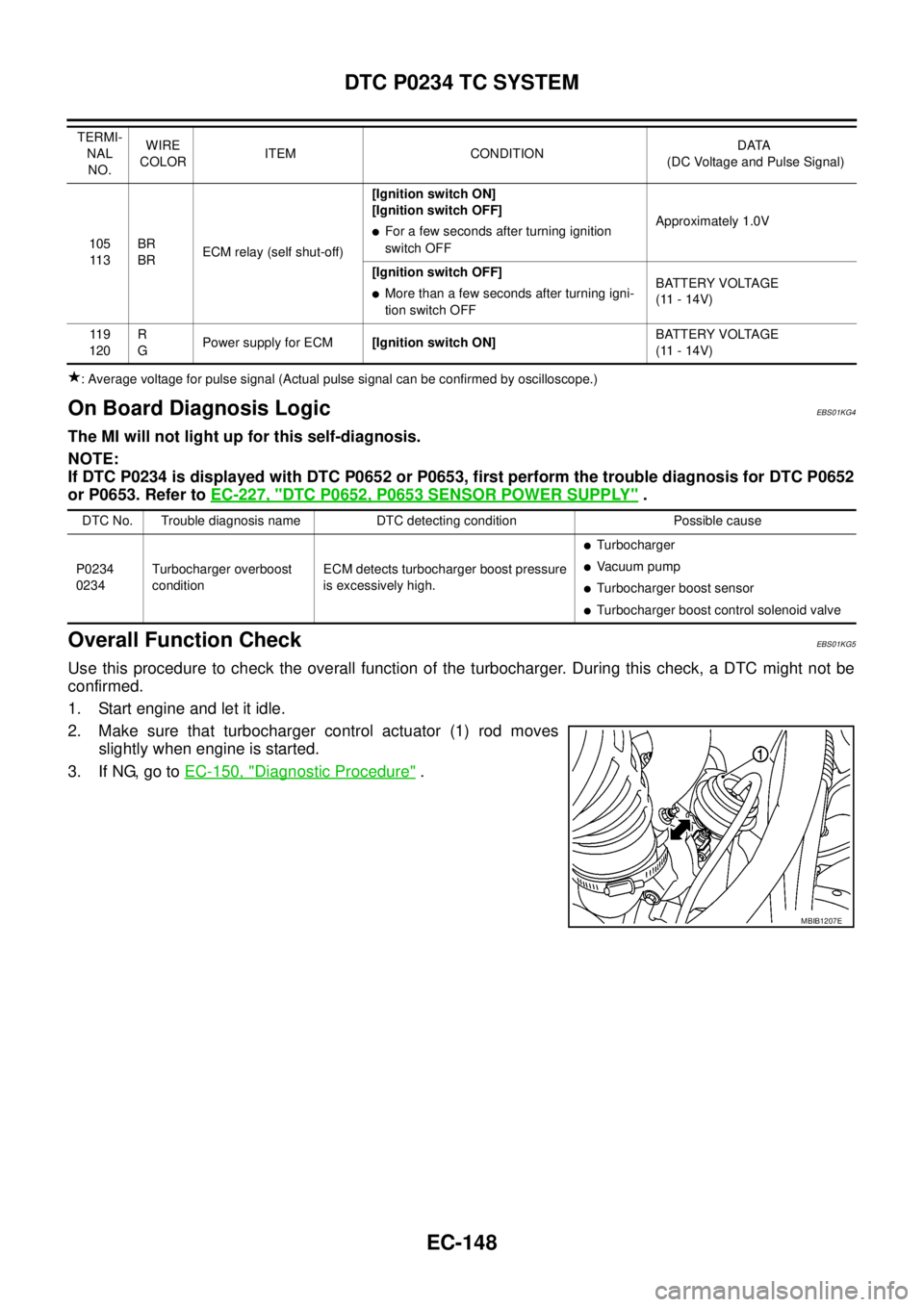
1. Start engine and let it idle.
2. Make sure that turbocharger control actuator (1) rod moves
slightly when engine is started.
3. If NG, go toEC-150, "
Diagnostic Procedure".
105
11 3BR
BRECM relay (self shut-off)[Ignition switch ON]
[Ignition switch OFF]lFor a few seconds after turning ignition
switch OFFApproximately 1.0V
[Ignition switch OFF]
lMore than a few seconds after turning igni-
tion switch OFFBATTERY VOLTAGE
(11 - 14V)
11 9
120R
GPower supply for ECM[Ignition switch ON]BATTERY VOLTAGE
(11 - 14V) TERMI-
NAL
NO.WIRE
COLORITEM CONDITIONDATA
(DC Voltage and Pulse Signal)
DTC No. Trouble diagnosis name DTC detecting condition Possible cause
P0234
0234Turbocharger overboost
conditionECM detects turbocharger boost pressure
is excessively high.
lTurbocharger
lVa c u u m p u m p
lTurbocharger boost sensor
lTurbocharger boost control solenoid valve
MBIB1207E
Page 1130 of 3171
EC-150
DTC P0234 TC SYSTEM
Diagnostic Procedure
EBS01KG7
1.CHECK VACUUM SOURCE
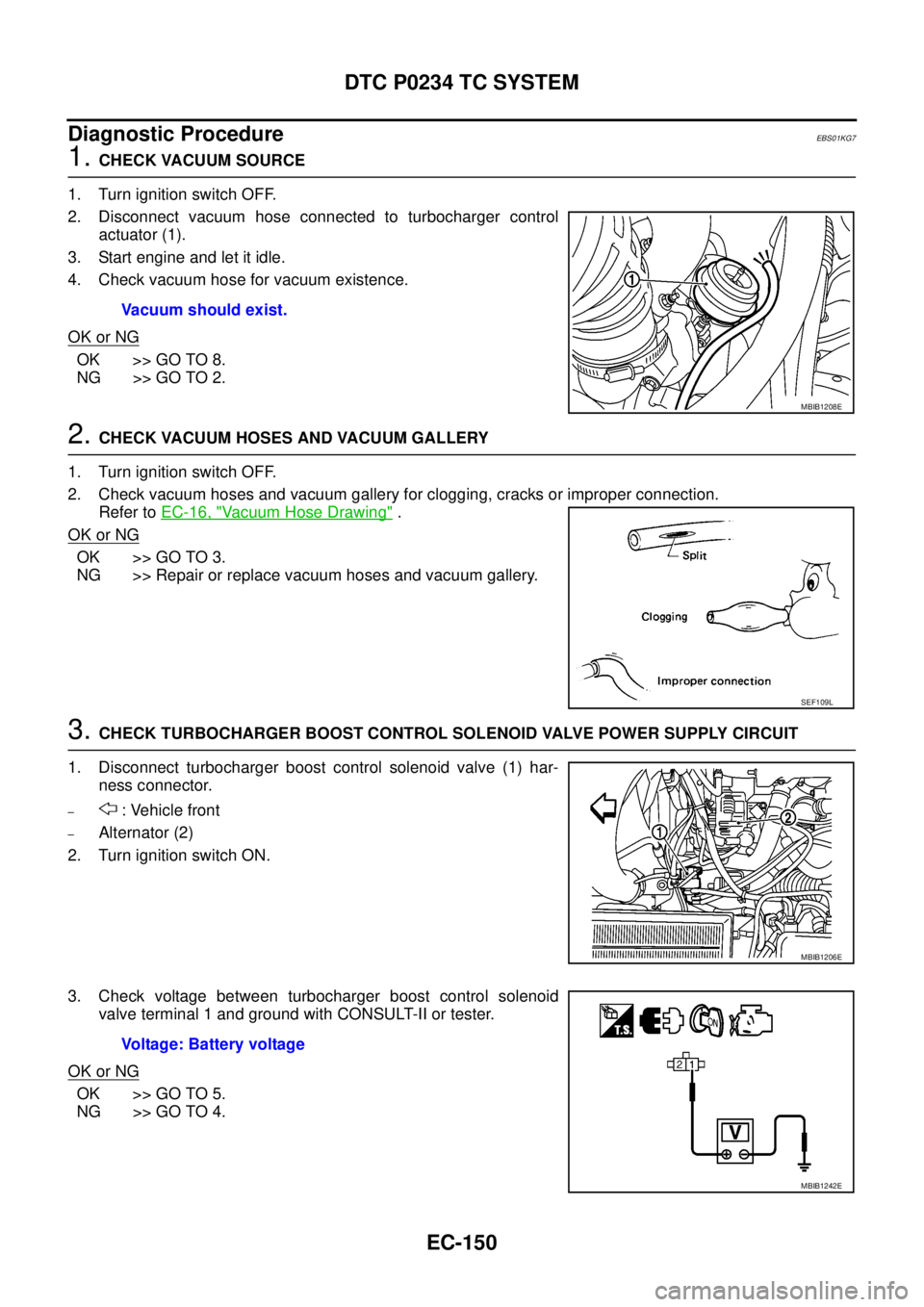
1. Turn ignition switch OFF.
2. Disconnect vacuum hose connected to turbocharger control
actuator (1).
3. Start engine and let it idle.
4. Check vacuum hose for vacuum existence.
OK or NG
OK >> GO TO 8.
NG >> GO TO 2.
2.CHECK VACUUM HOSES AND VACUUM GALLERY
1. Turn ignition switch OFF.
2. Check vacuum hoses and vacuum gallery for clogging, cracks or improper connection.
Refer toEC-16, "
Vacuum Hose Drawing".
OK or NG
OK >> GO TO 3.
NG >> Repair or replace vacuum hoses and vacuum gallery.
3.CHECK TURBOCHARGER BOOST CONTROL SOLENOID VALVE POWER SUPPLY CIRCUIT
1. Disconnect turbocharger boost control solenoid valve (1) har-
ness connector.
–: Vehicle front
–Alternator (2)
2. Turn ignition switch ON.
3. Check voltage between turbocharger boost control solenoid
valve terminal 1 and ground with CONSULT-II or tester.
OK or NG
OK >> GO TO 5.
NG >> GO TO 4.Vacuum should exist.
MBIB1208E
SEF109L
MBIB1206E
Voltage: Battery voltage
MBIB1242E
Page 1151 of 3171
DTC P0340 CMP SENSOR
EC-171
C
D
E
F
G
H
I
J
K
L
MA
EC
DTC P0340 CMP SENSORPFP:23731
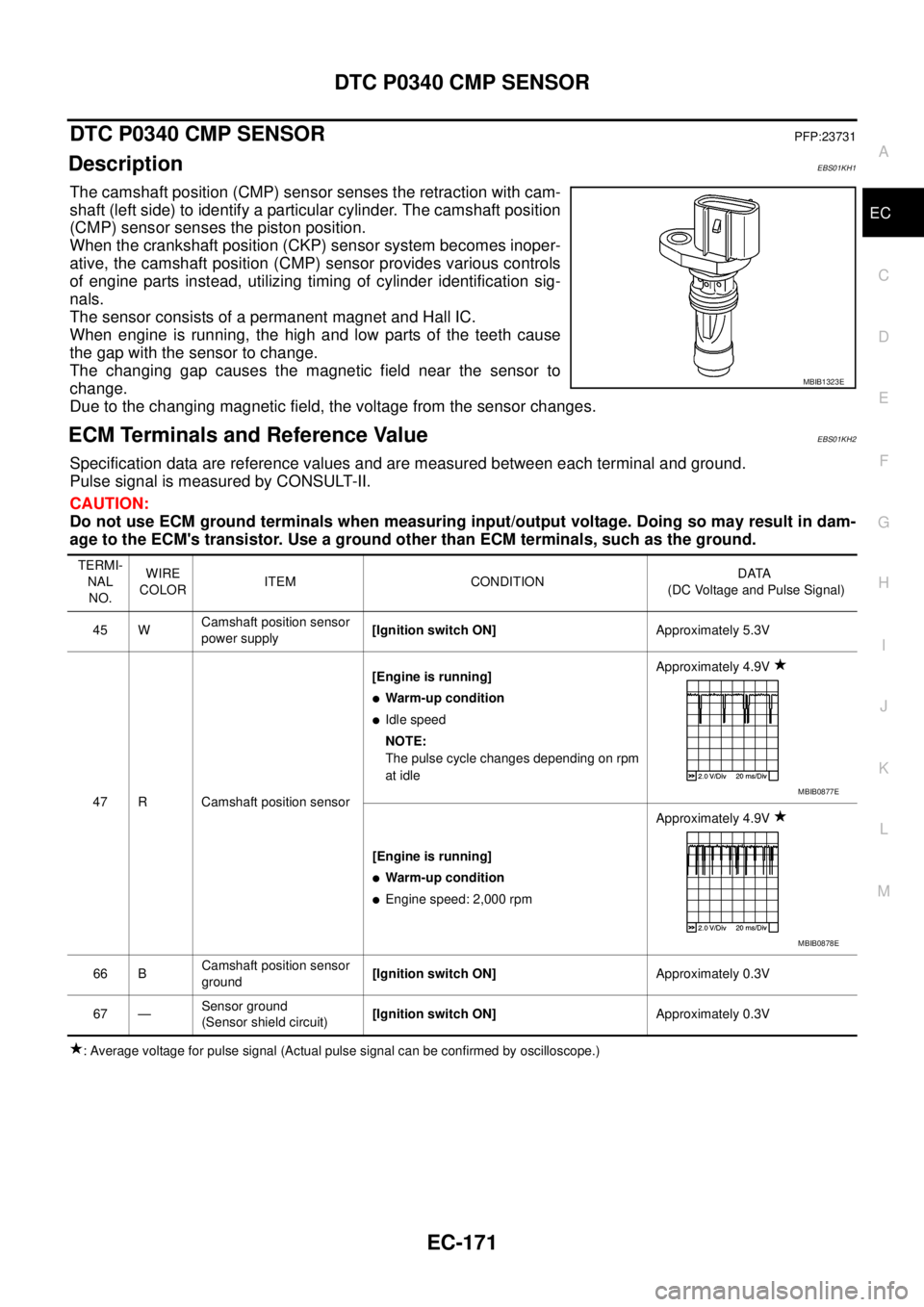
DescriptionEBS01KH1
The camshaft position (CMP) sensor senses the retraction with cam-
shaft (left side) to identify a particular cylinder. The camshaft position
(CMP) sensor senses the piston position.
When the crankshaft position (CKP) sensor system becomes inoper-
ative, the camshaft position (CMP) sensor provides various controls
of engine parts instead, utilizing timing of cylinder identification sig-
nals.
The sensor consists of a permanent magnet and Hall IC.
When engine is running, the high and low parts of the teeth cause
the gap with the sensor to change.
The changing gap causes the magnetic field near the sensor to
change.
Due to the changing magnetic field, the voltage from the sensor changes.
ECM Terminals and Reference ValueEBS01KH2
Specification data are reference values and are measured between each terminal and ground.
Pulse signal is measured by CONSULT-II.
CAUTION:
Do not use ECM ground terminals when measuring input/output voltage. Doing so may result in dam-
age to the ECM's transistor. Use a ground other than ECM terminals, such as the ground.
: Average voltage for pulse signal (Actual pulse signal can be confirmed by oscilloscope.)
MBIB1323E
TERMI-
NAL
NO.WIRE
COLORITEM CONDITIONDATA
(DC Voltage and Pulse Signal)
45 WCamshaft position sensor
power supply[Ignition switch ON]Approximately 5.3V
47 R Camshaft position sensor[Engine is running]
lWarm-up condition
lIdle speed
NOTE:
The pulse cycle changes depending on rpm
at idleApproximately 4.9V
[Engine is running]
lWarm-up condition
lEngine speed: 2,000 rpmApproximately 4.9V
66 BCamshaft position sensor
ground[Ignition switch ON]Approximately 0.3V
67 —Sensor ground
(Sensor shield circuit)[Ignition switch ON]Approximately 0.3V
MBIB0877E
MBIB0878E