engine control NISSAN NAVARA 2005 Repair Workshop Manual
[x] Cancel search | Manufacturer: NISSAN, Model Year: 2005, Model line: NAVARA, Model: NISSAN NAVARA 2005Pages: 3171, PDF Size: 49.59 MB
Page 999 of 3171
ENGINE CONTROL SYSTEM
EC-19
C
D
E
F
G
H
I
J
K
L
MA
EC
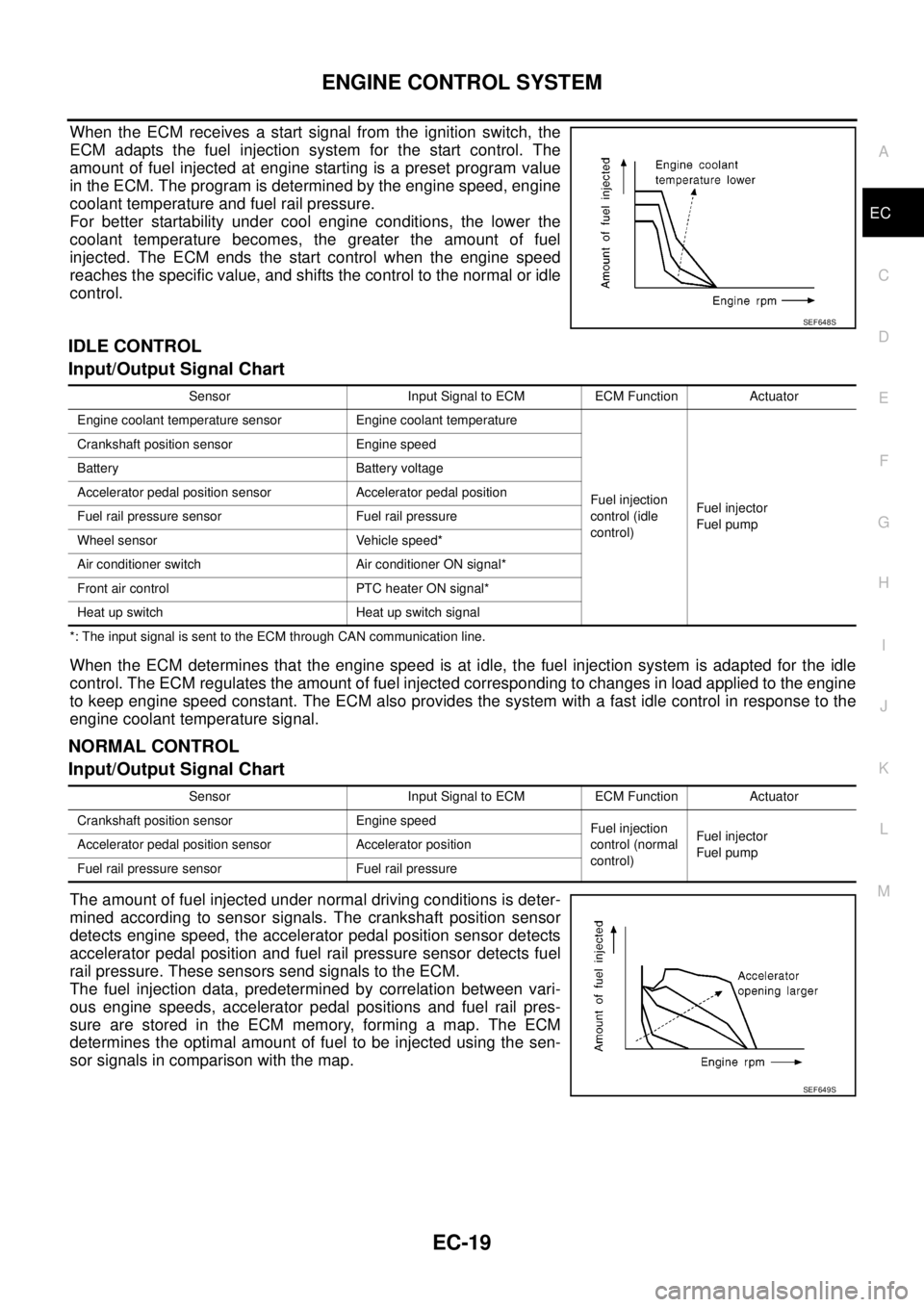
When the ECM receives a start signal from the ignition switch, the
ECM adapts the fuel injection system for the start control. The
amount of fuel injected at engine starting is a preset program value
in the ECM. The program is determined by the engine speed, engine
coolant temperature and fuel rail pressure.
For better startability under cool engine conditions, the lower the
coolant temperature becomes, the greater the amount of fuel
injected. The ECM ends the start control when the engine speed
reaches the specific value, and shifts the control to the normal or idle
control.
IDLE CONTROL
Input/Output Signal Chart
*: The input signal is sent to the ECM through CAN communication line.
When the ECM determines that the engine speed is at idle, the fuel injection system is adapted for the idle
control. The ECM regulates the amount of fuel injected corresponding to changes in load applied to the engine
to keep engine speed constant. The ECM also provides the system with a fast idle control in response to the
engine coolant temperature signal.
NORMAL CONTROL
Input/Output Signal Chart
The amount of fuel injected under normal driving conditions is deter-
mined according to sensor signals. The crankshaft position sensor
detects engine speed, the accelerator pedal position sensor detects
accelerator pedal position and fuel rail pressure sensor detects fuel
rail pressure. These sensors send signals to the ECM.
The fuel injection data, predetermined by correlation between vari-
ous engine speeds, accelerator pedal positions and fuel rail pres-
sure are stored in the ECM memory, forming a map. The ECM
determines the optimal amount of fuel to be injected using the sen-
sor signals in comparison with the map.
SEF648S
Sensor Input Signal to ECM ECM Function Actuator
Engine coolant temperature sensor Engine coolant temperature
Fuel injection
control (idle
control)Fuel injector
Fuel pump Crankshaft position sensor Engine speed
Battery Battery voltage
Accelerator pedal position sensor Accelerator pedal position
Fuel rail pressure sensor Fuel rail pressure
Wheel sensor Vehicle speed*
Air conditioner switch Air conditioner ON signal*
Front air control PTC heater ON signal*
Heat up switch Heat up switch signal
Sensor Input Signal to ECM ECM Function Actuator
Crankshaft position sensor Engine speed
Fuel injection
control (normal
control)Fuel injector
Fuel pump Accelerator pedal position sensor Accelerator position
Fuel rail pressure sensor Fuel rail pressure
SEF649S
Page 1000 of 3171

EC-20
ENGINE CONTROL SYSTEM
MAXIMUM AMOUNT CONTROL
Input/Output Signal Chart
The maximum injection amount is controlled to an optimum by the engine speed, intake air amount, engine
coolant temperature, and accelerator opening in accordance with the driving conditions.
This prevents the oversupply of the injection amount caused by decreased air density at a high altitude or dur-
ing a system failure.
DECELERATION CONTROL
Input/Output Signal Chart
The ECM sends a fuel cut signal to the fuel injectors and fuel pump during deceleration for better fuel effi-
ciency. The ECM determines the time of deceleration according to signals from the accelerator pedal position
sensor and crankshaft position sensor.
Fuel Injection Timing Control SystemEBS01KCF
DESCRIPTION
The target fuel injection timing in accordance with the engine speed and the fuel injection amount are recorded
as a map in the ECM beforehand. The ECM determines the optimum injection timing using sensor signals
accordance with the map.
Air Conditioning Cut ControlEBS01KCG
INPUT / OUTPUT SIGNAL CHART
*1: The input signal is sent to the ECM through CAN communication line.
*2: The output signal is sent from the ECM through CAN communication line.
SYSTEM DESCRIPTION
This system improves acceleration when the air conditioner is used.
When the accelerator pedal is fully depressed, the air conditioner is turned off for a few seconds.
When engine coolant temperature becomes excessively high, the air conditioner is turned off. This continues
until the engine coolant temperature returns to normal.
Fuel Cut Control (At No Load & High Engine Speed)EBS01KCH
INPUT/OUTPUT SIGNAL CHART
*: The input signal is sent to the ECM through CAN communication line.Sensor Input Signal to ECM ECM Function Actuator
Mass air flow sensor Amount of intake air
Fuel injection
control (maxi-
mum amount
control)Fuel injector Engine coolant temperature sensor Engine coolant temperature
Crankshaft position sensor Engine speed
Accelerator pedal position sensor Accelerator pedal position
Sensor Input Signal to ECM ECM Function Actuator
Accelerator pedal position sensor Accelerator pedal position Fuel injection
control (decel-
eration control)Fuel injector
Fuel pump
Crankshaft position sensor Engine speed
Sensor Input Signal to ECM ECM Function Actuator
Air conditioner switch
Air conditioner ON signal*
1
Air conditioner
cut controlAir conditioner relay*2
Accelerator pedal position sensor Accelerator pedal opening angle
Wheel sensor
Vehicle speed*
1
Engine coolant temperature sensor Engine coolant temperature
Refrigerant pressure sensor Refrigerant pressure
Sensor Input Signal to ECM ECM Function Actuator
Wheel sensor Vehicle speed*
Fuel cut control Fuel injector Accelerator pedal position sensor Accelerator pedal position
Crankshaft position sensor Engine speed
Page 1001 of 3171
ENGINE CONTROL SYSTEM
EC-21
C
D
E
F
G
H
I
J
K
L
MA
EC
If the engine speed is above 2,800 rpm under no load (for example, the shift position is neutral and engine
speed is over 2,800 rpm) fuel will be cut off after some time. The exact time when the fuel is cut off varies
based on engine speed. Fuel cut will be operated until the engine speed reaches 1,500 rpm, then fuel cut will
be cancelled.
NOTE:
This function is different from deceleration control listed underEC-18, "
Fuel Injection Control System"
.
Crankcase Ventilation SystemEBS01KCI
DESCRIPTION
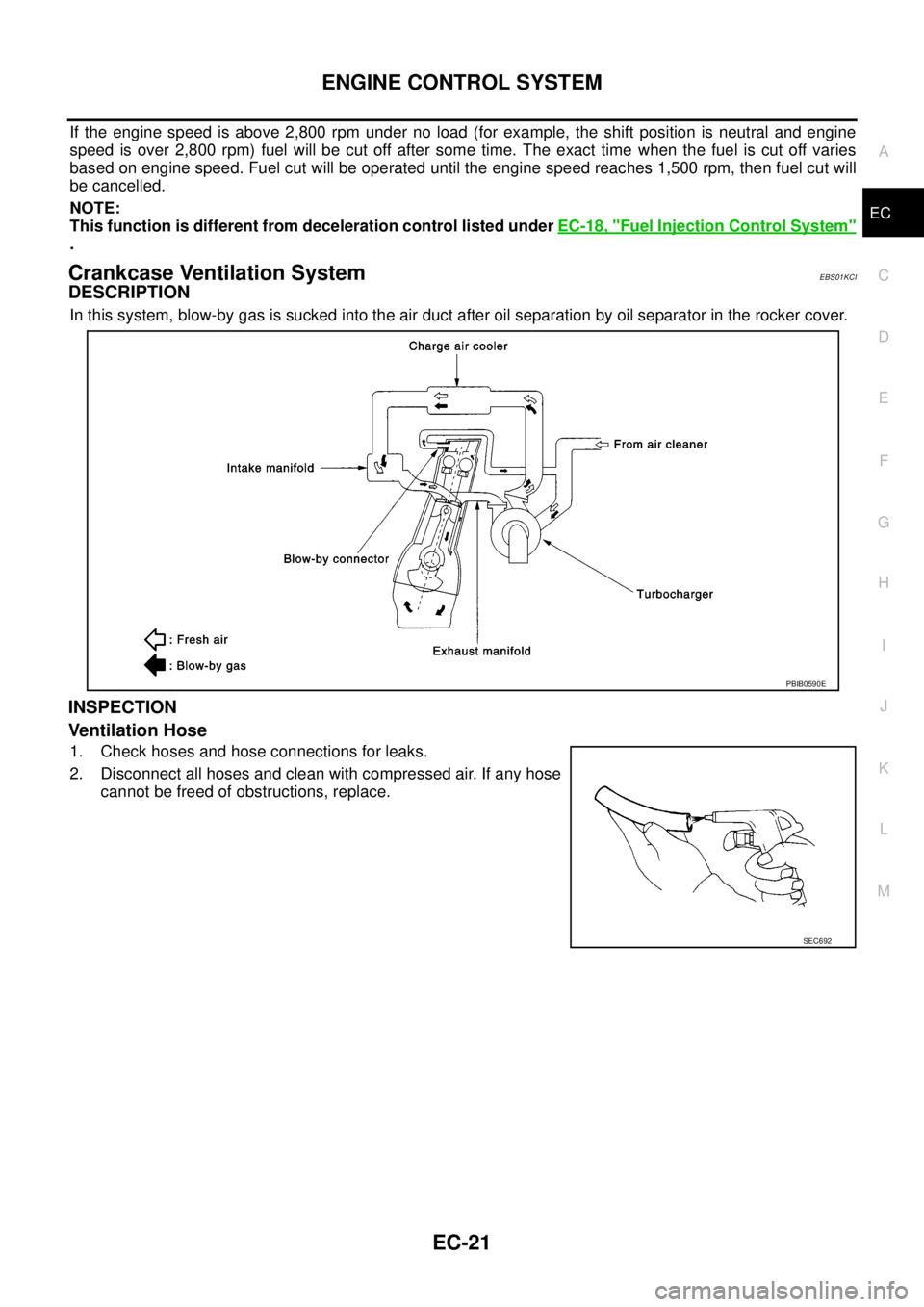
In this system, blow-by gas is sucked into the air duct after oil separation by oil separator in the rocker cover.
INSPECTION
Ventilation Hose
1. Check hoses and hose connections for leaks.
2. Disconnect all hoses and clean with compressed air. If any hose
cannot be freed of obstructions, replace.
PBIB0590E
SEC692
Page 1002 of 3171

EC-22
ENGINE CONTROL SYSTEM
CAN Communication
EBS01KCJ
SYSTEM DESCRIPTION
CAN (Controller Area Network) is a serial communication line for real time application. It is an on-vehicle mul-
tiplex communication line with high data communication speed and excellent error detection ability. Many elec-
tronic control units are equipped onto a vehicle, and each control unit shares information and links with other
control units during operation (not independent). In CAN communication, control units are connected with 2
communication lines (CAN H line, CAN L line) allowing a high rate of information transmission with less wiring.
Each control unit transmits/receives data but selectively reads required data only.
Refer toLAN-30, "
CAN Communication Unit", about CAN communication for detail.
Page 1004 of 3171
EC-24
BASIC SERVICE PROCEDURE
Fuel Pump Learning Value Clearing
EBS01KCL
DESCRIPTION
In order to always keep optimum fuel pressure in fuel rail, the ECM controls fuel pump in high precision with
monitoring the signal of fuel rail pressure sensor.
Accordingly, the ECM always learns characteristic value of fuel pump. Fuel Pump Learning Value Clearing is
an operation to clear the value of the fuel pump learning.
Fuel Pump Learning Value Clearing should be performed under the following conditions.
lFuel pump is changed.
lECM is replaced with used one which stores the fuel pump learning value of other fuel pump.
OPERATION PROCEDURE
NOTE:
When removing fuel pump, perform Fuel Pump Learning Value Clearing before starting engine.
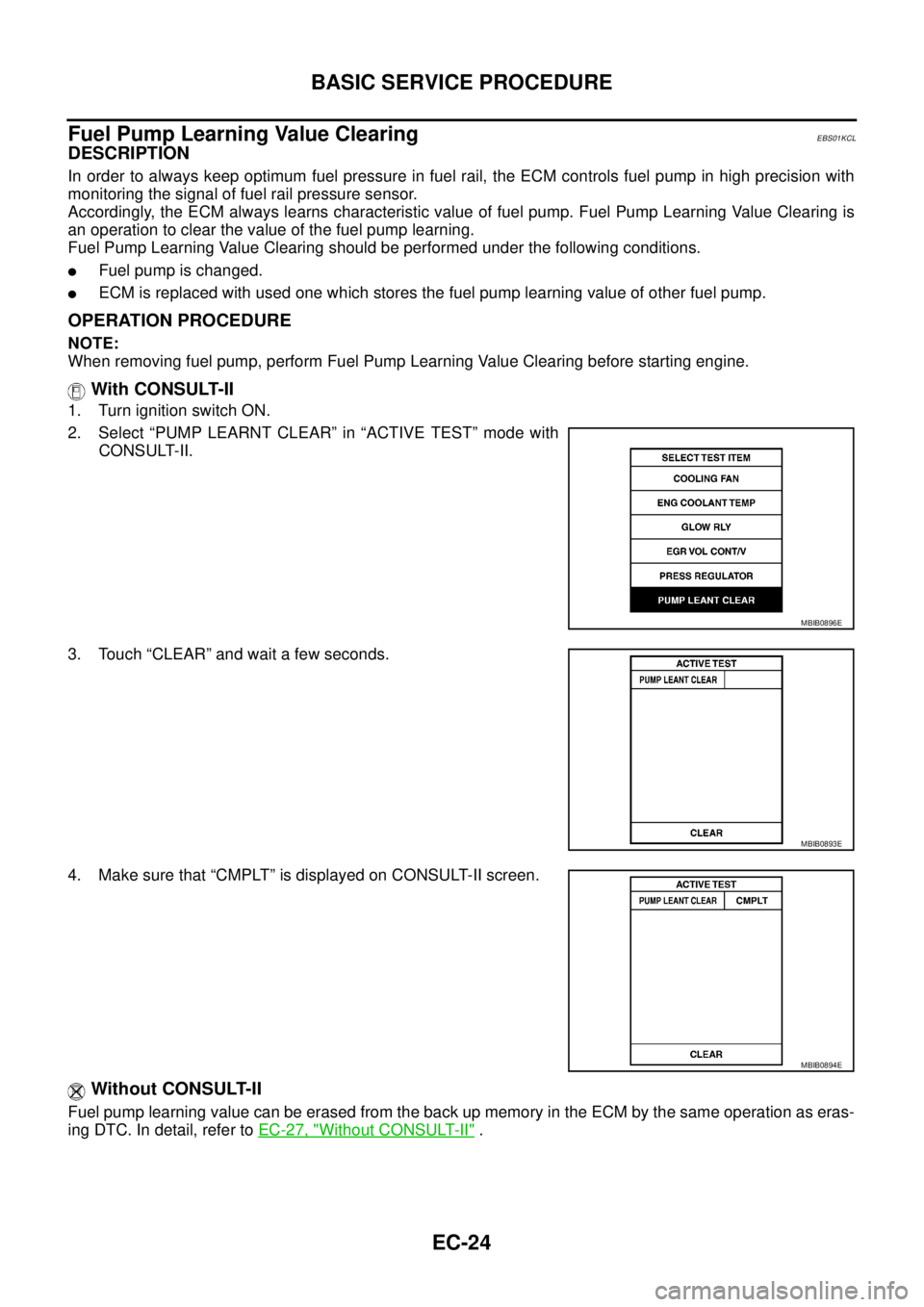
With CONSULT-II
1. Turn ignition switch ON.
2. Select “PUMP LEARNT CLEAR” in “ACTIVE TEST” mode with
CONSULT-II.
3. Touch “CLEAR” and wait a few seconds.
4. Make sure that “CMPLT” is displayed on CONSULT-II screen.
Without CONSULT-II
Fuel pump learning value can be erased from the back up memory in the ECM by the same operation as eras-
ingDTC.Indetail,refertoEC-27, "
Without CONSULT-II".
MBIB0896E
MBIB0893E
MBIB0894E
Page 1005 of 3171
BASIC SERVICE PROCEDURE
EC-25
C
D
E
F
G
H
I
J
K
L
MA
EC
Injector Adjustment Value RegistrationEBS01KCM
DESCRIPTION
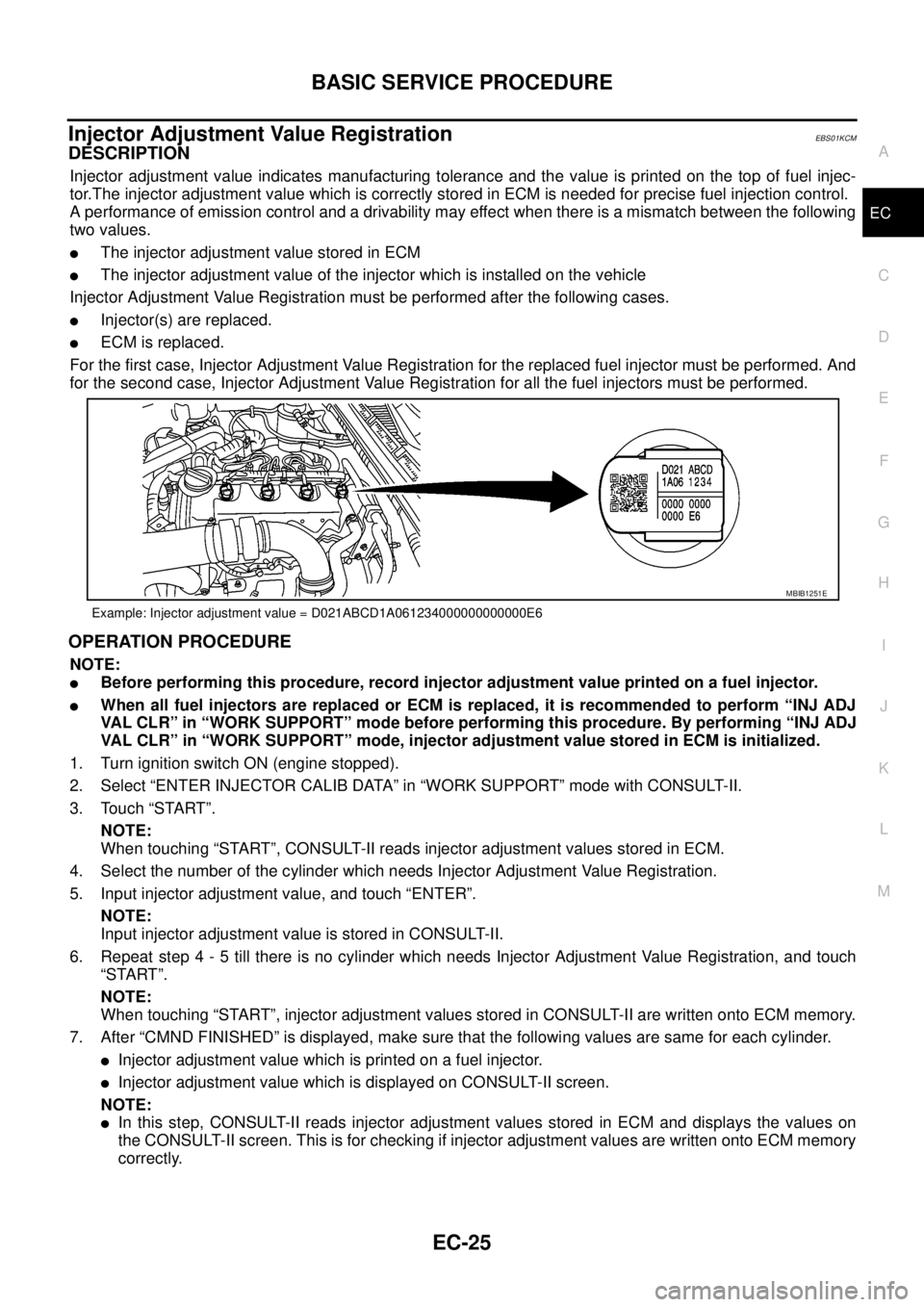
Injector adjustment value indicates manufacturing tolerance and the value is printed on the top of fuel injec-
tor.The injector adjustment value which is correctly stored in ECM is needed for precise fuel injection control.
A performance of emission control and a drivability may effect when there is a mismatch between the following
two values.
lThe injector adjustment value stored in ECM
lThe injector adjustment value of the injector which is installed on the vehicle
Injector Adjustment Value Registration must be performed after the following cases.
lInjector(s) are replaced.
lECM is replaced.
For the first case, Injector Adjustment Value Registration for the replaced fuel injector must be performed. And
for the second case, Injector Adjustment Value Registration for all the fuel injectors must be performed.
OPERATION PROCEDURE
NOTE:
lBefore performing this procedure, record injector adjustment value printed on a fuel injector.
lWhen all fuel injectors are replaced or ECM is replaced, it is recommended to perform “INJ ADJ
VAL CLR” in “WORK SUPPORT” mode before performing this procedure. By performing “INJ ADJ
VAL CLR” in “WORK SUPPORT” mode, injector adjustment value stored in ECM is initialized.
1. Turn ignition switch ON (engine stopped).
2. Select “ENTER INJECTOR CALIB DATA” in “WORK SUPPORT” mode with CONSULT-II.
3. Touch “START”.
NOTE:
When touching “START”, CONSULT-II reads injector adjustment values stored in ECM.
4. Select the number of the cylinder which needs Injector Adjustment Value Registration.
5. Input injector adjustment value, and touch “ENTER”.
NOTE:
Input injector adjustment value is stored in CONSULT-II.
6. Repeat step 4 - 5 till there is no cylinder which needs Injector Adjustment Value Registration, and touch
“START”.
NOTE:
When touching “START”, injector adjustment values stored in CONSULT-II are written onto ECM memory.
7. After “CMND FINISHED” is displayed, make sure that the following values are same for each cylinder.
lInjector adjustment value which is printed on a fuel injector.
lInjector adjustment value which is displayed on CONSULT-II screen.
NOTE:
lIn this step, CONSULT-II reads injector adjustment values stored in ECM and displays the values on
the CONSULT-II screen. This is for checking if injector adjustment values are written onto ECM memory
correctly.
Example: Injector adjustment value = D021ABCD1A061234000000000000E6
MBIB1251E
Page 1013 of 3171
TROUBLE DIAGNOSIS
EC-33
C
D
E
F
G
H
I
J
K
L
MA
EC
TROUBLE DIAGNOSISPFP:00004
Trouble Diagnosis IntroductionEBS01KCT
INTRODUCTION
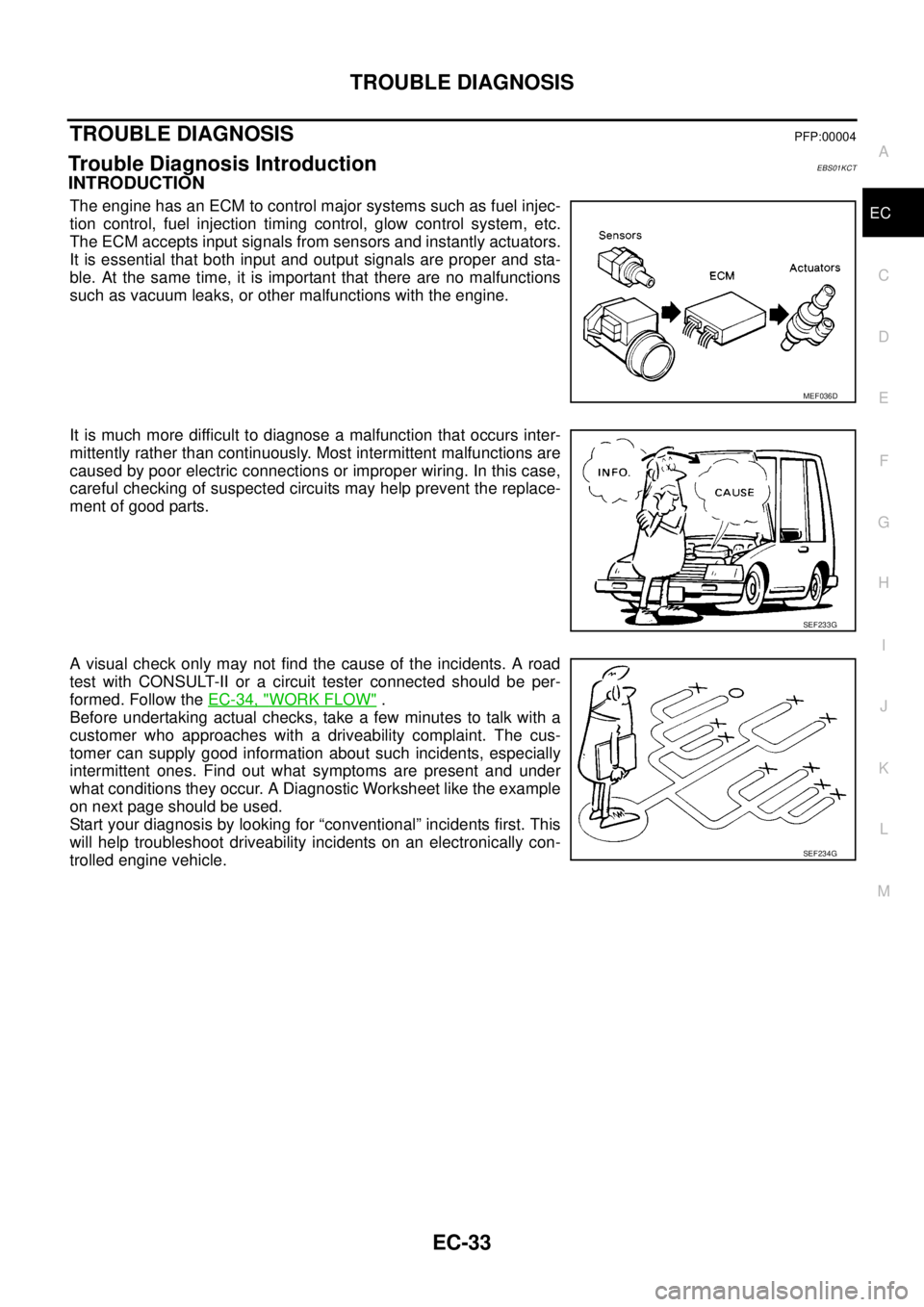
The engine has an ECM to control major systems such as fuel injec-
tion control, fuel injection timing control, glow control system, etc.
The ECM accepts input signals from sensors and instantly actuators.
It is essential that both input and output signals are proper and sta-
ble. At the same time, it is important that there are no malfunctions
such as vacuum leaks, or other malfunctions with the engine.
It is much more difficult to diagnose a malfunction that occurs inter-
mittently rather than continuously. Most intermittent malfunctions are
caused by poor electric connections or improper wiring. In this case,
careful checking of suspected circuits may help prevent the replace-
ment of good parts.
A visual check only may not find the cause of the incidents. A road
test with CONSULT-II or a circuit tester connected should be per-
formed. Follow theEC-34, "
WORK FLOW".
Before undertaking actual checks, take a few minutes to talk with a
customer who approaches with a driveability complaint. The cus-
tomer can supply good information about such incidents, especially
intermittent ones. Find out what symptoms are present and under
what conditions they occur. A Diagnostic Worksheet like the example
on next page should be used.
Start your diagnosis by looking for “conventional” incidents first. This
will help troubleshoot driveability incidents on an electronically con-
trolled engine vehicle.
MEF036D
SEF233G
SEF234G
Page 1022 of 3171

EC-42
TROUBLE DIAGNOSIS
Symptom Matrix Chart
EBS01KCW
SYSTEM — Basic engine control systemSYMPTOM
Reference
pageHARD/NO START/RESTART (EXCP. HA)
ENGINE STALL
HESITATION/SURGING/FLAT SPOT
KNOCK/DETONATION
LACK OF POWER
POOR ACCELERATION
HI IDLE
LOW IDLE NO START (with first firing)
NO START (without first firing)
HARD TO START WHEN ENGINE IS COLD
HARD TO START WHEN ENGINE IS HOT
AT I D L E
DURING DRIVING
WHEN DECELERATING
Warranty symptom code AA AB AC AD AE AF
Fuelpump 55555555 55 5 —
Fuelinjector 3333333334433EC-125
Glow control system 1 1 1 1 1EC-295
Engine body 3 3 3 3 3 3 3 3 4 4 3EM-106
EGR system33EC-302
Air cleaner and duct33EM-15
Fuel rail pressure relief valve 3 3 3 3 3 3 3 3 3 3 3EC-88
ENGINE CONTROL
Fuelpumpcircuit 44444444 44 4EC-217
Fuelinjectorcircuit 1111111111111EC-125
Fuel injector adjustment value 1 1 1 1EC-25
Mass air flow sensor circuit 1 1 1EC-92
Engine coolant temperature circuit 1 1 1 1EC-103
Vehicle speed signal circuit1LAN-30
Accelerator pedal position sensor circuit 1 1 1EC-108
,
EC-142
,
EC-275
Fuel rail pressure sensor circuitEC-118
Page 1023 of 3171
TROUBLE DIAGNOSIS
EC-43
C
D
E
F
G
H
I
J
K
L
MA
EC
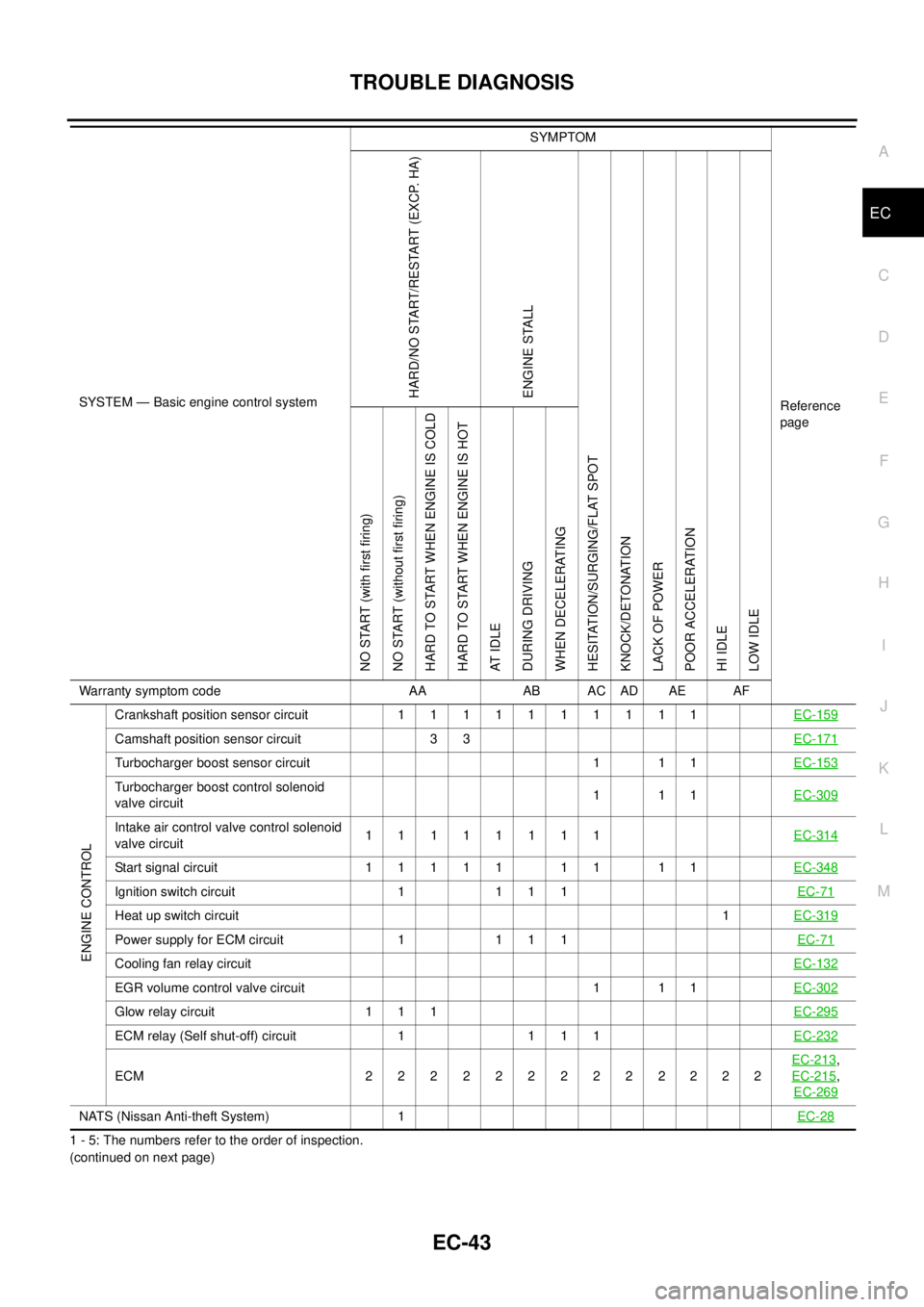
1 - 5: The numbers refer to the order of inspection.
(continued on next page)
ENGINE CONTROL
Crankshaftpositionsensorcircuit 1111111111EC-159
Camshaft position sensor circuit 3 3EC-171
Turbocharger boost sensor circuit 1 1 1EC-153
Turbocharger boost control solenoid
valve circuit111EC-309
Intake air control valve control solenoid
valve circuit11111111EC-314
Start signal circuit 1 1 1 1 1 1 1 1 1EC-348
Ignition switch circuit 1 1 1 1EC-71
Heat up switch circuit1EC-319
Power supply for ECM circuit 1 1 1 1EC-71
Cooling fan relay circuitEC-132
EGR volume control valve circuit 1 1 1EC-302
Glow relay circuit 1 1 1EC-295
ECM relay (Self shut-off) circuit 1 1 1 1EC-232
ECM 2222222222222EC-213
,
EC-215
,
EC-269
NATS (Nissan Anti-theft System) 1EC-28
SYSTEM — Basic engine control systemSYMPTOM
Reference
pageHARD/NO START/RESTART (EXCP. HA)
ENGINE STALL
HESITATION/SURGING/FLAT SPOT
KNOCK/DETONATION
LACK OF POWER
POOR ACCELERATION
HI IDLE
LOW IDLE NO START (with first firing)
NO START (without first firing)
HARD TO START WHEN ENGINE IS COLD
HARD TO START WHEN ENGINE IS HOT
AT I D L E
DURING DRIVING
WHEN DECELERATING
Warranty symptom code AA AB AC AD AE AF
Page 1024 of 3171

EC-44
TROUBLE DIAGNOSIS
SYSTEM — Basic engine control systemSYMPTOM
Reference
page
ROUGH IDLE/HUNTING
IDLING VIBRATION
SLOW/NO RETURN TO IDLE
OVERHEAT/HIGH ENGINE COOLANT TEMPERATURE
EXCESSIVE FUEL CONSUMPTION
EXCESSIVE OIL CONSUMPTION
ABNORMAL SMOKE COLOR
DEAD BATTERY (UNDER CHARGE)
Malfunction indicator illuminates.
Can be detected by CONSULT-II?BLACK SMOKE
WHITE SMOKE
Warranty symptom code AG AH AJ AK AL AM AP HA
Fuel pump 5 5 5 5 1 1 —
Fuel injector 3 3 3 4 3 3 1 1EC-125
Glow control system1EC-295
Engine body 3 3 3 3 1 3EM-106
EGR system3EC-302
Air cleaner and duct3EM-15
Fuel rail pressure relief valve 3 3 3 3EC-88
ENGINE CONTROL
Fuel pump circuit 4 4 4 4 1 1EC-217
Fuel injector circuit 1 1 1 1 1 1 1 1EC-125
Fuel injector adjustment value 1 1 1 1 1 1EC-25
Mass air flow sensor circuit 1 1 1EC-92
Engine coolant temperature circuit 1 1 1 1 1EC-103
Vehicle speed signal circuit11LAN-30
Accelerator pedal position sensor circuit 1 1 1EC-108
,
EC-142
,
EC-275
Fuel rail pressure sensor circuit11EC-118