transmission NISSAN NAVARA 2005 Repair Workshop Manual
[x] Cancel search | Manufacturer: NISSAN, Model Year: 2005, Model line: NAVARA, Model: NISSAN NAVARA 2005Pages: 3171, PDF Size: 49.59 MB
Page 2384 of 3171
SERVICE DATA AND SPECIFICATIONS (SDS)
MT-67
D
E
F
G
H
I
J
K
L
MA
B
MT
SERVICE DATA AND SPECIFICATIONS (SDS)PFP:00030
General SpecificationsECS00IDB
Engine typeYD25DDTi
Transmission modelFS6R31A
Axle type 2WD 4WD
Number of speed6
Synchromesh typeWarner
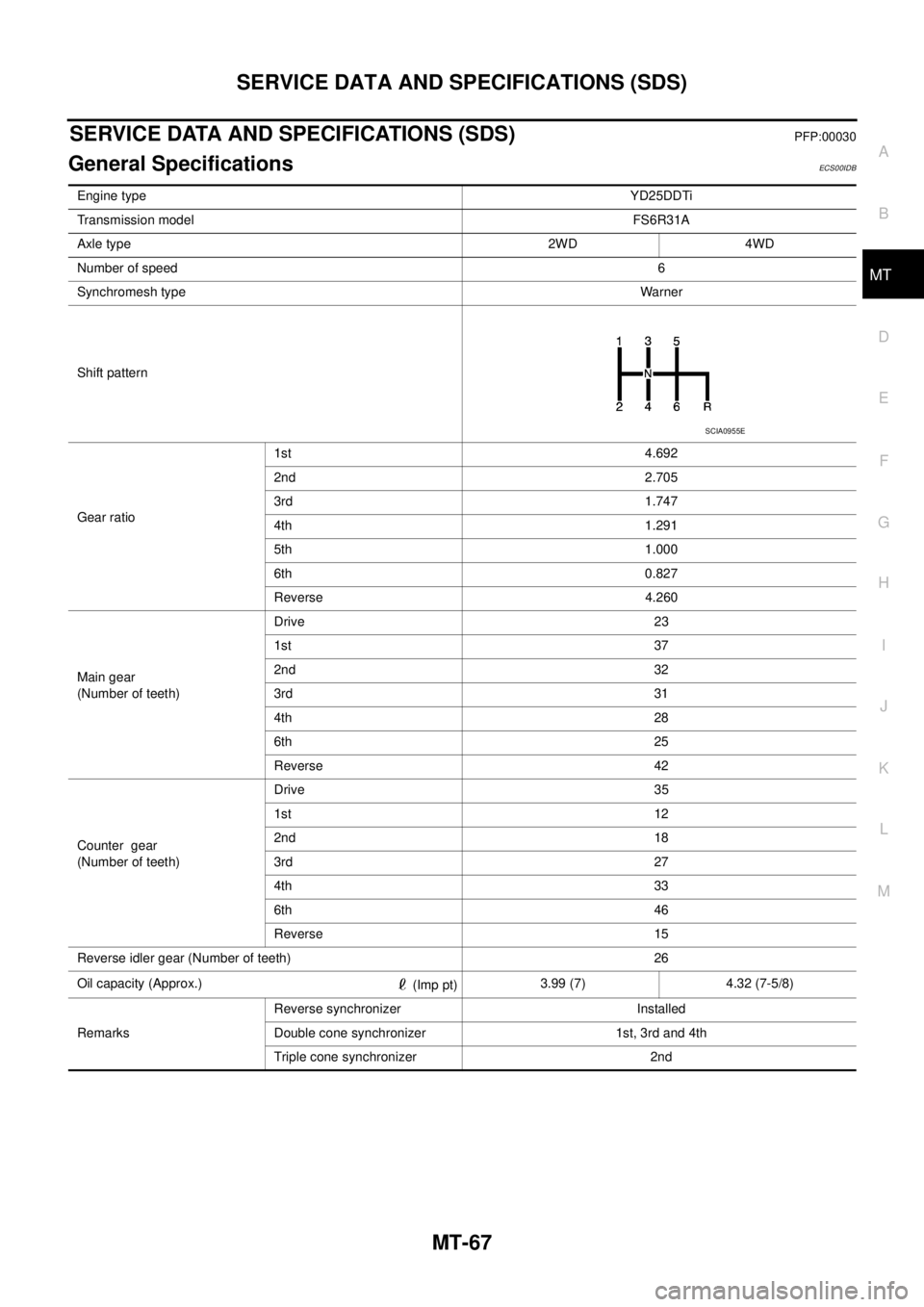
Shift pattern
Gear ratio1st 4.692
2nd 2.705
3rd 1.747
4th 1.291
5th 1.000
6th 0.827
Reverse 4.260
Main gear
(Number of teeth)Drive 23
1st 37
2nd 32
3rd 31
4th 28
6th 25
Reverse 42
Counter gear
(Number of teeth)Drive 35
1st 12
2nd 18
3rd 27
4th 33
6th 46
Reverse 15
Reverse idler gear (Number of teeth) 26
Oil capacity (Approx.)
(Imp pt)3.99 (7) 4.32 (7-5/8)
RemarksReverse synchronizer Installed
Double cone synchronizer 1st, 3rd and 4th
Triple cone synchronizer 2nd
SCIA0955E
Page 2546 of 3171
IPDM E/R (INTELLIGENT POWER DISTRIBUTION MODULE ENGINE ROOM)
PG-17
C
D
E
F
G
H
I
J
L
MA
B
PG
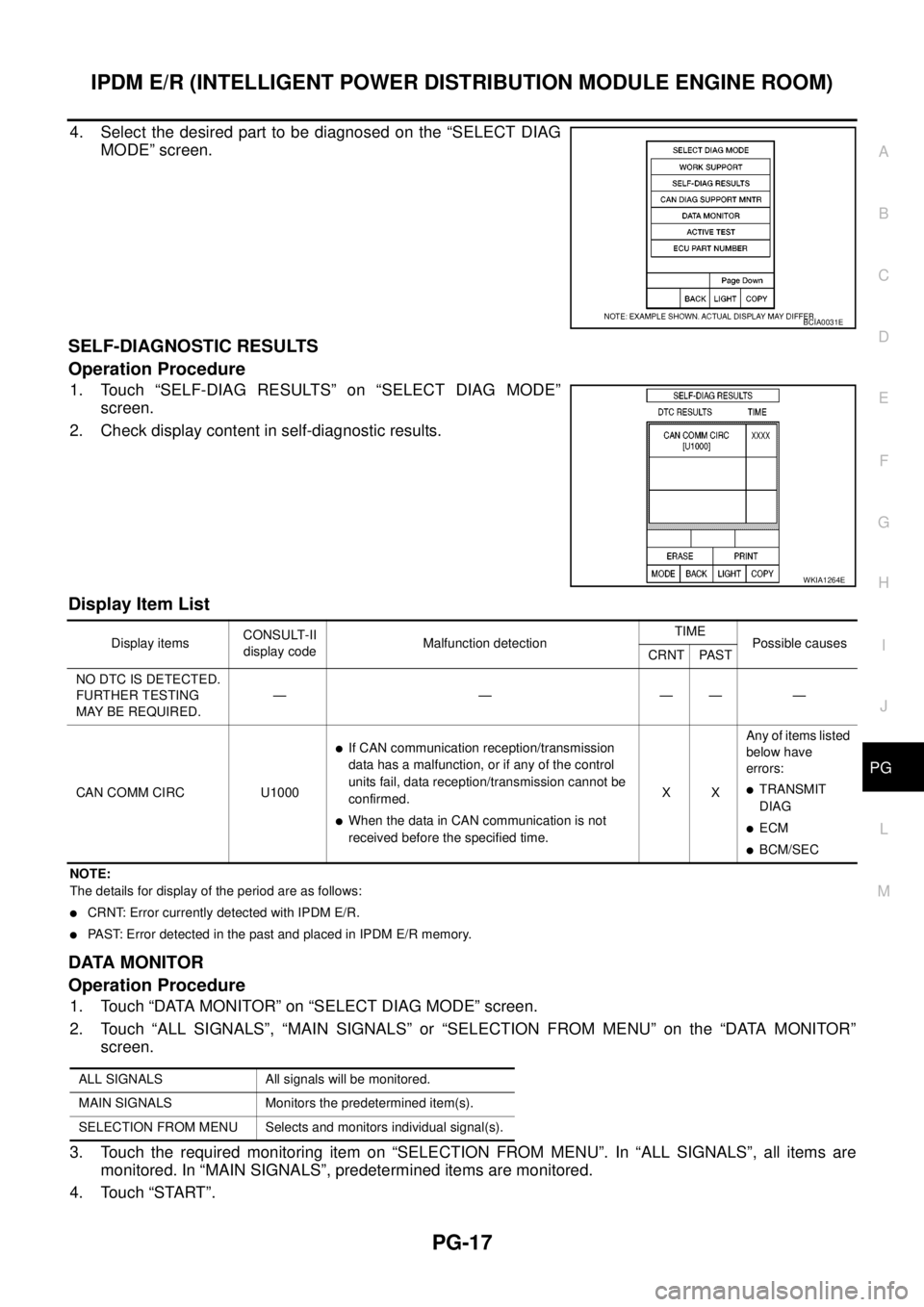
4. Select the desired part to be diagnosed on the “SELECT DIAG
MODE” screen.
SELF-DIAGNOSTIC RESULTS
Operation Procedure
1. Touch “SELF-DIAG RESULTS” on “SELECT DIAG MODE”
screen.
2. Check display content in self-diagnostic results.
Display Item List
NOTE:
The details for display of the period are as follows:
lCRNT: Error currently detected with IPDM E/R.
lPAST: Error detected in the past and placed in IPDM E/R memory.
DATA MONITOR
Operation Procedure
1. Touch “DATA MONITOR” on “SELECT DIAG MODE” screen.
2. Touch “ALL SIGNALS”, “MAIN SIGNALS” or “SELECTION FROM MENU” on the “DATA MONITOR”
screen.
3. Touch the required monitoring item on “SELECTION FROM MENU”. In “ALL SIGNALS”, all items are
monitored. In “MAIN SIGNALS”, predetermined items are monitored.
4. Touch “START”.
BCIA0031E
WKIA1264E
Display itemsCONSULT-II
display codeMalfunction detectionTIME
Possible causes
CRNT PAST
NO DTC IS DETECTED.
FURTHER TESTING
MAYBEREQUIRED.—————
CAN COMM CIRC U1000
lIf CAN communication reception/transmission
data has a malfunction, or if any of the control
units fail, data reception/transmission cannot be
confirmed.
lWhen the data in CAN communication is not
received before the specified time.XXAny of items listed
below have
errors:
lTRANSMIT
DIAG
lECM
lBCM/SEC
ALL SIGNALS All signals will be monitored.
MAIN SIGNALS Monitors the predetermined item(s).
SELECTION FROM MENU Selects and monitors individual signal(s).
Page 2627 of 3171

PR-12
SERVICE DATA AND SPECIFICATIONS (SDS)
SERVICE DATA AND SPECIFICATIONS (SDS)
PFP:00030
General SpecificationsEDS0035N
2WD Models
4WD Models
Snap RingEDS0035O
Model 2S1330
Unit: mm (in)
*Always check with the Parts Department for the latest parts information.
Model 2F S1300 and 3S S1310
Unit: mm (in)
*Always check with the Parts Department for the latest parts information.Applied modelYD25DDTi
6M/T 5A/T
Propeller shaft model 3S S1310
Number of joints3
Coupling method with rear final drive Flange type
Coupling method with transmission Sleeve type
1st Shaft length (Center bearing to spider) 675 mm (26.57 in) 742 mm (29.21 in)
2nd Shaft length (Spider to spider) 897 mm (35.31 in)
Shaft outer diameter 75.64 mm (2.9779 in)
Journal axial play 0.02 mm (0.0008 in) or less
Propeller shaft run out limit 0.6 mm (0.024 in) or less
Propeller shaft joint flex effort 1.96 N·m (0.20 kg-m, 17 in-lb) or less
Applied modelYD25DDTi
Propeller shaft modelFront Rear
2F S1300 2S1330 (aluminum tube)
Number of joints2
Coupling method with front final drive Flange type
Coupling method with transfer Flange type Sleeve type
Shaft length (Spider to spider) 718 mm (28.27 in) 1266.8 mm (35.51 in)
Shaft outer diameter 65 mm (2.56 in) 102.5 mm (2.97 in)
Journal axial play 0.02 mm (0.0008 in) or less
Propeller shaft run out limit 0.6 mm (0.024 in) or less 1.02 mm (0.0402 in) or less
Propeller shaft joint flex effort 1.96 N·m (0.20 kg-m, 17 in-lb) or less 2.26 N·m (0.23 kg-m, 20 in-lb) or less
Thickness Part number* Thickness Part number*
1.600 - 1.638 (0.0630 - 0.0645)
1.549 - 1.588 (0.0610 - 0.0625)37146-7S000
37147-7S0001.524 - 1.562 (0.0600 - 0.0615)
1.499 - 1.537 (0.0590 - 0.0605)37148-7S000
37149-7S000
Thickness Part number* Thickness Part number*
1.45 (0.0571)
1.50 (0.0591)
1.55 (0.0610)
1.60 (0.0630)37146 7F000
37147 7F000
37148 7F000
37149 7F0001.65 (0.0650)
1.70 (0.0669)
1.75 (0.0689)37150 7F000
37151 7F000
37152 7F000
Page 2690 of 3171
SUNROOF
RF-13
C
D
E
F
G
H
J
K
L
MA
B
RF
CAN Communication System DescriptionEIS00D4X
CAN (Controller Area Network) is a serial communication line for real time application. It is an on-vehicle mul-
tiplex communication line with high data communication speed and excellent error detection ability. Many elec-
tronic control units are equipped onto a vehicle, and each control unit shares information and links with other
control units during operation (not independent). In CAN communication, control units are connected with 2
communication lines (CAN H line, CAN L line) allowing a high rate of information transmission with less wiring.
Each control unit transmits/receives data but selectively reads required data only.
CAN Communication UnitEIS00D4Y
Refer toLAN-30, "CAN Communication Unit".
Page 2717 of 3171
![NISSAN NAVARA 2005 Repair Workshop Manual RFD-14
[WITH LIMITED SLIP DIFFERENTIAL]
REAR FINAL DRIVE ASSEMBLY
REAR FINAL DRIVE ASSEMBLY
PFP:38300
Removal and InstallationEDS00398
REMOVAL
1. Remove the rear propeller shaft. Refer toPR-8, "Remova](/img/5/57362/w960_57362-2716.png "NISSAN NAVARA 2005 Repair Workshop Manual RFD-14
[WITH LIMITED SLIP DIFFERENTIAL]
REAR FINAL DRIVE ASSEMBLY
REAR FINAL DRIVE ASSEMBLY
PFP:38300
Removal and InstallationEDS00398
REMOVAL
1. Remove the rear propeller shaft. Refer toPR-8, \"Remova")
RFD-14
[WITH LIMITED SLIP DIFFERENTIAL]
REAR FINAL DRIVE ASSEMBLY
REAR FINAL DRIVE ASSEMBLY
PFP:38300
Removal and InstallationEDS00398
REMOVAL
1. Remove the rear propeller shaft. Refer toPR-8, "Removal and Installation".
lPlug rear end of transmission or transfer.
2. Remove the axle shafts and back plate and torque members. Refer toRAX-7, "
Removal and Installation".
3. Disconnect the following components from the rear final drive.
lABS sensor wire harness
lRear cable (LH) and rear cable (RH)
lBrake hoses and brake tube
CAUTION:
Position the wire harness, cable and hoses away from the final drive assembly. Failure to do so
may result in components being damaged during rear axle assembly removal.
4. Support the rear final drive using a suitable jack.
5. Remove rear shock absorber lower bolts. Refer toRSU-6, "
Removal and Installation".
6. Remove leaf spring U-bolt nuts. Refer toRSU-7, "
Removal and Installation".
WARNING:
Support the rear final drive assembly using suitable jack before removing leaf spring U-bolt nuts.
7. Remove rear final drive assembly using suitable jack.
INSTALLATION
Installation is the reverse order of removal.
lWhen oil leaks while removing rear final drive assembly, check oil level after the installation. Refer to
RFD-9, "
Checking Differential Gear Oil".
lRefill brake fluid and bleed the air from the brake system. Refer toBR-11, "Bleeding Brake System".
Page 2746 of 3171
![NISSAN NAVARA 2005 Repair Workshop Manual DIFFERENTIAL LOCK SYSTEM
RFD-43
[WITH ELECTRONIC LOCKING DIFFERENTIAL]
C
E
F
G
H
I
J
K
L
MA
B
RFD
System DiagramEDS003AS
COMPONENTS FUNCTION DESCRIPTION
CAN CommunicationEDS003AT
SYSTEM DESCRIPTION
CA](/img/5/57362/w960_57362-2745.png "NISSAN NAVARA 2005 Repair Workshop Manual DIFFERENTIAL LOCK SYSTEM
RFD-43
[WITH ELECTRONIC LOCKING DIFFERENTIAL]
C
E
F
G
H
I
J
K
L
MA
B
RFD
System DiagramEDS003AS
COMPONENTS FUNCTION DESCRIPTION
CAN CommunicationEDS003AT
SYSTEM DESCRIPTION
CA")
DIFFERENTIAL LOCK SYSTEM
RFD-43
[WITH ELECTRONIC LOCKING DIFFERENTIAL]
C
E
F
G
H
I
J
K
L
MA
B
RFD
System DiagramEDS003AS
COMPONENTS FUNCTION DESCRIPTION
CAN CommunicationEDS003AT
SYSTEM DESCRIPTION
CAN (Controller Area Network) is a serial communication line for real time application. It is an on-vehicle mul-
tiplex communication line with high data communication speed and excellent error detection ability. Many elec-
tronic control units are equipped onto a vehicle, and each control unit shares information and links with other
control units during operation (not independent). In CAN communication, control units are connected with 2
communication lines (CAN H line, CAN L line) allowing a high rate of information transmission with less wiring.
Each control unit transmits/receives data but selectively reads required data only.
For details, refer toDI-65, "
CAN Communication Unit".
SDIA2500E
Component parts Function
Differential lock control unit
lControls differential lock solenoid and switches differential lock/unlock.
lAs a fail-safe function, differential lock disengages, if malfunction is detected in differential lock
system.
Differential lock solenoid Controls pressure plate by current from differential lock control unit.
Differential lock position switch Detects that differential is lock or unlock condition.
Differential lock mode switch Able to select differential lock or unlock.
DIFF LOCK indicator lamp Illuminates that differential is in lock or lock standby condition.
ABS actuator and electric unit
(control unit)Transmits the following signals via CAN communication to differential lock control unit.
lVehicle speed signal
Transfer control unitTransmits the following signal via CAN communication to differential lock control unit.
l4WD shift switch signal
Page 2784 of 3171
![NISSAN NAVARA 2005 Repair Workshop Manual REAR FINAL DRIVE ASSEMBLY
RFD-81
[WITH ELECTRONIC LOCKING DIFFERENTIAL]
C
E
F
G
H
I
J
K
L
MA
B
RFD
REAR FINAL DRIVE ASSEMBLYPFP:38300
Removal and InstallationEDS003BF
REMOVAL
1. Remove the rear propel](/img/5/57362/w960_57362-2783.png "NISSAN NAVARA 2005 Repair Workshop Manual REAR FINAL DRIVE ASSEMBLY
RFD-81
[WITH ELECTRONIC LOCKING DIFFERENTIAL]
C
E
F
G
H
I
J
K
L
MA
B
RFD
REAR FINAL DRIVE ASSEMBLYPFP:38300
Removal and InstallationEDS003BF
REMOVAL
1. Remove the rear propel")
REAR FINAL DRIVE ASSEMBLY
RFD-81
[WITH ELECTRONIC LOCKING DIFFERENTIAL]
C
E
F
G
H
I
J
K
L
MA
B
RFD
REAR FINAL DRIVE ASSEMBLYPFP:38300
Removal and InstallationEDS003BF
REMOVAL
1. Remove the rear propeller shaft. Refer toPR-8, "Removal and Installation".
lPlug rear end of transmission or transfer.
2. Remove the axle shafts and back plate and torque members. Refer toRAX-7, "
Removal and Installation".
3. Disconnect the following components from the rear final drive.
lABS sensor wire harness
lRear cable (LH) and rear cable (RH)
lBrake hoses and brake tube
lDifferential lock position switch harness connector
lDifferential lock solenoid harness connector
CAUTION:
Position the wire harness, cable and hoses away from the final drive assembly. Failure to do so
may result in components being damaged during rear axle assembly removal.
4. Support the rear final drive using a suitable jack.
5. Remove rear shock absorber lower bolts. Refer toRSU-6, "
Removal and Installation".
6. Remove leaf spring U-bolt nuts. Refer toRSU-7, "
Removal and Installation".
WARNING:
Support the rear final drive assembly using suitable jack before removing leaf spring U-bolt nuts.
7. Remove rear final drive assembly using suitable jack.
INSTALLATION
Installation is the reverse order of removal.
lWhen oil leaks while removing rear final drive assembly, check oil level after the installation. Refer to
RFD-40, "
Checking Differential Gear Oil".
lRefill brake fluid and bleed the air from the brake system. Refer toBR-11, "Bleeding Brake System".
lAfter the installation, check DIFF LOCK indicator lamp. Refer toRFD-33, "Precautions for Differential
Case Assembly and Differential Lock Control Unit Replacement".
Page 2864 of 3171
STARTING SYSTEM
SC-31
C
D
E
F
G
H
I
J
L
MA
B
SC
Removal and InstallationEKS00MZP
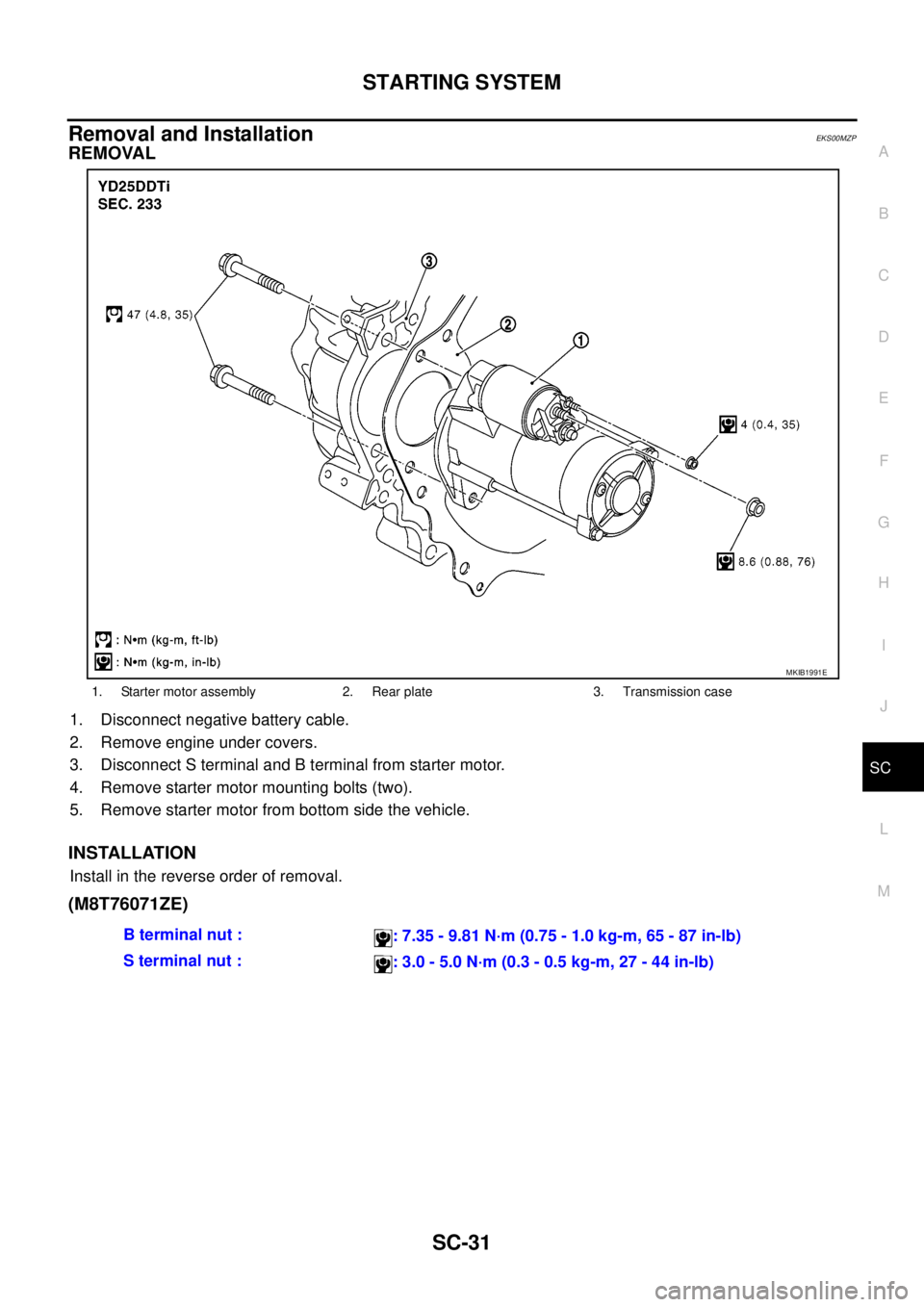
REMOVAL
1. Disconnect negative battery cable.
2. Remove engine under covers.
3. Disconnect S terminal and B terminal from starter motor.
4. Remove starter motor mounting bolts (two).
5. Remove starter motor from bottom side the vehicle.
INSTALLATION
Install in the reverse order of removal.
(M8T76071ZE)
1. Starter motor assembly 2. Rear plate 3. Transmission case
MKIB1991E
B terminal nut :
: 7.35 - 9.81 N·m (0.75 - 1.0 kg-m, 65 - 87 in-lb)
S terminal nut :
:3.0-5.0N·m(0.3-0.5kg-m,27-44in-lb)
Page 2985 of 3171
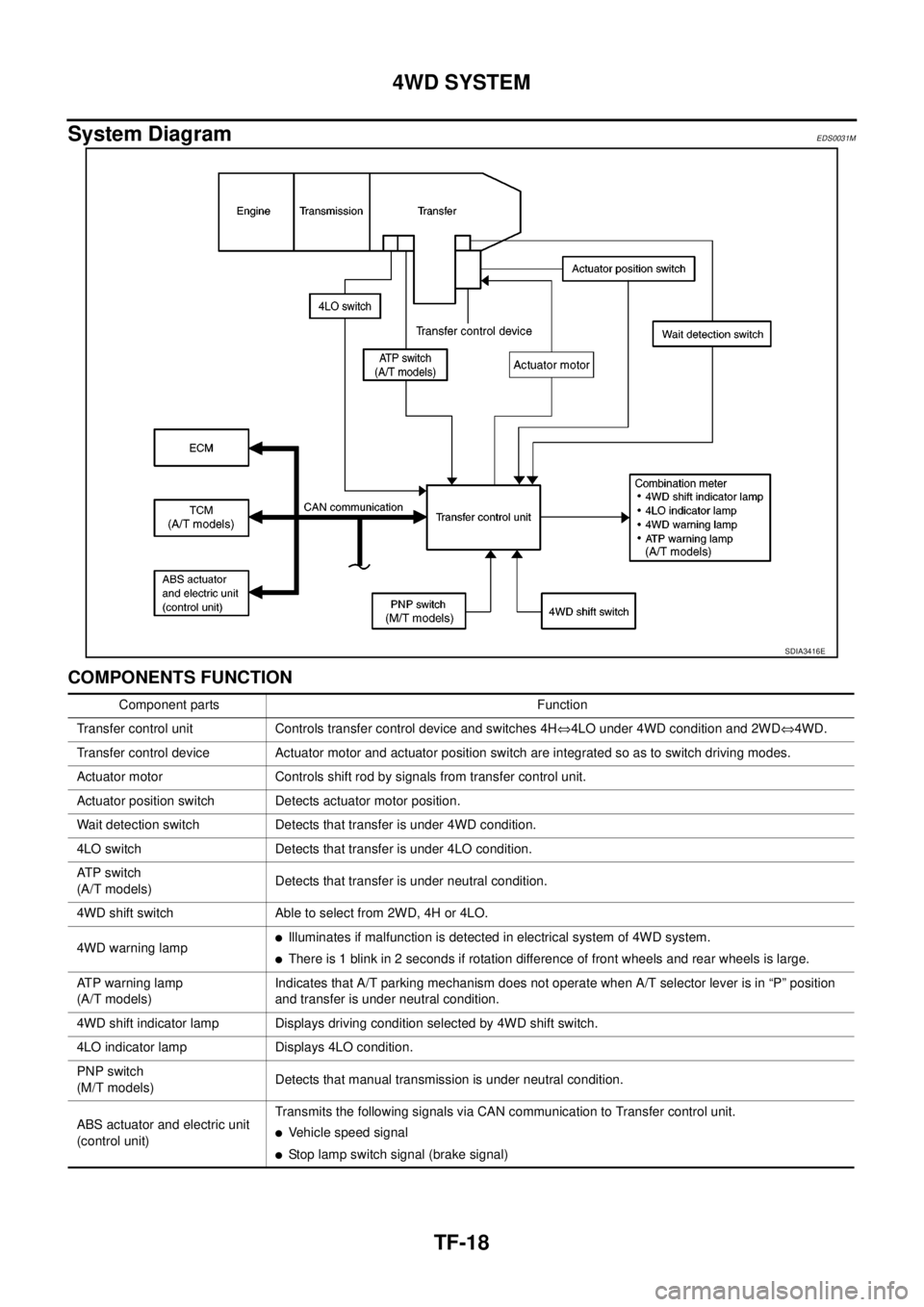
TF-18
4WD SYSTEM
System Diagram
EDS0031M
COMPONENTS FUNCTION
SDIA3416E
Component parts Function
Transfer control unit Controls transfer control device and switches 4HÛ4LO under 4WD condition and 2WDÛ4WD.
Transfer control device Actuator motor and actuator position switch are integrated so as to switch driving modes.
Actuator motor Controls shift rod by signals from transfer control unit.
Actuator position switch Detects actuator motor position.
Wait detection switch Detects that transfer is under 4WD condition.
4LO switch Detects that transfer is under 4LO condition.
AT P s w i t c h
(A/T models)Detects that transfer is under neutral condition.
4WD shift switch Able to select from 2WD, 4H or 4LO.
4WD warning lamp
lIlluminates if malfunction is detected in electrical system of 4WD system.
lThere is 1 blink in 2 seconds if rotation difference of front wheels and rear wheels is large.
ATP warning lamp
(A/T models)Indicates that A/T parking mechanism does not operate when A/T selector lever is in “P” position
and transfer is under neutral condition.
4WD shift indicator lamp Displays driving condition selected by 4WD shift switch.
4LO indicator lamp Displays 4LO condition.
PNP switch
(M/T models)Detects that manual transmission is under neutral condition.
ABS actuator and electric unit
(control unit)Transmits the following signals via CAN communication to Transfer control unit.
lVehicle speed signal
lStop lamp switch signal (brake signal)
Page 2986 of 3171
4WD SYSTEM
TF-19
C
E
F
G
H
I
J
K
L
MA
B
TF
CAN CommunicationEDS0031N
SYSTEM DESCRIPTION
CAN (Controller Area Network) is a serial communication line for real time application. It is an on-vehicle mul-
tiplex communication line with high data communication speed and excellent error detection ability. Many elec-
tronic control units are equipped onto a vehicle, and each control unit shares information and links with other
control units during operation (not independent). In CAN communication, control units are connected with 2
communication lines (CAN H line, CAN L line) allowing a high rate of information transmission with less wiring.
Each control unit transmits/receives data but selectively reads required data only.
For details, refer toLAN-23, "
CAN COMMUNICATION".
TCM
(A/T models)Transmits the following signal via CAN communication to Transfer control unit.lOutput shaft revolution signal
lA/T position indicator signal (PNP switch signal)
ECMTransmits engine speed signal via CAN communication to Transfer control unit.
lEngine speed signal Component parts Function