tow NISSAN NAVARA 2005 Repair Owner's Manual
[x] Cancel search | Manufacturer: NISSAN, Model Year: 2005, Model line: NAVARA, Model: NISSAN NAVARA 2005Pages: 3171, PDF Size: 49.59 MB
Page 1433 of 3171
![NISSAN NAVARA 2005 Repair Owners Manual FUEL PUMP
EM-51
C
D
E
F
G
H
I
J
K
L
MA
EM
8. Using the sprocket holder [SST], hold fuel pump sprocket to pre-
vent falling.
lFor sprocket holder, use KV11106060 machined as shown in
the figure, becaus](/img/5/57362/w960_57362-1432.png "NISSAN NAVARA 2005 Repair Owners Manual FUEL PUMP
EM-51
C
D
E
F
G
H
I
J
K
L
MA
EM
8. Using the sprocket holder [SST], hold fuel pump sprocket to pre-
vent falling.
lFor sprocket holder, use KV11106060 machined as shown in
the figure, becaus")
FUEL PUMP
EM-51
C
D
E
F
G
H
I
J
K
L
MA
EM
8. Using the sprocket holder [SST], hold fuel pump sprocket to pre-
vent falling.
lFor sprocket holder, use KV11106060 machined as shown in
the figure, because the previous bore is not fitting.
lWhen the sprocket holder is installed, if the positioning stop-
per pin [SST] interferes, pull out the positioning stopper pin
approximately 10 mm (0.39 in), then install it.
lAfter the sprocket holder is installed temporarily, tighten the
sprocket holder after making extension bar and TORX socket
(size: E10) (commercial service tool) insert into the machined
bore.
lThe length of the sprocket holder mounting bolts should be
approximately 15 mm (0.59 in) (M6 thread length).
lMake sure that the a- and b-faces of the sprocket holder con-
tact the bottom side of the sprocket (small diameter side).
CAUTION:
Do not remove the sprocket holder [SST] until fuel pump is installed.
lAfter the sprocket holder is installed, pull out the positioning
stopper pin from fuel pump sprocket.
9. Using the extension bar and the TORX socket (size: E10) (com-
mercial service tool), remove the tightening bolts.
CAUTION:
Do not disassemble or adjust fuel pump.
10. Remove the fuel pump toward the rear of engine.
CAUTION:
For removal, be careful not to drop the seal washer into the engine.
NOTE:
The seal washer of the tightening bolts cannot be reused.
11. Remove adjusting shim.
12. Attach a suitable tool in the M8 bolt hole on coupling.
SBIA0217E
PBIC2534E
MBIA0075E
PBIC2405E
Page 1481 of 3171
CYLINDER HEAD
EM-99
C
D
E
F
G
H
I
J
K
L
MA
EM
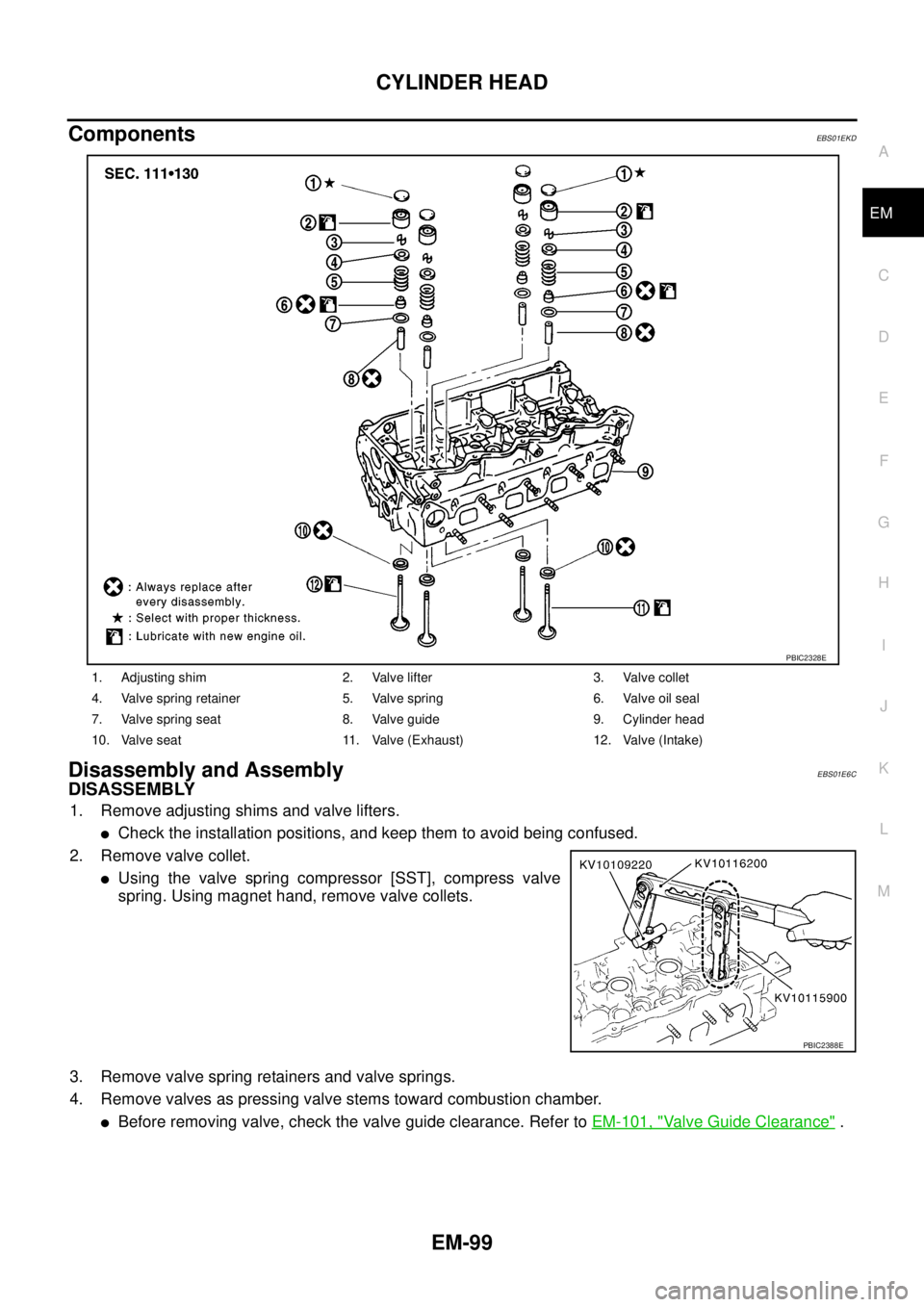
ComponentsEBS01EKD
Disassembly and AssemblyEBS01E6C
DISASSEMBLY
1. Remove adjusting shims and valve lifters.
lCheck the installation positions, and keep them to avoid being confused.
2. Remove valve collet.
lUsing the valve spring compressor [SST], compress valve
spring. Using magnet hand, remove valve collets.
3. Remove valve spring retainers and valve springs.
4. Remove valves as pressing valve stems toward combustion chamber.
lBefore removing valve, check the valve guide clearance. Refer toEM-101, "Valve Guide Clearance".
1. Adjusting shim 2. Valve lifter 3. Valve collet
4. Valve spring retainer 5. Valve spring 6. Valve oil seal
7. Valve spring seat 8. Valve guide 9. Cylinder head
10. Valve seat 11. Valve (Exhaust) 12. Valve (Intake)
PBIC2328E
PBIC2388E
Page 1498 of 3171
EM-116
CYLINDER BLOCK
7. Install main bearing caps.
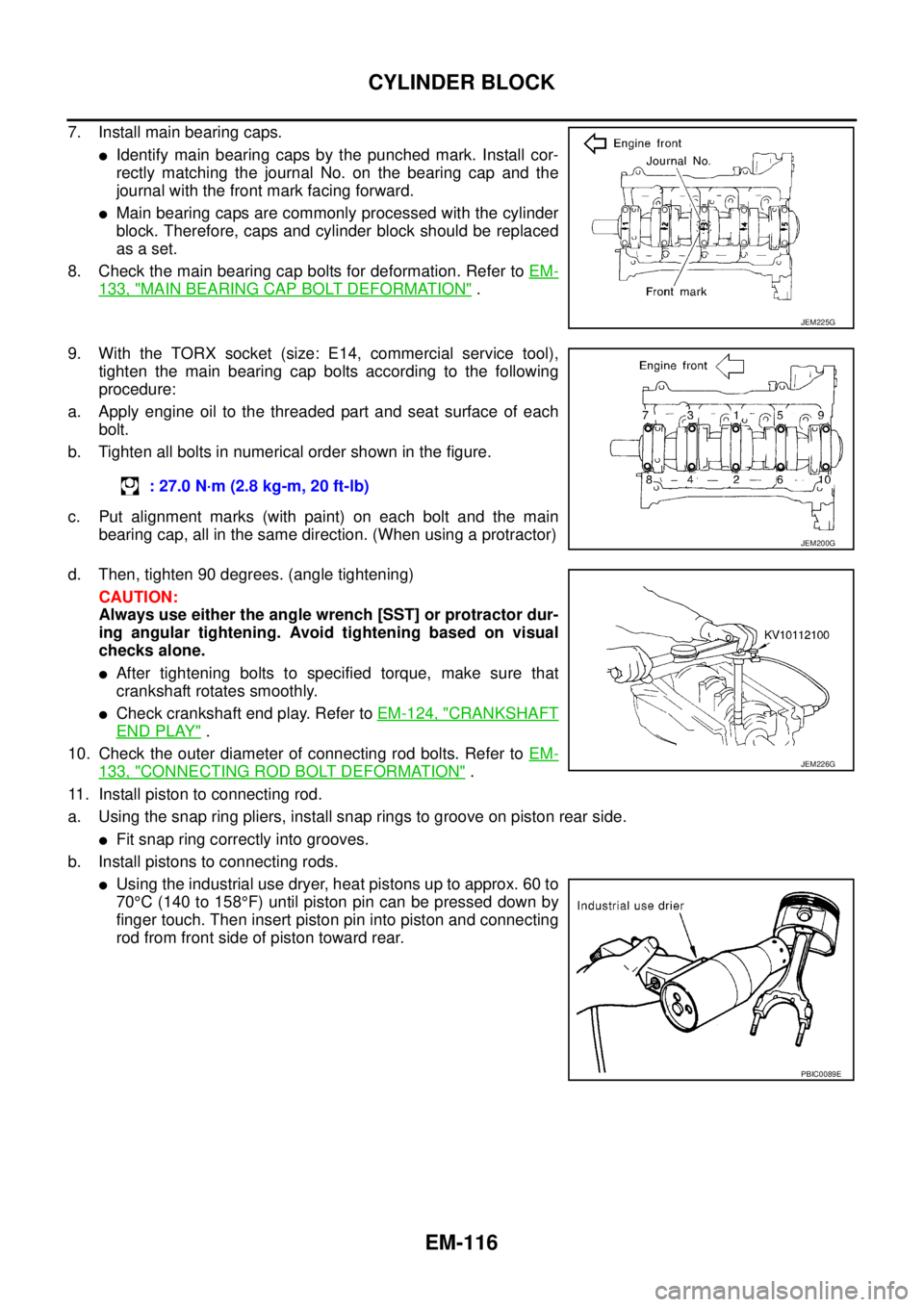
lIdentify main bearing caps by the punched mark. Install cor-
rectly matching the journal No. on the bearing cap and the
journal with the front mark facing forward.
lMain bearing caps are commonly processed with the cylinder
block. Therefore, caps and cylinder block should be replaced
as a set.
8. Check the main bearing cap bolts for deformation. Refer toEM-
133, "MAIN BEARING CAP BOLT DEFORMATION".
9. With the TORX socket (size: E14, commercial service tool),
tighten the main bearing cap bolts according to the following
procedure:
a. Apply engine oil to the threaded part and seat surface of each
bolt.
b. Tighten all bolts in numerical order shown in the figure.
c. Put alignment marks (with paint) on each bolt and the main
bearing cap, all in the same direction. (When using a protractor)
d. Then, tighten 90 degrees. (angle tightening)
CAUTION:
Always use either the angle wrench [SST] or protractor dur-
ing angular tightening. Avoid tightening based on visual
checks alone.
lAfter tightening bolts to specified torque, make sure that
crankshaft rotates smoothly.
lCheck crankshaft end play. Refer toEM-124, "CRANKSHAFT
END PLAY".
10. Check the outer diameter of connecting rod bolts. Refer toEM-
133, "CONNECTING ROD BOLT DEFORMATION".
11. Install piston to connecting rod.
a. Using the snap ring pliers, install snap rings to groove on piston rear side.
lFit snap ring correctly into grooves.
b. Install pistons to connecting rods.
lUsing the industrial use dryer, heat pistons up to approx. 60 to
70°C(140to158°F) until piston pin can be pressed down by
finger touch. Then insert piston pin into piston and connecting
rod from front side of piston toward rear.
JEM225G
: 27.0 N·m (2.8 kg-m, 20 ft-lb)
JEM200G
JEM226G
PBIC0089E
Page 1499 of 3171
CYLINDER BLOCK
EM-117
C
D
E
F
G
H
I
J
K
L
MA
EM
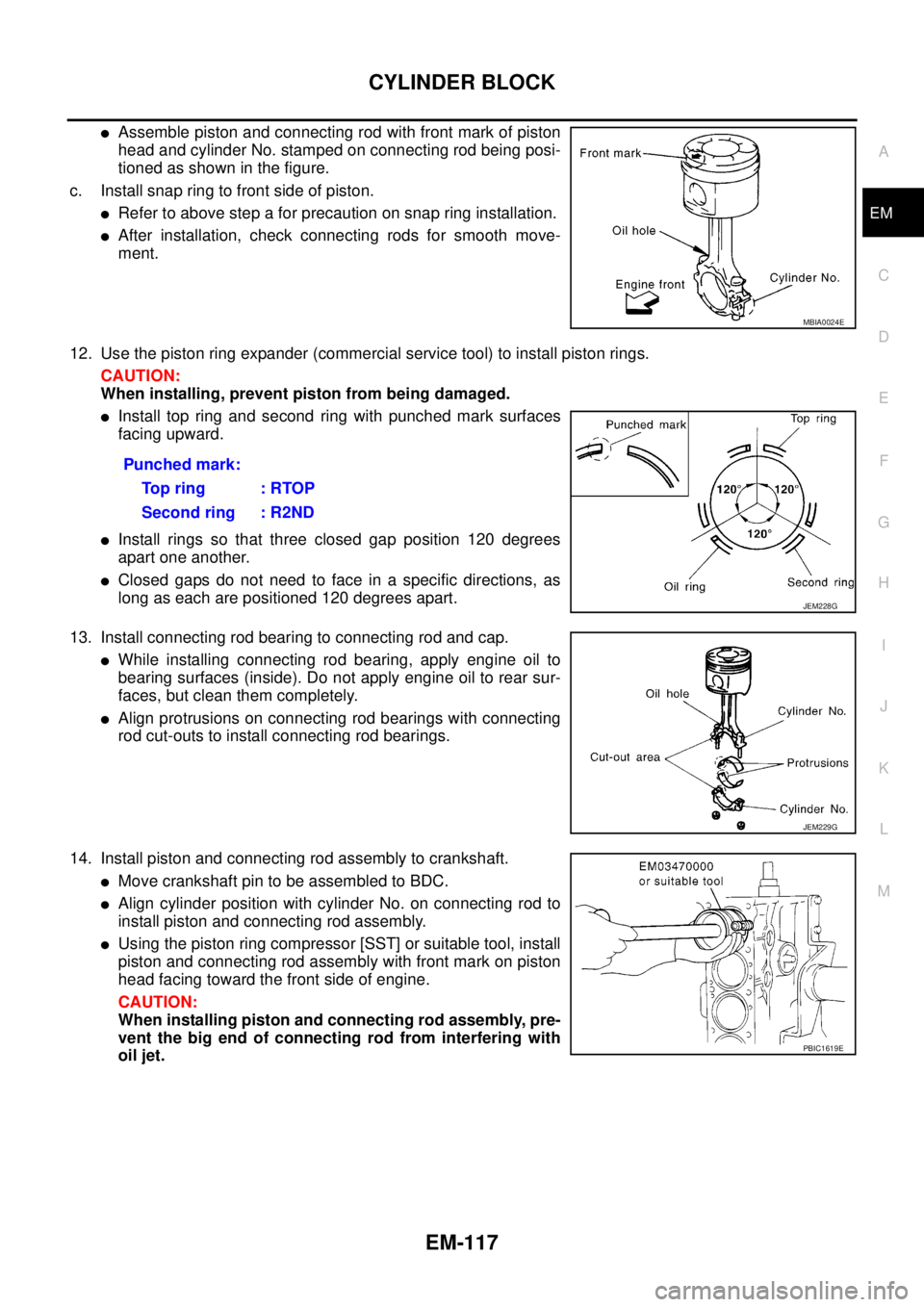
lAssemble piston and connecting rod with front mark of piston
head and cylinder No. stamped on connecting rod being posi-
tioned as shown in the figure.
c. Install snap ring to front side of piston.
lRefer to above step a for precaution on snap ring installation.
lAfter installation, check connecting rods for smooth move-
ment.
12. Use the piston ring expander (commercial service tool) to install piston rings.
CAUTION:
When installing, prevent piston from being damaged.
lInstall top ring and second ring with punched mark surfaces
facing upward.
lInstall rings so that three closed gap position 120 degrees
apart one another.
lClosed gaps do not need to face in a specific directions, as
long as each are positioned 120 degrees apart.
13. Install connecting rod bearing to connecting rod and cap.
lWhile installing connecting rod bearing, apply engine oil to
bearing surfaces (inside). Do not apply engine oil to rear sur-
faces, but clean them completely.
lAlign protrusions on connecting rod bearings with connecting
rod cut-outs to install connecting rod bearings.
14. Install piston and connecting rod assembly to crankshaft.
lMove crankshaft pin to be assembled to BDC.
lAlign cylinder position with cylinder No. on connecting rod to
install piston and connecting rod assembly.
lUsing the piston ring compressor [SST] or suitable tool, install
piston and connecting rod assembly with front mark on piston
head facing toward the front side of engine.
CAUTION:
When installing piston and connecting rod assembly, pre-
vent the big end of connecting rod from interfering with
oil jet.
MBIA0024E
Punched mark:
To p r i n g : R TO P
Second ring : R2ND
JEM228G
JEM229G
PBIC1619E
Page 1500 of 3171
EM-118
CYLINDER BLOCK
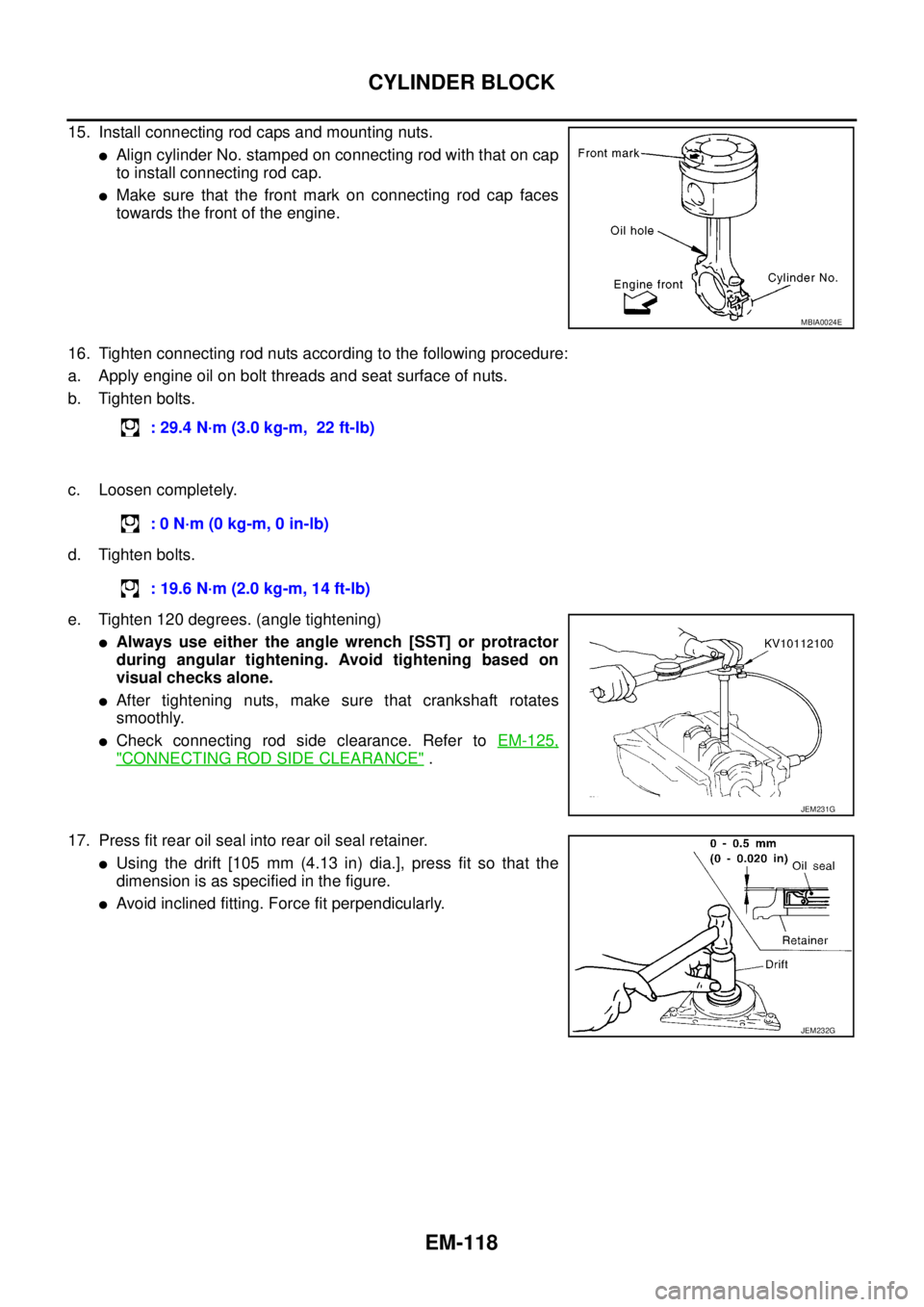
15. Install connecting rod caps and mounting nuts.
lAlign cylinder No. stamped on connecting rod with that on cap
to install connecting rod cap.
lMake sure that the front mark on connecting rod cap faces
towards the front of the engine.
16. Tighten connecting rod nuts according to the following procedure:
a. Apply engine oil on bolt threads and seat surface of nuts.
b. Tighten bolts.
c. Loosen completely.
d. Tighten bolts.
e. Tighten 120 degrees. (angle tightening)
lAlways use either the angle wrench [SST] or protractor
during angular tightening. Avoid tightening based on
visual checks alone.
lAfter tightening nuts, make sure that crankshaft rotates
smoothly.
lCheck connecting rod side clearance. Refer toEM-125,
"CONNECTING ROD SIDE CLEARANCE".
17. Press fit rear oil seal into rear oil seal retainer.
lUsing the drift [105 mm (4.13 in) dia.], press fit so that the
dimension is as specified in the figure.
lAvoid inclined fitting. Force fit perpendicularly.
MBIA0024E
: 29.4 N·m (3.0 kg-m, 22 ft-lb)
:0N·m(0kg-m,0in-lb)
: 19.6 N·m (2.0 kg-m, 14 ft-lb)
JEM231G
JEM232G
Page 1538 of 3171
FAX-6
WHEEL HUB
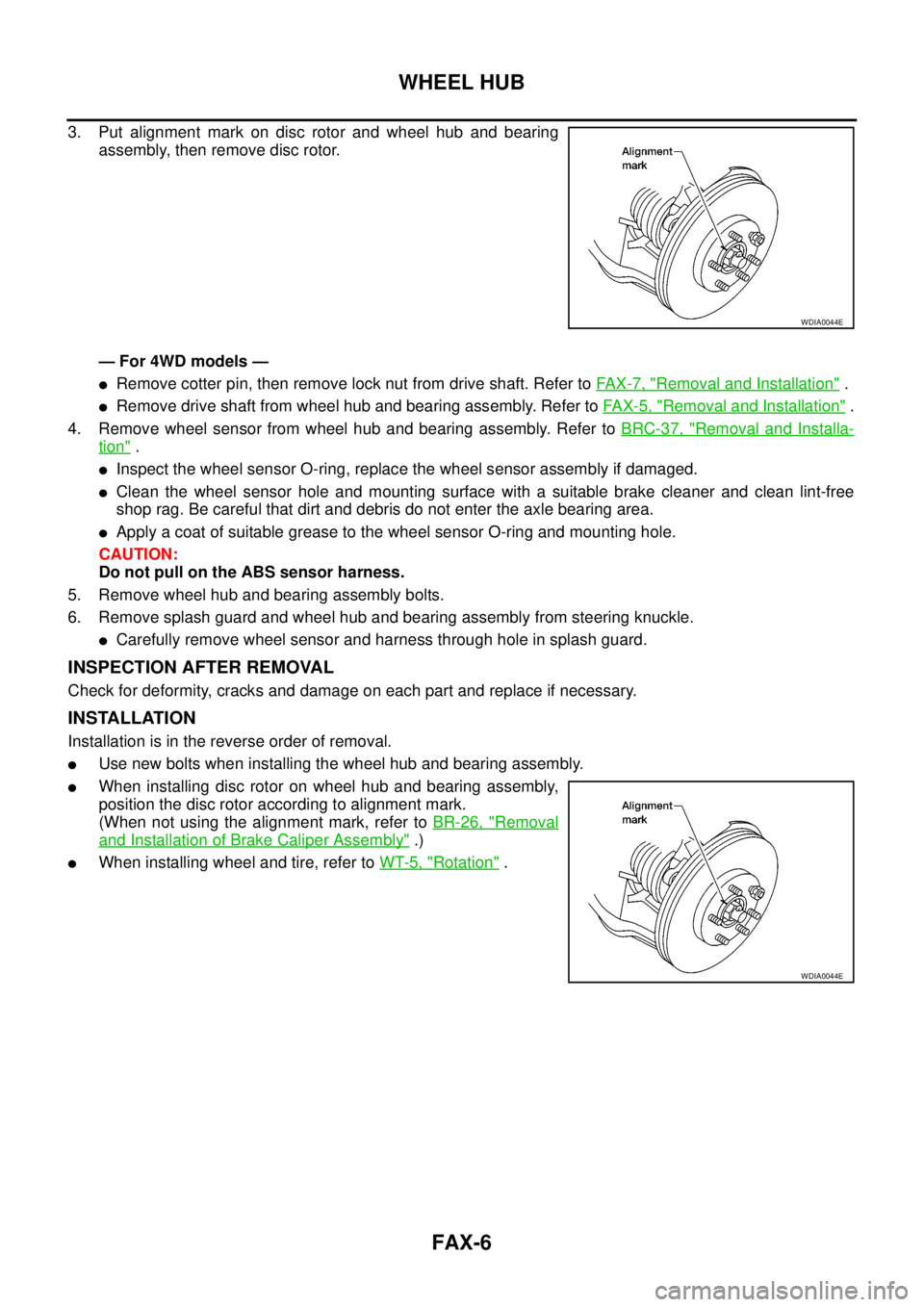
3. Put alignment mark on disc rotor and wheel hub and bearing
assembly, then remove disc rotor.
— For 4WD models —
lRemove cotter pin, then remove lock nut from drive shaft. Refer toFA X - 7 , "Removal and Installation".
lRemove drive shaft from wheel hub and bearing assembly. Refer toFAX-5, "Removal and Installation".
4. Remove wheel sensor from wheel hub and bearing assembly. Refer toBRC-37, "
Removal and Installa-
tion".
lInspect the wheel sensor O-ring, replace the wheel sensor assembly if damaged.
lClean the wheel sensor hole and mounting surface with a suitable brake cleaner and clean lint-free
shop rag. Be careful that dirt and debris do not enter the axle bearing area.
lApply a coat of suitable grease to the wheel sensor O-ring and mounting hole.
CAUTION:
Do not pull on the ABS sensor harness.
5. Remove wheel hub and bearing assembly bolts.
6. Remove splash guard and wheel hub and bearing assembly from steering knuckle.
lCarefully remove wheel sensor and harness through hole in splash guard.
INSPECTION AFTER REMOVAL
Check for deformity, cracks and damage on each part and replace if necessary.
INSTALLATION
Installation is in the reverse order of removal.
lUse new bolts when installing the wheel hub and bearing assembly.
lWhen installing disc rotor on wheel hub and bearing assembly,
position the disc rotor according to alignment mark.
(When not using the alignment mark, refer toBR-26, "
Removal
and Installation of Brake Caliper Assembly".)
lWhen installing wheel and tire, refer toWT-5, "Rotation".
WDIA0044E
WDIA0044E
Page 1541 of 3171
DRIVE SHAFT
FAX-9
C
E
F
G
H
I
J
K
L
MA
B
FA X
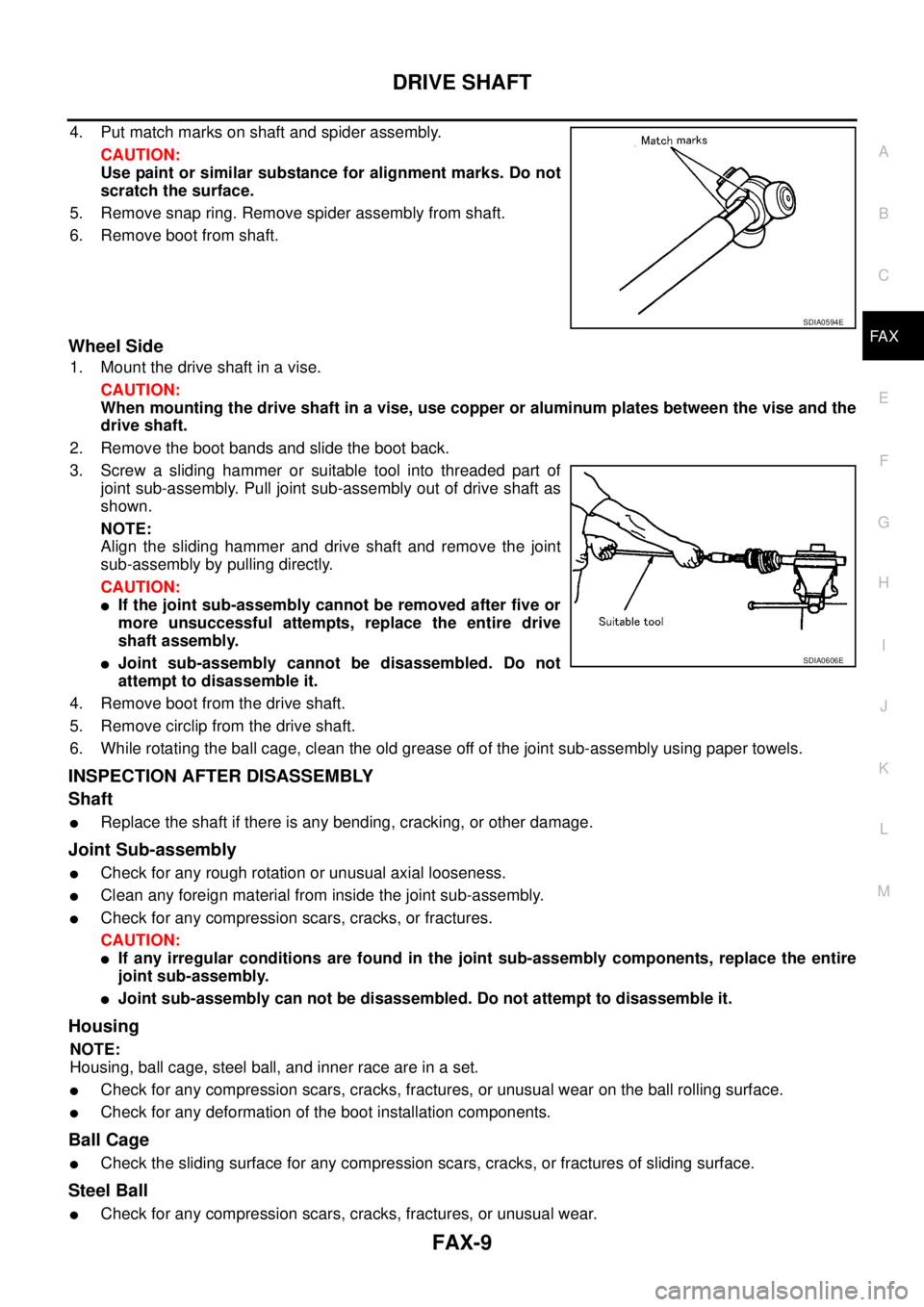
4. Put match marks on shaft and spider assembly.
CAUTION:
Use paint or similar substance for alignment marks. Do not
scratch the surface.
5. Remove snap ring. Remove spider assembly from shaft.
6. Remove boot from shaft.
Wheel Side
1. Mount the drive shaft in a vise.
CAUTION:
When mounting the drive shaft in a vise, use copper or aluminum plates between the vise and the
drive shaft.
2. Remove the boot bands and slide the boot back.
3. Screw a sliding hammer or suitable tool into threaded part of
joint sub-assembly. Pull joint sub-assembly out of drive shaft as
shown.
NOTE:
Align the sliding hammer and drive shaft and remove the joint
sub-assembly by pulling directly.
CAUTION:
lIf the joint sub-assembly cannot be removed after five or
more unsuccessful attempts, replace the entire drive
shaft assembly.
lJoint sub-assembly cannot be disassembled. Do not
attempt to disassemble it.
4. Remove boot from the drive shaft.
5. Remove circlip from the drive shaft.
6. While rotating the ball cage, clean the old grease off of the joint sub-assembly using paper towels.
INSPECTION AFTER DISASSEMBLY
Shaft
lReplace the shaft if there is any bending, cracking, or other damage.
Joint Sub-assembly
lCheck for any rough rotation or unusual axial looseness.
lClean any foreign material from inside the joint sub-assembly.
lCheck for any compression scars, cracks, or fractures.
CAUTION:
lIf any irregular conditions are found in the joint sub-assembly components, replace the entire
joint sub-assembly.
lJoint sub-assembly can not be disassembled. Do not attempt to disassemble it.
Housing
NOTE:
Housing, ball cage, steel ball, and inner race are in a set.
lCheck for any compression scars, cracks, fractures, or unusual wear on the ball rolling surface.
lCheck for any deformation of the boot installation components.
Ball Cage
lCheck the sliding surface for any compression scars, cracks, or fractures of sliding surface.
Steel Ball
lCheck for any compression scars, cracks, fractures, or unusual wear.
SDIA0594E
SDIA0606E
Page 1558 of 3171
FFD-12
FRONT OIL SEAL
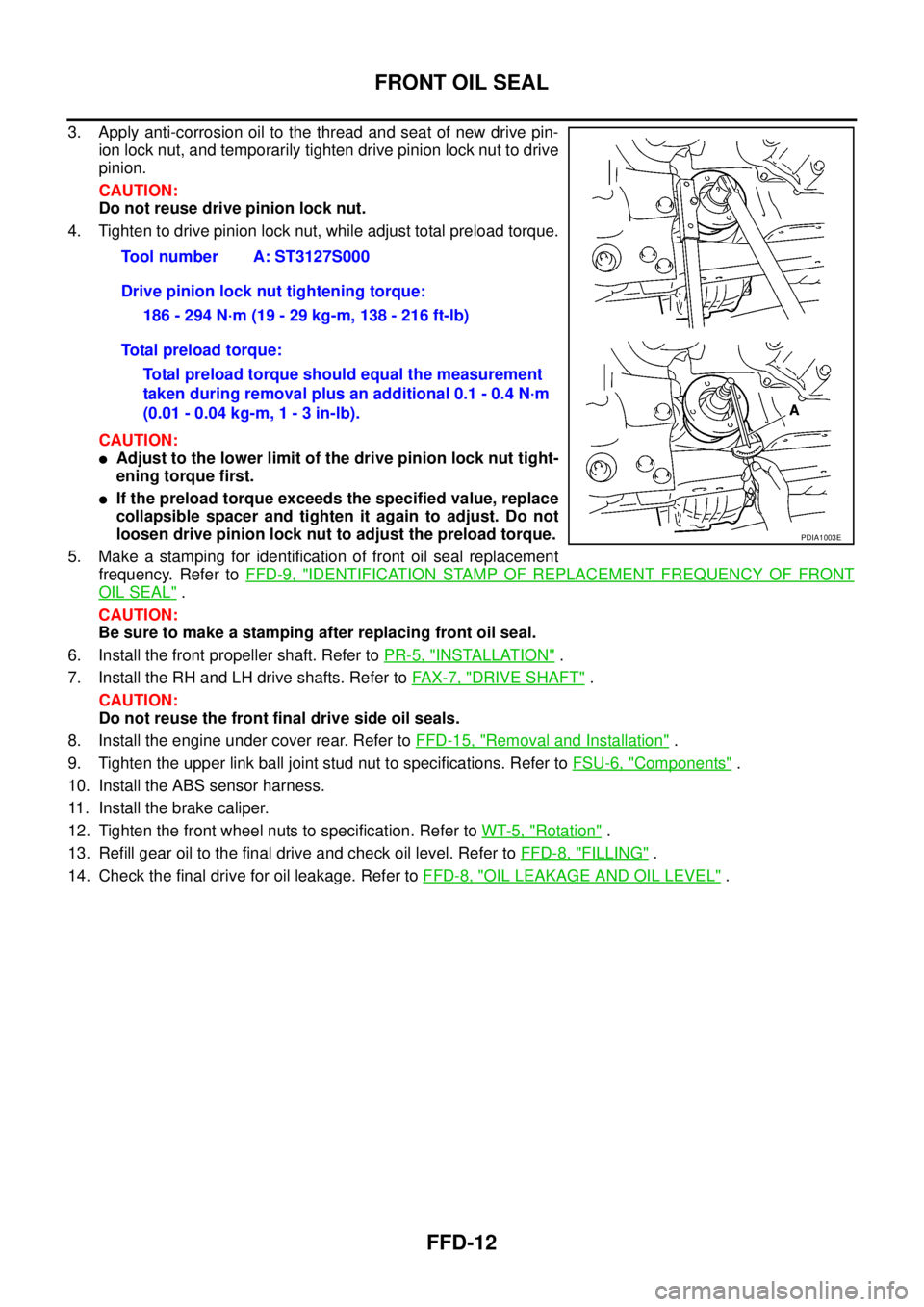
3. Apply anti-corrosion oil to the thread and seat of new drive pin-
ion lock nut, and temporarily tighten drive pinion lock nut to drive
pinion.
CAUTION:
Do not reuse drive pinion lock nut.
4. Tighten to drive pinion lock nut, while adjust total preload torque.
CAUTION:
lAdjust to the lower limit of the drive pinion lock nut tight-
ening torque first.
lIf the preload torque exceeds the specified value, replace
collapsible spacer and tighten it again to adjust. Do not
loosen drive pinion lock nut to adjust the preload torque.
5. Make a stamping for identification of front oil seal replacement
frequency. Refer toFFD-9, "
IDENTIFICATION STAMP OF REPLACEMENT FREQUENCY OF FRONT
OIL SEAL".
CAUTION:
Be sure to make a stamping after replacing front oil seal.
6. Install the front propeller shaft. Refer toPR-5, "
INSTALLATION".
7. Install the RH and LH drive shafts. Refer toFA X - 7 , "
DRIVE SHAFT".
CAUTION:
Do not reuse the front final drive side oil seals.
8. Install the engine under cover rear. Refer toFFD-15, "
Removal and Installation".
9. Tighten the upper link ball joint stud nut to specifications. Refer toFSU-6, "
Components".
10. Install the ABS sensor harness.
11. Install the brake caliper.
12. Tighten the front wheel nuts to specification. Refer toWT-5, "
Rotation".
13. Refill gear oil to the final drive and check oil level. Refer toFFD-8, "
FILLING".
14. Check the final drive for oil leakage. Refer toFFD-8, "
OIL LEAKAGE AND OIL LEVEL". Tool number A: ST3127S000
Drive pinion lock nut tightening torque:
186 - 294 N·m (19 - 29 kg-m, 138 - 216 ft-lb)
Total preload torque:
Total preload torque should equal the measurement
taken during removal plus an additional 0.1 - 0.4 N·m
(0.01 - 0.04 kg-m, 1 - 3 in-lb).
PDIA1003E
Page 1559 of 3171
SIDE OIL SEAL
FFD-13
C
E
F
G
H
I
J
K
L
MA
B
FFD
SIDE OIL SEALPFP:33142
Removal and InstallationEDS00354
REMOVAL
1. Remove the front wheels and tires using power tool.
2. Without disassembling the hydraulic lines, remove the caliper torque member bolts using power tool.
Then reposition the brake caliper aside using suitable wire. Refer toBR-26, "
Removal and Installation of
Brake Caliper Assembly".
CAUTION:
Do not press the brake pedal while brake caliper is removed.
3. Remove the ABS sensor harness from the mount on the knuckle.
CAUTION:
Do not pull on the ABS sensor harness.
4. Support the lower link using a suitable jack.
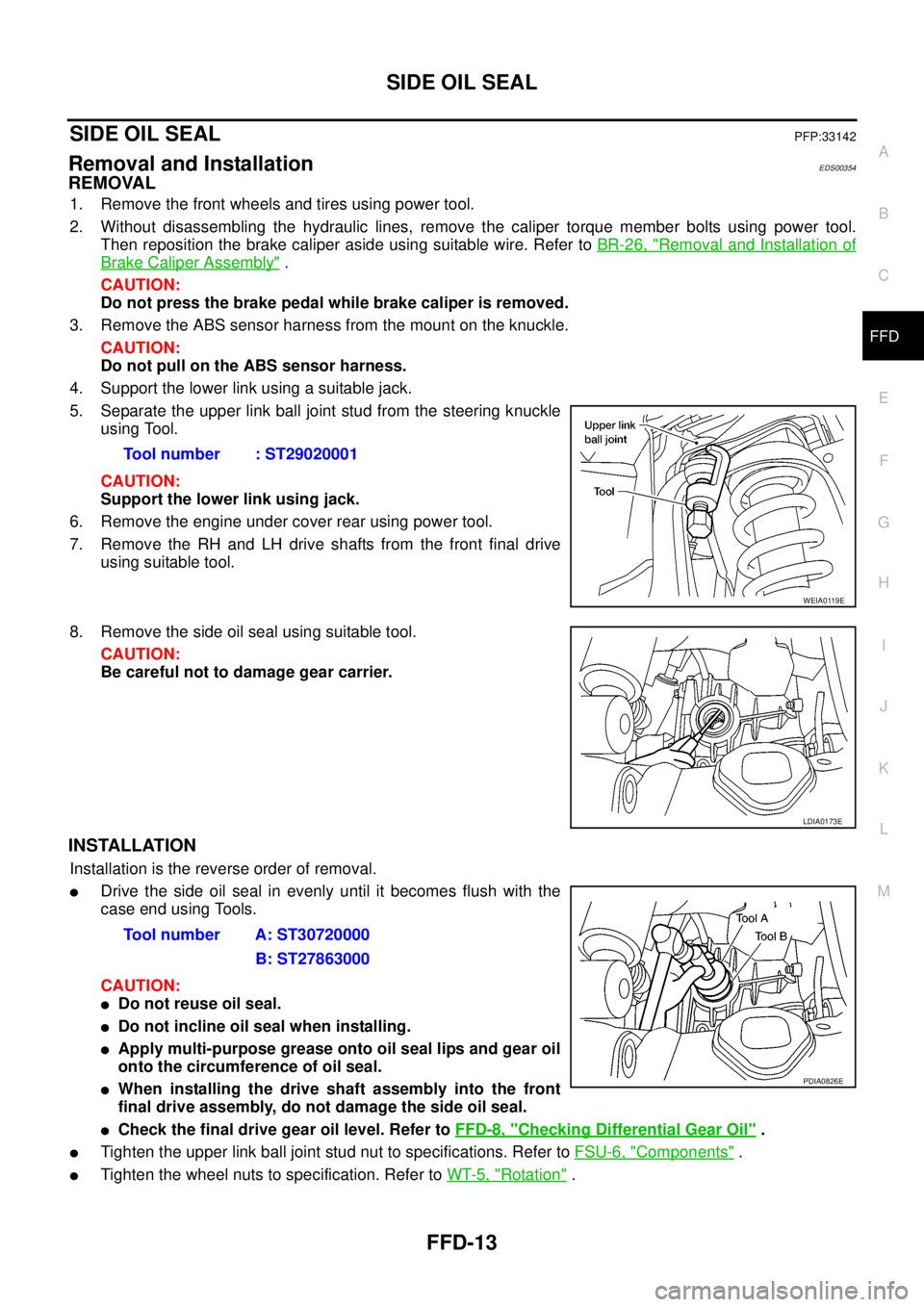
5. Separate the upper link ball joint stud from the steering knuckle
using Tool.
CAUTION:
Support the lower link using jack.
6. Remove the engine under cover rear using power tool.
7. Remove the RH and LH drive shafts from the front final drive
using suitable tool.
8. Remove the side oil seal using suitable tool.
CAUTION:
Be careful not to damage gear carrier.
INSTALLATION
Installation is the reverse order of removal.
lDrive the side oil seal in evenly until it becomes flush with the
case end using Tools.
CAUTION:
lDo not reuse oil seal.
lDo not incline oil seal when installing.
lApply multi-purpose grease onto oil seal lips and gear oil
onto the circumference of oil seal.
lWhen installing the drive shaft assembly into the front
final drive assembly, do not damage the side oil seal.
lCheck the final drive gear oil level. Refer toFFD-8, "Checking Differential Gear Oil".
lTighten the upper link ball joint stud nut to specifications. Refer toFSU-6, "Components".
lTighten the wheel nuts to specification. Refer toWT-5, "Rotation". Tool number : ST29020001
WEIA0119E
LDIA0173E
Tool number A: ST30720000
B: ST27863000
PDIA0826E
Page 1562 of 3171
FFD-16
FRONT FINAL DRIVE ASSEMBLY
CAUTION:
Do not pull on the ABS sensor harness.
4. Support the lower link using a suitable jack.
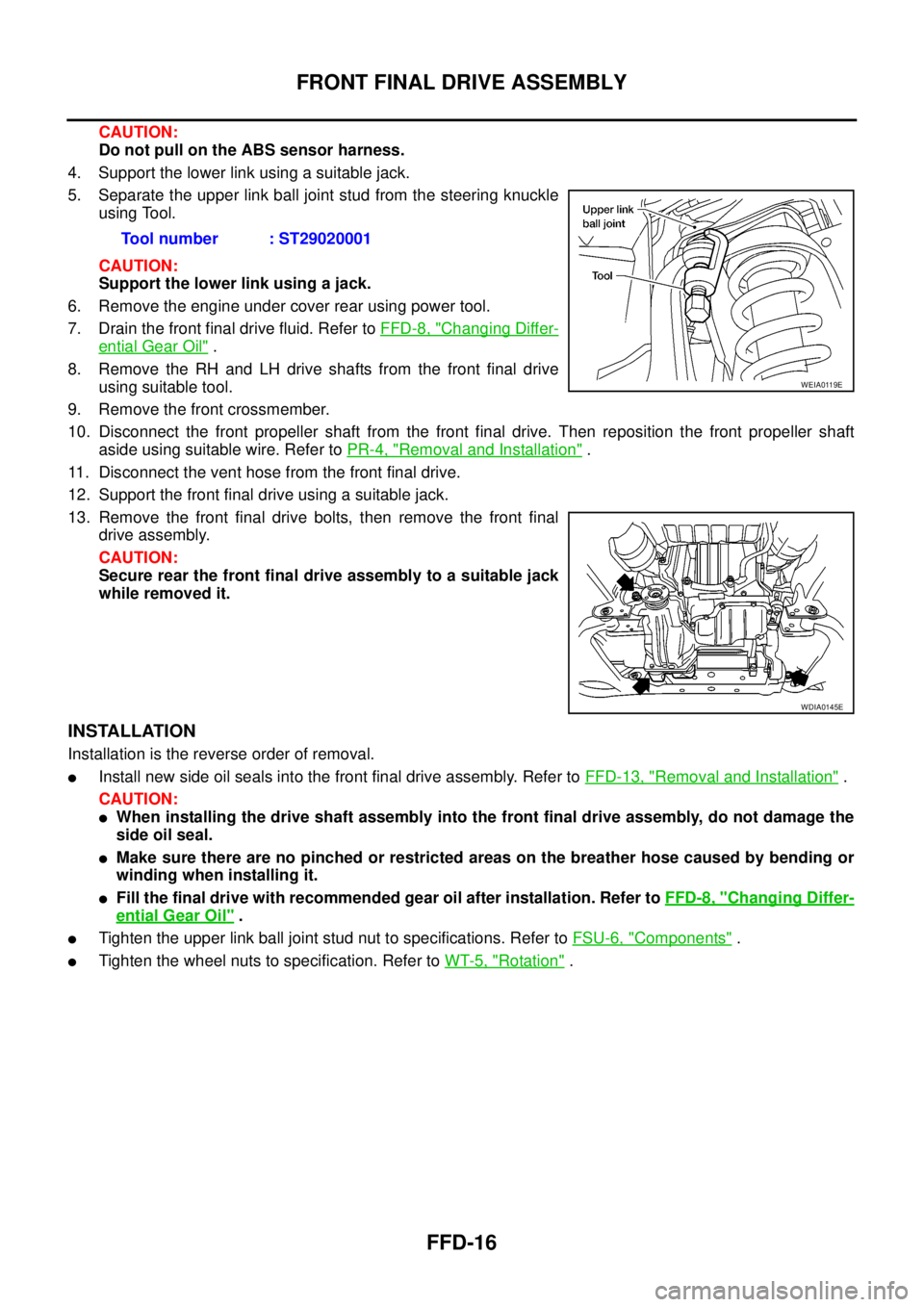
5. Separate the upper link ball joint stud from the steering knuckle
using Tool.
CAUTION:
Support the lower link using a jack.
6. Remove the engine under cover rear using power tool.
7. Drain the front final drive fluid. Refer toFFD-8, "
Changing Differ-
ential Gear Oil".
8. Remove the RH and LH drive shafts from the front final drive
using suitable tool.
9. Remove the front crossmember.
10. Disconnect the front propeller shaft from the front final drive. Then reposition the front propeller shaft
aside using suitable wire. Refer toPR-4, "
Removal and Installation".
11. Disconnect the vent hose from the front final drive.
12. Support the front final drive using a suitable jack.
13. Remove the front final drive bolts, then remove the front final
drive assembly.
CAUTION:
Secure rear the front final drive assembly to a suitable jack
while removed it.
INSTALLATION
Installation is the reverse order of removal.
lInstall new side oil seals into the front final drive assembly. Refer toFFD-13, "Removal and Installation".
CAUTION:
lWhen installing the drive shaft assembly into the front final drive assembly, do not damage the
side oil seal.
lMake sure there are no pinched or restricted areas on the breather hose caused by bending or
winding when installing it.
lFill the final drive with recommended gear oil after installation. Refer toFFD-8, "Changing Differ-
ential Gear Oil".
lTighten the upper link ball joint stud nut to specifications. Refer toFSU-6, "Components".
lTighten the wheel nuts to specification. Refer toWT-5, "Rotation". Tool number : ST29020001
WEIA0119E
WDIA0145E