battery NISSAN NAVARA 2005 Repair Workshop Manual
[x] Cancel search | Manufacturer: NISSAN, Model Year: 2005, Model line: NAVARA, Model: NISSAN NAVARA 2005Pages: 3171, PDF Size: 49.59 MB
Page 2961 of 3171
SRS-52
DISPOSAL OF AIR BAG MODULE AND SEAT BELT PRE-TENSIONER
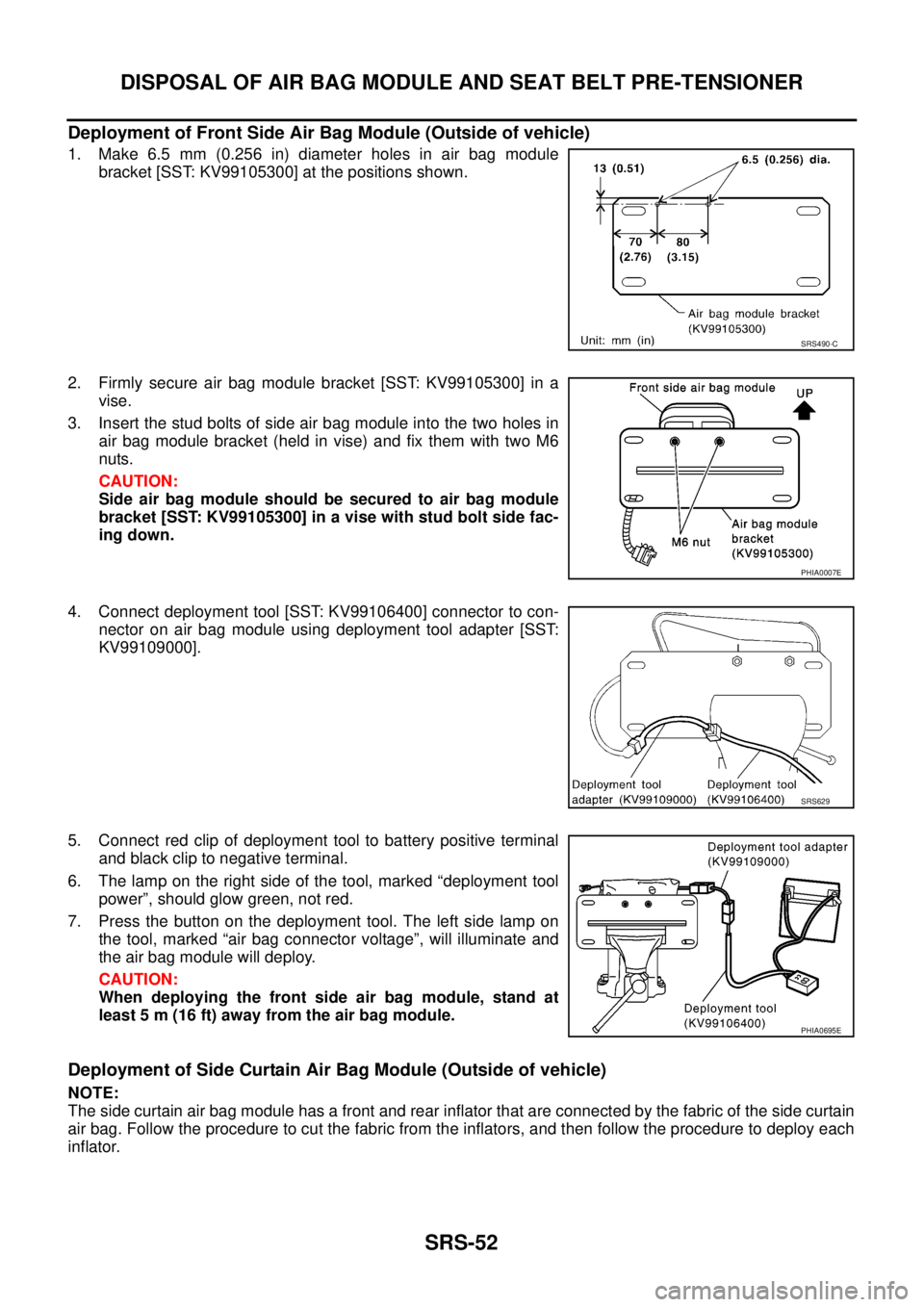
Deployment of Front Side Air Bag Module (Outside of vehicle)
1. Make 6.5 mm (0.256 in) diameter holes in air bag module
bracket [SST: KV99105300] at the positions shown.
2. Firmly secure air bag module bracket [SST: KV99105300] in a
vise.
3. Insert the stud bolts of side air bag module into the two holes in
air bag module bracket (held in vise) and fix them with two M6
nuts.
CAUTION:
Side air bag module should be secured to air bag module
bracket [SST: KV99105300] in a vise with stud bolt side fac-
ing down.
4. Connect deployment tool [SST: KV99106400] connector to con-
nector on air bag module using deployment tool adapter [SST:
KV99109000].
5. Connect red clip of deployment tool to battery positive terminal
and black clip to negative terminal.
6. The lamp on the right side of the tool, marked “deployment tool
power”, should glow green, not red.
7. Press the button on the deployment tool. The left side lamp on
the tool, marked “air bag connector voltage”, will illuminate and
the air bag module will deploy.
CAUTION:
When deploying the front side air bag module, stand at
least 5 m (16 ft) away from the air bag module.
Deployment of Side Curtain Air Bag Module (Outside of vehicle)
NOTE:
The side curtain air bag module has a front and rear inflator that are connected by the fabric of the side curtain
air bag. Follow the procedure to cut the fabric from the inflators, and then follow the procedure to deploy each
inflator.
SRS490-C
PHIA0007E
SRS629
PHIA0695E
Page 2962 of 3171
![NISSAN NAVARA 2005 Repair Workshop Manual DISPOSAL OF AIR BAG MODULE AND SEAT BELT PRE-TENSIONER
SRS-53
C
D
E
F
G
I
J
K
L
MA
B
SRS
1. Cut the inflator from side curtain air bag module.
2. Connect deployment tool [SST: KV99106400] to the infla](/img/5/57362/w960_57362-2961.png "NISSAN NAVARA 2005 Repair Workshop Manual DISPOSAL OF AIR BAG MODULE AND SEAT BELT PRE-TENSIONER
SRS-53
C
D
E
F
G
I
J
K
L
MA
B
SRS
1. Cut the inflator from side curtain air bag module.
2. Connect deployment tool [SST: KV99106400] to the infla")
DISPOSAL OF AIR BAG MODULE AND SEAT BELT PRE-TENSIONER
SRS-53
C
D
E
F
G
I
J
K
L
MA
B
SRS
1. Cut the inflator from side curtain air bag module.
2. Connect deployment tool [SST: KV99106400] to the inflator
using deployment tool adapter [SST: KV99110500].
3. Put the inflator connected with the deployment tool [SST:
KV99106400] into a tire without a wheel.
4. Put the tire with the inflator onto another tire without wheel. Add
an additional tire without a wheel and then a tire mounted on a
wheel on top.
CAUTION:
Tie all tires together with a strap in order to keep them
standing.
5. Connect red clip of deployment tool to battery positive terminal
and black clip to negative terminal.
6. The lamp on the right side of the tool, marked “deployment tool
power”, should glow green, not red.
7. Press the button on the deployment tool. The left side lamp on
the tool, marked “air bag connector voltage”, will illuminate and the air bag module will deploy.
CAUTION:
When deploying the side curtain air bag module, stand at least 5 m (16 ft) away from the side cur-
tain air bag module.
8. Repeat this procedure to deploy the second inflator.
SHIA0198E
PHIA0568E
PHIA0011E
PHIA0555E
Page 2963 of 3171
SRS-54
DISPOSAL OF AIR BAG MODULE AND SEAT BELT PRE-TENSIONER
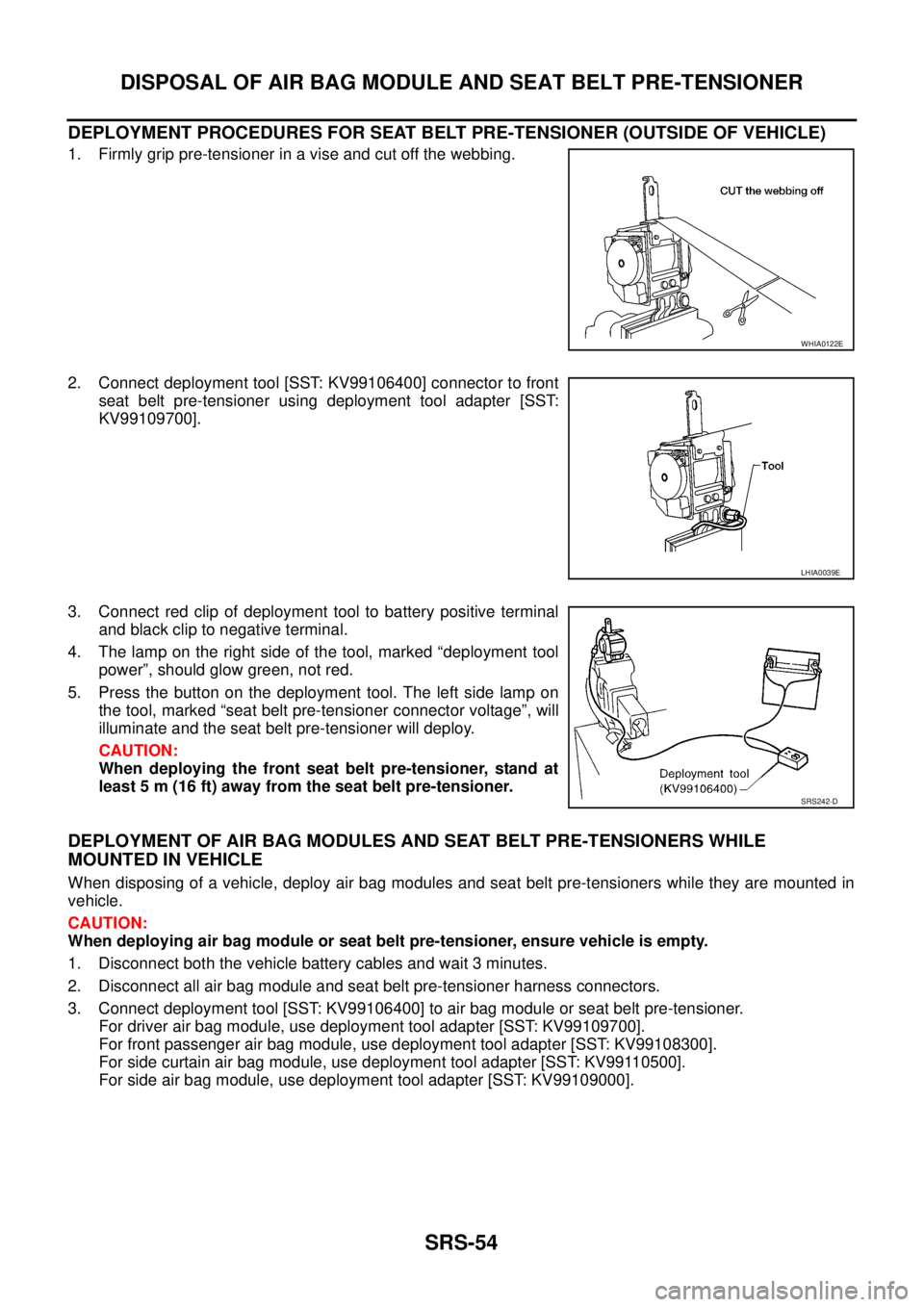
DEPLOYMENT PROCEDURES FOR SEAT BELT PRE-TENSIONER (OUTSIDE OF VEHICLE)
1. Firmly grip pre-tensioner in a vise and cut off the webbing.
2. Connect deployment tool [SST: KV99106400] connector to front
seat belt pre-tensioner using deployment tool adapter [SST:
KV99109700].
3. Connect red clip of deployment tool to battery positive terminal
and black clip to negative terminal.
4. The lamp on the right side of the tool, marked “deployment tool
power”, should glow green, not red.
5. Press the button on the deployment tool. The left side lamp on
the tool, marked “seat belt pre-tensioner connector voltage”, will
illuminate and the seat belt pre-tensioner will deploy.
CAUTION:
When deploying the front seat belt pre-tensioner, stand at
least 5 m (16 ft) away from the seat belt pre-tensioner.
DEPLOYMENT OF AIR BAG MODULES AND SEAT BELT PRE-TENSIONERS WHILE
MOUNTED IN VEHICLE
When disposing of a vehicle, deploy air bag modules and seat belt pre-tensioners while they are mounted in
vehicle.
CAUTION:
When deploying air bag module or seat belt pre-tensioner, ensure vehicle is empty.
1. Disconnect both the vehicle battery cables and wait 3 minutes.
2. Disconnect all air bag module and seat belt pre-tensioner harness connectors.
3. Connect deployment tool [SST: KV99106400] to air bag module or seat belt pre-tensioner.
For driver air bag module, use deployment tool adapter [SST: KV99109700].
For front passenger air bag module, use deployment tool adapter [SST: KV99108300].
For side curtain air bag module, use deployment tool adapter [SST: KV99110500].
For side air bag module, use deployment tool adapter [SST: KV99109000].
WHIA0122E
LHIA0039E
SRS242-D
Page 2964 of 3171
DISPOSAL OF AIR BAG MODULE AND SEAT BELT PRE-TENSIONER
SRS-55
C
D
E
F
G
I
J
K
L
MA
B
SRS
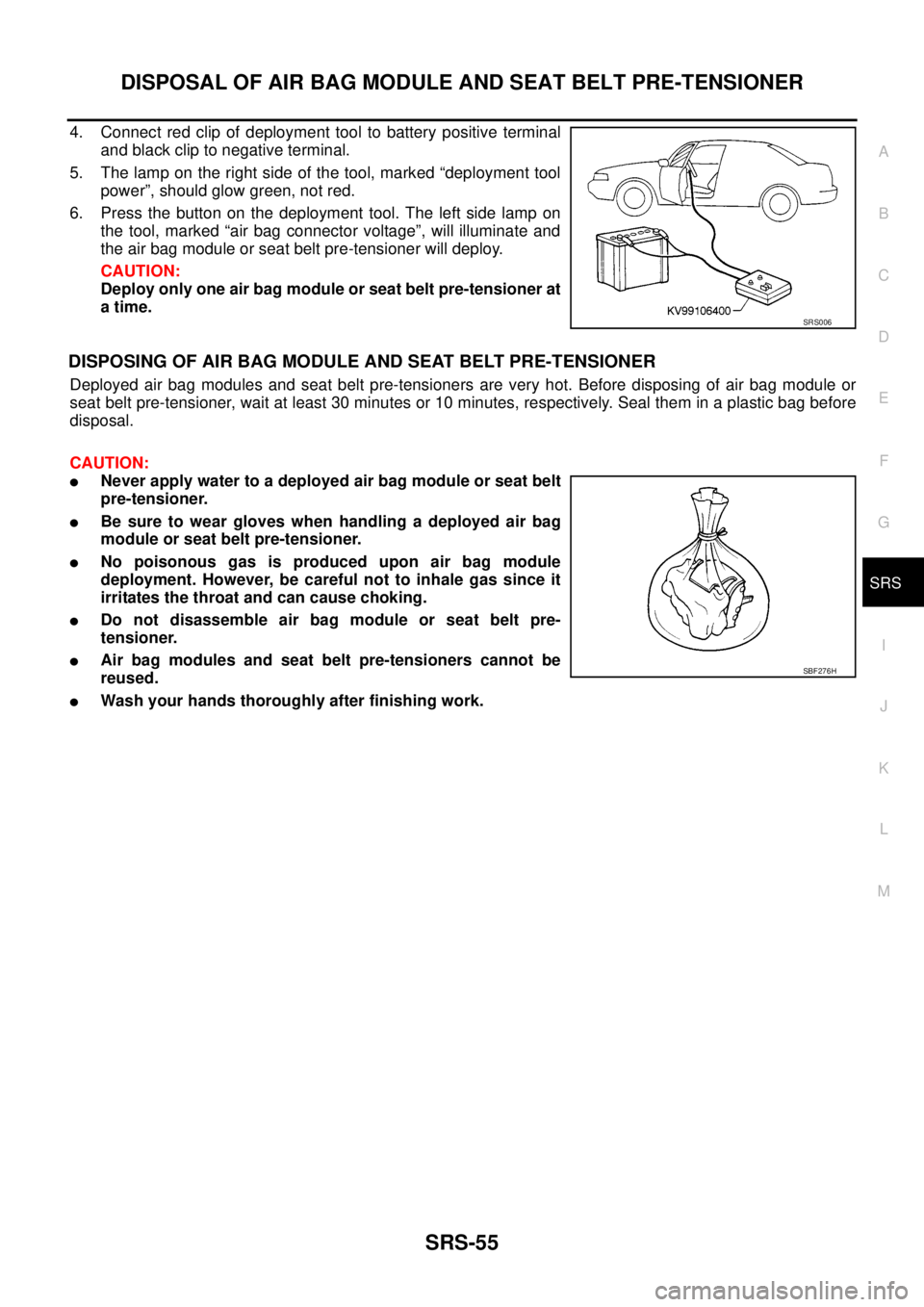
4. Connect red clip of deployment tool to battery positive terminal
and black clip to negative terminal.
5. The lamp on the right side of the tool, marked “deployment tool
power”, should glow green, not red.
6. Press the button on the deployment tool. The left side lamp on
the tool, marked “air bag connector voltage”, will illuminate and
the air bag module or seat belt pre-tensioner will deploy.
CAUTION:
Deploy only one air bag module or seat belt pre-tensioner at
atime.
DISPOSING OF AIR BAG MODULE AND SEAT BELT PRE-TENSIONER
Deployed air bag modules and seat belt pre-tensioners are very hot. Before disposing of air bag module or
seat belt pre-tensioner, wait at least 30 minutes or 10 minutes, respectively. Seal them in a plastic bag before
disposal.
CAUTION:
lNever apply water to a deployed air bag module or seat belt
pre-tensioner.
lBe sure to wear gloves when handling a deployed air bag
module or seat belt pre-tensioner.
lNo poisonous gas is produced upon air bag module
deployment. However, be careful not to inhale gas since it
irritates the throat and can cause choking.
lDo not disassemble air bag module or seat belt pre-
tensioner.
lAir bag modules and seat belt pre-tensioners cannot be
reused.
lWash your hands thoroughly after finishing work.
SRS006
SBF276H
Page 2973 of 3171
TF-6
PRECAUTIONS
If 4WD shift indicator lamp and 4LO indicator lamp do not indicate proper pattern, install new transfer con-
trol unit and retry the above check.
PrecautionsEDS0031B
lBefore connecting or disconnecting the transfer control unit harness connector, turn ignition
switch “OFF” and disconnect the battery cables. Battery voltage is applied to transfer control unit
even if ignition switch is turned “OFF”.
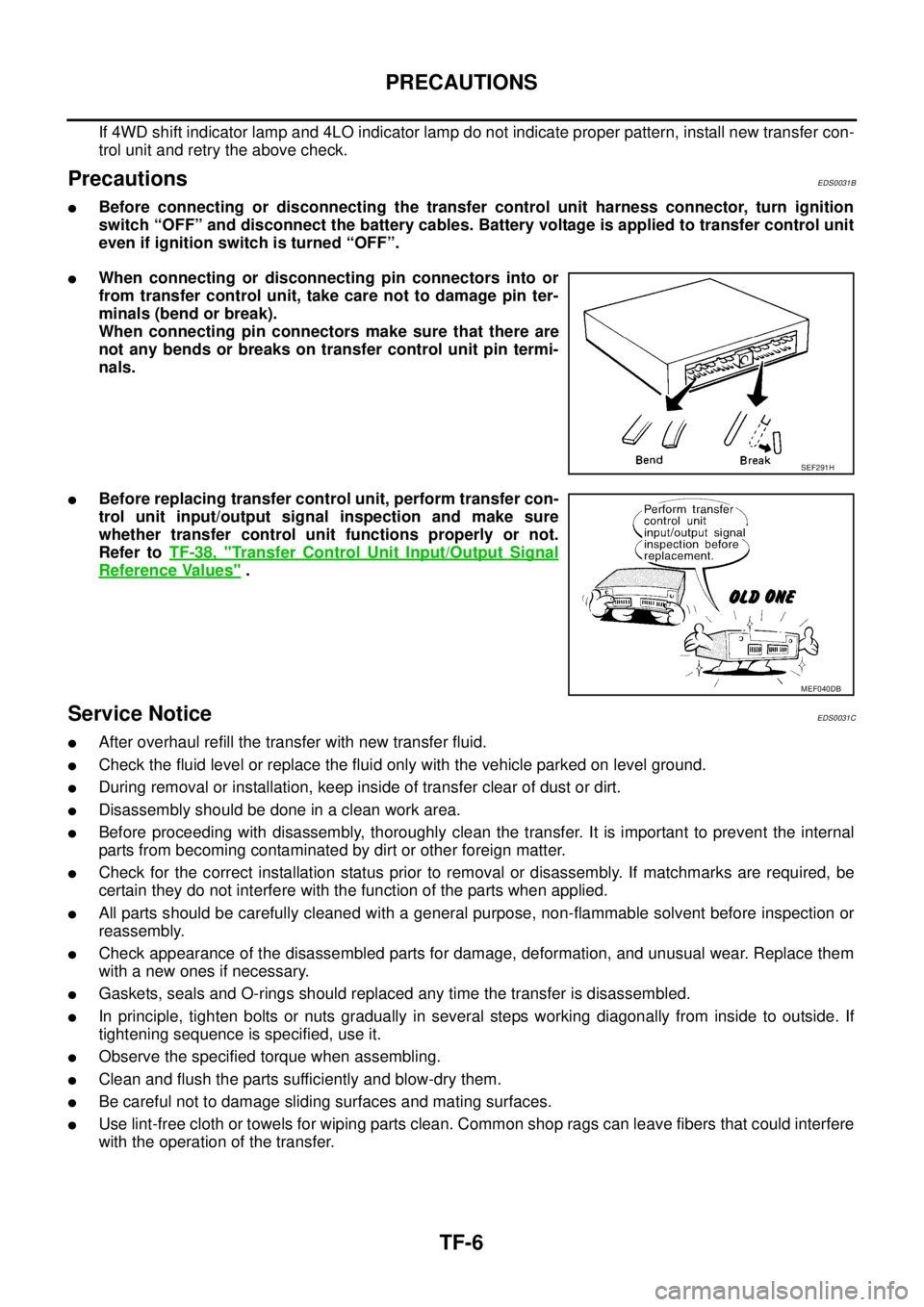
lWhen connecting or disconnecting pin connectors into or
from transfer control unit, take care not to damage pin ter-
minals (bend or break).
When connecting pin connectors make sure that there are
not any bends or breaks on transfer control unit pin termi-
nals.
lBefore replacing transfer control unit, perform transfer con-
trol unit input/output signal inspection and make sure
whether transfer control unit functions properly or not.
Refer toTF-38, "
Transfer Control Unit Input/Output Signal
Reference Values".
Service NoticeEDS0031C
lAfter overhaul refill the transfer with new transfer fluid.
lCheck the fluid level or replace the fluid only with the vehicle parked on level ground.
lDuring removal or installation, keep inside of transfer clear of dust or dirt.
lDisassemblyshouldbedoneinacleanworkarea.
lBefore proceeding with disassembly, thoroughly clean the transfer. It is important to prevent the internal
parts from becoming contaminated by dirt or other foreign matter.
lCheck for the correct installation status prior to removal or disassembly. If matchmarks are required, be
certain they do not interfere with the function of the parts when applied.
lAll parts should be carefully cleaned with a general purpose, non-flammable solvent before inspection or
reassembly.
lCheck appearance of the disassembled parts for damage, deformation, and unusual wear. Replace them
with a new ones if necessary.
lGaskets, seals and O-rings should replaced any time the transfer is disassembled.
lIn principle, tighten bolts or nuts gradually in several steps working diagonally from inside to outside. If
tightening sequence is specified, use it.
lObserve the specified torque when assembling.
lClean and flush the parts sufficiently and blow-dry them.
lBe careful not to damage sliding surfaces and mating surfaces.
lUse lint-free cloth or towels for wiping parts clean. Common shop rags can leave fibers that could interfere
with the operation of the transfer.
SEF291H
MEF040DB
Page 3005 of 3171
TF-38
TROUBLE DIAGNOSIS
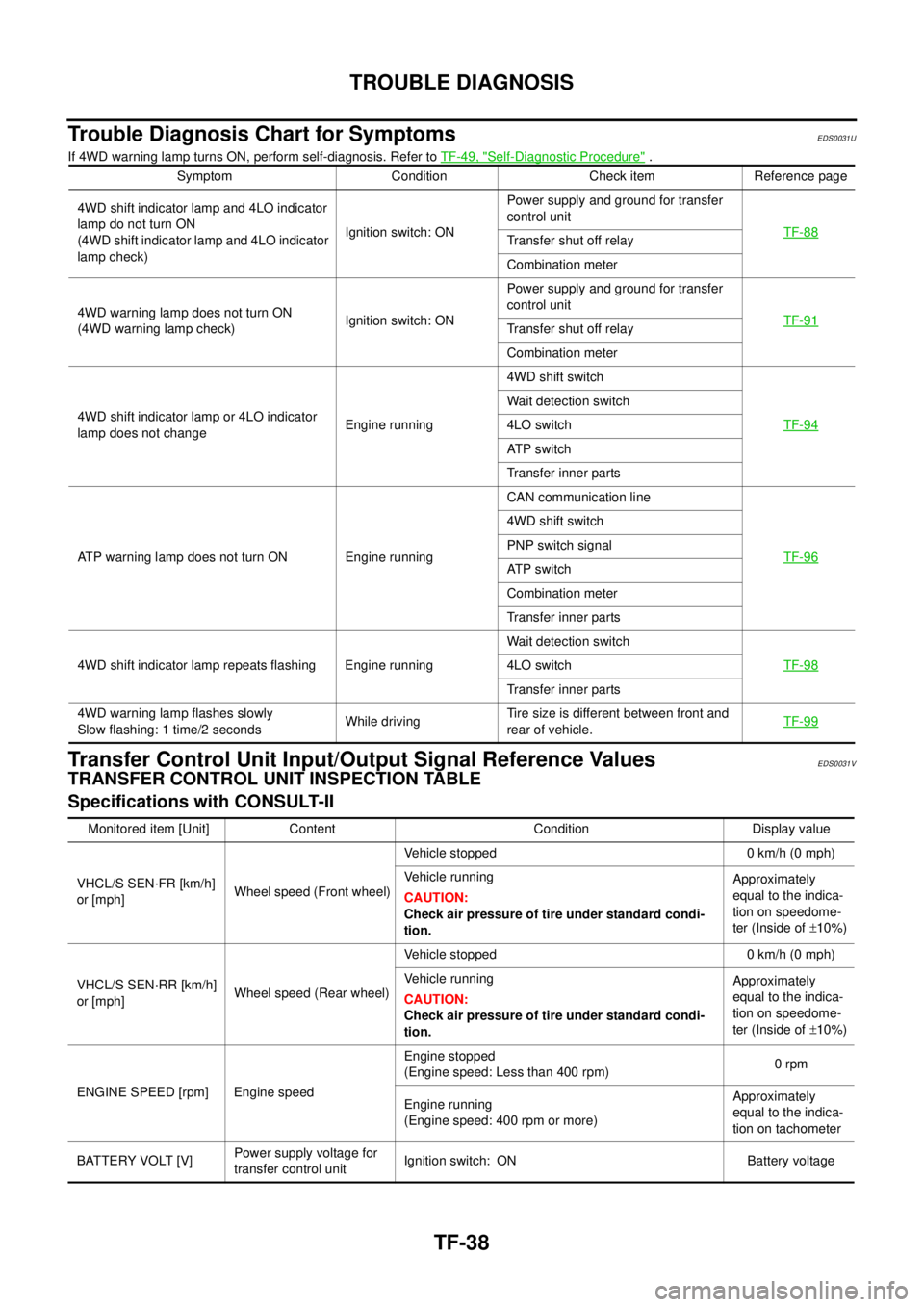
Trouble Diagnosis Chart for Symptoms
EDS0031U
If 4WD warning lamp turns ON, perform self-diagnosis. Refer toTF-49, "Self-Diagnostic Procedure".
Transfer Control Unit Input/Output Signal Reference ValuesEDS0031V
TRANSFER CONTROL UNIT INSPECTION TABLE
Specifications with CONSULT-II
Symptom Condition Check item Reference page
4WD shift indicator lamp and 4LO indicator
lamp do not turn ON
(4WD shift indicator lamp and 4LO indicator
lamp check)Ignition switch: ONPower supply and ground for transfer
control unit
TF-88
Transfer shut off relay
Combination meter
4WD warning lamp does not turn ON
(4WD warning lamp check)Ignition switch: ONPower supply and ground for transfer
control unit
TF-91
Transfer shut off relay
Combination meter
4WD shift indicator lamp or 4LO indicator
lamp does not changeEngine running4WD shift switch
TF-94
Wait detection switch
4LO switch
AT P s w i t c h
Transfer inner parts
ATP warning lamp does not turn ON Engine runningCAN communication line
TF-96
4WD shift switch
PNP switch signal
AT P s w i t c h
Combination meter
Transfer inner parts
4WD shift indicator lamp repeats flashing Engine runningWait detection switch
TF-98
4LO switch
Transfer inner parts
4WD warning lamp flashes slowly
Slow flashing: 1 time/2 secondsWhile drivingTire size is different between front and
rear of vehicle.TF-99
Monitored item [Unit] Content Condition Display value
VHCL/S SEN·FR [km/h]
or [mph]Wheel speed (Front wheel)Vehicle stopped 0 km/h (0 mph)
Vehicle running
CAUTION:
Check air pressure of tire under standard condi-
tion.Approximately
equal to the indica-
tion on speedome-
ter (Inside of±10%)
VHCL/S SEN·RR [km/h]
or [mph]Wheel speed (Rear wheel)Vehicle stopped 0 km/h (0 mph)
Vehicle running
CAUTION:
Check air pressure of tire under standard condi-
tion.Approximately
equal to the indica-
tion on speedome-
ter (Inside of±10%)
ENGINE SPEED [rpm] Engine speedEngine stopped
(Engine speed: Less than 400 rpm)0rpm
Engine running
(Engine speed: 400 rpm or more)Approximately
equal to the indica-
tion on tachometer
BATTERY VOLT [V]Power supply voltage for
transfer control unitIgnition switch: ON Battery voltage
Page 3008 of 3171
TROUBLE DIAGNOSIS
TF-41
C
E
F
G
H
I
J
K
L
MA
B
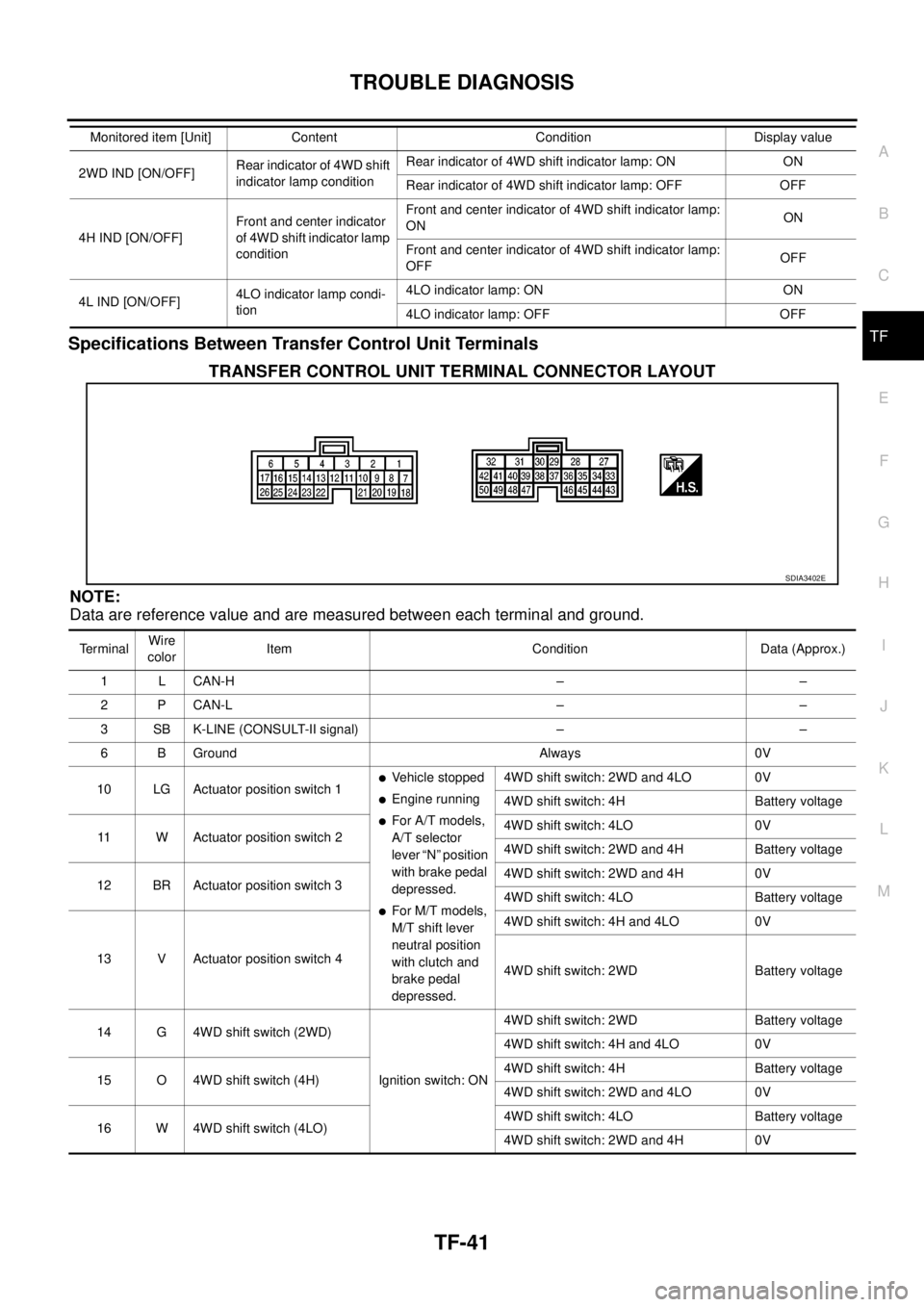
TFSpecifications Between Transfer Control Unit Terminals
TRANSFER CONTROL UNIT TERMINAL CONNECTOR LAYOUT
NOTE:
Data are reference value and are measured between each terminal and ground.
2WD IND [ON/OFF]Rear indicator of 4WD shift
indicator lamp conditionRear indicator of 4WD shift indicator lamp: ON ON
Rear indicator of 4WD shift indicator lamp: OFF OFF
4H IND [ON/OFF]Front and center indicator
of 4WD shift indicator lamp
conditionFront and center indicator of 4WD shift indicator lamp:
ONON
Front and center indicator of 4WD shift indicator lamp:
OFFOFF
4L IND [ON/OFF]4LO indicator lamp condi-
tion4LO indicator lamp: ON ON
4LO indicator lamp: OFF OFF Monitored item [Unit] Content Condition Display value
SDIA3402E
TerminalWire
colorItem Condition Data (Approx.)
1 L CAN-H – –
2 P CAN-L – –
3 SB K-LINE (CONSULT-II signal) – –
6 B Ground Always 0V
10 LG Actuator position switch 1
lVehicle stopped
lEngine running
lFor A/T models,
A/T selector
lever “N” position
with brake pedal
depressed.
lFor M/T models,
M/T shift lever
neutral position
with clutch and
brake pedal
depressed.4WD shift switch: 2WD and 4LO 0V
4WD shift switch: 4H Battery voltage
11 W Actuator position switch 24WD shift switch: 4LO 0V
4WD shift switch: 2WD and 4H Battery voltage
12 BR Actuator position switch 34WD shift switch: 2WD and 4H 0V
4WD shift switch: 4LO Battery voltage
13 V Actuator position switch 44WD shift switch: 4H and 4LO 0V
4WD shift switch: 2WD Battery voltage
14 G 4WD shift switch (2WD)
Ignition switch: ON4WD shift switch: 2WD Battery voltage
4WD shift switch: 4H and 4LO 0V
15 O 4WD shift switch (4H)4WD shift switch: 4H Battery voltage
4WD shift switch: 2WD and 4LO 0V
16 W 4WD shift switch (4LO)4WD shift switch: 4LO Battery voltage
4WD shift switch: 2WD and 4H 0V
Page 3009 of 3171

TF-42
TROUBLE DIAGNOSIS
17 O Wait detection switch
lVehicle stopped
lEngine running
lFor A/T models,
A/T selector
lever “N” position
with brake pedal
depressed.
lFor M/T models,
M/T shift lever
neutral position
with clutch and
brake pedal
depressed.4WD shift switch: 4H and 4LO 0V
4WD shift switch: 2WD Battery voltage
18 B Ground Always 0V
19 RPower supply
(Memory back-up)Ignition switch: ON
Battery voltage
Ignition switch: OFF
23 R ATP switch
lVehicle stopped
lEngine running
lFor A/T models,
A/T selector
lever “N” position
with brake pedal
depressed.
lFor M/T models,
M/T shift lever
neutral position
with clutch and
brake pedal
depressed.4WD shift switch:
4H to 4LO or 4LO to 4H
(While actuator motor is operating.)0V
Except the above Battery voltage
24 Y 4LO switch
lVehicle stopped
lEngine running
lFor A/T models,
A/T selector
lever “N” position
with brake pedal
depressed.
lFor M/T models,
M/T shift lever
neutral position
with clutch and
brake pedal
depressed.4WD shift switch: 4LO 0V
Except the above Battery voltage
25 LG Ignition switch monitorIgnition switch: ON Battery voltage
Ignition switch: OFF 0V
27 L Actuator motor power supplyIgnition switch: ON Battery voltage
Ignition switch: OFF
(5 seconds after ignition switch is turned OFF)0V Te r m i n a lWire
colorItem Condition Data (Approx.)
Page 3010 of 3171

TROUBLE DIAGNOSIS
TF-43
C
E
F
G
H
I
J
K
L
MA
B
TF
28 BR Actuator motor (+)
lVehicle stopped
lEngine running
lFor A/T models,
A/T selector
lever “N” position
with brake pedal
depressed.
lFor M/T models,
M/T shift lever
neutral position
with clutch and
brake pedal
depressed.When 4WD shift switch is operated
(while actuator motor is operating)Battery voltage
®0V
When 4WD shift switch is not operated 0V
31 G Actuator motor (-) Always 0V
32 B Ground Always 0V
33
(For M/T
models)P Park/Neutral position switch Ignition switch: ONM/T shift lever neutral position 0V
Except the above Battery voltage
35 V4WD shift indicator lamp
(Rear indicator)
Engine runningRear indicator of 4WD shift indicator
lamp: ON0V
Rear indicator of 4WD shift indicator
lamp: OFFBattery voltage
36 BR4WD shift indicator lamp
(Front and center indicator)Front and center indicator of 4WD shift
indicator lamp: ON0V
Front and center indicator of 4WD shift
indicator lamp: OFFBattery voltage
37 Y 4LO indicator lamp4LO indicator lamp: ON 0V
4LO indicator lamp: OFF Battery voltage
38 P 4WD warning lamp4WD warning lamp: ON 0V
4WD warning lamp: OFF Battery voltage
39
(For A/T
models)LG ATP warning lamp
lVehicle stopped
lEngine running
lA/T selector
lever “P” position
lBrake pedal
depressed4WD shift switch:
4H to 4LO or 4LO to 4H
(While actuator motor is operating.)Battery voltage
Except the above 0V
40 V Transfer shut off relayIgnition switch: ON 0V
Ignition switch: OFF
(5 seconds after ignition switch is turned OFF)Battery voltage
42 LG Transfer shift high relay
lVehicle stopped
lEngine running
lFor A/T models,
A/T selector
lever “N” position
with brake pedal
depressed.
lFor M/T models,
M/T shift lever
neutral position
with clutch and
brake pedal
depressed.4WD shift switch:
2WD to 4H or 4H to 4LO or 2WD to 4LO0V
Except the above Battery voltage TerminalWire
colorItem Condition Data (Approx.)
Page 3011 of 3171
TF-44
TROUBLE DIAGNOSIS
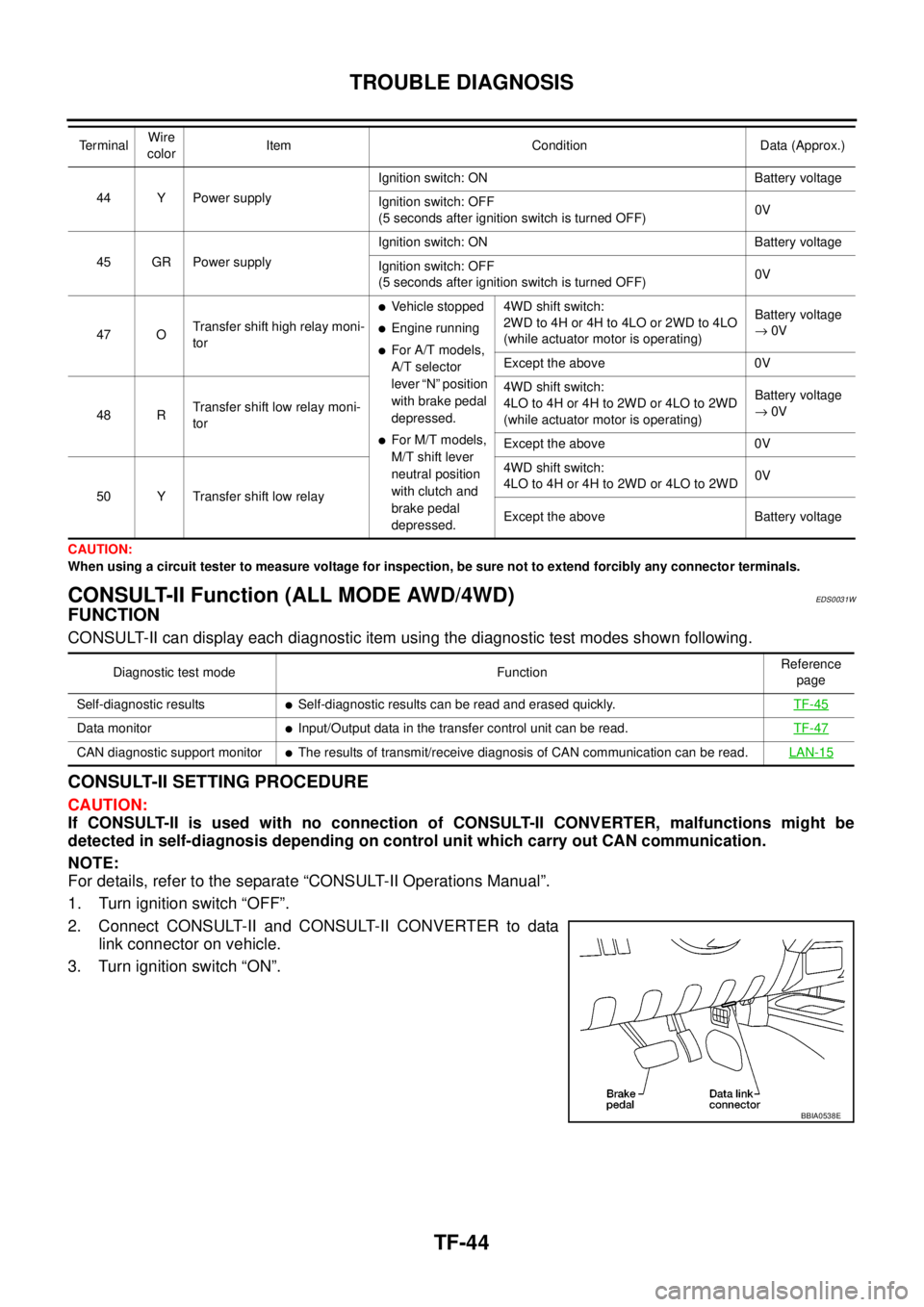
CAUTION:
When using a circuit tester to measure voltage for inspection, be sure not to extend forcibly any connector terminals.
CONSULT-II Function (ALL MODE AWD/4WD)EDS0031W
FUNCTION
CONSULT-II can display each diagnostic item using the diagnostic test modes shown following.
CONSULT-II SETTING PROCEDURE
CAUTION:
If CONSULT-II is used with no connection of CONSULT-II CONVERTER, malfunctions might be
detected in self-diagnosis depending on control unit which carry out CAN communication.
NOTE:
For details, refer to the separate “CONSULT-II Operations Manual”.
1. Turn ignition switch “OFF”.
2. Connect CONSULT-II and CONSULT-II CONVERTER to data
link connector on vehicle.
3. Turn ignition switch “ON”.
44 Y Power supplyIgnition switch: ON Battery voltage
Ignition switch: OFF
(5 seconds after ignition switch is turned OFF)0V
45 GR Power supplyIgnition switch: ON Battery voltage
Ignition switch: OFF
(5 seconds after ignition switch is turned OFF)0V
47 OTransfer shift high relay moni-
tor
lVehicle stopped
lEngine running
lFor A/T models,
A/T selector
lever “N” position
with brake pedal
depressed.
lFor M/T models,
M/T shift lever
neutral position
with clutch and
brake pedal
depressed.4WD shift switch:
2WD to 4H or 4H to 4LO or 2WD to 4LO
(while actuator motor is operating)Battery voltage
®0V
Except the above 0V
48 RTransfer shift low relay moni-
tor4WD shift switch:
4LO to 4H or 4H to 2WD or 4LO to 2WD
(while actuator motor is operating)Battery voltage
®0V
Except the above 0V
50 Y Transfer shift low relay4WD shift switch:
4LO to 4H or 4H to 2WD or 4LO to 2WD0V
Except the above Battery voltage Te r m i n a lWire
colorItem Condition Data (Approx.)
Diagnostic test mode FunctionReference
page
Self-diagnostic results
lSelf-diagnostic results can be read and erased quickly.TF-45
Data monitorlInput/Output data in the transfer control unit can be read.TF-47
CAN diagnostic support monitorlThe results of transmit/receive diagnosis of CAN communication can be read.LAN-15
BBIA0538E