light NISSAN NAVARA 2005 Repair Repair Manual
[x] Cancel search | Manufacturer: NISSAN, Model Year: 2005, Model line: NAVARA, Model: NISSAN NAVARA 2005Pages: 3171, PDF Size: 49.59 MB
Page 1037 of 3171
![NISSAN NAVARA 2005 Repair Repair Manual TROUBLE DIAGNOSIS
EC-57
C
D
E
F
G
H
I
J
K
L
MA
EC71 LTurbocharger boost sensor
ground[Ignition switch ON]Approximately 0.3V
72 BRRefrigerant pressure sensor
ground[Engine is running]
lWarm-up conditio](/img/5/57362/w960_57362-1036.png "NISSAN NAVARA 2005 Repair Repair Manual TROUBLE DIAGNOSIS
EC-57
C
D
E
F
G
H
I
J
K
L
MA
EC71 LTurbocharger boost sensor
ground[Ignition switch ON]Approximately 0.3V
72 BRRefrigerant pressure sensor
ground[Engine is running]
lWarm-up conditio")
TROUBLE DIAGNOSIS
EC-57
C
D
E
F
G
H
I
J
K
L
MA
EC71 LTurbocharger boost sensor
ground[Ignition switch ON]Approximately 0.3V
72 BRRefrigerant pressure sensor
ground[Engine is running]
lWarm-up condition
lIdle speedApproximately 0.3V
73 B Mass air flow sensor ground[Ignition switch ON]Approximately 0.3V
74 RIntake air temperature sen-
sor ground[Ignition switch ON]Approximately 0.3V
82 WAccelerator pedal position
sensor 1 power supply[Ignition switch ON]Approximately 5.3V
83 RAccelerator pedal position
sensor 1[Ignition switch ON]
lEngine: Stopped
lAccelerator pedal: Fully released0.95 - 1.17V
[Ignition switch ON]
lEngine: Stopped
lAccelerator pedal: Fully depressedMore than 4.6V
84 BAccelerator pedal position
sensor 1 ground[Ignition switch ON]Approximately 0.3V
85 —Sensor ground
(Accelerator pedal position
sensor shield circuit)[Ignition switch ON]Approximately 0.3V
87 P CAN communication line[Ignition switch ON]Approximately 2.0 - 2.6V
Output voltage varies with the
communication status.
89 SB Data link connector[Ignition switch ON]
lCONSULT-II: DisconnectedApproximately 0V - Battery volt-
age (11 - 14V)
90 WAccelerator pedal position
sensor 2 power supply[Ignition switch ON]Approximately 5.3V
91 RAccelerator pedal position
sensor 2[Ignition switch ON]
lEngine: Stopped
lAccelerator pedal: Fully released0.58 - 0.78V
[Ignition switch ON]
lEngine: Stopped
lAccelerator pedal: Fully depressedMore than 2.3V
92 BAccelerator pedal position
sensor 2 ground[Ignition switch ON]Approximately 0.3V
95 L CAN communication line[Ignition switch ON]Approximately 2.6 - 3.2V
Output voltage varies with the
communication status.
99 V Start signal[Ignition switch ON]Approximately 0.3V
[Ignition switch START]BATTERY VOLTAGE
(11 - 14V)
100 V Stop lamp switch[Ignition switch OFF]
lBrake pedal: Fully releasedApproximately 0V
[Ignition switch OFF]
lBrake pedal: Slightly depressedBATTERY VOLTAGE
(11 - 14V) TERMI-
NAL
NO.WIRE
COLORITEM CONDITIONDATA
(DC Voltage and Pulse Signal)
Page 1038 of 3171
![NISSAN NAVARA 2005 Repair Repair Manual EC-58
TROUBLE DIAGNOSIS
: Average voltage for pulse signal (Actual pulse signal can be confirmed by oscilloscope.)101 W ASCD brake switch[Ignition switch ON]
lBrake pedal: Fully released (A/T)
lClutch](/img/5/57362/w960_57362-1037.png "NISSAN NAVARA 2005 Repair Repair Manual EC-58
TROUBLE DIAGNOSIS
: Average voltage for pulse signal (Actual pulse signal can be confirmed by oscilloscope.)101 W ASCD brake switch[Ignition switch ON]
lBrake pedal: Fully released (A/T)
lClutch")
EC-58
TROUBLE DIAGNOSIS
: Average voltage for pulse signal (Actual pulse signal can be confirmed by oscilloscope.)101 W ASCD brake switch[Ignition switch ON]
lBrake pedal: Fully released (A/T)
lClutch pedal and brake pedal:
Fully released (M/T)BATTERY VOLTAGE
(11 - 14V)
[Ignition switch ON]
lBrake pedal: Slightly depressed (A/T)
lClutch pedal and/or brake pedal:
Slightly depressed (M/T)Approximately 0V
102 SB ASCD steering switch[Ignition switch ON]
lASCD steering switch: OFFApproximately 4.3V
[Ignition switch ON]
lON/OFF switch: PressedApproximately 0.3V
[Ignition switch ON]
lCANCEL switch: PressedApproximately 1.3V
[Ignition switch ON]
lRESUME/ACCELERATE switch: PressedApproximately 3.3V
[Ignition switch ON]
lSET/COAST switch: PressedApproximately 2.3V
103 BASCD steering switch
ground[Ignition switch ON]Approximately 0.3V
105 BR ECM relay (self shut-off)[Ignition switch ON]
[Ignition switch OFF]
lFor a few seconds after turning ignition
switch OFFApproximately 1.0V
[Ignition switch OFF]
lMore than a few seconds after turning igni-
tion switch OFFBATTERY VOLTAGE
(11 - 14V)
107
108R
RIgnition switch[Ignition switch ON]BATTERY VOLTAGE
(11 - 14V)
11 0G(A/T)
O (M/T)Park/Neutral position switch[Ignition switch ON]
lShift lever: P or N (A/T), Neutral (M/T)Approximately 0V
[Ignition switch ON]
lExcept the above positionBATTERY VOLTAGE
(11 - 14V)
113 BR ECM relay (self shut-off)[Ignition switch ON]
[Ignition switch OFF]
lFor a few seconds after turning ignition
switch OFFApproximately 1.0V
[Ignition switch OFF]
lMore than a few seconds after turning igni-
tion switch OFFBATTERY VOLTAGE
(11 - 14V)
114 B ECM ground[Engine is running]
lIdle speedApproximately 0V
11 9
120R
GPower supply for ECM[Ignition switch ON]BATTERY VOLTAGE
(11 - 14V)
121 VPower supply for ECM
(Back-up)[Ignition switch OFF]BATTERY VOLTAGE
(11 - 14V) TERMI-
NAL
NO.WIRE
COLORITEM CONDITIONDATA
(DC Voltage and Pulse Signal)
Page 1047 of 3171

TROUBLE DIAGNOSIS
EC-67
C
D
E
F
G
H
I
J
K
L
MA
EC
P/N POSI SWlIgnition switch: ONShift lever:
P or N (A/T), Neutral (M/T)ON
Except above OFF
START SIGNAL
lIgnition switch: ON®START®ON OFF®ON®OFF
AIRCONDSIG
lEngine: After warming up, idle
the engineAir conditioner switch: OFF OFF
Air conditioner switch: ON
(Compressor operates.)ON
BRAKE SW
lIgnition switch: ONBrake pedal: Fully released OFF
Brake pedal: Slightly depressed ON
BRAKE SW2
lIgnition switch: ON
lBrake pedal: Fully released (A/T)
lClutch pedal and brake pedal:
Fully released (M/T)OFF
lBrake pedal: Slightly depressed
(A/T)
lClutch pedal and/or brake pedal:
Slightly depressed (M/T)ON
IGN SW
lIgnition switch: ON®OFF ON®OFF
WARM UP SW
lIgnition switch: ONHeat up switch: OFF OFF
Heat up switch: ON ON
MAS AIR/FL SE*
lEngine: After warming up
lAir conditioner switch: OFF
lShift lever:
P or N (A/T), Neutral (M/T)
lNo loadIgnition switch: ON
(Engine stopped)Approximately 0.4V
Idle 1.3 - 1.7V
Engine is revving from idle to about
4,000 rpm.1.3 - 1.7V to Approximately 4.0V
(Check for liner voltage rise in
response to engine being
increased to about 4,000 rpm)
MAIN INJ WID
lEngine: After warming up
lShift lever:
P or N (A/T), Neutral (M/T)
lIdle speedNo load 0.50 - 0.70 msec
Blower fan switch: ON
Rear window defogger switch: ON0.50 - 0.80 msec
PUMP CURRENT
lEngine: After warming up
lAir conditioner switch: OFF
lShift lever:
P or N (A/T), Neutral (M/T)
lNo loadIdle 1,600 - 2,000 mA
2,000 rpm 1,500 - 1,900 mA
GLOW RLY Refer toEC-295, "
GLOW CONTROL SYSTEM".
COOLING FAN
lEngine: After warming up, idle
the engine
lAir conditioner switch: OFFEngine coolant temperature:
97°C (207°F) or lessOFF
Engine coolant temperature:
Between 98°C(208°F) and 104°C
(219°F)LOW
Engine coolant temperature:
105°C(221°F) or moreHI
EGR VOL CON/V
lEngine: After warming up
lAir conditioner switch: OFF
lShift lever:
P or N (A/T), Neutral (M/T)
lNo loadAfter 1 minute at idle More than 10 steps
Revving engine from idle to 3,200
rpm0step
INT/A VOLUME
lEngine: After warming up, idle the engine 150 - 450 mg/ MONITOR ITEM CONDITION SPECIFICATION
Page 1059 of 3171
DTC U1000 CAN COMMUNICATION LINE
EC-79
C
D
E
F
G
H
I
J
K
L
MA
EC
DTC U1000 CAN COMMUNICATION LINEPFP:23710
DescriptionEBS01KDA
CAN (Controller Area Network) is a serial communication line for real time application. It is an on-vehicle mul-
tiplex communication line with high data communication speed and excellent error detection ability. Many elec-
tronic control units are equipped onto a vehicle, and each control unit shares information and links with other
control units during operation (not independent). In CAN communication, control units are connected with 2
communication lines (CAN H line, CAN L line) allowing a high rate of information transmission with less wiring.
Each control unit transmits/receives data but selectively reads required data only.
On Board Diagnosis LogicEBS01KDB
The MI will not light up for this self-diagnosis.
DTC Confirmation ProcedureEBS01KDC
NOTE:
If DTC Confirmation Procedure has been previously conducted, always turn ignition switch OFF and wait at
least 10 seconds before conducting the next test.
WITH CONSULT-II
1. Turn ignition switch ON and wait at least 3 seconds.
2. Select “DATA MONITOR” mode with CONSULT-II.
3. If DTC is detected, go toEC-81, "
Diagnostic Procedure".
DTC No.Trouble diagnosis
nameDTC detecting condition Possible cause
U1000
1000CAN communication
line
lECM can not communicate to other control
unit.
lECM can not communicate for more than the
specified time.
lHarness or connectors
(CAN communication line is open or
shorted)
SEF817Y
Page 1062 of 3171
EC-82
DTC P0016 CKP - CMP CORRELATION
DTC P0016 CKP - CMP CORRELATION
PFP:10328
On Board Diagnosis LogicEBS01KDF
The MI will not light up for this self-diagnosis.
NOTE:
If DTC P0016 is displayed with DTC P0652 or P0653, first perform the trouble diagnosis for DTC P0652
or P0653. Refer toEC-227, "
DTC P0652, P0653 SENSOR POWER SUPPLY".
DTC Confirmation ProcedureEBS01KDG
NOTE:
If DTC Confirmation Procedure has been previously conducted, always turn ignition switch OFF and wait at
least 10 seconds before conducting the next test.
WITH CONSULT-II
1. Turn ignition switch ON.
2. Select “DATA MONITOR” mode with CONSULT-II.
3. Start engine and let it idle for at least 5 seconds.
4. If DTC is detected, go toEC-82, "
Diagnostic Procedure".
WITHOUT CONSULT-II
1. Start engine and let it idle for at least 5 seconds.
2. Turn ignition switch OFF, wait at least 10 seconds and then turn ON.
3. Perform Diagnostic Test Mode II (Self-diagnostic results) with ECM.
4. If DTC is detected, go toEC-82, "
Diagnostic Procedure".
Diagnostic ProcedureEBS01KDH
1.CHECK CAMSHAFT POSITION SENSOR
Refer toEC-175, "
Component Inspection".
OK or NG
OK >> GO TO 2.
NG >> Replace camshaft position sensor.
2.CHECK SPROCKET
Visually check for chipping signal plate gear tooth.
OK or NG
OK >> GO TO 3.
NG >> Remove debris and clean the signal plate or replace sprocket.
DTC No.Trouble diagnosis
nameDTC detecting condition Possible cause
P0016
0016Crankshaft position -
camshaft position cor-
relationThe correlation between crankshaft position sen-
sor signal and camshaft position sensor signal is
out of the normal range.
lCamshaft position sensor
lCrankshaft position sensor
lTiming chain
lSignal plate
SEF817Y
Page 1066 of 3171
EC-86
DTC P0089 FUEL PUMP
DTC P0089 FUEL PUMP
PFP:16700
On Board Diagnosis LogicEBS01KDM
The MI will not light up for this self-diagnosis.
NOTE:
If DTC P0089 is displayed with DTC P0652 or P0653, first perform the trouble diagnosis for DTC P0652
or P0653. Refer toEC-227, "
DTC P0652, P0653 SENSOR POWER SUPPLY".
DTC Confirmation ProcedureEBS01KDN
NOTE:
If DTC Confirmation Procedure has been previously conducted, always turn ignition switch OFF and wait at
least 10 seconds before conducting the next test.
WITH CONSULT-II
1. Start engine and warm it up to normal operating temperature.
2. Select “DATA MONITOR” mode with CONSULT-II.
3. Let engine idle for at least 30 seconds.
4. If DTC is detected, go toEC-87, "
Diagnostic Procedure".
WITHOUT CONSULT-II
1. Start engine and warm it up to normal operating temperature.
2. Let engine idle for at least 30 seconds.
3. Turn ignition switch OFF, wait at least 10 seconds and then turn ON.
4. Perform Diagnostic Test Mode II (Self-diagnostic results) with ECM.
5. If DTC is detected, go toEC-87, "
Diagnostic Procedure".
DTC No. Trouble diagnosis name DTC detecting condition Possible cause
P0089
0089Fuel pump performanceFuel pressure is too much higher than the target
value.
lFuel pump
lAir mixed with fuel
lLack of fuel
lFuel rail pressure sensor
SEF817Y
Page 1073 of 3171
DTC P0102, P0103 MAF SENSOR
EC-93
C
D
E
F
G
H
I
J
K
L
MA
EC
On Board Diagnosis LogicEBS01KDY
The MI will not light up for these self-diagnoses.
DTC Confirmation ProcedureEBS01KDZ
NOTE:
If DTC Confirmation Procedure has been previously conducted, always turn ignition switch OFF and wait at
least 10 seconds before conducting the next test.
WITH CONSULT-II
1. Turn ignition switch ON.
2. Select “DATA MONITOR” mode with CONSULT-II.
3. Wait at least 5 seconds.
4. If DTC is detected, go toEC-95, "
Diagnostic Procedure".
WITHOUT CONSULT-II
1. Turn ignition switch ON and wait at least 5 seconds.
2. Turn ignition switch OFF, wait at least 10 seconds and then turn ON.
3. Perform Diagnostic Test Mode II (Self-diagnostic results) with ECM.
4. If DTC is detected, go toEC-95, "
Diagnostic Procedure".
105
11 3BR
BRECM relay (self shut-
off)[Ignition switch ON]
[Ignition switch OFF]lFor a few seconds after turning ignition switch
OFFApproximately 1.0V
[Ignition switch OFF]
lMore than a few seconds after turning ignition
switch OFFBATTERY VOLTAGE
(11 - 14V)
11 9
120R
GPower supply for ECM[Ignition switch ON]BATTERY VOLTAGE
(11 - 14V) TERMI-
NAL
NO.WIRE
COLORITEM CONDITIONDATA
(DC Voltage)
DTC No. Trouble diagnosis name DTC detecting condition Possible cause
P0102
0102Mass air flow sensor circuit
low inputAn excessively low voltage from the sensor is
sent to ECM.
lHarness or connectors
(The sensor circuit is open or
shorted.)
lMass air flow sensor P0103
0103Mass air flow sensor circuit
high inputAn excessively high voltage from the sensor is
sent to ECM.
SEF817Y
Page 1078 of 3171
EC-98
DTC P0112, P0113 IAT SENSOR
DTC P0112, P0113 IAT SENSOR
PFP:22630
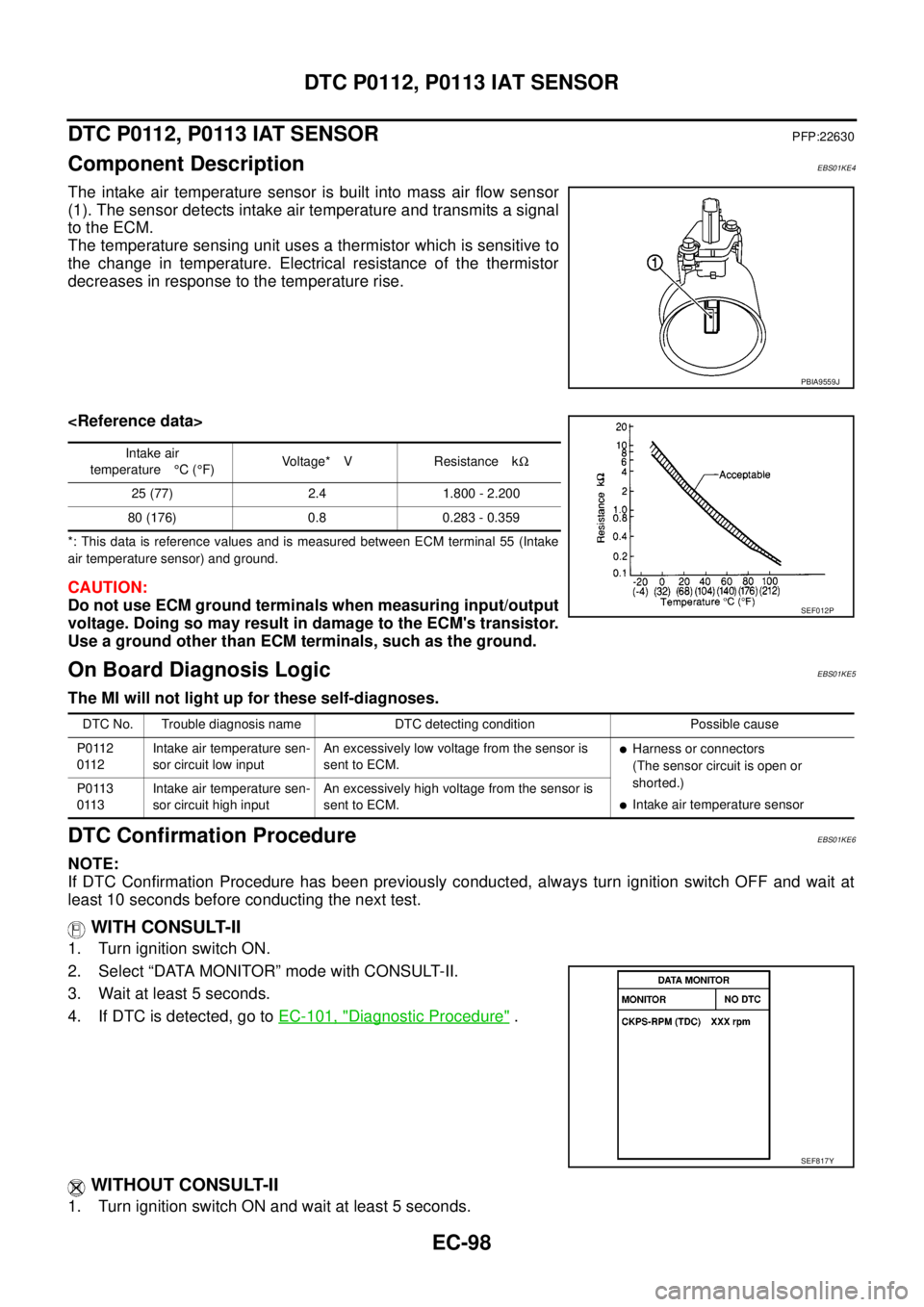
Component DescriptionEBS01KE4
The intake air temperature sensor is built into mass air flow sensor
(1). The sensor detects intake air temperature and transmits a signal
to the ECM.
The temperature sensing unit uses a thermistor which is sensitive to
the change in temperature. Electrical resistance of the thermistor
decreases in response to the temperature rise.
*: This data is reference values and is measured between ECM terminal 55 (Intake
air temperature sensor) and ground.
CAUTION:
Do not use ECM ground terminals when measuring input/output
voltage. Doing so may result in damage to the ECM's transistor.
Use a ground other than ECM terminals, such as the ground.
On Board Diagnosis LogicEBS01KE5
The MI will not light up for these self-diagnoses.
DTC Confirmation ProcedureEBS01KE6
NOTE:
If DTC Confirmation Procedure has been previously conducted, always turn ignition switch OFF and wait at
least 10 seconds before conducting the next test.
WITH CONSULT-II
1. Turn ignition switch ON.
2. Select “DATA MONITOR” mode with CONSULT-II.
3. Wait at least 5 seconds.
4. If DTC is detected, go toEC-101, "
Diagnostic Procedure".
WITHOUT CONSULT-II
1. Turn ignition switch ON and wait at least 5 seconds.
PBIA9559J
Intake air
temperature°C(°F)Voltage* V Resistance kW
25 (77) 2.4 1.800 - 2.200
80 (176) 0.8 0.283 - 0.359
SEF012P
DTC No. Trouble diagnosis name DTC detecting condition Possible cause
P0112
0112Intake air temperature sen-
sor circuit low inputAn excessively low voltage from the sensor is
sent to ECM.
lHarness or connectors
(The sensor circuit is open or
shorted.)
lIntake air temperature sensor P0113
0113Intake air temperature sen-
sor circuit high inputAn excessively high voltage from the sensor is
sent to ECM.
SEF817Y
Page 1083 of 3171
DTC P0117, P0118 ECT SENSOR
EC-103
C
D
E
F
G
H
I
J
K
L
MA
EC
DTC P0117, P0118 ECT SENSORPFP:22630
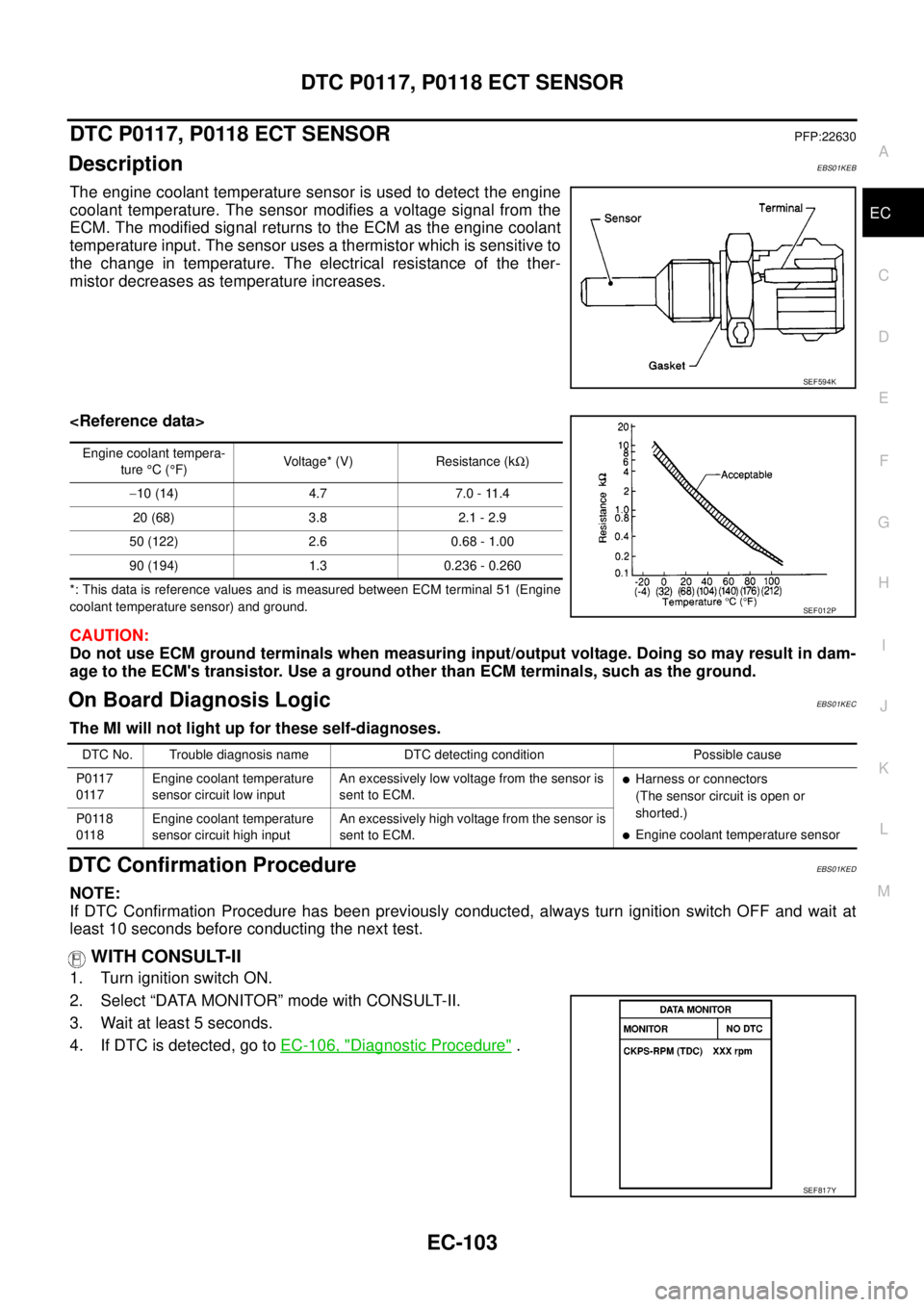
DescriptionEBS01KEB
The engine coolant temperature sensor is used to detect the engine
coolant temperature. The sensor modifies a voltage signal from the
ECM. The modified signal returns to the ECM as the engine coolant
temperature input. The sensor uses a thermistor which is sensitive to
the change in temperature. The electrical resistance of the ther-
mistor decreases as temperature increases.
*: This data is reference values and is measured between ECM terminal 51 (Engine
coolant temperature sensor) and ground.
CAUTION:
Do not use ECM ground terminals when measuring input/output voltage. Doing so may result in dam-
age to the ECM's transistor. Use a ground other than ECM terminals, such as the ground.
On Board Diagnosis LogicEBS01KEC
The MI will not light up for these self-diagnoses.
DTC Confirmation ProcedureEBS01KED
NOTE:
If DTC Confirmation Procedure has been previously conducted, always turn ignition switch OFF and wait at
least 10 seconds before conducting the next test.
WITH CONSULT-II
1. Turn ignition switch ON.
2. Select “DATA MONITOR” mode with CONSULT-II.
3. Wait at least 5 seconds.
4. If DTC is detected, go toEC-106, "
Diagnostic Procedure".
SEF594K
Engine coolant tempera-
ture°C(°F)Voltage* (V) Resistance (kW)
-10 (14) 4.7 7.0 - 11.4
20 (68) 3.8 2.1 - 2.9
50 (122) 2.6 0.68 - 1.00
90 (194) 1.3 0.236 - 0.260
SEF012P
DTC No. Trouble diagnosis name DTC detecting condition Possible cause
P0117
0117Engine coolant temperature
sensor circuit low inputAn excessively low voltage from the sensor is
sent to ECM.
lHarness or connectors
(The sensor circuit is open or
shorted.)
lEngine coolant temperature sensor P0118
0118Engine coolant temperature
sensor circuit high inputAn excessively high voltage from the sensor is
sent to ECM.
SEF817Y
Page 1089 of 3171
DTC P0122, P0123 APP SENSOR
EC-109
C
D
E
F
G
H
I
J
K
L
MA
EC
On Board Diagnosis LogicEBS01KEL
The MI will not light up for these self-diagnoses.
NOTE:
If DTC P0122 or P0123 is displayed with DTC P0642 or P0643, first perform the trouble diagnosis for
DTC P0642 or P0643. Refer toEC-222, "
DTC P0642, P0643 SENSOR POWER SUPPLY".
DTC Confirmation ProcedureEBS01KEM
NOTE:
If DTC Confirmation Procedure has been previously conducted, always turn ignition switch OFF and wait at
least 10 seconds before conducting the next test.
WITH CONSULT-II
1. Turn ignition switch ON.
2. Select “DATA MONITOR” mode with CONSULT-II.
3. Wait at least 5 seconds.
4. If DTC is detected, go toE C - 111 , "
Diagnostic Procedure".
WITHOUT CONSULT-II
1. Turn ignition switch ON and wait at least 5 seconds.
2. Turn ignition switch OFF, wait at least 10 seconds and then turn ON.
3. Perform Diagnostic Test Mode II (Self-diagnostic results) with ECM.
4. If DTC is detected, go toE C - 111 , "
Diagnostic Procedure".
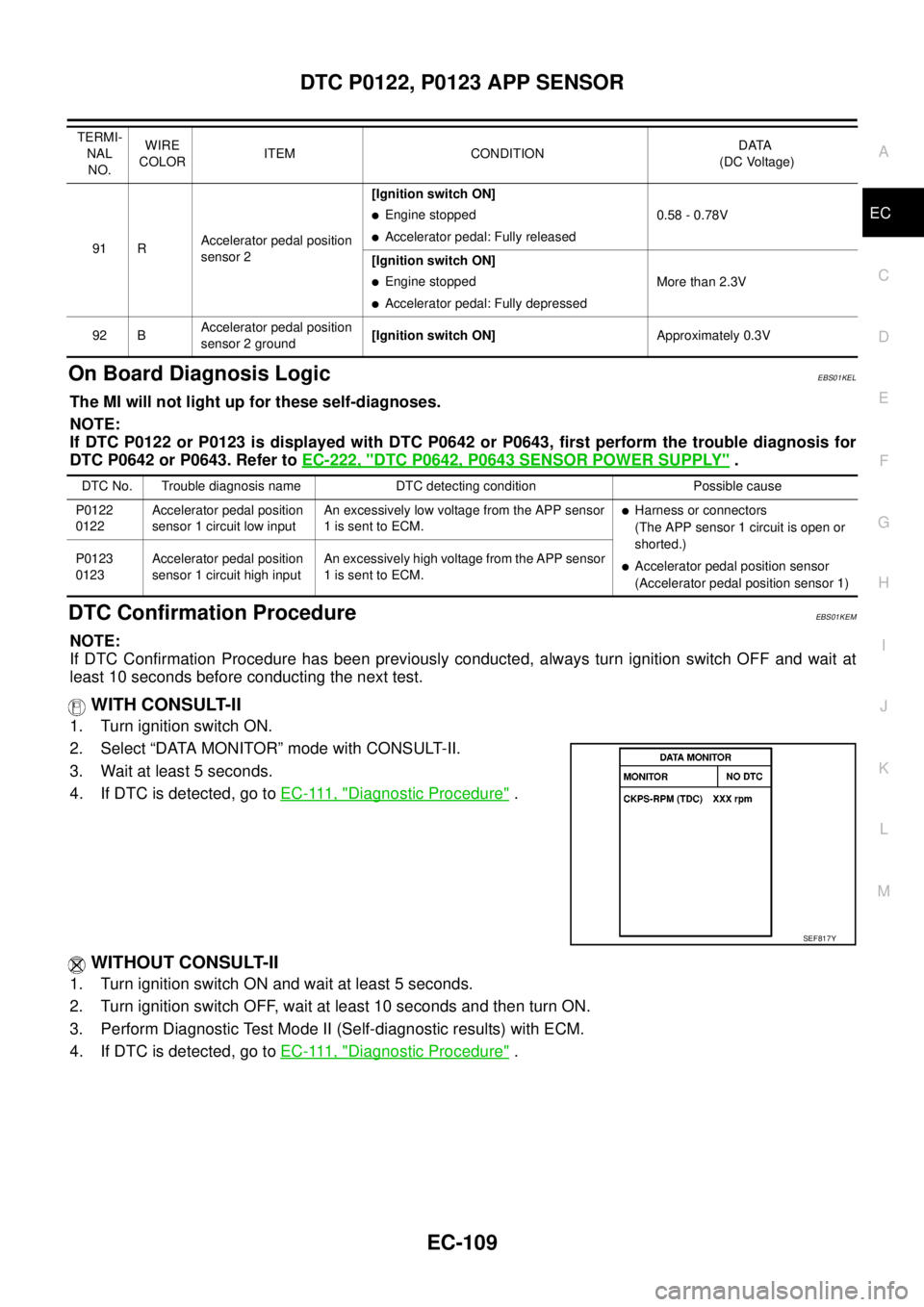
91 RAccelerator pedal position
sensor 2[Ignition switch ON]
lEngine stopped
lAccelerator pedal: Fully released0.58 - 0.78V
[Ignition switch ON]
lEngine stopped
lAccelerator pedal: Fully depressedMore than 2.3V
92 BAccelerator pedal position
sensor 2 ground[Ignition switch ON]Approximately 0.3V TERMI-
NAL
NO.WIRE
COLORITEM CONDITIONDATA
(DC Voltage)
DTC No. Trouble diagnosis name DTC detecting condition Possible cause
P0122
0122Accelerator pedal position
sensor 1 circuit low inputAn excessively low voltage from the APP sensor
1 is sent to ECM.
lHarness or connectors
(The APP sensor 1 circuit is open or
shorted.)
lAccelerator pedal position sensor
(Accelerator pedal position sensor 1) P0123
0123Accelerator pedal position
sensor 1 circuit high inputAn excessively high voltage from the APP sensor
1 is sent to ECM.
SEF817Y