wheel NISSAN NAVARA 2005 Repair Repair Manual
[x] Cancel search | Manufacturer: NISSAN, Model Year: 2005, Model line: NAVARA, Model: NISSAN NAVARA 2005Pages: 3171, PDF Size: 49.59 MB
Page 1168 of 3171

EC-188
DTC P0503 ASCD VEHICLE SPEED SENSOR
WITHOUT CONSULT-II
TESTING CONDITION:
Step 2 may be conducted with the drive wheels lifted in the shop or by driving the vehicle. If a road test
is expected to be easier, it is unnecessary to lift the vehicle.
1. Start engine.
2. Drivethevehicleatmorethan10km/h(6MPH).
3. Turn ignition switch OFF, wait at least 10 seconds and then turn ON.
4. Perform Diagnostic Test Mode II (Self-diagnostic results) with ECM.
5. If DTC is detected, go toEC-188, "
Diagnostic Procedure".
Diagnostic ProcedureEBS01KHS
1.CHECK DTC WITH ABS ACTUATOR AND ELECTRIC UNIT (CONTROL UNIT)
Refer toBRC-8, "
TROUBLE DIAGNOSIS".
OK or NG
OK >> GO TO 2.
NG >> Repair or replace.
2.CHECK COMBINATION METER
Check combination meter function.
Refer toDI-4, "
COMBINATION METERS".
>>INSPECTION END
Page 1170 of 3171
EC-190
DTC P0504 ASCD BRAKE SWITCH
On Board Diagnosis Logic
EBS01KHW
The MI will not light up for this diagnosis.
DTC confirmation ProcedureEBS01KHX
CAUTION:
Always drive vehicle at a safe speed.
NOTE:
If DTC Confirmation Procedure has been previously conducted, always turn ignition switch OFF and wait at
least 10 seconds before conducting the next test.
TESTING CONDITION:
Steps 3 and 4 may be conducted with the drive wheels lifted in the shop or by driving the vehicle. If a
road test is expected to be easier, it is unnecessary to lift the vehicle.
WITH CONSULT-II
1. Start engine.
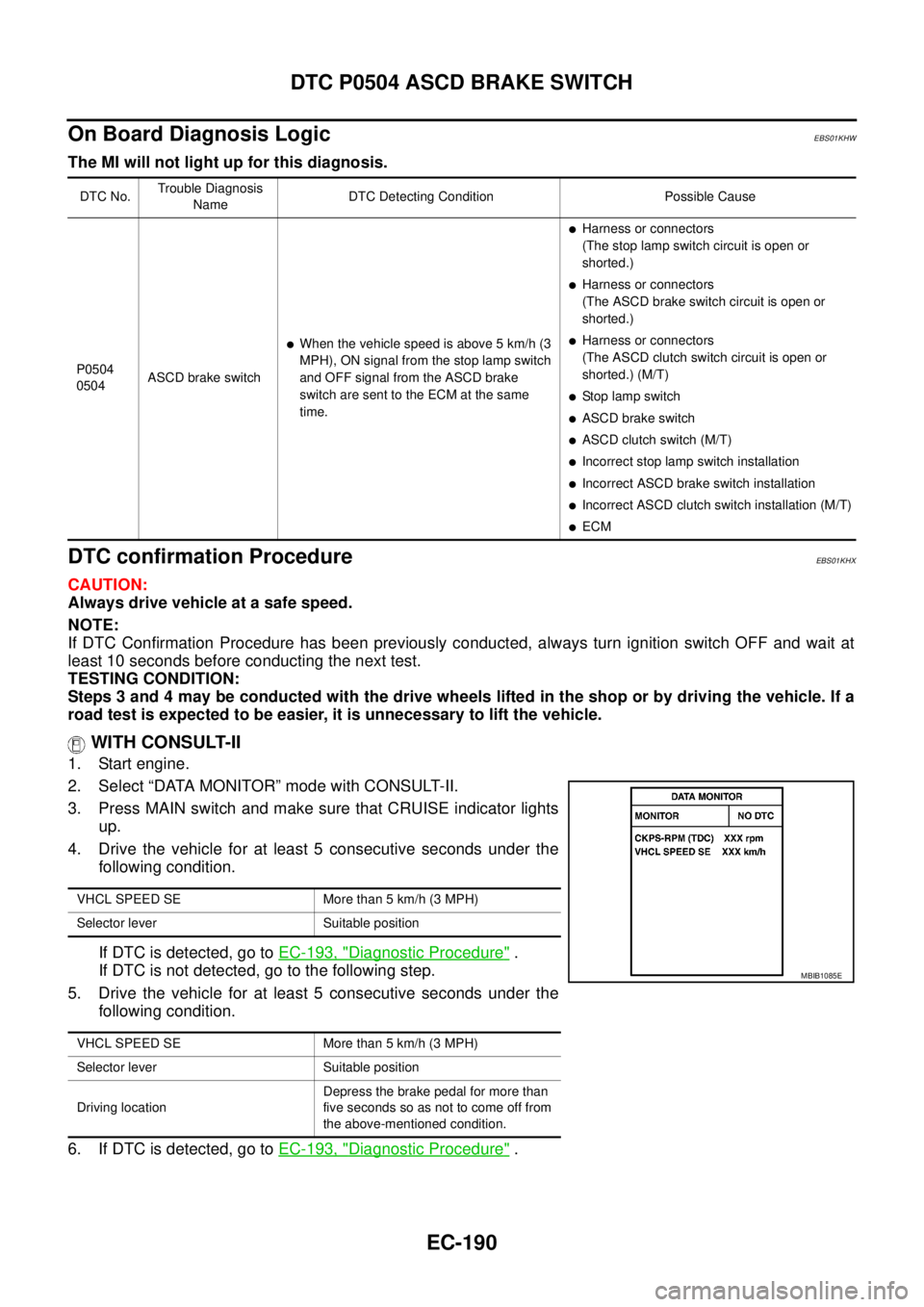
2. Select “DATA MONITOR” mode with CONSULT-II.
3. Press MAIN switch and make sure that CRUISE indicator lights
up.
4. Drive the vehicle for at least 5 consecutive seconds under the
following condition.
If DTC is detected, go toEC-193, "
Diagnostic Procedure".
If DTC is not detected, go to the following step.
5. Drive the vehicle for at least 5 consecutive seconds under the
following condition.
6. If DTC is detected, go toEC-193, "
Diagnostic Procedure".
DTC No.Trouble Diagnosis
NameDTC Detecting Condition Possible Cause
P0504
0504ASCD brake switch
lWhen the vehicle speed is above 5 km/h (3
MPH), ON signal from the stop lamp switch
and OFF signal from the ASCD brake
switch are sent to the ECM at the same
time.
lHarness or connectors
(The stop lamp switch circuit is open or
shorted.)
lHarness or connectors
(The ASCD brake switch circuit is open or
shorted.)
lHarness or connectors
(The ASCD clutch switch circuit is open or
shorted.) (M/T)
lStop lamp switch
lASCD brake switch
lASCD clutch switch (M/T)
lIncorrectstoplampswitchinstallation
lIncorrect ASCD brake switch installation
lIncorrect ASCD clutch switch installation (M/T)
lECM
VHCL SPEED SE More than 5 km/h (3 MPH)
Selector lever Suitable position
VHCL SPEED SE More than 5 km/h (3 MPH)
Selector lever Suitable position
Driving locationDepress the brake pedal for more than
five seconds so as not to come off from
the above-mentioned condition.
MBIB1085E
Page 1337 of 3171

SERVICE DATA AND SPECIFICATIONS (SDS)
EC-357
C
D
E
F
G
H
I
J
K
L
MA
EC
SERVICE DATA AND SPECIFICATIONS (SDS)PFP:00100
General SpecificationsEBS01KN4
*: Under the following conditions:
lHeat up switch: OFF
lAir conditioner switch: OFF
lElectric load: OFF (Lights, heater fan & rear window defogger)
lSteering wheel: Kept in straight-ahead position
Mass Air Flow SensorEBS01KN5
*: Engine is warmed up to normal operating temperature and running under no load.
Intake Air Temperature SensorEBS01KN6
Engine Coolant Temperature SensorEBS01KN7
Fuel Rail Pressure SensorEBS01KN8
Fuel InjectorEBS01KN9
Glow PlugEBS01KNA
EGR Volume Control ValveEBS01KNB
Crankshaft Position SensorEBS01KNC
Refer toEC-164, "Component Inspection".
Camshaft Position SensorEBS01KND
Refer toEC-175, "Component Inspection".
Target idle speedA/T No load* (in P or N position)
750±25 rpm
M/T No load* (in Neutral position)
Air conditioner: ONA/T In P or N position 750 rpm or more
M/T In Neutral position 800 rpm or more
Maximum engine speed4,900 rpm
Supply voltageBattery voltage (11 - 14V)
Ignition switch ON (Engine stopped.) Approx. 0.4V
Idle (Engine is warmed up to normal operating temperature.) 1.3 - 1.7V *
Temperature°C(°F) Resistance kW
25 (77)1.800 - 2.200
80 (176)0.283 - 0.359
Temperature°C(°F) Resistance kW
20 (68)2.1 - 2.9
50 (122)0.68 - 1.00
90 (194)0.236 - 0.260
Supply voltageApproximately 5V
Idle (Engine is warmed up to normal operating temperature.) 1.7 - 2.0V
2,000 rpm (Engine is warmed up to normal operating tempera-
ture.)2.0 - 2.3V
Resistance [at 10 - 60°C (50 - 140°F)] 0.2 - 0.8W
Resistance [at 25°C(77°F)] Approximately 0.8W
Resistance [at 25°C(77°F)] 13 - 17W
Page 1341 of 3171

PRECAUTIONS
EI-3
C
D
E
F
G
H
J
K
L
MA
B
EI
PRECAUTIONSPFP:00001
Service NoticeEIS00DY1
lWhen removing or installing various parts, place a cloth or padding on the vehicle body to prevent
scratches.
lHandle trim, molding, instruments, grille, etc. carefully during removing or installing. Be careful not to soil
or damage them.
lApply sealing compound where necessary when installing parts.
lWhen applying sealing compound, be careful that the sealing compound does not protrude from parts.
lWhen replacing any metal parts (for example body outer panel, members, etc.), be sure to take rust pre-
vention measures.
Precautions for Supplemental Restraint System (SRS) “AIR BAG” and “SEAT
BELT PRE-TENSIONER”
EIS00DZ5
The Supplemental Restraint System such as “AIR BAG” and “SEAT BELT PRE-TENSIONER”, used along
with a front seat belt, helps to reduce the risk or severity of injury to the driver and front passenger for certain
types of collision. Information necessary to service the system safely is included in the SRS and SB section of
this Service Manual.
WARNING:
lTo avoid rendering the SRS inoperative, which could increase the risk of personal injury or death
in the event of a collision which would result in air bag inflation, all maintenance must be per-
formed by an authorized NISSAN/INFINITI dealer.
lImproper maintenance, including incorrect removal and installation of the SRS, can lead to per-
sonal injury caused by unintentional activation of the system. For removal of Spiral Cable and Air
Bag Module, see the SRS section.
lDo not use electrical test equipment on any circuit related to the SRS unless instructed to in this
Service Manual. SRS wiring harnesses can be identified by yellow and/or orange harnesses or
harness connectors.
Precautions for SRS “AIR BAG” and “SEAT BELT PRE-TENSIONER” ServiceEIS00DZ2
lDo not use electrical test equipment to check SRS circuits unless instructed to in this Service Manual.
lBefore servicing the SRS, turn ignition switch OFF, disconnect both battery cables and wait at least 3 min-
utes.
For approximately 3 minutes after the cables are removed, it is still possible for the air bag and seat belt
pre-tensioner to deploy. Therefore, do not work on any SRS connectors or wires until at least 3 minutes
have passed.
lThe air bag diagnosis sensor unit must always be installed with the arrow marks “Ü” pointing toward the
front of the vehicle for proper operation. Also check the air bag diagnosis sensor unit for cracks, deformi-
ties or rust before installation and replace as required.
lThe spiral cable must be aligned with the neutral position since its rotations are limited. Do not attempt to
turn steering wheel or column after removal of steering gear.
lHandle air bag module carefully. Always place driver and front passenger air bag modules with the pad
side facing upward and seat mounted front side air bag module standing with the stud bolt side facing
down.
lConduct self-diagnosis to check entire SRS for proper function after replacing any components.
lAfter air bag inflates, the front instrument panel assembly should be replaced if damaged.
Page 1385 of 3171

EM-3
C
D
E
F
G
H
I
J
K
L
M
EMA BEARING .......................................................... 132
MAIN BEARING CAP BOLT DEFORMATION .. 133
CONNECTING ROD BOLT DEFORMATION .... 133
OIL JET ............................................................. 133
OIL JET RELIEF VALVE ................................... 133
FLYWHEEL DEFLECTION ............................... 134
MOVEMENT AMOUNT OF FLYWHEEL ........... 134
DRIVE PLATE ................................................... 134
SERVICE DATA AND SPECIFICATIONS (SDS) .... 135
Standard and Limit ............................................... 135
GENERAL SPECIFICATIONS .......................... 135
INTAKE MANIFOLD AND EXHAUST MANI-FOLD .................................................................135
DRIVE BELTS ...................................................135
CYLINDER HEAD .............................................136
VALVE ...............................................................136
CAMSHAFT .......................................................140
CYLINDER BLOCK ...........................................141
PISTON, PISTON RING AND PISTON PIN ......141
CONNECTING ROD .........................................144
CRANKSHAFT ..................................................144
AVAILABLE MAIN BEARING ............................145
AVAILABLE CONNECTING ROD BEARING ....145
MISCELLANEOUS COMPONENTS .................145
Page 1391 of 3171
PREPARATION
EM-9
C
D
E
F
G
H
I
J
K
L
MA
EM
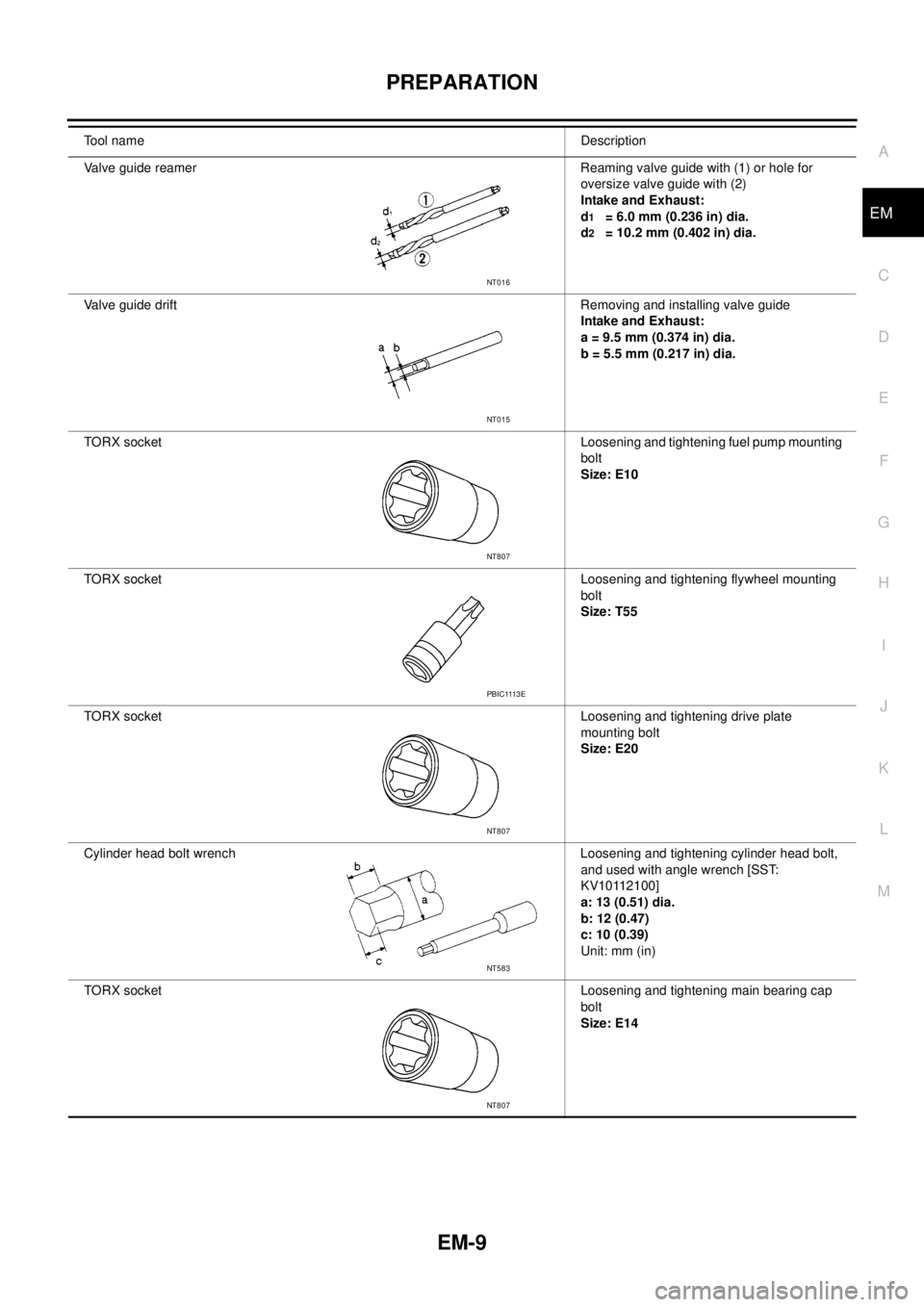
Valve guide reamer Reaming valve guide with (1) or hole for
oversize valve guide with (2)
Intake and Exhaust:
d
1= 6.0 mm (0.236 in) dia.
d
2= 10.2 mm (0.402 in) dia.
Valve guide drift Removing and installing valve guide
Intake and Exhaust:
a = 9.5 mm (0.374 in) dia.
b = 5.5 mm (0.217 in) dia.
TORX socketLoosening and tightening fuel pump mounting
bolt
Size: E10
TORX socketLoosening and tightening flywheel mounting
bolt
Size: T55
TORX socketLoosening and tightening drive plate
mounting bolt
Size: E20
Cylinder head bolt wrench Loosening and tightening cylinder head bolt,
and used with angle wrench [SST:
KV10112100]
a: 13 (0.51) dia.
b: 12 (0.47)
c: 10 (0.39)
Unit: mm (in)
TORX socketLoosening and tightening main bearing cap
bolt
Size: E14 Tool nameDescription
NT016
NT015
NT807
PBIC1113E
NT807
NT583
NT807
Page 1412 of 3171
EM-30
TURBO CHARGER
INSPECTION AFTER REMOVAL
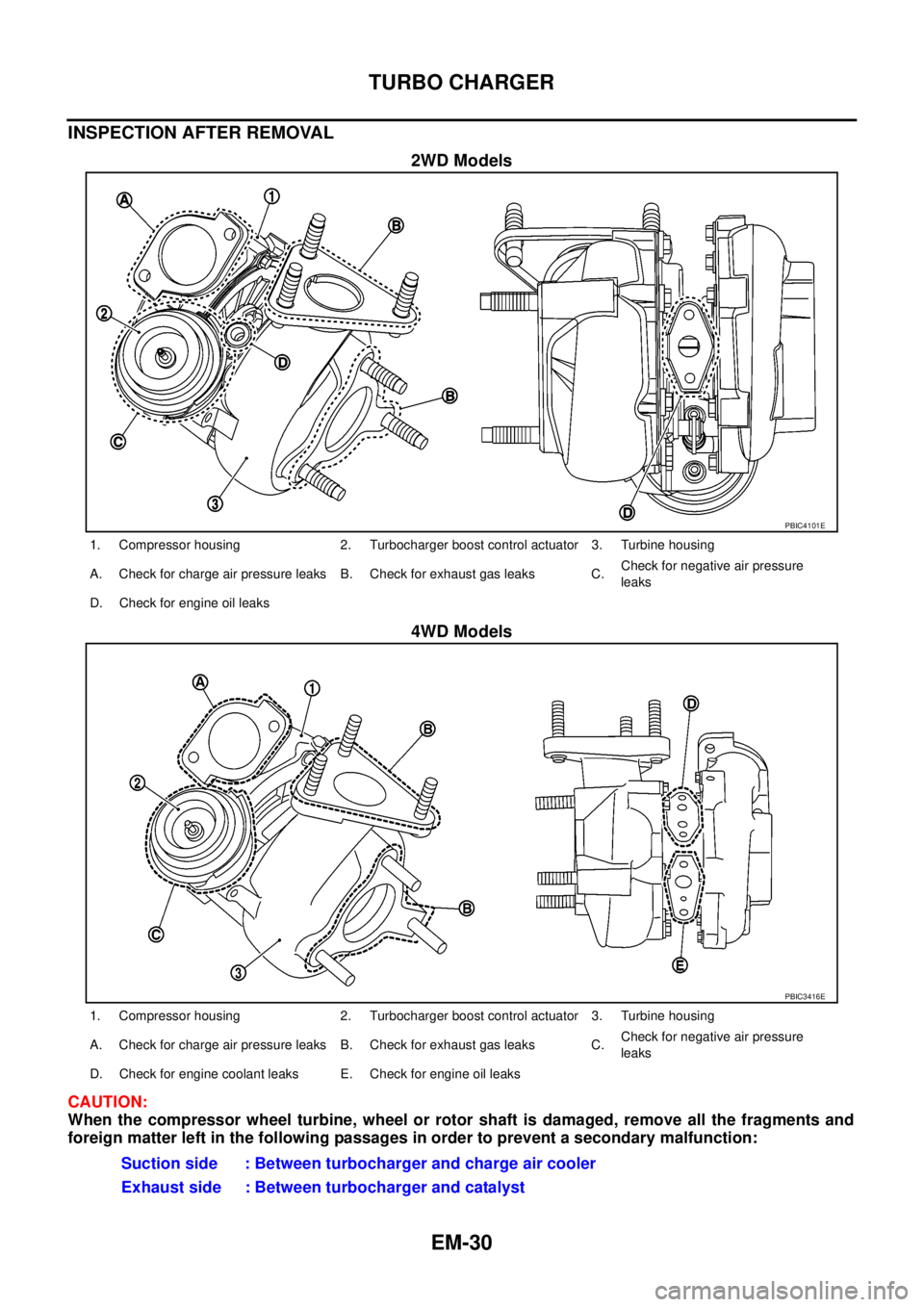
2WD Models
4WD Models
CAUTION:
When the compressor wheel turbine, wheel or rotor shaft is damaged, remove all the fragments and
foreign matter left in the following passages in order to prevent a secondary malfunction:
PBIC4101E
1. Compressor housing 2. Turbocharger boost control actuator 3. Turbine housing
A. Check for charge air pressure leaks B. Check for exhaust gas leaks C.Check for negative air pressure
leaks
D. Check for engine oil leaks
PBIC3416E
1. Compressor housing 2. Turbocharger boost control actuator 3. Turbine housing
A. Check for charge air pressure leaks B. Check for exhaust gas leaks C.Check for negative air pressure
leaks
D. Check for engine coolant leaks E. Check for engine oil leaks
Suction side : Between turbocharger and charge air cooler
Exhaust side : Between turbocharger and catalyst
Page 1413 of 3171
TURBO CHARGER
EM-31
C
D
E
F
G
H
I
J
K
L
MA
EM
Rotor Shaft Clearance
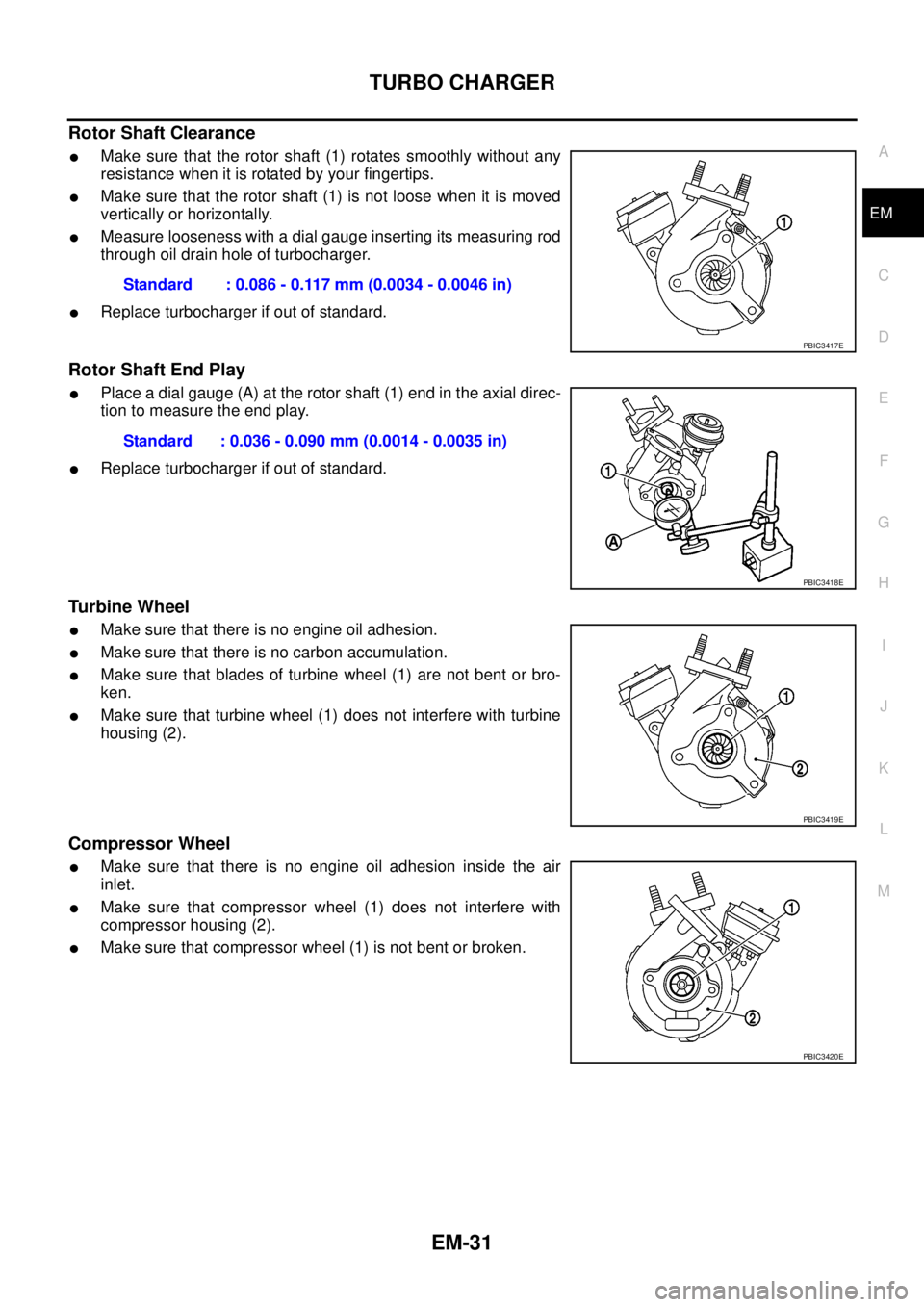
lMake sure that the rotor shaft (1) rotates smoothly without any
resistance when it is rotated by your fingertips.
lMake sure that the rotor shaft (1) is not loose when it is moved
vertically or horizontally.
lMeasure looseness with a dial gauge inserting its measuring rod
through oil drain hole of turbocharger.
lReplace turbocharger if out of standard.
Rotor Shaft End Play
lPlace a dial gauge (A) at the rotor shaft (1) end in the axial direc-
tion to measure the end play.
lReplace turbocharger if out of standard.
Turbine Wheel
lMake sure that there is no engine oil adhesion.
lMake sure that there is no carbon accumulation.
lMake sure that blades of turbine wheel (1) are not bent or bro-
ken.
lMake sure that turbine wheel (1) does not interfere with turbine
housing (2).
Compressor Wheel
lMake sure that there is no engine oil adhesion inside the air
inlet.
lMake sure that compressor wheel (1) does not interfere with
compressor housing (2).
lMake sure that compressor wheel (1) is not bent or broken.Standard : 0.086 - 0.117 mm (0.0034 - 0.0046 in)
PBIC3417E
Standard : 0.036 - 0.090 mm (0.0014 - 0.0035 in)
PBIC3418E
PBIC3419E
PBIC3420E
Page 1414 of 3171
EM-32
TURBO CHARGER
Turbocharger Boost Control Actuator
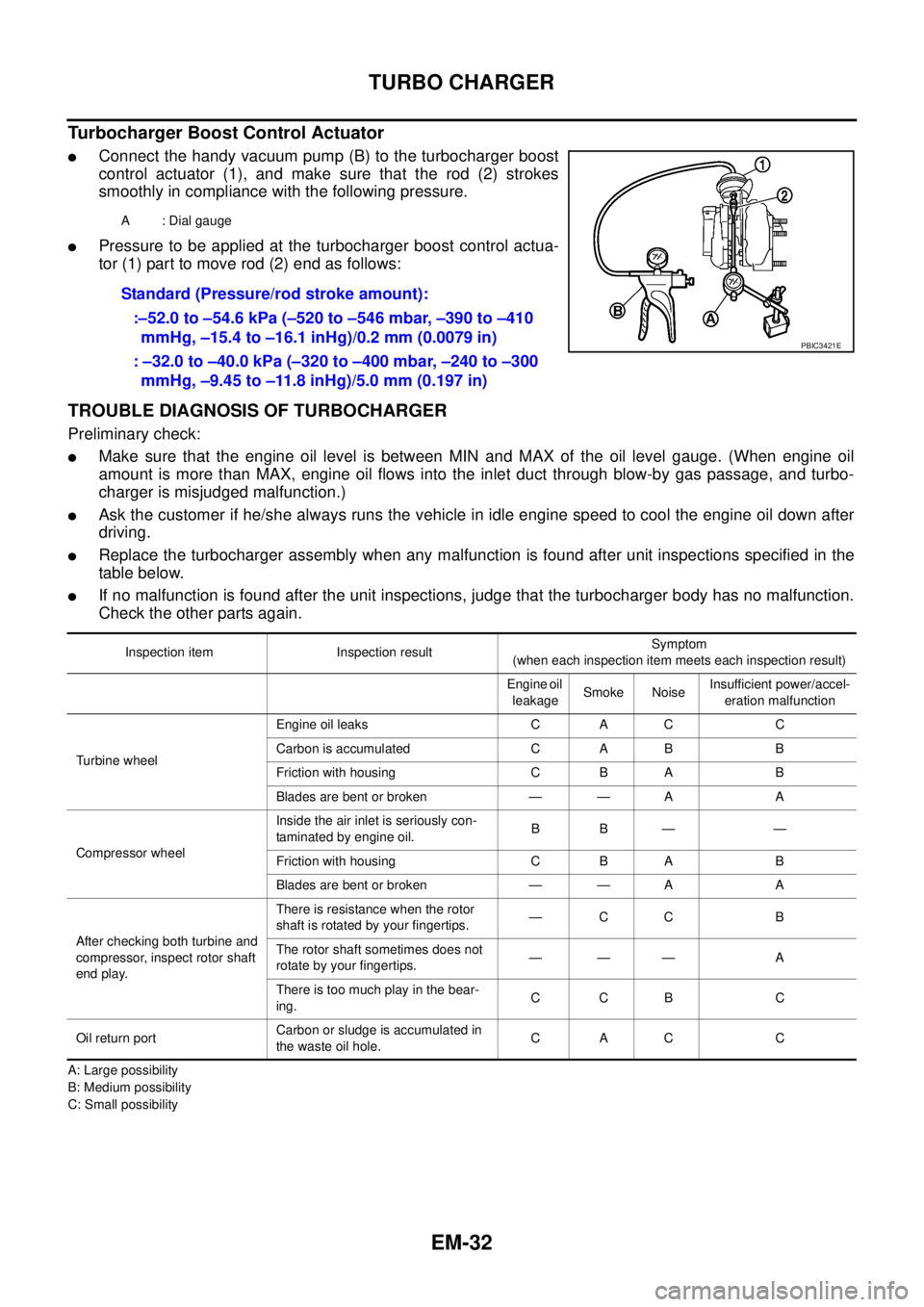
lConnect the handy vacuum pump (B) to the turbocharger boost
control actuator (1), and make sure that the rod (2) strokes
smoothly in compliance with the following pressure.
lPressure to be applied at the turbocharger boost control actua-
tor (1) part to move rod (2) end as follows:
TROUBLE DIAGNOSIS OF TURBOCHARGER
Preliminary check:
lMake sure that the engine oil level is between MIN and MAX of the oil level gauge. (When engine oil
amount is more than MAX, engine oil flows into the inlet duct through blow-by gas passage, and turbo-
charger is misjudged malfunction.)
lAsk the customer if he/she always runs the vehicle in idle engine speed to cool the engine oil down after
driving.
lReplace the turbocharger assembly when any malfunction is found after unit inspections specified in the
table below.
lIf no malfunction is found after the unit inspections, judge that the turbocharger body has no malfunction.
Check the other parts again.
A: Large possibility
B: Medium possibility
C: Small possibilityA : Dial gauge
Standard (Pressure/rod stroke amount):
:–52.0 to –54.6 kPa (–520 to –546 mbar, –390 to –410
mmHg, –15.4 to –16.1 inHg)/0.2 mm (0.0079 in)
: –32.0 to –40.0 kPa (–320 to –400 mbar, –240 to –300
mmHg, –9.45 to –11.8 inHg)/5.0 mm (0.197 in)
PBIC3421E
Inspection item Inspection resultSymptom
(when each inspection item meets each inspection result)
Engine oil
leakageSmoke NoiseInsufficient power/accel-
eration malfunction
Turbine wheelEngine oil leaks C A C C
Carbon is accumulated C A B B
Friction with housing C B A B
Blades are bent or broken — — A A
Compressor wheelInside the air inlet is seriously con-
taminated by engine oil.BB— —
Friction with housing C B A B
Blades are bent or broken — — A A
After checking both turbine and
compressor, inspect rotor shaft
end play.There is resistance when the rotor
shaft is rotated by your fingertips.—CC B
The rotor shaft sometimes does not
rotate by your fingertips.——— A
There is too much play in the bear-
ing.CCB C
Oil return portCarbon or sludge is accumulated in
the waste oil hole.CAC C
Page 1454 of 3171
EM-72
OIL SEAL
Removal and Installation of Rear Oil Seal
EBS01EK9
REMOVAL
1. Remove transmission and transfer assembly. Refer toMT-16, "TRANSMISSION ASSEMBLY"(M/T mod-
els) andAT- 2 4 7 , "
TRANSMISSION ASSEMBLY"(A/T models).
2. Remove flywheel (M/T models) or drive plate (A/T models). Refer toEM-110, "
CYLINDER BLOCK".
3. Remove rear oil seal with a suitable tool.
CAUTION:
Be careful not to damage crankshaft and cylinder block.
INSTALLATION
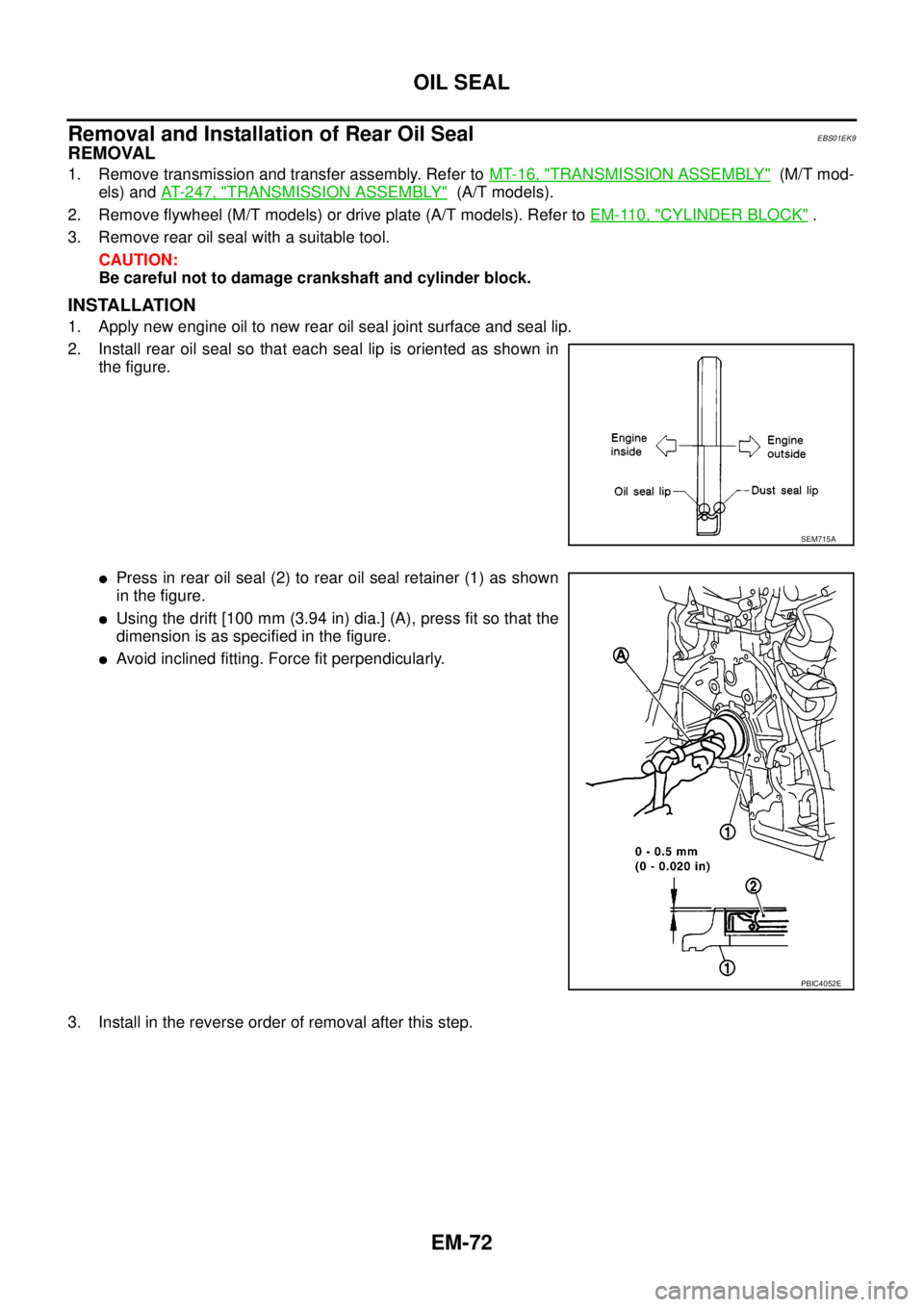
1. Apply new engine oil to new rear oil seal joint surface and seal lip.
2. Install rear oil seal so that each seal lip is oriented as shown in
the figure.
lPress in rear oil seal (2) to rear oil seal retainer (1) as shown
in the figure.
lUsing the drift [100 mm (3.94 in) dia.] (A), press fit so that the
dimension is as specified in the figure.
lAvoid inclined fitting. Force fit perpendicularly.
3. Install in the reverse order of removal after this step.
SEM715A
PBIC4052E