oil change NISSAN NAVARA 2005 Repair Workshop Manual
[x] Cancel search | Manufacturer: NISSAN, Model Year: 2005, Model line: NAVARA, Model: NISSAN NAVARA 2005Pages: 3171, PDF Size: 49.59 MB
Page 39 of 3171
A/T CONTROL SYSTEM
AT-31
D
E
F
G
H
I
J
K
L
MA
B
AT
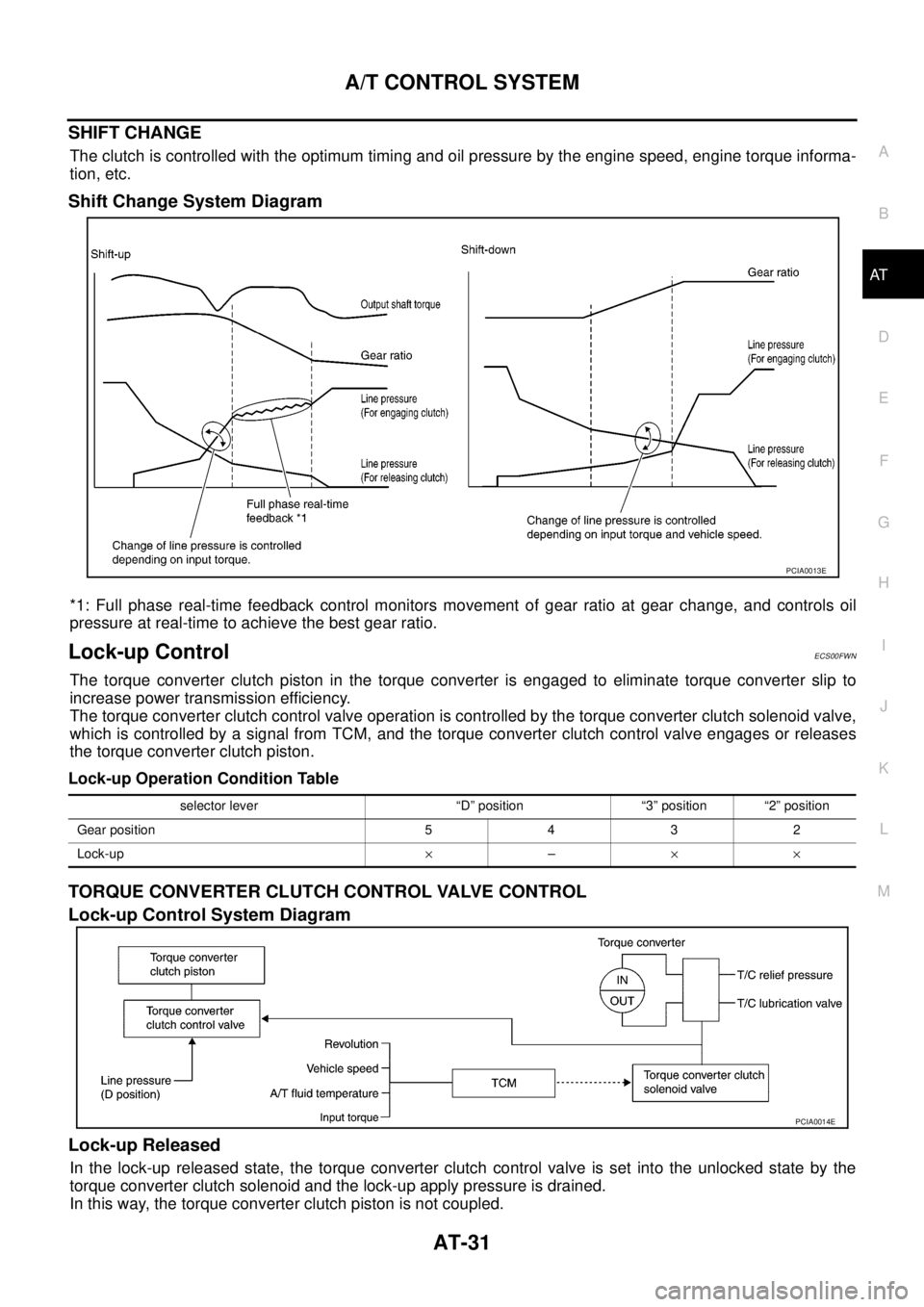
SHIFT CHANGE
The clutch is controlled with the optimum timing and oil pressure by the engine speed, engine torque informa-
tion, etc.
Shift Change System Diagram
*1: Full phase real-time feedback control monitors movement of gear ratio at gear change, and controls oil
pressure at real-time to achieve the best gear ratio.
Lock-up ControlECS00FWN
The torque converter clutch piston in the torque converter is engaged to eliminate torque converter slip to
increase power transmission efficiency.
The torque converter clutch control valve operation is controlled by the torque converter clutch solenoid valve,
which is controlled by a signal from TCM, and the torque converter clutch control valve engages or releases
the torque converter clutch piston.
Lock-up Operation Condition Table
TORQUE CONVERTER CLUTCH CONTROL VALVE CONTROL
Lock-up Control System Diagram
Lock-up Released
In the lock-up released state, the torque converter clutch control valve is set into the unlocked state by the
torque converter clutch solenoid and the lock-up apply pressure is drained.
In this way, the torque converter clutch piston is not coupled.
PCIA0013E
selector lever “D” position “3” position “2” position
Gear position 5 4 3 2
Lock-up´–´´
PCIA0014E
Page 41 of 3171

A/T CONTROL SYSTEM
AT-33
D
E
F
G
H
I
J
K
L
MA
B
AT
Control ValveECS00FWP
FUNCTION OF CONTROL VALVE
FUNCTION OF PRESSURE SWITCH
Name Function
Torque converter regulator valveIn order to prevent the pressure supplied to the torque converter from being excessive, the
line pressure is adjusted to the optimum pressure (torque converter operating pressure).
Pressure regulator valve
Pressure regulator plug
Pressure regulator sleeveAdjusts the oil discharged from the oil pump to the optimum pressure (line pressure) for
the driving state.
Front brake control valveWhen the front brake is coupled, adjusts the line pressure to the optimum pressure (front
brake pressure) and supplies it to the front brake. (In 1st, 2nd, 3rd, and 5th gears, adjusts
theclutchpressure.)
Accumulator control valveAdjusts the pressure (accumulator control pressure) acting on the accumulator piston and
low coast reducing valve to the pressure appropriate to the driving state.
Pilot valve AAdjusts the line pressure and produces the constant pressure (pilot pressure) required for
line pressure control, shift change control, and lock-up control.
Pilot valve BAdjusts the line pressure and produces the constant pressure (pilot pressure) required for
shift change control.
Low coast brake switching valve During engine braking, supplies the line pressure to the low coast brake reducing valve.
Low coast brake reducing valveWhen the low coast brake is coupled, adjusts the line pressure to the optimum pressure
(low coast brake pressure) and supplies it to the low coast brake.
N-R accumulator Produces the stabilizing pressure for when N-R is selected.
Direct clutch piston switching valve Operates in 4th gear and switches the direct clutch coupling capacity.
High and low reverse clutch control valveWhen the high and low reverse clutch is coupled, adjusts the line pressure to the optimum
pressure (high and low reverse clutch pressure) and supplies it to the high and low reverse
clutch. (In 1st, 3rd, 4th and 5th gears, adjusts the clutch pressure.)
Input clutch control valveWhen the input clutch is coupled, adjusts the line pressure to the optimum pressure (input
clutch pressure) and supplies it to the input clutch. (In 4th and 5th gears, adjusts the clutch
pressure.)
Direct clutch control valveWhen the direct clutch is coupled, adjusts the line pressure to the optimum pressure
(direct clutch pressure) and supplies it to the direct clutch. (In 2nd, 3rd, and 4th gears,
adjusts the clutch pressure.)
TCC control valve
TCC control plug
TCC control sleeveSwitches the lock-up to operating or released. Also, by performing the lock-up operation
transiently, lock-up smoothly.
Torque converter lubrication valveOperates during lock-up to switch the torque converter, cooling, and lubrication system oil
path.
Cool bypass valve Allows excess oil to bypass cooler circuit without being fed into it.
Line pressure relief valve Discharges excess oil from line pressure circuit.
N-D accumulator Produces the stabilizing pressure for when N-D is selected.
Manual valveSends line pressure to each circuit according to the select position. The circuits to which
the line pressure is not sent drain.
Name Function
ATFpressureswitch1(FR/B)Detects any malfunction in the front brake hydraulic pressure. When it detects any malfunction,
it puts the system into fail-safe mode.
ATFpressureswitch2(LC/B)Detects any malfunction in the low coast brake hydraulic pressure. When it detects any mal-
function, it puts the system into fail-safe mode.
ATFpressureswitch3(I/C)Detects any malfunction in the input clutch hydraulic pressure. When it detects any malfunction,
it puts the system into fail-safe mode.
ATF pressure switch 5 (D/C)Detects any malfunction in the direct clutch hydraulic pressure. When it detects any malfunc-
tion, it puts the system into fail-safe mode.
ATF pressure switch 6 (HLR/C)Detects any malfunction in the high and low reverse clutch hydraulic pressure. When it detects
any malfunction, it puts the system into fail-safe mode.
Page 69 of 3171
TROUBLE DIAGNOSIS
AT-61
D
E
F
G
H
I
J
K
L
MA
B
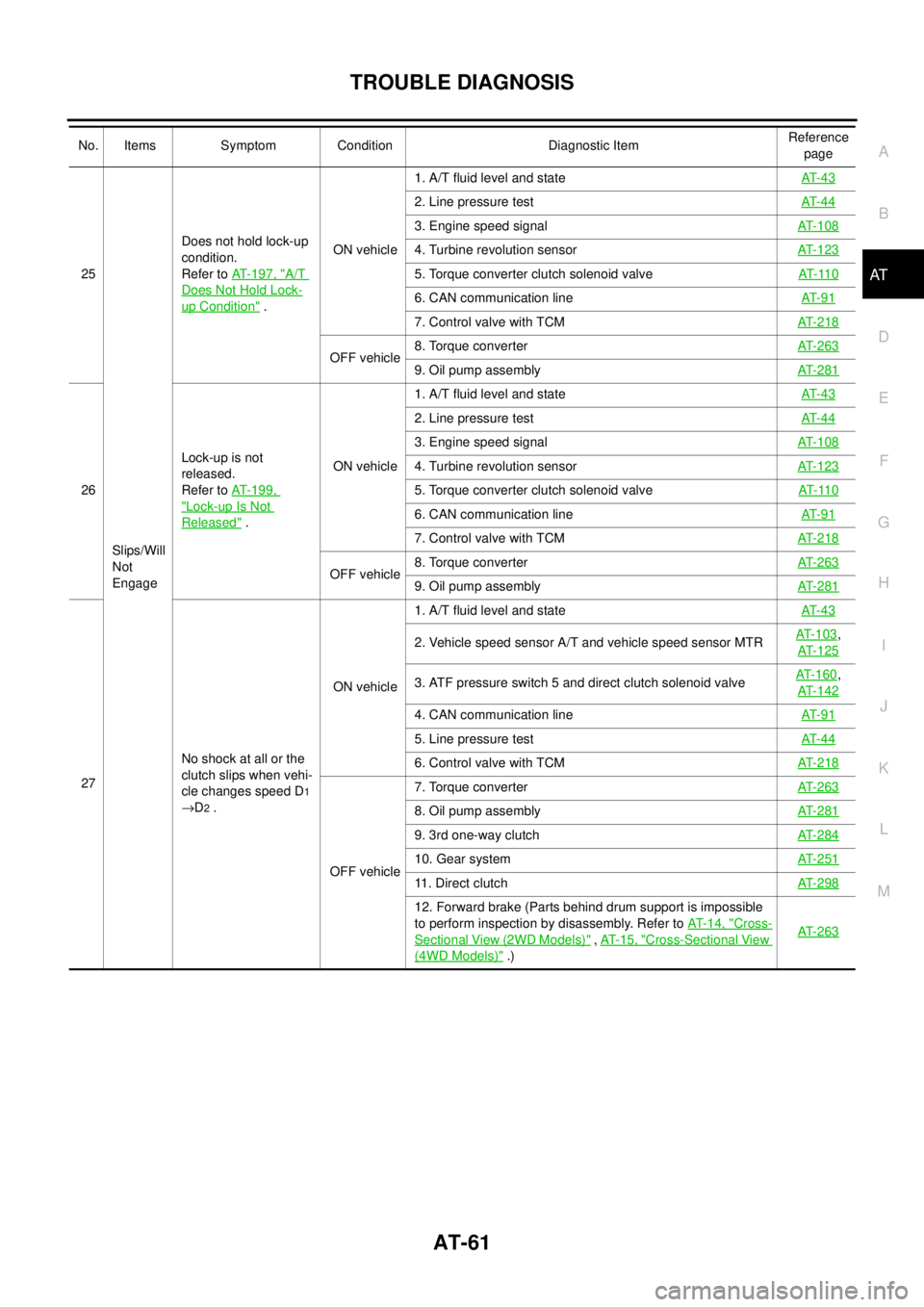
AT25
Slips/Will
Not
EngageDoes not hold lock-up
condition.
Refer toAT-197, "A/T
Does Not Hold Lock-
up Condition".ON vehicle1. A/T fluid level and stateAT- 4 3
2. Line pressure testAT- 4 4
3. Engine speed signalAT-108
4. Turbine revolution sensorAT-123
5. Torque converter clutch solenoid valveAT- 11 0
6. CAN communication lineAT- 9 1
7. Control valve with TCMAT-218
OFF vehicle8. Torque converterAT-2639. Oil pump assemblyAT-281
26Lock-up is not
released.
Refer toAT-199,
"Lock-up Is Not
Released".ON vehicle1. A/T fluid level and stateAT- 4 3
2. Line pressure testAT- 4 4
3. Engine speed signalAT-108
4. Turbine revolution sensorAT-123
5. Torque converter clutch solenoid valveAT- 11 0
6. CAN communication lineAT- 9 1
7. Control valve with TCMAT-218
OFF vehicle8. Torque converterAT-2639. Oil pump assemblyAT-281
27No shock at all or the
clutch slips when vehi-
cle changes speed D1
®D2.ON vehicle1. A/T fluid level and stateAT- 4 3
2. Vehicle speed sensor A/T and vehicle speed sensor MTRAT-103,
AT-125
3. ATF pressure switch 5 and direct clutch solenoid valveAT-160,
AT-142
4. CAN communication lineAT- 9 1
5. Line pressure testAT- 4 4
6. Control valve with TCMAT-218
OFF vehicle7. Torque converterAT-263
8. Oil pump assemblyAT-281
9. 3rd one-way clutchAT-284
10. Gear systemAT-251
11 . D i r e c t c l u t c hAT-298
12. Forward brake (Parts behind drum support is impossible
to perform inspection by disassembly. Refer toAT- 1 4 , "
Cross-
Sectional View (2WD Models)",AT- 1 5 , "Cross-Sectional View
(4WD Models)".)AT-263
No. Items Symptom Condition Diagnostic ItemReference
page
Page 70 of 3171
AT-62
TROUBLE DIAGNOSIS
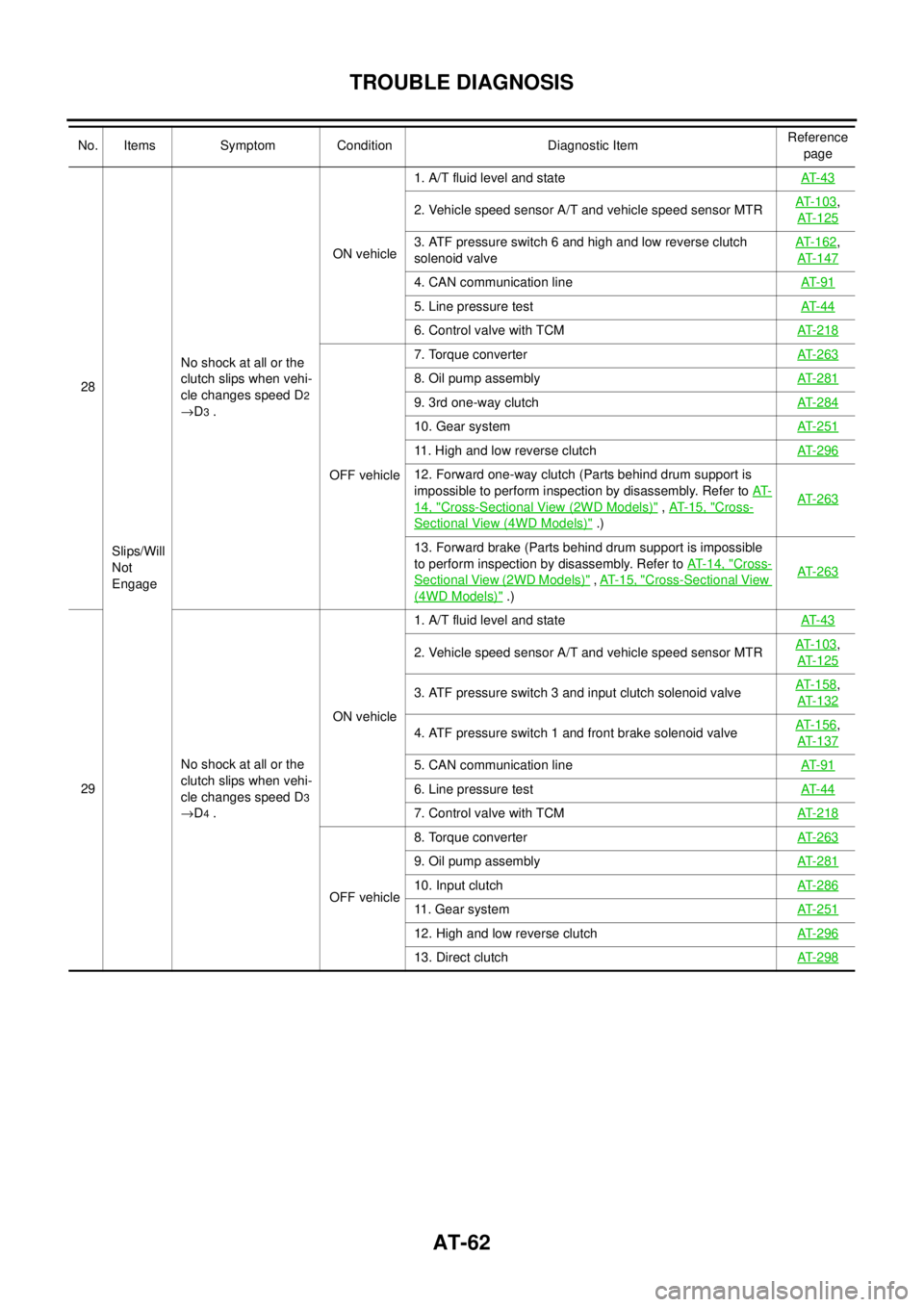
28
Slips/Will
Not
EngageNo shock at all or the
clutch slips when vehi-
cle changes speed D2
®D3.ON vehicle1. A/T fluid level and stateAT- 4 3
2. Vehicle speed sensor A/T and vehicle speed sensor MTRAT- 1 0 3,
AT- 1 2 5
3. ATF pressure switch 6 and high and low reverse clutch
solenoid valveAT- 1 6 2,
AT- 1 4 7
4. CAN communication lineAT- 9 1
5. Line pressure testAT- 4 4
6. Control valve with TCMAT- 2 1 8
OFF vehicle7. Torque converterAT- 2 6 3
8. Oil pump assemblyAT- 2 8 1
9. 3rd one-way clutchAT- 2 8 4
10. Gear systemAT- 2 5 1
11. High and low reverse clutchAT- 2 9 6
12. Forward one-way clutch (Parts behind drum support is
impossible to perform inspection by disassembly. Refer toAT-
14, "Cross-Sectional View (2WD Models)",AT- 1 5 , "Cross-
Sectional View (4WD Models)".)AT- 2 6 3
13. Forward brake (Parts behind drum support is impossible
to perform inspection by disassembly. Refer toAT-14, "
Cross-
Sectional View (2WD Models)",AT-15, "Cross-Sectional View
(4WD Models)".)AT- 2 6 3
29No shock at all or the
clutch slips when vehi-
cle changes speed D3
®D4.ON vehicle1. A/T fluid level and stateAT- 4 3
2. Vehicle speed sensor A/T and vehicle speed sensor MTRAT- 1 0 3,
AT- 1 2 5
3. ATF pressure switch 3 and input clutch solenoid valveAT- 1 5 8,
AT- 1 3 2
4. ATF pressure switch 1 and front brake solenoid valveAT- 1 5 6,
AT- 1 3 7
5. CAN communication lineAT- 9 1
6. Line pressure testAT- 4 4
7. Control valve with TCMAT- 2 1 8
OFF vehicle8. Torque converterAT- 2 6 3
9. Oil pump assemblyAT- 2 8 1
10. Input clutchAT- 2 8 6
11. Gear systemAT- 2 5 1
12. High and low reverse clutchAT- 2 9 6
13. Direct clutchAT- 2 9 8
No. Items Symptom Condition Diagnostic ItemReference
page
Page 71 of 3171
TROUBLE DIAGNOSIS
AT-63
D
E
F
G
H
I
J
K
L
MA
B
AT
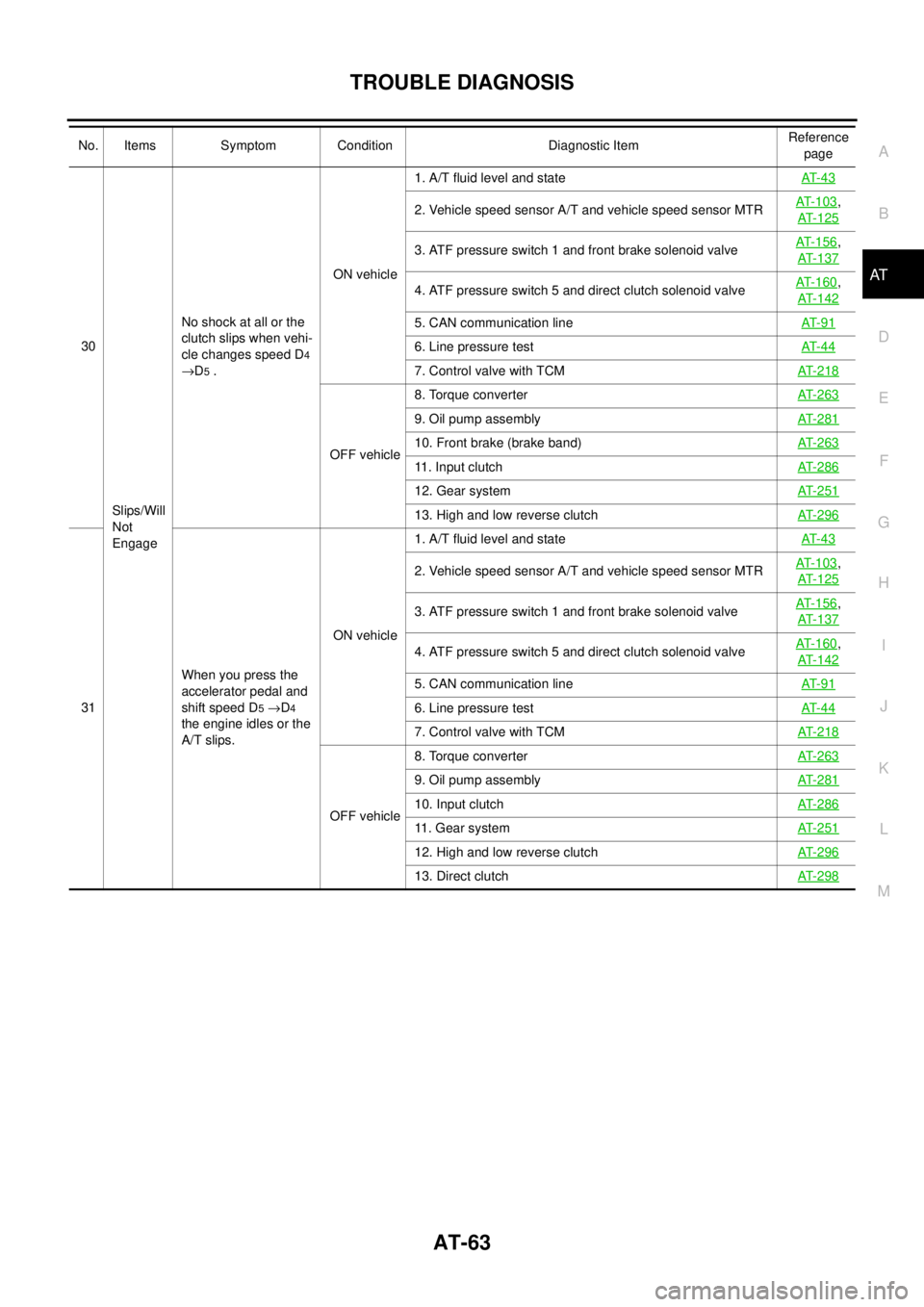
30
Slips/Will
Not
EngageNo shock at all or the
clutch slips when vehi-
cle changes speed D4
®D5.ON vehicle1. A/T fluid level and stateAT- 4 3
2. Vehicle speed sensor A/T and vehicle speed sensor MTRAT-103,
AT-125
3. ATF pressure switch 1 and front brake solenoid valveAT-156,
AT-137
4. ATF pressure switch 5 and direct clutch solenoid valveAT-160,
AT-142
5. CAN communication lineAT- 9 1
6. Line pressure testAT- 4 4
7. Control valve with TCMAT-218
OFF vehicle8. Torque converterAT-263
9. Oil pump assemblyAT-281
10. Front brake (brake band)AT-263
11. Input clutchAT-286
12. Gear systemAT-251
13. High and low reverse clutchAT-296
31When you press the
accelerator pedal and
shift speed D5®D4
the engine idles or the
A/T slips.ON vehicle1. A/T fluid level and stateAT- 4 3
2. Vehicle speed sensor A/T and vehicle speed sensor MTRAT-103,
AT-125
3. ATF pressure switch 1 and front brake solenoid valveAT-156,
AT-137
4. ATF pressure switch 5 and direct clutch solenoid valveAT-160,
AT-142
5. CAN communication lineAT- 9 1
6. Line pressure testAT- 4 4
7. Control valve with TCMAT-218
OFF vehicle8. Torque converterAT-263
9. Oil pump assemblyAT-281
10. Input clutchAT-286
11. Gear systemAT-251
12. High and low reverse clutchAT-296
13. Direct clutchAT-298
No. Items Symptom Condition Diagnostic ItemReference
page
Page 350 of 3171
ATC-16
PREPARATION
PREPARATION
PFP:00002
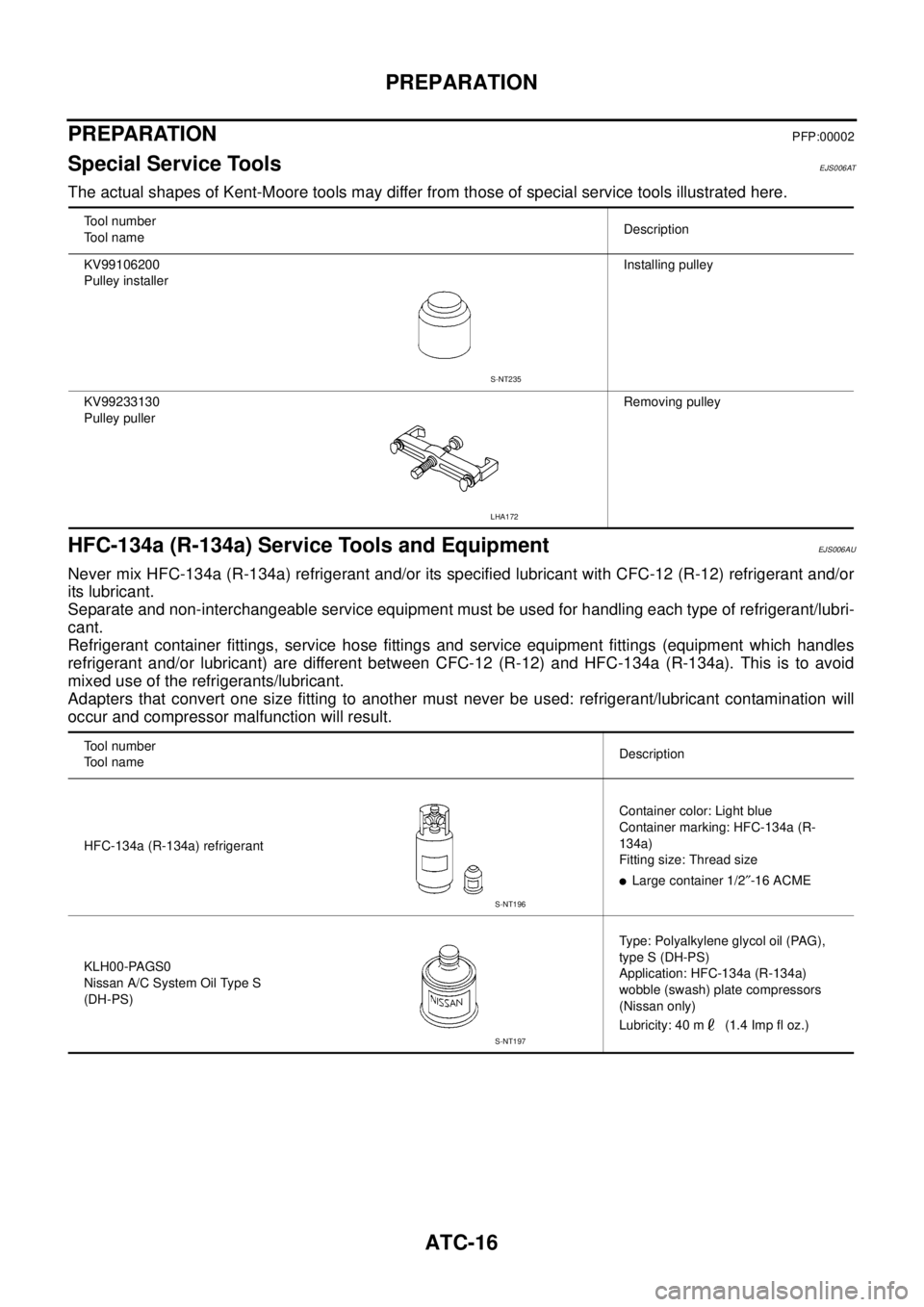
Special Service ToolsEJS006AT
The actual shapes of Kent-Moore tools may differ from those of special service tools illustrated here.
HFC-134a (R-134a) Service Tools and EquipmentEJS006AU
Never mix HFC-134a (R-134a) refrigerant and/or its specified lubricant with CFC-12 (R-12) refrigerant and/or
its lubricant.
Separate and non-interchangeable service equipment must be used for handling each type of refrigerant/lubri-
cant.
Refrigerant container fittings, service hose fittings and service equipment fittings (equipment which handles
refrigerant and/or lubricant) are different between CFC-12 (R-12) and HFC-134a (R-134a). This is to avoid
mixed use of the refrigerants/lubricant.
Adapters that convert one size fitting to another must never be used: refrigerant/lubricant contamination will
occur and compressor malfunction will result.
Tool number
Tool nameDescription
KV99106200
Pulley installerInstalling pulley
KV99233130
Pulley pullerRemoving pulley
S-NT235
LHA172
Tool number
Tool nameDescription
HFC-134a (R-134a) refrigerantContainer color: Light blue
Container marking: HFC-134a (R-
134a)
Fitting size: Thread size
lLarge container 1/2²-16 ACME
KLH00-PAGS0
Nissan A/C System Oil Type S
(DH-PS)Type: Polyalkylene glycol oil (PAG),
type S (DH-PS)
Application: HFC-134a (R-134a)
wobble (swash) plate compressors
(Nissan only)
Lubricity: 40 m (1.4 Imp fl oz.)
S-NT196
S-NT197
Page 1105 of 3171
DTC P0201 - P0204 FUEL INJECTOR
EC-125
C
D
E
F
G
H
I
J
K
L
MA
EC
DTC P0201 - P0204 FUEL INJECTORPFP:16600
Component DescriptionEBS01KFB
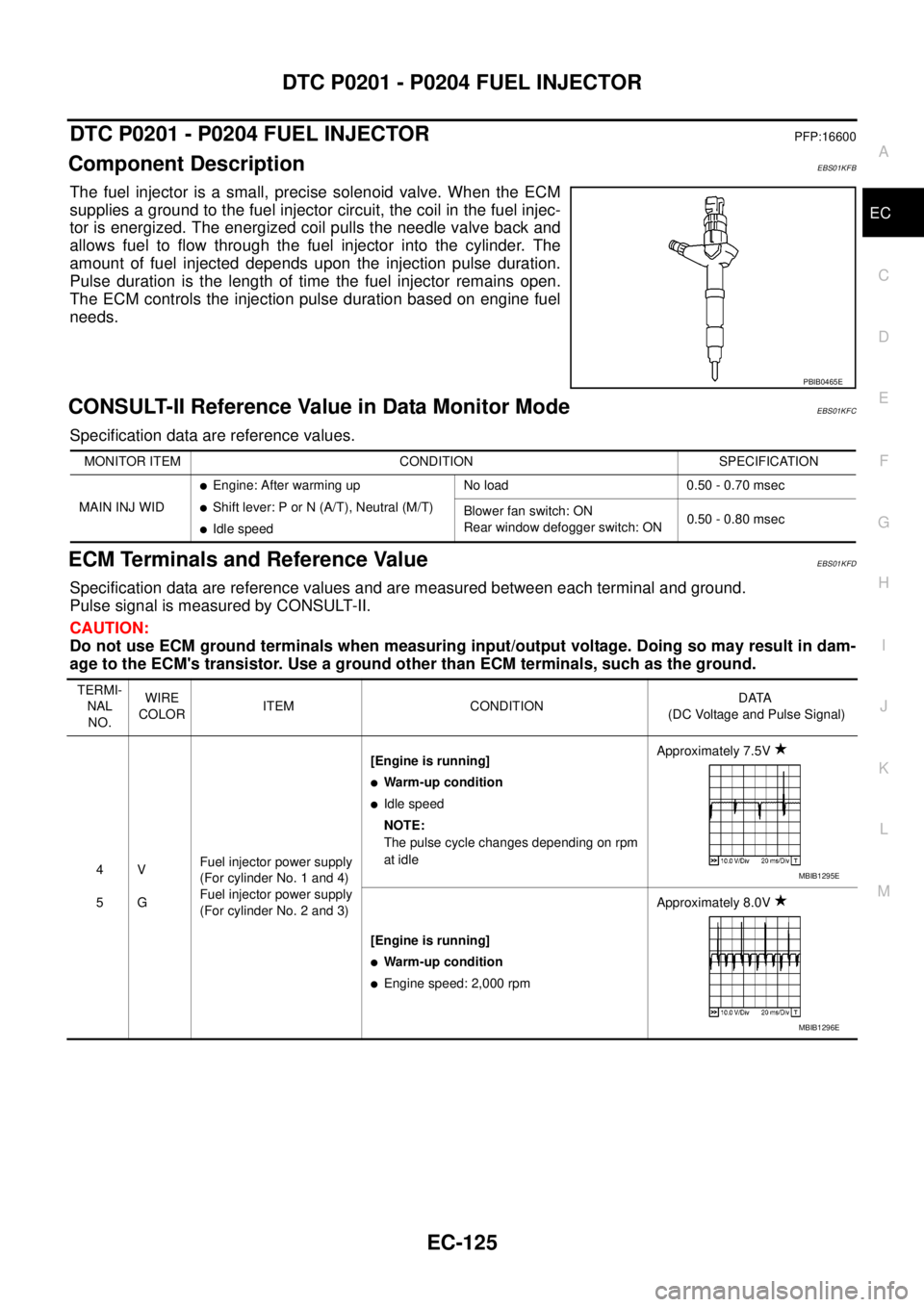
The fuel injector is a small, precise solenoid valve. When the ECM
supplies a ground to the fuel injector circuit, the coil in the fuel injec-
tor is energized. The energized coil pulls the needle valve back and
allows fuel to flow through the fuel injector into the cylinder. The
amount of fuel injected depends upon the injection pulse duration.
Pulse duration is the length of time the fuel injector remains open.
The ECM controls the injection pulse duration based on engine fuel
needs.
CONSULT-II Reference Value in Data Monitor ModeEBS01KFC
Specification data are reference values.
ECM Terminals and Reference ValueEBS01KFD
Specification data are reference values and are measured between each terminal and ground.
Pulse signal is measured by CONSULT-II.
CAUTION:
Do not use ECM ground terminals when measuring input/output voltage. Doing so may result in dam-
age to the ECM's transistor. Use a ground other than ECM terminals, such as the ground.
PBIB0465E
MONITOR ITEM CONDITION SPECIFICATION
MAIN INJ WID
lEngine: After warming up
lShift lever: P or N (A/T), Neutral (M/T)
lIdle speedNo load 0.50 - 0.70 msec
Blower fan switch: ON
Rear window defogger switch: ON0.50 - 0.80 msec
TERMI-
NAL
NO.WIRE
COLORITEM CONDITIONDATA
(DC Voltage and Pulse Signal)
4
5V
GFuel injector power supply
(For cylinder No. 1 and 4)
Fuel injector power supply
(For cylinder No. 2 and 3)[Engine is running]
lWarm-up condition
lIdle speed
NOTE:
The pulse cycle changes depending on rpm
at idleApproximately 7.5V
[Engine is running]
lWarm-up condition
lEngine speed: 2,000 rpmApproximately 8.0V
MBIB1295E
MBIB1296E
Page 1217 of 3171
DTC P1268 - P1271 FUEL INJECTOR
EC-237
C
D
E
F
G
H
I
J
K
L
MA
EC
DTC P1268 - P1271 FUEL INJECTORPFP:16600
Component DescriptionEBS01KJ8
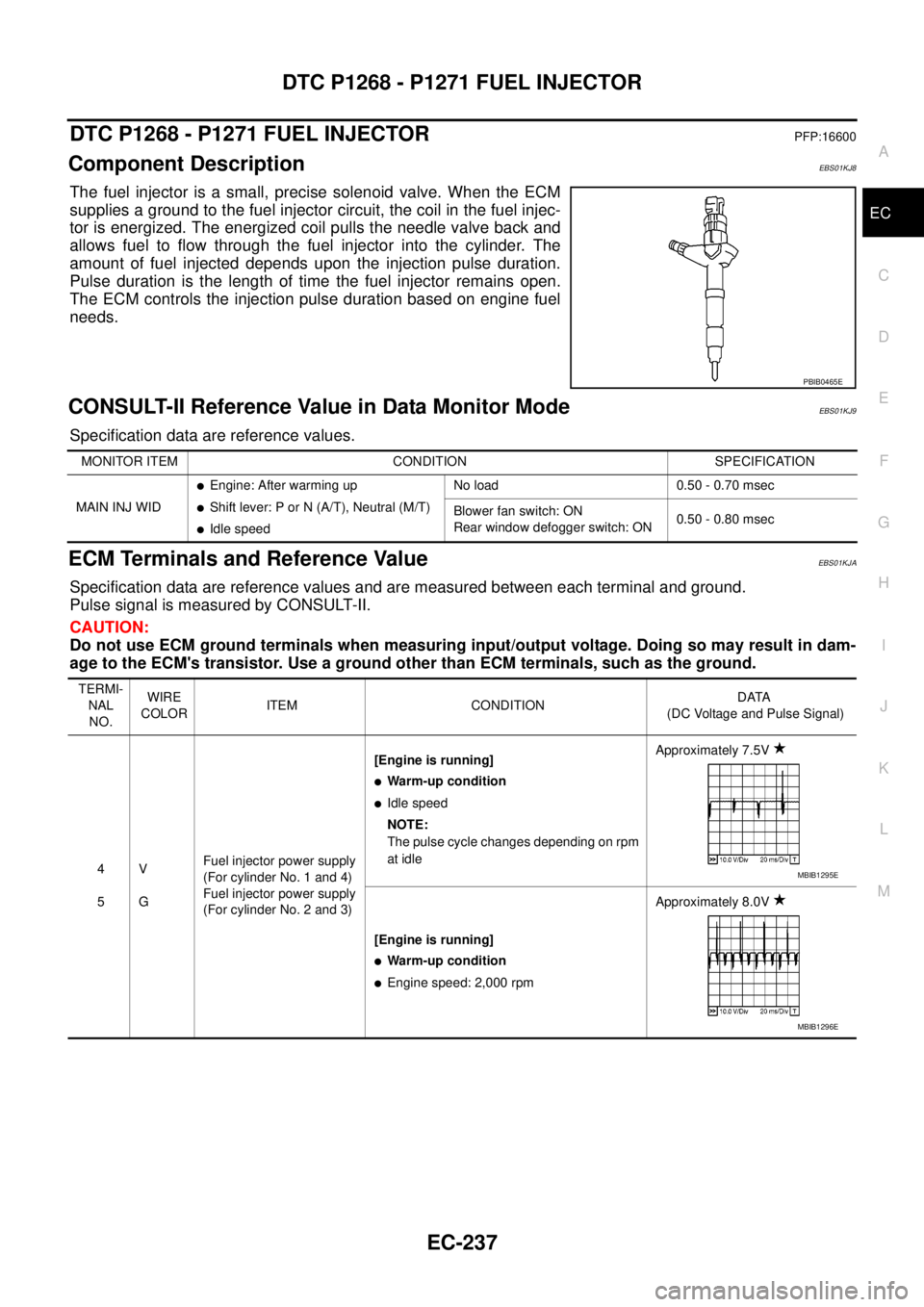
The fuel injector is a small, precise solenoid valve. When the ECM
supplies a ground to the fuel injector circuit, the coil in the fuel injec-
tor is energized. The energized coil pulls the needle valve back and
allows fuel to flow through the fuel injector into the cylinder. The
amount of fuel injected depends upon the injection pulse duration.
Pulse duration is the length of time the fuel injector remains open.
The ECM controls the injection pulse duration based on engine fuel
needs.
CONSULT-II Reference Value in Data Monitor ModeEBS01KJ9
Specification data are reference values.
ECM Terminals and Reference ValueEBS01KJA
Specification data are reference values and are measured between each terminal and ground.
Pulse signal is measured by CONSULT-II.
CAUTION:
Do not use ECM ground terminals when measuring input/output voltage. Doing so may result in dam-
age to the ECM's transistor. Use a ground other than ECM terminals, such as the ground.
PBIB0465E
MONITOR ITEM CONDITION SPECIFICATION
MAIN INJ WID
lEngine: After warming up
lShift lever: P or N (A/T), Neutral (M/T)
lIdle speedNo load 0.50 - 0.70 msec
Blower fan switch: ON
Rear window defogger switch: ON0.50 - 0.80 msec
TERMI-
NAL
NO.WIRE
COLORITEM CONDITIONDATA
(DC Voltage and Pulse Signal)
4
5V
GFuel injector power supply
(For cylinder No. 1 and 4)
Fuel injector power supply
(For cylinder No. 2 and 3)[Engine is running]
lWarm-up condition
lIdle speed
NOTE:
The pulse cycle changes depending on rpm
at idleApproximately 7.5V
[Engine is running]
lWarm-up condition
lEngine speed: 2,000 rpmApproximately 8.0V
MBIB1295E
MBIB1296E
Page 1261 of 3171
DTC P2146, P2149 FUEL INJECTOR POWER SUPPLY
EC-281
C
D
E
F
G
H
I
J
K
L
MA
EC
DTC P2146, P2149 FUEL INJECTOR POWER SUPPLYPFP:16600
Component DescriptionEBS01KL2
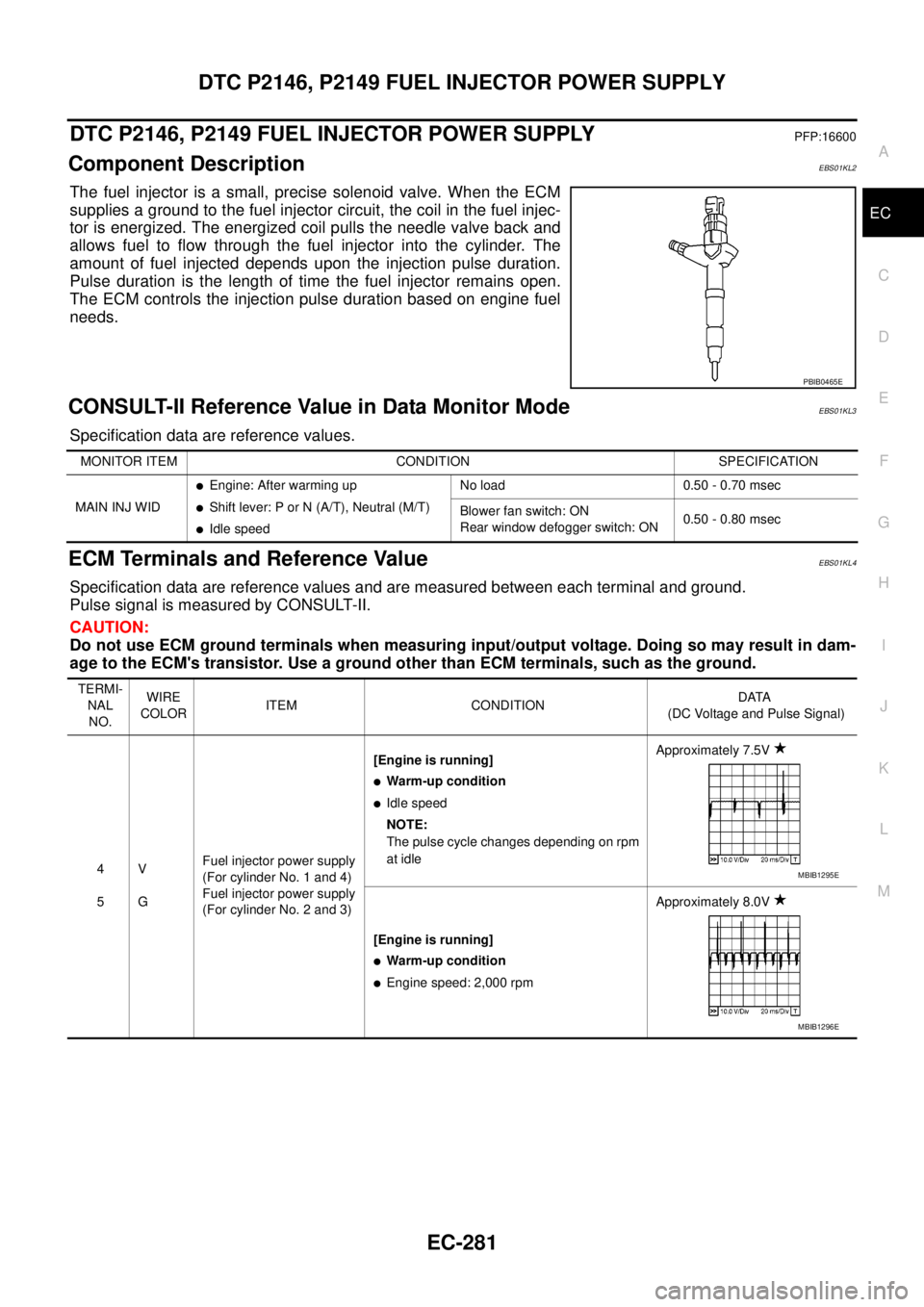
The fuel injector is a small, precise solenoid valve. When the ECM
supplies a ground to the fuel injector circuit, the coil in the fuel injec-
tor is energized. The energized coil pulls the needle valve back and
allows fuel to flow through the fuel injector into the cylinder. The
amount of fuel injected depends upon the injection pulse duration.
Pulse duration is the length of time the fuel injector remains open.
The ECM controls the injection pulse duration based on engine fuel
needs.
CONSULT-II Reference Value in Data Monitor ModeEBS01KL3
Specification data are reference values.
ECM Terminals and Reference ValueEBS01KL4
Specification data are reference values and are measured between each terminal and ground.
Pulse signal is measured by CONSULT-II.
CAUTION:
Do not use ECM ground terminals when measuring input/output voltage. Doing so may result in dam-
age to the ECM's transistor. Use a ground other than ECM terminals, such as the ground.
PBIB0465E
MONITOR ITEM CONDITION SPECIFICATION
MAIN INJ WID
lEngine: After warming up
lShift lever: P or N (A/T), Neutral (M/T)
lIdle speedNo load 0.50 - 0.70 msec
Blower fan switch: ON
Rear window defogger switch: ON0.50 - 0.80 msec
TERMI-
NAL
NO.WIRE
COLORITEM CONDITIONDATA
(DC Voltage and Pulse Signal)
4
5V
GFuel injector power supply
(For cylinder No. 1 and 4)
Fuel injector power supply
(For cylinder No. 2 and 3)[Engine is running]
lWarm-up condition
lIdle speed
NOTE:
The pulse cycle changes depending on rpm
at idleApproximately 7.5V
[Engine is running]
lWarm-up condition
lEngine speed: 2,000 rpmApproximately 8.0V
MBIB1295E
MBIB1296E
Page 1266 of 3171
EC-286
DTC P2147, P2148 FUEL INJECTOR CIRCUIT
DTC P2147, P2148 FUEL INJECTOR CIRCUIT
PFP:16600
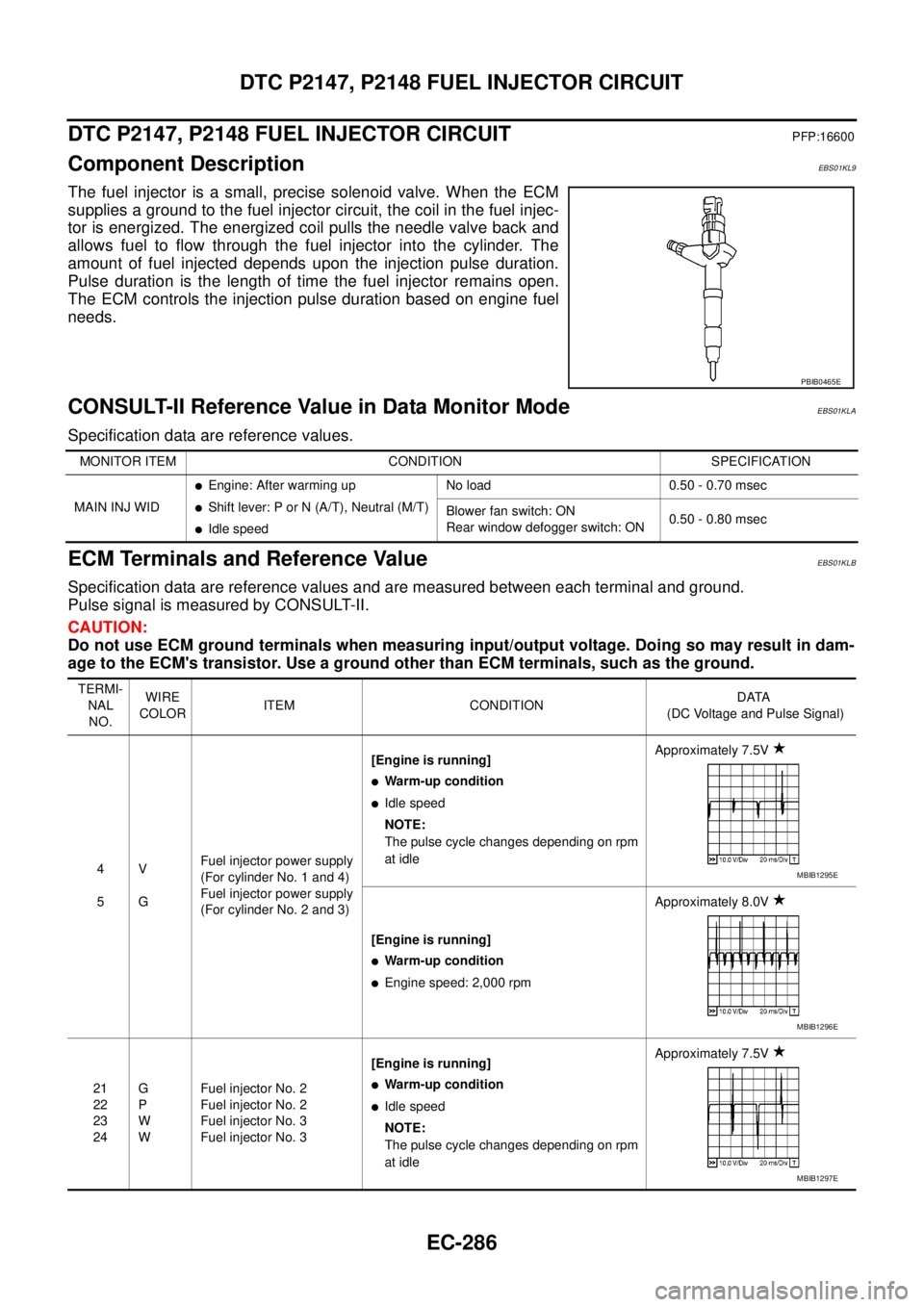
Component DescriptionEBS01KL9
The fuel injector is a small, precise solenoid valve. When the ECM
supplies a ground to the fuel injector circuit, the coil in the fuel injec-
tor is energized. The energized coil pulls the needle valve back and
allows fuel to flow through the fuel injector into the cylinder. The
amount of fuel injected depends upon the injection pulse duration.
Pulse duration is the length of time the fuel injector remains open.
The ECM controls the injection pulse duration based on engine fuel
needs.
CONSULT-II Reference Value in Data Monitor ModeEBS01KLA
Specification data are reference values.
ECM Terminals and Reference ValueEBS01KLB
Specification data are reference values and are measured between each terminal and ground.
Pulse signal is measured by CONSULT-II.
CAUTION:
Do not use ECM ground terminals when measuring input/output voltage. Doing so may result in dam-
age to the ECM's transistor. Use a ground other than ECM terminals, such as the ground.
PBIB0465E
MONITOR ITEM CONDITION SPECIFICATION
MAIN INJ WID
lEngine: After warming up
lShift lever: P or N (A/T), Neutral (M/T)
lIdle speedNo load 0.50 - 0.70 msec
Blower fan switch: ON
Rear window defogger switch: ON0.50 - 0.80 msec
TERMI-
NAL
NO.WIRE
COLORITEM CONDITIONDATA
(DC Voltage and Pulse Signal)
4
5V
GFuel injector power supply
(For cylinder No. 1 and 4)
Fuel injector power supply
(For cylinder No. 2 and 3)[Engine is running]
lWarm-up condition
lIdle speed
NOTE:
The pulse cycle changes depending on rpm
at idleApproximately 7.5V
[Engine is running]
lWarm-up condition
lEngine speed: 2,000 rpmApproximately 8.0V
21
22
23
24G
P
W
WFuel injector No. 2
Fuel injector No. 2
Fuel injector No. 3
Fuel injector No. 3[Engine is running]
lWarm-up condition
lIdle speed
NOTE:
The pulse cycle changes depending on rpm
at idleApproximately 7.5V
MBIB1295E
MBIB1296E
MBIB1297E