cooling NISSAN NOTE 2016 Service Workshop Manual
[x] Cancel search | Manufacturer: NISSAN, Model Year: 2016, Model line: NOTE, Model: NISSAN NOTE 2016Pages: 3641, PDF Size: 28.72 MB
Page 1672 of 3641

EXL-20
< SYSTEM DESCRIPTION >
DIAGNOSIS SYSTEM (IPDM E/R)
DIAGNOSIS SYSTEM (IPDM E/R)
Diagnosis DescriptionINFOID:0000000012542316
AUTO ACTIVE TEST
Description
In auto active test, the IPDM E/R sends a drive signal to the following systems to check their operation:
• Front wiper (LO, HI)
• Parking lamp
• Side marker lamp
• License plate lamp
• Tail lamp
• Front fog lamp
• Headlamp (LO, HI)
• A/C compressor (magnet clutch)
• Cooling fan
Operation Procedure
NOTE:
Never perform auto active test in the following conditions:
• Passenger door is open
• CONSULT is connected
1. Close the hood and lift the wiper arms from the windshield. (Prevent windshield damage due to wiper
operation)
NOTE:
When auto active test is performed with hood opened, sprinkle water on windshield beforehand.
2. Turn the ignition switch OFF.
3. Turn the ignition switch ON, and within 20 seconds, pr ess the driver door switch 10 times. Then turn the
ignition switch OFF.
4. Turn the ignition switch ON within 10 seconds. Af ter that the horn sounds once and the auto active test
starts.
5. After a series of the following operations is repeated 3 times, auto active test is completed.
NOTE:
• When auto active test has to be cancelled halfw ay through test, turn the ignition switch OFF.
• When auto active test is not activated, door swit ch may be the cause. Check door switch. Refer to DLK-98,
"ComponentFunctionCheck" (with Intelligent Key system) or DLK-232, "ComponentFunctionCheck"
(without Intelligent Key system).
Inspection in Auto Active Test
When auto active test is actuated, the following operation sequence is repeated 3 times.
Operation se-
quence Inspection location
Operation
1 Front wiper LO for 5 seconds → HI for 5 seconds
2 •Parking lamp
• Side marker lamp
• License plate lamp
• Tail lamp
• Front fog lamp (if equipped) 10 seconds
3 Headlamp LO for 10 seconds →HI ON ⇔ OFF 5 times
4 A/C compressor (magnet clutch) ON ⇔ OFF 5 times
5 Cooling fan LO for 5 seconds → MID for 3 seconds → HI for 2 seconds
Revision: August 2015 2016 Versa Note
cardiagn.com
Page 1673 of 3641
DIAGNOSIS SYSTEM (IPDM E/R)EXL-21
< SYSTEM DESCRIPTION >
C
DE
F
G H
I
J
K
M A
B
EXL
N
O P
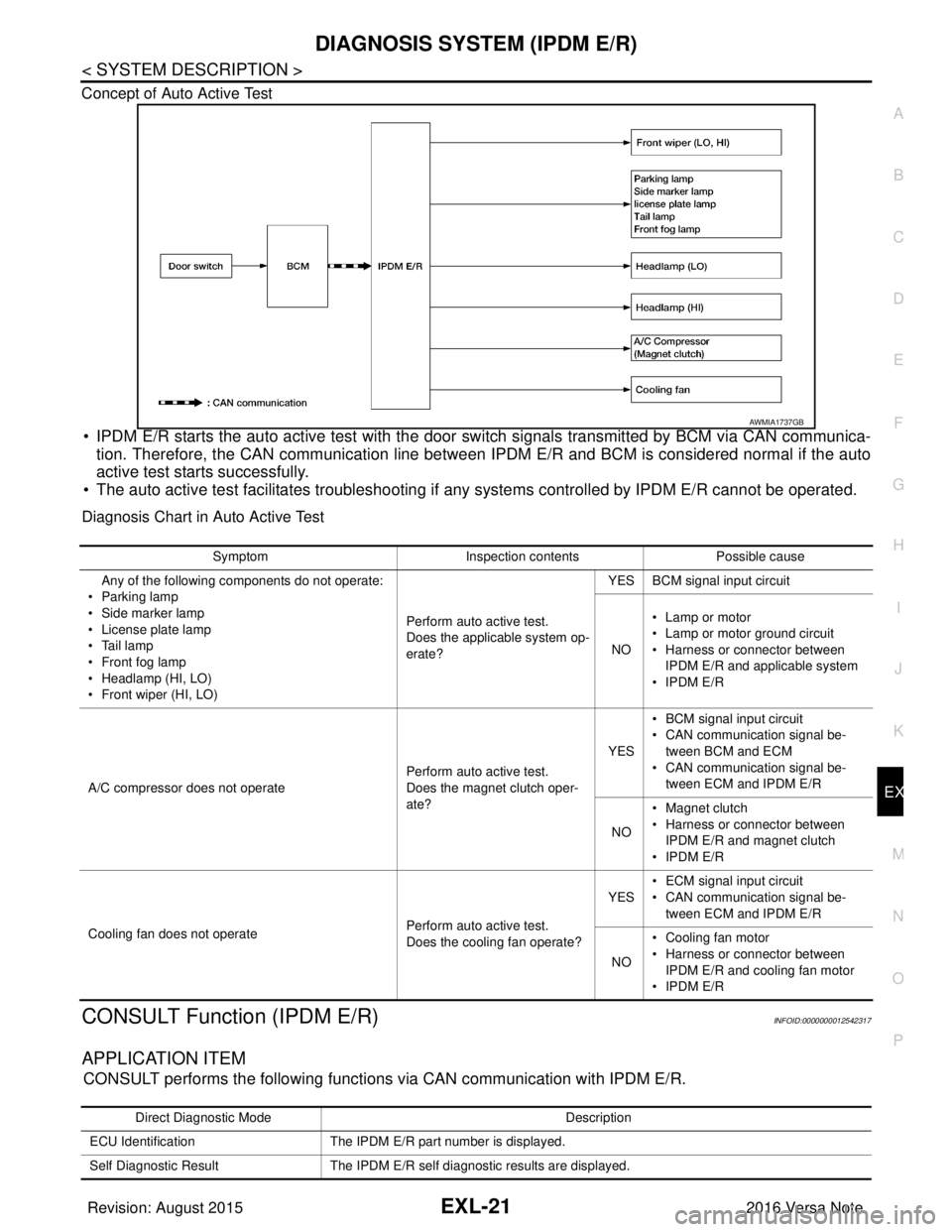
Concept of Auto Active Test
• IPDM E/R starts the auto active test with the door
switch signals transmitted by BCM via CAN communica-
tion. Therefore, the CAN communication line between IPDM E/R and BCM is considered normal if the auto
active test starts successfully.
• The auto active test facilitates troubleshooting if any systems controlled by IPDM E/R cannot be operated.
Diagnosis Chart in Auto Active Test
CONSULT Function (IPDM E/R)INFOID:0000000012542317
APPLICATION ITEM
CONSULT performs the following functions via CAN communication with IPDM E/R.
AWMIA1737GB
SymptomInspection contentsPossible cause
Any of the following components do not operate:
•Parking lamp
• Side marker lamp
• License plate lamp
•Tail lamp
•Front fog lamp
• Headlamp (HI, LO)
• Front wiper (HI, LO) Perform auto active test.
Does the applicable system op-
erate?YES BCM signal input circuit
NO • Lamp or motor
• Lamp or motor ground circuit
• Harness or connector between
IPDM E/R and applicable system
•IPDM E/R
A/C compressor does not operate Perform auto active test.
Does the magnet clutch oper-
ate?YES
• BCM signal input circuit
• CAN communication signal be-
tween BCM and ECM
• CAN communication signal be-
tween ECM and IPDM E/R
NO • Magnet clutch
• Harness or connector between
IPDM E/R and magnet clutch
•IPDM E/R
Cooling fan does not operate Perform auto active test.
Does the cooling fan operate?YES
• ECM signal input circuit
• CAN communication signal be-
tween ECM and IPDM E/R
NO • Cooling fan motor
• Harness or connector between
IPDM E/R and cooling fan motor
•IPDM E/R
Direct Diagnostic Mode Description
ECU Identification The IPDM E/R part number is displayed.
Self Diagnostic Result The IPDM E/R self diagnostic results are displayed.
Revision: August 2015 2016 Versa Note
cardiagn.com
Page 1674 of 3641

EXL-22
< SYSTEM DESCRIPTION >
DIAGNOSIS SYSTEM (IPDM E/R)
ECU IDENTIFICATION
The IPDM E/R part number is displayed.
SELF DIAGNOSTIC RESULT
Refer to PCS-20, "DTCIndex".
DATA MONITOR
ACTIVE TEST
Data Monitor The IPDM E/R input/output data is displayed in real time.
Active Test The IPDM E/R activates outputs to test components.
CAN Diag Support Mntr The result of transmit/receive diagnosis of CAN communication is displayed.
Direct Diagnostic Mode
Description
Monitor Item [Unit]Main
Signals Description
MOTOR FAN REQ [1/2/3/4] ×Indicates cooling fan speed signal received from ECM on CAN communication
line
AC COMP REQ [On/Off] ×Indicates A/C compressor request signal received from ECM on CAN commu-
nication line
TAIL&CLR REQ [On/Off] ×Indicates position light request signal received from BCM on CAN communica-
tion line
HL LO REQ [On/Off] ×Indicates low beam request signal received from BCM on CAN communication
line
HL HI REQ [On/Off] ×Indicates high beam request signal received from BCM on CAN communication
line
FR FOG REQ [On/Off] ×Indicates front fog light request signal received from BCM on CAN communica-
tion line
FR WIP REQ [Stop/1LOW/Low/Hi] ×Indicates front wiper request signal received from BCM on CAN communication
line
WIP AUTO STOP [STOP P/ACT P] ×Indicates condition of front wiper auto stop signal
WIP PROT [Off/BLOCK] ×Indicates condition of front wiper fail-safe operation
IGN RLY1 -REQ [On/Off] Indicates ignition switch ON signal received from BCM on CAN communication
line
IGN RLY [On/Off] ×Indicates condition of ignition relay
PUSH SW [On/Off] Indicates condition of push-button ignition switch
INTER/NP SW [On/Off] Indicates condition of CVT shift position
ST RLY CONT [On/Off] Indicates starter relay status signal received from BCM on CAN communication
line
IHBT RLY -REQ [On/Off] Indicates starter control relay signal received from BCM on CAN communication
line
ST/INHI RLY [Off/ ST /INHI] Indicates condition of starter relay and starter control relay
DETENT SW [On/Off] Indicates condition of CVT shift selector (park position switch)
DTRL REQ [Off] Indicates daytime running light request signal received from BCM on CAN com-
munication line
THFT HRN REQ [On/Off] Indicates theft warning horn request signal received from BCM on CAN commu-
nication line
HORN CHIRP [On/Off] Indicates horn reminder signal received from BCM on CAN communication line
Te s t i t e m D e s c r i p t i o n
HORN This test is able to check horn operation [On].
FRONT WIPER This test is able to check wiper motor operation [Hi/Lo/Off].
Revision: August 2015 2016 Versa Note
cardiagn.com
Page 1675 of 3641

DIAGNOSIS SYSTEM (IPDM E/R)EXL-23
< SYSTEM DESCRIPTION >
C
DE
F
G H
I
J
K
M A
B
EXL
N
O P
CAN DIAG SUPPORT MNTR
Refer to LAN-13, "CAN Diagnostic Support Monitor".
MOTOR FAN This test is able to check cooling fan operation [4/3/2/1].
EXTERNAL LAMPS This test is able to check external lamp operation [Fog/Hi/Lo/TAIL/Off].
Test item
Description
Revision: August 2015 2016 Versa Note
cardiagn.com
Page 1779 of 3641

EXT-12
< SYSTEM DESCRIPTION >
SYSTEM
While driving at high speed, ECM operates the shutter to open position when the vehicle reaches the specified
speed in order to prevent the shutte r from shutting up by wind resistance.
When the vehicle speed is reduced below the specified speed ECM operates active grille shutter to open posi-
tion.
ACTIVE GRILLE SHUTTER OPERATIONAL CONDITIONS
ECM operates active grille shutter to close position when following a ll conditions are met.
ECM operates active grille shutter to open positi on when one of the following conditions is met.
Item Status
Active grille shutter initial position learning Complete
Vehicle speed Approx. 30 - 140 km/h (19 - 88 MPH)
Engine coolant temperature Approx. less than 95°C (203 °F)
Engine oil temperature Approx. less than 140°C (284 °F)
CVT fluid temperature Approx. less than 135°C (275 °F)
Cooling fan OFF
Refrigerant pressure 0.78 MPa (7.95 kg/cm
2, 113.1 psi) or less
Malfunction of engine coolant temperature sensor system Not detected
Malfunction of engine oil temperature sensor system Not detected
Malfunction of vehicle speed sensor system Not detected
Malfunction of CAN communication system Not detected
ItemStatus
Vehicle speed • 22 km/h (14 MPH) or less
• 140 km/h (88 MPH) or more
Engine coolant temperature Approx. 95°C (203 °F) or more
Engine oil temperature Approx. 140°C (284 °F) or more
CVT fluid temperature Approx. 135°C (275 °F) or more
Cooling fan ON
Refrigerant pressure 1.18 MPa (12.04 kg/cm
2, 171.1 psi) or more
Malfunction of engine coolant temperature sensor system Detected
Malfunction of engine oil temperature sensor system Detected
Malfunction of vehicle speed sensor system Detected
Malfunction of CAN communication system Detected
Revision: August 2015 2016 Versa Note
cardiagn.com
Page 1919 of 3641
TOW TRUCK TOWINGGI-31
< PRECAUTION >
C
DE
F
G H
I
J
K L
M B
GI
N
O PTOW TRUCK TOWING
To w T r u c k To w i n gINFOID:0000000012433173
CAUTION:
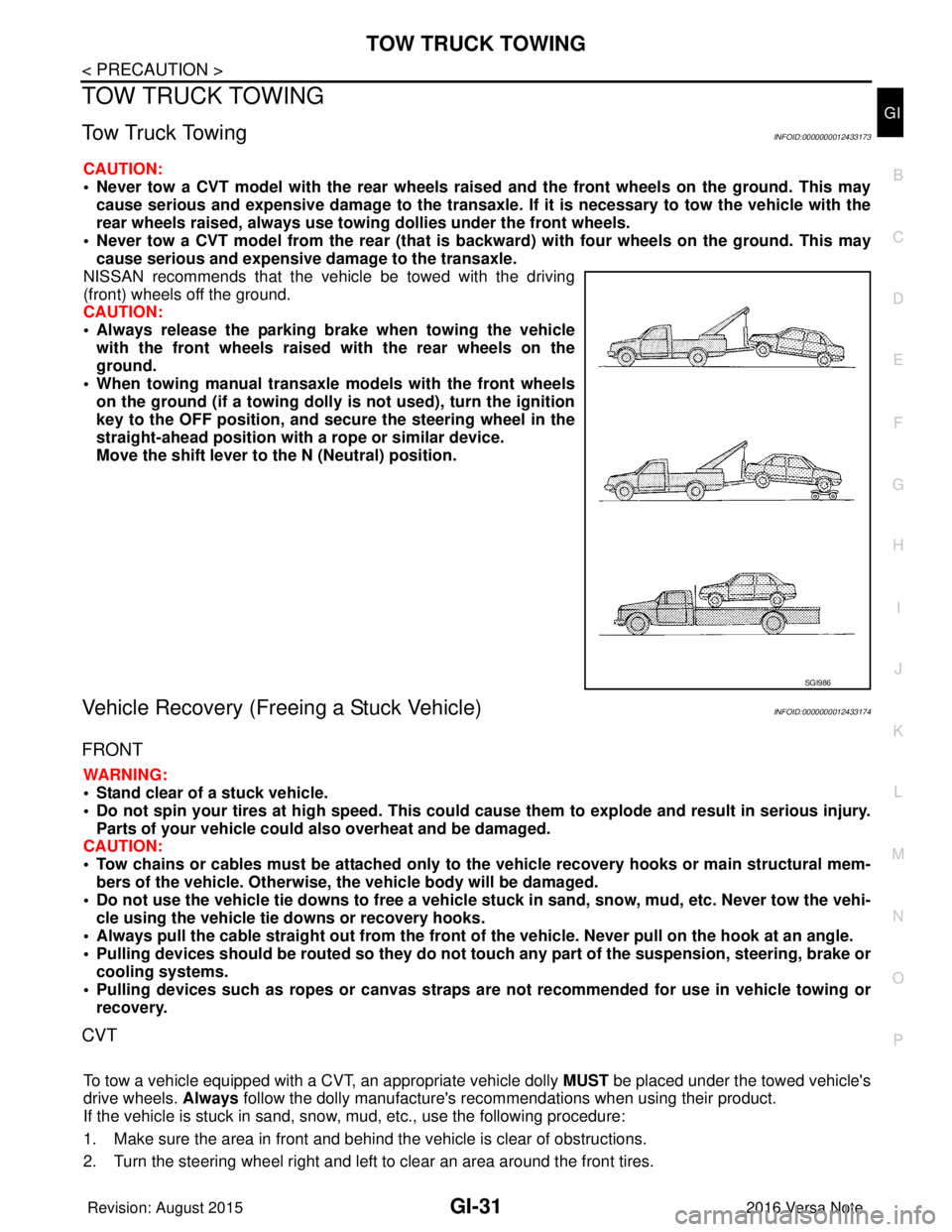
• Never tow a CVT model with the rear wheels raised and the front wheels on the ground. This may
cause serious and expensive damage to the transaxle. If it is necessary to tow the vehicle with the
rear wheels raised, always use towin g dollies under the front wheels.
• Never tow a CVT model from the rear (that is b ackward) with four wheels on the ground. This may
cause serious and expensive damage to the transaxle.
NISSAN recommends that the vehicle be towed with the driving
(front) wheels off the ground.
CAUTION:
• Always release the parking br ake when towing the vehicle
with the front wheels raised with the rear wheels on the
ground.
• When towing manual transaxle models with the front wheels on the ground (if a towing dolly is not used), turn the ignition
key to the OFF position, and secu re the steering wheel in the
straight-ahead position with a rope or similar device.
Move the shift lever to th e N (Neutral) position.
Vehicle Recovery (Freeing a Stuck Vehicle)INFOID:0000000012433174
FRONT
WARNING:
• Stand clear of a stuck vehicle.
• Do not spin your tires at high speed. This could cause them to explode and result in serious injury.
Parts of your vehicle could also overheat and be damaged.
CAUTION:
• Tow chains or cables must be attached only to the vehicle recovery hooks or main structural mem-
bers of the vehicle. Otherwise, the vehicle body will be damaged.
• Do not use the vehicle tie downs to free a vehicle stuck in sand, snow, mud, etc. Never tow the vehi-
cle using the vehicle tie downs or recovery hooks.
• Always pull the cable straight out from the front of the vehicle. Never pull on the hook at an angle.
• Pulling devices should be routed so they do not touch any part of the suspension, steering, brake or
cooling systems.
• Pulling devices such as ropes or canvas straps ar e not recommended for use in vehicle towing or
recovery.
CVT
To tow a vehicle equipped with a CVT, an appropriate vehicle dolly MUST be placed under the towed vehicle's
drive wheels. Always follow the dolly manufacture's re commendations when using their product.
If the vehicle is stuck in sand, snow , mud, etc., use the following procedure:
1. Make sure the area in front and behind the vehicle is clear of obstructions.
2. Turn the steering wheel right and left to clear an area around the front tires.
SGI986
Revision: August 2015 2016 Versa Note
cardiagn.com
Page 1970 of 3641

HAC-2
Diagnosis Procedure ..............................................37
A/C INDICATOR ................................................39
Diagnosis Procedure ........................................... ...39
FRONT BLOWER MOTOR ................................41
Description ........................................................... ...41
Diagnosis Procedure ..............................................41
Component Inspection (Front Blower Motor) ..........43
Component Inspection (B lower Relay) ...................43
Component Inspection (Front Blower Motor Re-
sistor) ................................................................... ...
43
Component Inspection (Fan Switch) ......................43
MAGNET CLUTCH ............................................45
Description ........................................................... ...45
Component Function Check ...................................45
Diagnosis Procedure ..............................................45
SYMPTOM DIAGNOSIS .............................47
MANUAL AIR CONDITIONING SYSTEM ...... ...47
Symptom Table ................................................... ...47
INSUFFICIENT COOLING .................................48
Description ........................................................... ...48
Diagnosis Procedure ..............................................48
INSUFFICIENT HEATING .................................49
Description ........................................................... ...49
Diagnosis Procedure ..............................................49
COMPRESSOR DOES NOT OPERATE ...........50
Description ........................................................... ...50
Diagnosis Procedure ............................................ ...50
REMOVAL AND INSTALLATION ..............52
FRONT AIR CONTROL .................................. ...52
Exploded View ..................................................... ...52
Removal and Installation .........................................52
THERMO CONTROL AMPLIFIER ................. ...53
Removal and Installation .........................................53
REFRIGERANT PRESSURE SENSOR ......... ...54
Removal and Installation .........................................54
FRONT BLOWER MOTOR RESISTOR ......... ...55
Exploded View ..................................................... ...55
Removal and Installation .........................................55
DOOR CABLE ................................................ ...56
Exploded View ..................................................... ...56
INTAKE DOOR CABLE ......................................... ...56
INTAKE DOOR CABLE : Removal and Installation
...
56
INTAKE DOOR CABLE : Adjustment .................. ...56
MODE DOOR CABLE ............................................ ...57
MODE DOOR CABLE : Removal and Installation ...57
MODE DOOR CABLE : Adjustment ........................57
AIR MIX DOOR CABLE ......................................... ...57
AIR MIX DOOR CABLE : Removal and Installation
...
57
AIR MIX DOOR CABLE : Adjustment .................. ...57
Revision: August 2015 2016 Versa Note
cardiagn.com
Page 1979 of 3641
![NISSAN NOTE 2016 Service Workshop Manual SYSTEMHAC-11
< SYSTEM DESCRIPTION > [MANUAL AIR CONDITIONING]
C
D
E
F
G H
J
K L
M A
B
HAC
N
O P
SYSTEM
System DescriptionINFOID:0000000012430717
SYSTEM DIAGRAM
SYSTEM DESCRIPTION
• The manual air co](/img/5/57363/w960_57363-1978.png "NISSAN NOTE 2016 Service Workshop Manual SYSTEMHAC-11
< SYSTEM DESCRIPTION > [MANUAL AIR CONDITIONING]
C
D
E
F
G H
J
K L
M A
B
HAC
N
O P
SYSTEM
System DescriptionINFOID:0000000012430717
SYSTEM DIAGRAM
SYSTEM DESCRIPTION
• The manual air co")
SYSTEMHAC-11
< SYSTEM DESCRIPTION > [MANUAL AIR CONDITIONING]
C
D
E
F
G H
J
K L
M A
B
HAC
N
O P
SYSTEM
System DescriptionINFOID:0000000012430717
SYSTEM DIAGRAM
SYSTEM DESCRIPTION
• The manual air conditioning system is c ontrolled by a sequence of functions from the front air control, BCM,
ECM, and IPDM E/R.
• The fan speed of the front blower motor is changed by t he combination of the fan control dial (fan switch)
operation and blower resistor control.
Compressor ControlINFOID:0000000012430718
PRINCIPLE OF OPERATION
Compressor is not activated.
Functional Circuit Diagram
ALIIA0813GB
Module/Function Door control A/C request signalCompressor control Cooling fan control
Front air control HAC-13
— HAC-11—
BCM —BCS-7
(With Intelligent Key system)
BCS-78
(Without Intelligent Key system) ——
ECM — —HAC-11
EC-38
IPDM E/R — —HAC-11EC-38
Revision: August 2015 2016 Versa Note
cardiagn.com
Page 2015 of 3641
![NISSAN NOTE 2016 Service Workshop Manual MANUAL AIR CONDITIONING SYSTEMHAC-47
< SYMPTOM DIAGNOSIS > [MANUAL AIR CONDITIONING]
C
D
E
F
G H
J
K L
M A
B
HAC
N
O P
SYMPTOM DIAGNOSIS
MANUAL AIR CONDITIONING SYSTEM
Symptom TableINFOID:000000001243](/img/5/57363/w960_57363-2014.png "NISSAN NOTE 2016 Service Workshop Manual MANUAL AIR CONDITIONING SYSTEMHAC-47
< SYMPTOM DIAGNOSIS > [MANUAL AIR CONDITIONING]
C
D
E
F
G H
J
K L
M A
B
HAC
N
O P
SYMPTOM DIAGNOSIS
MANUAL AIR CONDITIONING SYSTEM
Symptom TableINFOID:000000001243")
MANUAL AIR CONDITIONING SYSTEMHAC-47
< SYMPTOM DIAGNOSIS > [MANUAL AIR CONDITIONING]
C
D
E
F
G H
J
K L
M A
B
HAC
N
O P
SYMPTOM DIAGNOSIS
MANUAL AIR CONDITIONING SYSTEM
Symptom TableINFOID:0000000012430749
SYMPTOM TABLE
Symptom Reference Page
A/C system does not come on. Go to Trouble Diagnosis Procedure for A/C System. HAC-30
A/C system cannot be controlled.Go to Self-diagnosis Function. HAC-28
Air outlet does not change.Go to Adjustment Procedure for Mode Door. HAC-57
Discharge air temperature does not change. Go to Adjustment Procedure for Air Mix Door. HAC-57
Intake door does not change.Go to Adjustment Procedure for Intake Door. HAC-56
Front blower motor operation is malfunction-
ing.Go to Trouble Diagnosis Procedure for Front Blower Motor.
HAC-41
Magnet clutch does not engage.Go to Trouble Diagnosis Procedure for Magnet Clutch. HAC-45
Insufficient cooling.Go to Trouble Diagnosis Procedure for Insufficient Cooling. HAC-48
Insufficient heating.Go to Trouble Diagnosis Procedure for Insufficient Heating. HAC-49
Noise.Go to Trouble Diagnosis Procedure for Noise. HA-17
A/C switch LED does not illuminate. Go to Trouble Diagnosis Procedure for A/C System. HAC-39
Both high- and low-pressure sides are too
high.Go to Trouble Diagnosis Procedure for Abnormal Pressure.
HA-15
High-pressure side is too high and low pres-
sure side is too low.Go to Trouble Diagnosis Procedure for Abnormal Pressure.
HA-15
High-pressure side is too low and low-pres-
sure side is too high.Go to Trouble Diagnosis Procedure for Abnormal Pressure.
HA-15
Both high- and low-pressure side sometimes
become negative.Go to Trouble Diagnosis Procedure for Abnormal Pressure.
HA-15
Low-pressure side sometimes becomes neg-
ative.Go to Trouble Diagnosis Procedure for Abnormal Pressure.
HA-15
Low-pressure side becomes negative. Go to Trouble Diagnosis Procedure for Abnormal Pressure. HA-15
Revision: August 20152016 Versa Note
cardiagn.com
Page 2016 of 3641
![NISSAN NOTE 2016 Service Workshop Manual HAC-48
< SYMPTOM DIAGNOSIS >[MANUAL AIR CONDITIONING]
INSUFFICIENT COOLING
INSUFFICIENT COOLING
DescriptionINFOID:0000000012430750
Symptom
• Insufficient cooling
• No cool air comes out. (Air flow](/img/5/57363/w960_57363-2015.png "NISSAN NOTE 2016 Service Workshop Manual HAC-48
< SYMPTOM DIAGNOSIS >[MANUAL AIR CONDITIONING]
INSUFFICIENT COOLING
INSUFFICIENT COOLING
DescriptionINFOID:0000000012430750
Symptom
• Insufficient cooling
• No cool air comes out. (Air flow")
HAC-48
< SYMPTOM DIAGNOSIS >[MANUAL AIR CONDITIONING]
INSUFFICIENT COOLING
INSUFFICIENT COOLING
DescriptionINFOID:0000000012430750
Symptom
• Insufficient cooling
• No cool air comes out. (Air flow volume is normal.)
Diagnosis ProcedureINFOID:0000000012430751
NOTE:
Perform self-diagnosis with CONSULT before performing
symptom diagnosis. If any malfunction result or DTC
is detected, perform the corresponding diagnosis.
1.CHECK MAGNET CLUTCH OPERATION
1. Turn ignition switch ON.
2. Turn fan control dial ON.
3. Press A/C switch.
4. Check that A/C indicator turns ON. Check visually and by sound that compressor operates.
5. Press A/C switch again.
6. Check that A/C indicator turns OFF. Check that compressor stops.
Is the inspection result normal?
YES >> GO TO 2.
NO >> Check compressor operation. Refer to HAC-50, "
Diagnosis Procedure".
2.CHECK DRIVE BELT
Check tension of drive belt. Refer to EM-17, "
Inspection".
Is the inspection result normal?
YES >> GO TO 3.
NO >> Adjust or replace drive belt depending on the inspection results.
3.CHECK REFRIGERANT CYCLE PRESSURE
Connect the recovery/recycling recharging equipment to the vehicle and perform the pressure inspection
using gauge. Refer to HA-15, "
Symptom Table".
Is the inspection result normal?
YES >> GO TO 4.
NO >> Repair or replace parts depending on the inspection results.
4.CHECK AIR LEAKAGE FROM EACH DUCT
Check duct and nozzle, etc. of t he air conditioner system for leakage.
Is the inspection result normal?
YES >> Check air mix door cable installation and air mix door operation.
NO >> Repair or replace parts depending on the inspection results.
Revision: August 2015 2016 Versa Note
cardiagn.com