Heat NISSAN NOTE 2016 Service Repair Manual
[x] Cancel search | Manufacturer: NISSAN, Model Year: 2016, Model line: NOTE, Model: NISSAN NOTE 2016Pages: 3641, PDF Size: 28.72 MB
Page 56 of 3641
![NISSAN NOTE 2016 Service Repair Manual AV
NORMAL OPERATING CONDITIONAV-51
< SYMPTOM DIAGNOSIS > [BASE AUDIO]
C
D
E
F
G H
I
J
K L
M B A
O P
NORMAL OPERATING CONDITION
DescriptionINFOID:0000000012432888
RELATED TO NOISE
The majority of the a](/img/5/57363/w960_57363-55.png "NISSAN NOTE 2016 Service Repair Manual AV
NORMAL OPERATING CONDITIONAV-51
< SYMPTOM DIAGNOSIS > [BASE AUDIO]
C
D
E
F
G H
I
J
K L
M B A
O P
NORMAL OPERATING CONDITION
DescriptionINFOID:0000000012432888
RELATED TO NOISE
The majority of the a")
AV
NORMAL OPERATING CONDITIONAV-51
< SYMPTOM DIAGNOSIS > [BASE AUDIO]
C
D
E
F
G H
I
J
K L
M B A
O P
NORMAL OPERATING CONDITION
DescriptionINFOID:0000000012432888
RELATED TO NOISE
The majority of the audio concerns are the result of outside causes (bad CD, electromagnetic interference,
etc.).
The following noise results from variations in field strength, such as fading noise and multi-path noise, or
external noise from trains and other sources. It is not a malfunction.
• Fading noise: This noise occurs because of variations in the field strength in a narrow range due to moun-
tains or buildings blocking the signal.
• Multi-path noise: This noise results from the waves sent directly from the broadcast station arriving at the antenna at a different time from the waves which reflect off mountains or buildings.
The vehicle itself can be a source of noise if noise prevention parts or electrical equipment is malfunctioning.
Check if noise is caused and/or changed by engine speed, ignition switch turned to each position, and opera-
tion of each piece of electrical equipment, and determine the cause.
NOTE:
The source of the noise can be found easily by listening to the noise while removing the fuses of electrical
components, one by one.
Type of Noise and Possible Cause
RELATED TO HANDS-FREE PHONE
Occurrence condition Possible cause
Occurs only when engine is ON. A continuous growling noise occurs. The speed of
the noise varies with changes in the engine speed.
• Ignition components
The occurrence of the noise is linked with the operation of the fuel pump. • Fuel pump condenser
Noise only occurs when various
electrical components are oper-
ating. A cracking or snapping sound occurs with the op-
eration of various switches.
• Relay malfunction, audio unit malfunction
The noise occurs when various motors are operat-
ing. • Motor case ground
•Motor
The noise occurs constantly, not just under certain conditions. • Rear defogger coil malfunction
• Open circuit in printed heater
• Poor ground of antenna feeder line
A cracking or snapping sound occurs while the vehicle is being driven, especially when
it is vibrating excessively. • Ground wire of body parts
• Ground due to improper part installation
• Wiring connections or a short circuit
Symptom
Cause and Counter measure
Does not recognize cellular phone connection (No connection is
displayed on the display at the guide). Some Bluetooth
® enabled cellular phones may not be recognized
by the in-vehicle phone module.
Refer to “RELATED TO HANDS-FREE PHONE (Check Compati-
bility)” in AV- 4 8 , "
Symptom Table".
Cannot use hands-free phone. Customer will not be able to use a hands-free phone under the fol-
lowing conditions:
• The vehicle is outside of the telephone service area.
• The vehicle is in an area where it is difficult to receive radio
waves; such as in a tunnel, in an underground parking garage,
near a tall building or in a mountainous area.
• The cellular phone is locked to prevent it from being dialed.
NOTE:
While a cellular phone is connected through the Bluetooth
® wire-
less connection, the battery power of the cellular phone may dis-
charge quicker than usual. The Bluetooth
® Hands-Free Phone
System cannot charge cellular phones.
Revision: August 2015 2016 Versa Note
cardiagn.com
Page 116 of 3641
![NISSAN NOTE 2016 Service Repair Manual AV
NORMAL OPERATING CONDITIONAV-111
< SYMPTOM DIAGNOSIS > [DISPLAY AUDIO]
C
D
E
F
G H
I
J
K L
M B A
O P
NORMAL OPERATING CONDITION
DescriptionINFOID:0000000012432976
RELATED TO NOISE
The majority of t](/img/5/57363/w960_57363-115.png "NISSAN NOTE 2016 Service Repair Manual AV
NORMAL OPERATING CONDITIONAV-111
< SYMPTOM DIAGNOSIS > [DISPLAY AUDIO]
C
D
E
F
G H
I
J
K L
M B A
O P
NORMAL OPERATING CONDITION
DescriptionINFOID:0000000012432976
RELATED TO NOISE
The majority of t")
AV
NORMAL OPERATING CONDITIONAV-111
< SYMPTOM DIAGNOSIS > [DISPLAY AUDIO]
C
D
E
F
G H
I
J
K L
M B A
O P
NORMAL OPERATING CONDITION
DescriptionINFOID:0000000012432976
RELATED TO NOISE
The majority of the audio concerns are the result of outside causes (bad CD, electromagnetic interference,
etc.).
The following noise results from variations in field strength, such as fading noise and multi-path noise, or
external noise from trains and other sources. It is not a malfunction.
• Fading noise: This noise occurs because of variations in the field strength in a narrow range due to moun-
tains or buildings blocking the signal.
• Multi-path noise: This noise results from the waves sent directly from the broadcast station arriving at the antenna at a different time from the waves which reflect off mountains or buildings.
The vehicle itself can be a source of noise if noise prevention parts or electrical equipment is malfunctioning.
Check if noise is caused and/or changed by engine speed, ignition switch turned to each position, and opera-
tion of each piece of electrical equipment, and determine the cause.
NOTE:
The source of the noise can be found easily by listening to the noise while removing the fuses of electrical
components, one by one.
Type of Noise and Possible Cause
RELATED TO HANDS-FREE PHONE
Occurrence condition Possible cause
Occurs only when engine is ON. A continuous growling noise occurs. The speed of
the noise varies with changes in the engine speed.
• Ignition components
The occurrence of the noise is linked with the operation of the fuel pump. • Fuel pump condenser
Noise only occurs when various
electrical components are oper-
ating. A cracking or snapping sound occurs with the op-
eration of various switches.
• Relay malfunction, audio unit malfunction
The noise occurs when various motors are operat-
ing. • Motor case ground
•Motor
The noise occurs constantly, not just under certain conditions. • Rear defogger coil malfunction
• Open circuit in printed heater
• Poor ground of antenna feeder line
A cracking or snapping sound occurs while the vehicle is being driven, especially when
it is vibrating excessively. • Ground wire of body parts
• Ground due to improper part installation
• Wiring connections or a short circuit
Symptom
Cause and Counter measure
Does not recognize cellular phone connection (No connection is
displayed on the display at the guide). Some Bluetooth
® enabled cellular phones may not be recognized
by the in-vehicle phone module.
Refer to “RELATED TO HANDS-FREE PHONE (Check Compati-
bility)” in AV- 1 0 8 , "
Symptom Table".
Cannot use hands-free phone. Customer will not be able to use a hands-free phone under the fol-
lowing conditions:
• The vehicle is outside of the telephone service area.
• The vehicle is in an area where it is difficult to receive radio
waves; such as in a tunnel, in an underground parking garage,
near a tall building or in a mountainous area.
• The cellular phone is locked to prevent it from being dialed.
NOTE:
While a cellular phone is connected through the Bluetooth
® wire-
less connection, the battery power of the cellular phone may dis-
charge quicker than usual. The Bluetooth
® Hands-Free Phone
System cannot charge cellular phones.
Revision: August 2015 2016 Versa Note
cardiagn.com
Page 232 of 3641
![NISSAN NOTE 2016 Service Repair Manual AV
AUXILIARY INPUT JACKAV-227
< DTC/CIRCUIT DIAGNOSIS > [NAVIGATION]
C
D
E
F
G H
I
J
K L
M B A
O P
AUXILIARY INPUT JACK
Diagnosis ProcedureINFOID:0000000012433091
Regarding Wiring Diagram information,](/img/5/57363/w960_57363-231.png "NISSAN NOTE 2016 Service Repair Manual AV
AUXILIARY INPUT JACKAV-227
< DTC/CIRCUIT DIAGNOSIS > [NAVIGATION]
C
D
E
F
G H
I
J
K L
M B A
O P
AUXILIARY INPUT JACK
Diagnosis ProcedureINFOID:0000000012433091
Regarding Wiring Diagram information,")
AV
AUXILIARY INPUT JACKAV-227
< DTC/CIRCUIT DIAGNOSIS > [NAVIGATION]
C
D
E
F
G H
I
J
K L
M B A
O P
AUXILIARY INPUT JACK
Diagnosis ProcedureINFOID:0000000012433091
Regarding Wiring Diagram information, refer to AV-155, "Wiring Diagram".
1.CHECK AUX IN JACK HARNESS CONTINUITY
1. Turn ignition switch OFF.
2. Disconnect AV control unit connector M71 and AUX in jack connector.
3. Check continuity between AV control unit connector M71 and AUX in jack connector.
4. Check continuity between AV control unit connector M71 and ground.
Is the inspection result normal?
YES >> Replace the AUX in jack. Refer to AV-246, "Removal and Installation".
NO >> Repair or replace harness or connectors.
AV control unit AUX in jack
Continuity
Connector TerminalConnector Terminal
M71 30
M46 (without heated
seats)
M215 (with heated- seats) 1
Ye s
31
3
32 4
AV c o n t r o l u n i t
—Continuity
Connector Terminal
M71 30
Ground No
32
Revision: August 2015 2016 Versa Note
cardiagn.com
Page 237 of 3641
![NISSAN NOTE 2016 Service Repair Manual AV-232
< SYMPTOM DIAGNOSIS >[NAVIGATION]
NORMAL OPERATING CONDITION
NORMAL OPERATING CONDITION
DescriptionINFOID:0000000012433093
RELATED TO NOISE
The majority of the audio concerns are the result of](/img/5/57363/w960_57363-236.png "NISSAN NOTE 2016 Service Repair Manual AV-232
< SYMPTOM DIAGNOSIS >[NAVIGATION]
NORMAL OPERATING CONDITION
NORMAL OPERATING CONDITION
DescriptionINFOID:0000000012433093
RELATED TO NOISE
The majority of the audio concerns are the result of")
AV-232
< SYMPTOM DIAGNOSIS >[NAVIGATION]
NORMAL OPERATING CONDITION
NORMAL OPERATING CONDITION
DescriptionINFOID:0000000012433093
RELATED TO NOISE
The majority of the audio concerns are the result of outside causes (bad CD, electromagnetic interference,
etc.).
The following noise results from variations in field strength, such as fading noise and multi-path noise, or
external noise from trains and other sources. It is not a malfunction.
• Fading noise: This noise occurs because of variations in the field strength in a narrow range due to moun-
tains or buildings blocking the signal.
• Multi-path noise: This noise results from the waves s ent directly from the broadcast station arriving at the
antenna at a different time from the waves which reflect off mountains or buildings.
The vehicle itself can be a source of noise if noise prevention parts or electrical equipment is malfunctioning.
Check if noise is caused and/or changed by engine speed, ignition switch turned to each position, and opera-
tion of each piece of electrical equipment, and determine the cause.
NOTE:
The source of the noise can be found easily by listening to the noise while removing the fuses of electrical
components, one by one.
Type of Noise and Possible Cause
RELATED TO HANDS-FREE PHONE
Occurrence condition Possible cause
Occurs only when engine is ON. A continuous growling noise occurs. The speed of
the noise varies with changes in the engine speed.
• Ignition components
The occurrence of the noise is linked with the operation of the fuel pump. • Fuel pump condenser
Noise only occurs when various
electrical components are oper-
ating. A cracking or snapping sound occurs with the op-
eration of various switches.
• Relay malfunction, AV control unit malfunc-
tion
The noise occurs when various motors are operat-
ing. • Motor case ground
• Motor
The noise occurs constantly, not just under certain conditions. • Rear defogger coil malfunction
• Open circuit in printed heater
• Poor ground of antenna feeder line
A cracking or snapping sound occurs while the vehicle is being driven, especially when
it is vibrating excessively. • Ground wire of body parts
• Ground due to improper part installation
• Wiring connections or a short circuit
Symptom
Cause and Counter measure
Does not recognize cellular phone connection (No connection is
displayed on the display at the guide). Some Bluetooth
® enabled cellular phones may not be recognized
by the in-vehicle phone module.
Refer to “RELATED TO HANDS-FREE PHONE (Check Compati-
bility)” in AV- 2 2 8 , "
Symptom Table".
Cannot use hands-free phone. Customer will not be able to use a hands-free phone under the fol-
lowing conditions:
• The vehicle is outside of the telephone service area.
• The vehicle is in an area where it is difficult to receive radio
waves; such as in a tunnel, in an underground parking garage,
near a tall building or in a mountainous area.
• The cellular phone is locked to prevent it from being dialed.
NOTE:
While a cellular phone is connected through the Bluetooth
® wire-
less connection, the battery power of the cellular phone may dis-
charge quicker than usual. The Bluetooth
® Hands-Free Phone
System cannot charge cellular phones.
Revision: August 2015 2016 Versa Note
cardiagn.com
Page 400 of 3641

BRM-1
BODY EXTERIOR, DOORS, ROOF & VEHICLE SECURITY
C
DE
F
G H
I
J
L
M
SECTION BRM
A
B
BRM
N
O P
CONTENTS
BODY REPAIR
VEHICLE INFORMATION ... ..........................2
BODY EXTERIOR PAINT COLOR ................ .....2
Body Exterior Paint Color ................................. ......2
PRECAUTION ...............................................3
PRECAUTIONS .............................................. .....3
Precaution for Supplemental Restraint System
(SRS) "AIR BAG" and "SEAT BELT PRE-TEN-
SIONER" ............................................................. ......
3
Precaution for Heating Metal .....................................3
HANDLING PRECAUTIONS FOR PLASTICS .....4
Precautions For Plastics .................................... ......4
PRECAUTIONS IN REPAIRING HIGH
STRENGTH STEEL .............................................
8
High Strength Steel (HSS) ................................ ......8
Handling of Ultra High Strength Steel Plate Parts ....10
PREPARATION ...........................................11
REPAIRING MATERIAL ................................ ....11
Foam Repair ....................................................... ....11
BODY COMPONENT PARTS ............................12
Underbody Component Parts ............................ ....12
Body Component Parts ...........................................14
REMOVAL AND INSTALLATION ...............16
CORROSION PROTECTION .............................16
Description ........................................................... ....16
Anti-Corrosive Wax .................................................16
Undercoating ...........................................................17
BODY SEALING ...............................................19
Description ...............................................................19
REPLACEMENT OPERATIONS .......................22
Description ...............................................................22
Hoodledge ...............................................................25
Front Side Member ..................................................27
Front Pillar ..............................................................28
Dash Side ................................................................31
Center Pillar .............................................................32
Roof .........................................................................35
Outer Sill .................................................................36
Rear Fender ............................................................37
Rear Panel ..............................................................38
Rear Floor Rear .....................................................39
Rear Side Member Extension ...............................40
SERVICE DATA AND SPECIFICATIONS
(SDS) ............... .......................................... ...
41
BODY ALIGNMENT ..........................................41
Body Center Marks ............................................ ....41
Description ...............................................................42
Engine Compartment ..............................................42
Underbody ...............................................................44
Passenger Compartment ........................................47
Rear End Panel .......................................................48
Revision: August 2015 2016 Versa Note
cardiagn.com
Page 402 of 3641
PRECAUTIONSBRM-3
< PRECAUTION >
C
DE
F
G H
I
J
L
M A
B
BRM
N
O P
PRECAUTION
PRECAUTIONS
Precaution for Supplemental Restraint System (SRS) "AIR BAG" and "SEAT BELT
PRE-TENSIONER"
INFOID:0000000012562862
The Supplemental Restraint System such as “AIR BAG” and “SEAT BELT PRE-TENSIONER”, used along
with a front seat belt, helps to reduce the risk or severi ty of injury to the driver and front passenger for certain
types of collision. Information necessary to service the system safely is included in the SR and SB section of
this Service Manual.
WARNING:
• To avoid rendering the SRS inoper ative, which could increase the risk of personal injury or death in
the event of a collision which would result in air bag inflation, all maintenance must be performed by
an authorized NISSAN/INFINITI dealer.
• Improper maintenance, including in correct removal and installation of the SRS, can lead to personal
injury caused by unintentional act ivation of the system. For removal of Spiral Cable and Air Bag
Module, see the SR section.
• Do not use electrical test equipm ent on any circuit related to the SRS unless instructed to in this
Service Manual. SRS wiring harnesses can be identi fied by yellow and/or orange harnesses or har-
ness connectors.
PRECAUTIONS WHEN USING POWER TOOLS (AIR OR ELECTRIC) AND HAMMERS
WARNING:
• When working near the Airbag Diagnosis Sensor Un it or other Airbag System sensors with the Igni-
tion ON or engine running, DO NOT use air or el ectric power tools or strike near the sensor(s) with a
hammer. Heavy vibration could activate the sensor( s) and deploy the air bag(s), possibly causing
serious injury.
• When using air or electric power tools or hammers, always switch the Ignition OFF, disconnect the
battery and wait at least three mi nutes before performing any service.
Precaution for Heating MetalINFOID:0000000012430791
• Normal Steel (coated and non-coated)
390 MPa - 590MPa
• High Tensile (coated and non-coated) above 590 MPa
• Maximum temperature for heating both steel types is: 550 degrees Celsius
Revision: August 2015 2016 Versa Note
cardiagn.com
Page 403 of 3641

BRM-4
< PRECAUTION >
HANDLING PRECAUTIONS FOR PLASTICS
HANDLING PRECAUTIONS FOR PLASTICS
Precautions For PlasticsINFOID:0000000012430792
1. When repairing and painting a portion of the body adjacent to plastic parts, consider their characteristics
(influence of heat and solvent) and remove them if neces sary or take suitable measures to protect them.
2. Plastic parts should be repaired and painted using methods suiting the materials
, characteristics.
LOCATION OF PLASTIC PARTS
Abbre- viation Material name Heat resisting
temperature °C ( °F) Resistance to gasoline and
solvents Other cautions
PE Polyethylene 60 (140)Gasoline and most solvents are
harmless if applied for a very
short time (wipe up quickly). Flammable
PVC Poly Vinyl Chloride 80 (176) Same as above. Poison gas is emitted
when burned.
EPM/
EPDM Ethylene Propylene (Diene) co-
polymer
80 (176) Same as above.
Flammable
PP Polypropylene 90 (194) Same as above. Flammable, avoid bat-
tery acid.
UP Unsaturated Polyester 90 (194) Same as above. Flammable
PS Polystyrene 80 (176) Avoid solvents. Flammable
ABS Acrylonitrile Butadiene Styrene 80 (176) Avoid gasoline and solvents.
PMMA Poly Methyl Methacrylate 85 (185) Same as above.
EVAC Ethylene Vinyl Acetate 90 (194) Same as above.
ASA Acrylonitrile Styrene Acrylate 100 (222) Same as above. Flammable
PPE Poly Phenylene Ether 110 (230) Same as above.
PC Polycarbonate 120 (248) Same as above.
PAR Polyarylate 180 (356) Same as above.
PUR Polyurethane 90 (194) Same as above.
POM Poly Oxymethylene 120 (248) Same as above. Avoid battery acid.
PBT+
PC Poly Butylene Terephthalate +
Polycarbonate
120 (248) Same as above.
Flammable
PA Polyamide 140 (284) Same as above. Avoid immersing in wa-
ter.
PBT Poly Butylene Terephthalate 140 (284) Same as above.
PET Polyester 180 (356) Same as above.
PEI Polyetherimide 200 (392) Same as above.
Revision: August 2015 2016 Versa Note
cardiagn.com
Page 407 of 3641
BRM-8
< PRECAUTION >
PRECAUTIONS IN REPAIRING HIGH STRENGTH STEEL
PRECAUTIONS IN REPAIRING HIGH STRENGTH STEEL
High Strength Steel (HSS)INFOID:0000000012430793
High strength steel is used for body panels in order to reduce vehicle weight.
Accordingly, precautions in repairing automotive bodies made of high strength steel are described below:
SP130 is the most commonly used HSS.
Read the following precautions when repairing HSS:
1. Additional points to consider
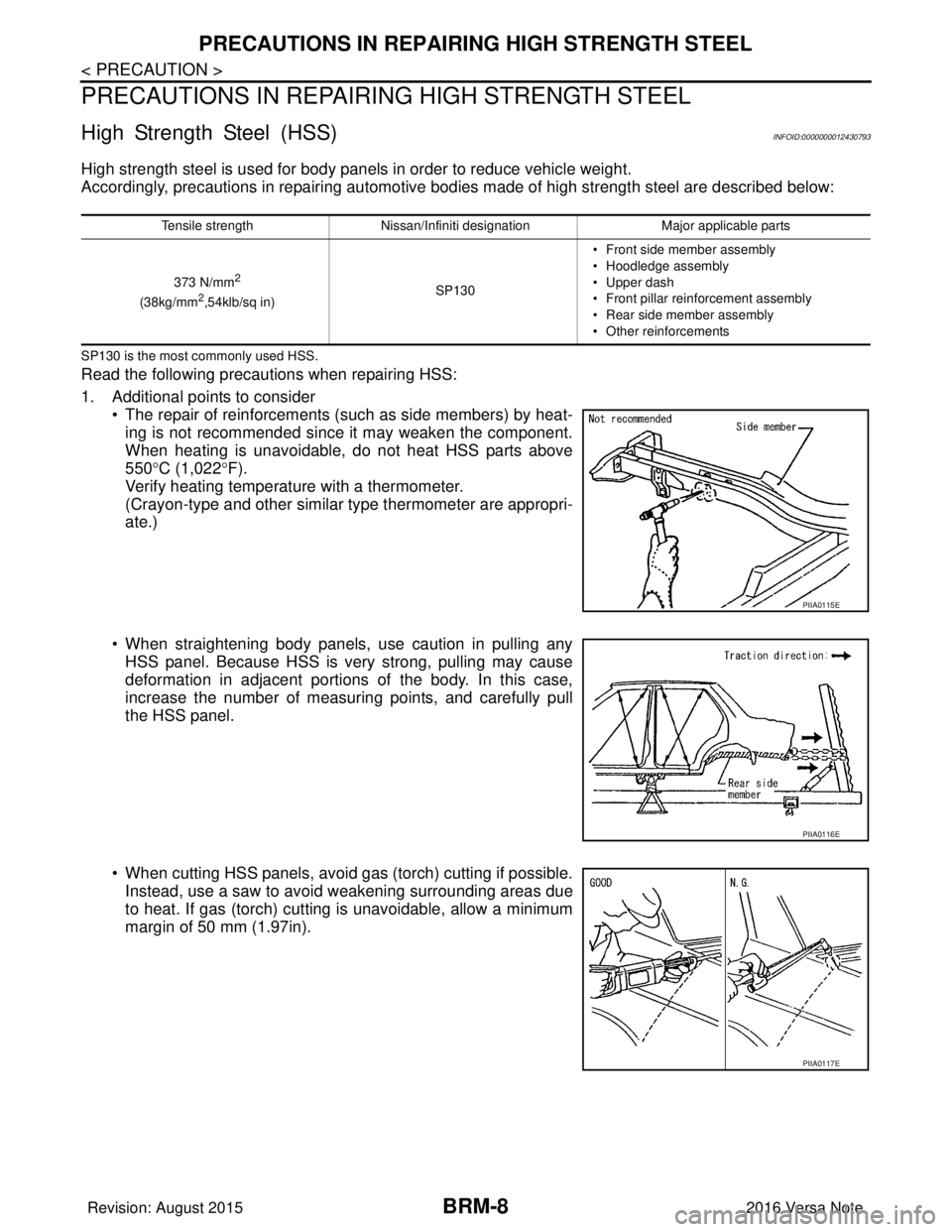
• The repair of reinforcements (such as side members) by heat-
ing is not recommended since it may weaken the component.
When heating is unavoidable, do not heat HSS parts above
550° C (1,022° F).
Verify heating temperature with a thermometer.
(Crayon-type and other similar type thermometer are appropri-
ate.)
• When straightening body panels, use caution in pulling any HSS panel. Because HSS is very strong, pulling may cause
deformation in adjacent portions of the body. In this case,
increase the number of measuring points, and carefully pull
the HSS panel.
• When cutting HSS panels, avoid gas (torch) cutting if possible. Instead, use a saw to avoid weakening surrounding areas due
to heat. If gas (torch) cutting is unavoidable, allow a minimum
margin of 50 mm (1.97in).
Tensile strength Nissan/Infiniti designation Major applicable parts
373 N/mm
2
(38kg/mm2,54klb/sq in) SP130• Front side member assembly
• Hoodledge assembly
• Upper dash
• Front pillar rein
forcement assembly
• Rear side member assembly
• Other reinforcements
PIIA0115E
PIIA0116E
PIIA0117E
Revision: August 2015 2016 Versa Note
cardiagn.com
Page 408 of 3641
PRECAUTIONS IN REPAIRING HIGH STRENGTH STEELBRM-9
< PRECAUTION >
C
DE
F
G H
I
J
L
M A
B
BRM
N
O P
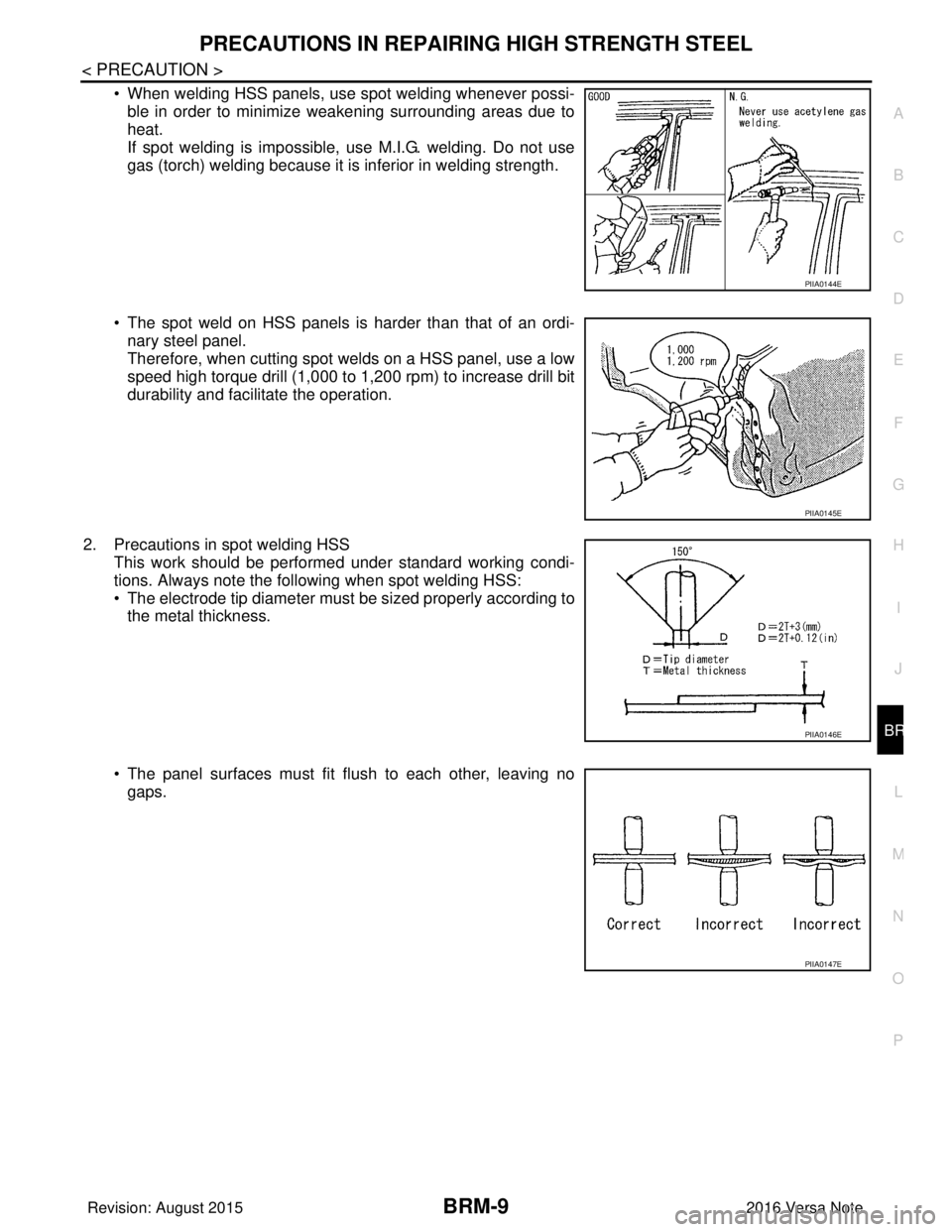
• When welding HSS panels, use spot welding whenever possi- ble in order to minimize weakening surrounding areas due to
heat.
If spot welding is impossible, use M.I.G. welding. Do not use
gas (torch) welding because it is inferior in welding strength.
• The spot weld on HSS panels is harder than that of an ordi- nary steel panel.
Therefore, when cutting spot welds on a HSS panel, use a low
speed high torque drill (1,000 to 1,200 rpm) to increase drill bit
durability and facilitate the operation.
2. Precautions in spot welding HSS This work should be performed under standard working condi-
tions. Always note the following when spot welding HSS:
• The electrode tip diameter must be sized properly according tothe metal thickness.
• The panel surfaces must fit flush to each other, leaving no gaps.
PIIA0144E
PIIA0145E
PIIA0146E
PIIA0147E
Revision: August 2015 2016 Versa Note
cardiagn.com
Page 415 of 3641
BRM-16
< REMOVAL AND INSTALLATION >
CORROSION PROTECTION
REMOVAL AND INSTALLATION
CORROSION PROTECTION
DescriptionINFOID:0000000012430798
To provide improved corrosion prevention, the following anti-corrosive measures have been implemented in
NISSAN production plants. When repairing or replacing body panels, it is necessary to use the same anti-cor-
rosive measures.
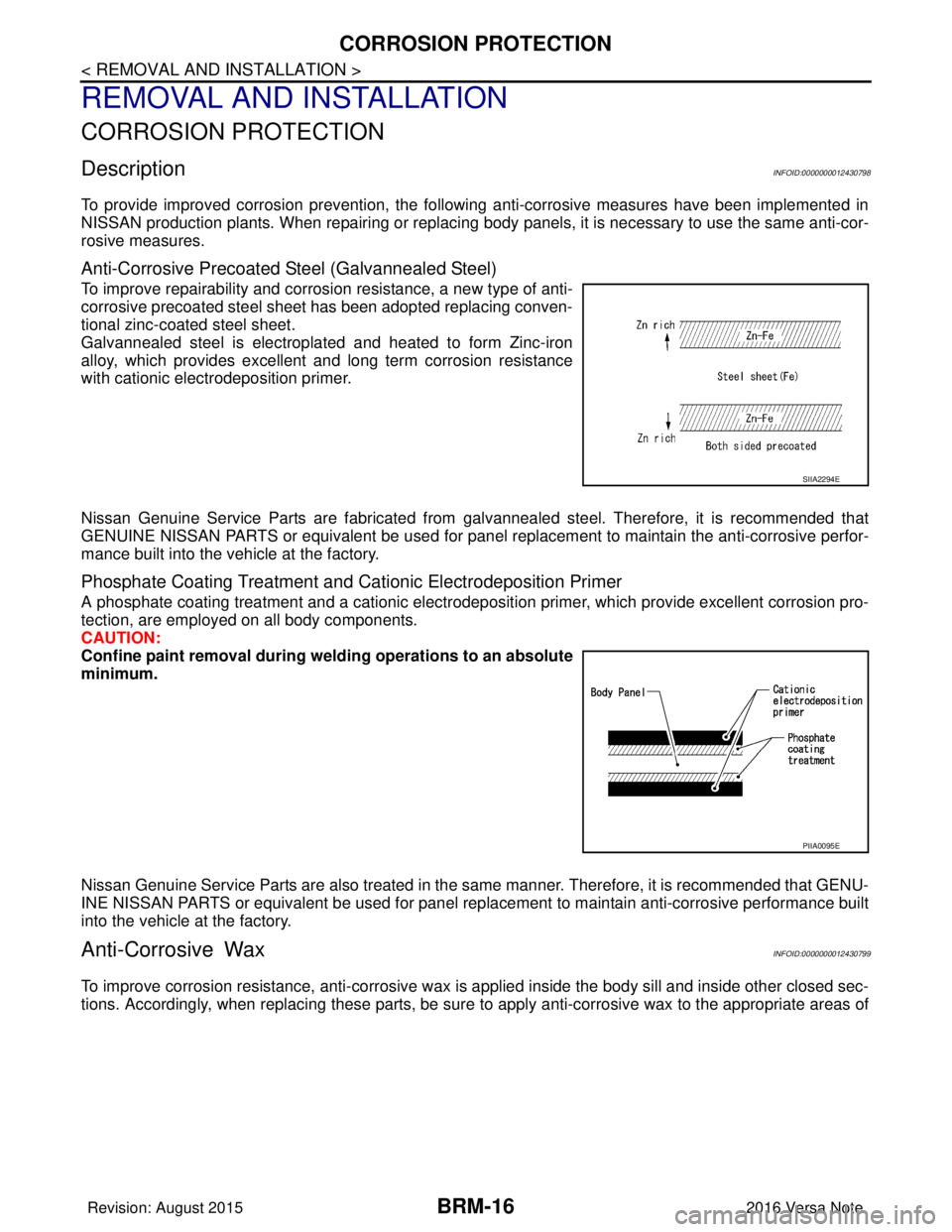
Anti-Corrosive Precoated Steel (Galvannealed Steel)
To improve repairability and corrosion resistance, a new type of anti-
corrosive precoated steel sheet has been adopted replacing conven-
tional zinc-coated steel sheet.
Galvannealed steel is electroplated and heated to form Zinc-iron
alloy, which provides excellent and long term corrosion resistance
with cationic electrodeposition primer.
Nissan Genuine Service Parts are fabricated from galvannealed steel. Therefore, it is recommended that
GENUINE NISSAN PARTS or equivalent be used for panel replacement to maintain the anti-corrosive perfor-
mance built into the vehicle at the factory.
Phosphate Coating Treatment and Cationic Electrodeposition Primer
A phosphate coating treatment and a cationic electrodepositi on primer, which provide excellent corrosion pro-
tection, are employed on all body components.
CAUTION:
Confine paint removal during weld ing operations to an absolute
minimum.
Nissan Genuine Service Parts are also treated in the same manner. Therefore, it is recommended that GENU-
INE NISSAN PARTS or equivalent be used for panel replacement to maintain anti-corrosive performance built
into the vehicle at the factory.
Anti-Corrosive WaxINFOID:0000000012430799
To improve corrosion resistance, anti-corrosive wax is applied inside the body sill and inside other closed sec-
tions. Accordingly, when replacing these parts, be sure to apply anti-corrosive wax to the appropriate areas of
SIIA2294E
PIIA0095E
Revision: August 2015 2016 Versa Note
cardiagn.com