sensor NISSAN PRIMERA 1999 Electronic Repair Manual
[x] Cancel search | Manufacturer: NISSAN, Model Year: 1999, Model line: PRIMERA, Model: NISSAN PRIMERA 1999Pages: 2267, PDF Size: 35.74 MB
Page 664 of 2267
On Board Diagnosis LogicNCEC0202When a misfire occurs, the engine speed will fluctuate. If the engine speed fluctuates enough to cause the
CKP sensor signal to vary, The ECM can determine that a misfire is occurring.
Sensor Input Signal to ECM ECM function
Crankshaft position sensor (POS) Engine speed On board diagnosis of misfire
The misfire detection logic consists of the following two conditions.
1. One Trip Detection Logic (Three Way Catalyst Damage)
On the first trip that a misfire condition occurs that can damage the three way catalyst (TWC) due to
overheating, the MI will blink.
When a misfire condition occurs, the ECM monitors the CKP sensor signal every 200 engine revolutions
for a change.
When the misfire condition decreases to a level that will not damage the TWC, the MI will turn off.
If another misfire condition occurs that can damage the TWC on a second trip, the MI will blink.
When the misfire condition decreases to a level that will not damage the TWC, the MI will remain on.
If another misfire condition occurs that can damage the TWC, the MI will begin to blink again.
(After the first trip detection, the MI will light up from engine starting. If a misfire is detected that will cause
three way catalyst damage, the MI will start blinking.)
2. Two Trip Detection Logic (Exhaust quality deterioration)
For misfire conditions that will not damage the TWC (but will affect emissions), the MI will only light when
the misfire is detected on a second trip. During this condition, the ECM monitors the CKP sensor signal
every 1,000 engine revolutions.
A misfire malfunction can be detected on any one cylinder or on multiple cylinders.
DTC No. Malfunction is detected when ... Check Items (Possible Cause)
P0300
0300IMultiple cylinders misfire.IImproper spark plug
IInsufficient compression
IIncorrect fuel pressure
IEGR volume control valve (If so equipped)
IThe injector circuit is open or shorted
IInjectors
IIntake air leak
IInsufficient ignition spark
ILack of fuel
IHeated oxygen sensor 1 (front) P0301
0301INo. 1 cylinder misfires.
P0302
0302INo. 2 cylinder misfires.
P0303
0303INo. 3 cylinder misfires.
P0304
0304INo. 4 cylinder misfires.
DTC Confirmation ProcedureNCEC0203CAUTION:
Always drive vehicle at a safe speed.
NOTE:
If ªDTC Confirmation Procedureº has been previously conducted,
always turn ignition switch ªOFFº and wait at least 9 seconds
before conducting the next test.
With CONSULT-II
1) Turn ignition switch ªONº, and select ªDATA MONITORº mode
with CONSULT-II.
NEF068A
DTC P0300 - P0304 NO.4-1CYLINDER MISFIRE,
MULTIPLE CYLINDER MISFIREQG16I18DE
On Board Diagnosis Logic
EC-222
Page 668 of 2267
9 CHECK FUEL PRESSURE
1. Install any parts removed.
2. Release fuel pressure to zero. Refer to EC-QG-29.
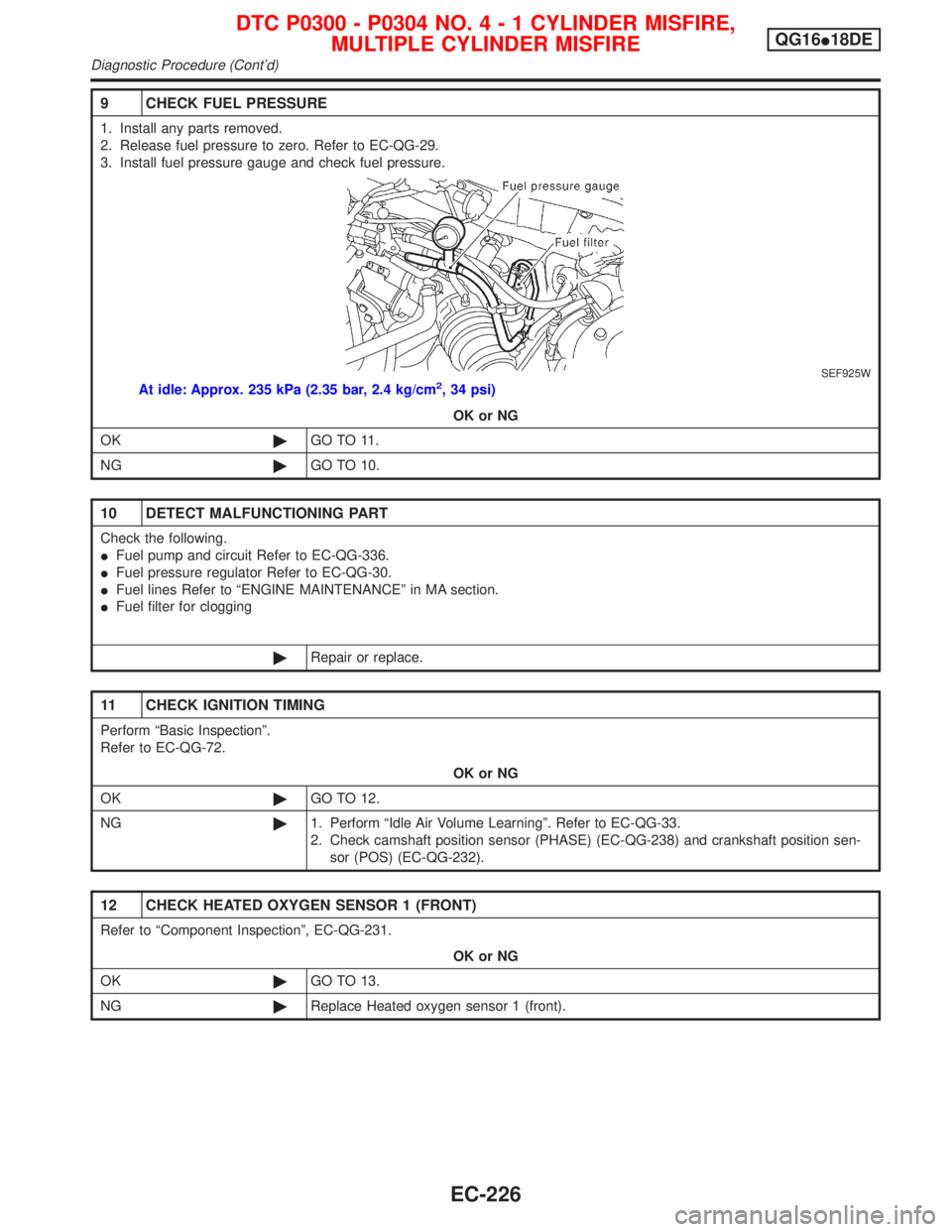
3. Install fuel pressure gauge and check fuel pressure.
SEF925W
At idle: Approx. 235 kPa (2.35 bar, 2.4 kg/cm2, 34 psi)
OK or NG
OK©GO TO 11.
NG©GO TO 10.
10 DETECT MALFUNCTIONING PART
Check the following.
IFuel pump and circuit Refer to EC-QG-336.
IFuel pressure regulator Refer to EC-QG-30.
IFuel lines Refer to ªENGINE MAINTENANCEº in MA section.
IFuel filter for clogging
©Repair or replace.
11 CHECK IGNITION TIMING
Perform ªBasic Inspectionº.
Refer to EC-QG-72.
OK or NG
OK©GO TO 12.
NG©1. Perform ªIdle Air Volume Learningº. Refer to EC-QG-33.
2. Check camshaft position sensor (PHASE) (EC-QG-238) and crankshaft position sen-
sor (POS) (EC-QG-232).
12 CHECK HEATED OXYGEN SENSOR 1 (FRONT)
Refer to ªComponent Inspectionº, EC-QG-231.
OK or NG
OK©GO TO 13.
NG©Replace Heated oxygen sensor 1 (front).
DTC P0300 - P0304 NO.4-1CYLINDER MISFIRE,
MULTIPLE CYLINDER MISFIREQG16I18DE
Diagnostic Procedure (Cont'd)
EC-226
Page 669 of 2267
13 CHECK MASS AIR FLOW SENSOR
With CONSULT-II
Check ªMASS AIR FLOWº in ªDATA MONITORº mode with CONSULT-II.
at idling: 1.0 - 4.0 g×m/sec
at 2,500 rpm: 5.0 - 10.0 g×m/sec
With GST
Check mass air flow sensor signal in MODE 1 with GST.
at idling: 1.0 - 4.0 g×m/sec
at 2,500 rpm: 5.0 - 10.0 g×m/sec
OK or NG
OK©GO TO 15.
NG©GO TO 14.
14 CHECK CONNECTORS
Check connectors for rusted terminals or loose connections in the mass air flow sensor circuit or engine grounds.
Refer to EC-QG-110.
OK or NG
NG©Repair or replace it.
15 CHECK SYMPTOM MATRIX CHART
Check items on the rough idle symptom in ªSymptom Matrix Chartº, EC-QG-82.
OK or NG
OK©GO TO 16.
NG©Repair or replace.
16 ERASE THE 1ST TRIP DTC
Some tests may cause a 1st trip DTC to be set.
Erase the 1st trip DTC from the ECM memory after performing the tests. Refer to EC-QG-44.
©GO TO 17.
17 CHECK INTERMITTENT INCIDENT
Perform ªTROUBLE DIAGNOSIS FOR INTERMITTENT INCIDENTº, EC-QG-102.
©INSPECTION END
DTC P0300 - P0304 NO.4-1CYLINDER MISFIRE,
MULTIPLE CYLINDER MISFIREQG16I18DE
Diagnostic Procedure (Cont'd)
EC-227
Page 670 of 2267
Component DescriptionNCEC0206The knock sensor is attached to the cylinder block. It senses
engine knocking using a piezoelectric element. A knocking vibration
from the cylinder block is sensed as vibrational pressure. This
pressure is converted into a voltage signal and sent to the ECM.
Freeze frame data will not be stored in the ECM for the knock
sensor. The MI will not light for knock sensor malfunction. The
knock sensor has one trip detection logic.
ECM Terminals and Reference ValueNCEC0207Specification data are reference values and are measured between each terminal and ground.
CAUTION:
Do not use ECM ground terminals when measuring input/output voltage. Doing so may result in dam-
age to the ECM's transistor. Use a ground other than ECM terminals, such as the ground.
TERMI-
NAL
NO.WIRE
COLORITEM CONDITION DATA (DC Voltage)
81 W Knock sensor[Engine is running]
IIdle speed1.0 - 4.0V
On Board Diagnosis LogicNCEC0208
DTC No. Malfunction is detected when ... Check Items (Possible Cause)
P0325
0325IAn excessively low or high voltage from the knock sen-
sor is sent to ECM.IHarness or connectors
(The knock sensor circuit is open or shorted.)
IKnock sensor
DTC Confirmation ProcedureNCEC0209NOTE:
If ªDTC Confirmation Procedureº has been previously conducted,
always turn ignition switch ªOFFº and wait at least 9 seconds
before conducting the next test.
TESTING CONDITION:
Before performing the following procedure, confirm that bat-
tery voltage is more than 10V at idle.
With CONSULT-II
1) Turn ignition switch ªONº and select ªDATA MONITORº mode
with CONSULT-II.
2) Start engine and run it for at least 5 seconds at idle speed.
3) If DTC is detected, go to ªDiagnostic Procedureº, EC-QG-230.
With GST
Follow the procedure ªWith CONSULT-IIº above.
SEF598K
NEF068A
DTC P0325 KNOCK SENSOR (KS)QG16I18DE
Component Description
EC-228
Page 671 of 2267
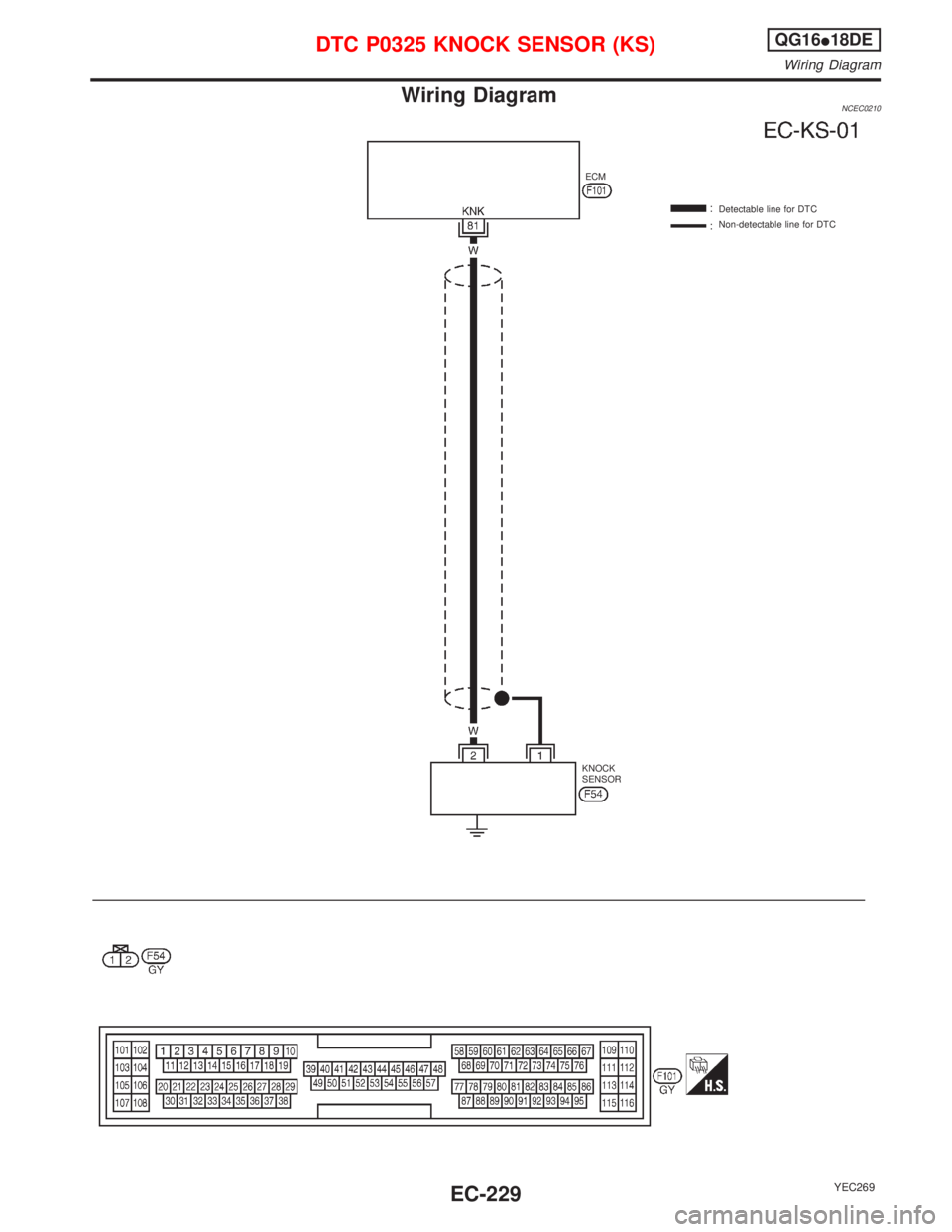
Wiring DiagramNCEC0210
YEC269
Detectable line for DTC
Non-detectable line for DTC ECM
KNOCK
SENSOR
DTC P0325 KNOCK SENSOR (KS)QG16I18DE
Wiring Diagram
EC-229
Page 672 of 2267
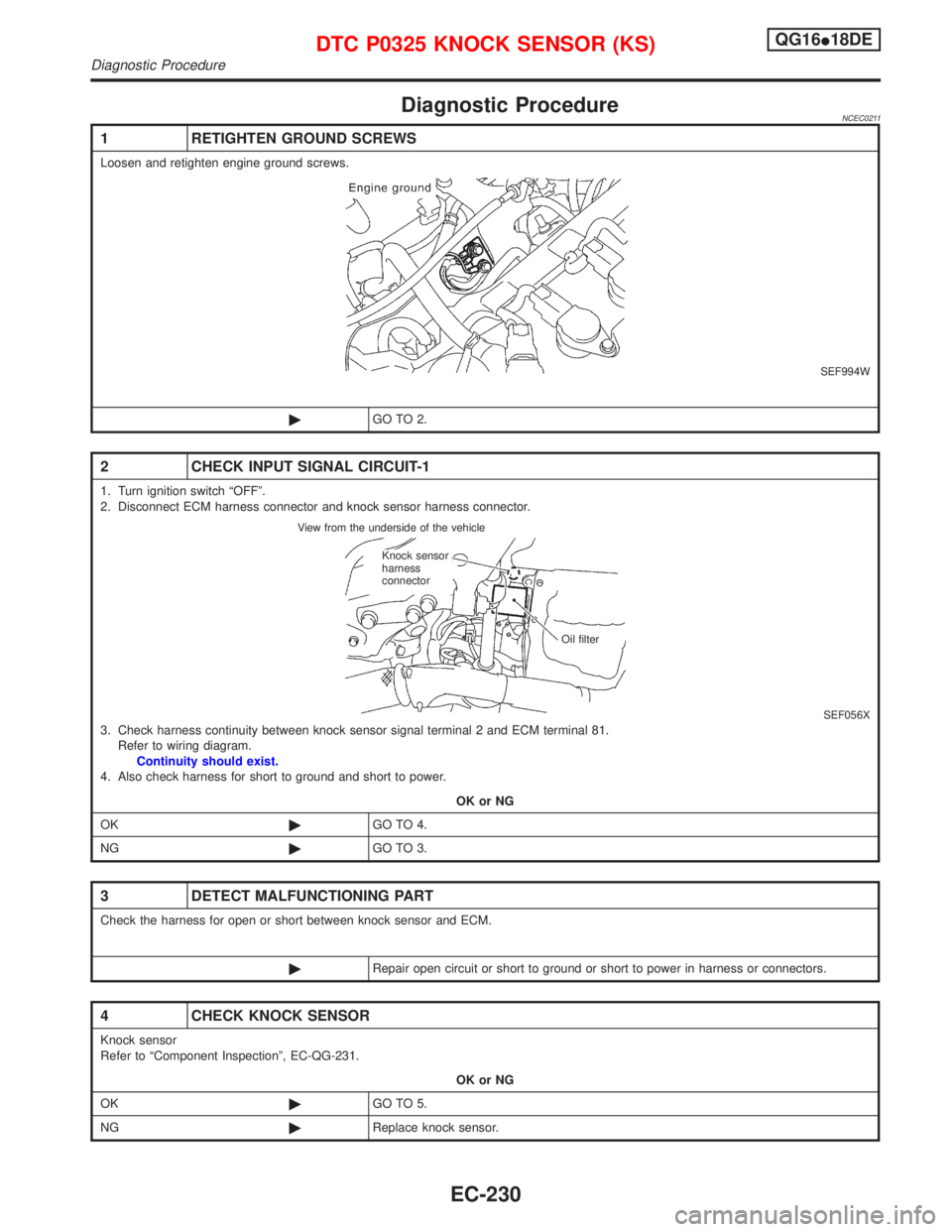
Diagnostic ProcedureNCEC0211
1 RETIGHTEN GROUND SCREWS
Loosen and retighten engine ground screws.
SEF994W
©GO TO 2.
2 CHECK INPUT SIGNAL CIRCUIT-1
1. Turn ignition switch ªOFFº.
2. Disconnect ECM harness connector and knock sensor harness connector.
SEF056X3. Check harness continuity between knock sensor signal terminal 2 and ECM terminal 81.
Refer to wiring diagram.
Continuity should exist.
4. Also check harness for short to ground and short to power.
OK or NG
OK©GO TO 4.
NG©GO TO 3.
3 DETECT MALFUNCTIONING PART
Check the harness for open or short between knock sensor and ECM.
©Repair open circuit or short to ground or short to power in harness or connectors.
4 CHECK KNOCK SENSOR
Knock sensor
Refer to ªComponent Inspectionº, EC-QG-231.
OK or NG
OK©GO TO 5.
NG©Replace knock sensor.
View from the underside of the vehicle
Knock sensor
harness
connector
Oil filter
DTC P0325 KNOCK SENSOR (KS)QG16I18DE
Diagnostic Procedure
EC-230
Page 673 of 2267
5 CHECK INTERMITTENT INCIDENT
Perform ªTROUBLE DIAGNOSIS FOR INTERMITTENT INCIDENTº, EC-QG-102.
©INSPECTION END
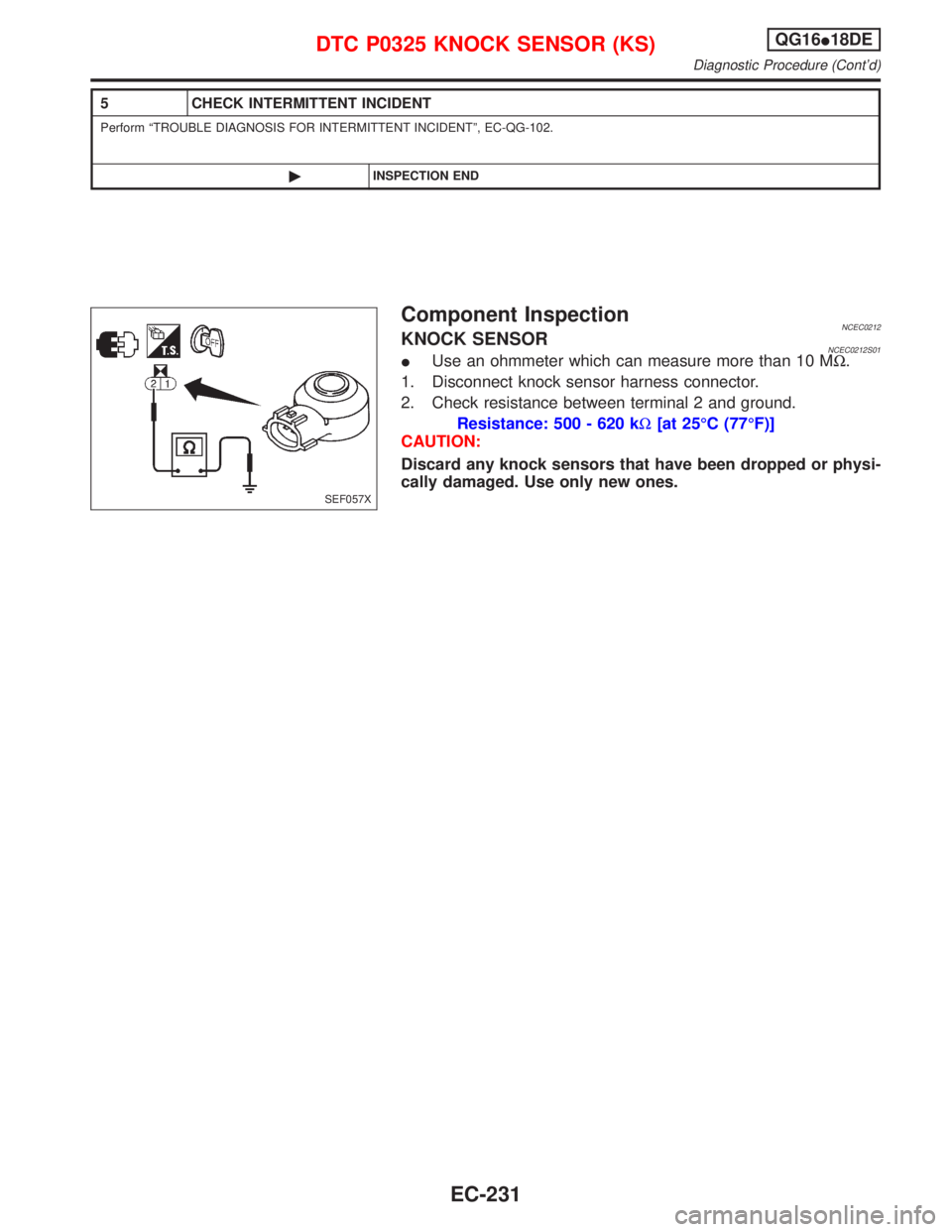
Component InspectionNCEC0212KNOCK SENSORNCEC0212S01IUse an ohmmeter which can measure more than 10 MW.
1. Disconnect knock sensor harness connector.
2. Check resistance between terminal 2 and ground.
Resistance: 500 - 620 kW[at 25ÉC (77ÉF)]
CAUTION:
Discard any knock sensors that have been dropped or physi-
cally damaged. Use only new ones.
SEF057X
DTC P0325 KNOCK SENSOR (KS)QG16I18DE
Diagnostic Procedure (Cont'd)
EC-231
Page 674 of 2267
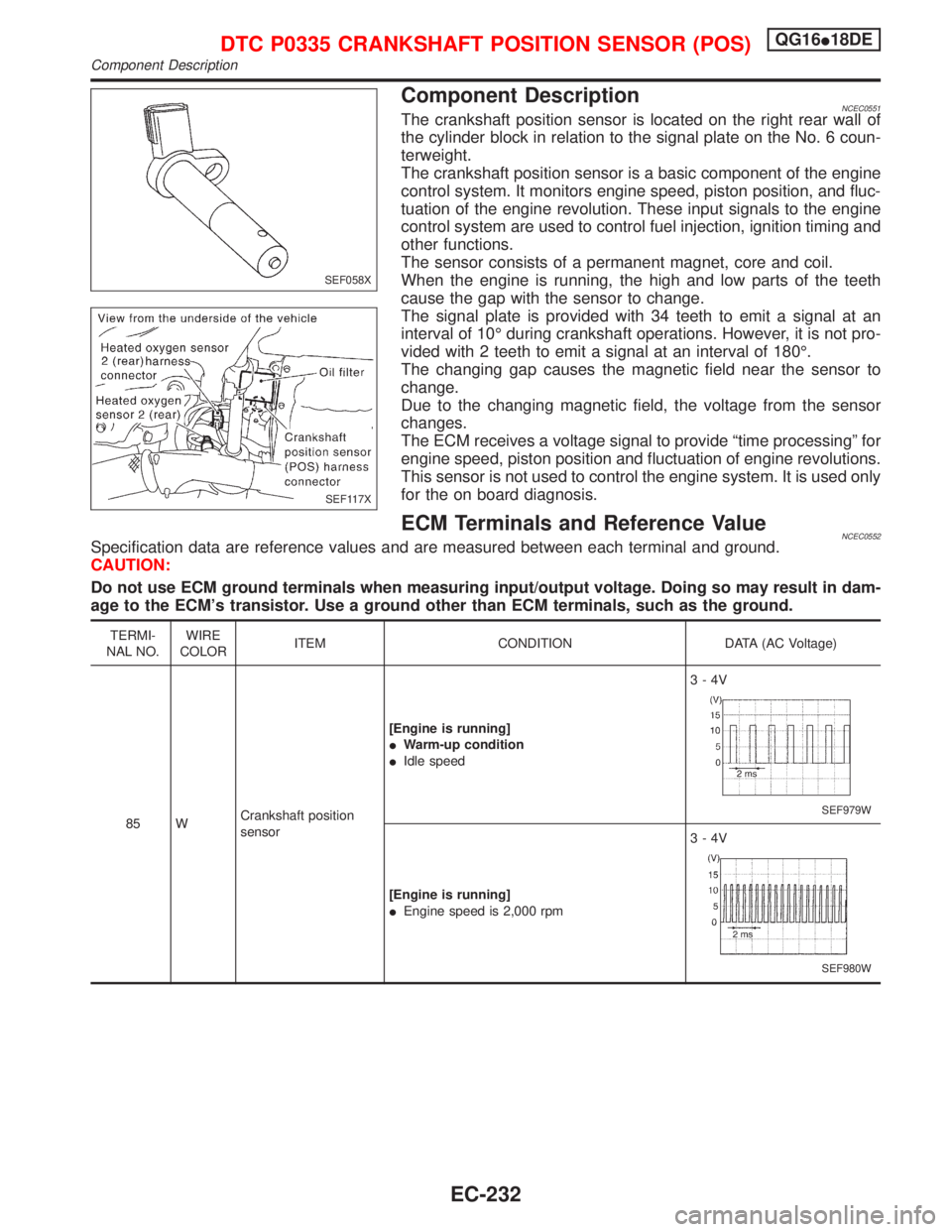
Component DescriptionNCEC0551The crankshaft position sensor is located on the right rear wall of
the cylinder block in relation to the signal plate on the No. 6 coun-
terweight.
The crankshaft position sensor is a basic component of the engine
control system. It monitors engine speed, piston position, and fluc-
tuation of the engine revolution. These input signals to the engine
control system are used to control fuel injection, ignition timing and
other functions.
The sensor consists of a permanent magnet, core and coil.
When the engine is running, the high and low parts of the teeth
cause the gap with the sensor to change.
The signal plate is provided with 34 teeth to emit a signal at an
interval of 10É during crankshaft operations. However, it is not pro-
vided with 2 teeth to emit a signal at an interval of 180É.
The changing gap causes the magnetic field near the sensor to
change.
Due to the changing magnetic field, the voltage from the sensor
changes.
The ECM receives a voltage signal to provide ªtime processingº for
engine speed, piston position and fluctuation of engine revolutions.
This sensor is not used to control the engine system. It is used only
for the on board diagnosis.
ECM Terminals and Reference ValueNCEC0552Specification data are reference values and are measured between each terminal and ground.
CAUTION:
Do not use ECM ground terminals when measuring input/output voltage. Doing so may result in dam-
age to the ECM's transistor. Use a ground other than ECM terminals, such as the ground.
TERMI-
NAL NO.WIRE
COLORITEM CONDITION DATA (AC Voltage)
85 WCrankshaft position
sensor[Engine is running]
IWarm-up condition
IIdle speed3-4V
SEF979W
[Engine is running]
IEngine speed is 2,000 rpm3-4V
SEF980W
SEF058X
SEF117X
DTC P0335 CRANKSHAFT POSITION SENSOR (POS)QG16I18DE
Component Description
EC-232
Page 675 of 2267
On Board Diagnosis LogicNCEC0553
DTC No. Malfunction is detected when ... Check Items (Possible Cause)
P0335
0335IThe 10É signal is not entered to ECM for the first few seconds
during engine cranking.
..........................................................................................................
IThe 10É signal is not entered to ECM during engine running.
..........................................................................................................
IThe 10É signal is not in the normal pattern at each engine
revolution.IHarness or connectors
(The crankshaft position sensor (POS) circuit is
open or shorted.)
ICrankshaft position sensor (POS)
IStarter motor (Refer to EL section.)
IStarting system circuit (Refer to EL section.)
IDead (Weak) battery
DTC Confirmation ProcedureNCEC0554NOTE:
If ªDTC Confirmation Procedureº has been previously conducted,
always turn ignition switch ªOFFº and wait at least 9 seconds
before conducting the next test.
With CONSULT-II
1) Turn ignition switch ªONº and select ªDATA MONITORº mode
with CONSULT-II.
2) Start engine and run it for at least 2 seconds at idle speed.
3) If 1st trip DTC is detected, go to ªDiagnostic Procedureº, EC-
QG-235.
With GST
Follow the procedure ªWith CONSULT-IIº above.
NEF068A
DTC P0335 CRANKSHAFT POSITION SENSOR (POS)QG16I18DE
On Board Diagnosis Logic
EC-233
Page 676 of 2267

Wiring DiagramNCEC0555
YEC070A
DTC P0335 CRANKSHAFT POSITION SENSOR (POS)QG16I18DE
Wiring Diagram
EC-234