sensor NISSAN PRIMERA 1999 Electronic Repair Manual
[x] Cancel search | Manufacturer: NISSAN, Model Year: 1999, Model line: PRIMERA, Model: NISSAN PRIMERA 1999Pages: 2267, PDF Size: 35.74 MB
Page 687 of 2267
CONSULT-II Reference Value in Data Monitor
Mode
NCEC0502Specification data are reference values.
MONITOR ITEM CONDITION SPECIFICATION
EGR TEMP SENIEngine: After warming up Less than 4.5V
EGR VOL CON/VIEngine: After warming up
IAir conditioner switch: ªOFFº
IShift lever: ªNº
INo-loadIdle 0 step
Revving engine up to 3,000 rpm
quickly10 - 55 step
ECM Terminals and Reference ValueNCEC0503Specification data are reference values and are measured between each terminal and ground.
CAUTION:
Do not use ECM ground terminals when measuring input/output voltage. Doing so may result in dam-
age to the ECM's transistor. Use a ground other than ECM terminals, such as the ground.
TERMI-
NAL
NO.WIRE
COLORITEM CONDITION DATA (DC Voltage)
8
9
17
18W/B
SB
G/R
R/YEGR volume control valve[Engine is running]
IWarm-up condition
IRev engine up from 2,000 to 4,000 rpm0 - 14V
58 B Sensor's ground[Engine is running]
IWarm-up condition
IIdle speed0V
72 PU EGR temperature sensor[Engine is running]
IWarm-up condition
IIdle speedLess than 4.5V
[Engine is running]
IWarm-up condition
IEGR system is operating.0-1V
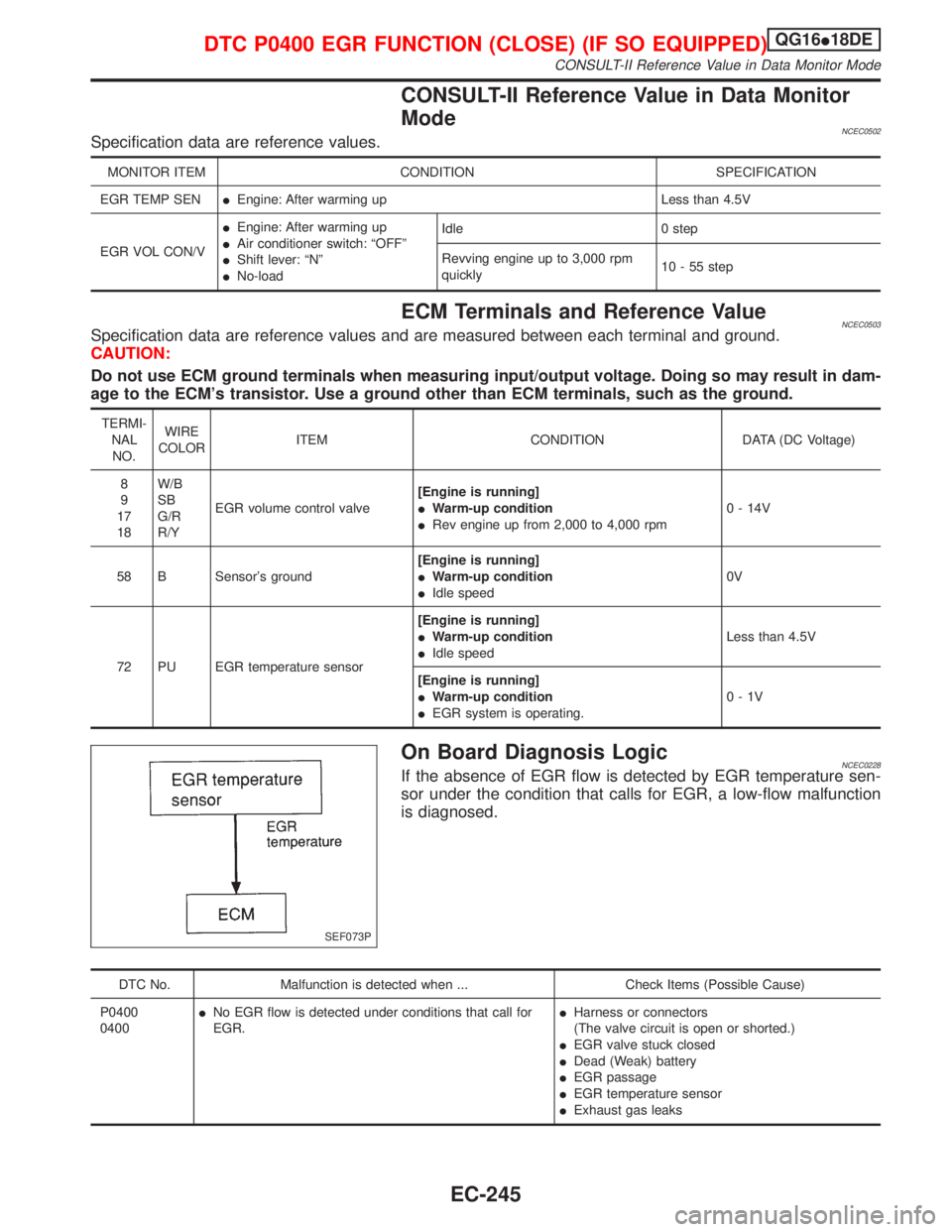
On Board Diagnosis LogicNCEC0228If the absence of EGR flow is detected by EGR temperature sen-
sor under the condition that calls for EGR, a low-flow malfunction
is diagnosed.
DTC No. Malfunction is detected when ... Check Items (Possible Cause)
P0400
0400INo EGR flow is detected under conditions that call for
EGR.IHarness or connectors
(The valve circuit is open or shorted.)
IEGR valve stuck closed
IDead (Weak) battery
IEGR passage
IEGR temperature sensor
IExhaust gas leaks
SEF073P
DTC P0400 EGR FUNCTION (CLOSE) (IF SO EQUIPPED)QG16I18DE
CONSULT-II Reference Value in Data Monitor Mode
EC-245
Page 692 of 2267

3 CHECK OUTPUT SIGNAL CIRCUIT
1. Turn ignition switch ªOFFº.
2. Disconnect ECM harness connector.
3. Check harness continuity between
ECM terminal 8 and EGR volume control valve terminal 1,
ECM terminal 9 and EGR volume control valve terminal 4,
ECM terminal 17 and EGR volume control valve terminal 3,
ECM terminal 18 and EGR volume control valve terminal 6.
Refer to wiring diagram.
Continuity should exist.
If OK, check harness for short to ground and short to power.
OK or NG
OK©GO TO 4.
NG©Repair open circuit, short to ground or short to power in harness connectors.
4 CHECK EGR PASSAGE
Check EGR passage for clogging and cracks.
OK or NG
OK©GO TO 5.
NG©Repair or replace EGR passage.
5 CHECK EGR TEMPERATURE SENSOR
Refer to ªTROUBLE DIAGNOSIS FOR DTC P1401º, EC-QG-300.
OK or NG
OK©GO TO 6.
NG©Replace EGR temperature sensor.
6 CHECK EGR VOLUME CONTROL VALVE
Refer to ªComponent Inspectionº, EC-QG-251.
OK or NG
OK©GO TO 7.
NG©Replace EGR volume control valve.
7 CHECK INTERMITTENT INCIDENT
Perform ªTROUBLE DIAGNOSIS FOR INTERMITTENT INCIDENTº, EC-QG-102.
©INSPECTION END
DTC P0400 EGR FUNCTION (CLOSE) (IF SO EQUIPPED)QG16I18DE
Diagnostic Procedure (Cont'd)
EC-250
Page 694 of 2267
DescriptionNCEC0504SYSTEM DESCRIPTIONNCEC0504S01
Sensor Input Signal to ECMECM func-
tionActuator
Crankshaft position sensor Engine speed
EGR control EGR volume control valve Mass air flow sensor Amount of intake air
Engine coolant temperature sensor Engine coolant temperature
Ignition switch Start signal
Throttle position sensor Throttle position
Vehicle speed sensor or ABS actuator and
electric unit (control unit)Vehicle speed
Battery Battery voltage
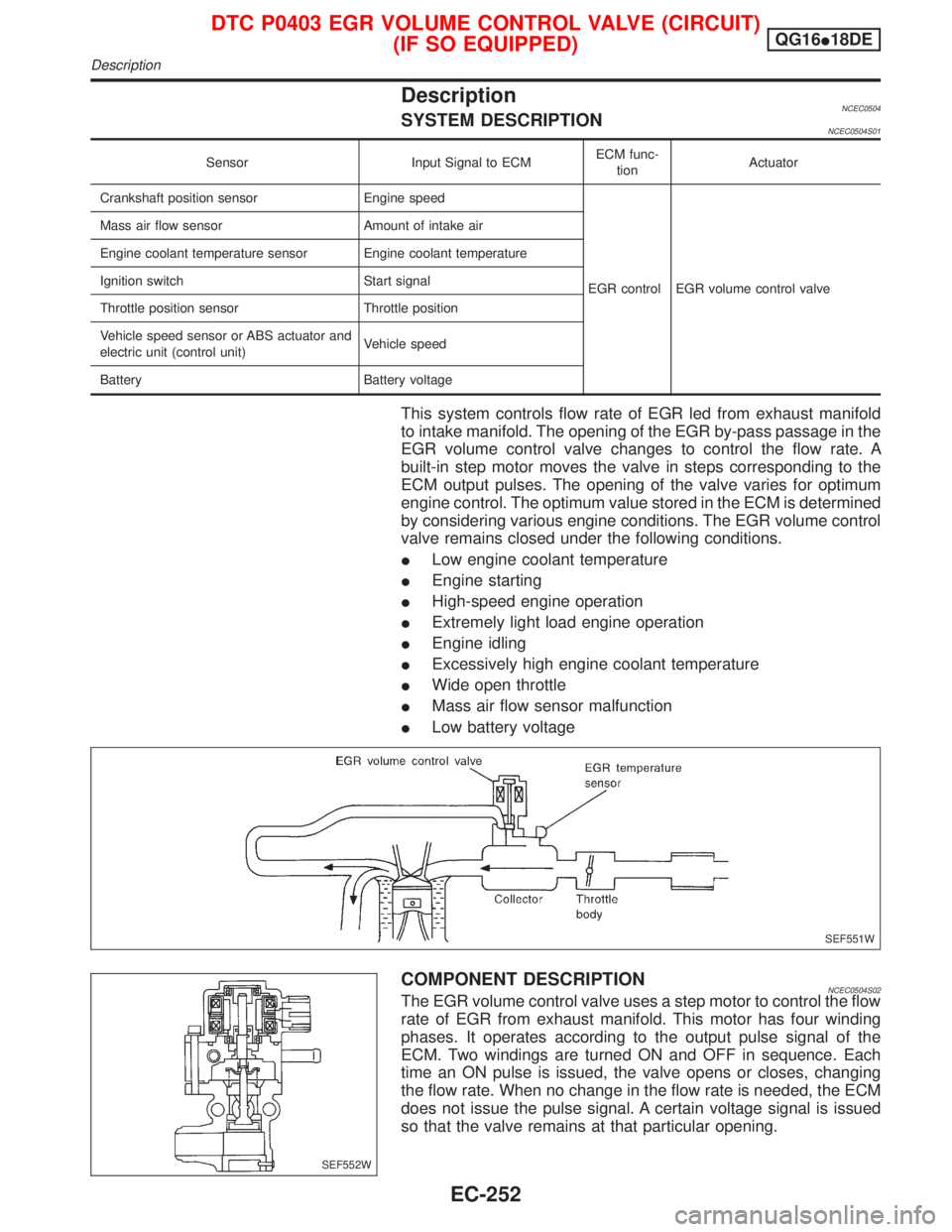
This system controls flow rate of EGR led from exhaust manifold
to intake manifold. The opening of the EGR by-pass passage in the
EGR volume control valve changes to control the flow rate. A
built-in step motor moves the valve in steps corresponding to the
ECM output pulses. The opening of the valve varies for optimum
engine control. The optimum value stored in the ECM is determined
by considering various engine conditions. The EGR volume control
valve remains closed under the following conditions.
ILow engine coolant temperature
IEngine starting
IHigh-speed engine operation
IExtremely light load engine operation
IEngine idling
IExcessively high engine coolant temperature
IWide open throttle
IMass air flow sensor malfunction
ILow battery voltage
COMPONENT DESCRIPTIONNCEC0504S02The EGR volume control valve uses a step motor to control the flow
rate of EGR from exhaust manifold. This motor has four winding
phases. It operates according to the output pulse signal of the
ECM. Two windings are turned ON and OFF in sequence. Each
time an ON pulse is issued, the valve opens or closes, changing
the flow rate. When no change in the flow rate is needed, the ECM
does not issue the pulse signal. A certain voltage signal is issued
so that the valve remains at that particular opening.
SEF551W
SEF552W
DTC P0403 EGR VOLUME CONTROL VALVE (CIRCUIT)
(IF SO EQUIPPED)QG16I18DE
Description
EC-252
Page 700 of 2267

On Board Diagnosis LogicNLEC0240The ECM monitors the switching frequency ratio of heated oxygen
sensors 1 (front) and 2 (rear).
A three way catalyst with high oxygen storage capacity will indicate
a low switching frequency of heated oxygen sensor 2 (rear). As
oxygen storage capacity decreases, the heated oxygen sensor 2
(rear) switching frequency will increase.
When the frequency ratio of heated oxygen sensors 1 (front) and
2 (rear) approaches a specified limit value, the three way catalyst
malfunction is diagnosed.
DTC No. Malfunction is detected when ... Check Items (Possible Cause)
P0420
0420IThree way catalyst does not operate properly.
IThree way catalyst does not have enough oxygen stor-
age capacity.IThree way catalyst
IExhaust tube
IIntake air leaks
IInjectors
IInjector leaks
ISpark plug
IImproper ignition timing
DTC Confirmation ProcedureNLEC0241CAUTION:
Always drive vehicle at a safe speed.
NOTE:
If ªDTC Confirmation Procedureº has been previously conducted,
always turn ignition switch ªOFFº and wait at least 9 seconds
before conducting the next test.
With CONSULT-II
TESTING CONDITION:
IOpen engine hood before conducting following proce-
dure.
IDo not hold engine speed more than specified minutes
below.
1) Turn ignition switch ªONº.
2) Select ªDTC & SRT CONFIRMATIONº then ªSRT WORK SUP-
PORTº mode with CONSULT-II.
3) Start engine.
4) Rev engine up to 3,000 500 rpm and hold it for 3 consecutive
minutes then release the accelerator pedal completely.
If ªCOMPLETEDº appears on the CONSULT-II screen, go to
step 7.
5) Wait 5 seconds at idle.
6) Rev engine up to 2,500 500 rpm and maintain it until ªINCMPº
of CATALYST changes to ªCMPLTº (it will take approximately
5 minutes.)
If not ªCMPLTº, stop engine and cool it down to less than 70ÉC
(158ÉF) and then retest from step 1.
7) Select ªSELF-DIAG RESULTSº mode with CONSULT-II.
8) Confirm that the 1st trip DTC is not detected.
If the 1st trip DTC is detected, go to ªDiagnostic Procedureº,
EC-259.
SEF184UD
SEF847Y
SEF848Y
SEF560X
DTC P0420 THREE WAY CATALYST FUNCTIONQG16I18DE
On Board Diagnosis Logic
EC-258
Page 701 of 2267
Overall Function CheckNCEC0242Use this procedure to check the overall function of the three way
catalyst. During this check, a 1st trip DTC might not be confirmed.
Without CONSULT-II
1) Start engine and drive vehicle at a speed of more than 70 km/h
(43 MPH) for 2 consecutive minutes.
2) Stop vehicle with engine running.
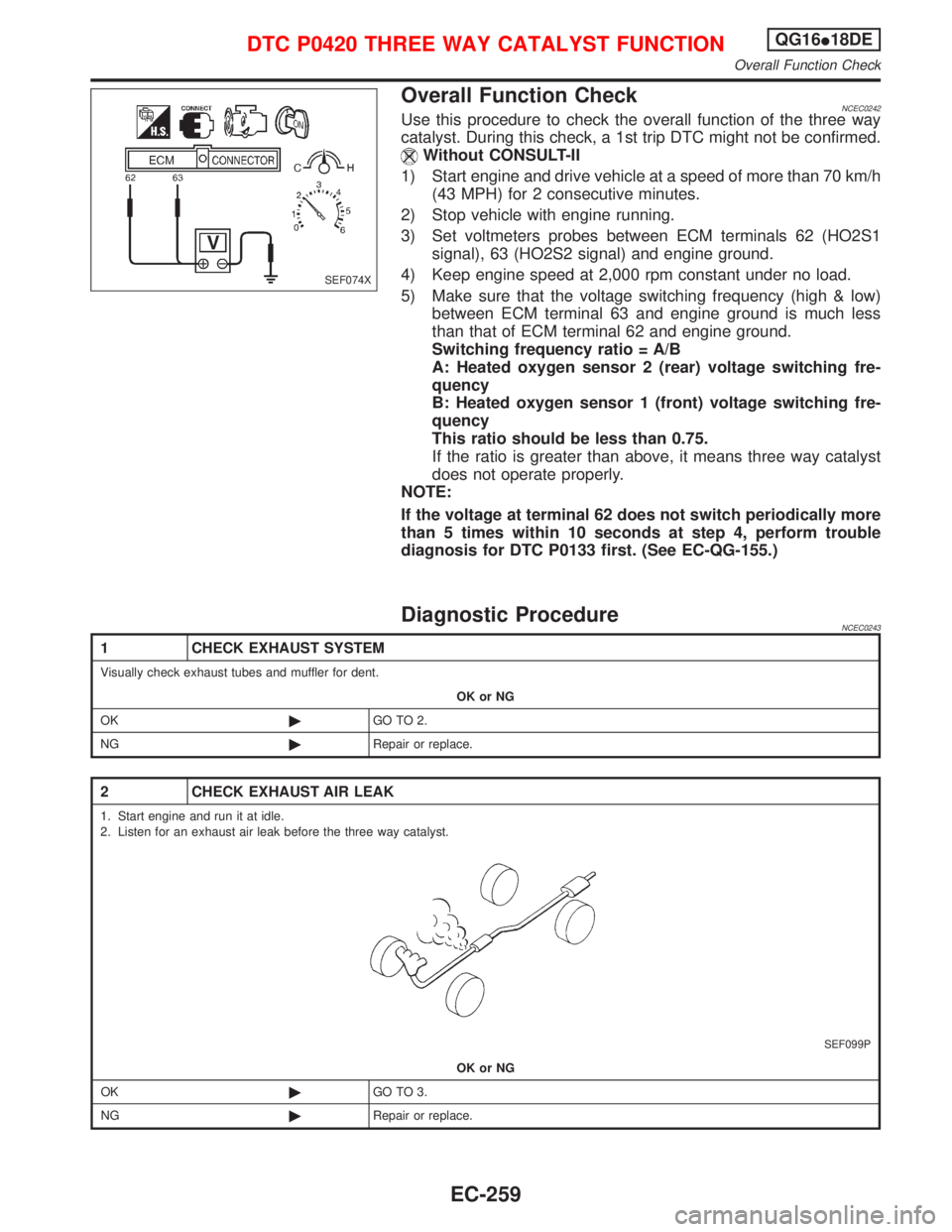
3) Set voltmeters probes between ECM terminals 62 (HO2S1
signal), 63 (HO2S2 signal) and engine ground.
4) Keep engine speed at 2,000 rpm constant under no load.
5) Make sure that the voltage switching frequency (high & low)
between ECM terminal 63 and engine ground is much less
than that of ECM terminal 62 and engine ground.
Switching frequency ratio = A/B
A: Heated oxygen sensor 2 (rear) voltage switching fre-
quency
B: Heated oxygen sensor 1 (front) voltage switching fre-
quency
This ratio should be less than 0.75.
If the ratio is greater than above, it means three way catalyst
does not operate properly.
NOTE:
If the voltage at terminal 62 does not switch periodically more
than 5 times within 10 seconds at step 4, perform trouble
diagnosis for DTC P0133 first. (See EC-QG-155.)
Diagnostic ProcedureNCEC0243
1 CHECK EXHAUST SYSTEM
Visually check exhaust tubes and muffler for dent.
OK or NG
OK©GO TO 2.
NG©Repair or replace.
2 CHECK EXHAUST AIR LEAK
1. Start engine and run it at idle.
2. Listen for an exhaust air leak before the three way catalyst.
SEF099P
OK or NG
OK©GO TO 3.
NG©Repair or replace.
SEF074X
DTC P0420 THREE WAY CATALYST FUNCTIONQG16I18DE
Overall Function Check
EC-259
Page 702 of 2267

3 CHECK INTAKE AIR LEAK
Listen for an intake air leak after the mass air flow sensor.
OK or NG
OK©GO TO 4.
NG©Repair or replace.
4 CHECK IGNITION TIMING
Check for ignition timing.
Refer to TROUBLE DIAGNOSIS Ð ªBASIC INSPECTIONº, EC-QG-72.
OK or NG
OK©GO TO 5.
NG©Check camshaft position sensor (PHASE) (EC-QG-238) and crankshaft position sensor
(POS) (EC-QG-232).
5 CHECK INJECTORS
1. Refer to Wiring Diagram for Injectors, EC-QG-319.
2. Stop engine and then turn ignition switch ªONº.
3. Check voltage between ECM terminals 101, 103, 105 and 107 and ground with CONSULT-II or tester.
SEF075XBattery voltage should exist.
OK or NG
OK©GO TO 6.
NG©Perform ªDiagnostic Procedureº INJECTOR, EC-QG-320.
DTC P0420 THREE WAY CATALYST FUNCTIONQG16I18DE
Diagnostic Procedure (Cont'd)
EC-260
Page 703 of 2267

6 CHECK IGNITION SPARK
1. Disconnect ignition coil assembly from rocker cover.
2. Connect a known good spark plug to the ignition coil assembly.
3. Place end of spark plug against a suitable ground and crank engine.
4. Check for spark.
SEF575Q
OK or NG
OK©GO TO 7.
NG©Check ignition coil, power transistor and their circuits. Refer to EC-QG-323.
7 CHECK INJECTOR
1. Turn ignition switch ªOFFº.
2. Remove injector assembly. Refer to EC-QG-30.
Keep fuel hose and all injectors connected to injector gallery.
3. Disconnect camshaft position sensor harness connector.
4. Turn ignition switch ªONº.
Make sure fuel does not drip from injector.
OK or NG
OK (Does not drip)©GO TO 8.
NG (Drips)©Replace the injector(s) from which fuel is dripping.
8 CHECK INTERMITTENT INCIDENT
Perform ªTROUBLE DIAGNOSIS FOR INTERMITTENT INCIDENTº, EC-QG-102.
Trouble is fixed©INSPECTION END
Trouble is not fixed©Replace three way catalyst.
DTC P0420 THREE WAY CATALYST FUNCTIONQG16I18DE
Diagnostic Procedure (Cont'd)
EC-261
Page 704 of 2267

DescriptionNCEC0248SYSTEM DESCRIPTIONNCEC0248S01
Sensor Input Signal to ECMECM func-
tionActuator
Crankshaft position sensor (POS) Engine speed
EVAP can-
ister purge
controlEVAP canister purge volume
control solenoid valve Mass air flow sensor Amount of intake air
Engine coolant temperature sensor Engine coolant temperature
Battery Battery voltage
Ignition switch Start signal
Throttle position sensor Throttle position
Heated oxygen 1 sensorDensity of oxygen in exhaust gas
(Mixture ratio feedback signal)
Vehicle speed sensor or ABS actuator and
electric unit (control unit)Vehicle speed
This system controls flow rate of fuel vapor from the EVAP canis-
ter. The opening of the vapor by-pass passage in the EVAP canis-
ter purge volume control solenoid valve changes to control the flow
rate. The EVAP canister purge volume control solenoid valve
repeats ON/OFF operation according to the signal sent from the
ECM. The opening of the valve varies for optimum engine control.
The optimum value stored in the ECM is determined by consider-
ing various engine conditions. When the engine is operating, the
flow rate of fuel vapor from the EVAP canister is regulated as the
air flow changes.
COMPONENT DESCRIPTIONNCEC0248S02The EVAP canister purge volume control solenoid valve uses a
ON/OFF duty to control the flow rate of fuel vapor from the EVAP
canister. The EVAP canister purge volume control solenoid valve
is moved by ON/OFF pulses from the ECM. The longer the ON
pulse, the greater the amount of fuel vapor that will flow through the
valve.
CONSULT-II Reference Value in Data Monitor
Mode
NCEC0249
MONITOR ITEM CONDITION SPECIFICATION
PURG VOL C/VIEngine: After warming up
INo-load
ILift up drive wheels and shift to
1st gear position.
IAir conditioner switch ªOFFºIdle 0%
More than 2,000 rpm Ð
SEF337U
DTC P0443 EVAP CANISTER PURGE VOLUME CONTROL
SOLENOID VALVE (CIRCUIT)QG16I18DE
Description
EC-262
Page 709 of 2267

Component DescriptionNCEC0272MODELS WITH VEHICLE SPEED SENSOR
The vehicle speed sensor is installed in the transaxle. It contains a
pulse generator which provides a vehicle speed signal to the
speedometer. The speedometer then sends a signal to the ECM.
MODELS WITHOUT VEHICLE SPEED SENSOR
The ABS actuator and electric unit (control unit) provides a vehicle
speed signal to the speedometer. The speedometer then sends a
signal to the ECM.
ECM Terminals and Reference ValueNCEC0273Specification data are reference values and are measured between each terminal and ground.
CAUTION:
Do not use ECM ground terminals when measuring input/output voltage. Doing so may result in dam-
age to the ECM's transistor. Use a ground other than ECM terminals, such as the ground.
TER-
MINAL
NO.WIRE
COLORITEM CONDITION DATA (DC Voltage)
86 OR/WVehicle speed sensor or
ABS actuator and elec-
tric unit (control unit)[Engine is running]
ILift up the vehicle
IIn 2nd gear position
IVehicle speed is 40 km/h (25 MPH)2.0 - 3.0 V
SEF976W
On Board Diagnosis LogicNCEC0274
DTC No. Malfunction is detected when ... Check Items (Possible Cause)
P0500
0500IThe almost 0 km/h (0 MPH) signal from vehicle speed
sensor or ABS actuator and electric unit (control unit) is
sent to ECM even when vehicle is being driven.Models with vehicle speed sensor
IHarness or connector
(The vehicle speed sensor circuit is open or
shorted.)
IVehicle speed sensor
Models without vehicle speed sensor
IHarness or connector (The ABS actuator and
electric unit (control unit) is open or shorted.)
IABS actuator and electric unit (control unit)
DTC Confirmation ProcedureNCEC0275CAUTION:
Always drive vehicle at a safe speed.
NOTE:
If ªDTC Confirmation Procedureº has been previously conducted,
always turn ignition switch ªOFFº and wait at least 9 seconds
before conducting the next test.
TESTING CONDITION:
This procedure may be conducted with the drive wheels lifted
in the shop or by driving the vehicle. If a road test is expected
to be easier, it is unnecessary to lift the vehicle.
SEF080X
DTC P0500 VEHICLE SPEED SENSOR (VSS)QG16I18DE
Component Description
EC-267
Page 710 of 2267

With CONSULT-II
1) Start engine
2) Read vehicle speed sensor signal in ªDATA MONITORº mode
with CONSULT-II. The vehicle speed on CONSULT-II should
exceed 10 km/h (6 MPH) when rotating wheels with suitable
gear position.
3) If NG, go to ªDiagnostic Procedureº, EC-QG-271.
If OK, go to following step.
4) Select ªDATA MONITORº mode with CONSULT-II.
5) Warm engine up to normal operating temperature.
6) Maintain the following conditions for at least 10 consecutive
seconds.
ENG SPEED 2,600 - 4,000 rpm
COOLAN TEMP/S More than 70ÉC (158ÉF)
B/FUEL SCHDL 6.0 - 11.7 msec
Selector lever Suitable position
PW/ST SIGNAL OFF
7) If 1st trip DTC is detected, go to ªDiagnostic Procedureº, EC-
QG-271.
With GST
Follow the procedure ªWith CONSULT-IIº above.
NEF112A
DTC P0500 VEHICLE SPEED SENSOR (VSS)QG16I18DE
DTC Confirmation Procedure (Cont'd)
EC-268