check engine NISSAN PRIMERA 1999 Electronic Service Manual
[x] Cancel search | Manufacturer: NISSAN, Model Year: 1999, Model line: PRIMERA, Model: NISSAN PRIMERA 1999Pages: 2267, PDF Size: 35.74 MB
Page 100 of 2267
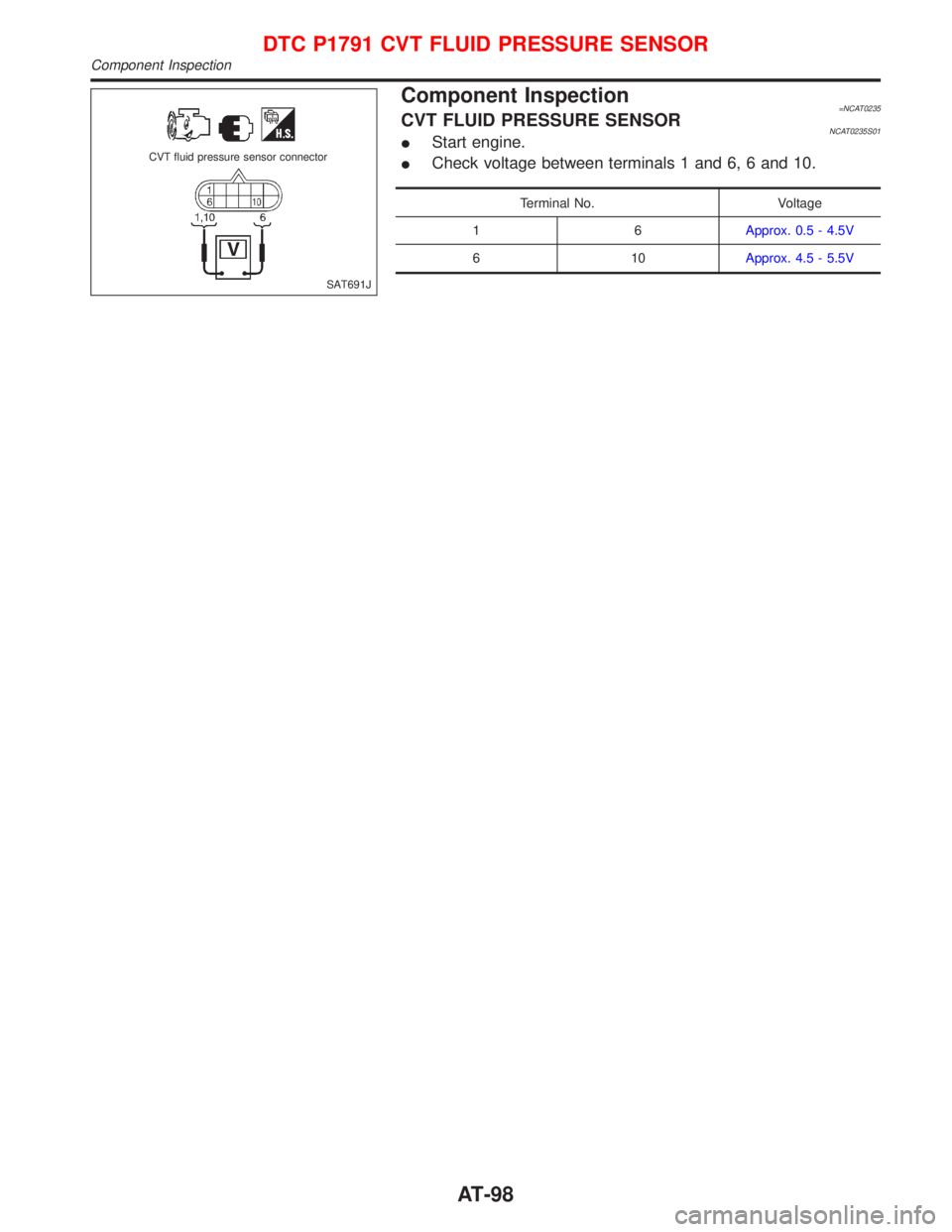
Component Inspection=NCAT0235CVT FLUID PRESSURE SENSORNCAT0235S01IStart engine.
ICheck voltage between terminals 1 and 6, 6 and 10.
Terminal No. Voltage
16Approx. 0.5 - 4.5V
610Approx. 4.5 - 5.5V
SAT691J CVT fluid pressure sensor connector
DTC P1791 CVT FLUID PRESSURE SENSOR
Component Inspection
AT-98
Page 101 of 2267

Description
ªCVT SAFE FUNCTIONº is function to protect CVT.
ON BOARD DIAGNOSIS LOGIC
Diagnostic trouble code Malfunction is detected when ... Check items (Possible cause)
: CVT SAFE FUNCTION
TCM is malfunctioning TCM
: 10th judgement flicker
DIAGNOSTIC TROUBLE CODE (DTC) CONFIRMATION
PROCEDURE
With CONSULT-II
1) Turn ignition switch ªONº and select ªDATA MONITORº mode
for CVT with CONSULT-II.
2) Start engine.
3) Run engine for at least 2 seconds at idle speed.
Without CONSULT-II
1) Start engine.
2) Perform self-diagnosis. Refer to SELF-DIAGNOSTIC PROCE-
DURE (Without CONSULT-II), AT-25.SAT651J
SAT971J
SAT455FALight
Shade
CVT SAFE FUNCTION
Description
AT-99
Page 103 of 2267
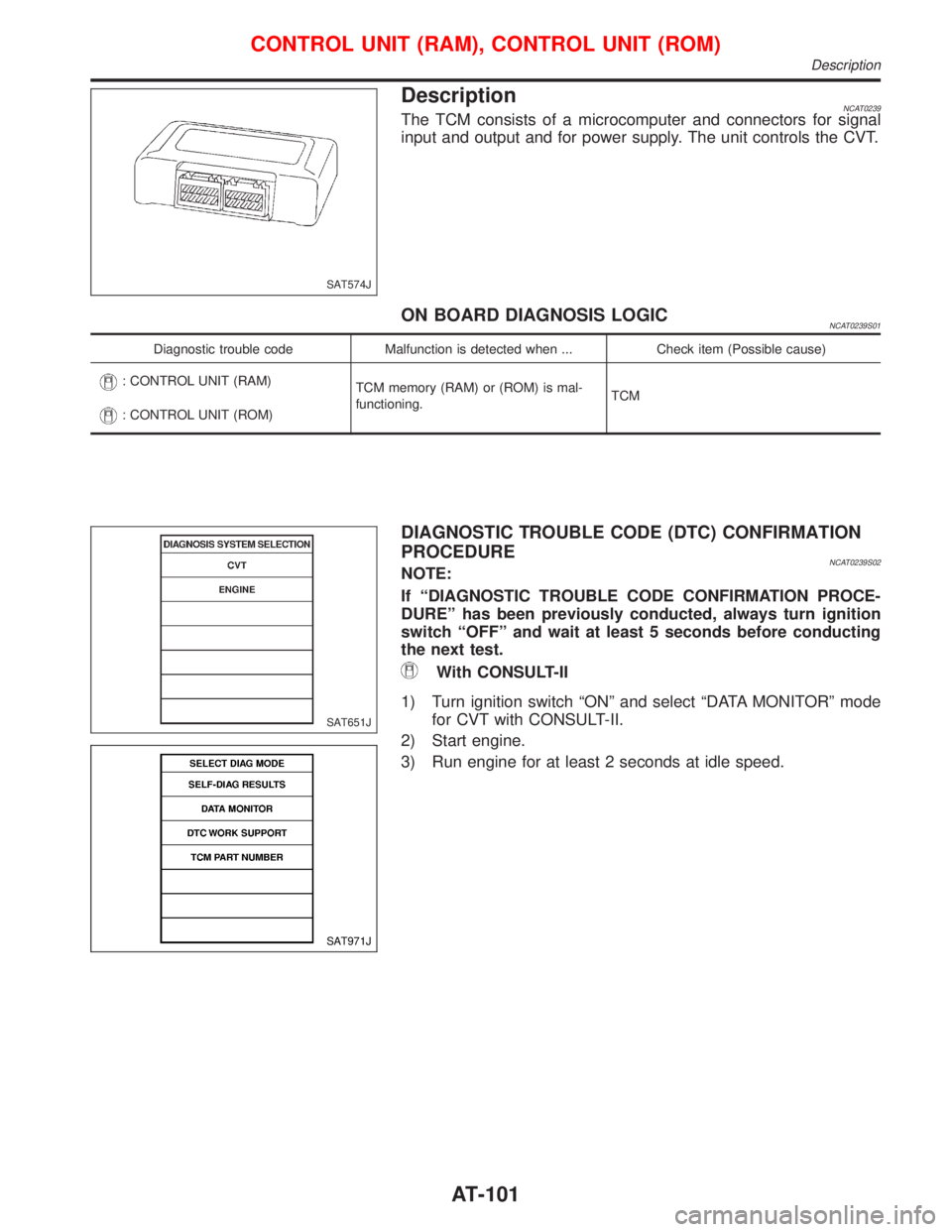
DescriptionNCAT0239The TCM consists of a microcomputer and connectors for signal
input and output and for power supply. The unit controls the CVT.
ON BOARD DIAGNOSIS LOGICNCAT0239S01
Diagnostic trouble code Malfunction is detected when ... Check item (Possible cause)
: CONTROL UNIT (RAM)
: CONTROL UNIT (ROM)TCM memory (RAM) or (ROM) is mal-
functioning.TCM
DIAGNOSTIC TROUBLE CODE (DTC) CONFIRMATION
PROCEDURE
NCAT0239S02NOTE:
If ªDIAGNOSTIC TROUBLE CODE CONFIRMATION PROCE-
DUREº has been previously conducted, always turn ignition
switch ªOFFº and wait at least 5 seconds before conducting
the next test.
With CONSULT-II
1) Turn ignition switch ªONº and select ªDATA MONITORº mode
for CVT with CONSULT-II.
2) Start engine.
3) Run engine for at least 2 seconds at idle speed.
SAT574J
SAT651J
SAT971J
CONTROL UNIT (RAM), CONTROL UNIT (ROM)
Description
AT-101
Page 105 of 2267
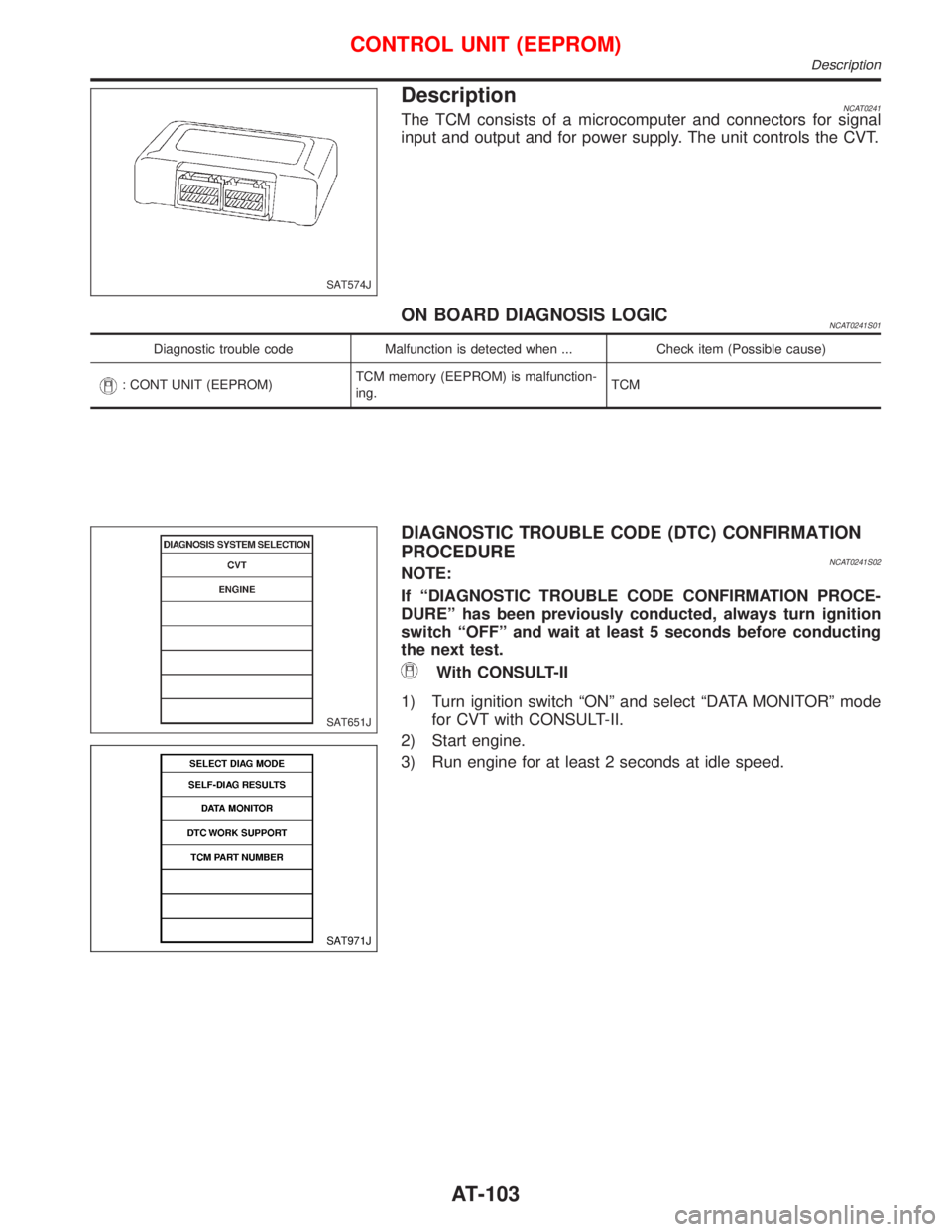
DescriptionNCAT0241The TCM consists of a microcomputer and connectors for signal
input and output and for power supply. The unit controls the CVT.
ON BOARD DIAGNOSIS LOGICNCAT0241S01
Diagnostic trouble code Malfunction is detected when ... Check item (Possible cause)
: CONT UNIT (EEPROM)TCM memory (EEPROM) is malfunction-
ing.TCM
DIAGNOSTIC TROUBLE CODE (DTC) CONFIRMATION
PROCEDURE
NCAT0241S02NOTE:
If ªDIAGNOSTIC TROUBLE CODE CONFIRMATION PROCE-
DUREº has been previously conducted, always turn ignition
switch ªOFFº and wait at least 5 seconds before conducting
the next test.
With CONSULT-II
1) Turn ignition switch ªONº and select ªDATA MONITORº mode
for CVT with CONSULT-II.
2) Start engine.
3) Run engine for at least 2 seconds at idle speed.
SAT574J
SAT651J
SAT971J
CONTROL UNIT (EEPROM)
Description
AT-103
Page 108 of 2267
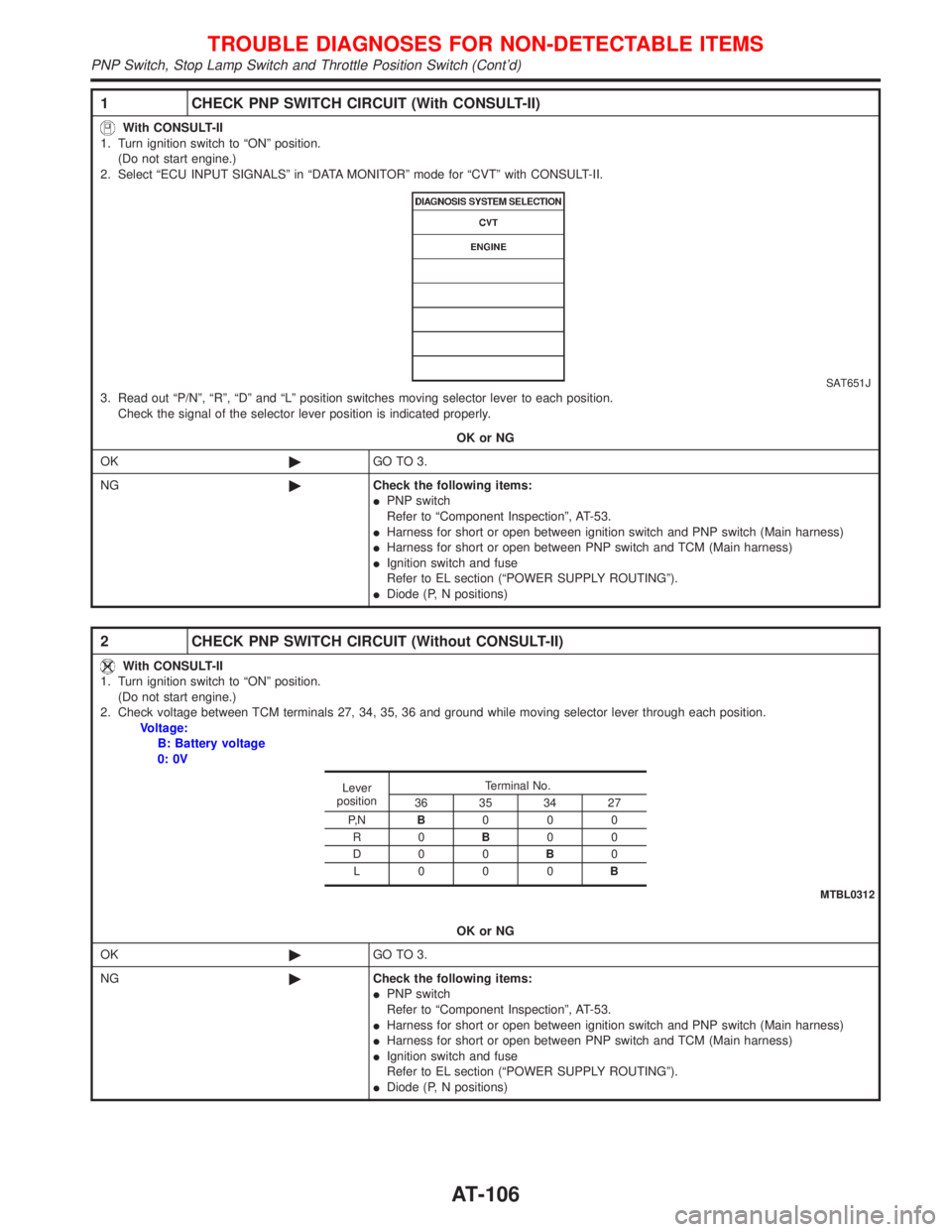
1 CHECK PNP SWITCH CIRCUIT (With CONSULT-II)
With CONSULT-II
1. Turn ignition switch to ªONº position.
(Do not start engine.)
2. Select ªECU INPUT SIGNALSº in ªDATA MONITORº mode for ªCVTº with CONSULT-II.
SAT651J3. Read out ªP/Nº, ªRº, ªDº and ªLº position switches moving selector lever to each position.
Check the signal of the selector lever position is indicated properly.
OK or NG
OK©GO TO 3.
NG©Check the following items:
IPNP switch
Refer to ªComponent Inspectionº, AT-53.
IHarness for short or open between ignition switch and PNP switch (Main harness)
IHarness for short or open between PNP switch and TCM (Main harness)
IIgnition switch and fuse
Refer to EL section (ªPOWER SUPPLY ROUTINGº).
IDiode (P, N positions)
2 CHECK PNP SWITCH CIRCUIT (Without CONSULT-II)
With CONSULT-II
1. Turn ignition switch to ªONº position.
(Do not start engine.)
2. Check voltage between TCM terminals 27, 34, 35, 36 and ground while moving selector lever through each position.
Voltage:
B: Battery voltage
0: 0V
OK or NG
OK©GO TO 3.
NG©Check the following items:
IPNP switch
Refer to ªComponent Inspectionº, AT-53.
IHarness for short or open between ignition switch and PNP switch (Main harness)
IHarness for short or open between PNP switch and TCM (Main harness)
IIgnition switch and fuse
Refer to EL section (ªPOWER SUPPLY ROUTINGº).
IDiode (P, N positions)
Lever
positionTerminal No.
36 35 34 27
P, NB000
R0B00
D0 0B0
L000B
MTBL0312
TROUBLE DIAGNOSES FOR NON-DETECTABLE ITEMS
PNP Switch, Stop Lamp Switch and Throttle Position Switch (Cont'd)
AT-106
Page 109 of 2267
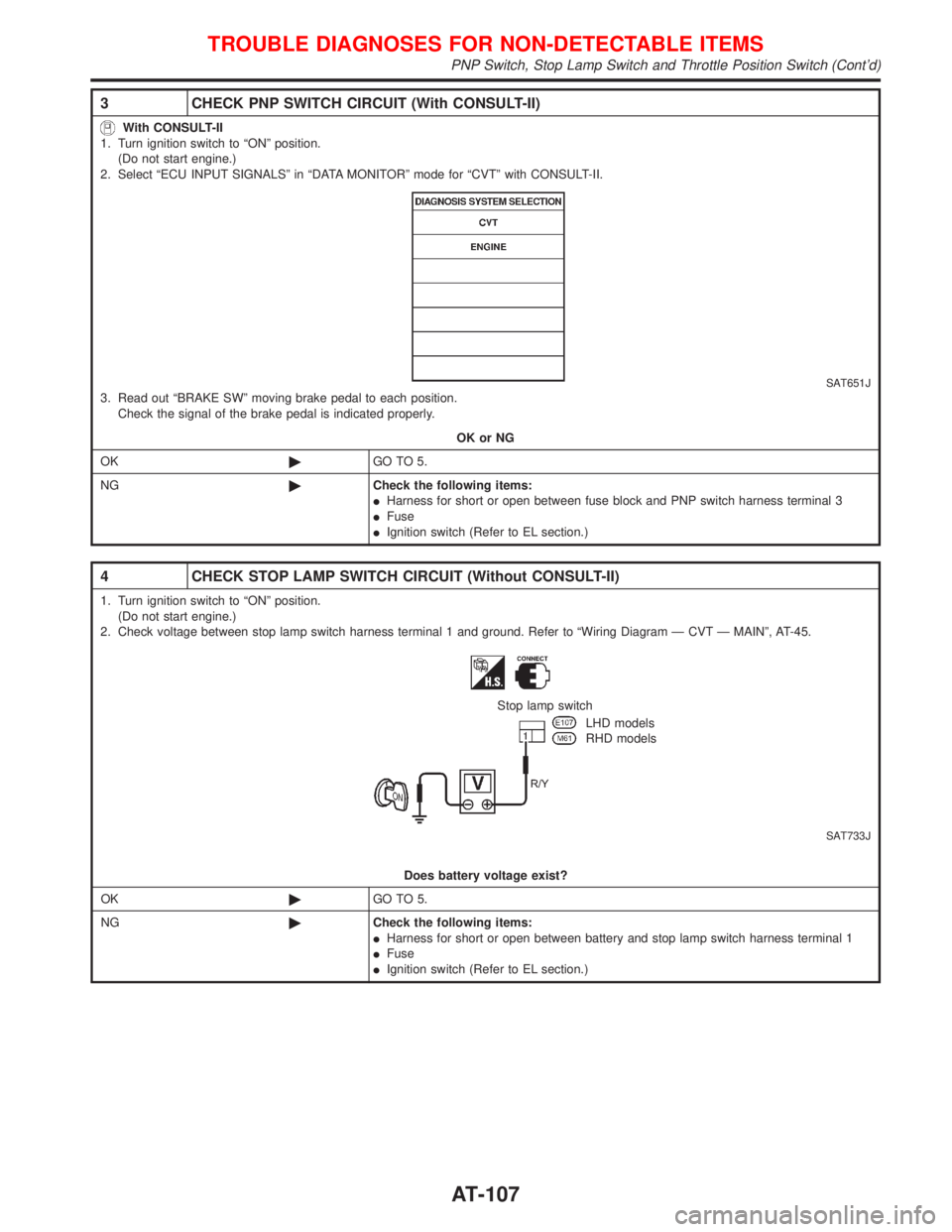
3 CHECK PNP SWITCH CIRCUIT (With CONSULT-II)
With CONSULT-II
1. Turn ignition switch to ªONº position.
(Do not start engine.)
2. Select ªECU INPUT SIGNALSº in ªDATA MONITORº mode for ªCVTº with CONSULT-II.
SAT651J3. Read out ªBRAKE SWº moving brake pedal to each position.
Check the signal of the brake pedal is indicated properly.
OK or NG
OK©GO TO 5.
NG©Check the following items:
IHarness for short or open between fuse block and PNP switch harness terminal 3
IFuse
IIgnition switch (Refer to EL section.)
4 CHECK STOP LAMP SWITCH CIRCUIT (Without CONSULT-II)
1. Turn ignition switch to ªONº position.
(Do not start engine.)
2. Check voltage between stop lamp switch harness terminal 1 and ground. Refer to ªWiring Diagram Ð CVT Ð MAINº, AT-45.
SAT733J
Stop lamp switch
LHD models
RHD models
Does battery voltage exist?
OK©GO TO 5.
NG©Check the following items:
IHarness for short or open between battery and stop lamp switch harness terminal 1
IFuse
IIgnition switch (Refer to EL section.)
TROUBLE DIAGNOSES FOR NON-DETECTABLE ITEMS
PNP Switch, Stop Lamp Switch and Throttle Position Switch (Cont'd)
AT-107
Page 110 of 2267
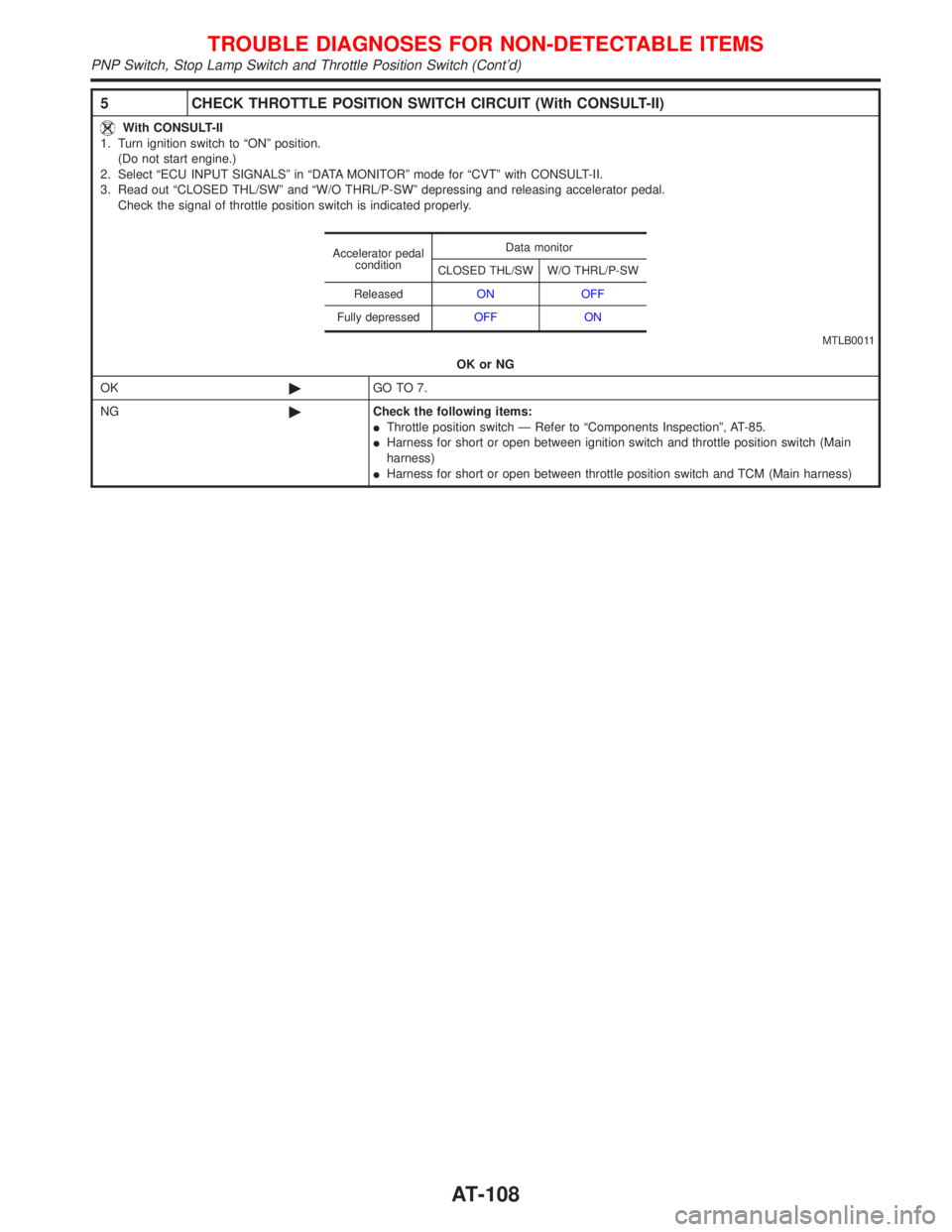
5 CHECK THROTTLE POSITION SWITCH CIRCUIT (With CONSULT-II)
With CONSULT-II
1. Turn ignition switch to ªONº position.
(Do not start engine.)
2. Select ªECU INPUT SIGNALSº in ªDATA MONITORº mode for ªCVTº with CONSULT-II.
3. Read out ªCLOSED THL/SWº and ªW/O THRL/P-SWº depressing and releasing accelerator pedal.
Check the signal of throttle position switch is indicated properly.
OK or NG
OK©GO TO 7.
NG©Check the following items:
IThrottle position switch Ð Refer to ªComponents Inspectionº, AT-85.
IHarness for short or open between ignition switch and throttle position switch (Main
harness)
IHarness for short or open between throttle position switch and TCM (Main harness)
Accelerator pedal
conditionData monitor
CLOSED THL/SW W/O THRL/P-SW
ReleasedON OFF
Fully depressedOFF ON
MTLB0011
TROUBLE DIAGNOSES FOR NON-DETECTABLE ITEMS
PNP Switch, Stop Lamp Switch and Throttle Position Switch (Cont'd)
AT-108
Page 111 of 2267
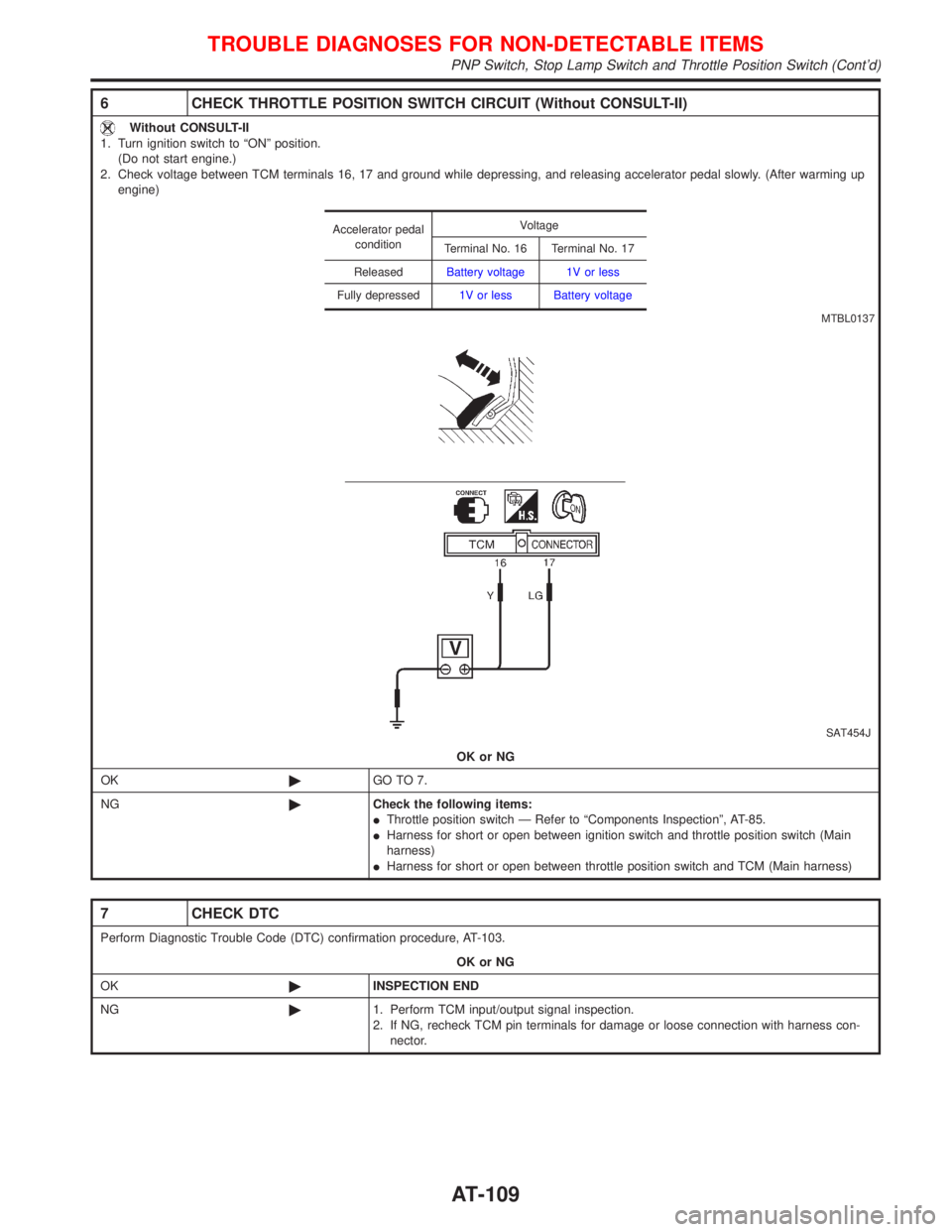
6 CHECK THROTTLE POSITION SWITCH CIRCUIT (Without CONSULT-II)
Without CONSULT-II
1. Turn ignition switch to ªONº position.
(Do not start engine.)
2. Check voltage between TCM terminals 16, 17 and ground while depressing, and releasing accelerator pedal slowly. (After warming up
engine)
SAT454J
OK or NG
OK©GO TO 7.
NG©Check the following items:
IThrottle position switch Ð Refer to ªComponents Inspectionº, AT-85.
IHarness for short or open between ignition switch and throttle position switch (Main
harness)
IHarness for short or open between throttle position switch and TCM (Main harness)
Accelerator pedal
conditionVoltage
Terminal No. 16 Terminal No. 17
ReleasedBattery voltage 1V or less
Fully depressed1V or less Battery voltage
MTBL0137
7 CHECK DTC
Perform Diagnostic Trouble Code (DTC) confirmation procedure, AT-103.
OK or NG
OK©INSPECTION END
NG©1. Perform TCM input/output signal inspection.
2. If NG, recheck TCM pin terminals for damage or loose connection with harness con-
nector.
TROUBLE DIAGNOSES FOR NON-DETECTABLE ITEMS
PNP Switch, Stop Lamp Switch and Throttle Position Switch (Cont'd)
AT-109
Page 119 of 2267
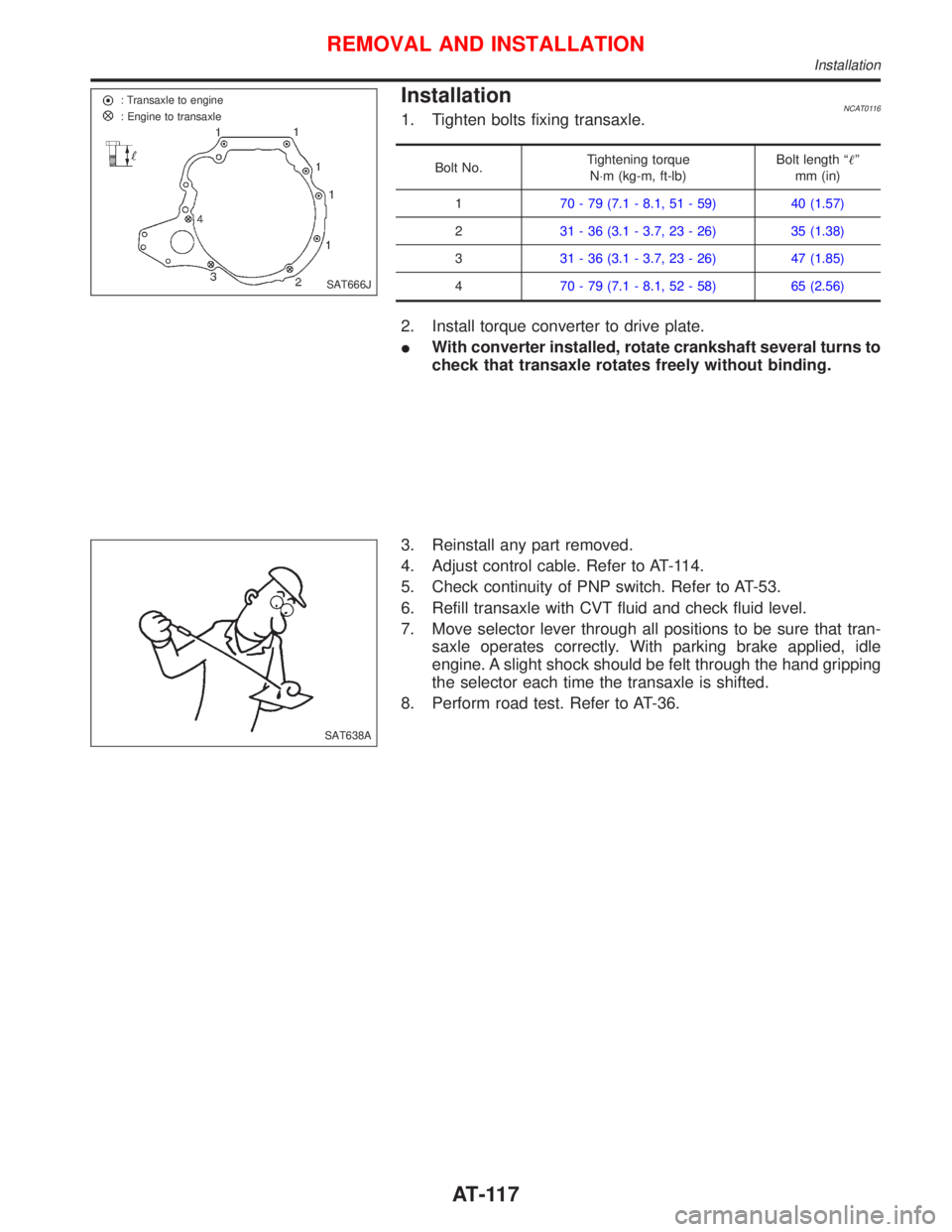
InstallationNCAT01161. Tighten bolts fixing transaxle.
Bolt No.Tightening torque
N×m (kg-m, ft-lb)Bolt length ªº
mm (in)
170 - 79 (7.1 - 8.1, 51 - 59) 40 (1.57)
231 - 36 (3.1 - 3.7, 23 - 26) 35 (1.38)
331 - 36 (3.1 - 3.7, 23 - 26) 47 (1.85)
470 - 79 (7.1 - 8.1, 52 - 58) 65 (2.56)
2. Install torque converter to drive plate.
IWith converter installed, rotate crankshaft several turns to
check that transaxle rotates freely without binding.
3. Reinstall any part removed.
4. Adjust control cable. Refer to AT-114.
5. Check continuity of PNP switch. Refer to AT-53.
6. Refill transaxle with CVT fluid and check fluid level.
7. Move selector lever through all positions to be sure that tran-
saxle operates correctly. With parking brake applied, idle
engine. A slight shock should be felt through the hand gripping
the selector each time the transaxle is shifted.
8. Perform road test. Refer to AT-36.
SAT666J : Transaxle to engine
: Engine to transaxle
SAT638A
REMOVAL AND INSTALLATION
Installation
AT-117
Page 129 of 2267
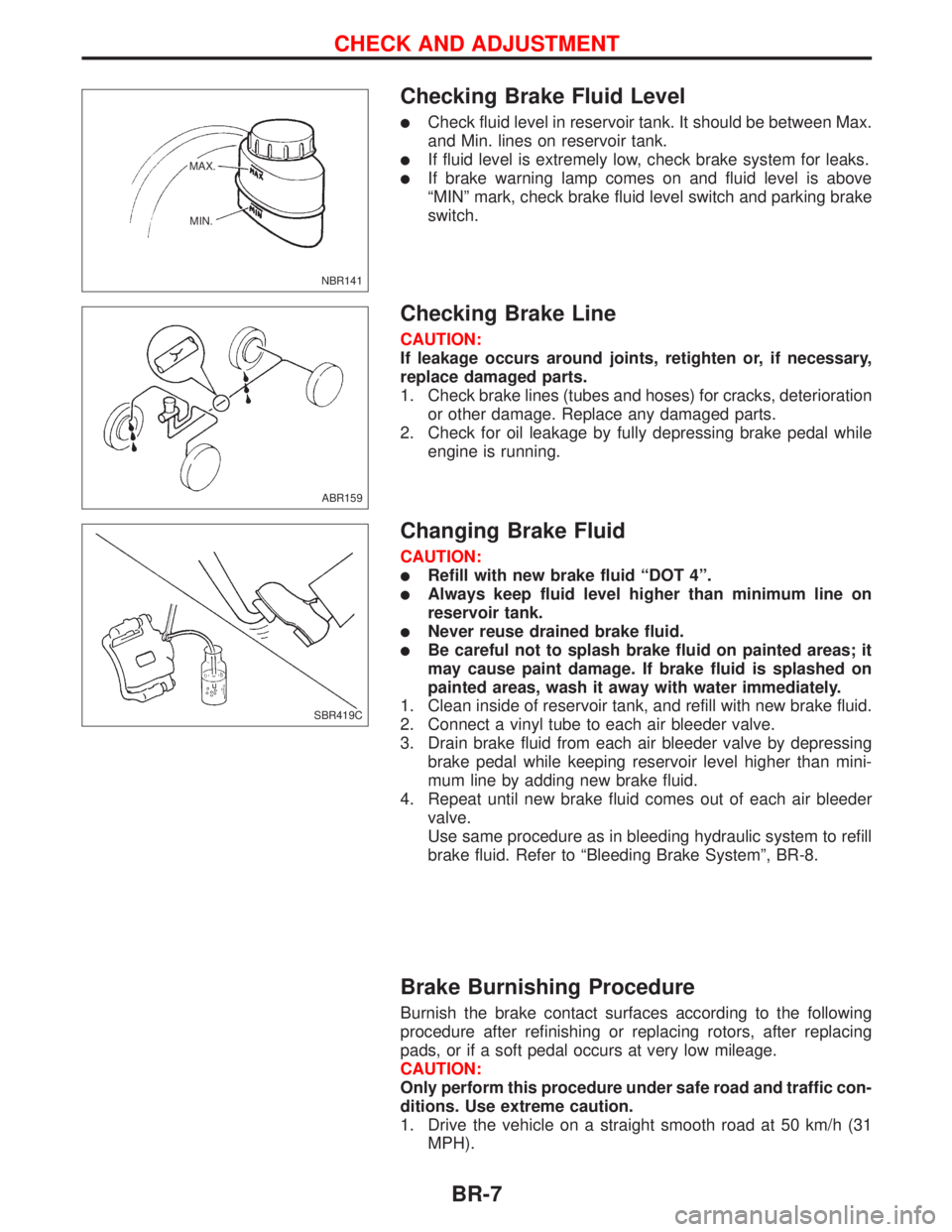
Checking Brake Fluid Level
lCheck fluid level in reservoir tank. It should be between Max.
and Min. lines on reservoir tank.
lIf fluid level is extremely low, check brake system for leaks.
lIf brake warning lamp comes on and fluid level is above
ªMINº mark, check brake fluid level switch and parking brake
switch.
Checking Brake Line
CAUTION:
If leakage occurs around joints, retighten or, if necessary,
replace damaged parts.
1. Check brake lines (tubes and hoses) for cracks, deterioration
or other damage. Replace any damaged parts.
2. Check for oil leakage by fully depressing brake pedal while
engine is running.
Changing Brake Fluid
CAUTION:
lRefill with new brake fluid ªDOT 4º.
lAlways keep fluid level higher than minimum line on
reservoir tank.
lNever reuse drained brake fluid.
lBe careful not to splash brake fluid on painted areas; it
may cause paint damage. If brake fluid is splashed on
painted areas, wash it away with water immediately.
1. Clean inside of reservoir tank, and refill with new brake fluid.
2. Connect a vinyl tube to each air bleeder valve.
3. Drain brake fluid from each air bleeder valve by depressing
brake pedal while keeping reservoir level higher than mini-
mum line by adding new brake fluid.
4. Repeat until new brake fluid comes out of each air bleeder
valve.
Use same procedure as in bleeding hydraulic system to refill
brake fluid. Refer to ªBleeding Brake Systemº, BR-8.
Brake Burnishing Procedure
Burnish the brake contact surfaces according to the following
procedure after refinishing or replacing rotors, after replacing
pads, or if a soft pedal occurs at very low mileage.
CAUTION:
Only perform this procedure under safe road and traffic con-
ditions. Use extreme caution.
1. Drive the vehicle on a straight smooth road at 50 km/h (31
MPH).
NBR141 MAX.
MIN.
ABR159
SBR419C
CHECK AND ADJUSTMENT
BR-7