check engine NISSAN PRIMERA 1999 Electronic Workshop Manual
[x] Cancel search | Manufacturer: NISSAN, Model Year: 1999, Model line: PRIMERA, Model: NISSAN PRIMERA 1999Pages: 2267, PDF Size: 35.74 MB
Page 136 of 2267
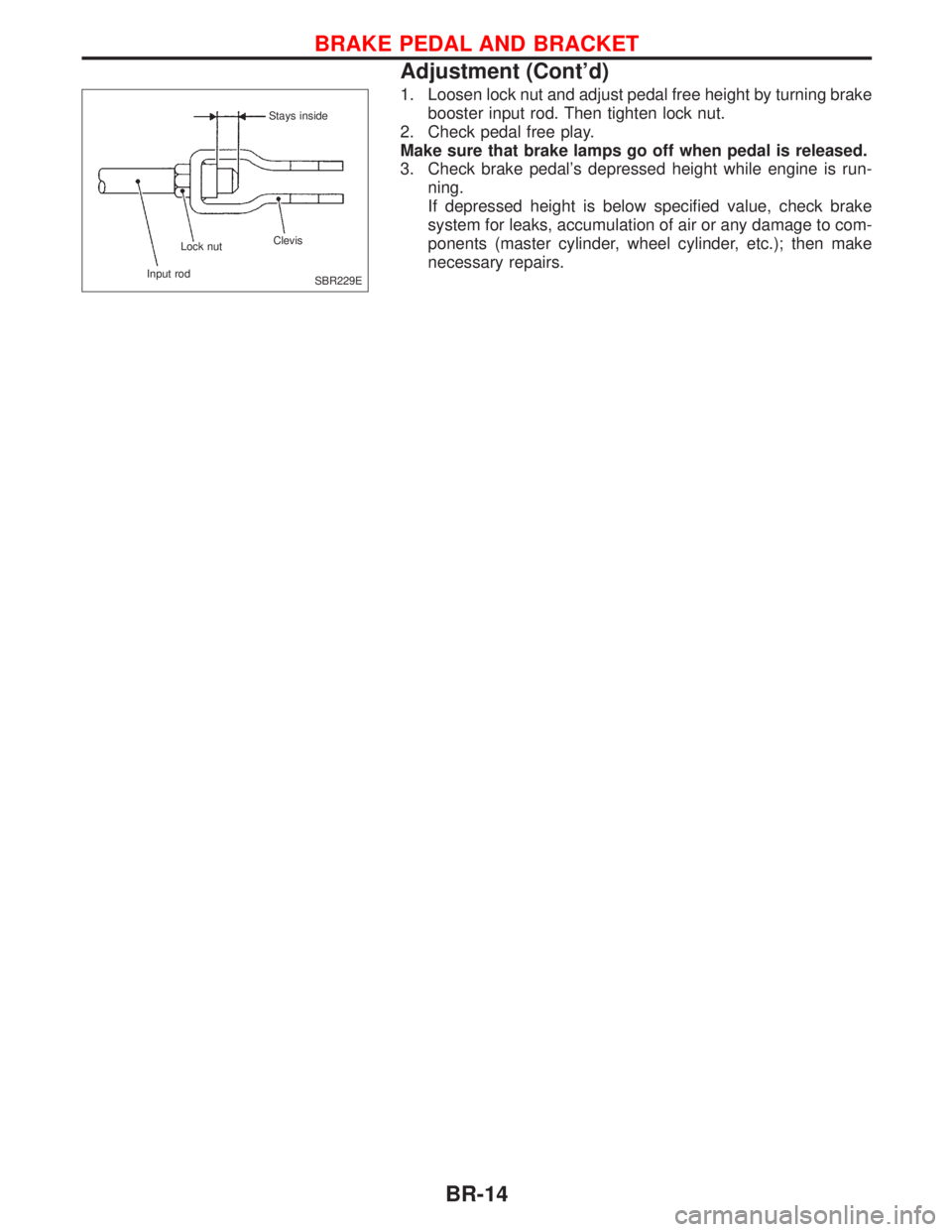
1. Loosen lock nut and adjust pedal free height by turning brake
booster input rod. Then tighten lock nut.
2. Check pedal free play.
Make sure that brake lamps go off when pedal is released.
3. Check brake pedal's depressed height while engine is run-
ning.
If depressed height is below specified value, check brake
system for leaks, accumulation of air or any damage to com-
ponents (master cylinder, wheel cylinder, etc.); then make
necessary repairs.
SBR229E Stays inside
Clevis
Lock nut
Input rod
BRAKE PEDAL AND BRACKET
Adjustment (Cont'd)
BR-14
Page 140 of 2267
On-vehicle Service
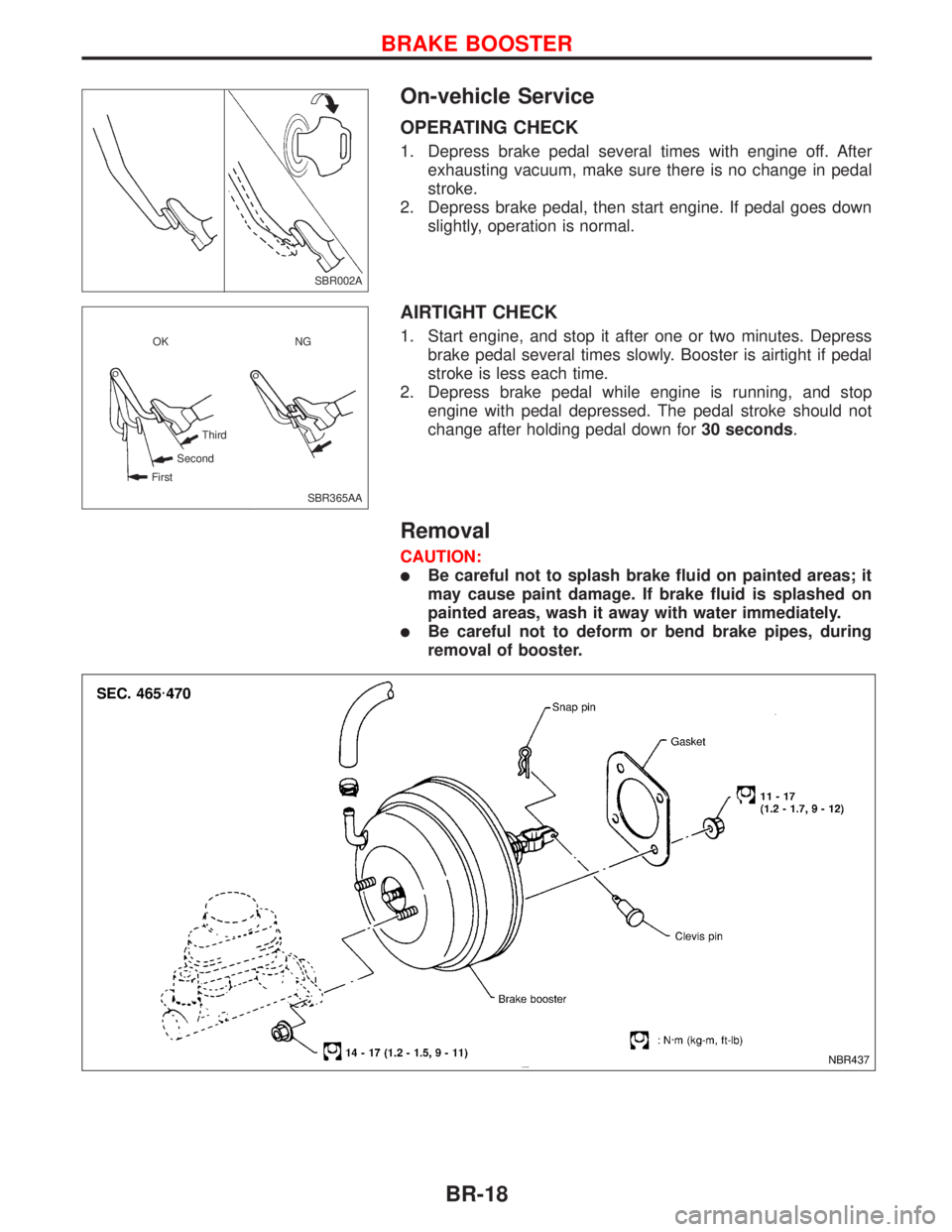
OPERATING CHECK
1. Depress brake pedal several times with engine off. After
exhausting vacuum, make sure there is no change in pedal
stroke.
2. Depress brake pedal, then start engine. If pedal goes down
slightly, operation is normal.
AIRTIGHT CHECK
1. Start engine, and stop it after one or two minutes. Depress
brake pedal several times slowly. Booster is airtight if pedal
stroke is less each time.
2. Depress brake pedal while engine is running, and stop
engine with pedal depressed. The pedal stroke should not
change after holding pedal down for30 seconds.
Removal
CAUTION:
lBe careful not to splash brake fluid on painted areas; it
may cause paint damage. If brake fluid is splashed on
painted areas, wash it away with water immediately.
lBe careful not to deform or bend brake pipes, during
removal of booster.
SBR002A
SBR365AA OK NG
Third
Second
First
NBR437
BRAKE BOOSTER
BR-18
Page 143 of 2267
Removal and Installation
CAUTION:
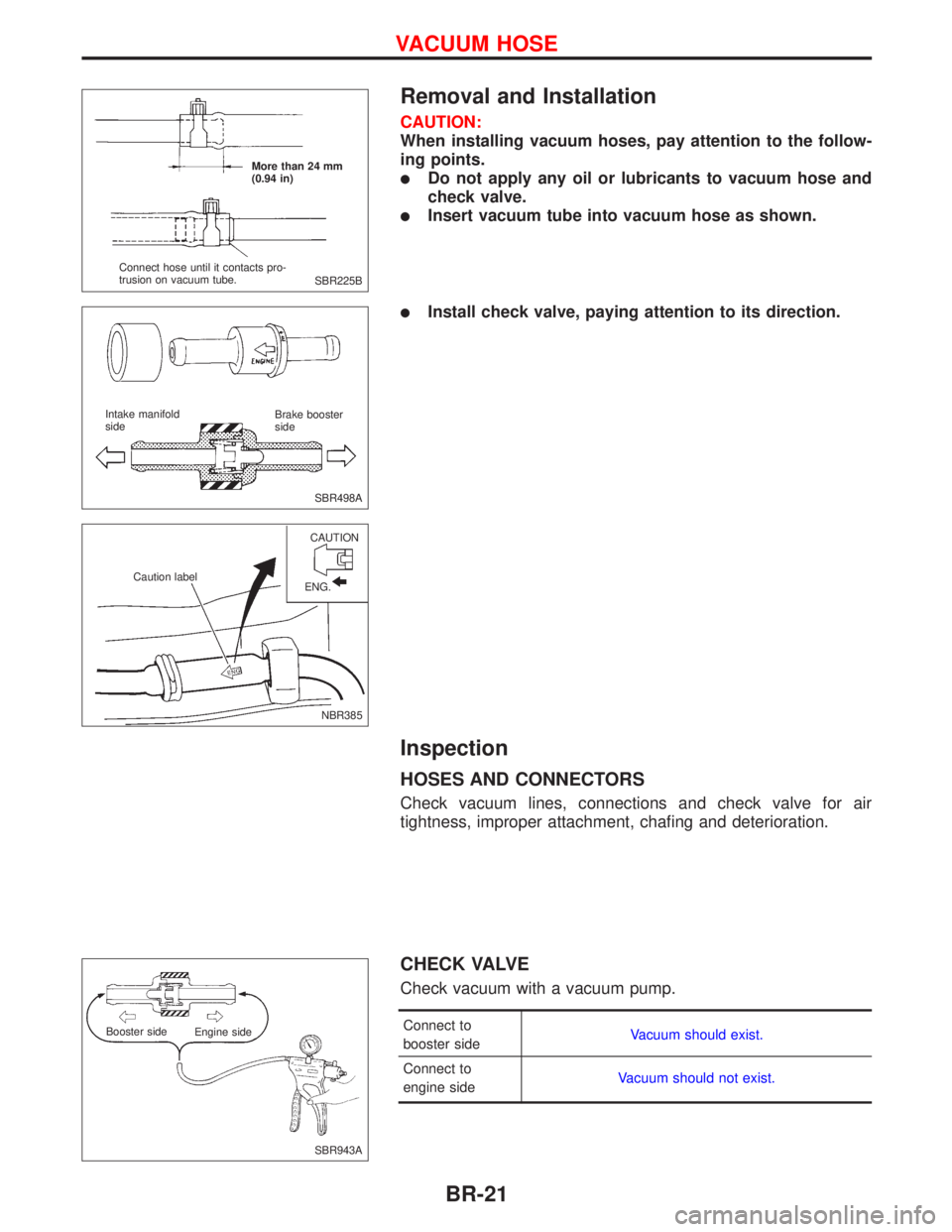
When installing vacuum hoses, pay attention to the follow-
ing points.
lDo not apply any oil or lubricants to vacuum hose and
check valve.
lInsert vacuum tube into vacuum hose as shown.
lInstall check valve, paying attention to its direction.
Inspection
HOSES AND CONNECTORS
Check vacuum lines, connections and check valve for air
tightness, improper attachment, chafing and deterioration.
CHECK VALVE
Check vacuum with a vacuum pump.
Connect to
booster sideVacuum should exist.
Connect to
engine sideVacuum should not exist.
SBR225B More than 24 mm
(0.94 in)
Connect hose until it contacts pro-
trusion on vacuum tube.
SBR498A Intake manifold
sideBrake booster
side
NBR385 CAUTION
Caution label
ENG.
SBR943A Booster side
Engine side
VACUUM HOSE
BR-21
Page 144 of 2267
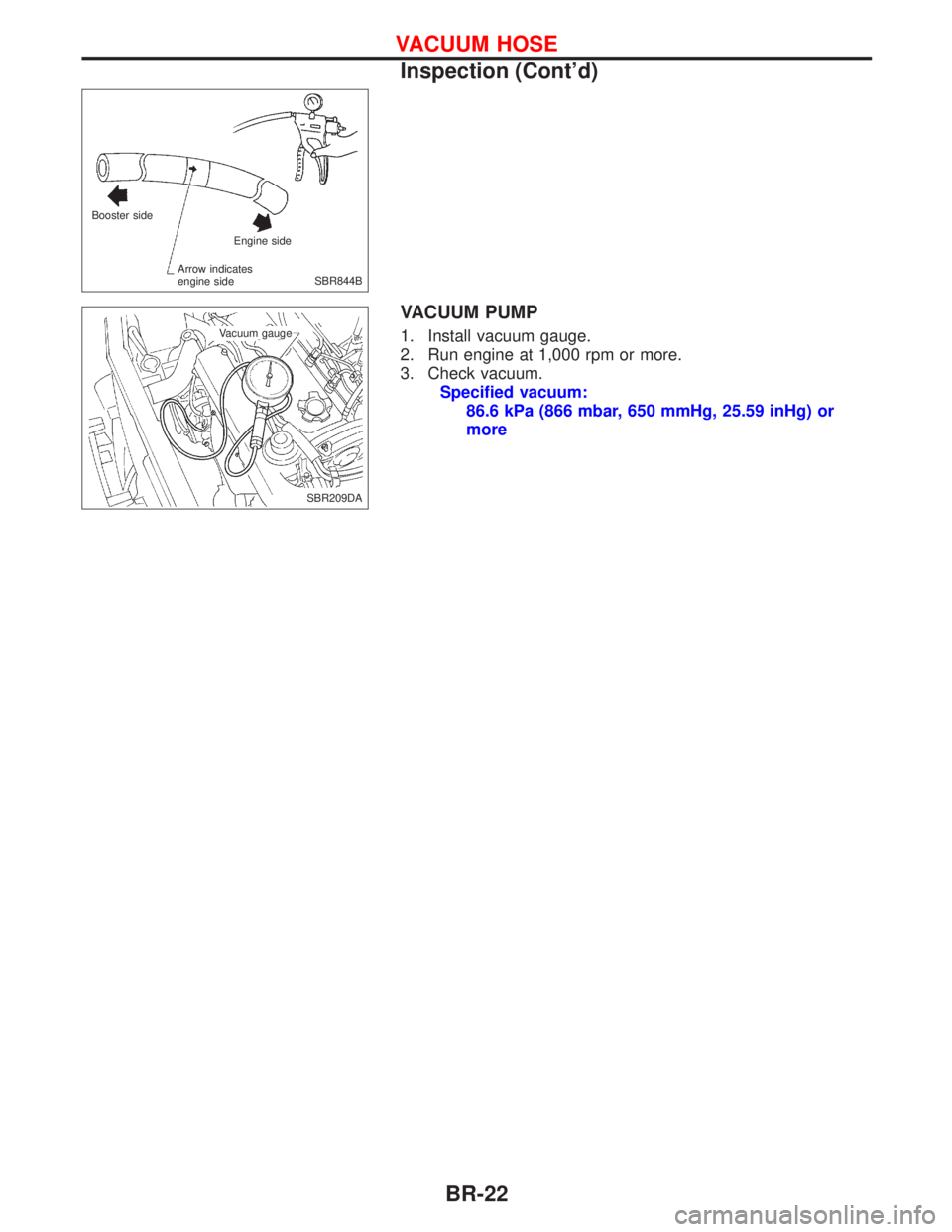
VACUUM PUMP
1. Install vacuum gauge.
2. Run engine at 1,000 rpm or more.
3. Check vacuum.
Specified vacuum:
86.6 kPa (866 mbar, 650 mmHg, 25.59 inHg) or
more
Booster side
Engine side
Arrow indicates
engine side
SBR844B
SBR209DA Vacuum gauge
VACUUM HOSE
Inspection (Cont'd)
BR-22
Page 171 of 2267
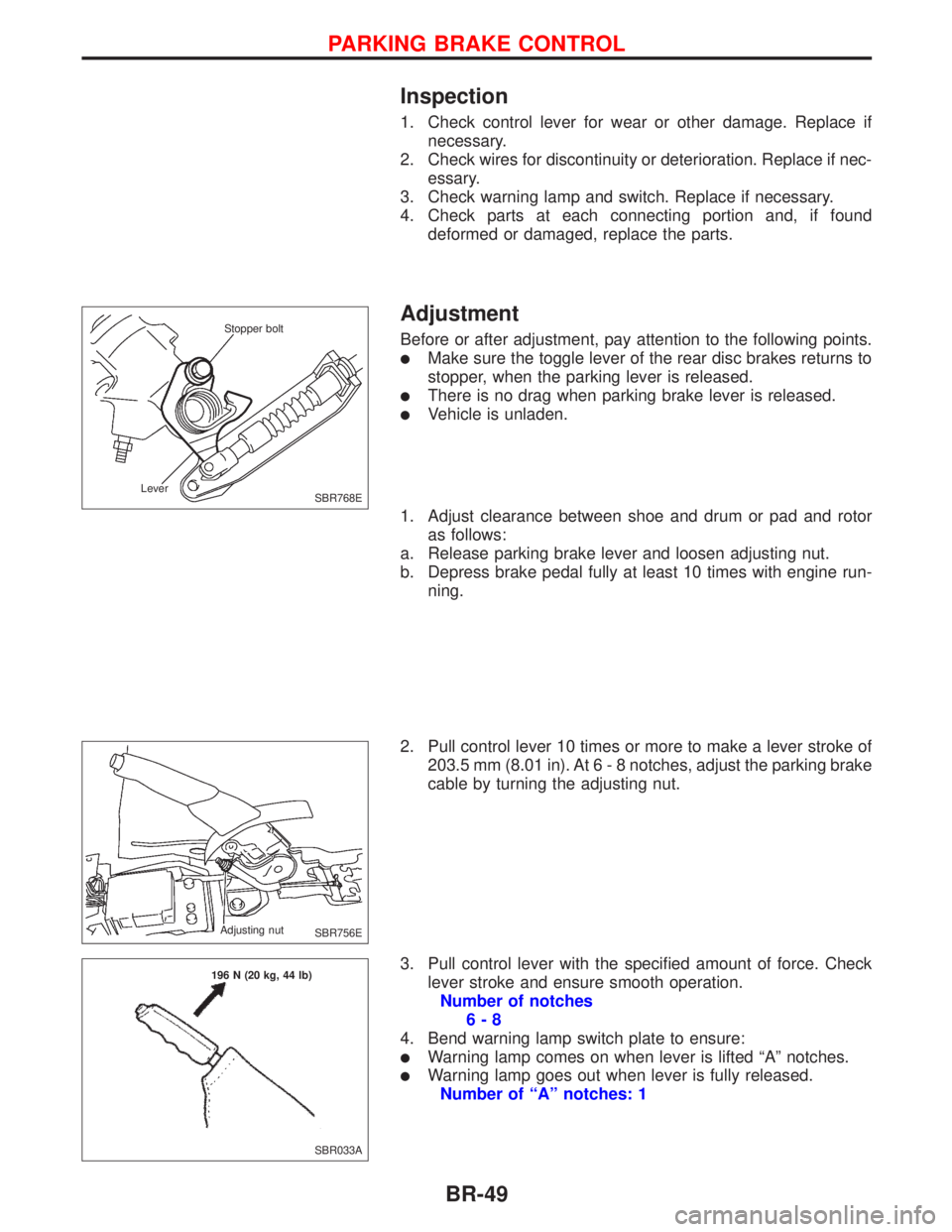
Inspection
1. Check control lever for wear or other damage. Replace if
necessary.
2. Check wires for discontinuity or deterioration. Replace if nec-
essary.
3. Check warning lamp and switch. Replace if necessary.
4. Check parts at each connecting portion and, if found
deformed or damaged, replace the parts.
Adjustment
Before or after adjustment, pay attention to the following points.
lMake sure the toggle lever of the rear disc brakes returns to
stopper, when the parking lever is released.
lThere is no drag when parking brake lever is released.
lVehicle is unladen.
1. Adjust clearance between shoe and drum or pad and rotor
as follows:
a. Release parking brake lever and loosen adjusting nut.
b. Depress brake pedal fully at least 10 times with engine run-
ning.
2. Pull control lever 10 times or more to make a lever stroke of
203.5 mm (8.01 in). At6-8notches, adjust the parking brake
cable by turning the adjusting nut.
3. Pull control lever with the specified amount of force. Check
lever stroke and ensure smooth operation.
Number of notches
6-8
4. Bend warning lamp switch plate to ensure:
lWarning lamp comes on when lever is lifted ªAº notches.
lWarning lamp goes out when lever is fully released.
Number of ªAº notches: 1
SBR768E Stopper bolt
Lever
SBR756E Adjusting nut
SBR033A 196 N (20 kg, 44 lb)
PARKING BRAKE CONTROL
BR-49
Page 192 of 2267
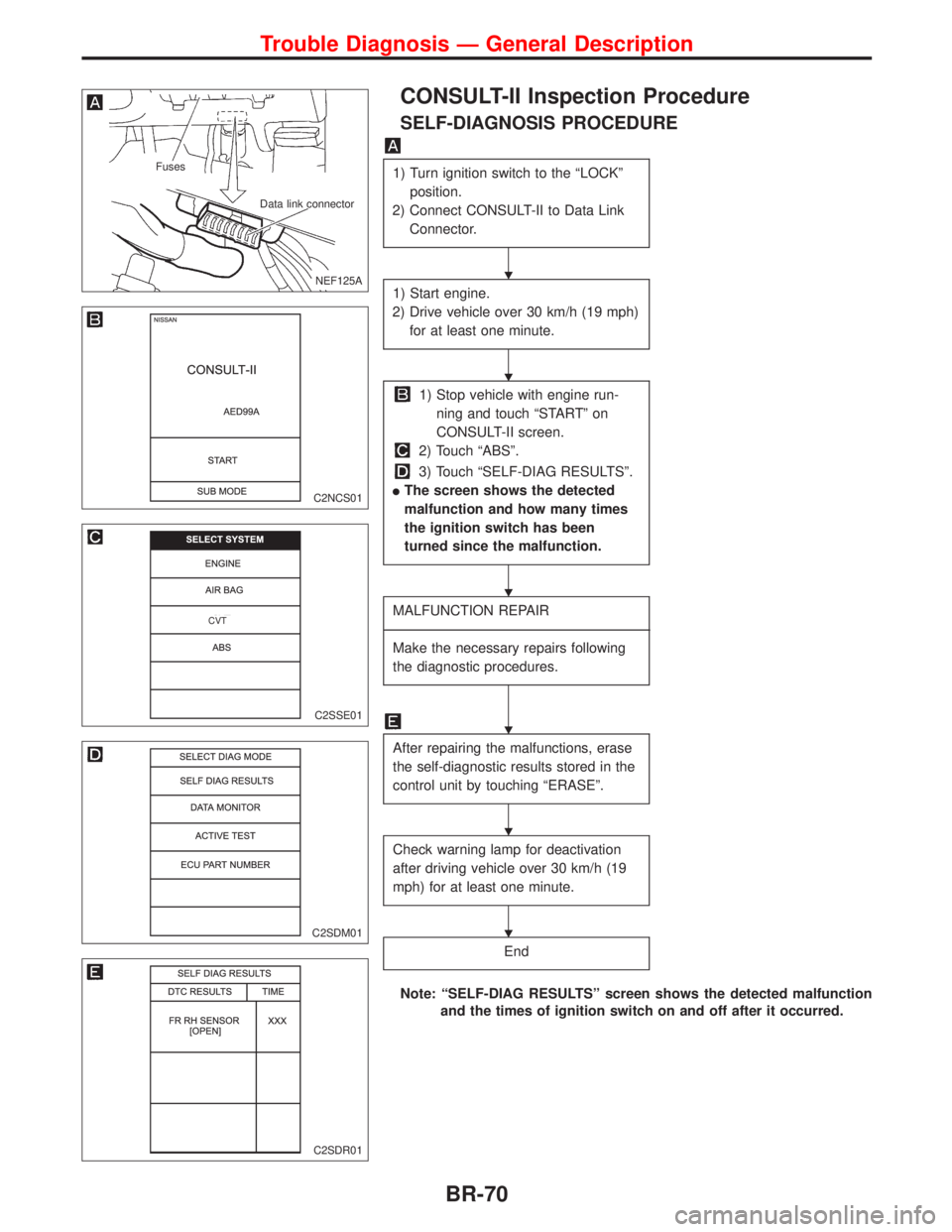
CONSULT-II Inspection Procedure
SELF-DIAGNOSIS PROCEDURE
1) Turn ignition switch to the ªLOCKº
position.
2) Connect CONSULT-II to Data Link
Connector.
1) Start engine.
2) Drive vehicle over 30 km/h (19 mph)
for at least one minute.
1) Stop vehicle with engine run-
ning and touch ªSTARTº on
CONSULT-II screen.
2) Touch ªABSº.
3) Touch ªSELF-DIAG RESULTSº.
lThe screen shows the detected
malfunction and how many times
the ignition switch has been
turned since the malfunction.
MALFUNCTION REPAIR
----------------------------------------------------------------------------------------------------------------------------------------------------------------------------------------------------------------------------------------------------------------------------------------------------------
Make the necessary repairs following
the diagnostic procedures.
After repairing the malfunctions, erase
the self-diagnostic results stored in the
control unit by touching ªERASEº.
Check warning lamp for deactivation
after driving vehicle over 30 km/h (19
mph) for at least one minute.
End
Note: ªSELF-DIAG RESULTSº screen shows the detected malfunction
and the times of ignition switch on and off after it occurred.
.NEF125A
Fuses
Data link connector
C2NCS01
C2SSE01
.CVT
C2SDM01
C2SDR01
H
H
H
H
H
H
Trouble Diagnosis Ð General Description
BR-70
Page 197 of 2267
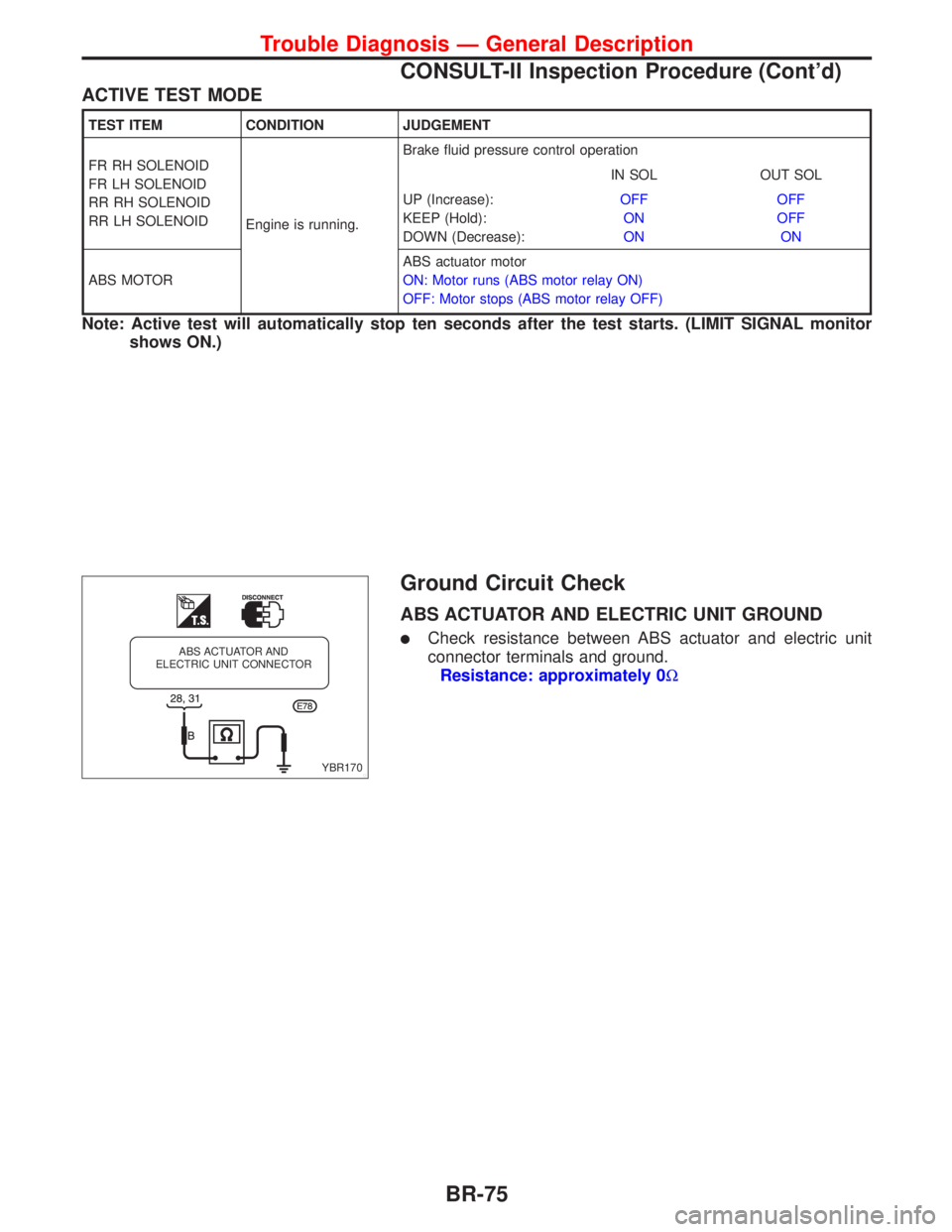
ACTIVE TEST MODE
TEST ITEM CONDITION JUDGEMENT
FR RH SOLENOID
FR LH SOLENOID
RR RH SOLENOID
RR LH SOLENOID
Engine is running.Brake fluid pressure control operation
IN SOL OUT SOL
UP (Increase):
KEEP (Hold):
DOWN (Decrease):OFF
ON
ONOFF
OFF
ON
ABS MOTORABS actuator motor
ON: Motor runs (ABS motor relay ON)
OFF: Motor stops (ABS motor relay OFF)
Note: Active test will automatically stop ten seconds after the test starts. (LIMIT SIGNAL monitor
shows ON.)
Ground Circuit Check
ABS ACTUATOR AND ELECTRIC UNIT GROUND
lCheck resistance between ABS actuator and electric unit
connector terminals and ground.
Resistance: approximately 0W
YBR170 ABS ACTUATOR AND
ELECTRIC UNIT CONNECTOR
Trouble Diagnosis Ð General Description
CONSULT-II Inspection Procedure (Cont'd)
BR-75
Page 201 of 2267
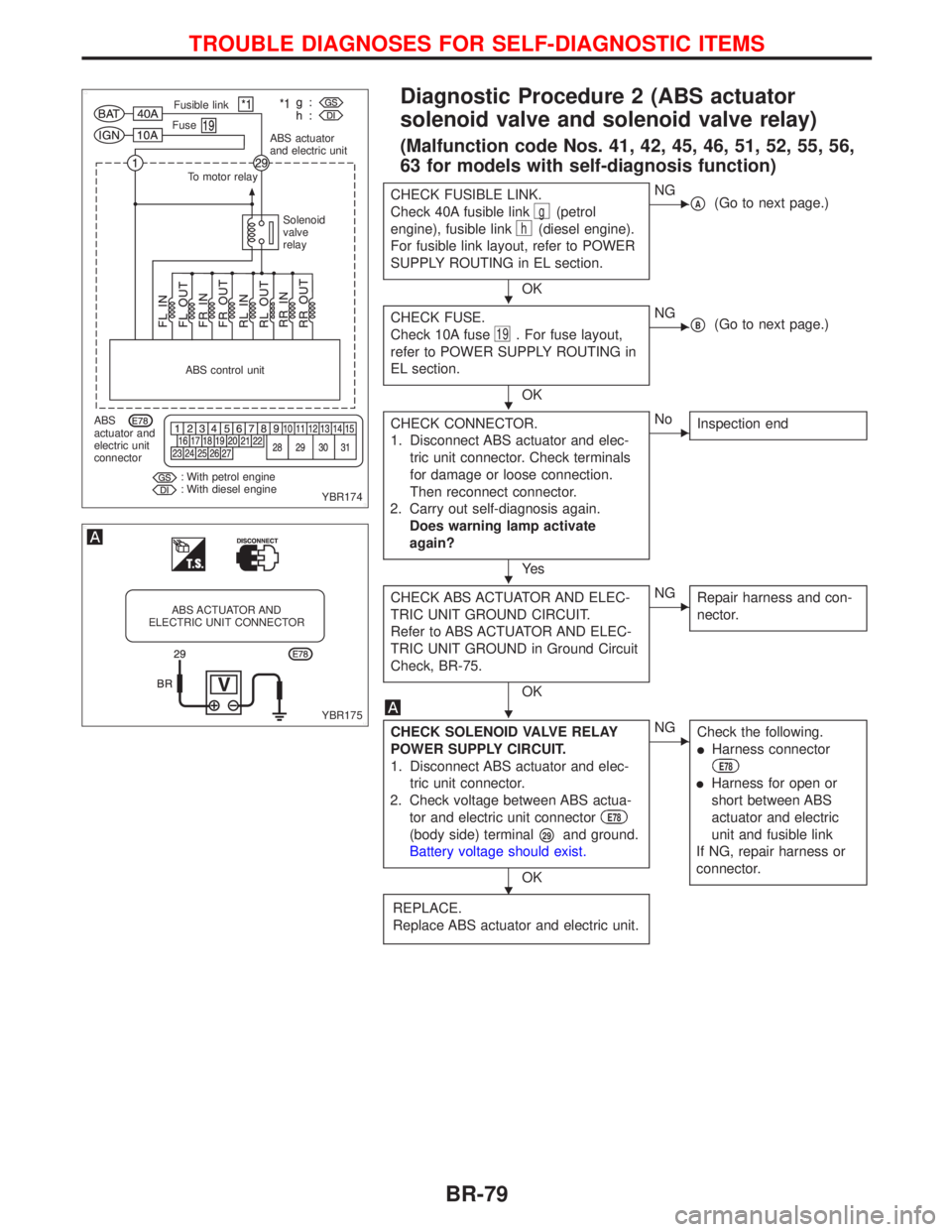
Diagnostic Procedure 2 (ABS actuator
solenoid valve and solenoid valve relay)
(Malfunction code Nos. 41, 42, 45, 46, 51, 52, 55, 56,
63 for models with self-diagnosis function)
CHECK FUSIBLE LINK.
Check 40A fusible link
g(petrol
engine), fusible link
h(diesel engine).
For fusible link layout, refer to POWER
SUPPLY ROUTING in EL section.
OK
ENGpA(Go to next page.)
CHECK FUSE.
Check 10A fuse
19. For fuse layout,
refer to POWER SUPPLY ROUTING in
EL section.
OK
ENGpB(Go to next page.)
CHECK CONNECTOR.
1. Disconnect ABS actuator and elec-
tric unit connector. Check terminals
for damage or loose connection.
Then reconnect connector.
2. Carry out self-diagnosis again.
Does warning lamp activate
again?
Ye s
ENo
Inspection end
CHECK ABS ACTUATOR AND ELEC-
TRIC UNIT GROUND CIRCUIT.
Refer to ABS ACTUATOR AND ELEC-
TRIC UNIT GROUND in Ground Circuit
Check, BR-75.
OK
ENG
Repair harness and con-
nector.
CHECK SOLENOID VALVE RELAY
POWER SUPPLY CIRCUIT.
1. Disconnect ABS actuator and elec-
tric unit connector.
2. Check voltage between ABS actua-
tor and electric unit connector
E78
(body side) terminalp29and ground.
Battery voltage should exist.
OK
ENG
Check the following.
lHarness connector
E78
lHarness for open or
short between ABS
actuator and electric
unit and fusible link
If NG, repair harness or
connector.
REPLACE.
Replace ABS actuator and electric unit.
YBR174 Fusible link
Fuse
ABS actuator
and electric unit
To motor relay
Solenoid
valve
relay
ABS control unit
ABS
actuator and
electric unit
connector
: With petrol engine
: With diesel engine
YBR175
ABS ACTUATOR AND
ELECTRIC UNIT CONNECTOR
H
H
H
H
H
TROUBLE DIAGNOSES FOR SELF-DIAGNOSTIC ITEMS
BR-79
Page 203 of 2267
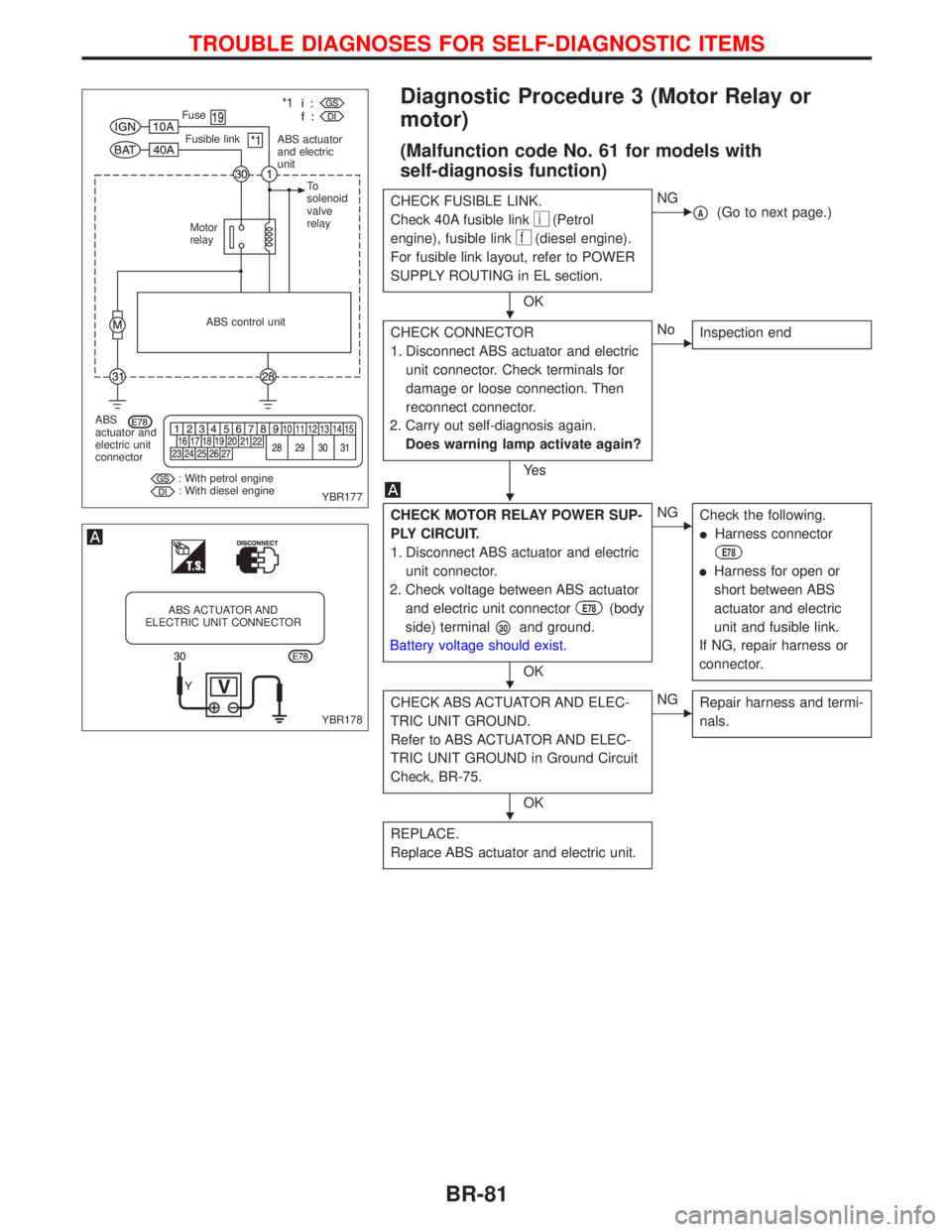
Diagnostic Procedure 3 (Motor Relay or
motor)
(Malfunction code No. 61 for models with
self-diagnosis function)
CHECK FUSIBLE LINK.
Check 40A fusible link
i(Petrol
engine), fusible link
f(diesel engine).
For fusible link layout, refer to POWER
SUPPLY ROUTING in EL section.
OK
ENG
pA(Go to next page.)
CHECK CONNECTOR
1. Disconnect ABS actuator and electric
unit connector. Check terminals for
damage or loose connection. Then
reconnect connector.
2. Carry out self-diagnosis again.
Does warning lamp activate again?
Ye s
ENo
Inspection end
CHECK MOTOR RELAY POWER SUP-
PLY CIRCUIT.
1. Disconnect ABS actuator and electric
unit connector.
2. Check voltage between ABS actuator
and electric unit connector
E78(body
side) terminal
p30and ground.
Battery voltage should exist.
OK
ENG
Check the following.
lHarness connector
E78
lHarness for open or
short between ABS
actuator and electric
unit and fusible link.
If NG, repair harness or
connector.
CHECK ABS ACTUATOR AND ELEC-
TRIC UNIT GROUND.
Refer to ABS ACTUATOR AND ELEC-
TRIC UNIT GROUND in Ground Circuit
Check, BR-75.
OK
ENG
Repair harness and termi-
nals.
REPLACE.
Replace ABS actuator and electric unit.
YBR177 Fusible link Fuse
ABS actuator
and electric
unit
Motor
relayTo
solenoid
valve
relay
ABS control unit
ABS
actuator and
electric unit
connector
: With petrol engine
: With diesel engine
YBR178
ABS ACTUATOR AND
ELECTRIC UNIT CONNECTOR
H
H
H
H
TROUBLE DIAGNOSES FOR SELF-DIAGNOSTIC ITEMS
BR-81
Page 209 of 2267
Diagnostic Procedure 9 (ABS does not
work.)
CHECK WARNING LAMP ACTIVATE.
Does the ABS warning lamp activate?
No
EYe s
Carry out self-diagnosis.
Refer to BR-67.
Go toin Diagnostic Procedure 7,
BR-86.
Note: ABS does not work when vehicle speed is under 10
km/h (6 MPH).
Diagnostic Procedure 10 (Pedal vibration and
noise)
INSPECTION START
1. Apply brake.
2. Start engine.
3. Does the symptom appear only
when engine is started?
No
EYe s
Carry out self-diagnosis.
Refer to BR-67.
CHECK IF SYMPTOM APPEARS.
Does the symptom appear when elec-
trical equipment switches (such as
headlamp) are operated?
Ye s
ENo
Go toin Diagnostic
Procedure 7, BR-86.
CHECK WHEEL SENSOR.
Check wheel sensor shield ground. For
location of shield ground, refer to wiring
diagram and ªHARNESS LAYOUTº in
EL section.
OK
ENG
Repair wheel sensor.
CHECK HARNESS CONNECTOR.
Check ABS actuator and electric unit
pin terminals for damage or the con-
nection of ABS actuator and electric
unit harness connector.
Reconnect ABS actuator and electric
unit harness connector. Then retest.
Note: ABS may operate and cause vibration under any of
the following conditions.
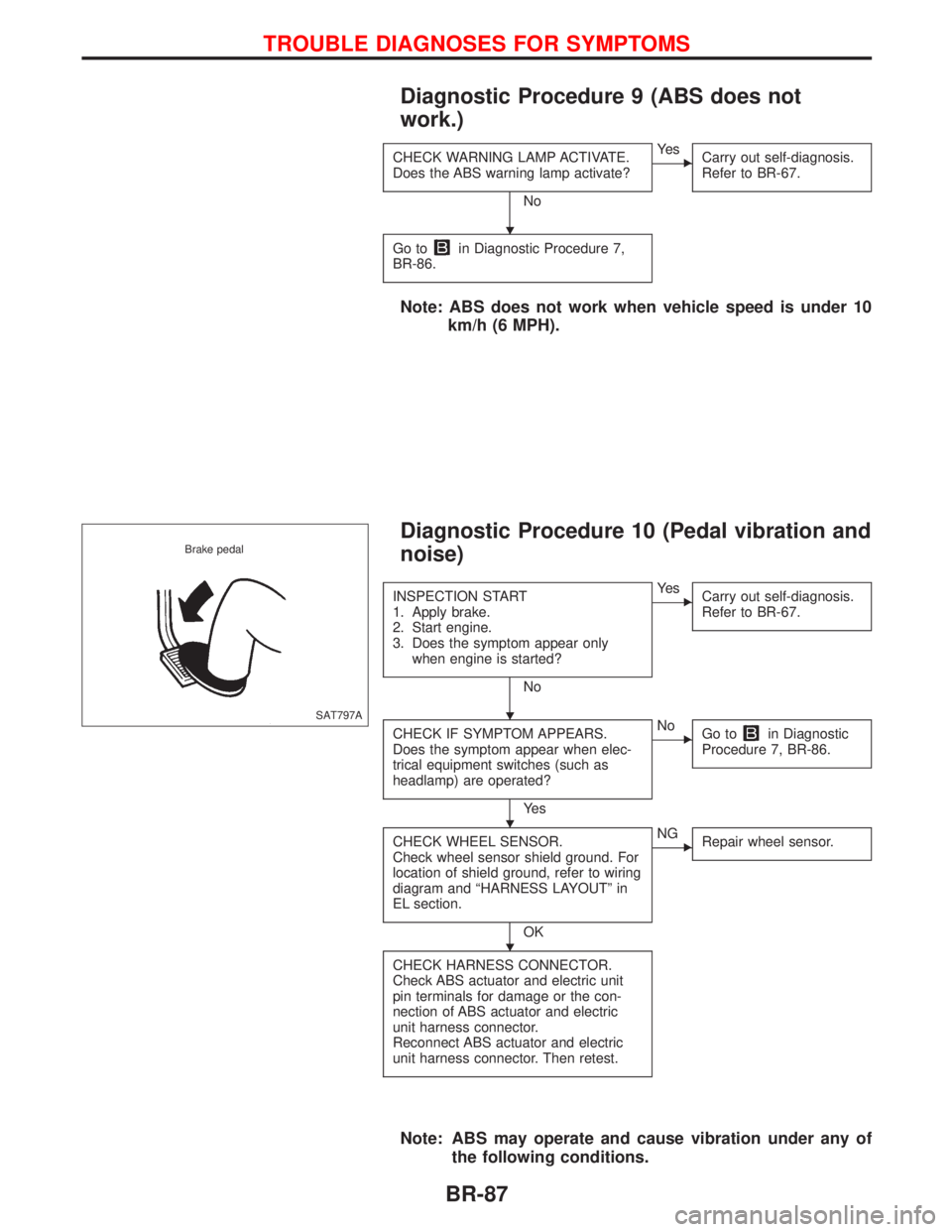
SAT797A Brake pedal
H
H
H
H
TROUBLE DIAGNOSES FOR SYMPTOMS
BR-87