sensor NISSAN PRIMERA 1999 Electronic Repair Manual
[x] Cancel search | Manufacturer: NISSAN, Model Year: 1999, Model line: PRIMERA, Model: NISSAN PRIMERA 1999Pages: 2267, PDF Size: 35.74 MB
Page 1039 of 2267
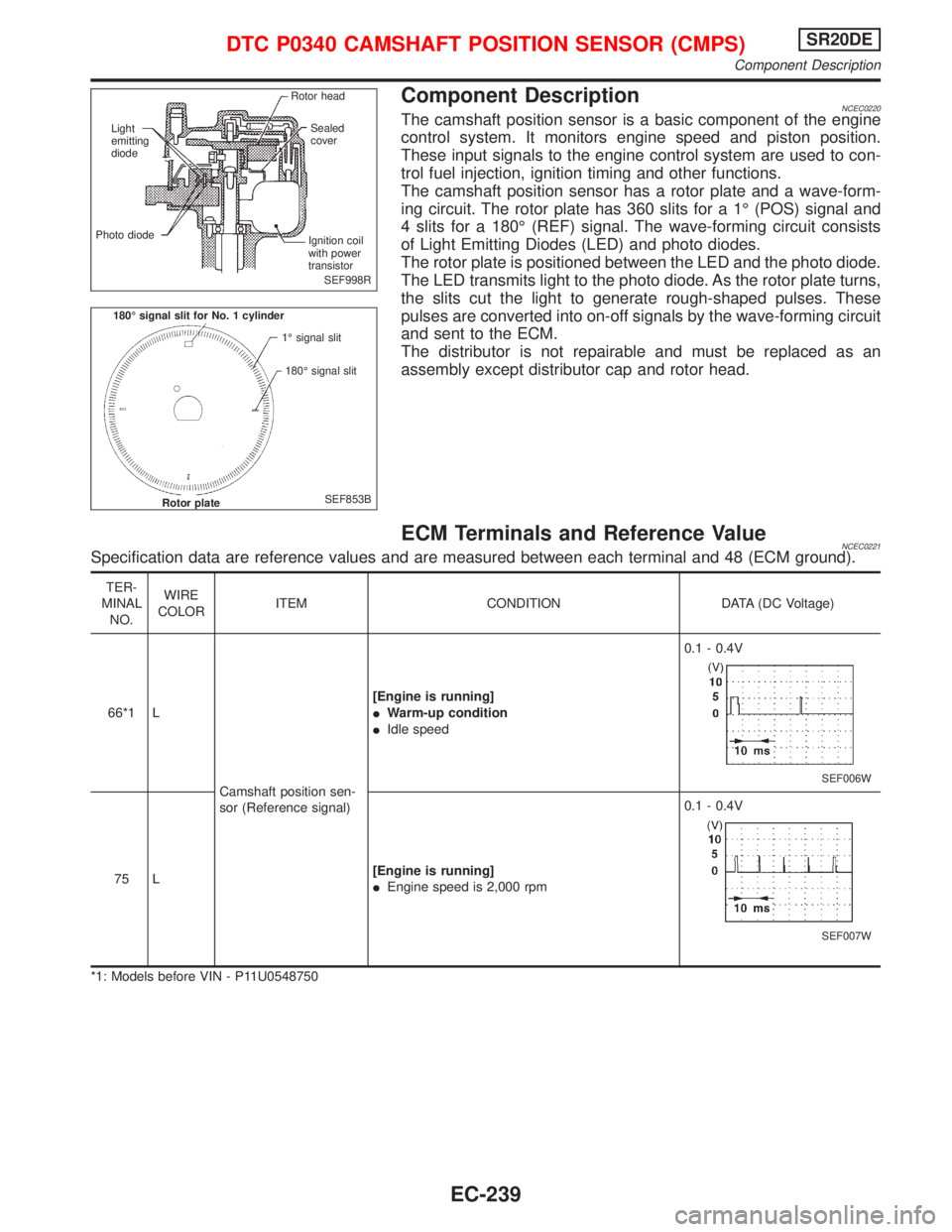
Component DescriptionNCEC0220The camshaft position sensor is a basic component of the engine
control system. It monitors engine speed and piston position.
These input signals to the engine control system are used to con-
trol fuel injection, ignition timing and other functions.
The camshaft position sensor has a rotor plate and a wave-form-
ing circuit. The rotor plate has 360 slits for a 1É (POS) signal and
4 slits for a 180É (REF) signal. The wave-forming circuit consists
of Light Emitting Diodes (LED) and photo diodes.
The rotor plate is positioned between the LED and the photo diode.
The LED transmits light to the photo diode. As the rotor plate turns,
the slits cut the light to generate rough-shaped pulses. These
pulses are converted into on-off signals by the wave-forming circuit
and sent to the ECM.
The distributor is not repairable and must be replaced as an
assembly except distributor cap and rotor head.
ECM Terminals and Reference ValueNCEC0221Specification data are reference values and are measured between each terminal and 48 (ECM ground).
TER-
MINAL
NO.WIRE
COLORITEM CONDITION DATA (DC Voltage)
66*1 L
Camshaft position sen-
sor (Reference signal)[Engine is running]
IWarm-up condition
IIdle speed0.1 - 0.4V
SEF006W
75 L[Engine is running]
IEngine speed is 2,000 rpm0.1 - 0.4V
SEF007W
*1: Models before VIN - P11U0548750
SEF998R Rotor head
Sealed
cover
Ignition coil
with power
transistor Light
emitting
diode
Photo diode
SEF853B 180É signal slit for No. 1 cylinder
1É signal slit
180É signal slit
Rotor plate
DTC P0340 CAMSHAFT POSITION SENSOR (CMPS)SR20DE
Component Description
EC-239
Page 1040 of 2267
![NISSAN PRIMERA 1999 Electronic Repair Manual TER-
MINAL
NO.WIRE
COLORITEM CONDITION DATA (DC Voltage)
85 B/WCamshaft position sen-
sor (Position signal)[Engine is running]
IWarm-up condition
IIdle speedApproximately 2.5V
0.2 ms
SEF004W
[Engine i](/img/5/57377/w960_57377-1039.png "NISSAN PRIMERA 1999 Electronic Repair Manual TER-
MINAL
NO.WIRE
COLORITEM CONDITION DATA (DC Voltage)
85 B/WCamshaft position sen-
sor (Position signal)[Engine is running]
IWarm-up condition
IIdle speedApproximately 2.5V
0.2 ms
SEF004W
[Engine i")
TER-
MINAL
NO.WIRE
COLORITEM CONDITION DATA (DC Voltage)
85 B/WCamshaft position sen-
sor (Position signal)[Engine is running]
IWarm-up condition
IIdle speedApproximately 2.5V
0.2 ms
SEF004W
[Engine is running]
IEngine speed is 2,000 rpmApproximately 2.4V
0.2 ms
SEF005W
On Board Diagnosis LogicNCEC0222
DTC No. Malfunction is detected when ... Check Items (Possible Cause)
P0340
0340A) Either 1É or 180É signal is not sent to ECM for the
first few seconds during engine cranking.IHarness or connectors
(The camshaft position sensor circuit is open or
shorted.)
ICamshaft position sensor
IStarter motor (Refer to EL section.)
IStarting system circuit (Refer to EL section.)
IDead (Weak) battery B) Either 1É or 180É signal is not sent to ECM often
enough while the engine speed is higher than the
specified engine speed.
C) The relation between 1É and 180É signal is not in
the normal range during the specified engine speed.
DTC Confirmation ProcedureNCEC0223Perform ªProcedure for malfunction Aº first. If DTC cannot be
confirmed, perform ªProcedure for malfunction B and Cº.
NOTE:
If ªDTC Confirmation Procedureº has been previously conducted,
always turn ignition switch ªOFFº and wait at least 9 seconds
before conducting the next test.
TESTING CONDITION:
Before performing the following procedure, confirm that bat-
tery voltage is more than 10.5V.
PROCEDURE FOR MALFUNCTION ANCEC0223S01With CONSULT-II
1) Turn ignition switch ªONº.
2) Select ªDATA MONITORº mode with CONSULT-II.
3) Crank engine for at least 2 seconds.
4) If 1st trip DTC is detected, go to ªDiagnostic Procedureº, EC-
SR-243.
With GST
Follow the procedure ªWith CONSULT-IIº above.
NEF068A
DTC P0340 CAMSHAFT POSITION SENSOR (CMPS)SR20DE
ECM Terminals and Reference Value (Cont'd)
EC-240
Page 1041 of 2267
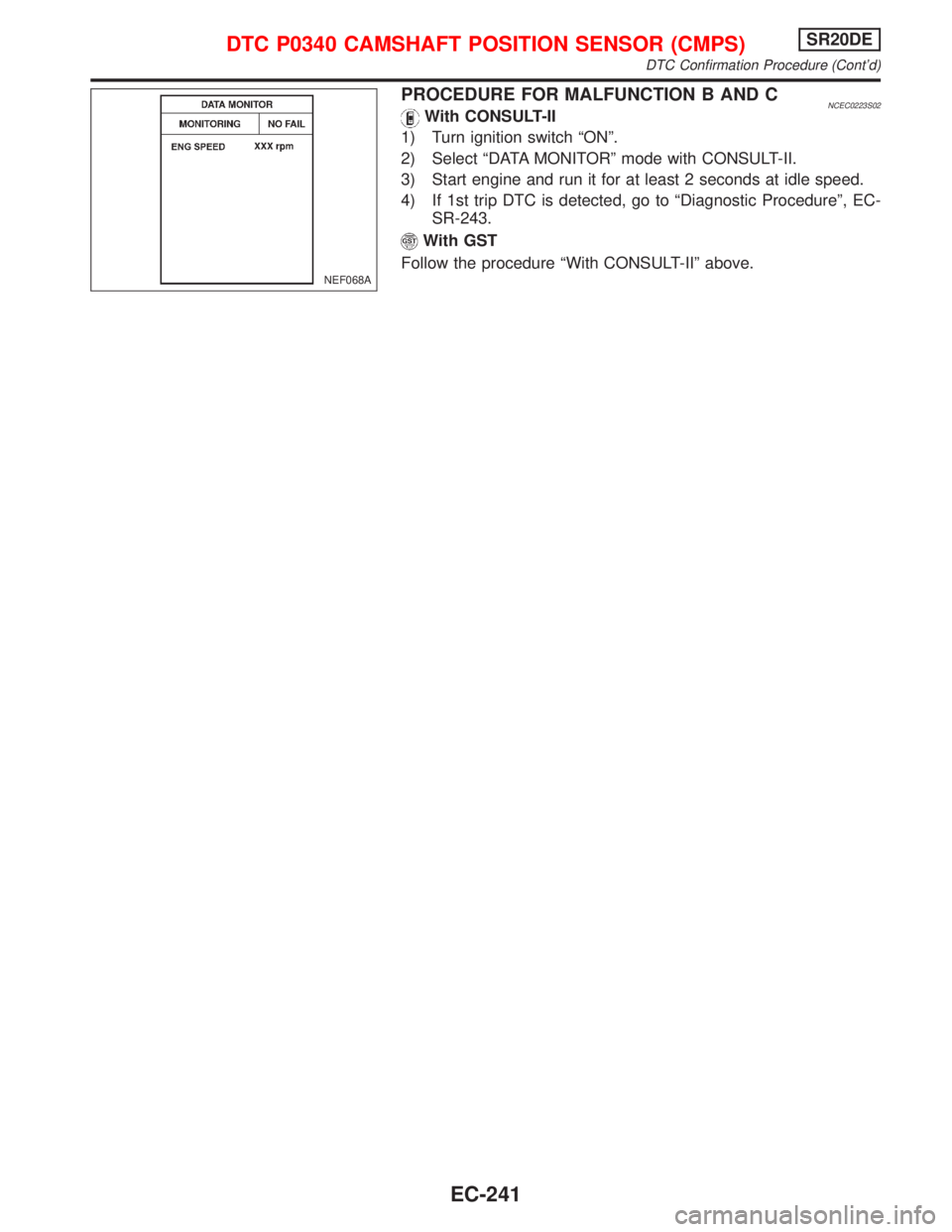
PROCEDURE FOR MALFUNCTION B AND CNCEC0223S02With CONSULT-II
1) Turn ignition switch ªONº.
2) Select ªDATA MONITORº mode with CONSULT-II.
3) Start engine and run it for at least 2 seconds at idle speed.
4) If 1st trip DTC is detected, go to ªDiagnostic Procedureº, EC-
SR-243.
With GST
Follow the procedure ªWith CONSULT-IIº above.
NEF068A
DTC P0340 CAMSHAFT POSITION SENSOR (CMPS)SR20DE
DTC Confirmation Procedure (Cont'd)
EC-241
Page 1042 of 2267

Wiring DiagramNCEC0224
YEC090A
DTC P0340 CAMSHAFT POSITION SENSOR (CMPS)SR20DE
Wiring Diagram
EC-242
Page 1043 of 2267
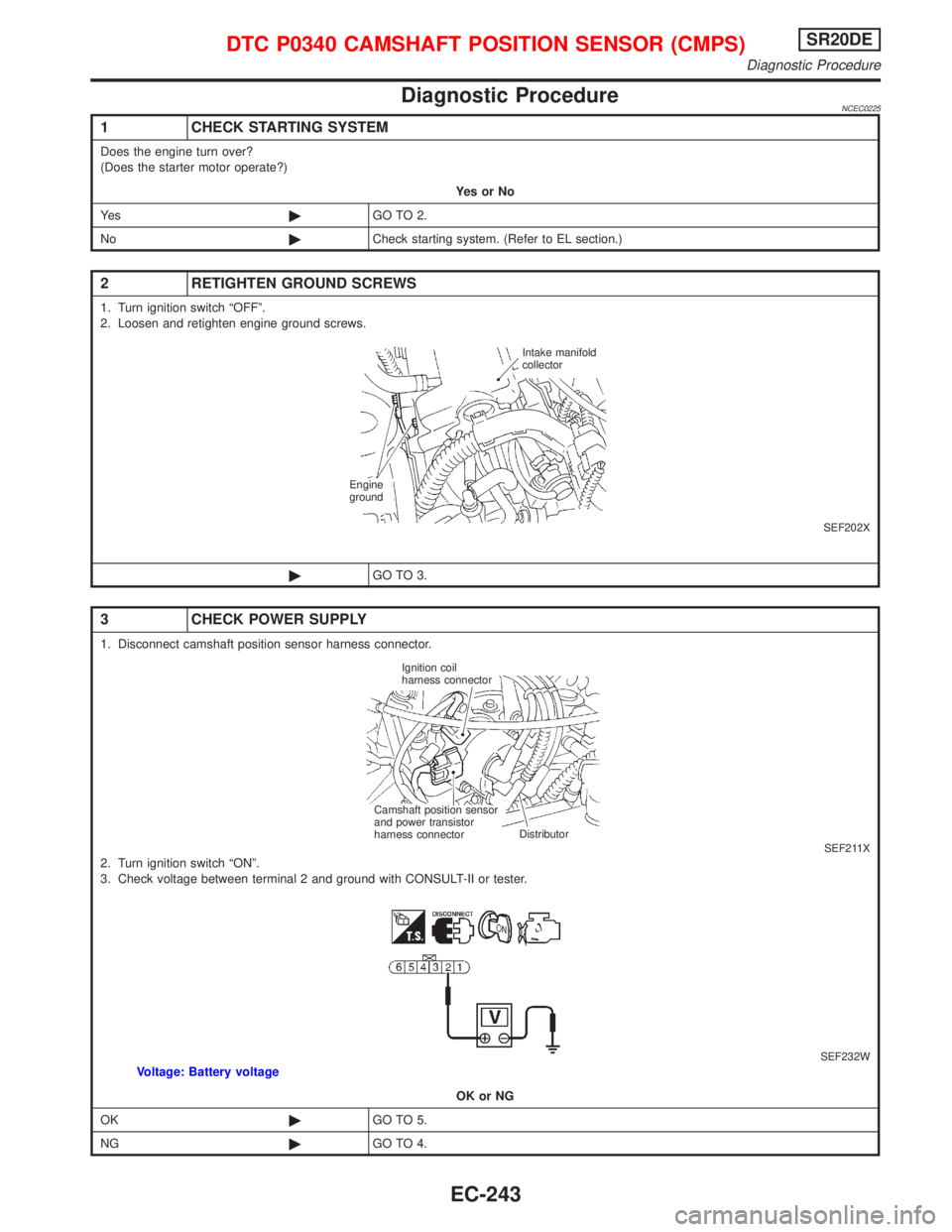
Diagnostic ProcedureNCEC0225
1 CHECK STARTING SYSTEM
Does the engine turn over?
(Does the starter motor operate?)
YesorNo
Ye s©GO TO 2.
No©Check starting system. (Refer to EL section.)
2 RETIGHTEN GROUND SCREWS
1. Turn ignition switch ªOFFº.
2. Loosen and retighten engine ground screws.
SEF202X
©GO TO 3.
3 CHECK POWER SUPPLY
1. Disconnect camshaft position sensor harness connector.
SEF211X2. Turn ignition switch ªONº.
3. Check voltage between terminal 2 and ground with CONSULT-II or tester.
SEF232WVoltage: Battery voltage
OK or NG
OK©GO TO 5.
NG©GO TO 4.
Intake manifold
collector
Engine
ground
Ignition coil
harness connector
Distributor Camshaft position sensor
and power transistor
harness connector
DTC P0340 CAMSHAFT POSITION SENSOR (CMPS)SR20DE
Diagnostic Procedure
EC-243
Page 1044 of 2267
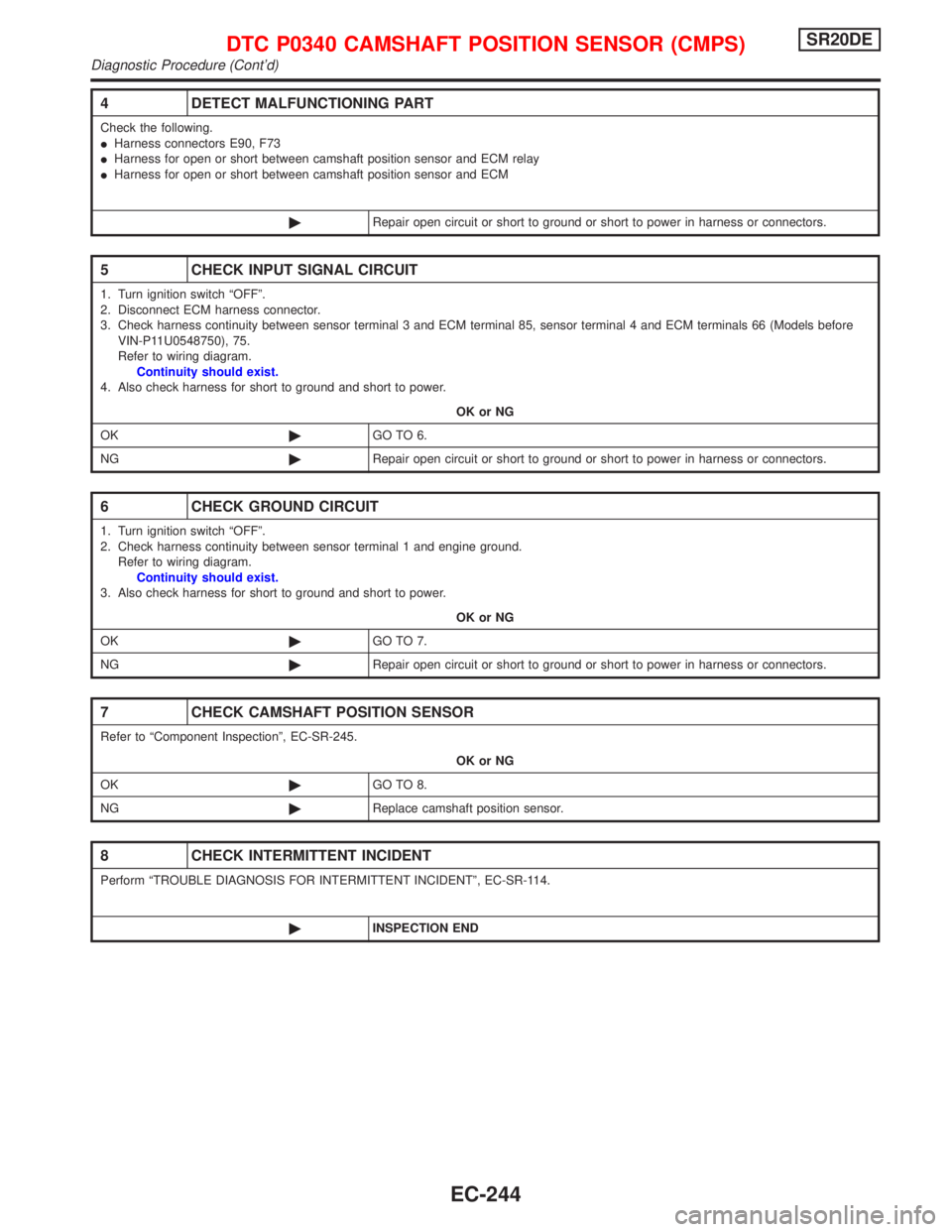
4 DETECT MALFUNCTIONING PART
Check the following.
IHarness connectors E90, F73
IHarness for open or short between camshaft position sensor and ECM relay
IHarness for open or short between camshaft position sensor and ECM
©Repair open circuit or short to ground or short to power in harness or connectors.
5 CHECK INPUT SIGNAL CIRCUIT
1. Turn ignition switch ªOFFº.
2. Disconnect ECM harness connector.
3. Check harness continuity between sensor terminal 3 and ECM terminal 85, sensor terminal 4 and ECM terminals 66 (Models before
VIN-P11U0548750), 75.
Refer to wiring diagram.
Continuity should exist.
4. Also check harness for short to ground and short to power.
OK or NG
OK©GO TO 6.
NG©Repair open circuit or short to ground or short to power in harness or connectors.
6 CHECK GROUND CIRCUIT
1. Turn ignition switch ªOFFº.
2. Check harness continuity between sensor terminal 1 and engine ground.
Refer to wiring diagram.
Continuity should exist.
3. Also check harness for short to ground and short to power.
OK or NG
OK©GO TO 7.
NG©Repair open circuit or short to ground or short to power in harness or connectors.
7 CHECK CAMSHAFT POSITION SENSOR
Refer to ªComponent Inspectionº, EC-SR-245.
OK or NG
OK©GO TO 8.
NG©Replace camshaft position sensor.
8 CHECK INTERMITTENT INCIDENT
Perform ªTROUBLE DIAGNOSIS FOR INTERMITTENT INCIDENTº, EC-SR-114.
©INSPECTION END
DTC P0340 CAMSHAFT POSITION SENSOR (CMPS)SR20DE
Diagnostic Procedure (Cont'd)
EC-244
Page 1045 of 2267
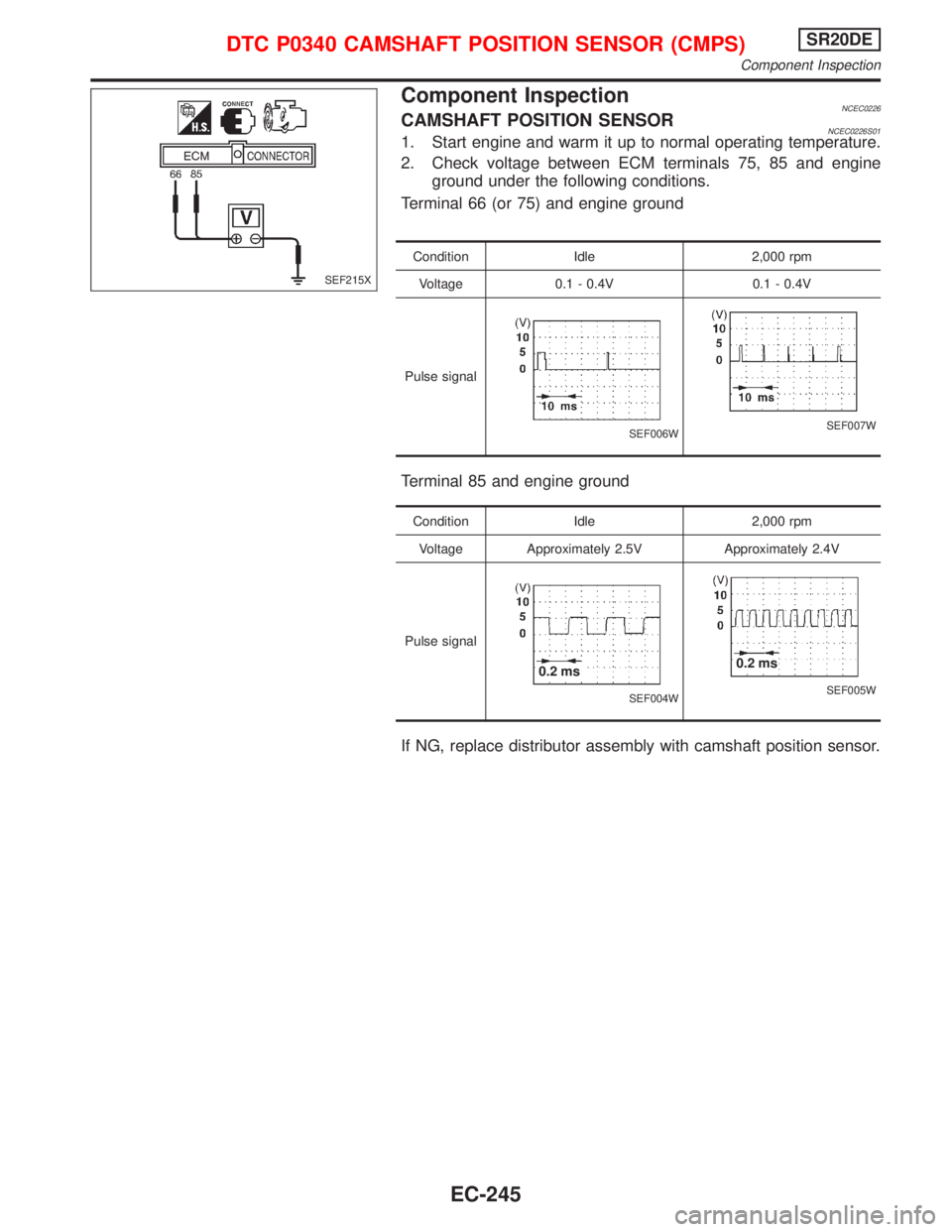
Component InspectionNCEC0226CAMSHAFT POSITION SENSORNCEC0226S011. Start engine and warm it up to normal operating temperature.
2. Check voltage between ECM terminals 75, 85 and engine
ground under the following conditions.
Terminal 66 (or 75) and engine ground
Condition Idle 2,000 rpm
Voltage 0.1 - 0.4V 0.1 - 0.4V
Pulse signal
SEF006WSEF007W
Terminal 85 and engine ground
Condition Idle 2,000 rpm
Voltage Approximately 2.5V Approximately 2.4V
Pulse signal
SEF004W
0.2 ms
SEF005W
0.2 ms
If NG, replace distributor assembly with camshaft position sensor.
SEF215X
DTC P0340 CAMSHAFT POSITION SENSOR (CMPS)SR20DE
Component Inspection
EC-245
Page 1046 of 2267
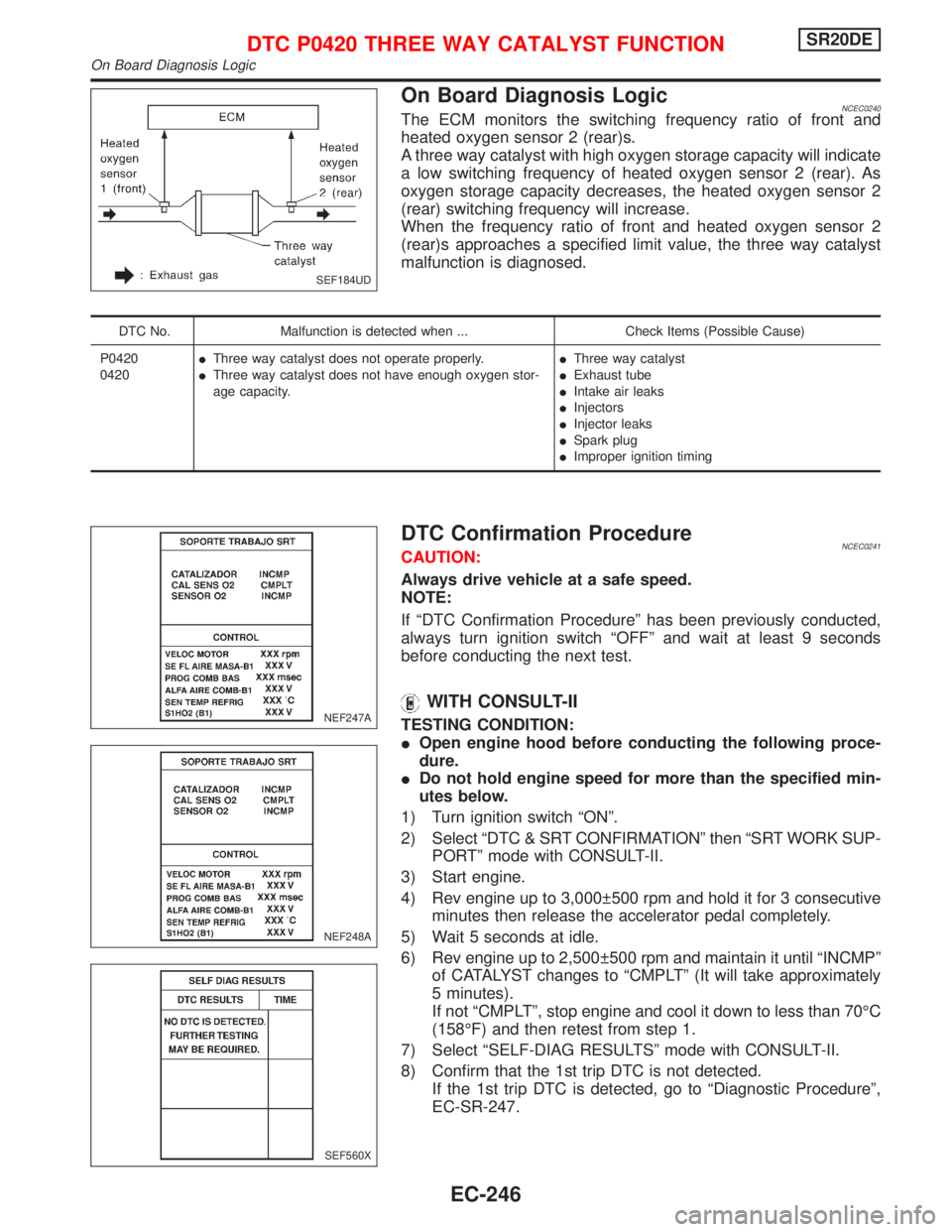
On Board Diagnosis LogicNCEC0240The ECM monitors the switching frequency ratio of front and
heated oxygen sensor 2 (rear)s.
A three way catalyst with high oxygen storage capacity will indicate
a low switching frequency of heated oxygen sensor 2 (rear). As
oxygen storage capacity decreases, the heated oxygen sensor 2
(rear) switching frequency will increase.
When the frequency ratio of front and heated oxygen sensor 2
(rear)s approaches a specified limit value, the three way catalyst
malfunction is diagnosed.
DTC No. Malfunction is detected when ... Check Items (Possible Cause)
P0420
0420IThree way catalyst does not operate properly.
IThree way catalyst does not have enough oxygen stor-
age capacity.IThree way catalyst
IExhaust tube
IIntake air leaks
IInjectors
IInjector leaks
ISpark plug
IImproper ignition timing
DTC Confirmation ProcedureNCEC0241CAUTION:
Always drive vehicle at a safe speed.
NOTE:
If ªDTC Confirmation Procedureº has been previously conducted,
always turn ignition switch ªOFFº and wait at least 9 seconds
before conducting the next test.
WITH CONSULT-II
TESTING CONDITION:
IOpen engine hood before conducting the following proce-
dure.
IDo not hold engine speed for more than the specified min-
utes below.
1) Turn ignition switch ªONº.
2) Select ªDTC & SRT CONFIRMATIONº then ªSRT WORK SUP-
PORTº mode with CONSULT-II.
3) Start engine.
4) Rev engine up to 3,000 500 rpm and hold it for 3 consecutive
minutes then release the accelerator pedal completely.
5) Wait 5 seconds at idle.
6) Rev engine up to 2,500 500 rpm and maintain it until ªINCMPº
of CATALYST changes to ªCMPLTº (It will take approximately
5 minutes).
If not ªCMPLTº, stop engine and cool it down to less than 70ÉC
(158ÉF) and then retest from step 1.
7) Select ªSELF-DIAG RESULTSº mode with CONSULT-II.
8) Confirm that the 1st trip DTC is not detected.
If the 1st trip DTC is detected, go to ªDiagnostic Procedureº,
EC-SR-247.
SEF184UD
NEF247A
NEF248A
SEF560X
DTC P0420 THREE WAY CATALYST FUNCTIONSR20DE
On Board Diagnosis Logic
EC-246
Page 1047 of 2267
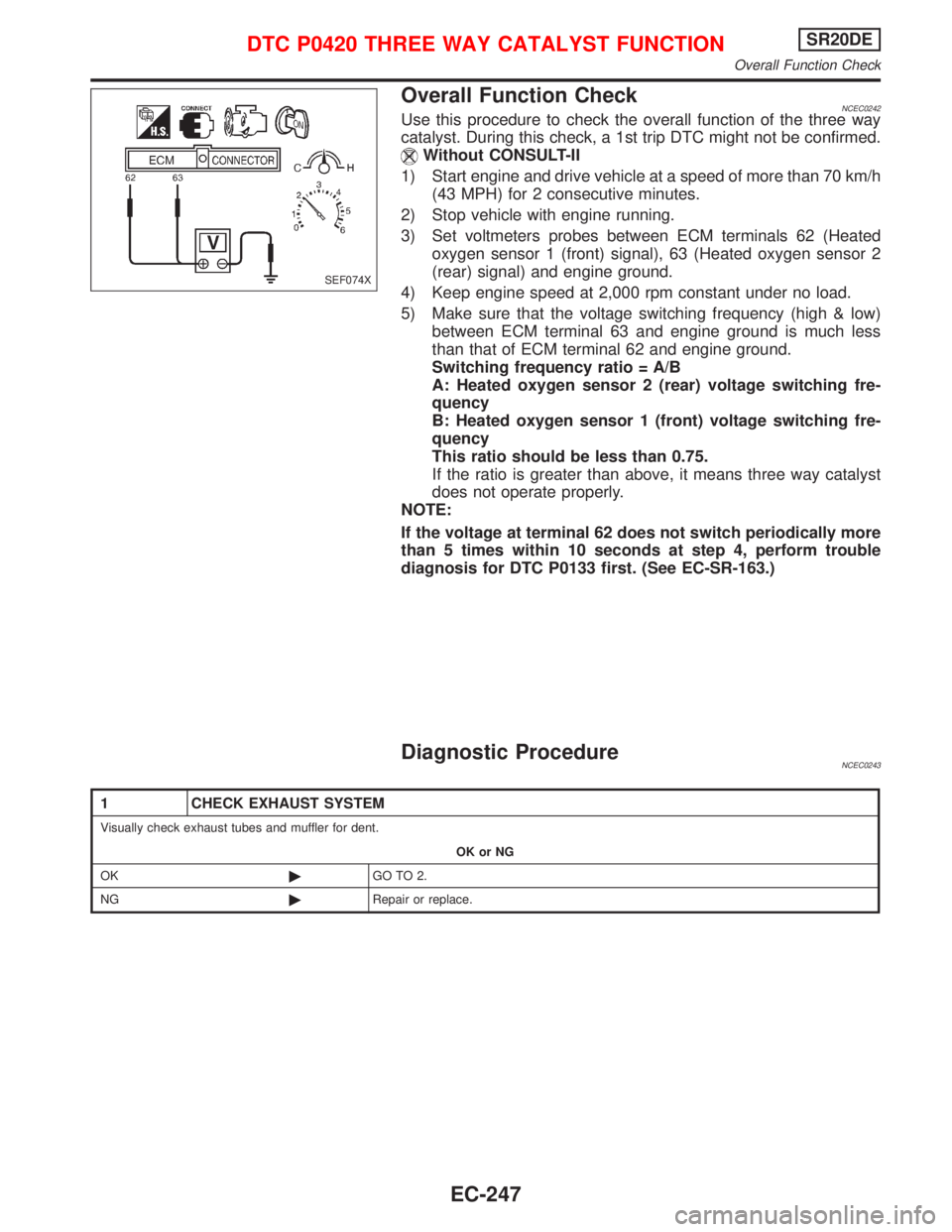
Overall Function CheckNCEC0242Use this procedure to check the overall function of the three way
catalyst. During this check, a 1st trip DTC might not be confirmed.
Without CONSULT-II
1) Start engine and drive vehicle at a speed of more than 70 km/h
(43 MPH) for 2 consecutive minutes.
2) Stop vehicle with engine running.
3) Set voltmeters probes between ECM terminals 62 (Heated
oxygen sensor 1 (front) signal), 63 (Heated oxygen sensor 2
(rear) signal) and engine ground.
4) Keep engine speed at 2,000 rpm constant under no load.
5) Make sure that the voltage switching frequency (high & low)
between ECM terminal 63 and engine ground is much less
than that of ECM terminal 62 and engine ground.
Switching frequency ratio = A/B
A: Heated oxygen sensor 2 (rear) voltage switching fre-
quency
B: Heated oxygen sensor 1 (front) voltage switching fre-
quency
This ratio should be less than 0.75.
If the ratio is greater than above, it means three way catalyst
does not operate properly.
NOTE:
If the voltage at terminal 62 does not switch periodically more
than 5 times within 10 seconds at step 4, perform trouble
diagnosis for DTC P0133 first. (See EC-SR-163.)
Diagnostic ProcedureNCEC0243
SEF074X
1 CHECK EXHAUST SYSTEM
Visually check exhaust tubes and muffler for dent.
OK or NG
OK©GO TO 2.
NG©Repair or replace.
DTC P0420 THREE WAY CATALYST FUNCTIONSR20DE
Overall Function Check
EC-247
Page 1048 of 2267
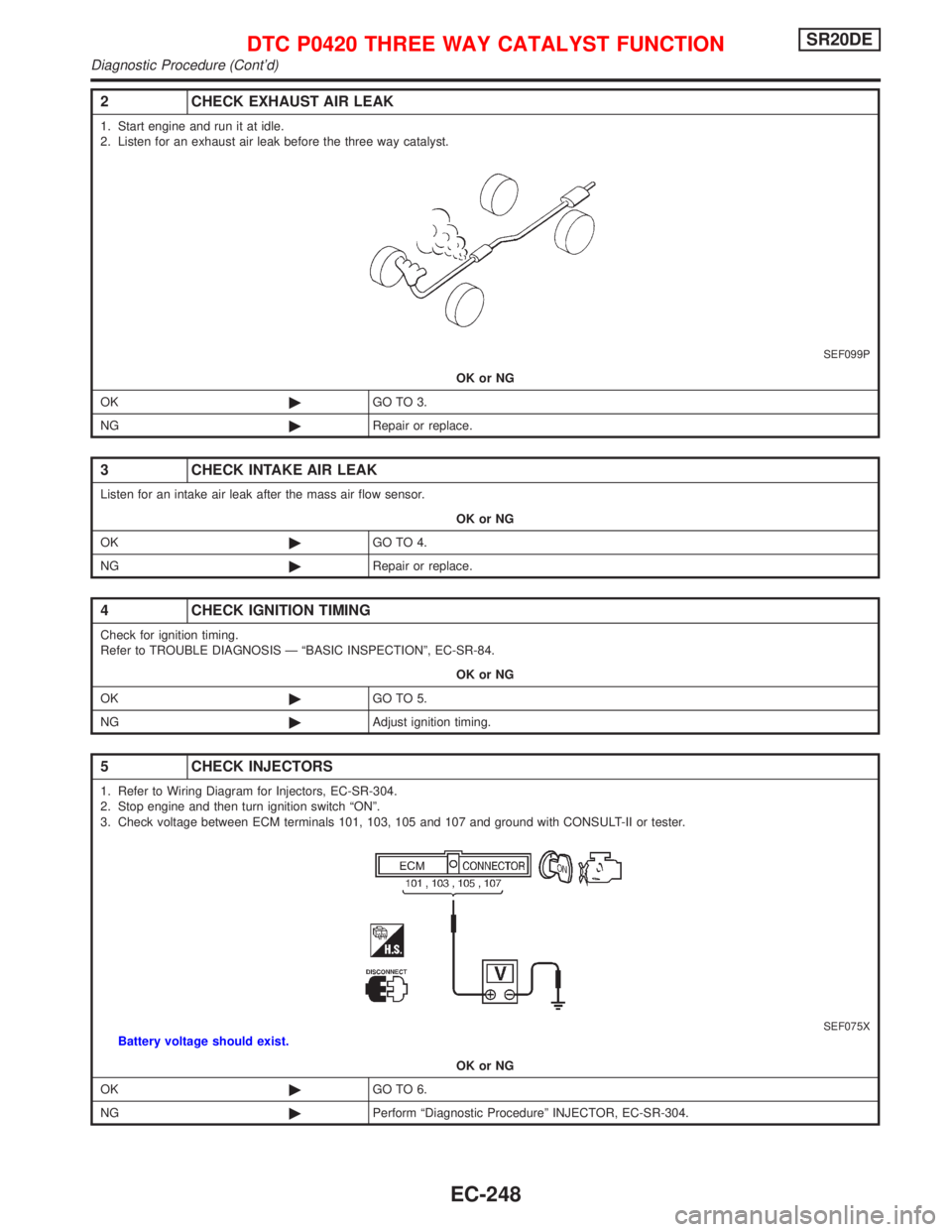
2 CHECK EXHAUST AIR LEAK
1. Start engine and run it at idle.
2. Listen for an exhaust air leak before the three way catalyst.
SEF099P
OK or NG
OK©GO TO 3.
NG©Repair or replace.
3 CHECK INTAKE AIR LEAK
Listen for an intake air leak after the mass air flow sensor.
OK or NG
OK©GO TO 4.
NG©Repair or replace.
4 CHECK IGNITION TIMING
Check for ignition timing.
Refer to TROUBLE DIAGNOSIS Ð ªBASIC INSPECTIONº, EC-SR-84.
OK or NG
OK©GO TO 5.
NG©Adjust ignition timing.
5 CHECK INJECTORS
1. Refer to Wiring Diagram for Injectors, EC-SR-304.
2. Stop engine and then turn ignition switch ªONº.
3. Check voltage between ECM terminals 101, 103, 105 and 107 and ground with CONSULT-II or tester.
SEF075XBattery voltage should exist.
OK or NG
OK©GO TO 6.
NG©Perform ªDiagnostic Procedureº INJECTOR, EC-SR-304.
DTC P0420 THREE WAY CATALYST FUNCTIONSR20DE
Diagnostic Procedure (Cont'd)
EC-248