lock NISSAN PULSAR 1987 Repair Manual
[x] Cancel search | Manufacturer: NISSAN, Model Year: 1987, Model line: PULSAR, Model: NISSAN PULSAR 1987Pages: 238, PDF Size: 28.91 MB
Page 151 of 238

Steering — Part 2 151
(8) Slide the rack out of the housing slightly so
that an adjustable spanner can be used to hold the
rack. (9) Using a Stillsons wrench, unscrew the ball
housings in turn using care not to allow the rack to
rotate. Keep all the tie rod parts in order. (10) Inspect the rack boots for cracks and deteri-
oration and renew as necessary. (11) Inspect the tie rod ends for wear and damage
and renew as necessary.
Dismantled view of the tie rod ball housing and the tie
rod end assemblies removed from the steering gear.
Assembly is a reversal of the dismantling proce-
dure with attention to the following points:
(1) Using large Stillsons and a large adjustable
spanner, install the tie rod and ball housing
assemblies
to the rack. Tighten the ball housings to the specified
torque.
NOTE: To avoid damage to the rack or
pinion the adjustable spanner must be
firmly tightened over the rack teeth and the
rack must not be allowed to rotate when
installing the ball housings.
(2) Measure a point 9 mm in from the rear face
of the ball housing of the rack and at 90 deg to the
rack teeth. Centre punch this point.
(3) At this point drill a 4 mm hole, 10 mm deep
through the rack and into the ball housing thread.
(4) Place a locking pin above the hole and drive
it into position.
(5) Lubricate the rack, rack teeth and t i e rod
boot groove with suitable EPL 1 grease. (6) Install the rack boots and secure with the
clamps. Renew the clamps if necessary. (7) Install the tie rod end locknuts and then the
tie rod ends, ensuring that they are screwed on the
same number of turns as was necessary to remove
them.
(8) Tighten the locknuts to the specified torque.
(9) Install the mounting rubbers and brackets
to
the steering gear as noted on removal. (10) Install the steering gear assembly to
the
vehicle as previously described. (11) Check and if necessary adjust the front wheel toe in as described in the Front Suspension section
under the appropriate heading.
TO RENEW TIE ROD END
(1)
Raise the front of the vehicle and support it
on chassis stands. (2) Remove the relevant front wheel.
(3) Loosen the tie rod end locknut and remove
the tie rod end castellated nut. Disconnect the tie rod
from the steering arm by plac ing a suitable dolly or
hammer against one side of the steering arm eye and
striking the opposite side with a hammer. (4) Unscrew the tie rod end from the tie rod,
noting the number of turns necessary to remove it.
(5) Screw the new tie rod end onto the t i e rod
the same number of turn s noted during removal.
(6) Connect the t i e rod to the steering arm and
install the castellated nut. Tighten the nut to the
specified torque and secure it with a new split pin.
(7) Install the front wheel and lower the vehicle
to the ground. (8) Check and if necessary, adjust the front
wheel toe in as described in the Front Suspension
section. Ensure that the rubber boots are not distorted
or twisted on the tie rod when the adjustment is
completed.
TO RENEW RUBBER BOOT
(1) Raise the front of the vehicle and support it
on chassis stands. (2) Remove the relevant t i e rod end as previ-
ously described. (3) Release the clamps securi ng the boot to the
tie rod and steering gear housing. (4) Unscrew and remove the locknut from the
tie rod. (5) Remove the rubber boot together with the
outer retaining clamp from the t i e rod. (6) Sparingly lubricate th e tie rod boot groove
with EPL 1 grease, install the new boot to the t i e
rod
and push it onto the steering gear rack housing. Install
and secure the inner and outer retaining clamps.
(7) Install the tie rod end locknut and screw
the
tie rod end onto the tie ro d the same number of turns
noted during removal. (8) Connect the tie rod to the steering arm and
install the castellated nut. Tighten the nut to the
specified torque and secure it with a new split pin. (9) Install the wheel and lower the vehicle to the
ground. (10) Check and if necessary, adjust the front
wheel toe in as described in the Front Suspension
section. Ensure that the rubber boots are not distorted
or twisted when the adjustment is completed.
Page 152 of 238

152
PART 3. POWER STEERING
SPECIFICATIONS
Steering gear type ................Rack and pinion with
integral power cylinder
Steering column type .................... Energy absorbing
collapsible and lilt adjustable
Steering wheel free play ................................. 35 mm
Number of turns lock to lock:
TRW ...............................................................2.82
PR24SA ........................................................... 2.7
Linkage.....................................Direct from rack ends
to ti e rods and steering knuckles
Power steering pump
maximum pr essure.................................... 6 865 kPa
Lubricant ...................................................... Dexron II
TORQUE WRENCH SETTINGS
Steering gear to bulkhead mounting bolts... 108 Nm
Tie rod to steering knuckle nut ...................... 98 Nm
Tie rod to tie rod end locknut....................... 98 Nm
Tie rod ball housing to rack............................ 88 Nm
Power steering pump pulley nut ..................... 68 Nm
1. DESCRIPTION
The vehicles covered by this manual are equipped
with either a TRW power steering system or a
Japanese PR24SA power steering system.
Both types are similar in construction and appear-
ance.
The power steering is a rack and pinion type
which is mounted on the lower section of the engine
compartment bulkhead by rubber mountings and
brackets.
Hydraulic pressure is supplied to the power
steering gear by a pump driven by a drive belt from
the engine.
The power steering pump has a separate fluid
reservoir located on the righ t side of the bulkhead.
No lubrication of the steering gear or steering
pump is required in service and in the event of the
loss of power assistance, the steering will continue to
operate but will require a greatly increased effort.
However, as the steering gear and pump are lubricated
by the power steering fluid, the cause of the loss of
power steering or fluid loss must be determined and
repaired promptly to prevent damage to the steering
pump and to a lesser extent, the steering gear.
The t i e rod ends and rubb er boots can be renewed
without removing the steering gear from the vehicle.
To renew the integral t i e rod and tie rod ball housings,
the steering gear must be removed.
As specialist knowledge and equipment are re-
quired to overhaul the power steering gear and the
hydraulic pump, it is recommended that these op-
erations be carried out by an authorized dealer.
However, procedures for the removal and installa-
tion of the steering gear and pump are fully de-
scribed in this section.
The steering column is of the energy absorbing
type and is designed to collapse in the event of a
severe front end collision. The energy absorbing com-
ponents are the column tu bes, steering shaft and tilt
bracket breakaway capsules. All these components
should be handled with extr eme care if service opera-
tions are to be carried out on the steering column
assembly.
2. IN CAR ADJUSTMENTS, CHECKS AND
MINOR REPAIRS
If the power steering system becomes partially or
fully inoperative it is most important that the follow-
ing preliminary inspection and testing procedure be
performed prior to undertaking any trouble shooting
or repair operations.
PUMP DRIVE BELT
Inspect the pump drive belt for breakage, glazing
or wear. If any of these characteristics are evident,
renew the belt using only a genuine replacement.
If the belt is loose but still serviceable, adjust it
using the procedure outlined in the Engine Tune-up
section.
NOTE: In most cases a loose drive belt can
be heard squealing when a load is placed on
the pump as the steering wheel is turned or
as the engine speed is increased.
Checking the power steering pump drive belt for
deterioration.
Page 153 of 238

Steering — Part 3 153
TO CHECK FLUID LEVEL
Check the fluid level in the power steering reser-
voir when the fluid is cold.
If it is necessary to top up the fluid, fill to between
the arrow marks on the dipstick using the recom-
mended fluid.
NOTE: Do not overfill the reservoir.
Checking the power steering fluid level using the
dipstick incorporated in the cap.
TO CHECK FOR FLUID LEAKS
Using a suitable solvent, clean around all power
steering assemblies and hose fittings where fluid
leakage might occur and start the engine. Turn the
steering wheel from one steering lock to the other
several times and stop the engine. Check for leakage.
Where leakage is found at ho se fittings, tighten and
recheck.
If the leak remains, renew the hoses or fittings as
required.
Where leakage is found in the steering gear
assembly or pump assembly, specialist attention is
necessary.
TO CHECK STEERING WHEEL FREE PLAY
With the engine running and the steering wheel in
the straight ahead positi on, measure the free move-
ment of the steering wheel before the front wheels
move. This is specified as steering wheel free play and
if it exceeds Specifications, check for free play in the
steering linkages and the universal coupling joints. If
these components are satisfactory, it will be necessary
to remove the steering gear from the vehicle for
renewal or overhaul.
PUMP BELT TENSION
The procedure for adjusting the power steering
pump bell tension is describe d in the Engine Tune-up
section
TO PURGE THE POWER STEERING SYSTEM
OF AIR
(1) Check that the pump reservoir is filled to the
correct mark on the dipstick. (2) Raise the front of the vehicle and support it
on chassis stands. (3) Turn the steering wheel quickly from lock to
lock several times, recheck the fluid level within the
pump reservoir and top up if required. (4) Start the engine, allow it to idle and slowly
turn the steering wheel from lock to lock several times.
Do not hold the steering at full lock for more than 15
seconds. (5) Check the fluid level in the pump reservoir,
top up if necessary. (6) If the fluid is aerated within the pump
reservoir or if pump noise persists, repeat operations
(3) to (6).
3. STEERING WHEEL
The procedure for removing and installing the
steering wheel is fully covered in the Manual Steering
section under the above heading.
4. STEERING COLUMN
The procedure for removing, dismantling and
assembling the steering column is fully covered in the
Manual Steering section under the above heading.
5. POWER STEERING PUMP
TO REMOVE AND INSTAL
( 1 ) Disconnect the negative battery terminal.
View of the power steering pump removed from the
vehicle.
Page 154 of 238

154 Steering —
(2) Remove the air inlet duct from the air
cleaner and throttle body. (3) Position a container or a piece of cloth
beneath the steering pump reservoir and disconnect
the fluid return and power steering pump supply hose
from the reservoir.
(4) Loosen the steering pump drive belt as
described in the Engi ne Tune-up section.
(5) Loosen the return hose clamp and the supply
union and disconnect the hoses from the power
steering pump. Plug the hoses to prevent the loss of
fluid.
(6) Loosen the retaining bolts and withdraw the
pump. (7) Thoroughly clean the exterior of the steering
pump and inspect it for cracks, damage and signs of
leakage.
Installation is a reversal of the removal procedure
with attention to the following points:
(1) Install the pump and retaining bolts.
(2) Install the drive belt and adjust it as de-
scribed in the Engine Tune-up section. (3) Install the hoses to the power steering pump
and tighten securely. (4) Top up the pump reservoir and purge the
power steering system of air as previously described.
TO OVERHAUL
As specialist knowledge and equipment arc re-
quired to overhaul the power steering pump, it is
recommended that this operation be performed by an
authorized dealer or steering specialist.
6. POWER STEERING GEAR ASSEMBLY
Special Equipment Required:
To Renew Tie Rod Ball Housings — Large Still-
sons
TO REMOVE AND INSTAL
The procedures for removing and installing the
power steering gear are similar to those carried out in
the Manual Steering section under the Steering Gear
Assembly heading except fo r the following differences.
(1) Place a container under the pressure and
return pipes that are conn ected to the steering gear
valve housing. Remove the pipes and allow the fluid
to drain into the container. (2) Suitably seal the pipes and the steering gear
to prevent the entry of di rt whilst the pipes are
removed.
(3) Upon removal of the power steering gear,
thoroughly clean the steering gear except the tie rod
ends in a suitable solvent. Be careful not to allow the
solvent to enter the apertu res where the pressure and
return pipes were removed. (4) Check the pipes and co nnections for cracks,
damage or obstructions and renew as necessary.
Installed view of the power steering gear with the
engine removed.
Installation is a reversal of the removal procedure
with attention to the following points:
(1) Install the pressure and return pipes to the
steering gear valve housing and tighten securely. (2) Fill the power steering reservoir to the cor-
rect level and bleed the system as described previously
under the heading In Car Adjustments. Checks and
Minor Repairs. (3) Check all power steering pipe connections
for leaks and repair as necessary. (4) Check, and if necessary, adjust the front
wheel toe in as described in the Front Suspension
section. After adjustment ensure that the rubber boots
are not distorted or twisted and the rubber boot
clamps and clips are facing downward.
TO OVERHAUL
As specialist knowledge and equipment are re-
quired to overhaul the power steering gear, it is rec-
ommended that this opera tion be performed by an
authorized dealer or steering specialist.
TO RENEW TIE ROD BALL HOUSINGS
TRW Steering Gear
The renewal of the tie rod ball housings is the
same as for the manual steering gear. Refer to Part 2.
Manual Steering section.
PR24SA Steering Gear
(1) Remove the power steering gear assembly
from the vehicle as previously described.
(2) Carefully mount the power steering gear in a
vice equipped with soft jaws. Loosen the tie rod end
locknuts without disturbing the location of the tie rod
ends and unscrew the tie rod ends, taking note of the
number of turns required to remove them. Unscrew
and remove the locknuts from the tie rod. (3) Remove the clamps from the rubber boots
and remove the boots.
Page 155 of 238

Steering — Part 3 155
(4) Support the rack carefully and lever back the
tabs of the ball housing lock washers. To prevent
damage to the steering gear, avoid any impact to the
steering rack.
(5) Holding the rack with an adjustable spanner,
unscrew the ball housings from the rack using a
Stillsons wrench. Remove and discard the lock wash-
ers. Installation is a reversal of the removal procedure
with attention to the following points:
(1) Install the new lock washer to the
rack,
ensuring that the lockwasher tangs are located in the
rack end. (2) Install the ball housing as semblies to the rack.
Tighten the ball housings to the specified torque and
secure by bending the lock washer. (3) Before installing the rubber boots ensure that
the vent holes, located towards each end of the rack
near the ball housings, are clear. If necessary clear the
hole with a suitable probe. (4) Apply sealant to the la rge end of the rubber
boot and grease to the small end. and install the boots,
being careful not to damage or twist them. Secure the boots with the clamps and clip
s ensuring that the clips
are facing downwards.
(5) Install the t i e rod end locknuts and tie rod
ends to the t i e rod. Install the t i e rod ends the same
number of turns noted on removal. Tighten the lock-
nuts to the specified torque.
Install the power steerin g gear assembly to the
vehicle as described under the previous heading and
bleed the system as described under the heading In
Car Adjustments, Checks and Minor Repairs.
TO RENEW RUBBER BOOTS
The procedure to renew the rubber boots is fully
covered in the Manual Steering section under the
Steering Gear Assembly heading.
TO RENEW TIE ROD ENDS
The procedure to renew the t i e rod ends is fully
covered in the Manual Steering section under the
Steering Gear Assembly heading.
Page 156 of 238

156
FRONT SUSPENSION
SPECIFICATIONS
Type.................. Independent MacPherson strut with
coil springs and control arms
Shock absorber .................. Hydraulic, non-repairable
Hub bearing end float (maximum) ............. 0.05 mm
Ball joint axial play (maximum) ....................0.7 mm
Ball joint turning torque (used)...............0.5-4.9 Nm
Wheel alignment:
Toe in ..................................................... 0-2 mm
Camber ........................................- 0 ° 1 0 ' ± 4 5 '
Caster ..............................................1 ° 1 0 ' ± 4 5 '
King pin inclination..................... 1 3 ° 5 5 ' ± 4 5 '
TORQUE WRENCH SETTINGS
Hub bearing nut..................................... 196-235 Nm
Suspension unit to steering knuckle nut ...... 118 Nm
Suspension unit to body nuts ......................... 29 Nm
Piston rod nut .................................................. 72 Nm
Brake caliper to steering knuckle bolts ........... 52 Nm
Ball joint to steering knuckle bolt ................... 86 Nm
Control arm bracket bolts ............................... 98 Nm
Control arm pivot bolt ................................ 118 Nm
Stabiliser bar link nuts..................................... 44 Nm
Stabiliser bar bracket bolts .............................. 21 Nm
1. FRONT SUSPENSION TROUBLE
SHOOTING
FRONT END NOISE
(1) Loose upper suspension mounting or piston
rod: Tighten the mounting or piston rod nuts. (2) Loose or worn suspension unit lower ball
joint: Tighten or renew the lower ball joint.
(3) Noise in the suspension unit: Renew the
faulty suspension unit, preferably in pairs.
(4) Worn or loose steering gear: Overhaul the
steering gear assembly. (5) Worn front hub bearings: Renew the hub
bearings:
(6) Loose or defective stab ilizer bar, control arm
or mountings: Check, tighten or renew the mounting
rubbers.
Check the ball joints for wear and deterioration.
(7) Worn stabilizer bar link ball joints: Renew
the stabilizer bar links.
(8) Drive shafts worn or insufficiently lubri-
cated: Check the lubricant and the dust boots and
renew as necessary. (9) Drive shaft splines in the hub or the
differential worn or dama ged: Check and renew as
necessary.
NOTE: To check the front suspension com-
ponents for wear, raise the front of the
vehicle, support it on chassis stands and
allow both front wheel to hang free. With an
assistant pushing and pulling the front
wheels in and out at the top and then at the
bottom, check for excessive looseness at the
front hub bearings and lower control arm
inner pivot bushes. Noise or vibration in the
front end can also be caused by excessive
tire or wheel unbalance. Drive shaft joint
noise is usually more pronounced when
moving slowly with the steering on full lock.
POOR OR ERRATIC ROAD HOLDING
ABILITY
(1) Low or uneven tire pressures: Inflate the
tires to the recommended pressures.
(2) Defective suspension unit: Renew the faulty
unit, preferably in pairs.
Page 163 of 238
Front Suspension 163
(2) Ensure that the stabilizer bar links are in
good condition. Renew if necessary.
(3) When installing the stabilizer bar ensure that
the links are installed perpendicular to the control arm
with the ball joint socket face parallel to the end of the
stabilizer bar. (4) Ensure that the brackets are installed with
the flat portion facing towards the front of the vehicle.
Tighten the retaining bolts securely.
7. SUSPENSION AND STEERING ANGLES
ADJUSTMENT
NOTE: Extensive knowledge and special-
ised equipment are required to measure and
correct the suspension and steering angles
with the exception of the front wheel toe in.
Therefore, as it is not a viable proposition
for the average person to carry out a com-
plete wheel alignment, the vehicle should be
taken to a wheel alignment specialist.
Prior to carrying out a wheel alignment, a thor-
ough inspection of the steering linkage, front hub
bearings, ball joints and suspension units should be
carried out. Faulty components should be renewed or
repaired as necessary.
The tread of the front ti res should be examined
for excessive or uneven wear as certain conditions of
tire wear are indicative of damaged or worn compo-
nents in the suspension, stee ring linkage and/or wheels
and bearings. Refer to the heading Tire Wear Trouble
Shooting in the Wheels and Tires section. If the tires
are found to be defective, renew them with serviceable
lyres.
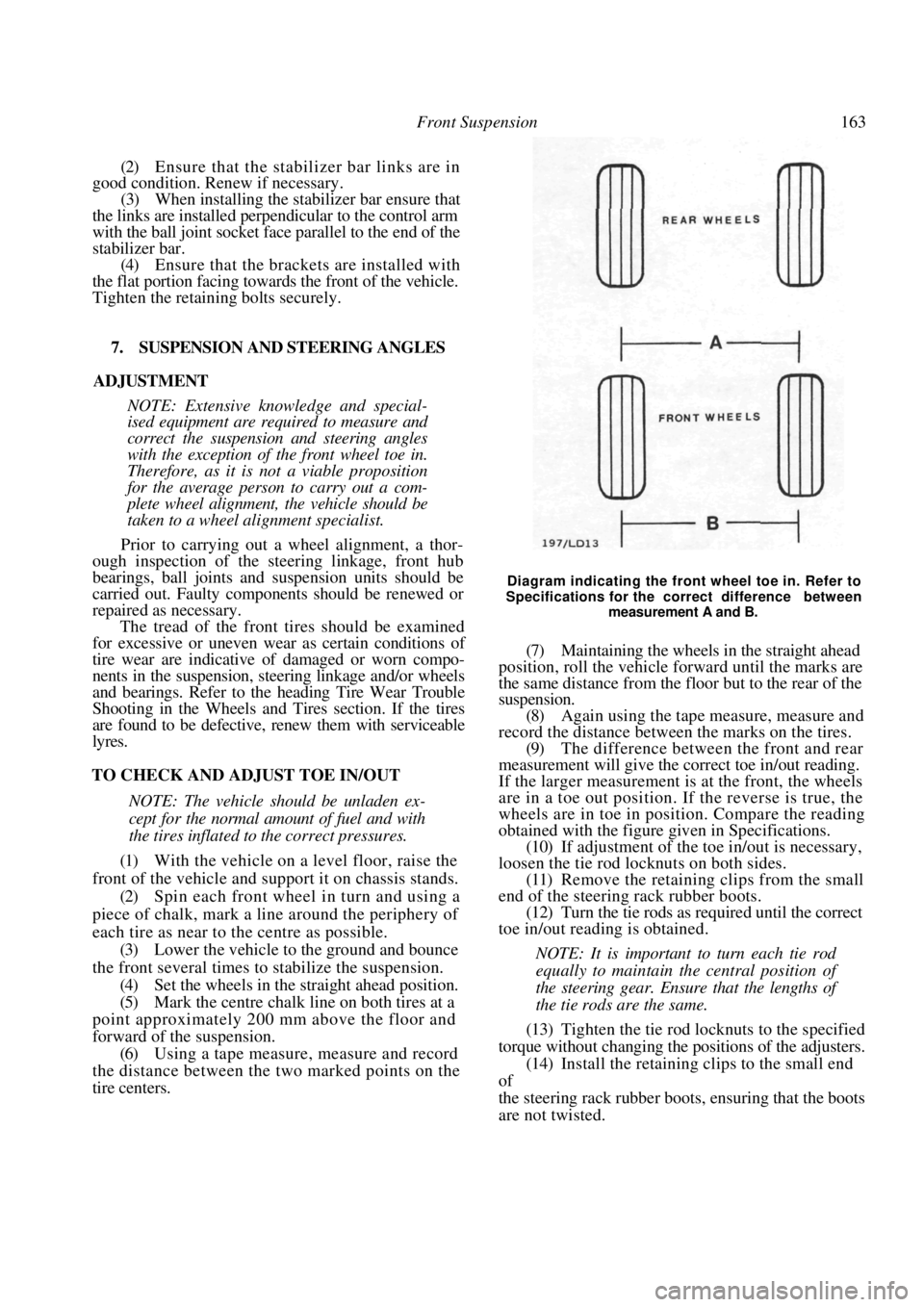
TO CHECK AND ADJUST TOE IN/OUT
NOTE: The vehicle s hould be unladen ex-
cept for the normal amount of fuel and with
the tires inflated to the correct pressures.
(1) With the vehicle on a level floor, raise the
front of the vehicle and s upport it on chassis stands.
(2) Spin each front wheel in turn and using a
piece of chalk, mark a line around the periphery of
each tire as near to the centre as possible. (3) Lower the vehicle to the ground and bounce
the front several times to stabilize the suspension. (4) Set the wheels in the straight ahead position.
(5) Mark the centre chalk line on both tires at a
point approximately 200 mm above the floor and
forward of the suspension. (6) Using a tape measure, measure and record
the distance between the two marked points on the
tire centers.
Diagram indicating the front wheel toe in. Refer to
Specifications for the correct difference between
measurement A and B.
(7) Maintaining the wheels in the straight ahead
position, roll the vehicle forward until the marks are
the same distance from the floor but to the rear of the
suspension. (8) Again using the tape measure, measure and
record the distance between the marks on the tires.
(9) The difference between the front and rear
measurement will give the correct toe in/out reading.
If the larger measurement is at the front, the wheels
are in a toe out position. If the reverse is true, the
wheels are in toe in position. Compare the reading
obtained with the figure given in Specifications.
(10) If adjustment of the to e in/out is necessary,
loosen the tie rod locknuts on both sides. (11) Remove the retaining clips from the small
end of the steering rack rubber boots. (12) Turn the tie rods as required until the correct
toe in/out reading is obtained.
NOTE: It is important to turn each tie rod
equally to maintain the central position of
the steering gear. Ensure that the lengths of
the tie rods are the same.
(13) Tighten the tie rod locknuts to the specified
torque without changing the positions of the adjusters.
(14) Install the retaining clips to the small end
of
the steering rack rubber boots, ensuring that the boots
are not twisted.
Page 172 of 238

172
BRAKES
SPECIFICATIONS
Type:
Except Pulsar/Vector GL from
July 1989 and Astra models ... Four wheel disc
Pulsar/Vector GL from
July 1989 and Astra models —
Front...............................................................Disc
Rear..............................................................Drum
Operation:
Footbrake ............... Vacuum assisted diagonally
split dual hydraulic
Handbrake................ Mechanical on rear wheels
Fluid type ...........................................................Dot 4
Master cylinder:
Make ........................................................ Girlock
Bore diameter —
Large .................................................... 25.40 mm
Small .................................................... 20.64 mm
Front disc brakes:
Caliper bore diameter ........................... 48.1 mm
Disc diameter ........................................ 240 mm
Disc thickness, minimum ......................... 16 mm
Disc runout, maximum ......................... 0.07 mm
Disc pad thickness, minimum ....................2 mm
Rear disc pads:
Caliper bore diameter ......................... 30.16 mm
Disc diameter ........................................ 234 mm
Disc thickness, minimum ...........................9 mm
Disc runout, maximum .......................... 0.07 mm
Disc pad thickness, minimum ....................2 mm
Rear drum brakes:
Wheel cylinder bore diameter ............ 15.87 mm
Drum diameter, maximum ............... 204.50 mm
Drum out of round, maximum.............. 0.03 mm
Drum runout, maximum ........................ 0.05 mm
Brake lining wear limit ........................... 1.5 mm
TORQUE WRENCH SETTINGS
Brake pedal bracket to body........................... 11 Nm
Brake pedal pivot bolt ..................................... 11 Nm
Brake servo unit to body................................. I I N m
Brake servo unit to master cylinder ............... 11 Nm
Pressure differential piston plug ...................... 12 Nm
Proportioning valve plug................................. 27 Nm
Caliper anchor plate bolts ............................... 52 Nm
Caliper guide bolts .......................................... 31 Nm
Brake hose to caliper....................................... 34 Nm
Handbrake cable bracket bolt ......................... 49 Nm
Handbrake lever to body ................................ 11 Nm
Cable clamp to body....................................... 11 Nm
Cam lever nut.................................................. 49 Nm
1. BRAKES TROUBLE SHOOTING
BRAKE PEDAL HARD
(1) Seized caliper piston or wheel cylinder: Over-
haul the caliper or wheel cylinder.
(2) Seized master cylinder piston: Overhaul the
master cylinder. (3) Seized pedal pivot: Rectify or renew the
pedal pivot shaft and bushes. (4) Restricted brake line: Remove the restriction
or renew the brake line.
(5) Vacuum servo system inoperative: Check
and repair the servo system.
NOTE: The vacuum servo system can be
checked as follows: With the engine
switched off, pump the brake pedal several
times to deplete any vacuum in the system.
With the engine still switched off, press
down firmly on the brake pedal and hold it
there noting the position and pressure re-
quired. Start the engine. If the servo unit is
operating correctly, the brake pedal will sink
slightly and the pressure required to hold it
may reduce. If the pedal does not sink
slightly when the engine is started, check the
vacuum supply to the servo unit. If vacuum
is reaching the brake servo unit, the unit can
be considered inoperative.
BRAKE DRAG
(1) Clogged master cylinder ports: Clean the
master cylinder and the fluid reservoir. Renew the
brake fluid. (2) Seized caliper piston or wheel cylinder: Over-
haul the caliper or wheel cylinder.
(3) Seized handbrake linkage: Free up or renew
the linkage.
Page 173 of 238
Brakes 173
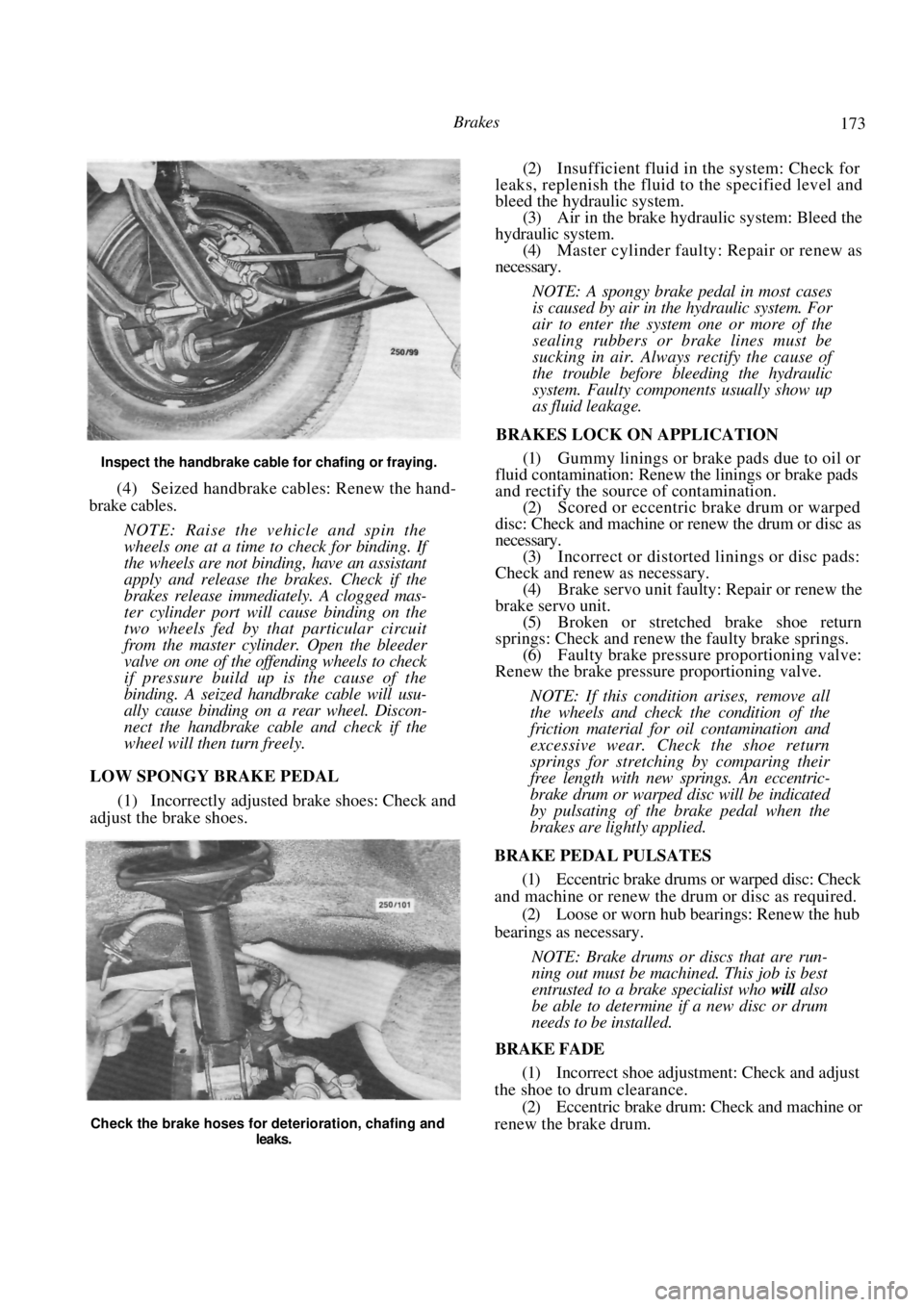
Inspect the handbrake cable for chafing or fraying.
(4) Seized handbrake cables: Renew the hand-
brake cables.
NOTE: Raise the vehicle and spin the
wheels one at a time to check for binding. If
the wheels are not binding, have an assistant
apply and release the brakes. Check if the
brakes release immediately. A clogged mas-
ter cylinder port will cause binding on the
two wheels fed by that particular circuit
from the master cylinder. Open the bleeder
valve on one of the o ffending wheels to check
if pressure build up is the cause of the
binding. A seized handbrake cable will usu-
ally cause binding on a rear wheel. Discon-
nect the handbrake cable and check if the
wheel will then turn freely.
LOW SPONGY BRAKE PEDAL
(1) Incorrectly adjusted brake shoes: Check and
adjust the brake shoes.
(2) Insufficient fluid in the system: Check for
leaks, replenish the fluid to the specified level and
bleed the hydraulic system.
(3) Air in the brake hydraulic system: Bleed the
hydraulic system. (4) Master cylinder faulty: Repair or renew as
necessary.
NOTE: A spongy brake pedal in most cases
is caused by air in the hydraulic system. For
air to enter the system one or more of the
sealing rubbers or brake lines must be
sucking in air. Always rectify the cause of
the trouble before bleeding the hydraulic
system. Faulty components usually show up
as fluid leakage.
BRAKES LOCK ON APPLICATION
(1) Gummy linings or brake pads due to oil or
fluid contamination: Renew the linings or brake pads
and rectify the source of contamination. (2) Scored or eccentric brake drum or warped
disc: Check and machine or renew the drum or disc as
necessary.
(3) Incorrect or distorted linings or disc pads:
Check and renew as necessary. (4) Brake servo unit faulty: Repair or renew the
brake servo unit. (5) Broken or stretched brake shoe return
springs: Check and renew th e faulty brake springs.
(6) Faulty brake pressure proportioning valve:
Renew the brake pressure proportioning valve.
NOTE: If this condition arises, remove all
the wheels and check the condition of the
friction material for oil contamination and
excessive wear. Check the shoe return
springs for stretching by comparing their
free length with new sp rings. An eccentric-
brake drum or warped disc will be indicated
by pulsating of the brake pedal when the
brakes are lightly applied.
BRAKE PEDAL PULSATES
(1) Eccentric brake drums or warped disc: Check
and machine or renew the drum or disc as required.
(2) Loose or worn hub bearings: Renew the hub
bearings as necessary.
NOTE: Brake drums or discs that are run-
ning out must be machined. This job is best
entrusted to a brake specialist who will also
be able to determine if a new disc or drum
needs to be installed.
BRAKE FADE
(1) Incorrect shoe adjustment: Check and adjust
the shoe to drum clearance. (2) Eccentric brake drum: Check and machine or
renew the brake drum.
Check the brake hoses for deterioration, chafing and
leaks.
Page 174 of 238
174 Brakes
(3) Linings saturated with hydraulic fluid: Re-
new the linings in sets. (4) Incorrect linings installed: Check and install
the recommended linings in sets.
NOTE: In most cases brake fade is caused
by overuse of the footbrake, which in turn
causes a build up of heat at the friction
material and drums or disc. Once this
excessive build up of heat is allowed to
dissipate the brakes should again function
normally.
BRAKES OVERHEAT
(1) Incorrect shoe adjustment: Check and adjust
the shoe to drum clearance.
(2) Broken shoe return springs: Renew any
faulty springs.
(3) Faulty handbrake cables or incorrect adjust-
ment: Check and renew or adjust the cables. (4) Frozen wheel cylinder or caliper pistons:
Overhaul the cylinders or calipers. (5) Obstructed or damaged hydraulic hose or
line: Remove the obstruction or renew the hydraulic
hose or line.
(6) Obstructed master cylinder compensating
port: Clean the compensating port. (7) Blocked vent in the master cylinder reservoir
cap; Check and remove the obstruction in the vent. (8) Overuse of footbrake: Revise driving habits.
NOTE: To check for brake binding raise the
vehicle and spin each wheel in turn by hand.
If it is found that one wheel cylinder or
caliper piston is sti cking it is advisable to
overhaul all the wheel cylinders and calipers.
BRAKE FAILURE
(1) Faulty master cylinder: Remove and over-
haul the master cylinder. (2) Loss of fluid due to a leaking wheel cylinder:
Overhaul or renew the wheel cylinders and bleed the
hydraulic system.
(3) Loss of fluid due to a leaking caliper: Over-
haul or renew the caliper assemblies and bleed the
hydraulic system. (4) Loss of fluid due to a fractured pipe or faulty
union: Renew the faulty components as necessary and
bleed the hydraulic system. (5) Air in the hydraulic system: Locate the
source of the air leak, rectify the problem and bleed
the hydraulic system. (6) Water in the hydraulic fluid: Drain, flush,
refill and bleed the hydraulic system.
NOTE: To locate the source of a fluid leak,
fill the master cylinder reservoir with fluid
and check for obvious signs of external
leakage while an assistant pumps the brake
pedal.
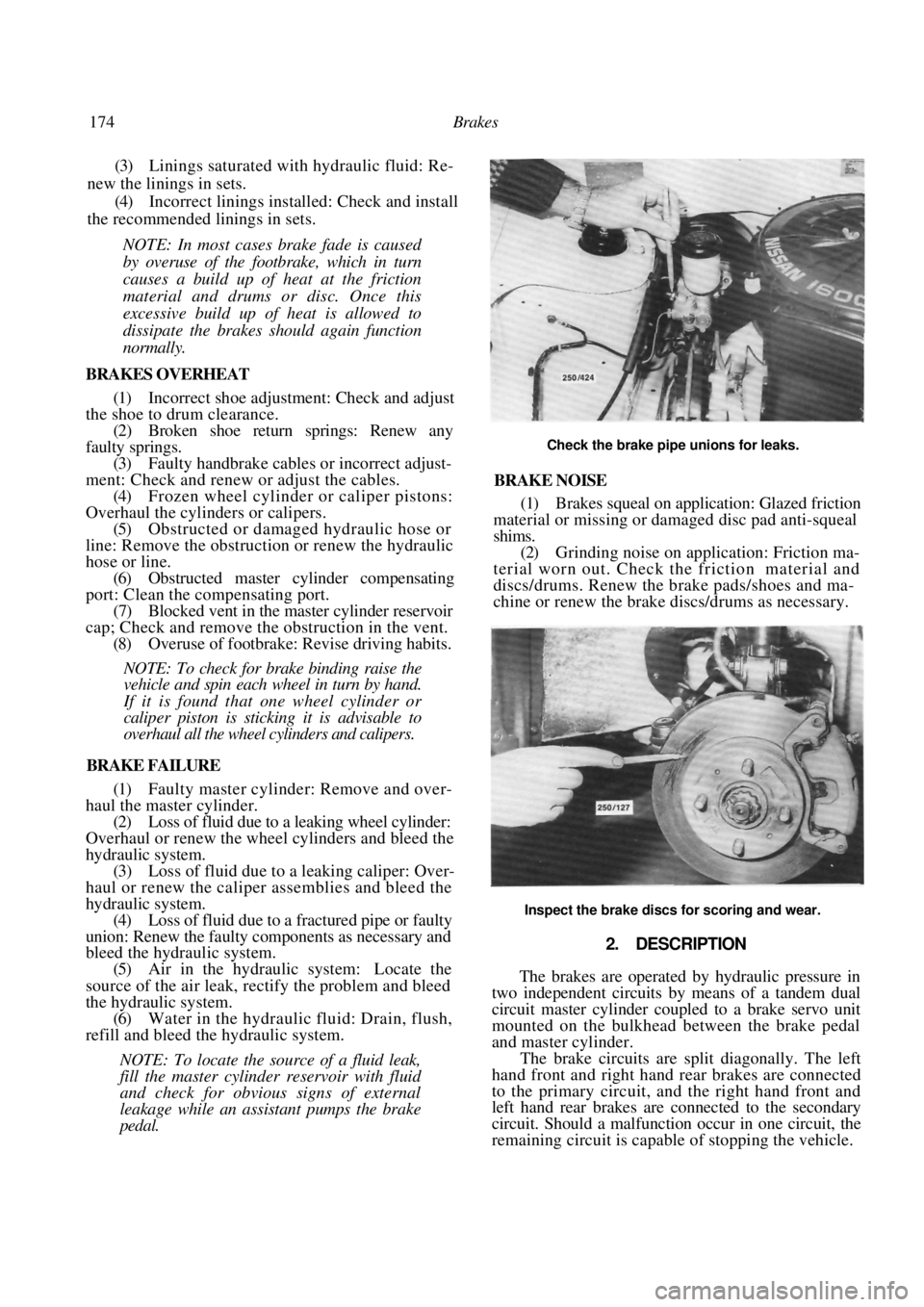
Check the brake pipe unions for leaks.
BRAKE NOISE
(1) Brakes squeal on application: Glazed friction
material or missing or da maged disc pad anti-squeal
shims. (2) Grinding noise on application: Friction ma-
terial worn out. Check the friction material and
discs/drums. Renew the brake pads/shoes and ma-
chine or renew the brake discs/drums as necessary.
Inspect the brake discs for scoring and wear.
2. DESCRIPTION
The brakes are operated by hydraulic pressure in
two independent circuits by means of a tandem dual
circuit master cylinder coupled to a brake servo unit
mounted on the bulkhead between the brake pedal
and master cylinder.
The brake circuits are sp lit diagonally. The left
hand front and right hand rear brakes are connected
to the primary circuit, and the right hand front and
left hand rear brakes are connected to the secondary
circuit. Should a malfunction occur in one circuit, the
remaining circuit is capable of stopping the vehicle.