ignition NISSAN QASHQAI 2017 Owner´s Manual
[x] Cancel search | Manufacturer: NISSAN, Model Year: 2017, Model line: QASHQAI, Model: NISSAN QASHQAI 2017Pages: 508, PDF Size: 2.68 MB
Page 408 of 508
7. Start the engine of the booster vehicle*B
and let it run for a few minutes.
8. Keep the engine speed of the booster
vehicle
*Bat about 2,000 rpm, and start
the engine of the vehicle
*Abeing jump
started.
CAUTION
Do not keep the starter motor engaged
for more than 10 seconds. If the engine
does not start right away, place the
ignition switch in the OFF position and
wait 10 seconds before trying again.
9. After starting your engine, carefully discon-
nect the negative cable and then the positive
cable (
*4?*3?*2?*1).
10. Replace the vent caps (if so equipped) . Be
sure to dispose of the cloth used to cover
the vent holes as it may be contaminated
with corrosive acid.Do not attempt to start the engine by pushing.
CAUTION
.Continuously Variable Transmission
(CVT) models cannot be push-
started or tow-started. Attempting
to do so may cause transmission
damage.
.Three-way catalyst equipped mod-
els should not be started by pushing
since the three way catalyst may be
damaged.
.Never try to start the vehicle by
towing it; when the engine starts,
the forward surge could cause the
vehicle to collide with the tow
vehicle.
WARNING
.Never continue driving if your vehi-
cle overheats. Doing so could cause
a vehicle fire.
.Never open the hood if steam is
coming out.
.Never remove the radiator or cool-
ant reservoir cap while the engine is
hot. If the radiator or coolant reser-
voir cap is removed when the engine
is hot, pressurized hot water will
spurt out and possibly cause burn-
ing, scalding or serious injury.
.If steam or coolant is coming from
the engine, stand clear of the vehi-
cle to prevent getting burned.
.The engine cooling fan will start at
anytime when the coolant tempera-
ture exceeds preset degrees.
.Be careful not to allow your hands,
hair, jewelry or clothing to come into
contact with, or to get caught in the
cooling fan or drive belts.
If your vehicle is overheating (indicated by an
extremely high temperature gauge reading) , or if
In case of emergency6-11
PUSH STARTING IF YOUR VEHICLE OVERHEATS
Page 412 of 508
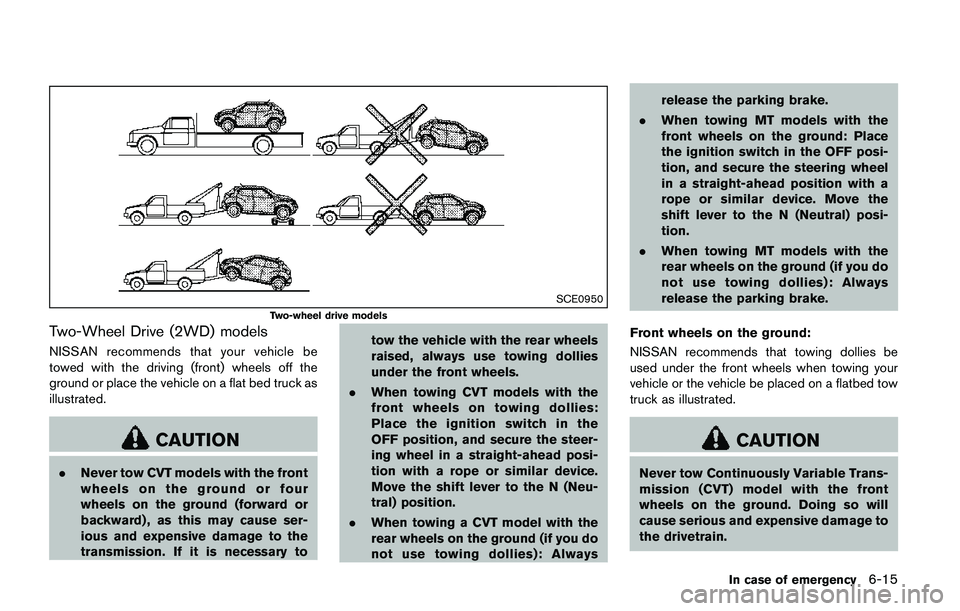
SCE0950
Two-wheel drive models
Two-Wheel Drive (2WD) models
NISSAN recommends that your vehicle be
towed with the driving (front) wheels off the
ground or place the vehicle on a flat bed truck as
illustrated.
CAUTION
.Never tow CVT models with the front
wheels on the ground or four
wheels on the ground (forward or
backward) , as this may cause ser-
ious and expensive damage to the
transmission. If it is necessary totow the vehicle with the rear wheels
raised, always use towing dollies
under the front wheels.
.When towing CVT models with the
front wheels on towing dollies:
Place the ignition switch in the
OFF position, and secure the steer-
ing wheel in a straight-ahead posi-
tion with a rope or similar device.
Move the shift lever to the N (Neu-
tral) position.
.When towing a CVT model with the
rear wheels on the ground (if you do
not use towing dollies): Alwaysrelease the parking brake.
.When towing MT models with the
front wheels on the ground: Place
the ignition switch in the OFF posi-
tion, and secure the steering wheel
in a straight-ahead position with a
rope or similar device. Move the
shift lever to the N (Neutral) posi-
tion.
.When towing MT models with the
rear wheels on the ground (if you do
not use towing dollies): Always
release the parking brake.
Front wheels on the ground:
NISSAN recommends that towing dollies be
used under the front wheels when towing your
vehicle or the vehicle be placed on a flatbed tow
truck as illustrated.
CAUTION
Never tow Continuously Variable Trans-
mission (CVT) model with the front
wheels on the ground. Doing so will
cause serious and expensive damage to
the drivetrain.
In case of emergency6-15
Page 413 of 508
6-16In case of emergency
Manual Transmission (MT) model:
1. Place the ignition switch in the OFF position.
2. Secure the steering wheel in a straight-
ahead position with rope or a similar device.
3. Move the shift lever to the N (Neutral)
position.
4. Release the parking brake.
5. Attach the safety chains whenever towing.
Rear wheels on the ground:
1. Place the ignition switch in the OFF position.
2. Move the shift lever to the N (Neutral)
position.
3. Release the parking brake.
4. Attach safety chains whenever towing.
All four wheels on the ground:
NISSAN recommends that the vehicle be placed
on a flatbed tow truck as illustrated.
CAUTION
Never tow CVT model with all four
wheels on the ground. Doing so will
cause serious and expensive damage to
the drivetrain.Manual Transmission (MT) model:
1. Place the ignition switch in the OFF position.
2. Move the shift lever to the N (Neutral)
position.
3. Release the parking brake.
VEHICLE RECOVERY (freeing a stuck
vehicle)
WARNING
To avoid vehicle damage, serious per-
sonal injury or death when recovering a
stuck vehicle:
.Contact a professional towing ser-
vice to recover the vehicle if you
have any questions regarding the
recovery procedure.
.Tow chains or cables must be at-
tached only to main structural mem-
bers of the vehicle.
.Do not use the vehicle tie-downs to
tow or free a stuck vehicle.
.Only use devices specifically de-
signed for vehicle recovery and
follow the manufacturer’s instruc-
tions..Always pull the recovery device
straight out from the front of the
vehicle. Never pull at an angle.
.Route recovery devices so they do
not touch any part of the vehicle
except the attachment point.
If your vehicle is stuck in sand, snow, mud, etc.,
use a tow strap or other device designed
specifically for vehicle recovery. Always follow
the manufacturer’s instructions for the recovery
device.
Rocking a stuck vehicle
WARNING
.Stand clear of a stuck vehicle.
.Do not spin your tires at high speed.
This could cause them to explode
and result in serious injury. Parts of
your vehicle could also overheat
and be damaged.
If your vehicle is stuck in sand, snow, mud, etc.,
use the following procedure:
1. Turn off the Vehicle Dynamic Control (VDC)
system.
Page 421 of 508
7-6Appearance and care
3. Make sure the floor mat does not interfere
with pedal operation. With the ignition in the
OFF position and the shift lever in the P
(Park) position (Continuously Variable Trans-
mission (CVT) models) or the shift lever in
the N (Neutral) position (Manual Transmis-
sion (MT) models) , fully apply and release all
pedals. The floor mat must not interfere with
pedal operation or prevent the pedal from
returning to its normal position. It is recom-
mended you see a NISSAN dealer for
details about installing the floor mats in your
vehicle.
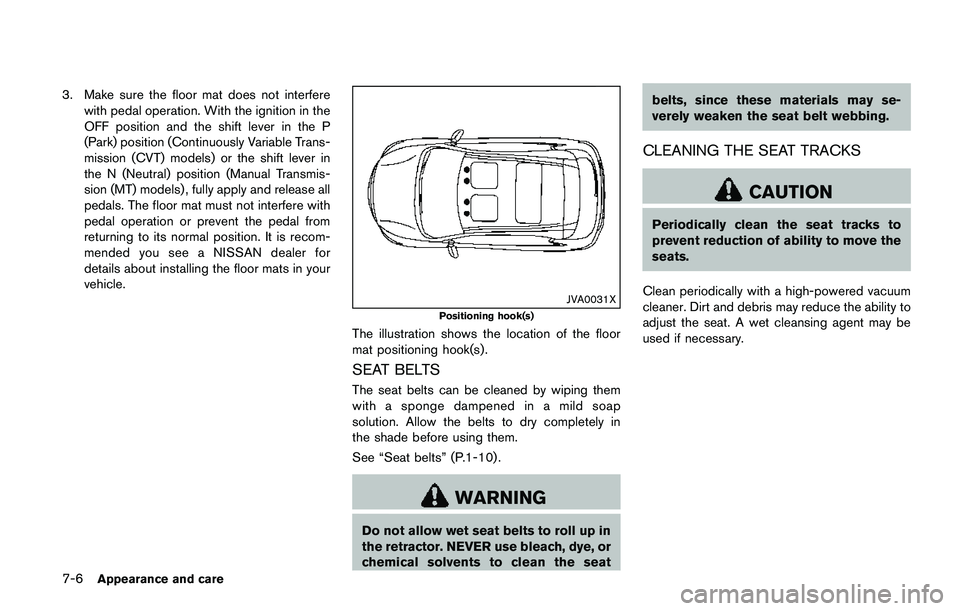
JVA0031X
Positioning hook(s)
The illustration shows the location of the floor
mat positioning hook(s) .
SEAT BELTS
The seat belts can be cleaned by wiping them
with a sponge dampened in a mild soap
solution. Allow the belts to dry completely in
the shade before using them.
See “Seat belts” (P.1-10).
WARNING
Do not allow wet seat belts to roll up in
the retractor. NEVER use bleach, dye, or
chemical solvents to clean the seatbelts, since these materials may se-
verely weaken the seat belt webbing.
CLEANING THE SEAT TRACKS
CAUTION
Periodically clean the seat tracks to
prevent reduction of ability to move the
seats.
Clean periodically with a high-powered vacuum
cleaner. Dirt and debris may reduce the ability to
adjust the seat. A wet cleansing agent may be
used if necessary.
Page 425 of 508
8-2Do-it-yourself
When performing any inspection or mainte-
nance work on your vehicle, always take care
to prevent serious accidental injury to yourself or
damage to the vehicle. The following are general
precautions which should be closely observed.
WARNING
.Park the vehicle on a level surface,
apply the parking brake securely
and block the wheels to prevent
the vehicle from moving. Move the
shift lever to the P (Park) position
(CVT model) or the shift lever to the
N (Neutral) position (MT model) .
.Be sure the ignition switch is in the
OFF or LOCK position when per-
forming any parts replacement or
repairs.
.If you must work with the engine
running, keep your hands, clothing,
hair and tools away from moving
fans, belts and any other moving
parts.
.It is advisable to secure or remove
any loose clothing and remove any
jewelry, such as rings, watches, etc.
before working on your vehicle..Always wear eye protection when-
ever you work on your vehicle.
.If you must run the engine in an
enclosed space such as a garage, be
sure there is proper ventilation for
exhaust gases to escape.
.Never get under the vehicle while it
is supported only by a jack. If it is
necessary to work under the vehicle,
support it with safety stands.
.Because the fuel lines are under
high pressure even when the engine
is off, it is recommended you visit a
NISSAN dealer for service of the
fuel filter or fuel lines.
.Do not work under the hood while
the engine is hot. Always turn off
the engine and wait until it cools
down.
.If you must work with the engine
running, keep your hands, clothing,
hair and tools away from moving
fans, belts and any other moving
parts.
.Keep smoking materials, flame and
sparks away from fuel and the
battery..On gasoline engine models with the
Multiport Fuel Injection (MFI) sys-
tem, the fuel filter and fuel lines
should be serviced because the fuel
lines are under high pressure even
when the engine is turned off. It is
recommended that you visit a
NISSAN dealer for this service.
.Your vehicle is equipped with an
automatic engine cooling fan. It may
come on at any time without warn-
ing, even if the ignition switch is in
the OFF position and the engine is
not running. To avoid injury, always
disconnect the negative battery
cable before working near the fan.
.Avoid direct contact with used en-
gine oil and coolant. Improperly
disposed engine oil, engine coolant,
and/or other vehicle fluids can hurt
the environment. Always conform to
local regulations for disposal of
vehicle fluids.
MAINTENANCE PRECAUTIONS
Page 426 of 508
CAUTION
.Do not work under the hood while
the engine is hot. Turn the engine
off and wait until it cools down.
.Avoid direct contact with used en-
gine oil and coolant. Improperly
disposed engine oil, and engine
coolant and/or other vehicle fluids
can damage the environment. Al-
ways conform to local regulations
for disposal of vehicle fluid.
.Never leave the engine or the CVT
related component harnesses dis-
connected while the ignition switch
is in the ON position.
.Never connect or disconnect the
battery or any transistorized com-
ponent while the ignition switch is
in the ON position.
.Your vehicle is equipped with an
automatic engine cooling fan. It may
come on at any time without warn-
ing, even if the ignition key is in the
OFF position and the engine is not
running. To avoid injury, always
disconnect the negative batterycable before working near the fan.
This “8. Do-it-yourself” section gives instruc-
tions regarding only those items which are
relatively easy for an owner to perform.
A genuine NISSAN Service Manual is also
available. (See “Owner’s manual/service manual
order information” (P.10-19) .)
You should be aware that incomplete or
improper servicing may result in operating
difficulties or excessive emissions, and could
affect your warranty coverage.If in doubt
about any servicing, it is recommended
you have it done by a NISSAN dealer.
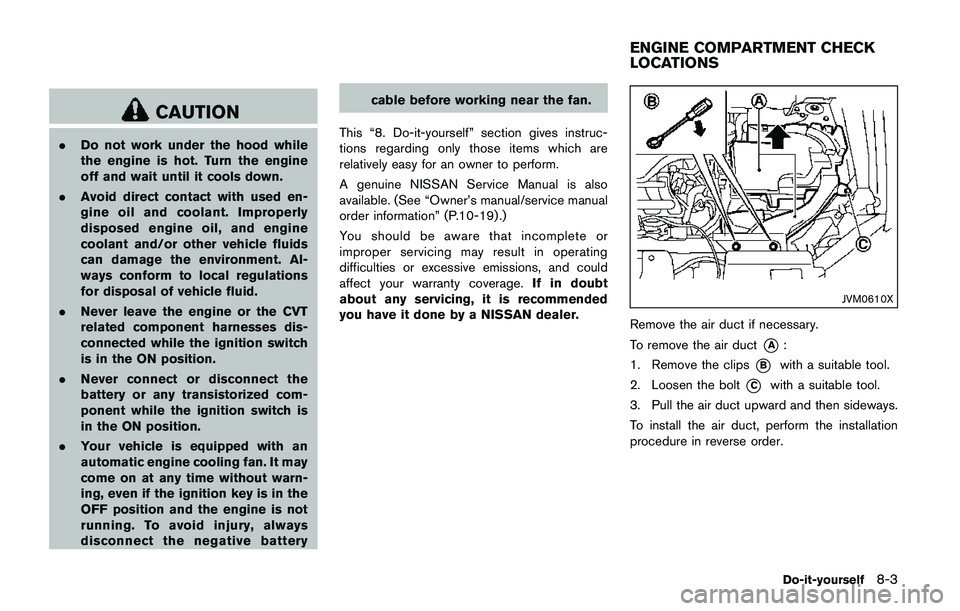
JVM0610X
Remove the air duct if necessary.
To remove the air duct
*A:
1. Remove the clips
*Bwith a suitable tool.
2. Loosen the bolt
*Cwith a suitable tool.
3. Pull the air duct upward and then sideways.
To install the air duct, perform the installation
procedure in reverse order.
Do-it-yourself8-3
ENGINE COMPARTMENT CHECK
LOCATIONS
Page 436 of 508
CAUTION
.Do not ground accessories directly
to the battery terminal. Doing so will
bypass the variable voltage control
system and the vehicle battery may
not charge completely.
.Use electrical accessories with the
engine running to avoid discharging
the vehicle battery.
The variable voltage control system measures
the amount of electrical discharge from the
battery and controls voltage generated by the
generator.
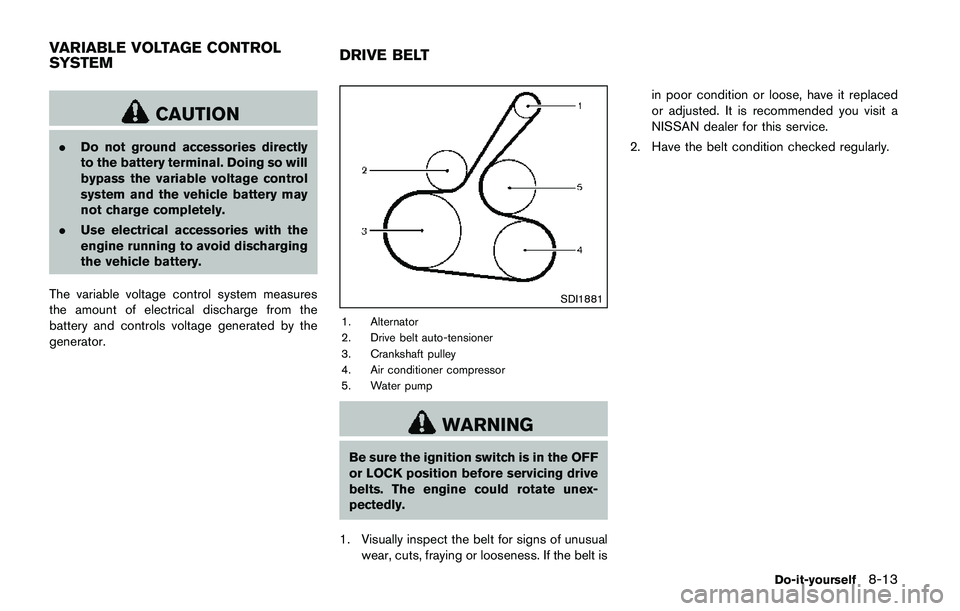
SDI1881
1. Alternator
2. Drive belt auto-tensioner
3. Crankshaft pulley
4. Air conditioner compressor
5. Water pump
WARNING
Be sure the ignition switch is in the OFF
or LOCK position before servicing drive
belts. The engine could rotate unex-
pectedly.
1. Visually inspect the belt for signs of unusual
wear, cuts, fraying or looseness. If the belt isin poor condition or loose, have it replaced
or adjusted. It is recommended you visit a
NISSAN dealer for this service.
2. Have the belt condition checked regularly.
Do-it-yourself8-13
VARIABLE VOLTAGE CONTROL
SYSTEMDRIVE BELT
Page 437 of 508
8-14Do-it-yourself
WARNING
Be sure the engine and ignition switch
are off and that the parking brake is
applied.
CAUTION
Be sure to use the correct socket to
remove the spark plugs. An incorrect
socket can damage the spark plugs.
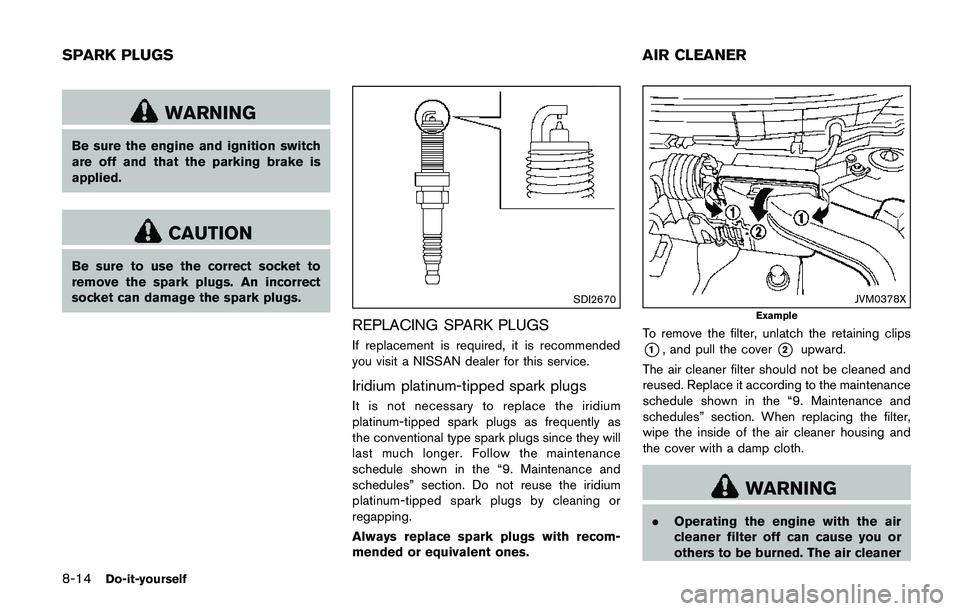
SDI2670
REPLACING SPARK PLUGS
If replacement is required, it is recommended
you visit a NISSAN dealer for this service.
Iridium platinum-tipped spark plugs
It is not necessary to replace the iridium
platinum-tipped spark plugs as frequently as
the conventional type spark plugs since they will
last much longer. Follow the maintenance
schedule shown in the “9. Maintenance and
schedules” section. Do not reuse the iridium
platinum-tipped spark plugs by cleaning or
regapping.
Always replace spark plugs with recom-
mended or equivalent ones.
JVM0378X
Example
To remove the filter, unlatch the retaining clips
*1, and pull the cover*2upward.
The air cleaner filter should not be cleaned and
reused. Replace it according to the maintenance
schedule shown in the “9. Maintenance and
schedules” section. When replacing the filter,
wipe the inside of the air cleaner housing and
the cover with a damp cloth.
WARNING
.Operating the engine with the air
cleaner filter off can cause you or
others to be burned. The air cleaner
SPARK PLUGS AIR CLEANER
Page 441 of 508
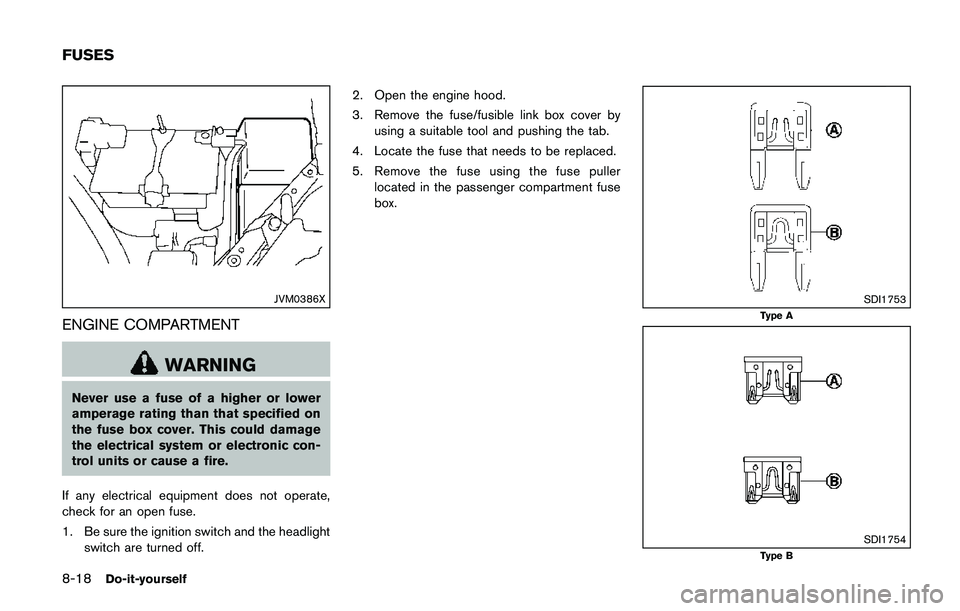
8-18Do-it-yourself
JVM0386X
ENGINE COMPARTMENT
WARNING
Never use a fuse of a higher or lower
amperage rating than that specified on
the fuse box cover. This could damage
the electrical system or electronic con-
trol units or cause a fire.
If any electrical equipment does not operate,
check for an open fuse.
1. Be sure the ignition switch and the headlight
switch are turned off.2. Open the engine hood.
3. Remove the fuse/fusible link box cover by
using a suitable tool and pushing the tab.
4. Locate the fuse that needs to be replaced.
5. Remove the fuse using the fuse puller
located in the passenger compartment fuse
box.
SDI1753
Type A
SDI1754Type B
FUSES
Page 443 of 508
8-20Do-it-yourself
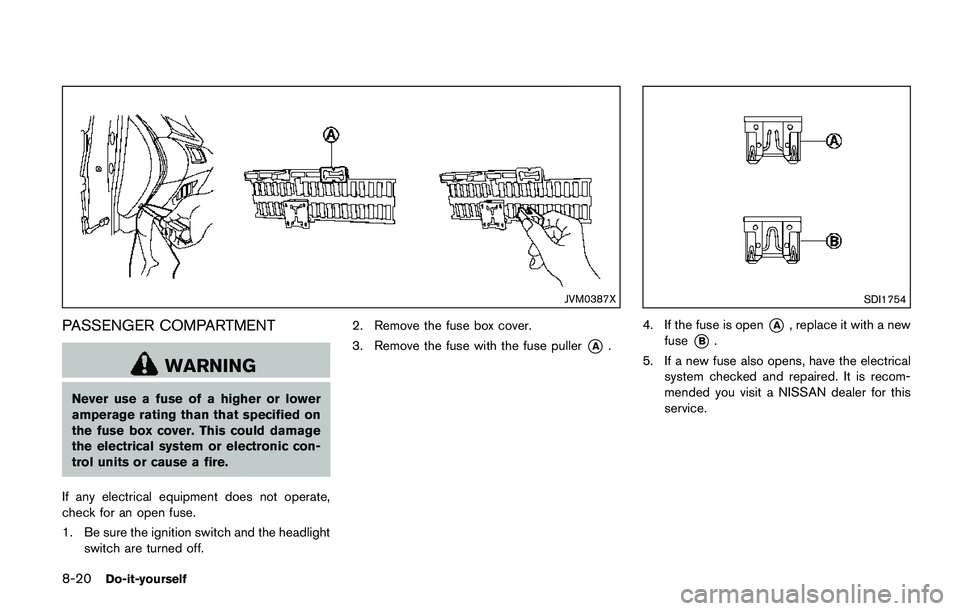
JVM0387X
PASSENGER COMPARTMENT
WARNING
Never use a fuse of a higher or lower
amperage rating than that specified on
the fuse box cover. This could damage
the electrical system or electronic con-
trol units or cause a fire.
If any electrical equipment does not operate,
check for an open fuse.
1. Be sure the ignition switch and the headlight
switch are turned off.2. Remove the fuse box cover.
3. Remove the fuse with the fuse puller
*A.
SDI1754
4. If the fuse is open*A, replace it with a new
fuse
*B.
5. If a new fuse also opens, have the electrical
system checked and repaired. It is recom-
mended you visit a NISSAN dealer for this
service.