Condition NISSAN TEANA 2008 Service Manual
[x] Cancel search | Manufacturer: NISSAN, Model Year: 2008, Model line: TEANA, Model: NISSAN TEANA 2008Pages: 5121, PDF Size: 69.03 MB
Page 2862 of 5121
![NISSAN TEANA 2008 Service Manual HAC-234
< SYMPTOM DIAGNOSIS >[WITH 7 INCH DISPLAY]
NOISE
NOISE
DescriptionINFOID:0000000003884805
Symptom
Noise
Noise is heard when the A/C system operates.
Inspection procedureINFOID:0000000003884](/img/5/57391/w960_57391-2861.png "NISSAN TEANA 2008 Service Manual HAC-234
< SYMPTOM DIAGNOSIS >[WITH 7 INCH DISPLAY]
NOISE
NOISE
DescriptionINFOID:0000000003884805
Symptom
Noise
Noise is heard when the A/C system operates.
Inspection procedureINFOID:0000000003884")
HAC-234
< SYMPTOM DIAGNOSIS >[WITH 7 INCH DISPLAY]
NOISE
NOISE
DescriptionINFOID:0000000003884805
Symptom
Noise
Noise is heard when the A/C system operates.
Inspection procedureINFOID:0000000003884806
1.CHECK OPERATION
1. Operate the A/C system and check the operation. Refer to HAC-108, "
WITHOUT INTELLIGENT AIR
CONDITIONER SYSTEM : Description & Inspection" (WITHOUT INTELLIGENT AIR CONDITIONER
SYSTEM) or HAC-112, "
WITH INTELLIGENT AIR CONDITIONER SYSTEM : Description & Inspection"
(WITH INTELLIGENT AIR CONDITIONER SYSTEM).
2. Check the parts where noise is occurring.
Can the parts where noise is occurring be checked?
YES-1 >> Noise from blower motor: GO TO 2.
YES-2 >> Noise from compressor: GO TO 3.
YES-3 >> Noise from expansion valve: GO TO 4.
YES-4 >> Noise from A/C piping (pipe, flexible hose): GO TO 6.
YES-5 >> Noise from drive belt: GO TO 7.
NO >> END.
2.CHECK BLOWER MOTOR
1. Remove blower motor.
2. Remove foreign materials that are in the blower unit.
3. Check the noise from blower motor again.
Is the inspection result normal?
YES >> END.
NO >> Replace blower motor.
3.CHECK COMPRESSOR
Perform trouble diagnosis for the compressor and check the compressor. Refer to HA-11, "
Symptom Table".
Is the inspection result normal?
YES >> END.
NO >> Refill the refrigerant or replace the compressor according to the inspection results.
4.CHECK WITH GAUGE PRESSURE
Perform the diagnosis with the gauge pressure. Refer to HA-8, "
Trouble Diagnosis For Unusual Pressure".
Is the inspection result normal?
YES >> GO TO 5.
NO >> Repair or replace parts according to the inspection results.
5.CHECK EXPANSION VALVE
1. Correct the refrigerant with recovery/recycling recharging equipment.
2. Recharge with the proper amount of the collected refrigerant after recycling or new refrigerant.
3. Check for the noise from expansion valve again.
Are the malfunction solved?
YES >> END.
NO >> Replace expansion valve.
6.CHECK A/C PIPING (PIPE, FLEXIBLE HOSE)
1. Check the A/C piping (pipes, flexible hoses) (for deformation and damage, etc.).
2. Check the installation condition of clips and brackets, etc, of the A/C piping (pipes, flexible hoses).
Is the inspection result normal?
YES >> Fix the line with rubber or come vibration absorbing material.
Page 2864 of 5121
![NISSAN TEANA 2008 Service Manual HAC-236
< SYMPTOM DIAGNOSIS >[WITH 7 INCH DISPLAY]
MEMORY FUNCTION DOES NOT OPERATE
MEMORY FUNCTION DOES NOT OPERATE
DescriptionINFOID:0000000003884807
Symptom
Memory function does not operate norma](/img/5/57391/w960_57391-2863.png "NISSAN TEANA 2008 Service Manual HAC-236
< SYMPTOM DIAGNOSIS >[WITH 7 INCH DISPLAY]
MEMORY FUNCTION DOES NOT OPERATE
MEMORY FUNCTION DOES NOT OPERATE
DescriptionINFOID:0000000003884807
Symptom
Memory function does not operate norma")
HAC-236
< SYMPTOM DIAGNOSIS >[WITH 7 INCH DISPLAY]
MEMORY FUNCTION DOES NOT OPERATE
MEMORY FUNCTION DOES NOT OPERATE
DescriptionINFOID:0000000003884807
Symptom
Memory function does not operate normally.
The setting is not maintained. (It returns to the initial condition.)
Inspection procedureINFOID:0000000003884808
1.CHECK OPERATION
1. Set temperature control dial to 32°C (90°F).
2. Press the OFF switch.
3. Turn the ignition switch OFF.
4. Turn the ignition switch ON.
5. Press the AUTO switch.
6. Check that the set temperature is maintained.
Is the inspection result normal?
YES >> END.
NO >> GO TO 2.
2.CHECK POWER SUPPLY AND GROUND CIRCUIT OF A/C AUTO AMP.
Check power supply and ground circuit of the A/C auto amp. Refer to HAC-191, "
A/C AUTO AMP. : Diagnosis
Procedure".
Is the inspection result normal?
YES >> Replace the A/C auto amp.
NO >> Repair or replace malfunctioning parts.
Page 2866 of 5121
![NISSAN TEANA 2008 Service Manual HAC-238
< PRECAUTION >[WITH 7 INCH DISPLAY]
PRECAUTIONS
Precaution for Procedure without Cowl Top Cover
INFOID:0000000003884814
When performing the procedure after removing cowl top cover, cover
the l](/img/5/57391/w960_57391-2865.png "NISSAN TEANA 2008 Service Manual HAC-238
< PRECAUTION >[WITH 7 INCH DISPLAY]
PRECAUTIONS
Precaution for Procedure without Cowl Top Cover
INFOID:0000000003884814
When performing the procedure after removing cowl top cover, cover
the l")
HAC-238
< PRECAUTION >[WITH 7 INCH DISPLAY]
PRECAUTIONS
Precaution for Procedure without Cowl Top Cover
INFOID:0000000003884814
When performing the procedure after removing cowl top cover, cover
the lower end of windshield with urethane, etc.
Precautions For Xenon Headlamp ServiceINFOID:0000000003884815
WARNING:
Comply with the following warnings to prevent any serious accident.
Disconnect the battery cable (negative terminal) or the power supply fuse before installing, remov-
ing, or touching the xenon headlamp (bulb included). The xenon headlamp contains high-voltage
generated parts.
Never work with wet hands.
Check the xenon headlamp ON-OFF status after assembling it to the vehicle. Never turn the xenon
headlamp ON in other conditions. Connect the power supply to the vehicle-side connector.
(Turning it ON outside the lamp case may cause fire or visual impairments.)
Never touch the bulb glass immediately after turning it OFF. It is extremely hot.
CAUTION:
Comply with the following cautions to prevent any error and malfunction.
Install the xenon bulb securely. (Insufficient bulb socket installation may melt the bulb, the connec-
tor, the housing, etc. by high-voltage leakage or corona discharge.)
Never perform HID circuit inspection with a tester.
Never touch the xenon bulb glass with hands. Never put oil and grease on it.
Dispose of the used xenon bulb after packing it in thick vinyl without breaking it.
Never wipe out dirt and contamination with organic solvent (thinner, gasoline, etc.).
Working with HFC-134a (R-134a)INFOID:0000000003884816
CAUTION:
CFC-12 (R-12) refrigerant and HFC-134a (R-134a) refrigerant are not compatible. Compressor mal-
function is likely to occur if the refrigerants are mixed, refer to “CONTAMINATED REFRIGERANT”
below. To determine the purity of HFC-134a (R-134a) in the vehicle and recovery tank, use Refriger-
ant Recovery/Recycling Recharging equipment and Refrigerant Identifier.
Use only specified lubricant for the HFC-134a (R-134a) A/C system and HFC-134a (R-134a) compo-
nents. Compressor malfunction is likely to occur if lubricant other than that specified is used.
The specified HFC-134a (R-134a) lubricant rapidly absorbs moisture from the atmosphere. The fol-
lowing handling precautions must be observed:
- Immediately cap (seal) the component to minimize the entry of moisture from the atmosphere when
removing refrigerant components from a vehicle.
- Never remove the caps (unseal) until just before connecting the components when installing refrig-
erant components to a vehicle. Connect all refrigerant loop components as quickly as possible to
minimize the entry of moisture into system.
- Use only the specified lubricant from a sealed container. Immediately reseal containers of lubricant.
Lubricant becomes moisture saturated and should not be used without proper sealing.
- Never allow lubricant (NISSAN A/C System Oil Type S) to come in to contact with styrene foam parts.
Damage may result.
CONTAMINATED REFRIGERANT
Take the appropriate steps shown below if a refrigerant other than pure HFC-134a (R-134a) is identified
in a vehicle:
Explain to the customer that environmental regulations prohibit the release of contaminated refrigerant into
the atmosphere.
PIIB3706J
Page 2867 of 5121
![NISSAN TEANA 2008 Service Manual PRECAUTIONS
HAC-239
< PRECAUTION >[WITH 7 INCH DISPLAY]
C
D
E
F
G
H
J
K
L
MA
B
HAC
N
O
P
Explain that recovery of the contaminated refrigerant could damage service equipment and refrigerant sup-
ply](/img/5/57391/w960_57391-2866.png "NISSAN TEANA 2008 Service Manual PRECAUTIONS
HAC-239
< PRECAUTION >[WITH 7 INCH DISPLAY]
C
D
E
F
G
H
J
K
L
MA
B
HAC
N
O
P
Explain that recovery of the contaminated refrigerant could damage service equipment and refrigerant sup-
ply")
PRECAUTIONS
HAC-239
< PRECAUTION >[WITH 7 INCH DISPLAY]
C
D
E
F
G
H
J
K
L
MA
B
HAC
N
O
P
Explain that recovery of the contaminated refrigerant could damage service equipment and refrigerant sup-
ply.
Suggest the customer return the vehicle to the location of previous service where the contamination may
have occurred.
If repairing, recover the refrigerant using only dedicated equipment and containers. Never reintroduce
contaminated refrigerant into the existing service equipment. Contact a local refrigerant product retailer
for available service if the facility does not have dedicated recovery equipment. This refrigerant must be dis-
posed of in accordance with all federal and local regulations. In addition, replacement of all refrigerant sys-
tem components on the vehicle is recommended.
The air conditioner warranty is void if the vehicle is within the warranty period. Please contact Nissan Cus-
tomer Affairs for further assistance.
General Refrigerant PrecautionINFOID:0000000003884817
WARNING:
Never breath A/C refrigerant, lubricant vapor or mist. Exposure may irritate eyes, nose and throat.
Remove HFC-134a (R-134a) from the A/C system, using certified service equipment meeting require-
ments of SAE J-2210 [HFC-134a (R-134a) recycling equipment], or J-2209 [HFC-134a (R-134a) recov-
ery equipment]. Ventilate work area before resuming service if accidental system discharge occurs.
Additional health and safety information may be obtained from refrigerant and lubricant manufactur-
ers.
Never release refrigerant into the air. Use approved recovery/recycling equipment to capture the
refrigerant each time an air conditioning system is discharged.
Always wear eye and hand protection (goggles and gloves) when working with any refrigerant or air
conditioning system.
Never store or heat refrigerant containers above 52°C (126°F).
Never heat a refrigerant container with an open flame. Place the bottom of the container in a warm
pail of water if container warming is required.
Never intentionally drop, puncture, or incinerate refrigerant containers.
Keep refrigerant away from open flames. Poisonous gas is produced if refrigerant burns.
Refrigerant displaces oxygen, therefore be certain to work in well ventilated areas to prevent suffo-
cation.
Never pressure test or leakage test HFC-134a (R-134a) service equipment and/or vehicle air condi-
tioning systems with compressed air during repair. Some mixtures of air and HFC-134a (R-134a)
have been shown to be combustible at elevated pressures. These mixtures, if ignited, may cause
injury or property damage. Additional health and safety information may be obtained from refriger-
ant manufacturers.
Refrigerant ConnectionINFOID:0000000003884818
A new type refrigerant connection has been introduced to all refrigerant lines except the following location.
Expansion valve to evaporator
Refrigerant pressure sensor to liquid tank
O-RING AND REFRIGERANT CONNECTION
Page 2869 of 5121
![NISSAN TEANA 2008 Service Manual PRECAUTIONS
HAC-241
< PRECAUTION >[WITH 7 INCH DISPLAY]
C
D
E
F
G
H
J
K
L
MA
B
HAC
N
O
P
WARNING:
Check that all refrigerant is discharged into the recycling equipment and the pressure in the system i](/img/5/57391/w960_57391-2868.png "NISSAN TEANA 2008 Service Manual PRECAUTIONS
HAC-241
< PRECAUTION >[WITH 7 INCH DISPLAY]
C
D
E
F
G
H
J
K
L
MA
B
HAC
N
O
P
WARNING:
Check that all refrigerant is discharged into the recycling equipment and the pressure in the system i")
PRECAUTIONS
HAC-241
< PRECAUTION >[WITH 7 INCH DISPLAY]
C
D
E
F
G
H
J
K
L
MA
B
HAC
N
O
P
WARNING:
Check that all refrigerant is discharged into the recycling equipment and the pressure in the system is
less than atmospheric pressure. Then gradually loosen the discharge side hose fitting and remove it.
CAUTION:
Observe the following when replacing or cleaning refrigerant cycle components.
Store it in the same way at it is when mounted on the car when the compressor is removed. Failure
to do so will cause lubricant to enter the low-pressure chamber.
Always use a torque wrench and a back-up wrench when connecting tubes.
Immediately plug all openings to prevent entry of dust and moisture after disconnecting tubes.
Connect the pipes at the final stage of the operation when installing an air conditioner in the vehicle.
Never remove the seal caps of pipes and other components until just before required for connection.
Allow components stored in cool areas to warm to working area temperature before removing seal
caps. This prevents condensation from forming inside A/C components.
Thoroughly remove moisture from the refrigeration system before charging the refrigerant.
Replace always used O-rings.
Apply lubricant to circle of the O-rings shown in illustration when connecting tube. Be careful not to
apply lubricant to threaded portion.
O-ring must be closely attached to the groove portion of tube.
Be careful not to damage O-ring and tube when replacing the O-ring.
Connect tube until a click can be heard. Then tighten the nut or bolt by hand. Check that the O-ring is
installed to tube correctly.
Perform leakage test and make sure that there is no leakage from connections after connecting line.
Disconnect the line and replace the O-ring when the refrigerant leaking point is found. Then tighten
the connections of seal seat to the specified torque.
Service EquipmentINFOID:0000000003884819
RECOVERY/RECYCLING EQUIPMENT
Be certain to follow the manufacturer instructions for machine operation and machine maintenance. Never
introduce any refrigerant other than that specified into the machine.
ELECTRICAL LEAK DETECTOR
Be certain to follow the manufacturer instructions for tester operation and tester maintenance.
VACUUM PUMP
Name : NISSAN A/C System Oil Type S
RHA861F
Page 2870 of 5121
![NISSAN TEANA 2008 Service Manual HAC-242
< PRECAUTION >[WITH 7 INCH DISPLAY]
PRECAUTIONS
The lubricant contained inside the vacuum pump is not compatible
with the specified lubricant for HFC-134a (R-134a) A/C systems.
The vent side o](/img/5/57391/w960_57391-2869.png "NISSAN TEANA 2008 Service Manual HAC-242
< PRECAUTION >[WITH 7 INCH DISPLAY]
PRECAUTIONS
The lubricant contained inside the vacuum pump is not compatible
with the specified lubricant for HFC-134a (R-134a) A/C systems.
The vent side o")
HAC-242
< PRECAUTION >[WITH 7 INCH DISPLAY]
PRECAUTIONS
The lubricant contained inside the vacuum pump is not compatible
with the specified lubricant for HFC-134a (R-134a) A/C systems.
The vent side of the vacuum pump is exposed to atmospheric pres-
sure. So the vacuum pump lubricant may migrate out of the pump
into the service hose. This is possible when the pump is switched
OFF after evacuation (vacuuming) and hose is connected to it.
To prevent this migration, use a manual valve placed near the hose-
to-pump connection, as per the following.
Vacuum pumps usually have a manual isolator valve as part of the
pump. Close this valve to isolate the service hose from the pump.
Use a hose equipped with a manual shut-off valve near the pump
end for pumps without an isolator. Close the valve to isolate the
hose from the pump.
Disconnect the hose from the pump if the hose has an automatic
shut-off valve. As long as the hose is connected, the valve is open
and lubricating oil may migrate.
Some one-way valves open when vacuum is applied and close
under no vacuum condition. Such valves may restrict the ability of
the pump to create a deep vacuum and are not recommended.
MANIFOLD GAUGE SET
Be certain that the gauge face indicates HFC-134a or R-134a. Be
sure the gauge set has 1/2″-16 ACME threaded connections for ser-
vice hoses. Confirm the set has been used only with refrigerant
HFC-134a (R-134a) and specified lubricants.
SERVICE HOSES
Be certain that the service hoses display the markings described
(colored hose with a black stripe). All hoses must equip positive
shut-off devices (either manual or automatic) near the end of the
hoses opposite to the manifold gauge.
SERVICE COUPLERS
RHA270DA
SHA533D
RHA272D
Page 2885 of 5121

INL-6
< FUNCTION DIAGNOSIS >
INTERIOR ROOM LAMP CONTROL SYSTEM
The interior room lamp turns ON and OFF (gradual brightening and dimming) by the interior room timer.
BCM judges the vehicle condition with the following items. It activates the interior room timer.
- Ignition switch status
- Door switch signal (ALL)
- Door lock/unlock signal (Remote keyless entry receiver, each request switch, door lock/unlock switch)
NOTE:
Each function of interior room lamp timer can be set by CONSULT-III. Refer to INL-16, "
INT LAMP : CON-
SULT-III Function (BCM - INT LAMP)".
Interior Room Lamp ON Operation
BCM always turns the interior room lamp ON when any door opens.
BCM activates the interior room timer in any of the following conditions to turn the interior room lamp ON for
a period of time.
- Any door opens before all doors close.
- Ignition switch is turned ON → OFF.
- Any door unlock signal is detected when all doors close with ignition switch OFF.
NOTE:
Restart the timer if new condition is input during the timer operating time.
Interior Room Lamp OFF Operation
BCM stops the timer in any of the following conditions to turns the interior room lamp OFF.
The timer operating time is expired.
Ignition switch position is other than OFF with all doors close.
Any door lock operation is detected with all doors close.
STEP LAMP CONTROL
BCM controls the step lamp (ground-side) to turn ON with any door switch ON.
TRUNK ROOM LAMP CONTROL
BCM controls the trunk room lamp (ground-side) to turn ON with trunk room lamp switch ON.
PUSH-BUTTON IGNITION SWITCH ILLUMINATION CONTROL
Push-button Ignition Switch Illumination Basic Operation
BCM provides the power supply to turn the push-button ignition switch illumination ON.
Push-button Ignition Switch Illumination ON Operation
BCM turns the push-button ignition switch illumination ON in the following conditions.
Ignition switch ON
Any of the following conditions with ignition switch OFF
- Engine start permission is entered.
- Intelligent Key inserted into the key slot.
- Driver door is LOCK → UNLOCK.
- Driver door is open.
Push-button Ignition Switch Illumination OFF Operation
BCM turns the push-button ignition switch illumination OFF in any of the following conditions.
The push-button ignition switch illumination ON conditions do not satisfy.
All of the following conditions with ignition switch OFF
- The push-button ignition switch illumination ON conditions do not change (15 seconds after the ignition
switch OFF) or the driver door is UNLOCK → LOCK.
Page 2887 of 5121

INL-8
< FUNCTION DIAGNOSIS >
INTERIOR ROOM LAMP CONTROL SYSTEM
Component Description
INFOID:0000000003774542
Part Description
BCM Activates the interior room lamp timer depending on the vehicle condition to turn the
interior room lamp ON/OFF.
Turns the step lamp ON/OFF according to any door switch status.
Remote keyless entry receiver Receives the lock/unlock signal from keyfob.
Transmits the lock/unlock signal to BCM.
Request switch
Door lock/unlock switchInputs the lock/unlock signal to BCM.
Door switch
Trunk room lamp switchInputs the switch signal to BCM.
Page 2888 of 5121
INTERIOR ROOM LAMP BATTERY SAVER SYSTEM
INL-9
< FUNCTION DIAGNOSIS >
C
D
E
F
G
H
I
J
K
MA
B
INL
N
O
P
INTERIOR ROOM LAMP BATTERY SAVER SYSTEM
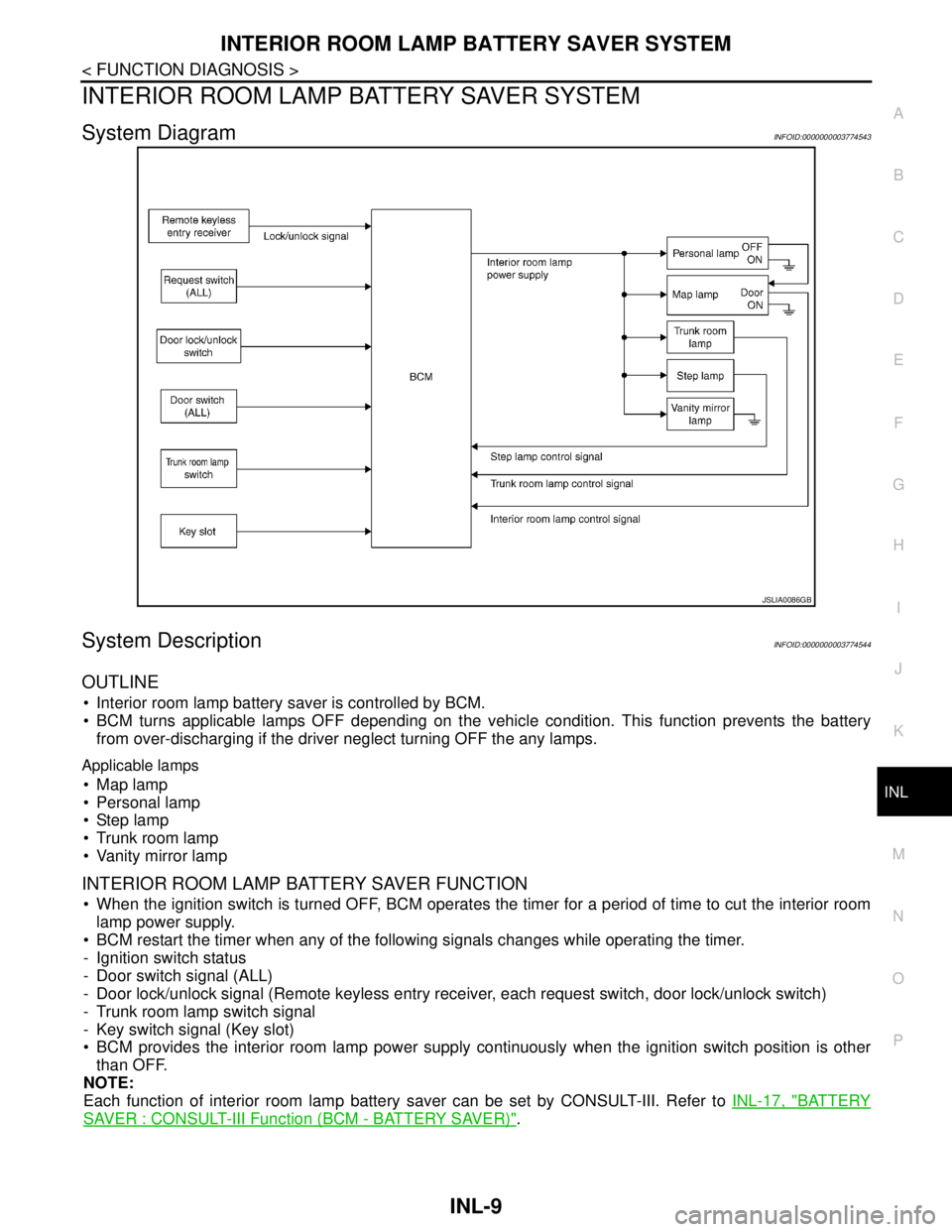
System DiagramINFOID:0000000003774543
System DescriptionINFOID:0000000003774544
OUTLINE
Interior room lamp battery saver is controlled by BCM.
BCM turns applicable lamps OFF depending on the vehicle condition. This function prevents the battery
from over-discharging if the driver neglect turning OFF the any lamps.
Applicable lamps
Map lamp
Personal lamp
Step lamp
Trunk room lamp
Vanity mirror lamp
INTERIOR ROOM LAMP BATTERY SAVER FUNCTION
When the ignition switch is turned OFF, BCM operates the timer for a period of time to cut the interior room
lamp power supply.
BCM restart the timer when any of the following signals changes while operating the timer.
- Ignition switch status
- Door switch signal (ALL)
- Door lock/unlock signal (Remote keyless entry receiver, each request switch, door lock/unlock switch)
- Trunk room lamp switch signal
- Key switch signal (Key slot)
BCM provides the interior room lamp power supply continuously when the ignition switch position is other
than OFF.
NOTE:
Each function of interior room lamp battery saver can be set by CONSULT-III. Refer to INL-17, "
BATTERY
SAVER : CONSULT-III Function (BCM - BATTERY SAVER)".
JSLIA0086GB
Page 2889 of 5121
INL-10
< FUNCTION DIAGNOSIS >
INTERIOR ROOM LAMP BATTERY SAVER SYSTEM
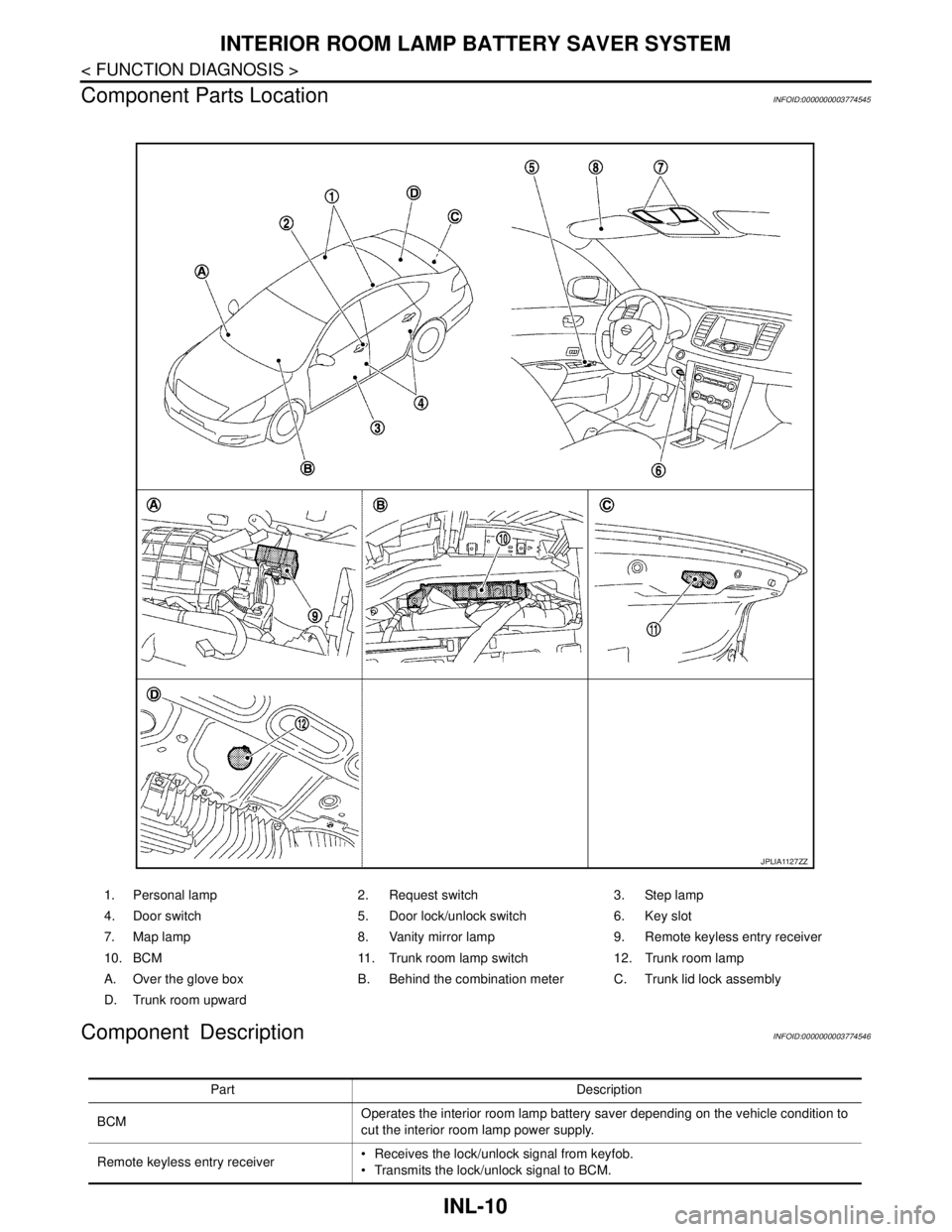
Component Parts Location
INFOID:0000000003774545
Component DescriptionINFOID:0000000003774546
1. Personal lamp 2. Request switch 3. Step lamp
4. Door switch 5. Door lock/unlock switch 6. Key slot
7. Map lamp 8. Vanity mirror lamp 9. Remote keyless entry receiver
10. BCM 11. Trunk room lamp switch 12. Trunk room lamp
A. Over the glove box B. Behind the combination meter C. Trunk lid lock assembly
D. Trunk room upward
JPLIA1127ZZ
Part Description
BCMOperates the interior room lamp battery saver depending on the vehicle condition to
cut the interior room lamp power supply.
Remote keyless entry receiver Receives the lock/unlock signal from keyfob.
Transmits the lock/unlock signal to BCM.