Condition NISSAN TEANA 2008 Service Manual
[x] Cancel search | Manufacturer: NISSAN, Model Year: 2008, Model line: TEANA, Model: NISSAN TEANA 2008Pages: 5121, PDF Size: 69.03 MB
Page 3841 of 5121
REAR LOWER LINK & COIL SPRING
RSU-9
< ON-VEHICLE REPAIR >
C
D
F
G
H
I
J
K
L
MA
B
RSU
N
O
P
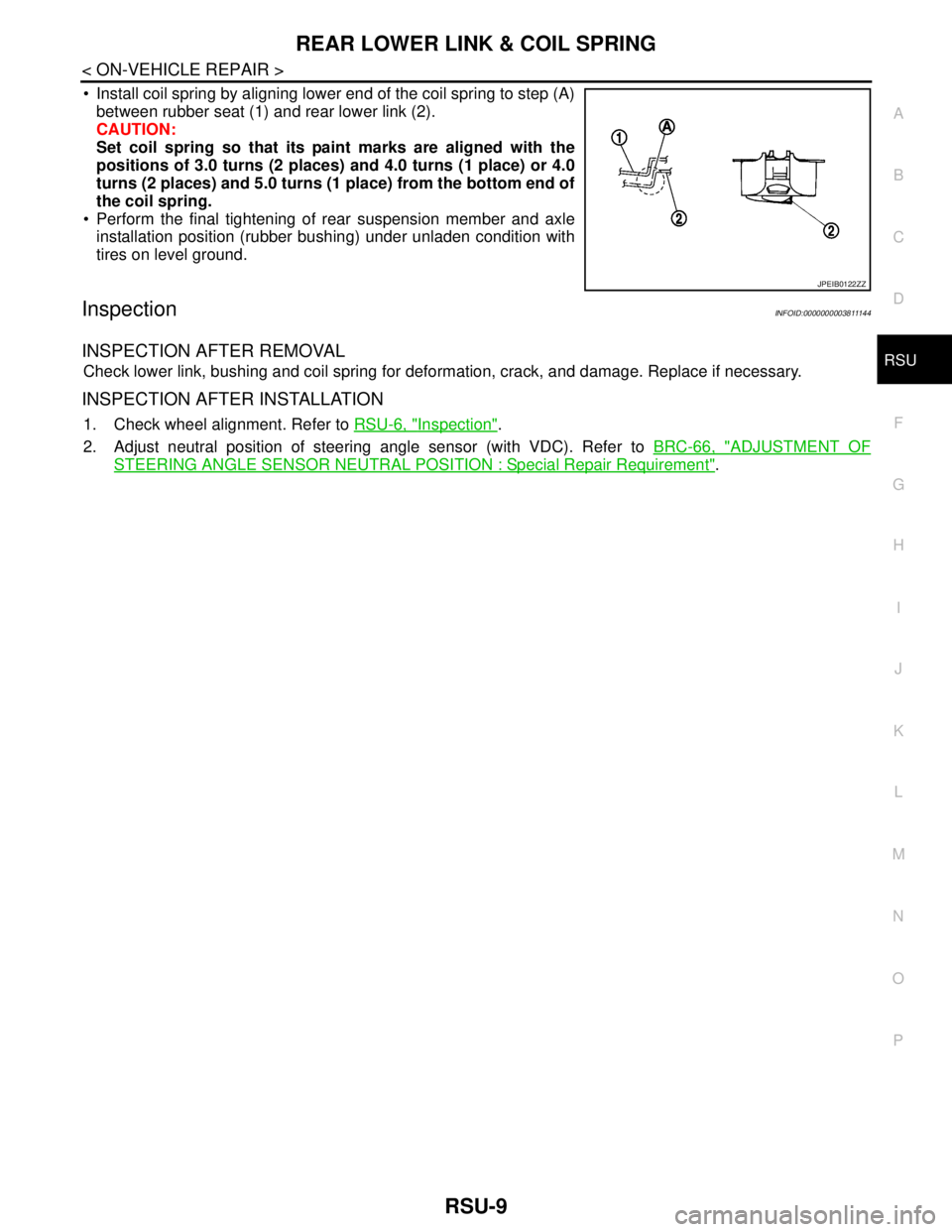
Install coil spring by aligning lower end of the coil spring to step (A)
between rubber seat (1) and rear lower link (2).
CAUTION:
Set coil spring so that its paint marks are aligned with the
positions of 3.0 turns (2 places) and 4.0 turns (1 place) or 4.0
turns (2 places) and 5.0 turns (1 place) from the bottom end of
the coil spring.
Perform the final tightening of rear suspension member and axle
installation position (rubber bushing) under unladen condition with
tires on level ground.
InspectionINFOID:0000000003811144
INSPECTION AFTER REMOVAL
Check lower link, bushing and coil spring for deformation, crack, and damage. Replace if necessary.
INSPECTION AFTER INSTALLATION
1. Check wheel alignment. Refer to RSU-6, "Inspection".
2. Adjust neutral position of steering angle sensor (with VDC). Refer to BRC-66, "
ADJUSTMENT OF
STEERING ANGLE SENSOR NEUTRAL POSITION : Special Repair Requirement".
JPEIB0122ZZ
Page 3842 of 5121
RSU-10
< ON-VEHICLE REPAIR >
REAR SHOCK ABSORBER
REAR SHOCK ABSORBER
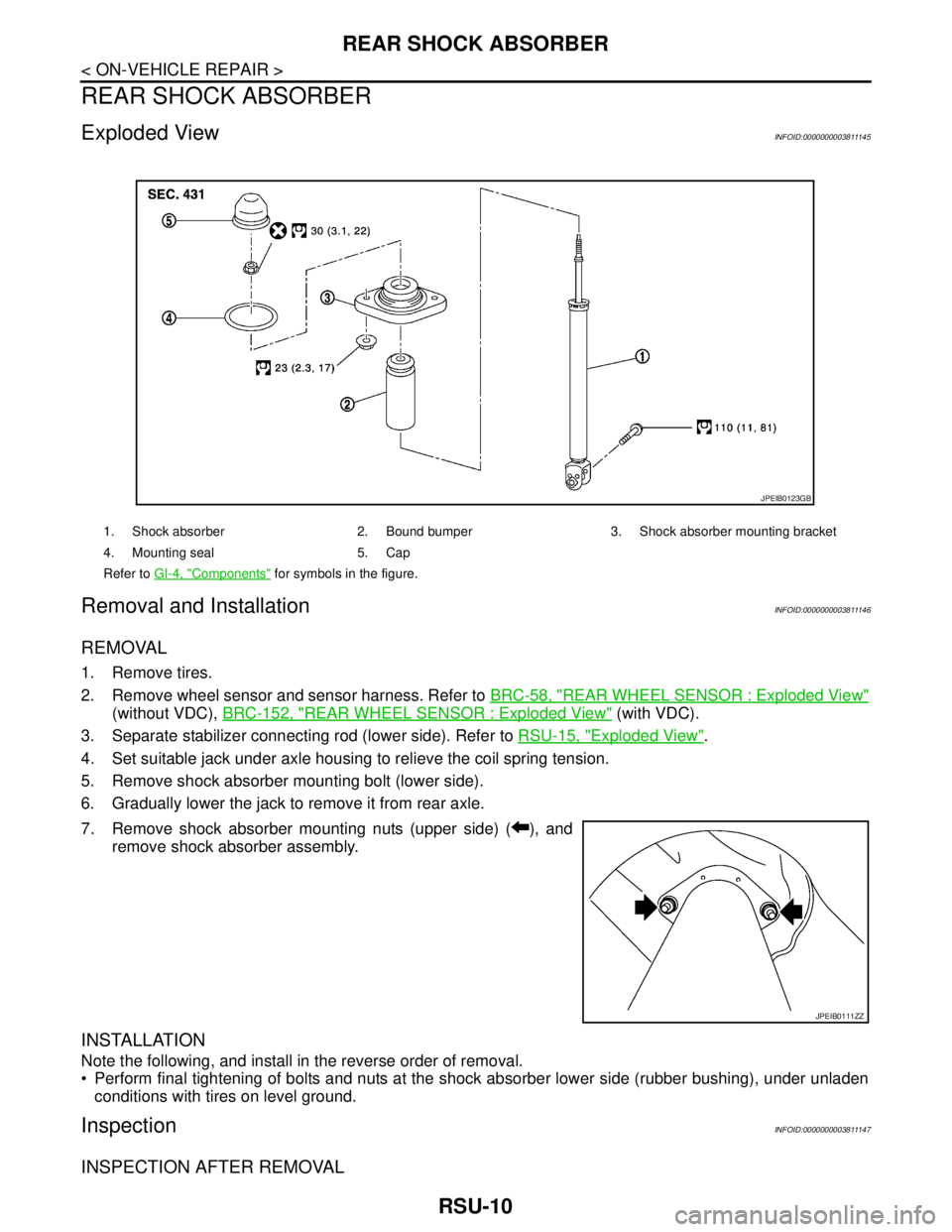
Exploded ViewINFOID:0000000003811145
Removal and InstallationINFOID:0000000003811146
REMOVAL
1. Remove tires.
2. Remove wheel sensor and sensor harness. Refer to BRC-58, "
REAR WHEEL SENSOR : Exploded View"
(without VDC), BRC-152, "REAR WHEEL SENSOR : Exploded View" (with VDC).
3. Separate stabilizer connecting rod (lower side). Refer to RSU-15, "
Exploded View".
4. Set suitable jack under axle housing to relieve the coil spring tension.
5. Remove shock absorber mounting bolt (lower side).
6. Gradually lower the jack to remove it from rear axle.
7. Remove shock absorber mounting nuts (upper side) ( ), and
remove shock absorber assembly.
INSTALLATION
Note the following, and install in the reverse order of removal.
Perform final tightening of bolts and nuts at the shock absorber lower side (rubber bushing), under unladen
conditions with tires on level ground.
InspectionINFOID:0000000003811147
INSPECTION AFTER REMOVAL
1. Shock absorber 2. Bound bumper 3. Shock absorber mounting bracket
4. Mounting seal 5. Cap
Refer to GI-4, "
Components" for symbols in the figure.
JPEIB0123GB
JPEIB0111ZZ
Page 3844 of 5121
RSU-12
< ON-VEHICLE REPAIR >
RADIUS ROD
RADIUS ROD
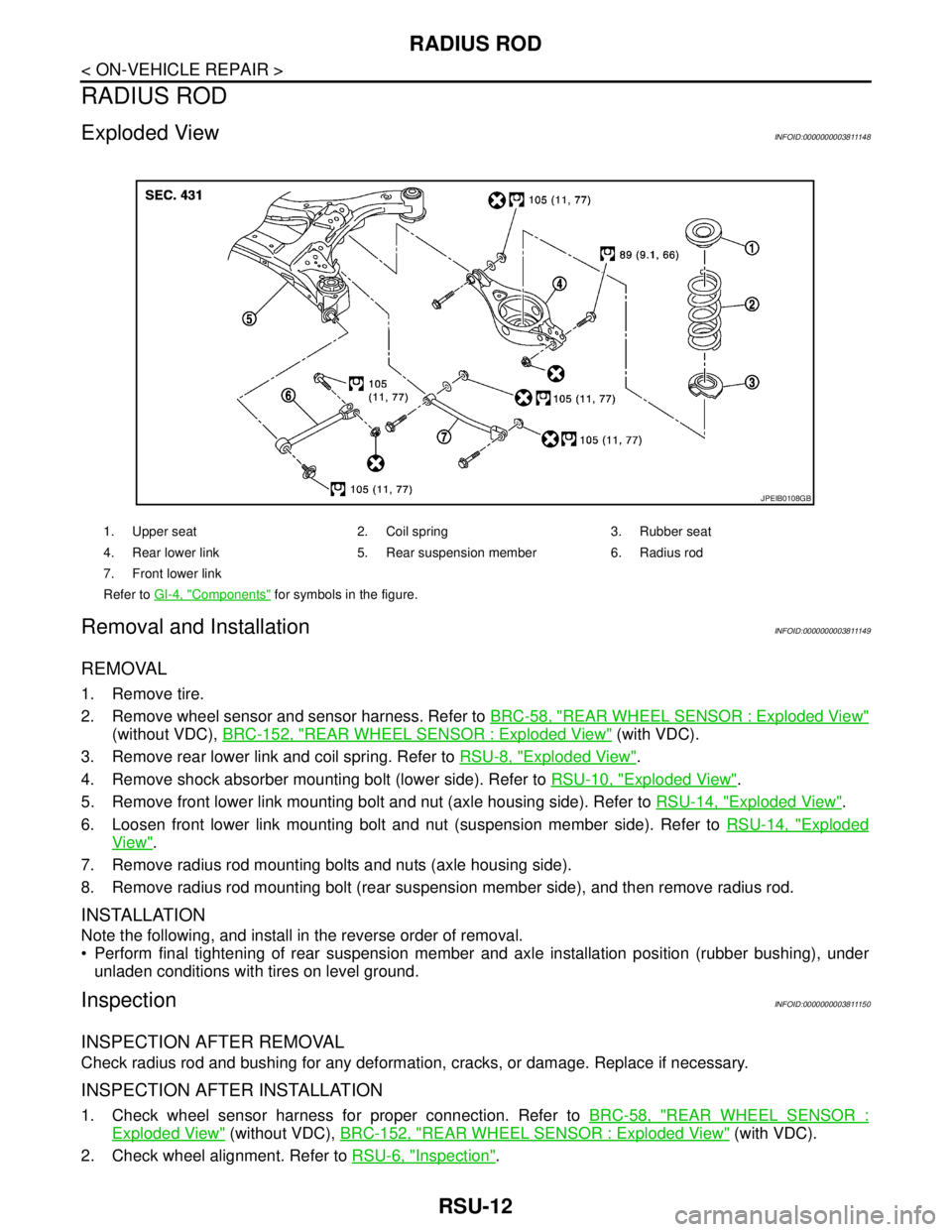
Exploded ViewINFOID:0000000003811148
Removal and InstallationINFOID:0000000003811149
REMOVAL
1. Remove tire.
2. Remove wheel sensor and sensor harness. Refer to BRC-58, "
REAR WHEEL SENSOR : Exploded View"
(without VDC), BRC-152, "REAR WHEEL SENSOR : Exploded View" (with VDC).
3. Remove rear lower link and coil spring. Refer to RSU-8, "
Exploded View".
4. Remove shock absorber mounting bolt (lower side). Refer to RSU-10, "
Exploded View".
5. Remove front lower link mounting bolt and nut (axle housing side). Refer to RSU-14, "
Exploded View".
6. Loosen front lower link mounting bolt and nut (suspension member side). Refer to RSU-14, "
Exploded
View".
7. Remove radius rod mounting bolts and nuts (axle housing side).
8. Remove radius rod mounting bolt (rear suspension member side), and then remove radius rod.
INSTALLATION
Note the following, and install in the reverse order of removal.
Perform final tightening of rear suspension member and axle installation position (rubber bushing), under
unladen conditions with tires on level ground.
InspectionINFOID:0000000003811150
INSPECTION AFTER REMOVAL
Check radius rod and bushing for any deformation, cracks, or damage. Replace if necessary.
INSPECTION AFTER INSTALLATION
1. Check wheel sensor harness for proper connection. Refer to BRC-58, "REAR WHEEL SENSOR :
Exploded View" (without VDC), BRC-152, "REAR WHEEL SENSOR : Exploded View" (with VDC).
2. Check wheel alignment. Refer to RSU-6, "
Inspection".
1. Upper seat 2. Coil spring 3. Rubber seat
4. Rear lower link 5. Rear suspension member 6. Radius rod
7. Front lower link
Refer to GI-4, "
Components" for symbols in the figure.
JPEIB0108GB
Page 3846 of 5121
RSU-14
< ON-VEHICLE REPAIR >
FRONT LOWER LINK
FRONT LOWER LINK
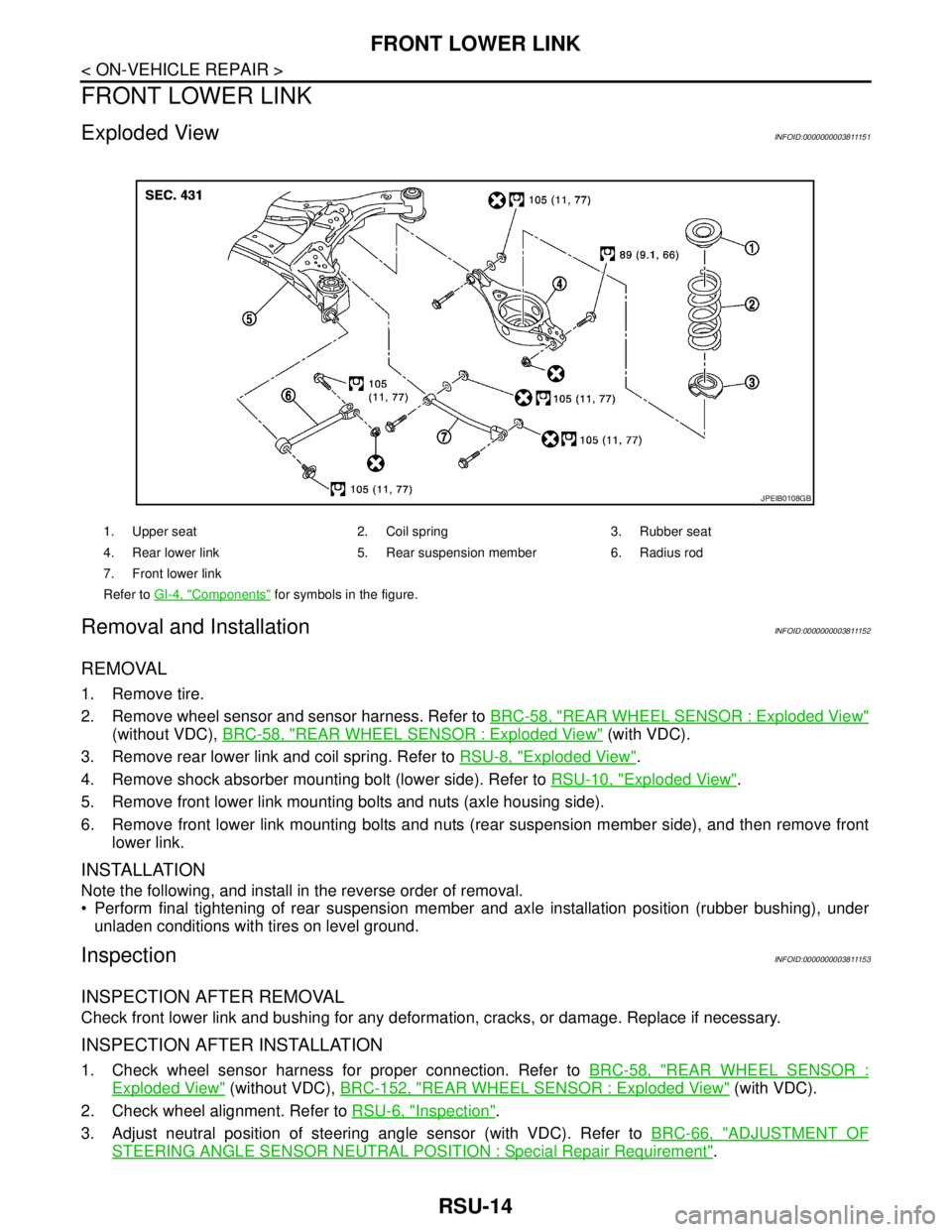
Exploded ViewINFOID:0000000003811151
Removal and InstallationINFOID:0000000003811152
REMOVAL
1. Remove tire.
2. Remove wheel sensor and sensor harness. Refer to BRC-58, "
REAR WHEEL SENSOR : Exploded View"
(without VDC), BRC-58, "REAR WHEEL SENSOR : Exploded View" (with VDC).
3. Remove rear lower link and coil spring. Refer to RSU-8, "
Exploded View".
4. Remove shock absorber mounting bolt (lower side). Refer to RSU-10, "
Exploded View".
5. Remove front lower link mounting bolts and nuts (axle housing side).
6. Remove front lower link mounting bolts and nuts (rear suspension member side), and then remove front
lower link.
INSTALLATION
Note the following, and install in the reverse order of removal.
Perform final tightening of rear suspension member and axle installation position (rubber bushing), under
unladen conditions with tires on level ground.
InspectionINFOID:0000000003811153
INSPECTION AFTER REMOVAL
Check front lower link and bushing for any deformation, cracks, or damage. Replace if necessary.
INSPECTION AFTER INSTALLATION
1. Check wheel sensor harness for proper connection. Refer to BRC-58, "REAR WHEEL SENSOR :
Exploded View" (without VDC), BRC-152, "REAR WHEEL SENSOR : Exploded View" (with VDC).
2. Check wheel alignment. Refer to RSU-6, "
Inspection".
3. Adjust neutral position of steering angle sensor (with VDC). Refer to BRC-66, "
ADJUSTMENT OF
STEERING ANGLE SENSOR NEUTRAL POSITION : Special Repair Requirement".
1. Upper seat 2. Coil spring 3. Rubber seat
4. Rear lower link 5. Rear suspension member 6. Radius rod
7. Front lower link
Refer to GI-4, "
Components" for symbols in the figure.
JPEIB0108GB
Page 3848 of 5121
RSU-16
< REMOVAL AND INSTALLATION >
REAR SUSPENSION ARM
REMOVAL AND INSTALLATION
REAR SUSPENSION ARM
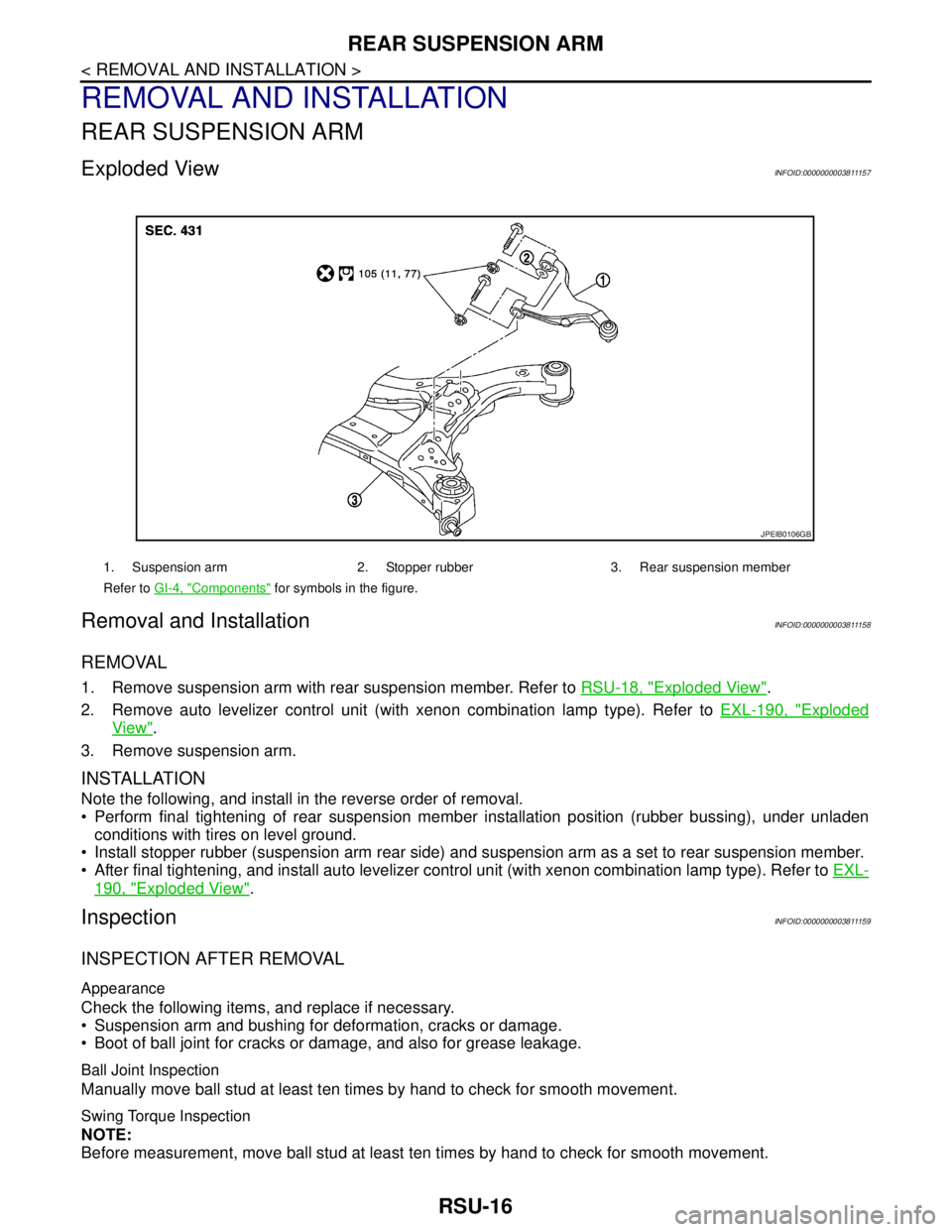
Exploded ViewINFOID:0000000003811157
Removal and InstallationINFOID:0000000003811158
REMOVAL
1. Remove suspension arm with rear suspension member. Refer to RSU-18, "Exploded View".
2. Remove auto levelizer control unit (with xenon combination lamp type). Refer to EXL-190, "
Exploded
View".
3. Remove suspension arm.
INSTALLATION
Note the following, and install in the reverse order of removal.
Perform final tightening of rear suspension member installation position (rubber bussing), under unladen
conditions with tires on level ground.
Install stopper rubber (suspension arm rear side) and suspension arm as a set to rear suspension member.
After final tightening, and install auto levelizer control unit (with xenon combination lamp type). Refer to EXL-
190, "Exploded View".
InspectionINFOID:0000000003811159
INSPECTION AFTER REMOVAL
Appearance
Check the following items, and replace if necessary.
Suspension arm and bushing for deformation, cracks or damage.
Boot of ball joint for cracks or damage, and also for grease leakage.
Ball Joint Inspection
Manually move ball stud at least ten times by hand to check for smooth movement.
Swing Torque Inspection
NOTE:
Before measurement, move ball stud at least ten times by hand to check for smooth movement.
1. Suspension arm 2. Stopper rubber 3. Rear suspension member
Refer to GI-4, "
Components" for symbols in the figure.
JPEIB0106GB
Page 3851 of 5121
REAR SUSPENSION MEMBER
RSU-19
< REMOVAL AND INSTALLATION >
C
D
F
G
H
I
J
K
L
MA
B
RSU
N
O
P
Perform the final tightening of each of parts under unladen conditions, which were removed when removing
rear suspension assembly.
After final tightening, install auto levelizer control unit (with xenon combination lamp type). Refer to EXL-190,
"Exploded View".
Never reuse cotter pin.
InspectionINFOID:0000000003811162
INSPECTION AFTER REMOVAL
Check rear suspension member for deformation, cracks, or any other damage. Replace if necessary.
INSPECTION AFTER INSTALLATION
1. Check wheel sensor harness for proper connection. Refer to BRC-58, "REAR WHEEL SENSOR :
Exploded View" (without VDC), BRC-152, "REAR WHEEL SENSOR : Exploded View" (with VDC).
2. Adjust parking brake operation (stroke). PB-2, "
Inspection and Adjustment".
3. Check wheel alignment. Refer to RSU-6, "
Inspection".
4. Adjust neutral position of steering angle sensor. Refer to BRC-66, "
ADJUSTMENT OF STEERING
ANGLE SENSOR NEUTRAL POSITION : Special Repair Requirement".
Page 3852 of 5121
RSU-20
< SERVICE DATA AND SPECIFICATIONS (SDS)
SERVICE DATA AND SPECIFICATIONS (SDS)
SERVICE DATA AND SPECIFICATIONS (SDS)
SERVICE DATA AND SPECIFICATIONS (SDS)
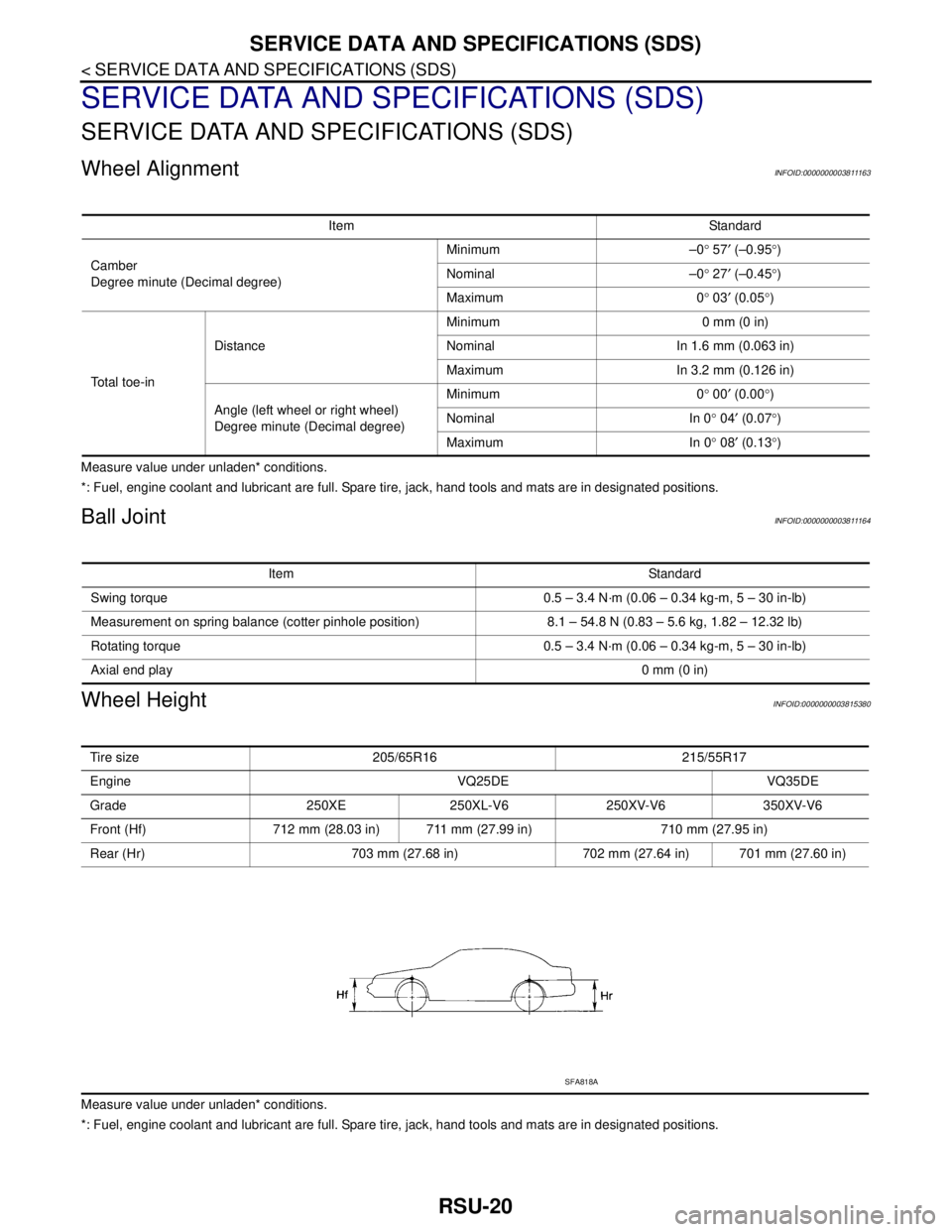
Wheel AlignmentINFOID:0000000003811163
Measure value under unladen* conditions.
*: Fuel, engine coolant and lubricant are full. Spare tire, jack, hand tools and mats are in designated positions.
Ball JointINFOID:0000000003811164
Wheel HeightINFOID:0000000003815380
Measure value under unladen* conditions.
*: Fuel, engine coolant and lubricant are full. Spare tire, jack, hand tools and mats are in designated positions.Item Standard
Camber
Degree minute (Decimal degree)Minimum –0° 57′ (–0.95°)
Nominal –0° 27′ (–0.45°)
Maximum 0° 03′ (0.05°)
To t a l t o e - i nDistanceMinimum 0 mm (0 in)
Nominal In 1.6 mm (0.063 in)
Maximum In 3.2 mm (0.126 in)
Angle (left wheel or right wheel)
Degree minute (Decimal degree)Minimum 0° 00′ (0.00°)
Nominal In 0° 04′ (0.07°)
Maximum In 0° 08′ (0.13°)
Item Standard
Swing torque 0.5 – 3.4 N·m (0.06 – 0.34 kg-m, 5 – 30 in-lb)
Measurement on spring balance (cotter pinhole position) 8.1 – 54.8 N (0.83 – 5.6 kg, 1.82 – 12.32 lb)
Rotating torque 0.5 – 3.4 N·m (0.06 – 0.34 kg-m, 5 – 30 in-lb)
Axial end play0 mm (0 in)
Tire size 205/65R16 215/55R17
Engine VQ25DE VQ35DE
Grade 250XE 250XL-V6 250XV-V6 350XV-V6
Front (Hf) 712 mm (28.03 in) 711 mm (27.99 in) 710 mm (27.95 in)
Rear (Hr) 703 mm (27.68 in) 702 mm (27.64 in) 701 mm (27.60 in)
SFA818A
Page 3869 of 5121
![NISSAN TEANA 2008 Service Manual DIAGNOSIS AND REPAIR WORK FLOW
SE-5
< BASIC INSPECTION >[WITH VENTILATION SEAT]
C
D
E
F
G
H
I
K
L
MA
B
SE
N
O
P
BASIC INSPECTION
DIAGNOSIS AND REPAIR WORK FLOW
Work FlowINFOID:0000000003809297
DETAILE](/img/5/57391/w960_57391-3868.png "NISSAN TEANA 2008 Service Manual DIAGNOSIS AND REPAIR WORK FLOW
SE-5
< BASIC INSPECTION >[WITH VENTILATION SEAT]
C
D
E
F
G
H
I
K
L
MA
B
SE
N
O
P
BASIC INSPECTION
DIAGNOSIS AND REPAIR WORK FLOW
Work FlowINFOID:0000000003809297
DETAILE")
DIAGNOSIS AND REPAIR WORK FLOW
SE-5
< BASIC INSPECTION >[WITH VENTILATION SEAT]
C
D
E
F
G
H
I
K
L
MA
B
SE
N
O
P
BASIC INSPECTION
DIAGNOSIS AND REPAIR WORK FLOW
Work FlowINFOID:0000000003809297
DETAILED FLOW
1.OBTAIN INFORMATION ABOUT SYMPTOM
Interview the customer to obtain as much information as possible about the malfunction (conditions and envi-
ronment when the malfunction occurred) when the customer brings the vehicle in.
>> GO TO 2.
2.REPRODUCE THE MALFUNCTION INFORMATION
Check the malfunction on the vehicle that the customer describes.
Inspect the relation of the symptoms and the condition when the symptoms occur.
>> GO TO 3.
3.IDENTIFY THE MALFUNCTIONING SYSTEM WITH “SYMPTOM DIAGNOSIS”
Use “Symptom diagnosis” from the symptom inspection result in step 2 and then identify where to start per-
forming the diagnosis based on possible causes and symptoms.
>> GO TO 4.
4.IDENTIFY THE MALFUNCTIONING PARTS WITH “COMPONENT DIAGNOSIS”
Perform the diagnosis with “Component diagnosis” of the applicable system.
>> GO TO 5.
5.REPAIR OR REPLACE THE MALFUNCTIONING PARTS
Repair or replace the specified malfunctioning parts.
>> GO TO 6.
6.FINAL CHECK
Check that malfunctions are not reproduced when obtaining the malfunction information from the customer,
referring to the symptom inspection result in step 2.
Are the malfunctions corrected?
YES >> INSPECTION END
NO >> GO TO 3.
Page 3876 of 5121
![NISSAN TEANA 2008 Service Manual SE-12
< COMPONENT DIAGNOSIS >[WITH VENTILATION SEAT]
POWER SUPPLY AND GROUND CIRCUIT
COMPONENT DIAGNOSIS
POWER SUPPLY AND GROUND CIRCUIT
VENTILATION SEAT CONTROL UNIT
VENTILATION SEAT CONTROL UNIT : D](/img/5/57391/w960_57391-3875.png "NISSAN TEANA 2008 Service Manual SE-12
< COMPONENT DIAGNOSIS >[WITH VENTILATION SEAT]
POWER SUPPLY AND GROUND CIRCUIT
COMPONENT DIAGNOSIS
POWER SUPPLY AND GROUND CIRCUIT
VENTILATION SEAT CONTROL UNIT
VENTILATION SEAT CONTROL UNIT : D")
SE-12
< COMPONENT DIAGNOSIS >[WITH VENTILATION SEAT]
POWER SUPPLY AND GROUND CIRCUIT
COMPONENT DIAGNOSIS
POWER SUPPLY AND GROUND CIRCUIT
VENTILATION SEAT CONTROL UNIT
VENTILATION SEAT CONTROL UNIT : Diagnosis ProcedureINFOID:0000000003809329
1.CHECK FUSE
Check that the following fuses are not fusing.
Is the fuse fusing?
YES >> Replace the blown fuse after repairing the affected circuit if a fuse is blown.
NO >> GO TO 2.
2.CHECK POWER SUPPLY CIRCUIT
1. Turn ignition switch OFF.
2. Disconnect ventilation seat control unit connector.
3. Check voltage between ventilation seat control unit harness connector and ground.
Is the measurement value normal?
YES >> GO TO 3.
NO >> Repair or replace harness.
3.CHECK GROUND CIRCUIT
Check continuity between ventilation seat control unit harness connector and ground.
Does continuity exist?
YES >> INSPECTION END
NO >> Repair or replace harness.
Terminal No. Signal name Fuse No.
Front seat 44 Battery power supply 35
Rear seat 44 Battery power supply 38
Front seat and rear seat 46 Ignition power supply 3
(+)
(−) ConditionVoltag e
(Approx.) Ventilation seat control unit
Connector Terminal
Front seat (driver side)B466 46
Ground IgnitIon switchON
Battery voltage B465 44 OFF
Front seat (passenger side)B442 46 ON
B441 44 OFF
Rear seat (LH)B490 46 ON
B489 44 OFF
Rear seat (RH)B501 46 ON
B500 44 OFF
Ventilation seat control unit
GroundContinuity
Connector Terminal
Front seat (driver side) B465
45
Exists Front seat (passenger side) B441
Rear seat (LH) B489
45
Rear seat (RH) B500
Page 3877 of 5121
![NISSAN TEANA 2008 Service Manual HEATED SEAT SWITCH
SE-13
< COMPONENT DIAGNOSIS >[WITH VENTILATION SEAT]
C
D
E
F
G
H
I
K
L
MA
B
SE
N
O
P
HEATED SEAT SWITCH
FRONT SEAT
FRONT SEAT : DescriptionINFOID:0000000003809330
Switches the LO or](/img/5/57391/w960_57391-3876.png "NISSAN TEANA 2008 Service Manual HEATED SEAT SWITCH
SE-13
< COMPONENT DIAGNOSIS >[WITH VENTILATION SEAT]
C
D
E
F
G
H
I
K
L
MA
B
SE
N
O
P
HEATED SEAT SWITCH
FRONT SEAT
FRONT SEAT : DescriptionINFOID:0000000003809330
Switches the LO or")
HEATED SEAT SWITCH
SE-13
< COMPONENT DIAGNOSIS >[WITH VENTILATION SEAT]
C
D
E
F
G
H
I
K
L
MA
B
SE
N
O
P
HEATED SEAT SWITCH
FRONT SEAT
FRONT SEAT : DescriptionINFOID:0000000003809330
Switches the LO or HI temperature of the front heated seat and turns OFF the front heated seat operation.
FRONT SEAT : Component Function CheckINFOID:0000000003809331
1.CHECK FUNCTION
Check that the related indicator lamp illuminates when front heated seat switch is set to LO or HI position.
Is the inspection result normal?
YES >> Front heated seat switch function is OK.
NO >> Refer toSE-13, "
FRONT SEAT : Diagnosis Procedure".
FRONT SEAT : Diagnosis ProcedureINFOID:0000000003809332
1.CHECK FRONT VENTILATION SEAT CONTROL UNIT INPUT SIGNAL
1. Turn ignition switch ON.
2. Check voltage between front ventilation seat control unit harness connector and ground.
Is the inspection result normal?
YES >> Front heated seat switch circuit is OK.
NO-1 >> LO or HI mode is NG: GO TO 2.
NO-2 >> LO and HI modes are NG: GO TO 3.
2.CHECK FRONT HEATED SEAT SWITCH CIRCUIT
1. Turn ignition switch OFF.
2. Disconnect front heated seat switch connector and front ventilation seat control unit connector.
3. Check continuity between front heated seat switch harness connector and front ventilation seat control
unit harness connector.
4. Check continuity between front heated seat switch harness connector and ground.
(+)
(–) ConditionVoltage (V)
(Approx.) Front ventilation seat control unit
Connector Terminal
Driver side B46652
GroundFront heated seat switch LO modePressed 0
Released Battery voltage
51 HI modePressed 0
Released Battery voltage
Passenger side B44252
Front heated seat switchLO modePressed 0
Released Battery voltage
51 HI modePressed 0
Released Battery voltage
Front heated seat switch Front ventilation seat control unit
Continuity
Connector Terminal Connector Terminal
Driver sideLO
M2062
B46652
Existed HI 1 51
Passenger sideLO
M2072
B44252
HI 1 51