Trans NISSAN TEANA 2008 Service Manual
[x] Cancel search | Manufacturer: NISSAN, Model Year: 2008, Model line: TEANA, Model: NISSAN TEANA 2008Pages: 5121, PDF Size: 69.03 MB
Page 3242 of 5121

SQUEAK AND RATTLE TROUBLE DIAGNOSES
MIR-9
< SYMPTOM DIAGNOSIS >
C
D
E
F
G
H
I
J
K
MA
B
MIR
N
O
P
Again, pressing on the components to stop the noise while duplicating the conditions can isolate most of these
incidents. Repairs usually consist of insulating with felt cloth tape.
SEATS
When isolating seat noise it is important to note the position the seat is in and the load placed on the seat
when the noise occurs. These conditions should be duplicated when verifying and isolating the cause of the
noise.
Cause of seat noise include:
1. Headrest rods and holder
2. A squeak between the seat pad cushion and frame
3. Rear seatback lock and bracket
These noises can be isolated by moving or pressing on the suspected components while duplicating the con-
ditions under which the noise occurs. Most of these incidents can be repaired by repositioning the component
or applying urethane tape to the contact area.
UNDERHOOD
Some interior noise may be caused by components under the hood or on the engine wall. The noise is then
transmitted into the passenger compartment.
Causes of transmitted underhood noise include:
1. Any component mounted to the engine wall
2. Components that pass through the engine wall
3. Engine wall mounts and connectors
4. Loose radiator mounting pins
5. Hood bumpers out of adjustment
6. Hood striker out of adjustment
These noises can be difficult to isolate since they cannot be reached from the interior of the vehicle. The best
method is to secure, move or insulate one component at a time and test drive the vehicle. Also, engine RPM
or load can be changed to isolate the noise. Repairs can usually be made by moving, adjusting, securing, or
insulating the component causing the noise.
Page 3260 of 5121
MWI-6
< FUNCTION DIAGNOSIS >
METER SYSTEM
FUNCTION DIAGNOSIS
METER SYSTEM
METER SYSTEM
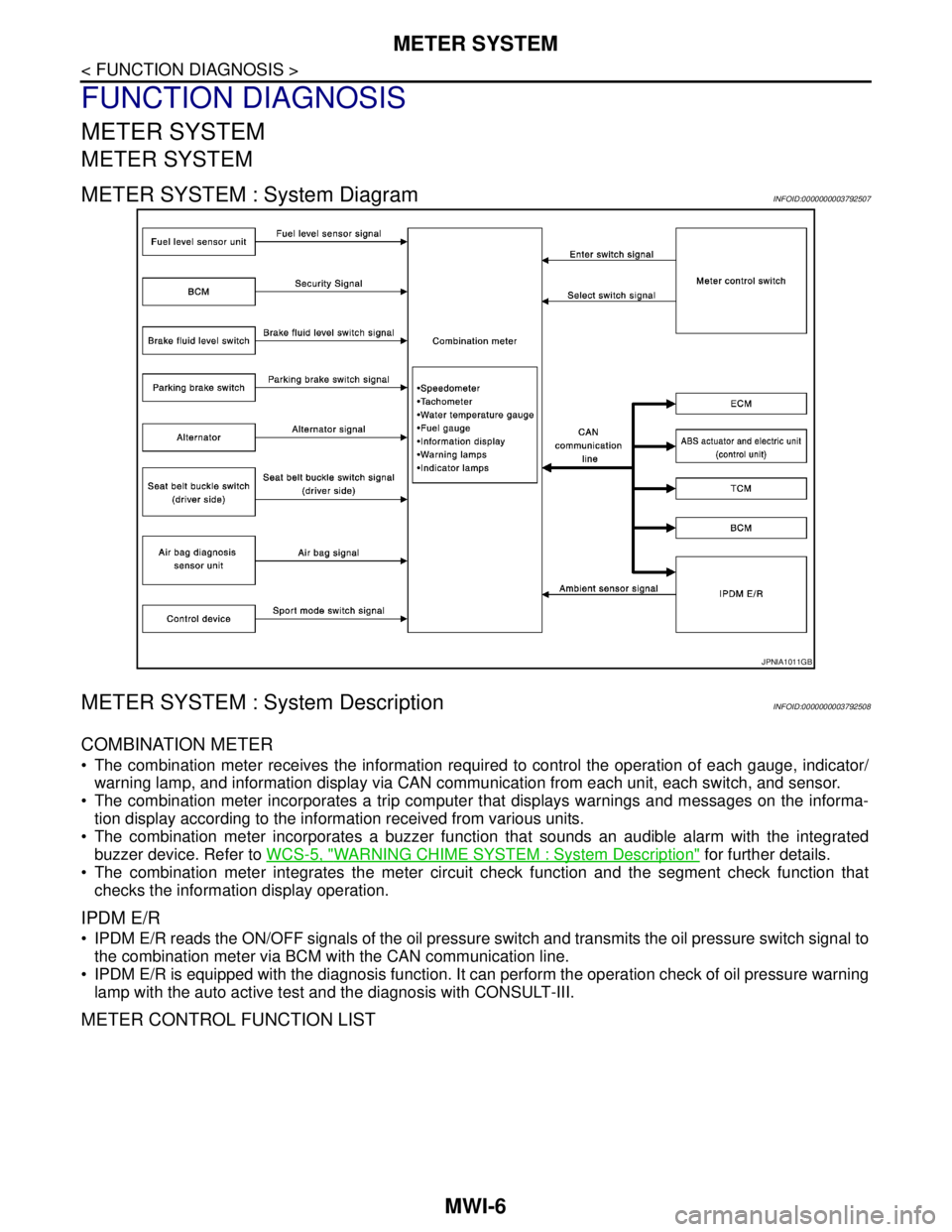
METER SYSTEM : System DiagramINFOID:0000000003792507
METER SYSTEM : System DescriptionINFOID:0000000003792508
COMBINATION METER
The combination meter receives the information required to control the operation of each gauge, indicator/
warning lamp, and information display via CAN communication from each unit, each switch, and sensor.
The combination meter incorporates a trip computer that displays warnings and messages on the informa-
tion display according to the information received from various units.
The combination meter incorporates a buzzer function that sounds an audible alarm with the integrated
buzzer device. Refer to WCS-5, "
WARNING CHIME SYSTEM : System Description" for further details.
The combination meter integrates the meter circuit check function and the segment check function that
checks the information display operation.
IPDM E/R
IPDM E/R reads the ON/OFF signals of the oil pressure switch and transmits the oil pressure switch signal to
the combination meter via BCM with the CAN communication line.
IPDM E/R is equipped with the diagnosis function. It can perform the operation check of oil pressure warning
lamp with the auto active test and the diagnosis with CONSULT-III.
METER CONTROL FUNCTION LIST
JPNIA1011GB
Page 3264 of 5121
MWI-10
< FUNCTION DIAGNOSIS >
METER SYSTEM
METER SYSTEM : Component Description
INFOID:0000000003792510
SPEEDOMETER
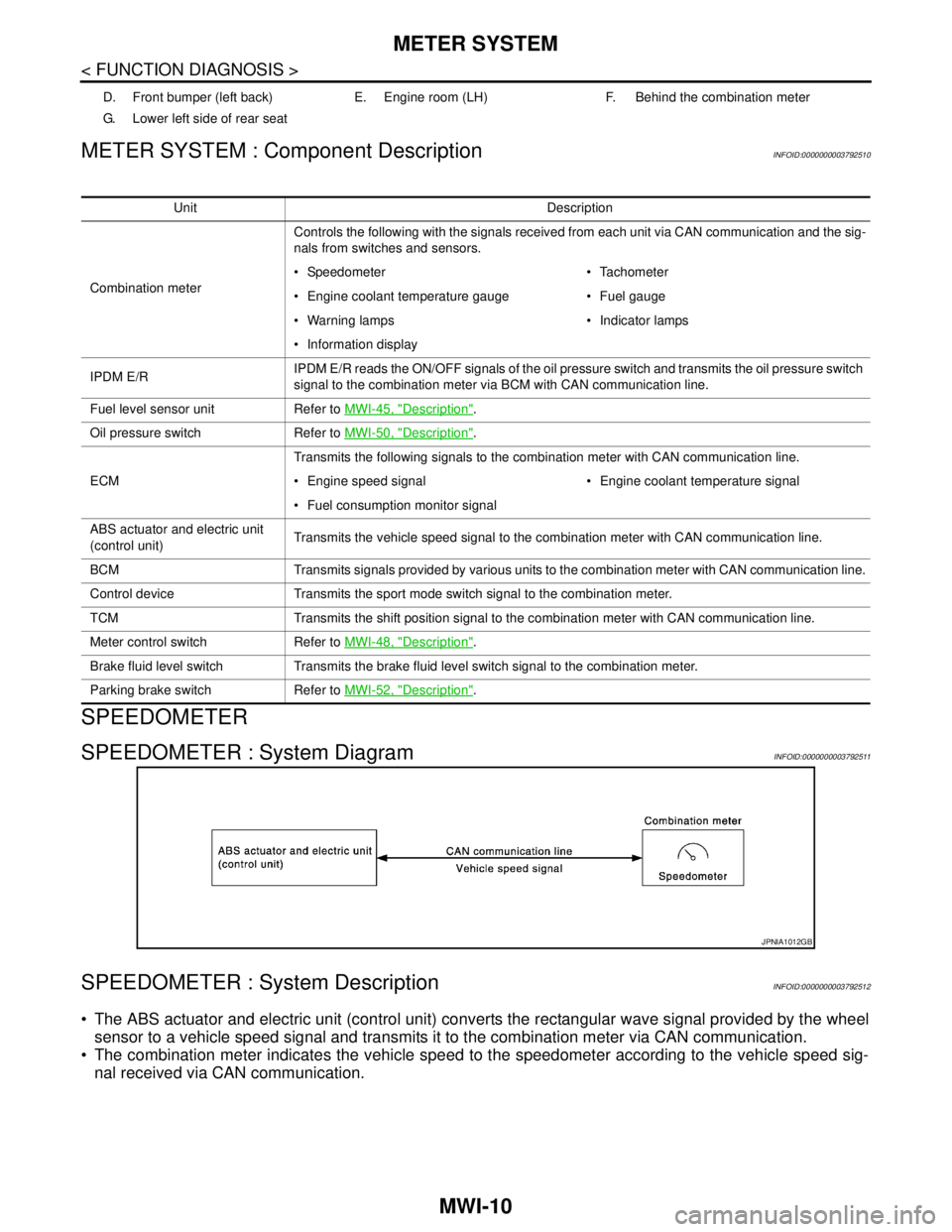
SPEEDOMETER : System DiagramINFOID:0000000003792511
SPEEDOMETER : System DescriptionINFOID:0000000003792512
The ABS actuator and electric unit (control unit) converts the rectangular wave signal provided by the wheel
sensor to a vehicle speed signal and transmits it to the combination meter via CAN communication.
The combination meter indicates the vehicle speed to the speedometer according to the vehicle speed sig-
nal received via CAN communication.
D. Front bumper (left back) E. Engine room (LH) F. Behind the combination meter
G. Lower left side of rear seat
Unit Description
Combination meterControls the following with the signals received from each unit via CAN communication and the sig-
nals from switches and sensors.
Speedometer Tachometer
Engine coolant temperature gauge Fuel gauge
Warning lamps Indicator lamps
Information display
IPDM E/RIPDM E/R reads the ON/OFF signals of the oil pressure switch and transmits the oil pressure switch
signal to the combination meter via BCM with CAN communication line.
Fuel level sensor unit Refer to MWI-45, "
Description".
Oil pressure switch Refer to MWI-50, "
Description".
ECMTransmits the following signals to the combination meter with CAN communication line.
Engine speed signal Engine coolant temperature signal
Fuel consumption monitor signal
ABS actuator and electric unit
(control unit)Transmits the vehicle speed signal to the combination meter with CAN communication line.
BCM Transmits signals provided by various units to the combination meter with CAN communication line.
Control device Transmits the sport mode switch signal to the combination meter.
TCM Transmits the shift position signal to the combination meter with CAN communication line.
Meter control switch Refer to MWI-48, "
Description".
Brake fluid level switch Transmits the brake fluid level switch signal to the combination meter.
Parking brake switch Refer to MWI-52, "
Description".
JPNIA1012GB
Page 3266 of 5121
MWI-12
< FUNCTION DIAGNOSIS >
METER SYSTEM
SPEEDOMETER : Component Description
INFOID:0000000003792514
TACHOMETER
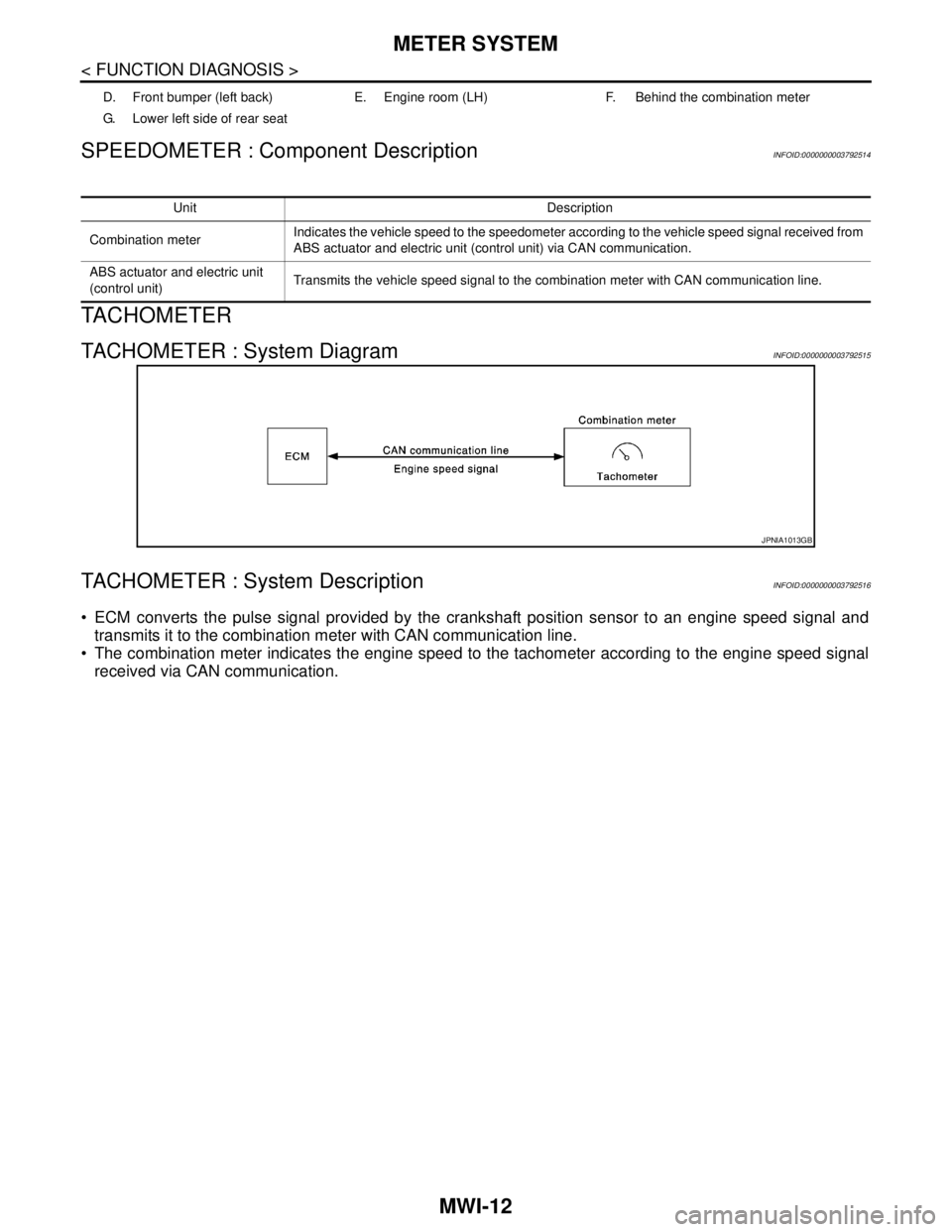
TACHOMETER : System DiagramINFOID:0000000003792515
TACHOMETER : System DescriptionINFOID:0000000003792516
ECM converts the pulse signal provided by the crankshaft position sensor to an engine speed signal and
transmits it to the combination meter with CAN communication line.
The combination meter indicates the engine speed to the tachometer according to the engine speed signal
received via CAN communication.
D. Front bumper (left back) E. Engine room (LH) F. Behind the combination meter
G. Lower left side of rear seat
Unit Description
Combination meterIndicates the vehicle speed to the speedometer according to the vehicle speed signal received from
ABS actuator and electric unit (control unit) via CAN communication.
ABS actuator and electric unit
(control unit)Transmits the vehicle speed signal to the combination meter with CAN communication line.
JPNIA1013GB
Page 3268 of 5121
MWI-14
< FUNCTION DIAGNOSIS >
METER SYSTEM
TACHOMETER : Component Description
INFOID:0000000003792518
ENGINE COOLANT TEMPERATURE GAUGE
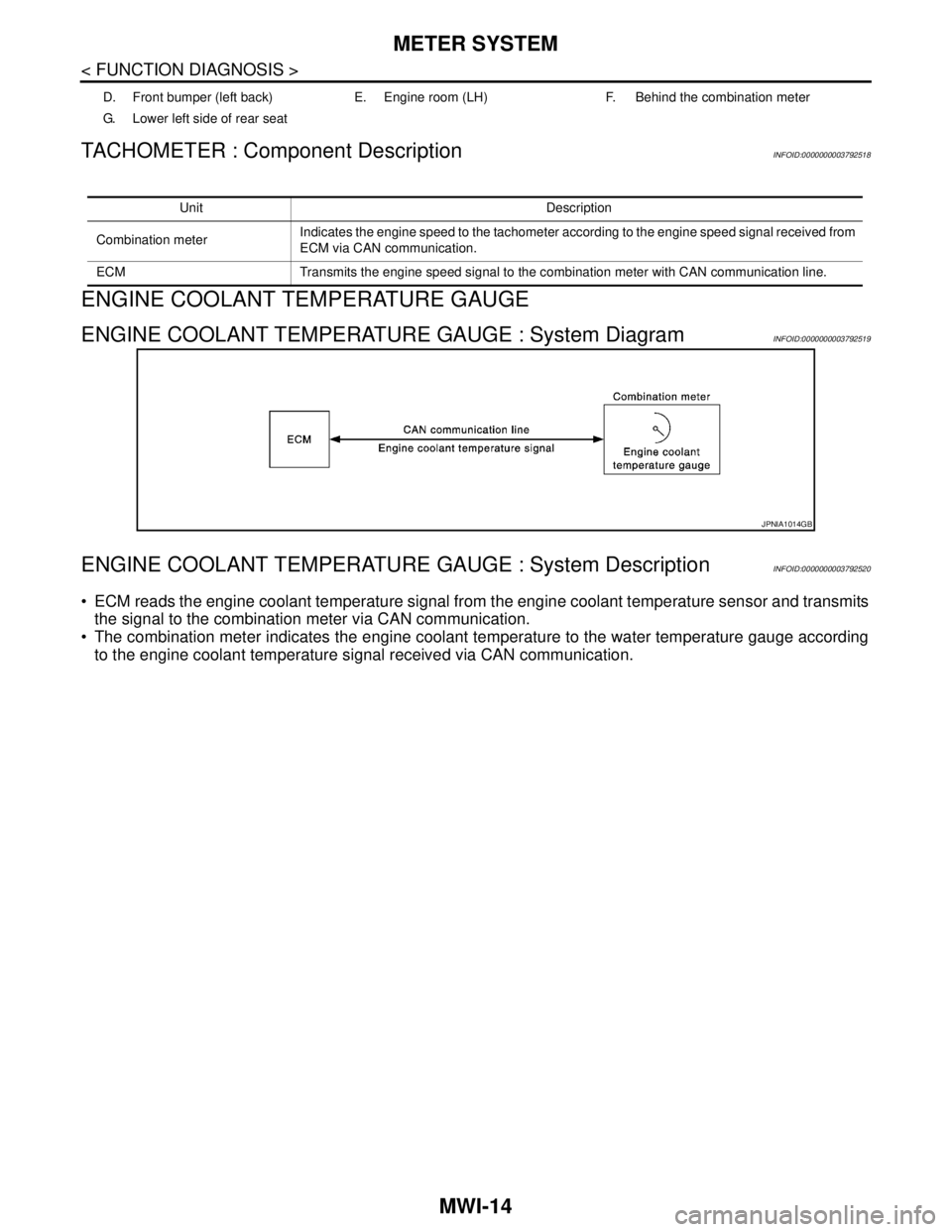
ENGINE COOLANT TEMPERATURE GAUGE : System DiagramINFOID:0000000003792519
ENGINE COOLANT TEMPERATURE GAUGE : System DescriptionINFOID:0000000003792520
ECM reads the engine coolant temperature signal from the engine coolant temperature sensor and transmits
the signal to the combination meter via CAN communication.
The combination meter indicates the engine coolant temperature to the water temperature gauge according
to the engine coolant temperature signal received via CAN communication.
D. Front bumper (left back) E. Engine room (LH) F. Behind the combination meter
G. Lower left side of rear seat
Unit Description
Combination meterIndicates the engine speed to the tachometer according to the engine speed signal received from
ECM via CAN communication.
ECM Transmits the engine speed signal to the combination meter with CAN communication line.
JPNIA1014GB
Page 3270 of 5121
MWI-16
< FUNCTION DIAGNOSIS >
METER SYSTEM
ENGINE COOLANT TEMPERATURE GAUGE : Component Description
INFOID:0000000003792522
FUEL GAUGE
FUEL GAUGE : System DiagramINFOID:0000000003792523
FUEL GAUGE : System DescriptionINFOID:0000000003792524
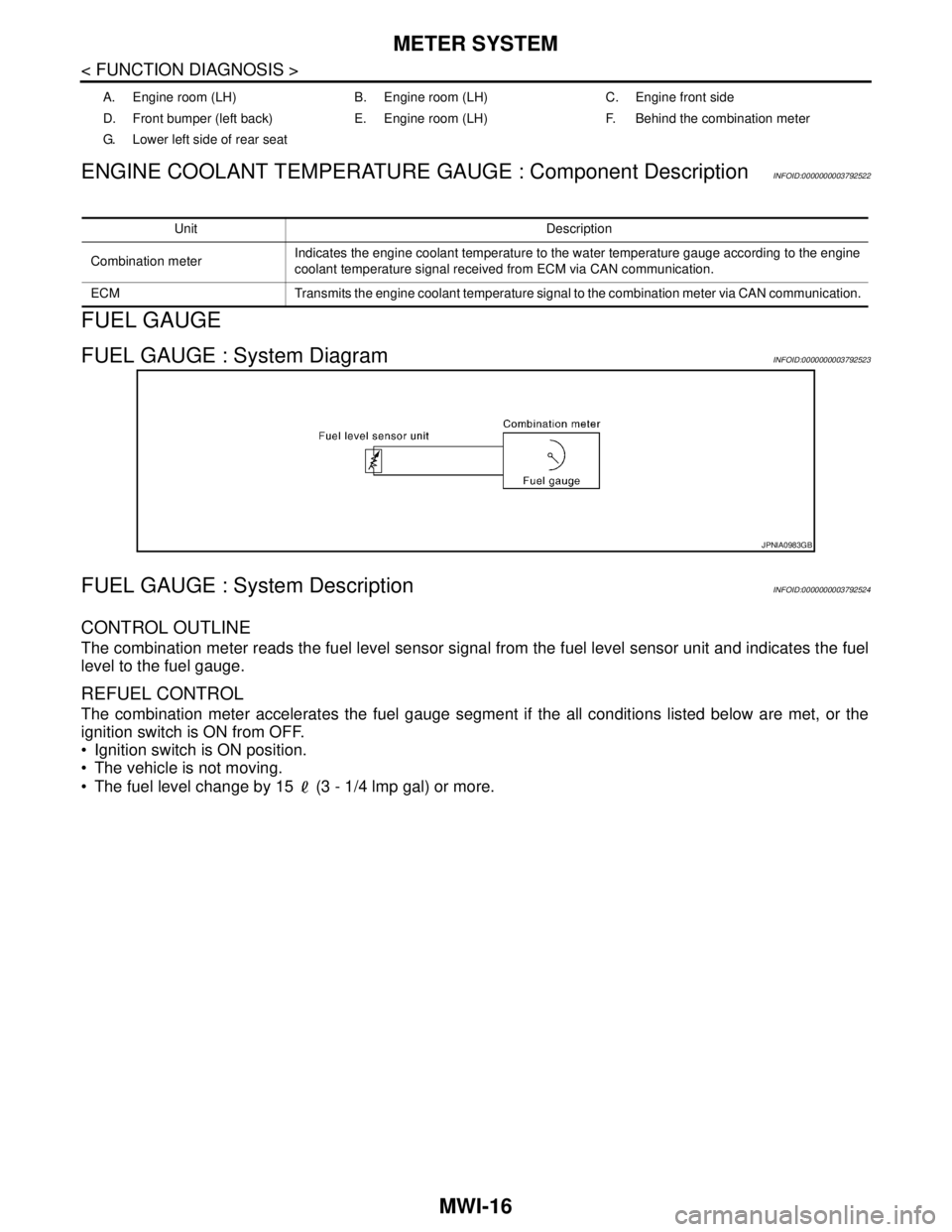
CONTROL OUTLINE
The combination meter reads the fuel level sensor signal from the fuel level sensor unit and indicates the fuel
level to the fuel gauge.
REFUEL CONTROL
The combination meter accelerates the fuel gauge segment if the all conditions listed below are met, or the
ignition switch is ON from OFF.
Ignition switch is ON position.
The vehicle is not moving.
The fuel level change by 15 (3 - 1/4 lmp gal) or more.
A. Engine room (LH) B. Engine room (LH) C. Engine front side
D. Front bumper (left back) E. Engine room (LH) F. Behind the combination meter
G. Lower left side of rear seat
Unit Description
Combination meterIndicates the engine coolant temperature to the water temperature gauge according to the engine
coolant temperature signal received from ECM via CAN communication.
ECM Transmits the engine coolant temperature signal to the combination meter via CAN communication.
JPNIA0983GB
Page 3272 of 5121
MWI-18
< FUNCTION DIAGNOSIS >
METER SYSTEM
FUEL GAUGE : Component Description
INFOID:0000000003792526
ODO/TRIP METER
ODO/TRIP METER : System DiagramINFOID:0000000003792527
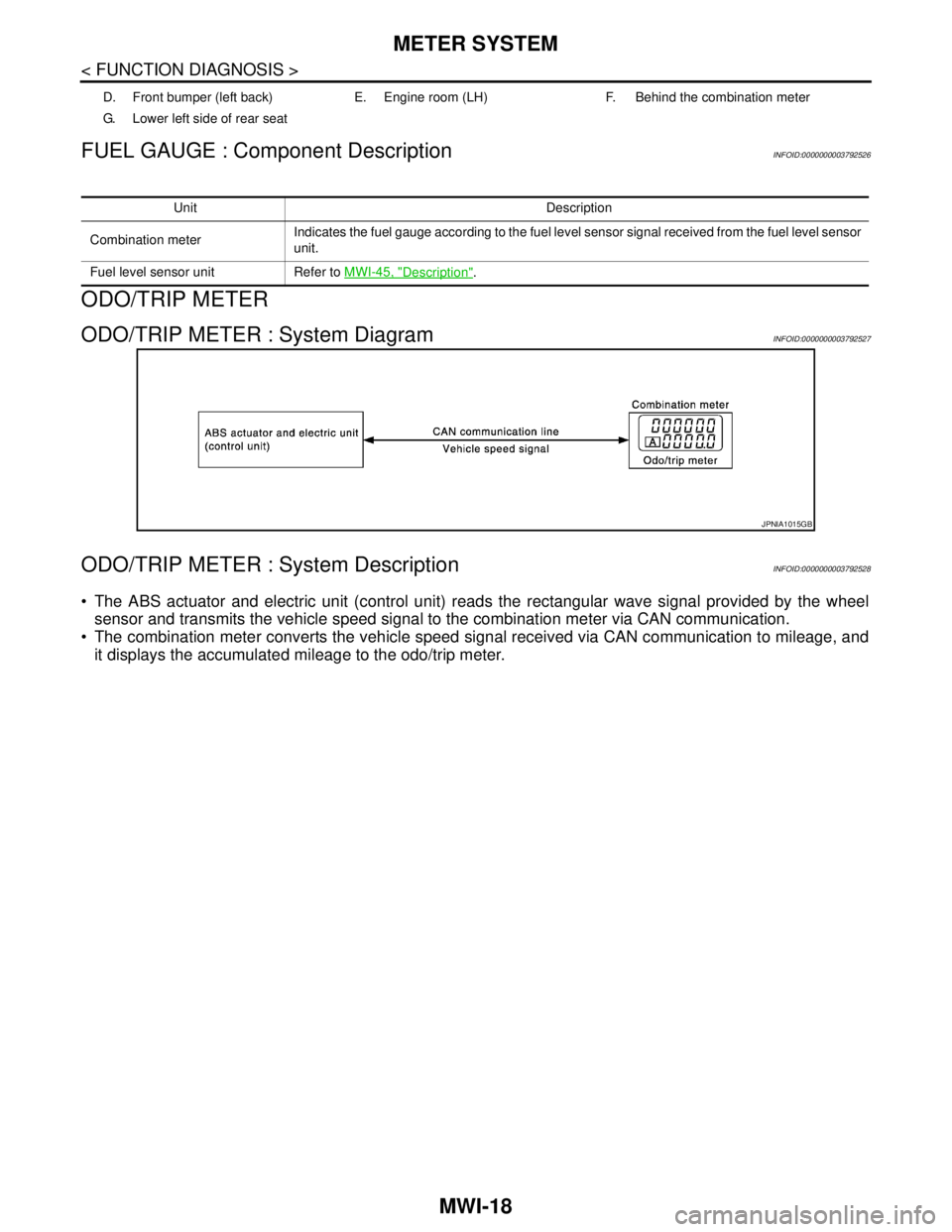
ODO/TRIP METER : System DescriptionINFOID:0000000003792528
The ABS actuator and electric unit (control unit) reads the rectangular wave signal provided by the wheel
sensor and transmits the vehicle speed signal to the combination meter via CAN communication.
The combination meter converts the vehicle speed signal received via CAN communication to mileage, and
it displays the accumulated mileage to the odo/trip meter.
D. Front bumper (left back) E. Engine room (LH) F. Behind the combination meter
G. Lower left side of rear seat
Unit Description
Combination meterIndicates the fuel gauge according to the fuel level sensor signal received from the fuel level sensor
unit.
Fuel level sensor unit Refer to MWI-45, "
Description".
JPNIA1015GB
Page 3274 of 5121
MWI-20
< FUNCTION DIAGNOSIS >
METER SYSTEM
ODO/TRIP METER : Component Description
INFOID:0000000003792530
SHIFT POSITION INDICATOR
SHIFT POSITION INDICATOR : System DiagramINFOID:0000000003792531
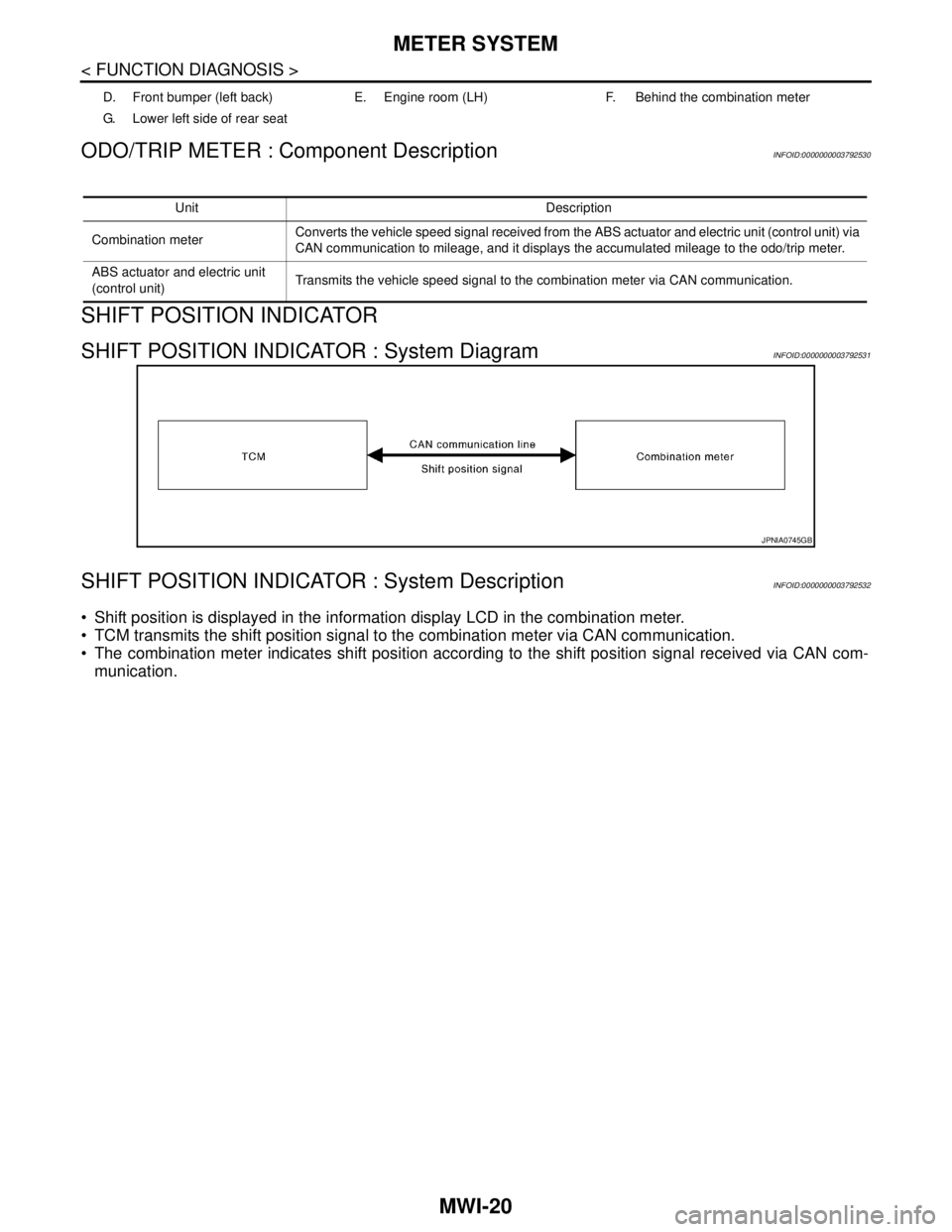
SHIFT POSITION INDICATOR : System DescriptionINFOID:0000000003792532
Shift position is displayed in the information display LCD in the combination meter.
TCM transmits the shift position signal to the combination meter via CAN communication.
The combination meter indicates shift position according to the shift position signal received via CAN com-
munication.
D. Front bumper (left back) E. Engine room (LH) F. Behind the combination meter
G. Lower left side of rear seat
Unit Description
Combination meterConverts the vehicle speed signal received from the ABS actuator and electric unit (control unit) via
CAN communication to mileage, and it displays the accumulated mileage to the odo/trip meter.
ABS actuator and electric unit
(control unit)Transmits the vehicle speed signal to the combination meter via CAN communication.
JPNIA0745GB
Page 3276 of 5121
MWI-22
< FUNCTION DIAGNOSIS >
METER SYSTEM
SHIFT POSITION INDICATOR : Component Description
INFOID:0000000003792534
WARNING LAMPS/INDICATOR LAMPS
WARNING LAMPS/INDICATOR LAMPS : System DiagramINFOID:0000000003792535
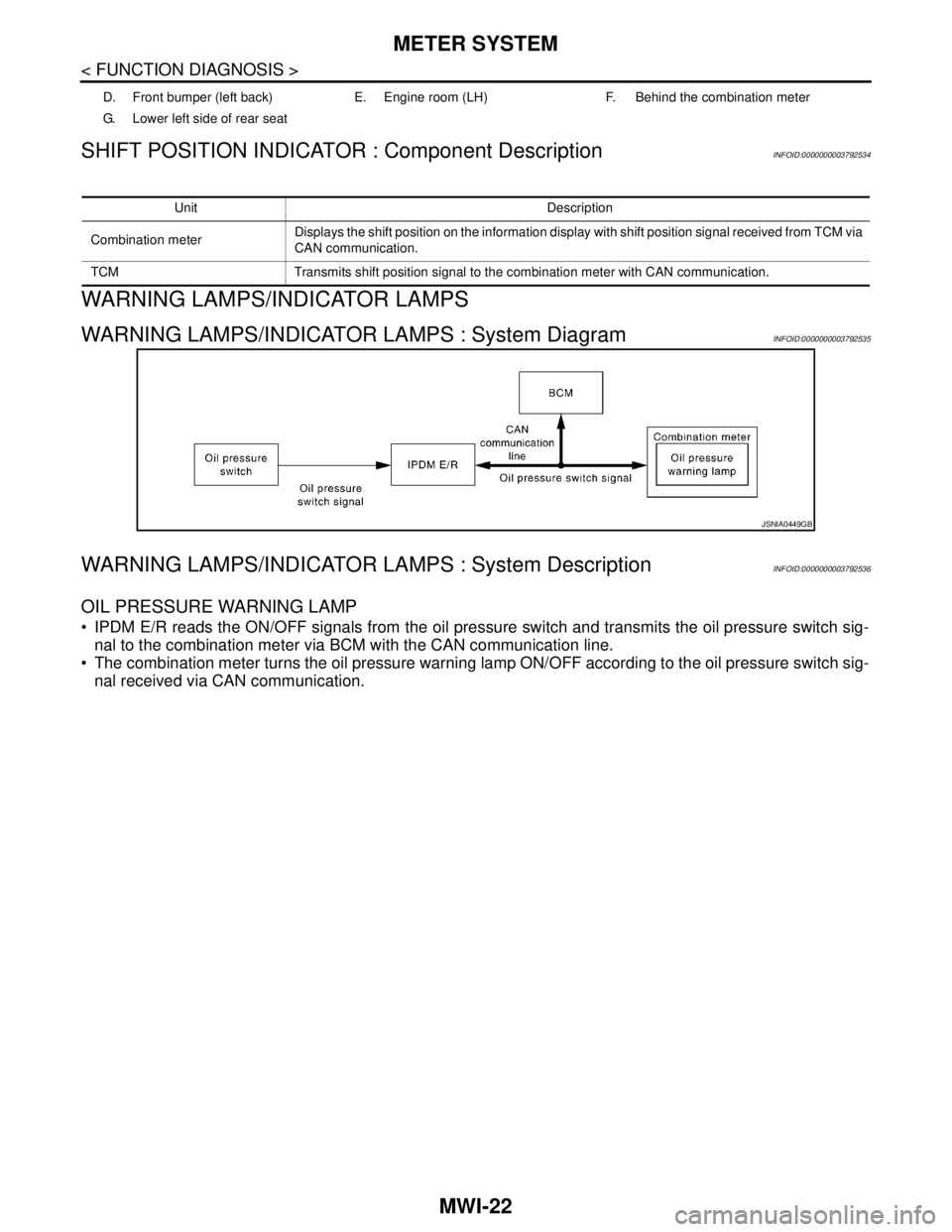
WARNING LAMPS/INDICATOR LAMPS : System DescriptionINFOID:0000000003792536
OIL PRESSURE WARNING LAMP
IPDM E/R reads the ON/OFF signals from the oil pressure switch and transmits the oil pressure switch sig-
nal to the combination meter via BCM with the CAN communication line.
The combination meter turns the oil pressure warning lamp ON/OFF according to the oil pressure switch sig-
nal received via CAN communication.
D. Front bumper (left back) E. Engine room (LH) F. Behind the combination meter
G. Lower left side of rear seat
Unit Description
Combination meterDisplays the shift position on the information display with shift position signal received from TCM via
CAN communication.
TCM Transmits shift position signal to the combination meter with CAN communication.
JSNIA0449GB
Page 3278 of 5121
MWI-24
< FUNCTION DIAGNOSIS >
METER SYSTEM
WARNING LAMPS/INDICATOR LAMPS : Component Description
INFOID:0000000003792538
METER ILLUMINATION CONTROL
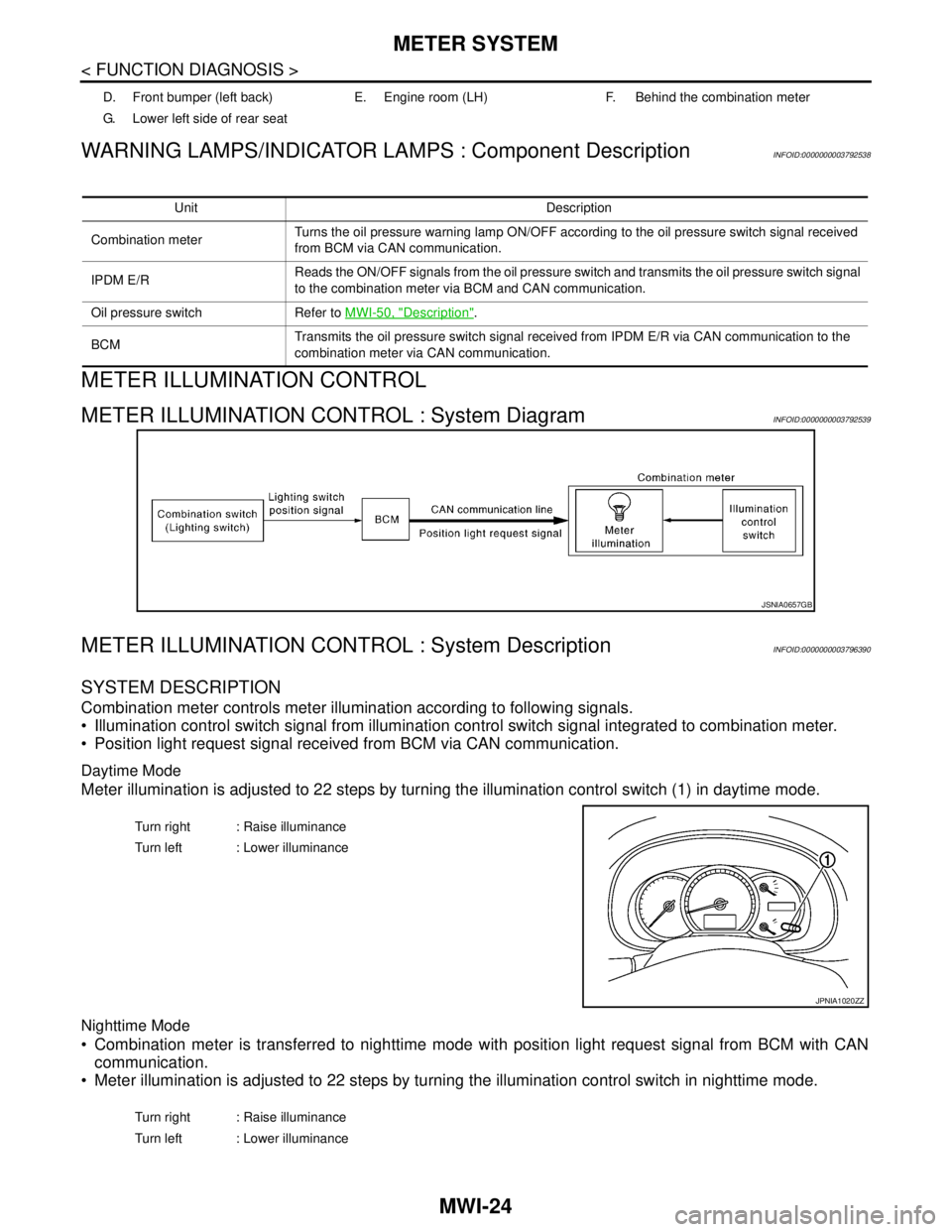
METER ILLUMINATION CONTROL : System DiagramINFOID:0000000003792539
METER ILLUMINATION CONTROL : System DescriptionINFOID:0000000003796390
SYSTEM DESCRIPTION
Combination meter controls meter illumination according to following signals.
Illumination control switch signal from illumination control switch signal integrated to combination meter.
Position light request signal received from BCM via CAN communication.
Daytime Mode
Meter illumination is adjusted to 22 steps by turning the illumination control switch (1) in daytime mode.
Nighttime Mode
Combination meter is transferred to nighttime mode with position light request signal from BCM with CAN
communication.
Meter illumination is adjusted to 22 steps by turning the illumination control switch in nighttime mode.
D. Front bumper (left back) E. Engine room (LH) F. Behind the combination meter
G. Lower left side of rear seat
Unit Description
Combination meterTurns the oil pressure warning lamp ON/OFF according to the oil pressure switch signal received
from BCM via CAN communication.
IPDM E/RReads the ON/OFF signals from the oil pressure switch and transmits the oil pressure switch signal
to the combination meter via BCM and CAN communication.
Oil pressure switch Refer to MWI-50, "
Description".
BCMTransmits the oil pressure switch signal received from IPDM E/R via CAN communication to the
combination meter via CAN communication.
JSNIA0657GB
Turn right : Raise illuminance
Turn left : Lower illuminance
JPNIA1020ZZ
Turn right : Raise illuminance
Turn left : Lower illuminance