mirror NISSAN TEANA 2008 Owner's Guide
[x] Cancel search | Manufacturer: NISSAN, Model Year: 2008, Model line: TEANA, Model: NISSAN TEANA 2008Pages: 5121, PDF Size: 69.03 MB
Page 2389 of 5121
![NISSAN TEANA 2008 Owners Guide EXL-360
< SERVICE DATA AND SPECIFICATIONS (SDS) [HALOGEN TYPE]
SERVICE DATA AND SPECIFICATIONS (SDS)
SERVICE DATA AND SPECIFICATIONS (SDS)
SERVICE DATA AND SPECIFICATIONS (SDS)
Bulb SpecificationsINFO](/img/5/57391/w960_57391-2388.png "NISSAN TEANA 2008 Owners Guide EXL-360
< SERVICE DATA AND SPECIFICATIONS (SDS) [HALOGEN TYPE]
SERVICE DATA AND SPECIFICATIONS (SDS)
SERVICE DATA AND SPECIFICATIONS (SDS)
SERVICE DATA AND SPECIFICATIONS (SDS)
Bulb SpecificationsINFO")
EXL-360
< SERVICE DATA AND SPECIFICATIONS (SDS) [HALOGEN TYPE]
SERVICE DATA AND SPECIFICATIONS (SDS)
SERVICE DATA AND SPECIFICATIONS (SDS)
SERVICE DATA AND SPECIFICATIONS (SDS)
Bulb SpecificationsINFOID:0000000003773752
Item Type Wattage (W)
Front combination lampHeadlamp (HI) H9 65
Headlamp (LO) H11 55
Parking Lamp W5W 5
Front turn signal WY21W (Amber) 21
Front fog lamp H11 55
Front side turn signal lamp (integrated into the door mirror) LED —
Rear combination lampStop/tail lamp LED —
Rear turn signal lamp S25 (Amber) 21
Back-up lamp W16W 16
License plate lamp W5W 5
High-mounted stop lamp LED —
Rear fog lamp W21W 21
Page 2422 of 5121
DOOR OUTSIDE MOLDING
EXT-33
< ON-VEHICLE REPAIR >
C
D
E
F
G
H
I
J
L
MA
B
EXT
N
O
P
DOOR OUTSIDE MOLDING
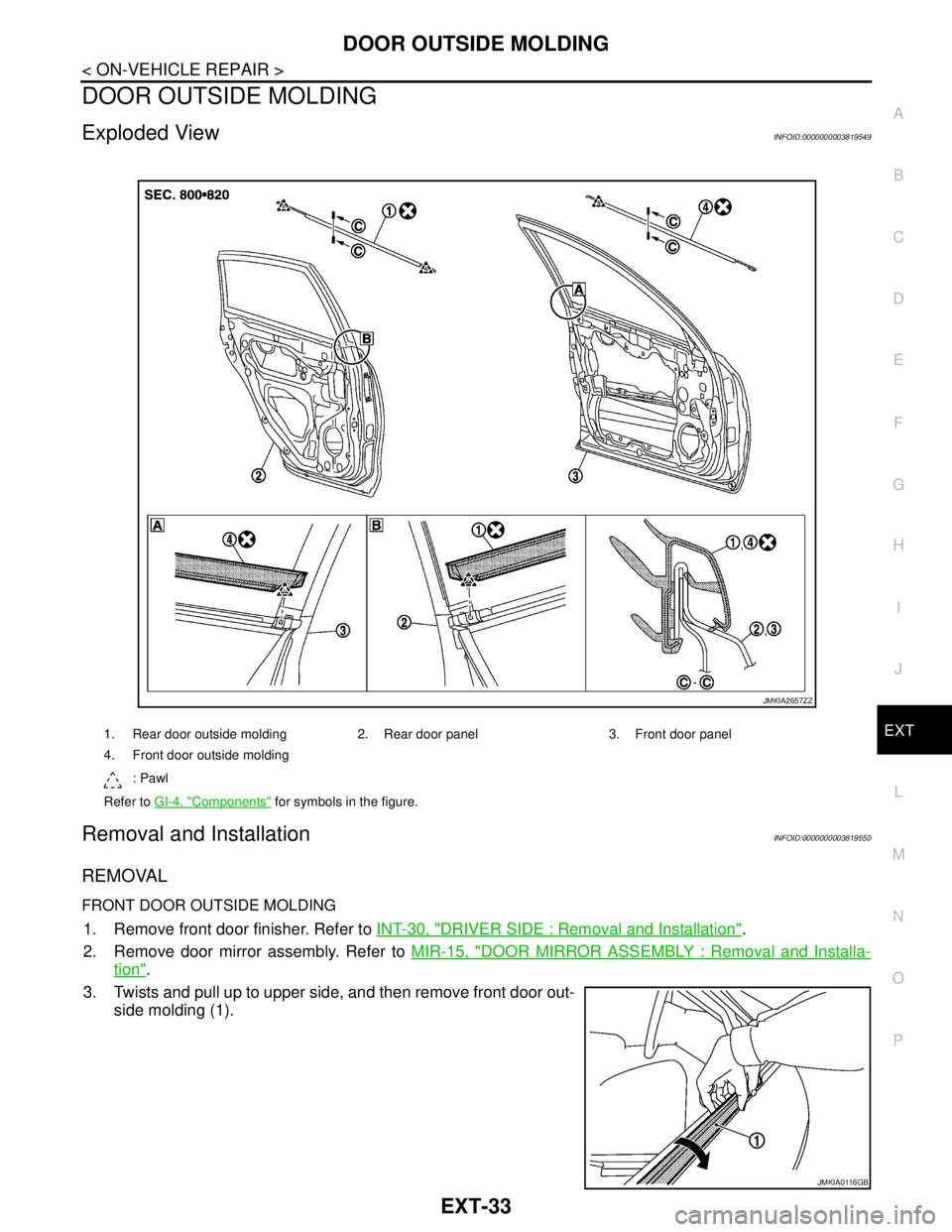
Exploded ViewINFOID:0000000003819549
Removal and InstallationINFOID:0000000003819550
REMOVAL
FRONT DOOR OUTSIDE MOLDING
1. Remove front door finisher. Refer to INT-30, "DRIVER SIDE : Removal and Installation".
2. Remove door mirror assembly. Refer to MIR-15, "
DOOR MIRROR ASSEMBLY : Removal and Installa-
tion".
3. Twists and pull up to upper side, and then remove front door out-
side molding (1).
1. Rear door outside molding 2. Rear door panel 3. Front door panel
4. Front door outside molding
: Pawl
Refer to GI-4, "
Components" for symbols in the figure.
JMKIA2657ZZ
JMKIA0116GB
Page 2554 of 5121
WINDSHIELD GLASS
GW-11
< ON-VEHICLE REPAIR >
C
D
E
F
G
H
I
J
L
MA
B
GW
N
O
P
Removal and InstallationINFOID:0000000003825398
REMOVAL
1. Remove front pillar garnish (LH/RH). Refer to INT-39, "Removal and Installation".
2. Remove partially headlining (front edge). Refer to INT-50, "
NORMAL ROOF : Removal and Installation"
for normal roof or INT-54, "SUNROOF : Removal and Installation" for sunroof.
3. Remove front wiper arms (LH/RH). Refer to WW-105, "
Removal and Installation".
4. Remove front fender cover (LH/RH). Refer to DLK-199, "
Exploded View".
5. Remove cowl top cover. Refer to EXT-20, "
Removal and Installation".
6. Remove roof side molding (LH/RH). Refer to EXT-29, "
Removal and Installation".
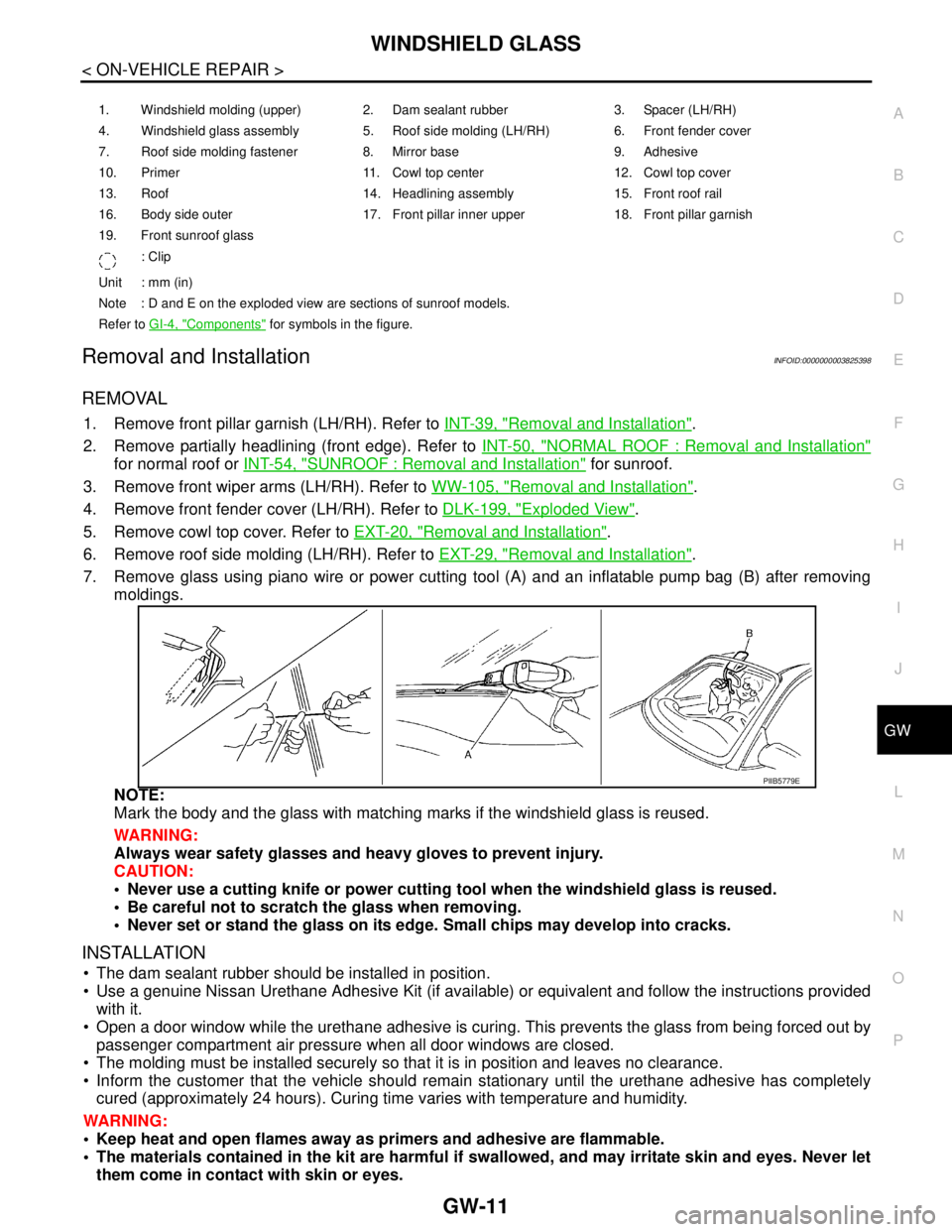
7. Remove glass using piano wire or power cutting tool (A) and an inflatable pump bag (B) after removing
moldings.
NOTE:
Mark the body and the glass with matching marks if the windshield glass is reused.
WARNING:
Always wear safety glasses and heavy gloves to prevent injury.
CAUTION:
Never use a cutting knife or power cutting tool when the windshield glass is reused.
Be careful not to scratch the glass when removing.
Never set or stand the glass on its edge. Small chips may develop into cracks.
INSTALLATION
The dam sealant rubber should be installed in position.
Use a genuine Nissan Urethane Adhesive Kit (if available) or equivalent and follow the instructions provided
with it.
Open a door window while the urethane adhesive is curing. This prevents the glass from being forced out by
passenger compartment air pressure when all door windows are closed.
The molding must be installed securely so that it is in position and leaves no clearance.
Inform the customer that the vehicle should remain stationary until the urethane adhesive has completely
cured (approximately 24 hours). Curing time varies with temperature and humidity.
WARNING:
Keep heat and open flames away as primers and adhesive are flammable.
The materials contained in the kit are harmful if swallowed, and may irritate skin and eyes. Never let
them come in contact with skin or eyes.
1. Windshield molding (upper) 2. Dam sealant rubber 3. Spacer (LH/RH)
4. Windshield glass assembly 5. Roof side molding (LH/RH) 6. Front fender cover
7. Roof side molding fastener 8. Mirror base 9. Adhesive
10. Primer 11. Cowl top center 12. Cowl top cover
13. Roof 14. Headlining assembly 15. Front roof rail
16. Body side outer 17. Front pillar inner upper 18. Front pillar garnish
19. Front sunroof glass
: Clip
Unit : mm (in)
Note : D and E on the exploded view are sections of sunroof models.
Refer to GI-4, "
Components" for symbols in the figure.
PIIB5779E
Page 2560 of 5121
FRONT DOOR GLASS
GW-17
< ON-VEHICLE REPAIR >
C
D
E
F
G
H
I
J
L
MA
B
GW
N
O
P
FRONT DOOR GLASS
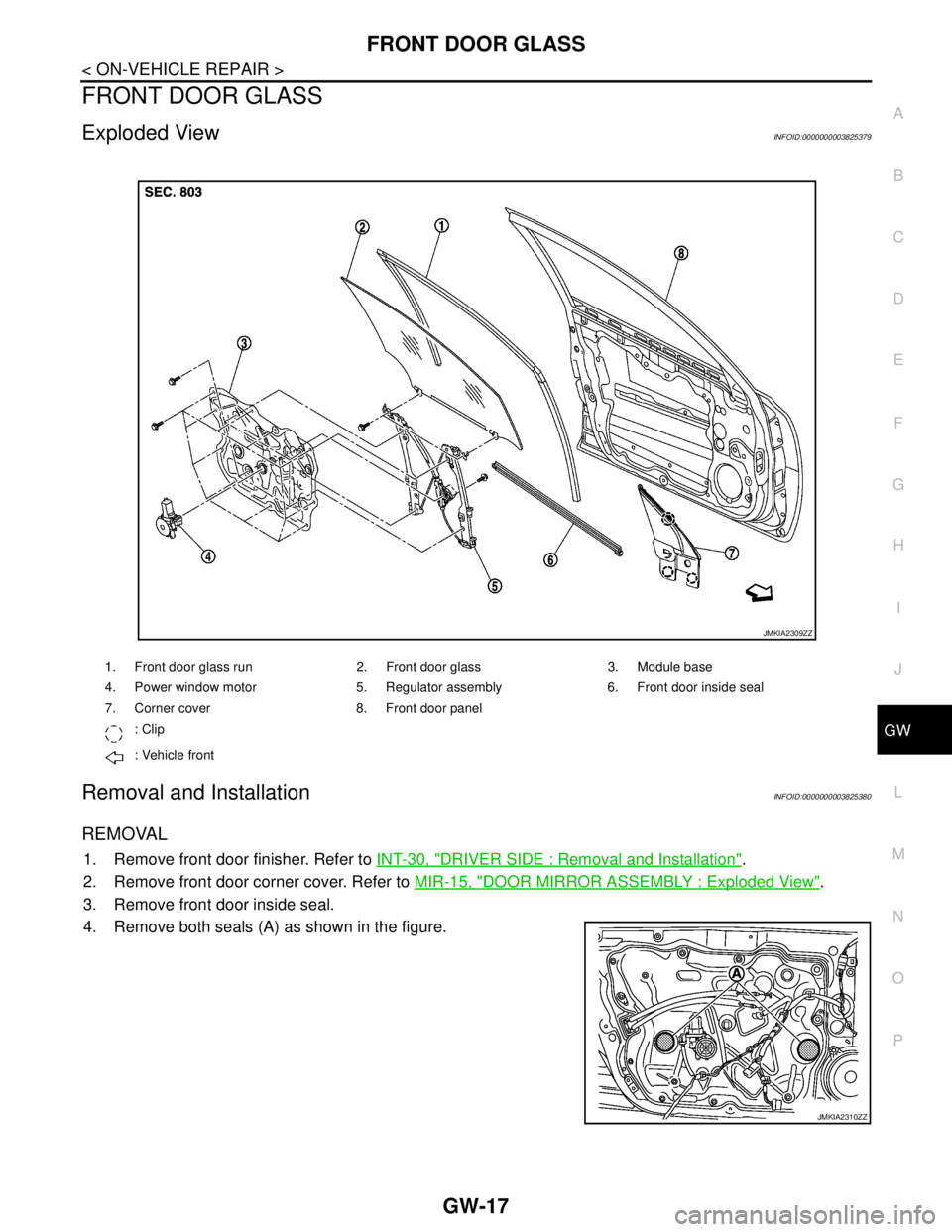
Exploded ViewINFOID:0000000003825379
Removal and InstallationINFOID:0000000003825380
REMOVAL
1. Remove front door finisher. Refer to INT-30, "DRIVER SIDE : Removal and Installation".
2. Remove front door corner cover. Refer to MIR-15, "
DOOR MIRROR ASSEMBLY : Exploded View".
3. Remove front door inside seal.
4. Remove both seals (A) as shown in the figure.
1. Front door glass run 2. Front door glass 3. Module base
4. Power window motor 5. Regulator assembly 6. Front door inside seal
7. Corner cover 8. Front door panel
: Clip
: Vehicle front
JMKIA2309ZZ
JMKIA2310ZZ
Page 2601 of 5121

HA-32
< ON-VEHICLE MAINTENANCE >
FLUORESCENT LEAK DETECTOR
FLUORESCENT LEAK DETECTOR
InspectionINFOID:0000000003795981
CHECKING SYSTEM FOR LEAKAGES USING THE FLUORESCENT LEAK DETECTOR
1. Check A/C system for leakages using the UV lamp and safety goggles (SST: J-42220) in a low sunlight
area (area without windows preferable). Illuminate all components, fittings and lines. The dye appears as
a bright green/yellow area at the point of leakage. Fluorescent dye observed at the evaporator drain open-
ing indicates an evaporator core assembly (tubes, core or expansion valve) leakage.
2. Use an adjustable mirror or wipe the area with a clean shop rag or cloth, with the UV lamp for dye residue
if the suspected area is difficult to see.
3. Remove any residual dye using dye cleaner (SST: J-43872) to prevent future misdiagnosis after the leak-
age is repaired.
4. Perform a system performance check and verify the leakage repair with an approved electrical leak detec-
tor.
NOTE:
Other gases in the work area or substances on the A/C components, for example, anti-freeze, windshield
washer fluid, solvents and lubricants, may falsely trigger the leak detector. Make sure the surfaces to be
checked are clean.
Clean with a dry cloth or blow off with shop air.
Do not allow the sensor tip of the detector to contact with any substance. This may also cause false readings
and may damage the detector.
DYE INJECTION
(This procedure is only necessary when recharging the system or when the compressor has seized and was
replaced.)
1. Check A/C system static (at rest) pressure. Pressure must be at least 345 kPa (3.45 bar, 3.52 kg/cm
2, 50
psi).
2. Pour one bottle (1/4 ounce / 7.4 cc) of the A/C refrigerant dye into the injector tool (SST: J-41459).
3. Connect the injector tool to the A/C low-pressure side service valve.
4. Start the engine. Then switch A/C ON.
5. Inject one bottle (1/4 ounce / 7.4 cc) of fluorescent dye through the low-pressure service valve using dye
injector tool (SST: J-41459) (refer to the manufacture’s operating instructions) when the A/C operating
(compressor running).
6. Disconnect the injector tool from the service valve with the engine still running.
CAUTION:
Be careful when replacing the A/C system or a component, pour the dye directly into the open sys-
tem connection and proceed with the service procedures.
7. Operate the A/C system for a minimum of 20 minutes to mix the dye with the system oil. Depending on the
leakage size, operating conditions and location of the leakage, it may take from minutes to days for the
dye to penetrate a leakage and become visible.
8. Attach a blue label if necessary.
Page 2881 of 5121

INL-2
BCM (BODY CONTROL MODULE) ..................53
Reference Value .....................................................53
Wiring Diagram - BCM - .........................................76
Fail-safe ..................................................................82
DTC Inspection Priority Chart ..............................84
DTC Index ..............................................................85
SYMPTOM DIAGNOSIS .............................87
INTERIOR LIGHTING SYSTEM SYMPTOMS ...87
Symptom Table ......................................................87
PRECAUTION .............................................88
PRECAUTIONS .................................................88
Precaution for Supplemental Restraint System
(SRS) "AIR BAG" and "SEAT BELT PRE-TEN-
SIONER" .................................................................
88
ON-VEHICLE REPAIR ................................89
MAP LAMP ........................................................89
Exploded View ........................................................89
Removal and Installation ........................................89
Replacement ..........................................................89
MOOD LAMP .....................................................90
MAP LAMP ................................................................90
MAP LAMP : Exploded View ..................................90
FRONT DOOR GRIP .................................................90
FRONT DOOR GRIP : Exploded View ...................90
FRONT DOOR GRIP : Replacement ......................90
REAR DOOR GRIP ...................................................90
REAR DOOR GRIP : Exploded View .....................91
REAR DOOR GRIP : Replacement ........................91
VANITY MIRROR LAMP ...................................92
Exploded View ........................................................92
Replacement ...........................................................92
ASHTRAY ILLUMINATION ...............................93
Exploded View ........................................................93
Replacement ...........................................................93
GLOVE BOX LAMP ...........................................94
Exploded View ........................................................94
Replacement ...........................................................94
STEP LAMP .......................................................95
Exploded View ........................................................95
Removal and Installation .........................................95
Replacement ...........................................................95
PERSONAL LAMP ............................................96
Exploded View ........................................................96
Removal and Installation .........................................96
Replacement ...........................................................96
TRUNK ROOM LAMP .......................................97
Exploded View ........................................................97
Removal and Installation .........................................97
Replacement ...........................................................97
SERVICE DATA AND SPECIFICATIONS
(SDS) ..........................................................
98
SERVICE DATA AND SPECIFICATIONS
(SDS) .................................................................
98
Bulb Specifications ..................................................98
Page 2888 of 5121
INTERIOR ROOM LAMP BATTERY SAVER SYSTEM
INL-9
< FUNCTION DIAGNOSIS >
C
D
E
F
G
H
I
J
K
MA
B
INL
N
O
P
INTERIOR ROOM LAMP BATTERY SAVER SYSTEM
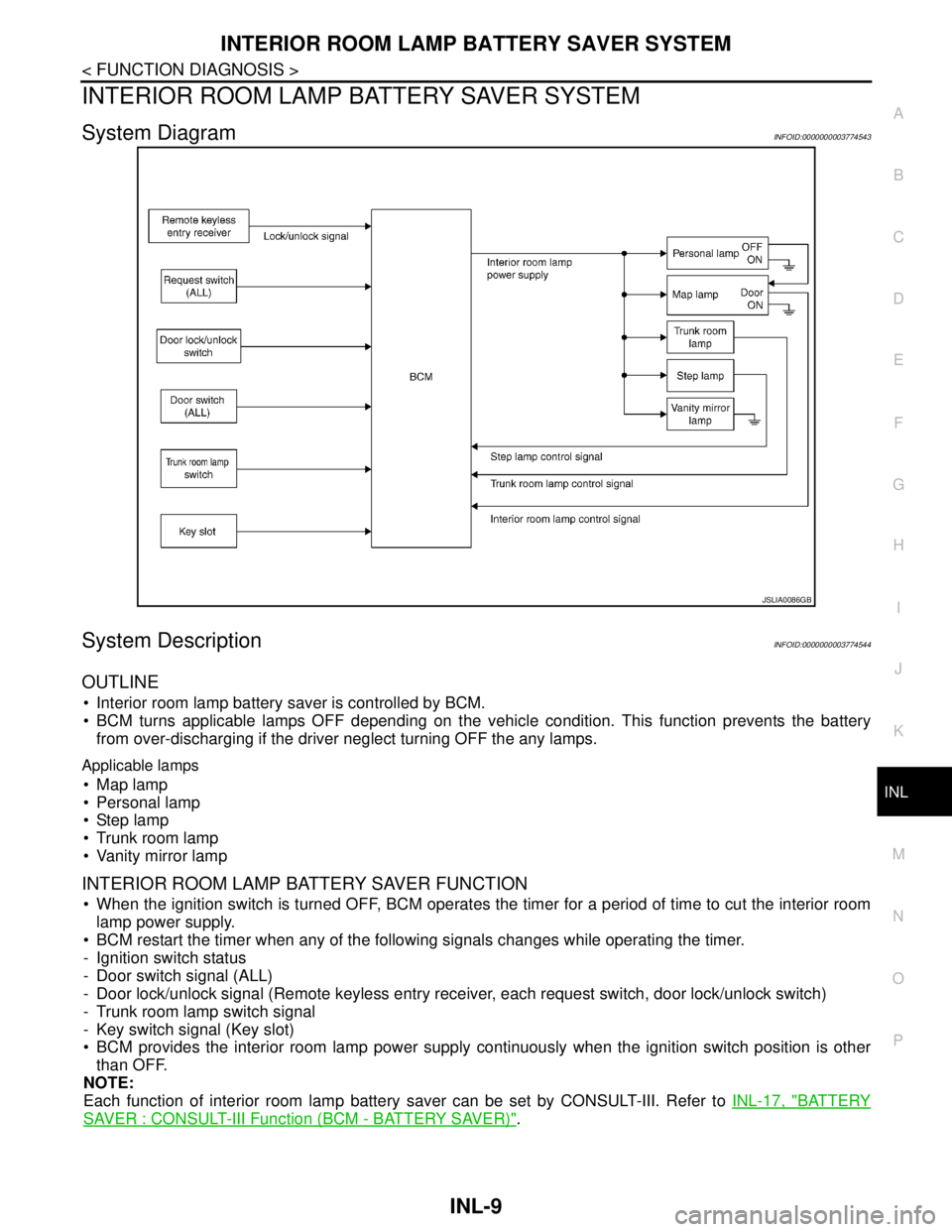
System DiagramINFOID:0000000003774543
System DescriptionINFOID:0000000003774544
OUTLINE
Interior room lamp battery saver is controlled by BCM.
BCM turns applicable lamps OFF depending on the vehicle condition. This function prevents the battery
from over-discharging if the driver neglect turning OFF the any lamps.
Applicable lamps
Map lamp
Personal lamp
Step lamp
Trunk room lamp
Vanity mirror lamp
INTERIOR ROOM LAMP BATTERY SAVER FUNCTION
When the ignition switch is turned OFF, BCM operates the timer for a period of time to cut the interior room
lamp power supply.
BCM restart the timer when any of the following signals changes while operating the timer.
- Ignition switch status
- Door switch signal (ALL)
- Door lock/unlock signal (Remote keyless entry receiver, each request switch, door lock/unlock switch)
- Trunk room lamp switch signal
- Key switch signal (Key slot)
BCM provides the interior room lamp power supply continuously when the ignition switch position is other
than OFF.
NOTE:
Each function of interior room lamp battery saver can be set by CONSULT-III. Refer to INL-17, "
BATTERY
SAVER : CONSULT-III Function (BCM - BATTERY SAVER)".
JSLIA0086GB
Page 2889 of 5121
INL-10
< FUNCTION DIAGNOSIS >
INTERIOR ROOM LAMP BATTERY SAVER SYSTEM
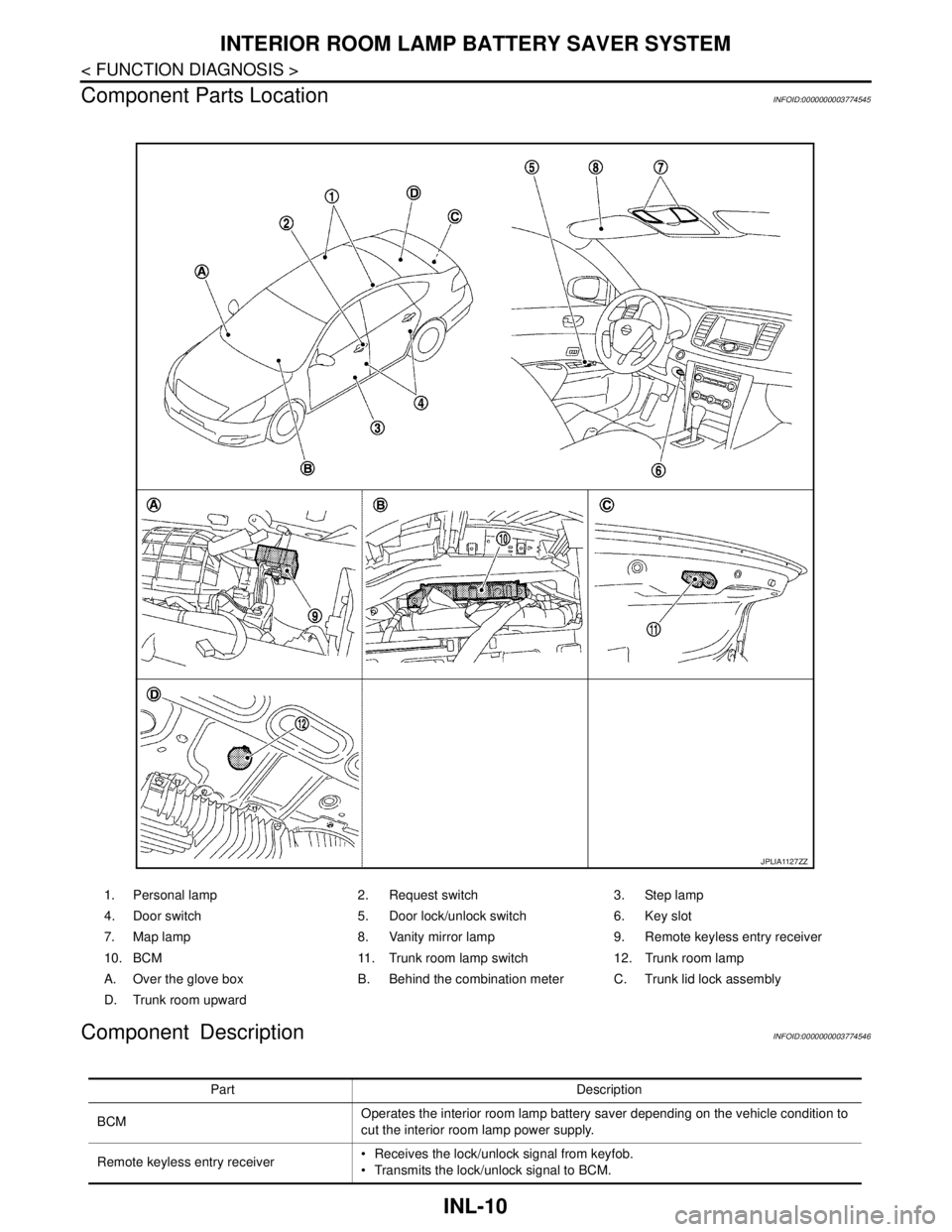
Component Parts Location
INFOID:0000000003774545
Component DescriptionINFOID:0000000003774546
1. Personal lamp 2. Request switch 3. Step lamp
4. Door switch 5. Door lock/unlock switch 6. Key slot
7. Map lamp 8. Vanity mirror lamp 9. Remote keyless entry receiver
10. BCM 11. Trunk room lamp switch 12. Trunk room lamp
A. Over the glove box B. Behind the combination meter C. Trunk lid lock assembly
D. Trunk room upward
JPLIA1127ZZ
Part Description
BCMOperates the interior room lamp battery saver depending on the vehicle condition to
cut the interior room lamp power supply.
Remote keyless entry receiver Receives the lock/unlock signal from keyfob.
Transmits the lock/unlock signal to BCM.
Page 2899 of 5121
INL-20
< COMPONENT DIAGNOSIS >
INTERIOR ROOM LAMP POWER SUPPLY CIRCUIT
INTERIOR ROOM LAMP POWER SUPPLY CIRCUIT
DescriptionINFOID:0000000003774555
Provides the interior room lamp power supply. Also cuts the power supply when the interior room lamp battery
saver activating.
Component Function CheckINFOID:0000000003774556
1.CHECK INTERIOR ROOM LAMP POWER SUPPLY FUNCTION
CONSULT-III ACTIVE TEST
1. Turn ignition switch ON.
2. Turn each interior room lamp ON.
- Map lamp
- Personal lamp
- Step lamp
- Vanity mirror lamp
- Trunk room lamp
3. Select "BATTERY SAVER" of BCM (BATTERY SAVER) active test item.
4. With operating the test items, check that each interior room lamp turns ON/OFF.
Does the interior room lamp turn ON/OFF?
YES >> Interior room lamp power supply circuit is normal.
NO >> Refer to INL-20, "
Diagnosis Procedure".
Diagnosis ProcedureINFOID:0000000003774557
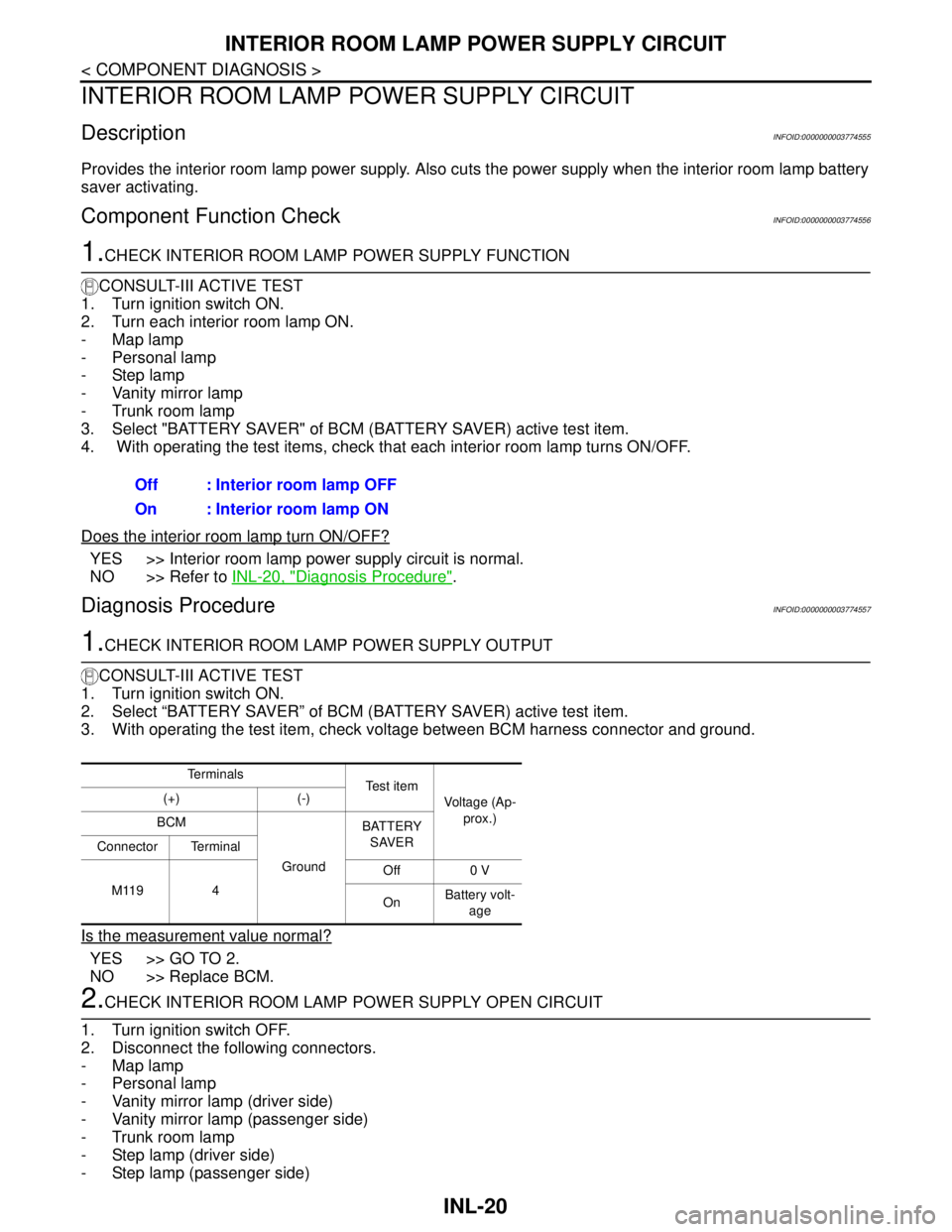
1.CHECK INTERIOR ROOM LAMP POWER SUPPLY OUTPUT
CONSULT-III ACTIVE TEST
1. Turn ignition switch ON.
2. Select “BATTERY SAVER” of BCM (BATTERY SAVER) active test item.
3. With operating the test item, check voltage between BCM harness connector and ground.
Is the measurement value normal?
YES >> GO TO 2.
NO >> Replace BCM.
2.CHECK INTERIOR ROOM LAMP POWER SUPPLY OPEN CIRCUIT
1. Turn ignition switch OFF.
2. Disconnect the following connectors.
- Map lamp
- Personal lamp
- Vanity mirror lamp (driver side)
- Vanity mirror lamp (passenger side)
- Trunk room lamp
- Step lamp (driver side)
- Step lamp (passenger side)Off : Interior room lamp OFF
On : Interior room lamp ON
Te r m i n a l s
Te s t i t e m
Voltage (Ap-
prox.) (+) (-)
BCM
GroundBATTERY
SAVER
Connector Terminal
M119 4Off 0 V
OnBattery volt-
age
Page 2900 of 5121

INTERIOR ROOM LAMP POWER SUPPLY CIRCUIT
INL-21
< COMPONENT DIAGNOSIS >
C
D
E
F
G
H
I
J
K
MA
B
INL
N
O
P
3. Check continuity between BCM harness connector and each interior room lamp harness connector.
Does continuity exist?
YES >> GO TO 3.
NO >> Repair the harnesses or connectors.
3.CHECK INTERIOR ROOM LAMP POWER SUPPLY SHORT CIRCUIT
Check continuity between BCM harness connector and ground.
Does continuity exist?
YES >> Repair the harnesses or connectors.
NO >> Check that each interior room lamp has no internal short circuit.
BCM Each interior room lamp
Continu-
ity Connec-
torTerminal Connector Terminal
M119 4Map lamp R19 1
Existed Personal lamp R21 1
Vanity mirror lamp
(driver side)R24 2
Vanity mirror lamp
(passenger side)R10 2
Trunk room lamp B91 1
Step lamp
(driver side)D17 1
Step lamp
(passenger side)D51 1
BCM
GroundContinuity
Connector Terminal
M119 4 Not existed